Home Blog Page 3113

CGSS, Uzbek embassy to deepen cooperation

CGSS will work in collaboration with the Women Association of Uzbekistan with the aim to empower women entrepreneurs in both countries 

DNA

ISLAMABAD: CGSS Management led by Lt Col Khalid Taimur Akram (Retd), Executive Director, CGSS had a meeting with the Diplomatic Staff of Embassy of Republic of Uzbekistan, Islamabad.

During the detailed meeting, it was decided that CGSS will work in collaboration with the Women Association of Uzbekistan with the aim to empower women entrepreneurs in both countries. This program will connect entrepreneurs of Pakistan and Uzbekistan to find areas of mutual interest. Through this program, training sessions, awareness campaigns, and courses will be offered to women of both the countries to enhance their entrepreneurial skills and help them to promote their businesses in Pakistan and Uzbekistan.

Furthermore, it was decided that CGSS in collaboration with the Government of Uzbekistan will establish Zaheer ud Din Babur Center for promotion of Central Asian culture. This Center will alsoenhance the academic cooperation between Pakistan and Uzbekistan.

It was agreed that CGSS will organize soft skills trainings also for the youth of Uzbekistan which will empower them to grow and inculcateself-motivation, creativity, positivity and leadership.

Khamenei says Macron’s support for blasphemous caricatures ‘stupid act’

TEHRAN Iran’s supreme leader Ayatollah Ali Khamenei on Wednesday called the French president’s support for blasphemous caricatures depicting the Prophet Mohammed (PBUH) a “stupid act” and an “insult” to those who voted for him.

“Ask your president why he supports insulting God’s messenger in the name of freedom of expression. Does freedom of expression mean insulting, especially a sacred personage?” Khamenei said, referring to French President Emmanuel Macron, in a message addressed to “French youth” on his official website.

“Isn’t this stupid act an insult to the reason of the people who elected him?” he added.

PHMA calls for promoting industrialization, enhancing exports

Lahore (PR): The Pakistan Hosiery Manufacturers Association (PHMA) has called for promoting industrialization and enhancing exports through lowering cost of production, paying early refunds to solve liquidity crunch and relaxing import policy for industrial raw material.

PHMA zonal chairman Faisal Mheboob Sheikh and chief coordinator Adil Butt, in a joint statement issued here on Thursday, stressed the need for revival of SRO 1125, reintroducing the system of No Payment No Refund of Sales Tax for the five export-oriented sectors. All stuck up claims of exporters Customs Rebates Sale Tax rebates should be released, as the liquidity crunch is a major stumbling block in the way of improving exports.

Faisal Mheboob Sheikh said that economic scenario has totally changed due to coronavirus pandemic and its impact on industrial sector is now visible in the country, he said. So, the revival of zero rated regime was the only remedy for exports of the country, adding that government must announce previous system “No Payment No Refund” to sustain export sector of the country.

He said that business community was facing tough challenges because of limited business. In this context, he sought attention of the government for formulation of regional, provincial and central level task force, and formulation of sector wise regional policies which would help the government address the problems confronted by exporters.

Apparel industry should be allowed to import fabric under SRO 492 scheme as weaving industry of Pakistan is unable to fulfill the demands of fashion wear. It is proposed that cotton yarn, the major raw material of the apparel sector should be exempted from all duties and taxes to encourage value addition.

PHMA zonal chief suggested that One Window Operation should be introduced for the replacing the lengthy procedures that involve interaction of manufacturers with various agencies. The government agencies were harassing the textile industry every day. Social Security, EOBI and other taxes should be merged and deducted at the source.

PHMA chief coordinator Adil Butt asked the government to appreciate the role of value-added apparel sector for its potential to harvest maximum benefits of GSP Plus, providing mass employment to the jobless population of the country.

He also sought government’s attention for formulating aggressive marketing plan and hurdle-free policies as well as urgent decisions in favour of exports while taking on board major stakeholders. Adil Butt called for concerted efforts for exploring new markets both traditional and non-traditional in order to introduce home made products. He urged the government to announce favorable policies and allow duty-free import of raw material and accessories. This move will attract investors and help in setting up new industries in the country which will create wide opportunities for employment.

We direly need a stimulus economic plan coupled with relief package by the government to maximize production, and fill the gap created by Covid-19. He also emphasized the need for seeking technical knowhow from China and other countries for the sake of innovation, and improvement of products.

Civilian casualties as a result of Armenia’s act of aggression against Azerbaijan

BAKU (DNA) -Since September 27, 2020 the armed forces of Armenia have been targeting the civilian population, private houses and civilian infrastructure in Azerbaijan in a deliberate, widespread and systematic manner. By doing so, Armenia grossly violates its obligations under international humanitarian law, including the 1949 Geneva Conventions and its Additional Protocols as well as disregards the humanitarian ceasefire declared on October 10, 18 and 25.

On October 28, Armenia continued to escalate tensions with attacks in various directions, including across the international border with Azerbaijan. The border regions of Azerbaijan –  Tovuz, Gadabay, Dashkasan and Gubadli were fired by the enemy from the territory of Berd, Chambarak, Vardenis and Gorus regions of Armenia.

Moreover, Armenia’s armed forces continuously targetedAghjabadi, Barda, Goranboy and Tartar regions with heavy artillery, including “Smerch” and BM-21 “Grad” multiple-launch rocket systems that caused enormous human suffering and damage to civil infrastructure.

Azerbaijan National Agency for Mine Action (ANAMA) reported that the Barda region was attacked with 300mm “Smerch” 9M525 rockets containing 9N235 bomblets, which is a cluster munition banned under the international law.

As of October 28, in total 90 civilians, including children, women and elderly were killed, more than 380 civilians have been hospitalized with serious injuries.Currently, damages to private and public property being assessed (as of 27 October, reported damages were around 2300 private houses, 92 apartment buildings and more than 400 civilian infrastructure).

Widespread and systematic rocket attacks on the Barda city

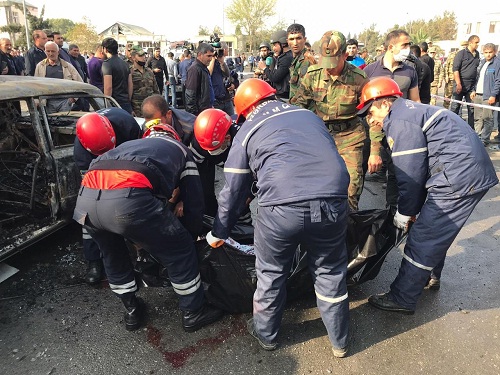
On October 28, Armenia, acting on its stated policy of terror, committed another heinous crime against the civilians in Azerbaijan. Around 1pm local time, Armenia launched 300mm “Smerch” rockets with banned cluster munitions at densely populated areas of the Bardacity (located apprx100 km from Armenia’s border and 30 km away from the conflict zone), including its business center and surroundings. As of now, the General Prosecutor’s office confirmed 21 civilians killed and more than 70 wounded. Civil infrastructure facilities and vehicles were extensively damaged.

The attack on Barda’s residential areas is the second deliberate attack within 20 hours with banned munitions. Earlier, on October 27, as a result of Armenia’s attack using the same type of cluster munition, four civilians died and thirteen civilians were injured. In total, civilian casualties in the Barda region within 20 hours are reportedly 108 with 25 killed and 83 injured (as of now, the list of casualties are being clarified).

The attack on the Barda city is the single, most blody

According to ANAMA’s report, six locations (HuseinJavid str., Baku str., Natavan str., Koroglu str., Bahadur Haciyev str. and Heydar Aliyev–UzeirHajibeyov crossing) in the Barda city were hit with with 300mm “Smerch” 9M525 rockets containing 9N235 bomblets.

This is another terror act bythegovernment of Armenia against the civil population of Azerbaijan, follows a notorious pattern of terror acts earlier committed by Armenia in Ganja, Tartar and other towns in a deliberate, widespread and systematic manner. The policy of terror were publicly declared by Armenia’s government officials as a strategy to strike at peaceful settlements in order to cause panic.[1]

The rocket attacks against the civilian population in Barda, along with ballistic missile attacks which Ganja and other towns constitute a war crime anda crime against humanity perpetrated in a deliberate, widespread and systematic manner.

Below are photo evidences from the scene.

1

China could help Pakistan combat desertification and shortage of fuelwood

BEIJING,  Oct. 29 (DNA): China could help Pakistan to combat desertification and shortage of fuelwood by exchanging the new technology.This was stated by Nowsherwan Zarif, who used to be a public servant in Pakistan Forest Institute in Peshawar and now is on a 4-year study leave in Harbin, China, according to China Economic Net (CEN).“I am doing a Ph.D. at Northeast Forestry University since 2017. As a researcher, my duty is to plant different forest species. I have to plant,” he said .My basic aim is to enhance my expertise in the field of forestry and learn modern techniques which can help Pakistan in the future,  he said in an interview to CEN.

“Pakistani government also encouraged us to learn more modern forestry techniques. We can introduce different expertise and inventions and plant different varieties of trees to enhance soil fertility and soil nutrients.” he said.According to Nowsherwan, there are a lot of disciplines in which China can help Pakistan improve. “With the increasing population in Pakistan, the fuelwood demand boosted as well.China’s advanced forest genetics and tree breeding technology can be useful in Pakistan. Fast-growing species and other forest species can also be introduced to Pakistan to satisfy the demand.In the recent few decades, China has done commendable jobs in enhancing the forest coverage rate. Now, the government of Pakistan is also taking a keen interest in plantations to make Pakistan green.A planting project is launched to plant 10 billion trees all over Pakistan within 5 years. We have already achieved 1 billion plantations 5 years back, it is a good initiative for the Pakistan government. ” Nowsherwan was also impressed by China’s experience in combating desertification.He said, he saw a documentary about how China convert desert into oasis or forest. Pakistan can learn the related technologies and introduce drought resistance species from China.”Nowsherwan’s wife is also doing a Ph.D. at the same university. Her major is Forest Resource Economic Management.“Last winter she went back to Pakistan for the collection of research data, which is related to the impacts of large dam on riparian vegetation in Pakistan, while I had to stay here because I need to finish my lab works before March.” he said.During the epidemic period, Nowsherwan stayed in China and his wife stayed in Pakistan.“Our school deputed one teacher to every student to care for their physical and mental health. They provided us every facility like masks, hand sanitizer, floor cleaner, etc. They kept in touch with us 24/7 during the whole epidemic so we may not get panic and depressed, ” he added.

China, Pakistan may promote hybrid wheat through cooperative enterprises: Dr. Zhang Shengquan

ISLAMABAD, Oct 29  (DNA):  Beijing hybrid wheat is ready to be popularized in Pakistan and we’re stepping in the marketization stage and looking for cooperative enterprises in Pakistan,” said Dr Zhang Shengquan, an expert of Beijing Academy of Agriculture and Forestry Sciences (BAAFS).

She said, the prospects of better yield through hybrid’s technology has been achieved after 11 years of local experiments and demonstrations in Peshawar, Gwadar Pro reported on Thursday.

Zhang said, “after comparing with thousands of species of other wheat and selecting from ten thousand of genome of Beijing hybrid wheat, the final Beijing hybrid wheat we have bred can fully adapt to the climate and soil in Pakistan.

It also can greatly alleviate the food crisis in Pakistan and meet the nutritional needs of the Pakistani people.

In order to achieve high yields in Pakistan, Beijing hybrid wheat has been fully accustomed to Pakistan’s arid and hot climate for the past 11 years of experimentation.

”Meanwhile, the wheat rust is a major factor in the reduction of wheat production in Pakistan. Beijing hybrid wheat can basically achieve immunity or high resistance to this crop disease.

Zhang said, Pakistan suffers from a chronic wheat shortage because of high demand for high-quality wheat and low yields.Therefore, while ensuring excellent drought resistance, lodging resistance, disease and insect resistance, increasing yield is our research focus.

According to experimental data this year, compared with the best local varieties in Pakistan, planted on the same acreage, Beijing hybrid wheat harvested 120% of crop using only 10% of seeds.

The composition testing shows that the nutrition and taste of Beijing hybrid wheat can meet the needs of Pakistani people, and the texture of flour is very suitable for Nam and Chabati.“

After 11 years of research and experiments, we are confident that the current Beijing hybrid wheat has fully met the ripe conditions for large-scale promotion in Pakistan.

We’ll provide Beijing hybrid wheat seed to Pakistan so that our iron brother can overcome the food crisis. We are willing to provide as much seeds as they need,” said Zhang Sheng Quan.

Potato to fulfill Pakistanis’ food bag and purse in post-COVID era: Report

ISLAMABAD, Oct. 29 ): Potato is likely to play a bigger role in the post COVID-19 era to meet the food’s requirements, said a report published by Gwadar Pro on Thursday.

The report stated that potato can not only meet people’s daily nutrition needs, but also gain revenue via exports.The country’s long growing seasons and high production yields of potatoes enable it to meet not only local consumption but also exports.
Most potatoes of Pakistan are consumed locally, but the export has been increasing year on year. According to Muhammed Tauha from Chase International, a Pakistani exporter of potatoes, production reached over 4.1 million tons of which 3 million tons were meant for local consumption and the rest for exports.

According to the report, in 2019, Pakistan exported potatoes to Afghanistan, United Arab Emirates, Sri Lanka, Qatar, Omen, Malaysia, Russia, and Kuwait.
Potato Growers Society Vice President Chaudhry Maqsood Ahmad Jatt claimed that the total cost of a bag of potatoes, from sowing up till its transportation to the market, stands at over Rs 2,000.
Providing a breakup of the cost, he explained that at least 13 bags of potato seed are used per acre for sowing and each bag of quality imported seed costs Rs 9,000.

A sum of Rs 60,000-70,000 per acre is spent on fertilizers, pesticides, labour and paying rent for land.

Potatoes’ development potential has been recognized and a series of measures have been rolled out.

The All Pakistan Fruit and Vegetable Exporters, Importers and Merchants Association (PFVA) has presented a comprehensive road map titled “Horticulture Vision – 2030” to the Federal Government.

By effective implementation of the horticulture vision, Pakistan can easily enhance exports of fruits and vegetables to $1 billion within a period of two years, $2 billion in five years and $6 billion in a decade.

For the potato industry, Mr Jatt, who is also the chairman of the Potato Research and Development Board Punjab, recommends that the government could take at least two steps to improve the lot of potato growers and save them from financial losses.

Firstly, it should immediately arrange and promote exports through land routes to neighbouring Iran and Afghanistan up to the Central Asian States.
The other one, it should announce a subsidy for potato exporters with the condition that they will pay the growers prime rate for the produce.
As for increasing the potato output, Cheng Xiaofei, a professor of Northeast Agricultural University, China, advised to use new seed varieties, modern technologies and improve the management of cultivation.
For seed varieties, the country imports more than 7,000 metric tons of seed potatoes valuing around Euro 1 million per annum from the Netherlands. Pakistan Agricultural Research Council (PARC) recently announced to produce two million disease-resistant potato tubers using tissue culture technology.

The Chairman of PARC Dr Muhammad Azeem Khan said, “We will produce virus free potato tubers locally, which will save our precious foreign exchange.”

Pakistan’s ‘smart lockdown policy’ can benefit small businesses elsewhere, Raza Bashir Tarar tells webinar in Ottawa

29th October 2020

Pakistan government achieved considerable success despite initial criticism in keeping small businesses afloat at the peak of Covid-19 pandemic by adopting a policy of smart lockdowns and letting the small businesses operate by following SOPs in all major cities.

*This was stated by High Commissioner for Pakistan to Canada Mr. Raza Bashir Tarar while attending a webinar arranged by Canada Pakistan Affiliated Chamber of Trade (CPACT) on the subject of “How the Pandemic is Impacting Small Businesses in Ottawa”*. Ottawa City Councillor Mr. Eli El-Chantiry, local small business activist Michael Wood, CPACT Chairperson Uzma Khan and a number of local Pakistani and other businessmen also attended the webinar.

Raza Bashir Tarar told the participants that keeping small businesses closed for extended periods could be very tough and actually lead to business closures if prompt measures to extend stimulus packages such as partial payment of staff salaries, grant of subsidized loans, deferment of existing loans and subsidy in utilities were not quickly taken.He urged the Canada Pakistan Affiliated Chamber of Trade (CPACT) and other Pakistani business platforms in Canada to compile the business data profiles of Pakistanis’ owned small businesses out of the 6200 small business units operating Ottawa. “The availability of data and information would help promote community relations and lead to joint strategies to cope with the pandemic as long as a credible vaccine was not developed to stem the growth and resurgence of virus,” he said.The High Commissioner advised the small Pakistani businesses in Ottawa and other cities of Canada to adopt innovative marketing and service delivery techniques by using the tools of social media to keep their businesses running. He urged the Pakistani community to keep track of what household products and grains, particularly those imported from Pakistan, could be purchased from the stores owned by the Pakistanis.He said food exports from Pakistan to Canada currently stood at US$ 12 million per annum but the volume of Pakistani food imports could be increased manifold by the support and patronage of the Pakistani community in Canada as the Pakistani food products, particularly its rice which had proven to be free of any traces of pesticides, were higher in quality, taste and aroma and could easily capture a good market share in short time.

Erdogan blasts ‘disgusting’ Charlie Hebdo cartoons

ISTANBUL, OCT 28  –  Turkish President Recep Tayyip Erdogan on Wednesday vented his outrage at the French satirical weekly Charlie Hebdo for mocking him in a front-page cartoon.

His office also vowed to take unspecified “legal and diplomatic actions” against the weekly.

The publication has stoked fury in Turkish political circles and added to a sense of crisis enveloping Turkey’s deteriorating relations with France.

It came out just days after Erdogan called for a boycott of French products and questioned President Emmanuel Macron’s sanity for promoting a drive against radical Islam.

Macron’s accompanying defence of the media’s right to mock religion has stirred angry protests across Turkey and swathes of the Muslim world.

Erdogan said he had never personally seen the Charlie Hebdo drawing because he did not want to “give credit to such immoral publications”.

But he called it “disgusting” nonetheless.

“I don’t need to say anything to those scoundrels who insult my beloved Prophet (PBUH) on such a scale,” Erdogan said in a speech to his party’s lawmakers in the parliament.

“I am sad and frustrated not because of this disgusting attack on me personally but because of the impertinence taking aim at our Prophet we love more than ourselves,” he said.

Erdogan on Wednesday accused “Macron and those who share the same mentality with him” of pursuing “vicious, provocative and ugly policies that sow the seeds of hatred”.

Ankara prosecutors said they were launching an investigation into the publication for “insulting the head of state”.

The cartoon was published in the middle of an emotional debate over France’s broader policy toward Muslims.

That conversation has been lent urgency by the murder near Paris this month of a teacher who showed his class the blasphemous sketches previously published by Charlie Hebdo.

Macron’s defence of the drawings saw tens of thousands march Tuesday through the Bangladesh capital Dhaka and protesters burn pictures of Macron and French tricolour flags in Syria.

Smaller protests returned to Dhaka on Wednesday and also hit the Indian city Mumbai and parts of the Gaza Strip.

Stay Connected

64FansLike
60FollowersFollow

Latest Reviews

Exchange Rates

USD - United States Dollar
EUR
1.17
GBP
1.35
AUD
0.72
CAD
0.73