Home Blog Page 3079

Japan ruling party sets Sept 14 vote on PM Abe’s successor

Japan’s ruling party will vote on September 14 on Prime Minister Shinzo Abe’s replacement, an official confirmed Wednesday, as powerful chief cabinet secretary Yoshihide Suga consolidated his frontrunner status in the race.

A vote in parliament — expected to endorse the Liberal Democratic Party’s new leader — is likely to follow on September 16.

The new prime minister will face a raft of challenges, from the coronavirus pandemic to a tanking economy, as well as ensuring the postponed Tokyo Olympic Games can go ahead.Key LDP factions have already thrown their support behind Suga, who is expected to formally announce his candidacy later Wednesday.

Two other candidates, former defence minister Shigeru Ishiba and LDP policy chief Fumio Kishida, have so far announced plans to stand.

Abe, Japan’s longest-serving leader, kicked off the race when he said last week he would step down over health problems.

– Scaled-back vote –

The LDP has opted for a scaled-back leadership vote that will not include rank-and-file members.

Instead, only its MPs and three representatives from each of the country’s 47 prefectures will vote.

The decision has elicited some criticism, but party officials said it would take too long to organise a broader vote.

Experts said the format favours Suga, 71, who has built an effectively insurmountable lead in the race already.

His selection “is increasingly assured, as the LDP’s factions -– with the exception of the factions headed by rival candidates Shigeru Ishiba and Fumio Kishida -– have lined up behind Suga”, said Tobias Harris, a Japan expert at Teneo consultancy, in a note.

Suga has held his key post for years — coordinating policy among ministries and agencies, and serving as the effective face of the government as its chief spokesman.

Considered a pragmatic politician, he is a close Abe advisor who encouraged the prime minister to run again after a disastrous first term in office ended after just a year in 2007.

– Rivals –

Kishida, 63, a former foreign minister, was in the past considered Abe’s favoured successor.

But the outgoing prime minister has said he will not endorse a candidate, and Kishida’s limited public profile is likely to leave him struggling to challenge the likes of Suga.

On Wednesday, the policy chief said more was needed from Abe’s signature economic stimulus programme, as it had primarily benefited big companies and the rich.

“Trickle-down effects are expected for the middle class, mid-sized and small-sized companies and for the countryside, but that’s not happening yet,” he argued in an interview with local media.

Ishiba, 63, polls well with the general public but is less popular among party members.

He once left the LDP — spending time as both an independent and briefly joining another party — and many within the ruling bloc have not forgiven the political dalliance.

Ishiba has also stressed the need for everyday people on lower incomes to benefit from government economic policies, and said Japan needs to reduce its reliance on nuclear power.

Punjab government reshuffles officers, provincial secretaries

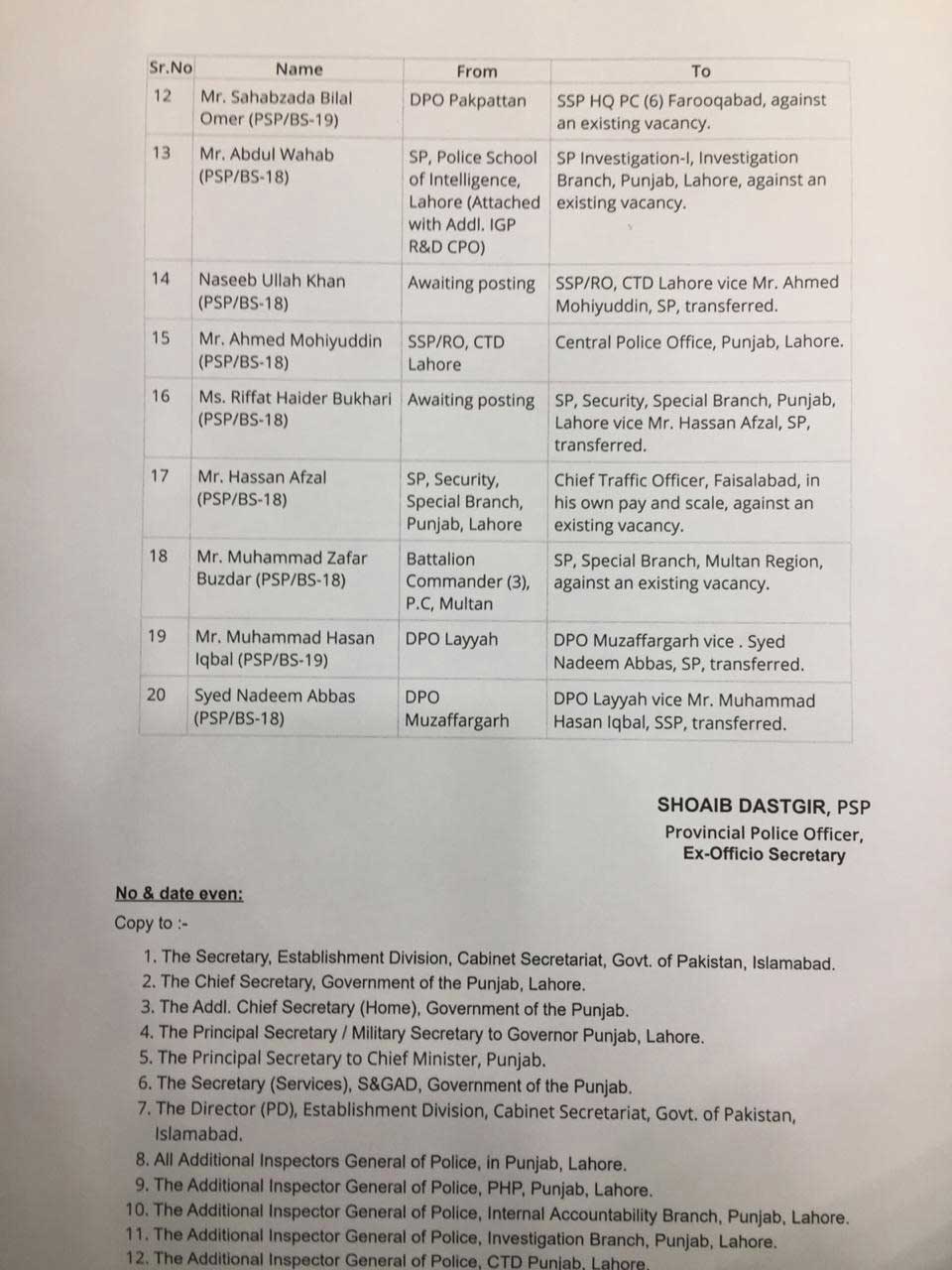
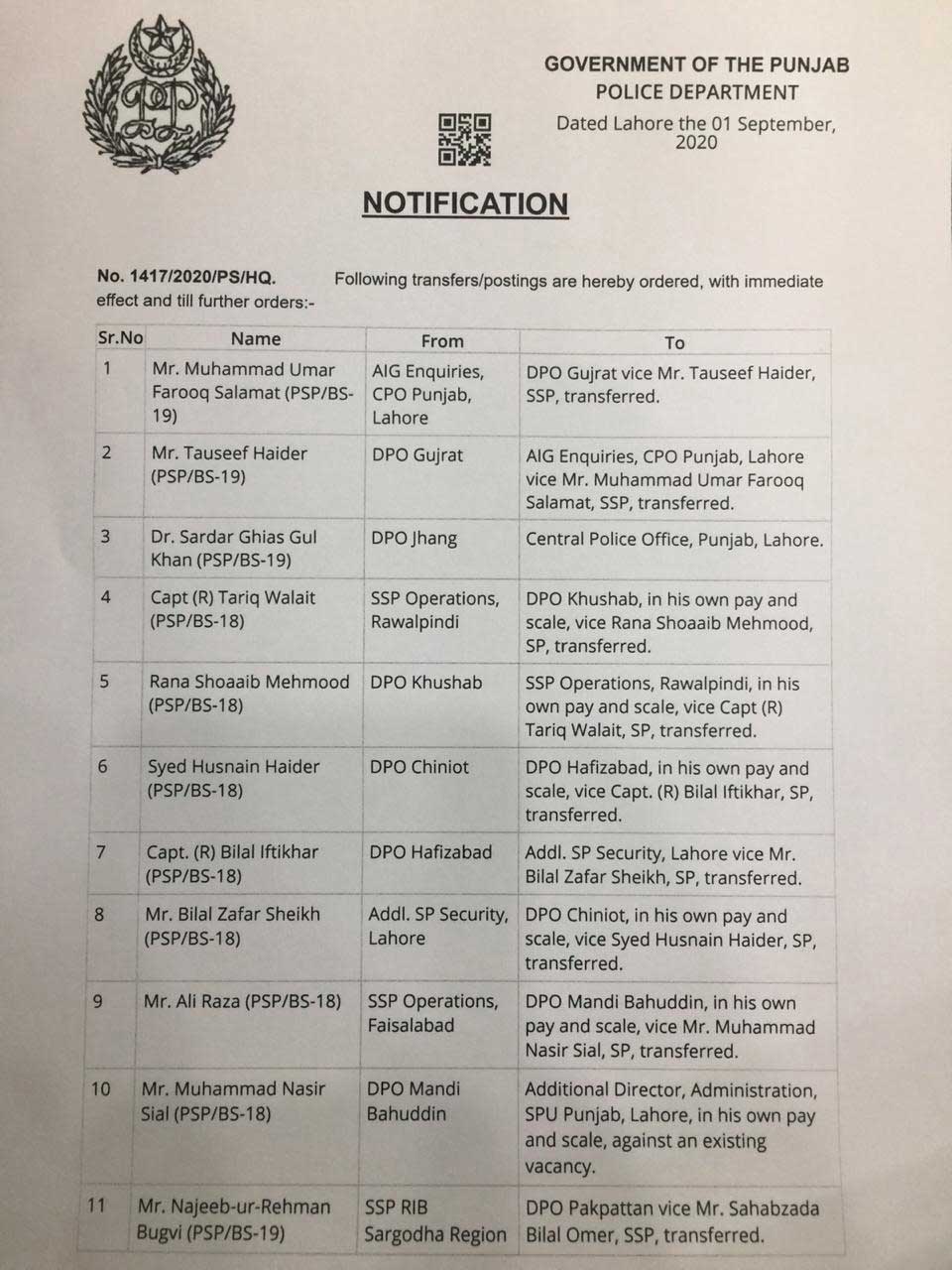
LAHORE : In a major reshuffle by the Punjab government on Wednesday several officers and provincial secretaries were transferred to different posts, including the commissioner Multan and others.

According to a notification by the provincial government, Nadeem Sarwar has been appointed as the secretary, prosecutor Nadeem ur Rehman has been appointed as secretary human rights, while Nabil Javed has been appointed as the chief economist of the Planning and Development Board.

Ali Bahadur Qazi who is serving as secretary population has been given the additional charge of secretary Punjab Management Professional Development, while secretary (I&C) Masood Mukhtar has been transferred to the Planning and Development Board.

Commissioner Multan Shan-ul-Haq has been made officer on special duty (OSD) while Javed Akhtar Mahmood has been made Commissioner Multan. Deputy Commissioner Gujrat Dr Khurram, Shahzad has been made OSD, while Mohammad Saif Anwar Cheema has been appointed as deputy commissioner Gujrat.

Photo: Punjab government

Deputy Commissioner Mandi Bahauddin Mehtab Waseem Azhar has been made OSD, while Tariq Ali Basra has been appointed in his place. Deputy Commissioner Toba Tek Singh Amna Muneer has been made OSD, while Umar Javed has been appointed in her place.

Deputy Commissioner Mandi Sialkot Nasir Mahmood Basheer has been appointed OSD with Deputy Commissioner Sahiwal Zeeshan Javed taking over his post. ADCR Sahiwal Owais Mushtaq has been given the additional charge of deputy commissioner Sahiwal.

Zulfiqar Hameed, Capital City Police Officer, Lahore has been transferred and posted as Additional Inspector General of Police Operations. Deputy Inspector General of Police Specialized Protection Unit Muhammad Umar Sheikh has been transferred and posted as Capital City police officer.

Photo: Punjab government

Bilal Siddique has been posted as deputy IGP Specialized Protection Unit, while Sohail Habib Tajik has been directed to report to Services & General Administration Department till further orders. Imran Ahmar who was serving as a regional police officer in Dera Ghazi Khan Region has been transferred to Rawalpindi.

Meanwhile, Captain (r) Muhammad Faisal Rana has been transferred to Dera Ghazi Khan Region as a regional police officer. Tariq Abbas Qureshi has been transferred to Sahiwal as a regional police officer, while Mir Humayun Bashir Tarar has been posted as Deputy Inspector General of Police, Highways Patrolling Posts, Punjab.

Croatia’s Rakitic leaves Barcelona to rejoin Sevilla

Croatia midfielder Ivan Rakitic has rejoined Europa League holders Sevilla on a four-year deal from Barcelona for an undisclosed fee, the Liga team said on Tuesday.

His departure ends a trophy-laden six-year spell at Camp Nou during which Rakitic won four league titles, four Copa del Rey trophies plus the Champions League and Club World Cup.

Spanish media reports had said the 32-year-old, who had one year left on his contract, was not part of new Barca coach Ronald Koeman’s plans for next season.

“Sevilla FC and FC Barcelona have reached an agreement for the transfer of midfielder Ivan Rakitic, who will return to the club for a second spell after his first spell at the club between January 2011 and June 2014,” Sevilla said in a statement.

Rakitic captained Sevilla to Europa League success in 2014 before leaving to join Barca.

Pakistan beat England in final T20 to level series

MANCHESTER : Mohammad Hafeez and teenage debutant Haider Ali both starred with the bat for Pakistan in the third and final T20I as the men in green ended their tour of England with a five-run win at Old Trafford on Tuesday.

It was Pakistan’s first victory in 66 days in England and meant they squared this three-match series at 1-1 after they suffered a 1-0 loss in last month’s three-Test series.

Hafeez made 86 not out and Haider 54 in Pakistan’s 190-4.

There was a 20-year age gap between the 39-year-old Hafeez and the 19-year-old Haider but it was hard to notice the difference as they shared a stand of exactly 100 after coming together at 32-2.

Hafeez’s knock followed his 69 in England´s five-wicket win in the second T20 at Old Trafford on Sunday and was his fourth half-century in his last five T20 international innings.

England were 69-4 in their chase before Moeen Ali, who should have been out for seven, revived their hopes with 61.

But when veteran paceman Wahab Riaz, in for the injured Mohammad Amir, ran out Chris Jordan and then caught and bowled Moeen, England were 174-8 with seven balls left.

They needed 12 off two balls when Tom Curran hit a six.

But Curran could not repeat the shot when Haris Rauf bowled a yorker with the last ball of the match.

England suffered a setback just four balls into their chase when Jonny Bairstow was bowled for a duck by a superb yorker from left-arm quick Shaheen Afridi.

Dawid Malan, fresh from his unbeaten 54 on Sunday, was brilliantly caught by a leaping Fakhar Zaman near the boundary rope after hoisting left-arm spinner Imad Wasim.

England captain Eoin Morgan looked in good touch following his 66 on Sunday but he was run out for just 10 after a dreadful mix-up with Tom Banton.

And when Banton was lbw for 46, featuring eight fours, on review to Rauf, England were struggling at 69-4.

Moeen should have been out when he went down the pitch to Imad but former Pakistan captain Sarfaraz Ahmed, selected in place of in-form wicketkeeper Mohammad Rizwan, fumbled the easy stumping.

It was the cue for left-handed batsman Moeen to launch a blistering assault as he compiled a 25-ball fifty, including two fours and four sixes.

After Morgan won the toss, off-spinner Moeen bowled Fakhar with his first ball of the match.

But Haider slog-swept his second ball in international cricket, from Moeen, for six.

Pakistan captain Babar Azam, the world´s top-ranked Twenty20 batsman, followed his 56 on Sunday with a brisk 21 before he was bowled by Curran.

Haider struck all-rounder Lewis Gregory´s first ball for an elegant legside pick-up six that soared over the longest boundary.

Hafeez followed up with two sixes off successive deliveries from leg-spinner Adil Rashid before Haider went to a 28-ball fifty with a pulled four off Gregory.

Hafeez then drove Rashid for six and swept him for four to complete a 31-ball fifty before Haider was bowled by Jordan.

PML-N President Shehbaz Sharif arrives in Karachi

LAHORE : Pakistan Muslim League-Nawaz (PML-N) President and  Leader of the Opposition in the National Assembly, Shahbaz Sharif, has arrived in Karachi to express solidarity with those affected from the urban flooding and torrential rains in the metropolis.

He was received by PML-N Karachi chapter leadership upon arrival at Jinnah International Airport, Karachi. Shehbaz Sharif was accompanied by PML-N Secretary General Ahsan Iqbal and party’s spokesperson Marriyum Aurangzeb.

During the visit, PML-N president will visit Faisal Edhi of Edhi Foundation Shehbaz Sharif and meet with the affected people.

PML-N President Shahbaz Sharif will also visit the party’s Nazimabad office, meet with workers and get a briefing on the impact of rains and floods in the port city.

Sources said the opposition leader will also meet with Pakistan Peoples Party (PPP) Chairman Bilawal Bhutto Zardari.

It is pertinent to mention here that Karachiites are still suffering the miseries of choked sewerage lines, dilapidated roads, piles of trash after the spell of torrential rains that caused urban flooding in many areas adjacent to drainage rivers.

The recent spell of rain and thundershowers caused flash floods in various low-lying areas, however, the citizens found no way out from the troubles of blocked sewerage lines to drain rainwater occupying their homes, shops, communities and roads.

E-paper sep 2

Tajikistan Is a Country Of Full-Water Lakes And Rivers

DUSHANBE, 02.09.2020. : Paradisiacal Tajikistan has unique qualities umatched by other countries.

Anyone who has traveled the world knows perfectly well that the taste of Tajik fruits is incomparable. You can taste grapes, apples, melons, other fruits and vegetables in the US, European countries, Russia or Georgia, compare them and come to the conclusion that they do not taste like the fruits of Tajikistan.

What is the reason? The reason is in the peculiarities of water and sun, and the fertile lands of Tajikistan.

Tajikistan is a country with the purest waters, largest glaciers, countless rivers, springs, and waterfalls that attract tourists from all over the world.

Tajikistan has large sources of fresh water in the world. A particularly large number of glaciers represent a huge reserve of clean water.

There are 947 number of rivers and tributaries. This includes the basins of the Amu Darya, Pyanj, Syrdarya, Zaravshon, Kafarnihon, numerous tributaries such as Karatog – Shirkent, Kyzylsu – Yakhsu, Isfara, Khojabakirgon, Oksu and the beds of the Asht and Somgor rivers.

There are 1,300 lakes in Tajikistan with a total area of 705 km2. The total volume of their water resources is 46,3 km3, of which 20 km3 is drinking water.

Tajikistan also has Sarez Lake, dozens of lakes with crystal clear water, unique springs that are sources of deep rivers. Additionally, the renewable groundwater resources in Tajikistan are 18.7 km3 per year.

It should be recalled that the President Emomali Rahmon’s initiatives in the international arena for the protection of water resources are aimed not only for the local population, but also for all of humanity, which is constantly faced with the problem of water shortages.

As part of President Emomali Rahmon and the government’s initiatives, the competition Water is the Guarantee to the Rural Development and Tourism, announced by Khovar and the Committee for Tourism Development and dedicated to the 30th anniversary of independence, will undoubtedly contribute to the achievement of lofty goals by studying, analyzing and implementing the most pressing problems in this area.

Perhaps not all tourists in the world know that Tajikistan is a country in which there are rare folk crafts and customs. These include various types of folk crafts, national cuisine, beautiful national traditions and rituals, which are of great interest to foreigners.

????????????????????????????????????

Tajikistan is one of the most ancient historical lands, where every stone and wall is covered with legends about the history of mankind. There are many historical sites dating to the Stone and Bronze Age, the period of the Achaemenid, Kushanids, and the Ephthalite dynasty.

Another attraction is the passage along the ancient territory of the Great Silk Road, along which served as the route of Buddhist monks and political envoys. It is now confirmed that caravans with tin and lapis lazuli passed through the territory of present-day Tajikistan long before the Great Silk Road. The first large city in the world on the territory of Eurasia was precisely ancient Sarazm.

Along with the ancient Sarazm, which has a history of more than 5,000 years, there are historical fortresses Yamchun and Kakh-kakha in Ishkoshim, the Hulbuk and Kasri Sangin areas, and dozens of other localities.

You can also add hot springs and gemstone deposits to this list. For example, one can name the healing springs Avj, Bibifotimavu Zahro, and dozens of others.

Every inch of this land is attractive to tourists, both in terms of its unique nature, ethnographic value, folk crafts, traditions, clothing, cooking, and dozens of other factors.

The most ancient and reliable historical source that provides fascinating information about the picturesque nature of our country is the sacred book Avesta. Historical information was presented in order to attract the attention of travelers to our lands since ancient times. Today the territory of our country is one of the most interesting tourist destinations that attract tourists from all over the planet.

The Arab scientist and traveler Al-Maqdisi mentions Badakhshon in his memoirs. Chinese manuscripts are the oldest written sources about our country and its unique nature.

Marco Polo was the first traveler to visit Tajikistan and share his memories.

Saudi Arabia, Pakistan must work together for Muslim unity

The Pakistani leadership has done well by categorically dismissing media speculation about any differences in its relationship with Saudi Arabia. In this regard, Foreign Minister Shah Mahmood Qureshi’s clarification of his controversial public statement and its endorsement by Prime Minister Imran Khan, coupled with Pakistan Army Chief of Staff Gen. Qamar Javed Bajwa’s visit to Riyadh for military purposes, have reinforced the fact that the exceptionally close bond between the two nations is resilient enough to absorb such critical shocks.

However, it is now quite clear that there was an organized attempt by hostile forces to create friction in Saudi-Pakistan ties. This started when Qureshi’s public remark that was critical of the Organization of Islamic Cooperation’s (OIC) role in Kashmir was blown out of all proportion to suggest that Riyadh and Islamabad had parted ways. The so-called notion of Saudi Arabia refusing to sustain its economic support to Pakistan was propagated as an additional justification. Then, Bajwa’s previously scheduled visit to Saudi Arabia was wrongly portrayed as a “damage control” bid. If this was not enough, the fact that his purely military trip did not include a meeting with Crown Prince Mohammed bin Salman was misconstrued as a “royal snub.”

It is therefore quite reassuring that Qureshi has himself taken the lead to reiterate that there was no change in Saudi Arabia’s position on the Kashmir dispute, or that it had asked Pakistan to pay back loans or stopped its oil supply. “It’s all speculation. No such decision taken,” he said last week, adding that Pakistan and Saudi Arabia had a “heart-to-heart relationship with a shared goal of peace.”

The same day, Pakistan’s Foreign Ministry “strongly (condemned) recent missile and drone attacks towards the Kingdom of Saudi Arabia by Houthi militia,” and called for an “immediate cessation of such attacks.” It also stated: “Pakistan reiterates its full support and solidarity with Saudi Arabia against any threats to its security and territorial integrity.”

Earlier in the month, Qureshi clarified that Saudi Arabia “acknowledges the feelings and aspirations of Pakistanis,” and, even while visiting China on Aug. 21, he said that relations between the two brotherly countries “have always been good and will remain good in the future.” Qureshi was in Beijing to participate in an already-scheduled second round of the China-Pakistan strategic dialogue, yet certain media outlets speculated as if China had come to the rescue of Pakistan’s economy after Saudi Arabia refused to help.

Therefore, it was a timely act on Prime Minister Khan’s part to also dismiss the rumors of any rift in Pakistan-Saudi ties as “completely baseless” one day after Bajwa visited Riyadh. Finally, Saudi Arabia’s Vice Minister of Defense Prince Khalid bin Salman, who is the younger brother of Crown Prince Mohammed, also rebuked the rumor-mongers by tweeting: “Met today with my brother, H.E. General Qamar Bajwa, Pakistan’s Chief of Army Staff. We discussed bilateral relations, military cooperation, and our common vision for preserving regional security.”

Saudi Arabia and Pakistan have long-standing defense ties, which are governed by a bilateral security cooperation agreement signed in 1982, under which Pakistan assists Saudi Arabia in military training and defense production capabilities. Pakistani troops are also stationed in Saudi Arabia in training and advisory roles. That Pakistan’s former army Chief of Staff Gen. Raheel Sharif commands the 41-member Islamic Military Counter Terrorism Alliance headquartered in Riyadh is a reflection of their close military collaboration. Bajwa’s visit also reaffirmed the two nations’ mutual quest for the further strengthening of their security cooperation.

Just as in military-to-military ties, there is no issue in people-to-people relations between Saudi Arabia and Pakistan. Millions of Pakistanis work in Saudi Arabia, and millions of them pay homage to Makkah and Madinah each year. Having served in Pakistan for almost a decade as Saudi ambassador, I can proudly claim that the love and affection the Pakistani people have for Saudi Arabia and the Muslim Ummah is unparalleled. Therefore, if there is one lesson to learn from the most recent conspiracy to sabotage the historic Saudi-Pakistan relationship, it is that we must reset its political fabric in a manner that matches mutual public aspirations and sustained defense cooperation.

Enhanced political cooperation between Saudi Arabia and Pakistan would require close coordination over bilateral and regional policies and strategies. Pakistan is a very important Muslim nation in the eyes of Saudi Arabia. I say so as a Saudi citizen, having retired from diplomatic service almost half a decade ago, as well as on the basis of my humble knowledge of working in Pakistan. The Kingdom is changing for good, offering new opportunities for the young and educated youth, which Pakistanis must be aware of.

Saudi Arabia today aspires to break the shackles of bitter history and move into a progressive future.

Dr. Ali Awadh Asseri

It is equally important to understand what Saudi Arabia currently perceives, or aspires for, in the wake of the current challenges facing the Muslim Ummah. Here is a brief purview of their historical context and current dynamics.

For half a century, Saudi Arabia has provided a leadership in the Islamic world that is premised on the pursuit of unity and peace for all Muslim people. Major crises have come along the way — the foremost of which was the 1979 ayatollah’s revolt in Iran, which installed a regime that has exported sectarian militarism across regional frontiers. Its manifestations are amply clear in several Arab countries today, especially Yemen, Iraq, Syria and Lebanon. Also, for Pakistan, recent history provides sufficient proof of Iran’s destabilizing conduct in the Baloch insurgency, as well as the Afghan war. Until now, Tehran has been a force for regional disintegration. How can we presume that, after having reportedly agreed a controversial economic deal with China, the Iranian regime will mend its ways and work for a regionally integrated world accruing collective socioeconomic benefits for its inhabited nations?

Saudi Arabia was reforming in the decade before 1979 — a process started by King Faisal bin Abdelaziz — but this was reversed by the ayatollah’s revolt. Subsequent decades engaged the Kingdom in an unnecessary quest to safeguard the Ummah from any division on sectarian grounds. Since 2015, Crown Prince Mohammed has renewed Saudi Arabia’s modernist journey by unveiling Vision 2030, under which major sociopolitical reforms have begun.

Consequently, the current Saudi national discourse revolves around youth education, women’s empowerment and public entertainment. Slowly but surely, the Saudi economy is diversifying away from oil. The national priority lies in developing agriculture, industry and infrastructure. New high-tech future city projects such as Neom are underway. This grand transition could transform Pakistan’s workforce in Saudi Arabia from performing menial jobs to becoming engaging in skilled professions.

Besides reforming from the inside, Saudi Arabia is diversifying its economic integration beyond the Western world or Arab regions toward the economically promising countries and regions of Asia, including with China, Russia, India, Pakistan and the Association of Southeast Asian Nations. Hence, both in its domestic and international outlooks, Saudi Arabia today aspires to break the shackles of bitter history and move into a progressive future, which is what Vision 2030 is all about.

On the contrary, if the ayatollahs of Iran were not enough to sabotage Saudi Arabian progress and Islamic unity in the past, recent years have seen the emergence of a new self-proclaimed leader of the so-called Sunni Muslim world: Turkey’s Recep Tayyip Erdogan. He — on the ashes of his own people and the suffering of the Syrians next door — wants to revive the decadent Ottomans. In the ideational sphere, he sponsors soap operas that romanticize imperial wars and force Muslims to think backwards rather than move forward.

Erdogan’s Turkey has, more recently, ganged up with Iran and Qatar. Together with Malaysia under ex-Prime Minister Mahathir Mohammed, they organized a select Islamic gathering in Kuala Lumpur last year, which Pakistan was wise enough to boycott. The aim was to divide the Muslim Ummah by creating an alternative to the OIC, the Muslim world’s largest representative organization, which is headquartered in Jeddah. As if the divisive tactics of Al Jazeera or TRT World were not enough, in the past year there has also been talk of starting a global TV channel on behalf of the Muslim world, which may serve the same purpose.

The ongoing conspiracy to undermine Saudi Arabia’s position in the Islamic world would not be complete without a few lines about the unfortunate role that Qatar has played in the Gulf region. It is a member of the Arab world’s most successful regional organization, namely the Gulf Cooperation Council (GCC), which was created precisely due to the Iranian threat in 1981 and which forbids interference in the internal affairs of other members. How can we explain Doha’s conduct when it chooses to befriend Iran at a time when it is an even greater regional danger, and also supports declared terrorist actors that are destabilizing the regimes of fellow GCC members?

In 2017, Saudi Arabia and several other Arab states were left with no choice but to blockade Qatar for these reasons. The crisis would end instantly end as and when its leaders chooses to live in peace and harmony with their fellow Arab neighbors, rather than aligning with the non-Arab regimes of Iran or Turkey, which rest on the subjugation of their Muslim populace.

These are some of the stark geopolitical realities that threaten the unity and peace of the Muslim Ummah from within. They are worth pointing out so that we remain aware of the challenges they pose and we can strive unitedly to tackle them. At the end of the day, the hatchers of the current conspiracy to divide the Muslims will meet their divine fate. After all, the holy places are in Makkah and Madinah, not in Istanbul or Tehran. It will always be in the direction of the Kaaba that millions of Muslims turn at prayer five times a day. Allah has bestowed this great gift upon Saudi Arabia alone.

Islamic faith is at the core of both the Pakistani and Saudi cultures. Therefore, both nations must carefully calibrate their bilateral and regional policies and strategies to defeat the hostile forces that are trying to create friction between them and divide the Islamic world. The recent crisis should serve as a reminder to avoid public diplomacy on such sensitive issues, as the vested interests inimical to the Saudi-Pakistani strategic partnership will jump on the opportunity, like they did this month. These vested interests, just as a point of clarification, are linked with the regimes and leaders of the countries concerned, not their people, whose salvation and prosperity are in every Muslim’s interest.

With the relationship back on track, quick progress should be made on economic issues. Apart from enhancing defense cooperation and sustaining current economic support, Saudi Arabia must reassure Pakistan of its long-term engagement for the economic development of the country through visible progress in bilateral trade and investment. For its part, Pakistan must diversify its workforce potential in response to the emerging demands of the Vision 2030 implementation process. In short, once the political relations are safe and steady, progress in economic and other spheres of cooperation becomes an organic reality. (Courtesy Arab News)

Dr. Ali Awadh Asseri is a former senior Saudi diplomat, who served as ambassador of the Kingdom of Saudi Arabia to Pakistan from 2001 to 2009. He holds a PhD in economics from Beirut Arab University and has written a book titled “Combating Terrorism: Saudi Arabia’s Role in the War on Terror.”

Japan’s Shinzo Abe thanks PM Imran Khan

DNA

ISLAMABAD, Japan’s former prime minister Shinzo Abe on Tuesday thanked Prime Minister Imran Khan for his “warm words of kindness”, where he had acknowledged Abe’s contributions for strengthening Pakistan-Japan ties.

“Thank you, Prime Minister Imran Khan for your warm words of kindness. I sincerely hope that our bilateral relations will be further strengthened in the future,” Abe tweeted.

Abe Shinzo, Japan’s longest serving prime minister since 2012, had resigned from his post due to health concerns.

Imran Khan in his tweet a few days ago had said that “great progress had been made in Pakistan-Japan ties under PM Abe Shinzo , with relations being further strengthened under his leadership, leading to enhanced cooperation in all areas.”

Khan had also sent Abe “best wishes for health and future endeavours. DNA

===========

Stay Connected

64FansLike
60FollowersFollow

Latest Reviews

Exchange Rates

USD - United States Dollar
EUR
1.17
GBP
1.35
AUD
0.67
CAD
0.72