Home Blog Page 3012

Dangerous Nexus among RAW, NDS, TTP and ISIS

Sajjad Shaukat

It is most regrettable that by disregarding the modern global trends like renunciation of war, peaceful settlement of disputes and economic development in wake of the spread of coronavirus and its negative economic consequences almost all over the world, even on India, India’s hegemonic designs are destablising the region and its peace.

So as to achieve its secret designs, in accordance with the direction of Indian fanatic Prime Minister Narendra Modi-the leader of the extremist ruling party BJP, New Delhi has accelerated interference in the internal affairs of regional countries. For the purpose, Indian military and intelligence agency RAW have been given free hand to target Pakistan, Afghanistan and China, including other regional countries through manipulation of political dissent, ethnic divisions and economic backwardness.

India which has become epicenter of terrorism in South Asia is foiling the peace process between Afghanistan and Pakistan, including the entire region by managing terrorist attacks.

In this respect, reliable sources as mentioned in Pakistan’s media on August 18, 2020 revealed that Afghanistan-based the Tehreek-e-Taliban Pakistan (TTP) has merged with its splinter groups Jamat-ul-Ahrar (JuA) and Hizb-ul-Ahrar (HuA) in Afghanistan. Their sole objective is to restart terrorist activity in Pakistan, while simultaneously sabotaging efforts to restore peace and stability in its war-ravaged Afghanistan.

Afghanistan’s National Directorate of Security and RAW played a key role in their reunification. The agreement, reportedly, designated Mufti Noor Wali as the amir (Chief) of TTP, making him responsible for all planned terrorist activities inside Pakistan and Afghanistan.

In this regard, Islamabad has repeatedly accused Kabul of turning a blind eye towards TTP and other terrorists who fled to Afghanistan to escape counter-terrorist operations in Pakistan.

Besides, the UN report of July 26, 2020 disclosed: “The banned Tehreek-e-Taliban Pakistan and its splinter group Jamaat-ul-Ahrar (JuA) continue to target Pakistan from their bases in Afghanistan…the significant presence of ISIL-K (The Islamic State of Iraq and the Levant Khorasan) in Afghanistan”, which the UN warns “now pursues a global agenda”.

The UN report warns of “a strong presence of ISIL-India in Kerala and Karnataka. ISIL-K considers Afghan territory a base for spreading terrorist influence across the wider region…The investigators found links between Indian nationals and terrorist attacks in Sri-Lank”.

It is notable and four heavily armed militants on June 29, this year made a brazen terror attack to take over the Pakistan Stock Exchange (PSX) building in country’s high-security commercial hub Karachi. The militants who arrived in a car, opened indiscriminate fire and lobbed grenades at the main gate of the building. Thus, they martyred four security guards and a police officer. The police and Rangers’ officials arrived at the scene and killed all the four terrorists. They foiled attempt of the terrorists who wanted to enter the PSX compound.

The Balochistan Liberation Army (BLA) linked Majeed Brigade claimed responsibility for the assault at the PSX building.

Likewise, Pakistan’s security forces had successfully thwarted an attack on the Chinese consulate in Karachi on November 23, 2018. In the exchange of firing, two policemen were martyred, including two civilians, as three gunmen tried to enter the consulate, but were intercepted by security guards at a checkpoint.

BLA had also claimed responsibility for the failed terror attempt on the Chinese consulate in Karachi.

In this connection, a senior counterterrorism expert Raja Umer Khattab told a newspaper that “the nationalist group of Balochistan [BLA] is behind failed attack on the PSX in Karachi, while the Indian spy agency RAW was the mastermind of both the Chinese consulate and PSX attacks…Their aim was to damage Pakistan’s image in the world as well as hit the economy of our country.”

It is mentionable that RAW which is in collusion with Israeli Mossad and NDS has well-established its terror-network in Afghanistan and has been fully assisting cross-border incursions and terror-activities in various regions of Pakistan through Baloch separatist elements and anti-Pakistan groups like Jundullah and TTP, including their affiliated outfits. RAW is also using terrorists of ISIS which claimed responsibility for a number of terrorism-related attacks in Pakistan and Afghanistan. These terror entities also abducted and killed many Chinese and Iranian nationals. These agencies, especially RAW are making efforts to destablise Afghanistan, Tibetan regions of China, Iranian Sistan-Baluchistan and particularly Balochistan province of Pakistan by arranging the subversive activities, promoting acrimonious sense of dissent, sectarian violence and arousing sentiments of separatism.

In this respect, Indo-Israel lobbies which are well-penetrated in the US Administration and are working in other Western countries became pro-active to manipulate the war on terror. Besides, Pakistan is the only nuclear country in the Muslim World, having close ties with China. Hence, it has become target of the Indo-Israeli secret diplomacy. New Delhi and Tel Aviv (Jerusalem) are collectively manipulating the double standards of the West in relation to terrorism and human rights vis-à-vis Pakistan, China and Iran.

Notably, Pakistan’s armed forces and especially army have successfully broken the backbone of the foreign-backed terrorists by the military operations Zarb-e-Azb, Radd-ul-Fasaad and Operation Khyber 4, while countries primary agency ISI has broken the network of these terrorist groups by capturing several militants and thwarting a number of terror attempts. So, peace was restored in various regions of the country, particularly in Balaochistan and Khyber Pakhtunkhwa (KP) provinces, including Karachi.

But, in the recent past, terror assaults in some areas of the country—especially North Waziristan and Balochistan which is central point of the China-Pakistan Economic Corridor (CPEC) indicate that the CIA-led RAW, NDS and Mossad are weakening Pakistan and want to damage the CPEC project which is part of China’s One Belt, One Road (OBOR) initiative or BRI. The US and India, including some Western countries have already opposed this project. So, these external agencies have continued supporting separatists of Balochistan and TTP and its affiliated terror outfits which have claimed responsibility for various subversive acts.

It is mentionable that Pakistan’s Foreign Minister Shah Mahmood Qureshi met US special envoy for Afghan Reconciliation Zalmay Khalilzad at Islamabad on July 1, 2020. After the meeting, Qureshi said that “Pakistan is ready to cooperate with regional and international stakeholders for enduring and peaceful political solution to the Afghan issue…the development of whole region depends on establishment of peace in Afghanistan…India has been continuously trying to destabilize Pakistan to divert attention from its internal chaos…India is interfering in Balochistan province of Pakistan at the same time it is also adversely affecting peace efforts in Afghanistan.”

As regards the recently-held intra-Afghan dialogue in Doha-the capital of Qatar, the US has appreciated Islamabad’s positive role.

Zalmay Khalilzad who, repeatedly, visited Pakistan and met country’s civil and military leadership admired Pakistan’s role in the US-Taliban peace dialogue. It was due to Pakistan’s key role in Doha that on February 29, this year, the US and the Taliban signed the historical agreement for bringing peace to Afghanistan.

Nevertheless, especially India is playing the main role in creating unrest in Afghanistan by using terrorist elements for carrying out violent incidents there with a view to shifting the blame game towards Pakistan and those Taliban whose leader signed the US-Afghan peace deal. New Delhi is also misleading the Afghan government and America to delay and finally to cancel the holding of the intra Afghan dialogue.

Undoubtedly, we can conclude that dangerous nexus among RAW, NDS, TTP and ISIS, particularly backed by the Indian extremist government is targeting Pakistan and Afghanistan, including other regional countries to obtain Indian nefarious designs at the cost of the peace of the region.

Sajjad Shaukat writes on international affairs and is author of the book: US vs Islamic Militants, Invisible Balance of Power: Dangerous Shift in International Relations

Email: [email protected]
Pakistan, Iraq vow to enhance defense ties

The Iraqi ambassador called on Zubaida Jalal and acknowledged the efforts of Pakistan for regional peace and stability 

RAWALPINDI (DNA): Minister for Defence Production Zubaida Jalal has said that Pakistan desires peace for Iraqi people and the region.

Ambassador of Iraq to Pakistan Hamid Abbas Lafta called on Minister for Defence Production Zubaida Jalal in Rawalpindi on Thursday.

The Minister welcomed the dignitary and expressed Pakistan’s desire for peace and prosperity of Iraqi People.

The Minister for Defence Production informed the dignitary that defence collaboration between the two countries can further be enhanced by sharing their mutual experiences in the field of defence production. 

The Federal Minister also highlighted the important role of Pakistan as a stabilizing factor for regional security. She further said that regional cooperation is essential to attain sustainable peace and stability in the region.

The visiting dignitary acknowledged and praised the efforts of Pakistan for regional peace and stability and said that Iraq government and people have confidence in Pakistan and its people and we will continue to work closely with it to further enhance bilateral relations.

Corruption worth Rs100bn unearthed in Sindh Building Control Authority

KARACHI: Corruption worth Rs100 billion has been unearthed in the Sindh Building Control Authority (SBCA).

The revelation was made in a reported compiled by Sindh Local Government Board consisting of 59 pages.

According to the report, 128 officers including three former director generals of the SBCA were involved in corruption. Rs27 billion were forged via the transfer of lands. The report recommended to sake four officers from their jobs over corruption.Strict action has been recommended against 775 officers of the SBCA over their direct involvement in the corruption.

“Illegal structures were constructed in large number during the last 18 years in the city”, the report read.

On August 26, the Sindh government had formed a committee to review the Sindh Building Control Authority’s (SBCA) affairs and monitor the issuance of permits for construction of high-rises and approval of maps by it.

PM Khan to effectively raise Kashmir issue at UNGA session: FM Qureshi

ISLAMABAD : Foreign Minister (FM) Shah Mahmood Qureshi has said that Prime Minister Imran Khan will effectively raise Kashmir issue at the ongoing UN General Assembly (UNGA) session like the last year, drawing the world attention to the grave human rights violations in Indian Illegally Occupied Jammu and Kashmir (IIOJ&K).

In a statement, FM Shah Mahmood Qureshi said we demand that the restrictions imposed in Indian Illegally Occupied Jammu and Kashmir should be immediately lifted and the communication blackout should be ended.

He said the amendments in the domicile laws by the Indian government to illegally change the demography of the Indian Illegally Occupied Jammu and Kashmir should immediately be reversed.FM Qureshi said India resorts to ceasefire violations along the Line of Control to divert attention whenever it faces domestic pressure or the situation in Indian illegally occupied Jammu and Kashmir goes out of its control.

Shah Mahmood Qureshi thanked Turkish President Recep Tayyip Erdogan for raising voice for Kashmiris at the UN General Assembly forum.

He said the international community will have to take the Kashmir issue seriously because if tension increases between two nuclear states, peace and stability of the region will get threatened.

ECP announces scheduled for polling in GB

ISLAMABAD : Chief Election Commissioner Gilgit-Baltistan (GB), Raja Shehbaz on Thursday announced the scheduled for polling in the region.

The candidates have been asked to submit their candidature credentials with the Returning Officers from tomorrow, reported Radio Pakistan.

The credentials will be accepted for five days.President Dr. Arif Alvi on Wednesday gave go-ahead to holding of general elections for the Gilgit-Baltistan assembly on November 15.

He had approved a summary regarding the polls sent to him by Prime Minister Imran Khan. The Legislative Assembly of Gilgit-Baltistan was dissolved after it completed its five-year tenure on 24 June.

Previously, the Gilgit-Baltistan Election Commission had postponed the elections of the Gilgit-Baltistan assembly and suspended the election schedule issued on July 2.

The election schedule had been suspended in the wake of the decision of the Gilgit-Baltistan Chief Court, a notification issued by the commission said. According to the election schedule issued on July 2, polling was supposed to be held on August 18.

British High Commissioner calls on KP CM to discuss matters of mutual interest

British High Commissioner to Pakistan Christian Turner called on Khyber Pakhtunkhwa Mahmood Khan in Peshawar on Thursday.

Speaking on the occasion, the Chief Minister said the provincial government is keen to initiate joint ventures in education and health sectors of the province.

The British High Commissioner expressed readiness of British government to work in girls’ education and health sectors.

Australian cricket legend Dean Jones dies

MUMBAI (DNA): Former Australian cricket legend Dean Jones has died of a massive heart attack. Jones was part of Star Sports commentary team and was in a bio-secure bubble in a seven-star hotel in Mumbai. He was 59.

Dean Jones has been an active cricket analyst and was signed up to do off-tube commentary on the Indian Premier League (IPL) 2020 now underway in UAE.

Jones is a popular figure in the Indian media. His show ‘Prof Deano’ was extremely popular on NDTV. He has commentated on various leagues of the world and was known for his forthright views.

Born in Melbourne, Dean Jones played 52 Test matches scoring 3631 runs at an average of 46.55. With a 216 as his best score, Jones scored 11 centuries and was an important member of Allan Border’s team.

Jones also played 164 ODIs and scored 6068 runs with the help of seven centuries and 46 fifties.

Jones also coached Pakistan Super League teams Islamabad United and Karachi Kings.

Jones was one of the first Australian batsmen cut out for the limited-overs game and he was quite successful at it.

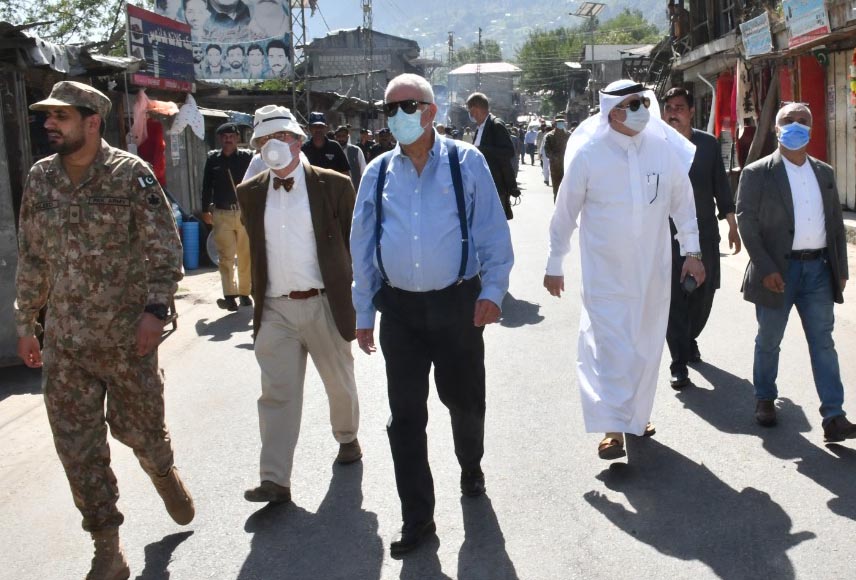
Diplomats visit Line of Control

LOC: Ambassadors and high commissioners of various countries visited Line of Control and saw with the own eyes atrocities committed against innocent people living in the area. ISPR arranged the trip. Diplomats were briefed about Indian violations of LoC, which were taking place almost on daily basis. DNA

Chinese universities collaborate for tech: advancement in Pakistan

ISLAMABAD, Sep. 24 : Chinese Universities will collaborate with the Government of Pakistan to open Campuses in Pak-Austria Institute of Applied Sciences and Technology Haripur in Khyber Pakhtunkhwa (KPK) province.

According to Gwadar Pro on Thursday, the five Chinese along with three Austrian universities will handle various departments of the institute to contribute to the country’s technological advancement. This huge project will take another 5 to 7 years to be fully completed.

The institute will offer around 30 most modern courses to students including artificial intelligence, material engineering, mineral development, food technology and agricultural sciences. The modern robots and drones used in agriculture will also be taught to students.

The prime focus of establishing such institution is to meet the workforce demands in key growth sectors such as industry, IT, information and communication technologies, medical technologies, electrical and mechanical as well as mineral resource development, extractive metallurgy and construction.

For the first two years the students will receive education in Pakistan while the rest of the education will be completed either in China or in Austria. Later after completing ,their  degrees, the young professionals can come back and serve the country.

The project’s location is especially important because it is near the Hatter industrial estate where around 80 Chinese companies will shift their businesses.

The country’s first digital city is also in this area where the most modern software park will be established. The 50 acres park will open doors for software development in the KPK province. The place also has due importance due to the Havelian dry port which will be the trade route to China in near future.

Pak-Austria Institute of Applied Science and Technology is a leap forward to assist the government of Pakistan in acquiring the much-needed pool of quality human resource in order to enhance the prosperity of Pakistan through developing a knowledge economy.

While inaugurating the project, Prime Minister Imran Khan said that Pakistan need to advance science and technology field for the progress of the country. Pakistan is moving in the right direction with a focus on education, science, technology and knowledge economy.

How Morocco dealt with COVID-19 pandemic?

Ambassador of Morocco to Pakistan Mohammed Karmoune gave an exclusive interview to Daily Islamabad POST, CENTRELINE magazine and DNA News Agency. The ambassador spoke about bilateral relations as well as various aspects of Moroccan economy, trade and culture. He also talked about his country’s efforts to deal with coronavirus. Here are excerpts from his interview. 

EXCLUSIVE

Ansar Mahmood Bhatti

A country of excellence in an exceptional circumstance

In March, Morocco’s strategy of containing the spread of Coronavirus was praised by certain European political figures and media outlets. During his statement before the National Assembly in Paris, French leftist politician Jean Luc Melenchon considered Morocco’s response as inspirational; and said “Morocco has performed well in its plan to combat Covid-19 by commandeering its textile industry to make protective masks. France should be inspired by it.” In neighboring Spain, the president of the Foreign Affairs Committee in the Senate, Antonio Gutierrez Limones, described the Moroccan response as efficient and effective;

Italian News Agency NOVA also praised Morocco’s plan of dealing with the Coronavirus threat as “unprecedented and the first of its kind in Africa”.

On March 2nd, Morocco registered the first positive coronavirus patient on its soil. Since then, the country has embarked on a real race against the clock to avoid a health tragedy.

In this regard, Morocco had to take immediate Stepsto defeat Covid-19.

An immediate response plan based on a series of preventive actions

Morocco chooses prevention and immediately adopts a series of drastic measures. Gradually, the kingdom barricaded its borders, closed schools and universities, cafes, restaurants, and non-essential shops. The country canceled sporting, cultural and artistic events and eventually even closed all mosques and places of worship.

On March 18, a few days after the announcement of the first local case of contamination with COVID-19, Minister of Health called on the population to limit their movements to the maximum and to apply voluntary confinement.

Free test

To halt the virus, Morocco facilitated, like South Korea, the testing by making it free and available to all individuals that may have been exposed to infected patients or that are simply not feeling well. As a matter of fact, before the first case was announced, more than 100 individuals had already been tested. Which makes Morocco, the only country in the MENA region effectively assessing, and harshly tracking the number of Coronavirus cases.

Massive public awareness

DSC_2234

On television channels, as well as radio and social networks, the Ministry of Health hammers out hygiene rules and acts as a barrier to prevent the spread of the virus. Furthermore, the authorities are embarking on a massive awareness campaign, using criers to get the message out to as many people as possible.

A special solidarity fund to fight the pandemic and limit its economic and social impact

Leading the battle against the coronavirus will come at a price. To prepare, the King Mohammed VI ordered the creation of a fund dedicated to managing the pandemic. In less than a week, the country has managed to raise more than 30 billion Moroccan dirhams (3 billion Euros) by putting all its players to work, big business, senior civil servants, parliamentarians, senior officers, high ranking officers, politicians … now is the time for solidarity. Several companies within Morocco’s food industry also donated millions of food products to assist families during the lockdown.

This special fund dedicated to upgrading infrastructure and acquiring the medical equipment necessary to treat COVID-19 is also used to manage the health repercussions of the epidemic and cushion its economic and social impact.The whole country is invited to participate at its level in the national effort. To help the segment of the population most affected by the freezing of economic activity in the country, this fund notably, allowed the payment of compensation of 2,000 Moroccan dirhams per month (around 187 Euros) to employees affiliated to the National Social Security Fund who is currently on sick leave.

A billion dirhams has also been paid to the Ministry of Health to upgrade infrastructure and acquire medical equipment in preparation for a possible worsening of the epidemiological situation.

Military forces called in to reinforce

The images of the armored units that roam the streets leave no room for doubt, the army is also taking part in the fight against the coronavirus. The monarch gave his instructions to reinforce military medicine in the country’s medical structures, in the form of medical and paramedical personnel. The social services of the Royal Armed Forces and the royal gendarmerie will also be mobilized within this framework.

A new therapeutic protocol: Morocco relies on chloroquine

This is the treatment everyone is talking about. Morocco officially adopts the treatment of chloroquine and hydroxychloroquine in the therapeutic management of confirmed cases of COVID-19.

In a circular dated Monday, March 23, Minister of Health, after consultation with the technical and scientific committee of the National Program for the Prevention and Control of Influenza and Severe Acute Respiratory Infections in the Kingdom, gave the green light to the introduction of this treatment in the therapeutic management of COVID-19.

As a reminder, the Moroccan government acquired from the Sanofi laboratory the entire stock of drugs marketed under the names “Nivaquine” and “Plaquenil” and manufactured at the Sanofi Maroc industrial site in Casablanca.

The stocks of this treatment initially indicated for treating and preventing malaria, were fully “made available exclusively to health establishments, with a strict protocol of use, subject to monitoring and control”.

Strategyof transparency

The Moroccan government also made transparency and open-information its main weapon to win against the rapid spread by sharing daily with citizens any relevant information. As a matter of fact, all members of the Moroccan Government were tested and all of their results of the COVID-19 were instantly shared with the public.

Ventilator and Thermometer (MADE IN MOROCCO)

Morocco plans to increase its intensive care beds capacity to 3000 as it allocated $200 million to acquire health equipment to deal with coronavirus.100,000 testing kits and collectors in addition to protective gear and other medicine to treat COVID-19 patients.

Morocco is also encouraging local institutions and universities to manufacture locally medical devices to assist to country’s efforts in the fight against the novel coronavirus.

In this connection, the Ministry of Industry, Trade and Digital Economy brought together a cluster of 20 researchers and engineers who invented two 100% Morocco-made devices, an automatic ventilator and, an infrared thermometer.

Morocco makes face masks compulsory due to coronavirus

Morocco made wearing face masks mandatory starting from April 7 for anyone allowed to go out during the coronavirus outbreak.

The masks were sold at a subsidized price of 0.8 dirhams ($0.08) per unit. Those who wouldn’t comply to wearing masks, could face prison sentences of up to three months and a fine of up to 1,300 dirhams. Textile factories across the country have been encouraged to produce face masks.

The Coronavirus shows the bright face of Moroccans: solidarity, synergy, and love for the homeland

Once again, perhaps it is more than what we are used to in the past but whenever the hardships, tribulations and natural calamities challenge us, Moroccans demonstrate to the whole world the originality of their precious mettle. They stress that what unites them is greater than what separates them. This was evident by their comprehensive solidarity and mobilization in the face of the emerging coronavirus or “COVID-19” that afflicted all countries, as they did not delay their positive interaction with the high initiative launched by King Mohammed VI in March 2020, to accelerate the creation of a special fund to manage and respond to the epidemic.

This is without neglecting to mention the tremendous efforts made by the medical staff in the hospital centers, the security agencies in maintaining security and stability in all cities, and the educational frameworks in their keenness to continue giving lessons to learners, students, and trainees via the Internet. The work of the national media that works hard to educate citizens and provide them with the correct information also needs to be mentioned. As does the work of sanitation workers who watch the streets and neighborhoods, and other forms of solidarity and initiatives aimed at clustering against this epidemic, which threatens the lives of everyone, especially the elderly.

Despite the dangers of coronavirus on the health and lives of people, the pandemic revealed the bright face of the ancient Moroccan people in terms of nobility and noble values and contributed to strengthening the weaving of the social fabric. However, these noble people were not at any point in their glorious history in need of such disasters to revive the spirit of fraternity and cohesion in their depths. Moreover, this spirit is not strange for a society that has known for decades many forms of solidarity and interdependence among all its social strata, in various cities, villages, rural areas, and urban areas. It is based on what has been entrenched in the minds of its members from religious teachings and morals, and formed from them an authentic Moroccan culture rooted deep in human history.

This is because of the value of solidarity is among the most prominent high civilization values that have roots in the depth of Moroccan history, and are the most established and enduring.

Perhaps among the most prominent manifestations of gallantry and chivalry recorded in these difficult circumstances of our contemporary history, there are some bosses of cafes and restaurants and places that have been closed from the commitment to continue to pay workers wages, and there is a category of large taxi owners who chose to share with their drivers their loss, and there is also owners have given up the leasehold entitlements of missing persons and their jobs until the return of things to normal … Multiple and varied examples show to what extent the culture of solidarity has spread in our country …

Moroccans, despite the deviation that is taken upon some of them, are distinguished in the majority of them by the spirit of solidarity that we rarely find among other peoples, as they do not depend on doing good and undertaking good initiatives in secret and in public, individually or collectively, and whether it is related to surgeries or financial aid during religious occasions, academic seasons, etc., especially in crises such as we are today, which contributes to the consolidation of more values of solidarity, brotherhood, friendship, compassion, and tolerance.

Morocco a model of unity, responsibility and resilience

King Mohammed VI called for unity on African leaders to deal with the Covid-19 pandemic. The sovereign spoke on this matter with the presidents of Côte d’Ivoire and Senegal, to launch an initiative of African Heads of State aimed at establishing an operational framework to support the countries of the continent in their different phases of pandemic management.

Morocco also donated to the African Union Commission medical supplies that would boost the continental capacity to respond to the COVID-19 pandemic. The donation represents the values of support and solidarity between African Union Member States.

A strong signal for South-South cooperation

Concretely, the Kingdom of Morocco quickly went from words to deeds. Since Sunday, June 14, the cargo planes of the airline Royal Air Maroc are active again on the tarmacs of African airports.

In the wake of his commitment made in April 2020 to strengthen South-South solidarity, King Mohammed VI ordered the dispatch of medical aid to 15 sub-Saharan countries, with massive help:8 million masks, 900,000 visors, 600,000 charlottes, 60,000 gowns, 30,000 liters of hydroalcoholic gel, 75,000 boxes of chloroquine and 15,000 boxes of azithromycin, all from Moroccan factories in accordance with the standards required by the ‘WHO.

Conclusion

The measures taken by Morocco at the first stage of the COVID-19 outbreak is showing how much Morocco did not underestimate the situation and learned from other countries’ mistakes.

In comparison to the majority of African countries, Morocco’s strong institutions, peaceful society, robust infrastructure, and several achievements on food security, have definitely helped policy-makers to draw a prompt response to exacerbate the Coronavirus panic, and dismiss spurious information around it.

Morocco’s public health sector might not be as sophisticated as Japan’s for instance, however, this safety-preparedness approach is not only a winning strategy, but it is also unprecedent for the majority of MENA countries, and even for some European countries.

“Despite the fragile economic situation Morocco faced before the pandemic, the actions taken by the Government and all the other institutions show it is among the first countries globally to sacrifice its own economic welfare to prevent this virus from spreading,”. “This move, in turn, has inspired Moroccans to trust the Government’s measures and help one another in this time of crisis.

“The Coronavirus situation shows the societal benefits of cohesion and solidarity with one another and shows how it is important to consider the positives of this difficult period, rather than just the negatives.”

Stay Connected

64FansLike
60FollowersFollow

Latest Reviews

Exchange Rates

USD - United States Dollar
EUR
1.17
GBP
1.35
AUD
0.67
CAD
0.72