Home Blog Page 3011

LHC stops PCB from taking financial guarantees from PSL franchises for next season

LAHORE : The Lahore High Court (LHC) on Friday stopped the Pakistan Cricket Board (PCB) from taking any financial guarantees from the Pakistan Super League (PSL) franchises for the next season of the country’s premier cricket tournament.

LHC’s Justice Sajid Mehmood Sethi issued the orders and asked the PCB to submit its reply in the case filed by the franchises by September 30.

On Thursday, the franchises had approached the LHC against the PCB for its failure to address their reservations over the tournament’s financial model.

In a petition filed through leading lawyers Ahmer Bilal Soofi and Salman Akram Raja, the franchises said they have been suffering major losses due to the financial model being used by the cricket board over the last five years.

They said they were hoping that the league would be profitable for them after the fifth edition took place in Pakistan instead of UAE but that was not the case.

“Over the past few months, the relationship between the PCB and the franchises had turned sour while the cancellation of governing council’s meeting, towards the end of July, took matters to the point of no return,” the petition stated.

The petition added that the franchises were also not happy with the fact that the PCB had asked them to submit financial guarantee, by September 25, for the next season, even before the fifth edition has been completed, rather than addressing their grievances.

“The franchises were disappointed to see the PCB’s approach, while dealing with them, despite helping the board turn the league into a big brand,” it further stated.

PTI foreign funding case: ECP’s scrutiny body restarts probe

ISLAMABAD: The scrutiny committee of the Election Commission of Pakistan (ECP) on Thursday started the investigations into PTI’s foreign funding case afresh after an initial report submitted by the panel on August 17 was rejected for being incomplete and not in detail.

It was rare that the scrutiny report was prepared after over 70 meetings and two and half years of the committee deliberations that was initially mandated to complete scrutiny in one month, according to a report published in The News Friday.

PTI foreign funding case is pending since November 2014, witnessing various hiccups. However, even today, it is hard to speculate as to when it will be decided, the publication reported.

Sources told the publication that in the meeting, the scrutiny committee restarted from scratches by seeking to verify the evidence submitted by the petitioner that includes evidence on illegal funding, money laundering, concealment of bank accounts, and receiving funds in private bank accounts of PTI employees.

On Monday, the ECP had rejected the report on PTI’s foreign funding accounts, terming it neither complete nor well detailed in all respect.

The commission had ordered the committee to conduct afresh the scrutiny and complete the process in six weeks.

The ECP in its order dated August 27, 2020, stated that “the Commission has thoroughly gone through it and came to the conclusion “that the Committee neither scrutinised the record nor evaluated the evidence from the documents”.

It goes without saying that the much-awaited order validates the concerns of the petitioner Akbar S Babar, expressed repeatedly regarding the transparency and credibility of the scrutiny process by the committee formed in March 2018 on the order of the commission.

The foreign funding case, filed by Babar, who remained a close confidante of PTI Chairman Imran Khan, way back in November 2014 and alleged financial irregularities in the party funding, which poured in from abroad.

The ECP, in its order, had reprimanded three-member committee by stating that “it was the duty and responsibility of the committee to scrutinise the authenticity and reliability and credibility of each and every document submitted by both parties and after proper scrutiny of documents”.

It is painful to say that directions were not followed in the strict sense despite lapse of more than 28/29 months, the order stated.

‘Enough is enough’: China fires broadside at US in Security Council

UNITED NATIONS : China on Thursday fired a broadside at the United States at a high-level UN meeting over its criticism on the coronavirus, with its envoy stating, “Enough is enough!”

Two days after President Donald Trump used his annual address to the General Assembly to attack China’s record, the US ambassador to the United Nations also took an outraged tone — after which her Chinese counterpart showed palpable anger.

“I must say, enough is enough! You have created enough troubles for the world already,” Chinese envoy Zhang Jun told a Security Council meeting on global governance attended through videoconference by several heads of state.

“The US has nearly seven million confirmed cases and over 200,000 deaths by now. With the most advanced medical technologies and system in the world, why has the US turned out to have the most confirmed cases and fatalities?” he asked in English.

“If someone should be held accountable, it should be a few US politicians themselves.”

Using a phrase often told by US leaders to China, Zhang said, “The US should understand that a major power should behave like a major power.”

The United States “is completely isolated,” he said in remarks enthusiastically backed by his Russian counterpart.

‘Shame on each of you’

His remarks came after the US ambassador, Kelly Craft, opened with angry words that took diplomats off-guard.

“You know, shame on each of you. I am astonished and I am disgusted by the content of today’s discussion,” Craft said.

“I am actually really quite ashamed of this Council — members of the Council who took this opportunity to focus on political grudges rather than the critical issue at hand. My goodness.”

Diplomats said they were puzzled at the tone of Craft, who had left by the time the Chinese ambassador spoke.

Craft was “very aggressive” after a session that had been “more or less full of consensus,” one diplomat said on condition of anonymity.

With world leaders asked to send speeches in advance for a virtual General Assembly, Chinese President Xi Jinping could not reply on Tuesday to Trump and delivered a mild-mannered speech in which he unveiled more ambitious targets on climate change.

But the spokesman for the General Assembly, Brenden Varma, said China had requested to speak next Tuesday, the day set up for any nation to reply to statements.

Trump in his speech had demanded action against China for spreading the “plague” of COVID-19 to the world.

China suppressed news of the respiratory disease when it first emerged last year in Wuhan and initial advice played down the risks of transmission.

China’s communist leaders have more recently tried to transform the narrative into one of the country’s success in stopping the virus.

Trump’s response to the pandemic — which he has provocatively called the “China virus” — has emerged as a major political issue as he seeks a new term in the November 3 election.

Africans seek debt relief

Several African leaders used their virtual addresses to the General Assembly to plead for more international assistance, fearing that COIVD will impede development.

“Our nations are asking for financial support that rises to the level of the economic crisis they’re witnessing,” said Niger’s President Mahamadou Issoufou.

“Just a debt moratorium will not be enough faced with the challenges that have arisen. We simply have to cancel the debt completely,” he said, reiterating a call made Tuesday by his counterpart from the Democratic Republic of Congo, Felix Tshisekedi.

The Group of 20 major economies in mid-April suspended debt payments for the poorest nations through the end of the year as they face major budget shortfalls due to the COVID shutdown.

The African Union is seeking to extend the moratorium through 2021, warning of dire economic effects from the health crisis.

“This pandemic could erase more than a decade of economic growth and social progress achieved by the African continent,” Ivory Coast President Alassane Ouattara said.

Despite the economic concerns, Africa has been one of the regions least affected in health terms by COVID-19, with the continent reporting 1.8 million cases and 34,500 deaths.

SC orders making judicial commission’s report on APS tragedy public

ISLAMABAD : The Supreme Court (SC) has directed attorney general to make judicial commission’s report on Army Public School (APS) incident public.

The apex court directed the Attorney General of Pakistan (AGP) Khalid Jawed Khan to publicise judicature comments on the JC report on APS attack case. Amanullah has been amicus curiae to assist the court.

The suo motu case of the 2014 APS attack was heard by a two-member bench of the apex court headed by Chief Justice of Pakistan (CJP) Justice Gulzar Ahmed.The attorney general informed the top court that culprits involved in the terrorist attack had been pronounced sentences after being arrested, whereas, the federal government is continuing maximum efforts on the humanitarian grounds. He added that it was a matter of fact that he could not make eye contact with the affected parents.

Chief Justice of Pakistan (CJP) Justice Gulzar Ahmed remarked, “How can we know about what happened there?” He asked the affected parents to apprise the court for what they were seeking from the government.

He directed authorities to provide copies of the government’s response in the case and inquiry commission’s report to the parents. Justice Ahmed continued that AGP must listen about the requirements of the affectees.

The chief justice asked the attorney general to take steps for ending the tradition of putting the responsibility for any incident on low-grade officials. He added that the authorities will have to start imposing punishment from higher-ranked officers.

CJP Gulzar Ahmed said that the government must ensure to stop such incidents from happening and what was the reason for the major security lapse.

Later, the top court adjourned that hearing of the case for one month.

The chief justice also accepted the invitation to attend a memorial ceremony in Peshawar on December 16.

On Dec 16, 2014, six terrorists had stormed the Army Public School (APS) in Peshawar and martyred around 150 students and teachers. After this tragic incident, the government chalked out the National Action Plan (NAP) to eliminate terrorism from the country.

KP’s First XI player Asif Afridi quarantined after breaching COVID-19 protocols

Multan : Khyber Pakhtunkhwa First XI player, Asif Afridi has been quarantined after he was found to have breached the bio-secure protocols, PCB announced.

Asif breached the social distancing protocols during a meeting with his friend in the team lobby. He will undergo isolation as well as a COVID-19 test. He will re-integrate with his side after testing negative.

The 33-year-old has apologized for his actions and will be extremely cautious in the future. “I sincerely apologize for my actions. These protocols have been designed for the safety of all participants and it is mandatory on everyone to abide by them to ensure the health of everyone involved in the competition. In this case, I have let myself down but will be extremely careful in the future.”

It must be noted that the first XI National T20 Cup will start in Multan on 30 September, before it moves to Rawalpindi for second-round action from 9-18 October.

British HC Christian Turner visits Peshawar museum

PESHAWAR : British High Commissioner to Pakistan, Christian Turner visited Peshawar museum to explore beautifully preserved cultural treasures in Peshawar.

Christian Turner shared his video message via his Twitter handle, starting with Pashtu. He added that the UK is helping the Khyber Pakhtunkhwa government in various sectors.

He appreciated the efforts of the provincial government to ensure women education and making them independent.

Last week, the United Kingdom’s (UK) credit financing agency, UK Export Finance (UKEF) has increased its financing limit to three times for British businesses looking to export to and invest in Pakistan to £1.5 billion, said British High Commissioner to Pakistan Dr. Christian Turner.

The high commissioner had met with the Adviser to Prime Minister on Commerce and Investment Abdul Razak Dawood today to discuss trade ties and business potential between the two countries.

A Beginning to Seek Peace inAfghanistan

Frank F. Islam

On September 12, representatives of the Afghan government and the Taliban met in Doha to start the Afghan Peace Process negotiations.  U.S. Secretary of State, Mike Pompeo referred to these negotiations as a “truly momentous breakthrough.” 

Max Boot, an expert for the Council of Foreign Relations disagreed.  He advises “…no one should expect a breakthrough quickly – or at all.  The two sides are too far apart and the conditions are not propitious to end the civil conflict that has been raging in one form or another since 1978.”

Are the negotiations themselves a breakthrough?  I think not.  They are simply a beginning. 

The United States and the Taliban signed a peace agreement on February 29.  Among other things, that agreement: Stipulated that the US would withdraw its 13,000+ troops in phases over a span of 14 months. Barred the Taliban from engaging with any extremist group to work against the US and its allies worldwide. Called for an exchange of 5,000 Taliban prisoners and 1,000 Afghan security personnel.  Proposed initiating a comprehensive intra-Afghan dialogue duringthe first week of March.

In an earlier column, shortly after the peace agreement was signed, I wrote that there was much that needed to be done to convert the uncertainty created by that peace agreement into an opportunity.  There is a chance now to seize the opportunity.

Because the fact remains that, even though the parties are at the negotiating table, there is still much uncertainty.  The extent of that uncertainty is demonstrated by the harsh reality that it took more than one half a year to get there.

This delay was caused by a number of factors including:  The Afghan government not participating in structuring the peace agreement.  The Taliban violating the truce required by the agreement by engaging in considerable violence in early March.

The violence lessened after that.  And, the major stumbling blocks to moving forward became the prisoner exchange and other critical unsettled issues such as the future political roadmap for Afghanistan, human rights, and the Taliban’s connection with Al-Qaeda and other affiliated groups. 

In early August, the Afghan government approved the release of the final 400 Taliban fighters.  This was followed by a round of talks between Taliban leaders, led by political chief Mullah Abdul Ghani Baradar, and Pakistan Foreign Minister Shah Mehmood Qureshi in the last week of August which helped set the stage for the peace negotiations

There are some current conditions that could contribute to their being consummated successfully.  They include:  the economic needs of Afghanistan; Afghanistan’s collaboration with other regional allies; the desire of the U.S. public to see the “endless war” in Afghanistan brought to a halt; and, the U.S. presidential elections.

The continuing war has devastated trade and commerce in Afghanistan.  In 2020 the situation has worsened.  According to a July report from the World Bank,“Afghanistan’s economy is set to contract by between 5.5 percent and 7.4 percent in 2020 because of COVID-19, exacerbating poverty, and leading to a sharp decline in government revenues.”

That is the bad news.  The good news is that Afghanistan has been working with regional allies China and Pakistan to reduce the violence in Afghanistan which could help increase future trade and development.  It has a trilateral MOU in place on cooperation in counterterrorism.  If peace could be reached, this relationship could facilitate Afghanistan’s participation in the multi-billion-dollar China-Pakistan Economic Corridor (CPEC) to connect the whole region economically.

India, has already invested $2 billion in aid and reconstruction activities in Afghanistan.  Peace in Afghanistan could lead to the development of other initiatives in the form of projects such as the Central Asia-South Asia power project (CASA-1000), an electricity-transmission line in the region, and the China-Kyrgyzstan-Tajikistan-Afghanistan-Iran railway.

The Afghan peace process is also linked to U.S. public opinion.A recent report of the Eurasia Group Foundation (ERF), a US based nonprofit, revealed a significant surge in public support of the planned withdrawal of American forces from Afghanistan.   The ERF found “strong public support among both Republicans and Democrats for the planned withdrawal of all remaining troops over the next 14 months.”

Both U.S. presidential candidates want to reduce America’s footprint in Afghanistan.  President Donald Trump would eliminate it entirely.  Democratic candidate former Vice President Joe Biden, who was a strong opponent of the Afghanistan troop increase by the Obama administration, would retain a small contingent of 1,500 to 2,000 for special operations against ISIS and other insurgent groups. 

Importantly, as the Washington Post noted in a September 14 editorial, “The chance for an Afghan peace will depend on the willingness of the U.S. president to maintain U.S. forces in place until the Taliban show a genuine will to settle. “ 

The conditions described provide the context for peace but will be totally insufficient for accomplishing it.  That will require authenticity, compromising and collaboration at the negotiating table.  It will require respecting the existing Afghanistan constitution and protecting progress that have been made in Afghanistan on key issues such as women’s rights, civil liberties and the democratic process.

The Taliban and the Afghan start these negotiations light years apart philosophically and decades apart experientially.  Time will tell whether they can cross those distances and use this beginning to give the Afghan citizens the happy ending they deserve

(Frank F. Islam is an Entrepreneur, Civic Leader, and Thought Leader based in Washington DC. The views expressed here are personal)

President, PM laud APNS for celebrating national newspaper readership day

Shibli Faraz, Federal Minister for Information and Broadcasting, aptly said, “Despite aggressive inroads of digital broadcast, online and social media, relevance of print media, newspapers, can hardly be underestimated

KARACHI (DNA)- The President of Pakistan, Dr, Arif Alvi and the Prime Minister of Pakistan, Mr. Imran Khan have commended All Pakistan Newspapers Society (APNS) for celebrating 25th September as National Newspaper Readership Day, endorsing the importance of the initiative as it will help promote reading habits in our society.

The President of Pakistan, Dr. Arif Alvi, in his message for National Newspaper Readership Day highlighted it’s importance by saying, “Despite the growth of electronic and digital media, newspapers still play a significant role in creating awareness and educating the people about various economic and social issues. Currently, the world is facing the challenge of fake news and newspapers need to discourage this trend by promoting responsible, impartial, truthful and authentic journalism. Furthermore, newspapers are required to play its role in countering fake news and inculcating goods moral values in society.”

The President also urged all citizens of the country, particularly the youth, to develop the habit of reading to keep themselves abreast of the latest developments in the arena of international politics, economy, science and technology, particularly in the fields of artificial intelligence, cloud computing and big data.

Similarly, the Prime Minister of Pakistan also expressed his support towards the day and congratulated APNS for such a step. “Newspaper is an important source of information for all. Despite variety of challenges faced by newspaper industry in the present age of modern media, importance of print media remains intact especially in combating the challenge of fake news and false information,” said Prime Minister of Pakistan, Mr. Imran Khan on National Newspaper Readership Day.

Initiated last year, All Pakistan Newspapers Society (APNS) declared 25th September as National Newspaper Readership Day to promote newspaper reading habit in Pakistan. In the wake of the pandemic of Covid-19 where news travelled fast, it became extremely challenging to distinguish between fake and authentic information. This caused chaos and unrest in societies. Hence, it became all the more relevant and important to promote newspaper reading in the country so that our masses can identify real news against the fake one.

Furthering to the cause associated with the day, the Federal Minister for Information and Broadcasting, Chief Minister Punjab and Chief Minister Sindh also shared their messages highlighting the importance of National Newspaper Readership Day and congratulating APNS for their efforts.

Shibli Faraz, Federal Minister for Information and Broadcasting, aptly said, “Despite aggressive inroads of digital broadcast, online and social media, relevance of print media, newspapers, can hardly be underestimated. It becomes even more credible because the menace of fake news has wracked havoc on the authenticity of information available for the public consumption; especially after the sensationalism of photo shopped videos and infographics in the social media.”

“Reliance on well-researched facts for filing a news story so that it could pass the rigorous editorial check, before finding a place in print edition of a newspaper lends credibility to a print media story vis-à-vis hastily drafted and sometimes unscrupulous content of readily available means of dissemination of information”, Shibli Faraz further added. 

Newspapers have always been the source of authentic information with sources. Nothing goes into print without verification and absolute check and balance of truthfulness in content. This makes our traditional media first choice for accurate information. To promote newspaper reading habit for a balanced and well aware society, APNS introduced National Newspaper Readership Day with a message to fight fake news, adopt newspaper reading habit and also teach your children to read newspapers for a balanced news and happenings.

For this, Chief Minister Sindh, Murad Ali Shah, appreciated the APNS and urged all citizens to stand together with the cause. “Let’s all join hands and vow to develop a habit of reading newspapers and checking facts before falling prey to fake news and rumours.We should also instil the habit of reading newspaper in our children as well so that they grow up to become responsible and socially aware citizens of Pakistan,” shared Murad Ali Shah, CM Sindh.

This year APNS launched the National Newspaper Readership Day with a number of messages from “Don’t spread rumours. spread verifiable news” to “We don’t cover up the fact. We uncover them” and from “Fight fake news. Pick a copy of a newspaper today and every day” to “Encourage your child to read. Start with a newspaper.” All these messages hold immense importance keeping in mind the time we live in and our social structure.

With the advent of social media, it was considered that newspapers will be dead in no time. However, with the influx of fake news and incorrect information, it made the existence of newspaper more important and relevant than ever. Print is completely based on facts and information with sources, which other media may not pay much importance to. Also, the stories in print are investigative and detailed, which the limited word count stories cannot compete with.

Chief Minister of Punjab, Sardar Usman Buzdar also highlighted the importance of print media by sharing, “Newspaper reading is the need of the hour. The electronic media, in their fight for breaking the news, is damaging its own roots while social media, without any check and balance, is out of control and often false. Hence, in this time and age, newspaper reading becomes all the more important. I believe the habit of newspaper reading should be instilled in our people once again. Regular newspaper reading provides information and news to people as per their needs, interests and requirements, and keeps them updated.”

He further stated that newspapers represented the voice of our people that inculcated the spirit of freedom and independence pre 1947, when we were struggling for our identity and a separate homeland. These newspapers were at a forefront to fight for our cause and help unite the nation towards one single aim of achieving Pakistan. Today, he is proud to say that our newspapers have grown and developed themselves over the years, and can stand competition with any international newspaper across the globe.

Hameed Haroon, President APNS, said, “APNS is honoured to receive encouraging remarks from the Government. Newspapers have always played their part in the betterment and progress of the country by highlighting important issues and providing feasible solutions to those. We are pleased that the Government understands the importance of newspapers in society. It is due totheir unwavering support and cooperation that APNS can thrive and make the messages associated with the day grow with time.”

Sarmad Ali, Secretary General APNS, shared, “National Newspaper Readership Day is in its natal phase but with the support of the Government of Pakistan, it will continue to work on meaningful reading habits of the people of Pakistan, putting special emphasis on newspapers.”

The Government of Pakistan appreciated the remarkable initiative of APNS to celebrate 25th September as National Newspaper Readership day in order to educate readers about the importance and utility of reading newspapers for gaining access to reliable news in the times of massive proliferation of fake news through digital, online and social media outlets.

As the Prime Minister of Pakistan rightly said, ”I strongly believe that a free press is a key to building an aware, self-reliant and educated society that exercises its will through democratic government.”

The President of Pakistan Dr. Arif Alvi also stated, “I really appreciate the initiative of APNS in promoting the habit of reading among the people which would significantly help in educating them about modern day’s problems and issues. I would also like to extend my heartfelt felicitations to the entire nation, APNS and newspapers on National Newspaper Reading Day.”

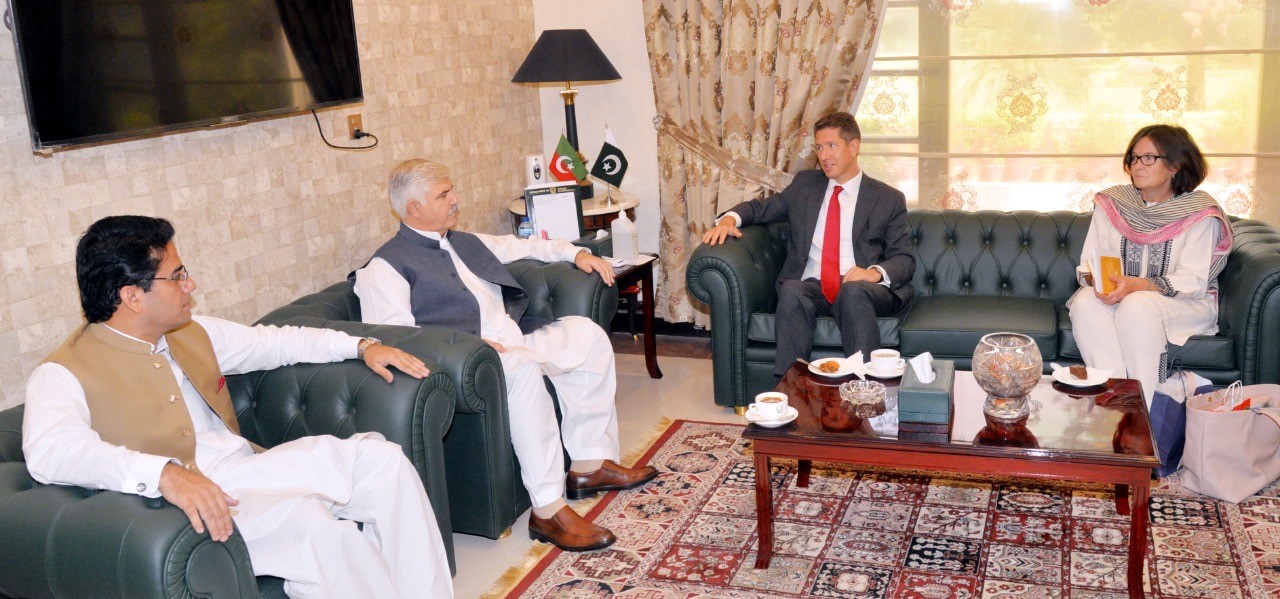
British High Commissioner visits Peshawar to underline UK’s long-standing relationship with Khyber Pakhtunkhwa

Islamabad
24th September, 2020 :
British High Commissioner Dr Christian Turner has visited Peshawar to see how UK aid has been working closely with the Provincial Governmentof Khyber Pakhtunkhwato transform lives.

On his first visit, he met Ministers, parliamentarians, and development experts – discussing how the UK will continue a commitment which has already lasted more than 10 years.

02

The British High Commissioner was joined on his high-level visit with Country Development Director Annabel Gerry.

British High Commissioner Dr Christian Turner, CMG, said:

“The UKwill continue working closely with Khyber Pakhtunkhwa in future to help provide basic services like education and health, and build resilience against things like COVID-19 and flooding.

01

There is a great chance now to secure a more peaceful Afghanistan and this means greater regional trade, and closer connections. We also support inclusion and diversity, working to ensure women are part of the economy and girls have a full 12 years of education”

Dr Christian Turner and Annabel Gerry held meetings with the Chief Minister KP Mehmood Khan and KP Minister for Local Government, Elections and Rural Development Department Kamran Khan Bangash. They also met with a group of Khyber Pakhtunkhwa-focussed development experts.

They also met KP Finance and Health Minister, Taimur Saleem Jhagra, and Lt Gen Nauman Mahmood, XI Corps Commander. They held a meeting with membersof the Khyber Pakhtunkhwa Assembly to discuss political developments in the province, and ended with a visit to Peshawar Museum.

Indian tyranny and public sentiment in IIOJ&K

Iqbal Khan

Security forces deployed by New Delhi have since long been accused of abusing their emergency powers in IIOJK.  Nearly a dozen special emergency laws protect Indian soldiers serving in Kashmir from facing trial in civilian courts, and convictions in military courts are extremely rare. Human Rights watchdogs from all over the world have urged India to revoke these draconian laws giving total impunity to its law enforcing personnel.

In a rare admission of wrongdoing, Indian army confessed on September 18 that its soldiers exceeded their powers during a “fake encounter” operation in Indian Illegally Occupied Jammu and Kashmir (IIOJ&K) that killed three men on July 18,they were buried in remote border area. Actually they were local daily wage labourers.The incident generated outrage in Kashmir, with political groups, rights activists and many residents demanding an independent probe into the deaths.Indian Army spokesman Rajesh Kalia said the soldiers on the operation had “exceeded” their powers and “contravened” the guidelines governing military conduct in Kashmir.”Disciplinary proceedings” would be taken against those responsible, Kalia added.A concurrent police investigation into the killing had yet to establish the involvement of the three men “with terrorism or related activities,” the army statement added.

According to senior journalist and Indo-Pak peace activist Chanchal Manohar Singh, “After almost a year, the resolve of all major political parties in Jammu and Kashmir to reiterate the demand of the implementation of the Gupkar Declaration of August 04, 2019, has finally reflected the signs of dissent against the “unconstitutional” and “unilateral” abrogation of Articles 370 and 35 A. And “Gupkar Declarations proves Kashmir is experimental lab for [Indian] politicians”.

Former IIOJ&K Chief Minster Farooq Abdullah gathered pro India Kashmiri politicians at his Gupkar road residence in Srinagar, to make public their future course of action. Gupkar Declaration IIwas announced on August 22, it wasa follow up to pre annexation Gupkar Declaration I of August 04, 2019.

Farooq Abdullah had presided over the meeting of pro India political parties leading to Gupkar Ion August 04, 2019.Meeting was attended by the representative of:Jammu and Kashmir National Conference;Jammu and Kashmir Peoples Democratic Party;Jammu and Kashmir People’s Conference;Jammu and Kashmir Pradesh Congress Committee;Communist Party of India (Marxist);Peoples United Front; Awami National Conference. All these parties are focused on autonomy of Indian annexed Kashmir within the ambit of Indian constitution. Participants had deliberated on the thenprevailing political situation triggered by massive deployment of security forces, the multitude advisories issued, the abandonment of Amarnath Yatra midway, and forced removal of tourists from the Valley.

It was unanimously resolved: “That all the parties would be united in their resolve to protect and defend the identity, autonomy and special status of J&K against all attacks and onslaughts whatsoever; That modification, abrogation of Articles 35A, 370, unconstitutional delimitation or trifurcation of the State would be an aggression against the people of Jammu, Kashmir and Ladakh; That the parties participating in the meeting resolved to seek audience with the President and Prime Minister of India and the leaders of other political parties to apprise them of the current situation and make an appeal to them to safeguard the legitimate interests of the people of the State with regard to the guarantees given to the State by the Constitution of our country”.They pondered over the unwholesome consequences bound to follow the unconstitutional violation of these guarantees; andresolved to remain together and stand united in their struggle for safeguarding the identity, autonomy, and special status of the State. So far they have kept their word.

However, before they could implement the decision of the Gupkar Declaration I, most of them were thrown in jails or were kept under preventive detention with the abrogation of Article 370. For a year, no political activity was seen in IIOJ&K, except some membership drives by Bhartiya Janta Party (BJP). Many political leaders, including former chief minister Mehbooba Mufti are still under detention, while some, including, Farooq Abdullah, have been released after signing a bond of compliance with the government.

Now on 22nd August, 2020, anew resolution termed Gupkar Declaration-II was circulated in media. This was the first combined statement issued by the political parties after more than a year. Acknowledging the difficulties in bringing out a resolution of all political parties, it stated that the signatories to the Gupkar Declaration-I, “have barely managed to establish basic level of communication with each other” in the face of a series of prohibitive and punitive curbs.

The Gupkar Declaration II enlists three points (demands) only in 122 words: “That all the parties would be united in their resolve to protect and defend the identity, autonomy, and special status of J&K against all attacks and onslaughts whatsoever.That modification, abrogation of Articles 35A, 370, unconstitutional delimitation or trifurcation of the State would be an aggression against the people of Jammu, Kashmir and Ladakh; That the parties participating in the meeting resolved to seek audience with the president and prime minister of India and the leaders of other political parties to apprise them of the current situation and make an appeal to them to safeguard the legitimate interests of the people of the State with regard to the guarantees given to the State by the Constitution of our country”.

The Gupkar Declaration II has cleared its ideology of peace by mentioning that “We don’t believe in bullets and bullet and stone throwing politics”. This is very significant as the Gupkar Declaration has separated itself from those fighting with arms. Farooq Abdullah blamed the Prime Minister for creation of a new chapter of peoples’ alienation in J&K. Every decision is taken at PM level.

Only response to the Gupkar Declaration came from the J&K BJP president Ravinder Raina, who launched a scathing attack on sponsoring political parties, especially the National Conference and the Congress for enacting the instrument of Gupkar Declaration to demand reversal of Abrogation of Article 370. Rana charged that those who want to fight the nullification of Article 370 and demand for the restoration of special status to the erstwhile state are supporters of Pakistan.

Pakistan Foreign Minister Shah Mehmood Qureshi’s stated that the second declaration was “not an ordinary occurrence but an important development”.Reacting sharply to Pakistan hailing the recent Gupkar Declaration II Farooq Abdullah asserted that “we are not anyone’s puppets”. “Pakistan has always abused mainstream political parties of Jammu and Kashmir but now suddenly they like us.”

Gupkar declarations offer nothing to those who are struggling for the right of self-determination for the people of Jammu and Kashmir, their focus is on perpetuating pre August 05, 2019 status of IIOJ&K. However, these declarations indicate that even pro India political elements of IIOJ&K are not ready to reconcile with annexation of IIOJ&K. It is in this context that Pakistan’s foreign minister has termed it as an “important development”.

Notwithstanding the futile political gimmicks in IIOJ&K, tyranny of Indian occupation forces continue to make the life of Kashmiris people miserable. Indifference of international community is neither tenable nor understandable.

The writer is a freelance contributor. E-mail: [email protected]

Stay Connected

64FansLike
60FollowersFollow

Latest Reviews

Exchange Rates

USD - United States Dollar
EUR
1.17
GBP
1.35
AUD
0.67
CAD
0.72