Home Blog Page 300

U.S. and us: the world

U.S. and us: the world

Dr M Ali Hamza

The detention of Maduro is not a dusty historical footnote; it is a live wire in the geopolitics of 2026, offering a potent blueprint for aggression. This sets a catastrophic precedent: sovereign borders and the sanctity of a nation’s leadership are negotiable if a great power deems it necessary. Russia’s ongoing justification for its war in Ukraine, operates on this identical premise. If Washington can plot to remove a leader it calls illegitimate or drug mafia, Moscow argues, then why can’t it dismantle a government it labels a threat? The 2026 news cycle makes this analogy impossible to ignore, paralysing Western moral authority in Global South capitals. For Vladimir Putin, it is a gift allowing him to frame his invasion not as an outlier, but as a mere mimicry of established US playbook tactics; just executed more overtly. Trumps proudly speaking the kidnapping of Maduro did not just expose a mistake, it actively reinforced the very doctrine of unilateral intervention that Russia uses to justify its actions in Ukraine today.

The forceful U.S. operations targeting Venezuelan President Nicolás Maduro including extra-legal capture plots have established a dangerous new global standard. This is not an isolated precedent; it is part of a demonstrable pattern of U.S. aggression now visibly targeting Iran, challenging the very foundation of the international order.

The facts are stark. Following the maximalist “maximum pressure” campaign, which crippled Iran’s economy in a bid to incite popular unrest, the U.S. has aggressively amplified internal Iranian dissent. This is executed by supporting for opposition groups. The goal is transparent: to create conditions of civil strife that weaken the regime from within, mirroring the attempted coercive regime change in Caracas.

This strategy represents a profound challenge to global norms. It moves beyond traditional diplomacy or even sanctions into the realm of hybrid warfare, where sovereign nations are internally destabilized by an external power. The emotional and logical appeal for nations opposing U.S. hegemony, like Russia and China, becomes clear: the international system is not rules-based but might-based. If the U.S. can justify kidnapping a foreign president or fueling riots to topple a government, it legitimizes any powerful state acting unilaterally against its perceived adversaries. The aggression against Iran, therefore, is not merely a bilateral conflict; it is an aggressive assertion that U.S. security interests override the sovereignty of nations, a precedent that destabilizes the world.

The recent diplomatic friction between the United States and Denmark over Greenland’s future is not a minor bilateral dispute, but a revealing tactic of diversion. By publicly floating the idea of purchasing Greenland in 2019 and continuing strategic investment talks, the U.S. creates a controlled, manageable controversy that serves a dual purpose. On the surface, it asserts American hemispheric interests in the Arctic, a region of immense strategic and resource value. However, its deeper function is to redirect global diplomatic attention. While the world focuses on a narrative of U.S. ambition clashing with Danish sovereignty, a clean, sovereign-versus-superpower story, more aggressive and consequential U.S. actions elsewhere face less scrutiny. This “Greenland gambit” provides a smokescreen.

Denmark’s firm, public rejection is essential to this theater. It allows the U.S. to appear checked by a steadfast ally, projecting an image of a system where even small nations can say no. This manufactured drama subtly reinforces a narrative of a rules-based order, even as the U.S. systematically undermines those same rules through extraterritorial kidnappings, hybrid warfare, and unilateral sanctions against nations like Iran and Venezuela. The Greenland discussion is a geopolitical sleight of hand: a loud, symbolic argument over territory that will never change hands, designed to distract from the quiet, real-world erosion of sovereignty that is already underway. It is aggression disguised as awkward diplomacy.

Trump’s persistent campaign to destabilize sovereign states, from orchestrating capture plots against Venezuela’s Maduro to fueling hybrid warfare in Iran, is not a contained strategy. It is a reckless catalyst for global systemic collapse. By repeatedly crossing the red line of sovereignty, Washington is not merely targeting regimes; it is invoking a dangerous and equal reaction from other great powers. This pattern of aggression, presented under the thin veil of democratic promotion, is actively dismantling the very international order it claims to uphold.

The logic is inescapable: if unilateral regime change and internal subversion are legitimized as tools for the West, they become justified tools for all. Russia and China observe these manoeuvres not with alarm, but with a cold calculus of precedent. Moscow’s intervention of Ukraine and Beijing’s increasing engagement in the Asia-Pacific are, in their framing, merely adopting the playbook authored in Washington and London. The emotional resonance for billions in the Global South is a deepening cynicism, seeing not a rules-based order but a law of the jungle where hypocrisy is the only constant.

We are accelerating toward a multipolar war of all against all, where norms are relics and every nation prepares for clandestine intervention or open conflict. The sole responsibility for this descent will lie with the Western allies who are blinded by a crusading exceptionalism, chose to break the system rather than share it. Their short-sighted campaigns in Caracas and Tehran are not securing peace; they are moving the world inescapably toward destruction.
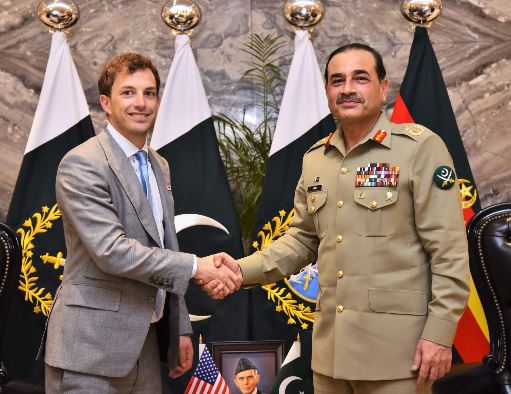
US investment delegation meets Field Marshal Munir

US investment delegation meets Field Marshal Munir

RAWALPINDI, JAN 14 /DNA/ – A delegation of World Liberty Financial USA led by Mr. Zachary Witkoff, Chief Executive Officer of a leading global Fintech firm, called on Field Marshal Syed Asim Munir, NI (M), HJ, COAS & CDF.

The meeting reflected the growing interest of international private investment groups in Pakistan’s evolving economic landscape and also signals rising global confidence in Pakistan’s fintech potential and aims to strengthen financial inclusion and cross border digital finance. Mr Witkoff highlighted the immense economic potential Pakistan holds and lauded the efforts of Pakistan’s leadership in embracing futuristic technologies to realize the full possibilities of its economic prowess.

Field Marshal Syed Asim Munir welcomed the exchange of views and emphasized Pakistan’s commitment to economic stability, investor confidence, and enabling an environment conducive to responsible private sector participation in national development.

Thailand train accident kills 28 at China-backed project

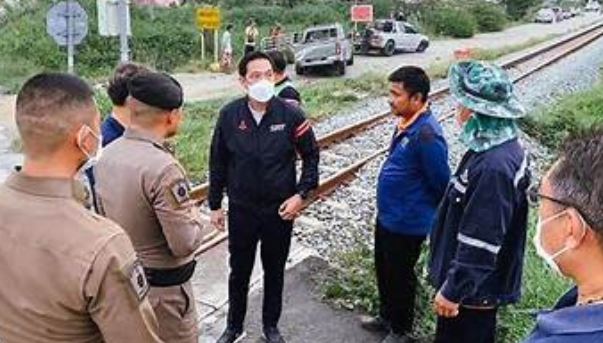
BANGKOK, JAN 14: A crane at a China-backed high-speed rail project in Thailand collapsed onto a passenger train on Wednesday and caused it to derail, killing at least 28 people and injuring dozens more, authorities said.

                  The massive crane’s broken structure was left resting on giant concrete pillars, while smoke rose from the wreckage of the train below, footage from the scene verified by AFP showed.

                  Rescuers worked to extract passengers from the tilted carriages in Nakhon Ratchasima province, northeast of the capital Bangkok.

                  Mitr Intrpanya, who was at the scene, said he heard a loud noise “like something sliding down from above, followed by two explosions”.

                  “When I went to see what had happened, I found the crane sitting on a passenger train with three carriages,” the 54-year-old told AFP. “The metal from the crane appeared to strike the middle of the second carriage, slicing it in half.”

                  The health ministry said in a statement that 28 were killed and 64 people were hospitalised, seven in serious condition.

                  The accident happened at a construction site that is part of a more than $5 billion project backed by Beijing to build a high-speed rail network in Thailand.

                  It aims to connect Bangkok to Kunming in China via Laos by 2028 as part of China’s vast “Belt and Road” infrastructure initiative.

                  – ‘Only company in charge’ –

                  Engineering consultant Theerachote Rujiviphat, an adviser on the high-speed project, told AFP the Thai company contracted to build the section of the high-speed rail where the crane fell, Italian-Thai Development, was solely responsible for its collapse.

                  Theerachote, from the China Railway Design Corporation, said the launching crane that fell onto the existing rail tracks also belonged to Italian-Thai Development.

                  “It is the only company in charge. A similar accident also happened a few years ago under their responsibility,” Theerachote added.

                  A representative for Italian-Thai Development, one of Thailand’s biggest construction firms, said the company could not immediately answer questions from AFP.

                  Thai Prime Minister Anutin Charnvirakul said authorities must determine the cause of the crane collapse and hold those responsible to account.

                  “These kind of incidents happen very regularly,” he told reporters in Bangkok.

                  “I have heard that it is the same company (involved in previous accidents). It is time to change the law to blacklist construction companies that are repeatedly responsible for accidents.”

                  Italian-Thai Development and its director were among more than 20 people and firms indicted in August in a case linked to the collapse of a Bangkok high-rise in an earthquake. The collapse killed around 90 people, mostly construction workers.

                  China’s foreign ministry said Beijing was looking into what happened on Wednesday, and “attaches great importance to the safety of this project and its personnel”.

                  “Currently, it appears that the relevant section is being constructed by a Thai company,” spokeswoman Mao Ning said at a regular press briefing.

                  Mao also extended China’s “condolences for the casualties resulting from the accident”.

                  – Deadly accidents –

                  The Nakhon Ratchasima provincial public relations department said the crane collapsed onto a train travelling from Bangkok to Ubon Ratchathani province, “causing it to derail and catch fire”.

                  Thatchapon Chinnawong, the Sikhio district police chief, told AFP that authorities had resumed the rescue operations after briefly pausing due to “chemical leakage” at the scene.

                  Transport Minister Phiphat Ratchakitprakarn said 195 people were on board the train and authorities were rushing to identify the deceased.

                  Thailand has around 5,000 kilometres (3,107 miles) of railway but the run-down network has long driven people to favour travel by road.

                  Upon completion of the 600-kilometre high-speed railway, Chinese-made trains will run from Bangkok to Nong Khai, on the Mekong River border with Laos, at up to 250 kilometres per hour.

                  In 2020, then Thai prime minister Prayut Chan-o-Cha, who pushed closer ties with Beijing, signed a deal for Thailand to cover all expenditures for the project, while using China-advised technology.

                  Industrial and construction site accidents are common in Thailand, where lax enforcement of safety regulations has led to deadly incidents.

                  In 2023, a freight train killed eight people after it struck a pickup truck crossing railway tracks in eastern Thailand.

Pakistan in talks with multiple countries over fighter jet sales: PM Shehbaz

Pakistan in talks with multiple countries over fighter jet sales: PM Shehbaz

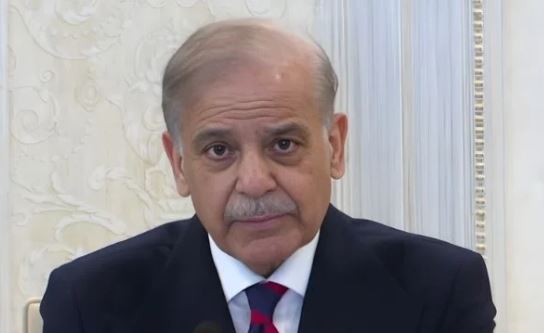
ISLAMABAD: Prime Minister Shehbaz Sharif on Wednesday said Pakistan was holding talks with several countries for the sale of its fighter jets, citing a surge in international demand following the country’s success against India in the May 2025 armed conflict.

“After Pakistan won the war last year, the demand for Pakistani fighter jets has increased […] many countries are actively engaged with us to acquire the jets,” the premier said while addressing a meeting of the federal cabinet.

Minister for Defence Production Raza Hayat Haraj, in an interview with the BBC, had also confirmed that Pakistan was in talks with several countries over potential agreements to sell JF-17 Thunder fighter jets.

The minister said negotiations were underway with multiple states for the export of the multi-role combat aircraft, which has been jointly developed by Pakistan and China.

He added that any agreement would require China’s consent, given its role in the development of the JF-17. “These negotiations are taking place and they take some time. Many countries are interested in these aircraft,” the minister said.

Reuters has reported, citing official sources, mentioning talks with Libya, Sudan, Bangladesh, Indonesia, and Saudi Arabia regarding defence agreements, particularly the sale of JF-17 Thunder jets.

However, Minister Raza Haraj avoided naming any country, saying: “These are classified matters. I cannot name any country or say at what level our talks with them are”.

Pakistan and India went to war in May after India launched an unprovoked attack on Pakistan following the attack on tourists in the Indian Illegally Occupied Jammu and Kashmir (IIOJK).

New Delhi maintains that the terrorists who killed 26 tourists in IIOJK’s Pahalgam were Pakistanis — a charge that Islamabad has denied and has also asked India to partake in a neutral investigation.

Pakistan, during the 87-hour conflict, downed its six fighter jets, including three Rafale, and dozens of drones. The war between the two nuclear-armed nations ended on May 10 with a ceasefire agreement brokered by the United States.

During today’s address to the cabinet meeting, the prime minister said that a memorandum of understanding (MoU) had been signed with World Liberty Financial to explore using World Liberty’s stablecoin for cross-border transactions.

He noted that the agreement would benefit Pakistan’s economy.

PM Shehbaz further said Pakistan had shown significant economic progress in a short period and that economic stability had been achieved, with the government now focusing on growth-oriented measures.

Referring to the security situation, the prime minister reiterated the government’s resolve to completely eradicate terrorism, saying the security forces were fully committed to eliminating the menace.

He added that seven Danish schools were being established in Balochistan as part of efforts to improve education and development in the province.

The prime minister said Pakistan had made notable strides on the economic front and vowed that the government would now accelerate efforts to ensure sustained development across the country.

New Palliative Care Centre opens in Hyderabad with Hungarian support

New Palliative Care Centre opens in Hyderabad with Hungarian support

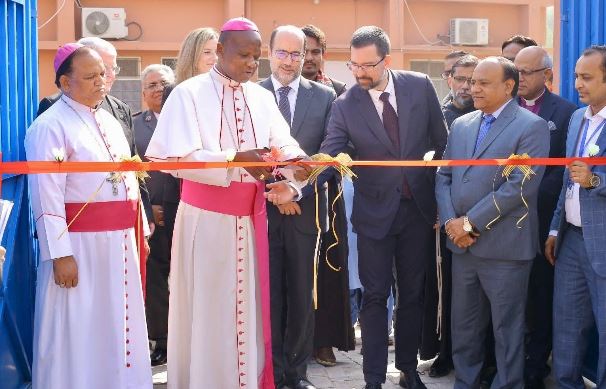
HYDERABAD, JAN 14 /DNA/ – A new Palliative Care Day Centre, offering vital support and comfort to patients, was officially inaugurated at St. Elizabeth Hospital on January 12. The facility was constructed with generous funding provided by the Hungary Helps program.

The inauguration ceremony was attended by a distinguished gathering of dignitaries. The Hungarian delegation included Mr. Márk Aurél Érszegi, Special Advisor for Religion and Diplomacy of the Ministry of Foreign Affairs and Trade of Hungary, and H.E. Dr. Zoltán Varga, Ambassador of Hungary to Pakistan. The Apostolic Nuncio to Pakistan, H.E. Archbishop Germano Penemote, leaders from the Catholic Church in Pakistan and the Church of Pakistan, alongside the Deputy Speaker of the Sindh Assembly, also graced the occasion.

In their remarks, Hungarian officials expressed deep honour at contributing to this critical healthcare initiative. They highlighted their pride that the significant facility bears the name of St. Elizabeth of Hungary, a historic figure renowned for her charity and care for the sick and poor.

The new centre is set to enhance the quality of life for patients requiring palliative care in the Hyderabad region, providing specialized medical, psychological, and spiritual support in a dedicated and modern environment.

PM Shehbaz, Qatar’s Amir discuss bilateral ties, Middle East

PM Shehbaz, Qatar's Amir discuss bilateral ties, Middle East

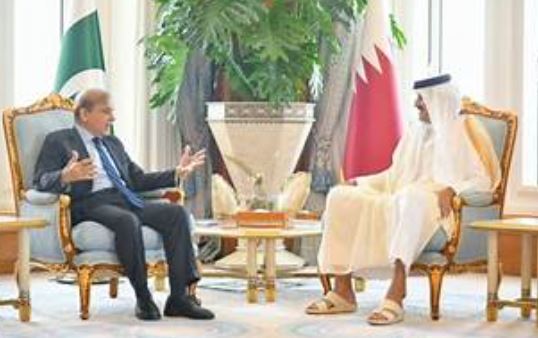
ISLAMABAD, JAN 14 /DNA/ – Prime Minister Muhammad Shehbaz Sharif received a telephone call from His Highness Sheikh Tamim bin Hamad Al Thani, Amir of the State of Qatar, this evening.

During their warm and cordial conversation, the two leaders expressed satisfaction at the current trajectory of bilateral relations between Pakistan and Qatar and reaffirmed their shared resolve to further strengthen these time-tested fraternal bonds.
Recent developments in the Middle East were also discussed.

The Prime Minister appreciated Qatar’s constructive and proactive role in promoting peace, dialogue, and mediation across the region, and acknowledged its meaningful efforts to defuse tensions through diplomatic solutions. He assured the Qatari leadership that Pakistan would also continue to play a positive role in maintaining regional peace and stability.

Both leaders agreed to remain in close contact in the days ahead.

Pakistan appoints new envoys

Pakistan appoints new envoys

Staff Report

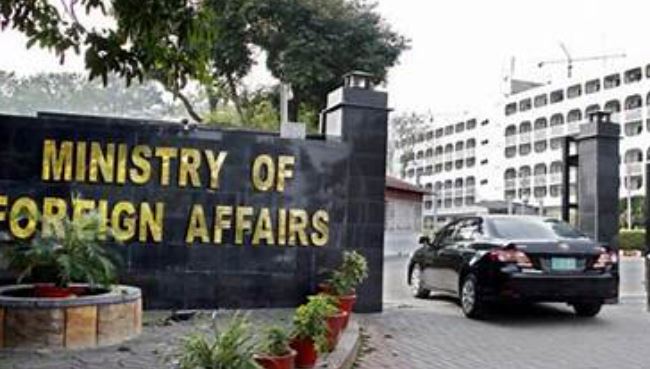
ISLAMABAD, JAN 14 /DNA/ – The Ministry of Foreign Affairs has announced a series of postings and transfers among senior diplomats.

 Imran Ahmad Siddiqi has been designated as Pakistan’s Ambassador to Kabul, while Ubaid Nizamani will take charge in Germany.

Salman Sharif has been posted to Italy, and CP Usman Tipu has been proposed for the London mission. Hasnain Yousaf is set to assume responsibilities in Cuba.

In the headquarters, Ambassador Ayesha Ali has taken over as Additional Secretary for Europe, Sajjad Karim has been appointed Director General South Asia, and Bilal Chaudhry will serve as Director General China.

These appointments reflect Islamabad’s efforts to strengthen its diplomatic presence across key regions and enhance engagement with important partners worldwide.=DNA

===============

Uzbek, Kazakh president to visit Pakistan

Uzbek, Kazakh president to visit Pakistan

Ansar M Bhatti

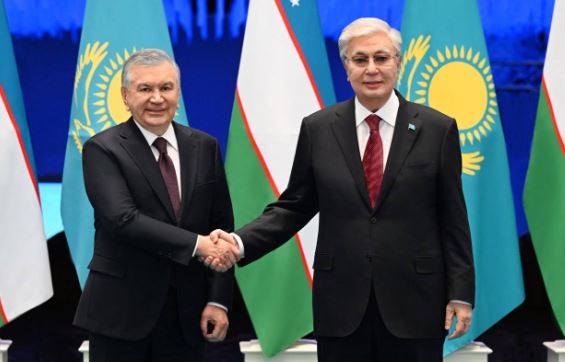
ISLAMABAD: President Shavkat Mirziyoyev of Uzbekistan and Kassym-Jomart Tokayev of Kazakhstan are expected to visit Pakistan in February 2026, with Pakistani sources confirming that preparations are already underway to receive both leaders.

The upcoming visits are being viewed as a significant diplomatic development, as Pakistan enjoys cordial relations with both Uzbekistan and Kazakhstan and has long sought to deepen its engagement with Central Asia.

 Officials in Islamabad believe the visits will provide an opportunity to strengthen cooperation in areas such as trade, energy, connectivity, and cultural exchange, while also reinforcing Pakistan’s role as a bridge between South Asia and Central Asia.

The visit of the two Central Asian presidents is expected to highlight the importance of trilateral cooperation and regional stability, with discussions likely to focus on expanding economic corridors, enhancing transport links, and promoting peace and prosperity across the region.

Pakistani authorities are optimistic that the visits will cement long-term ties and open new avenues of collaboration, underscoring the strategic importance of Pakistan’s partnership with Uzbekistan and Kazakhstan at a time when regional connectivity and economic integration are becoming increasingly vital.

Hockey community unites in condolence during Islamabad training camp

Hockey community unites in condolence during Islamabad training camp

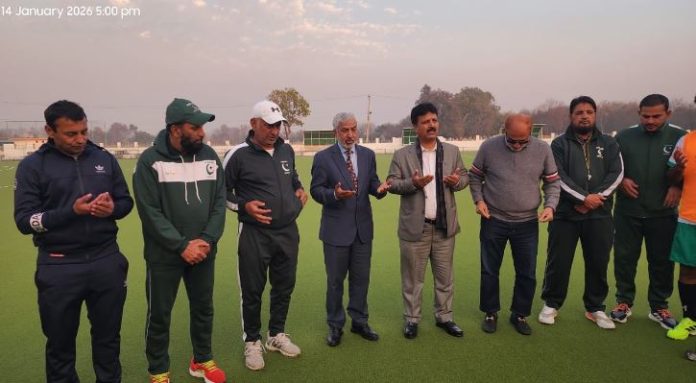
ISLAMABAD, JAN 14 /DNA/ – The hockey community came together in a solemn moment of solidarity during the ongoing training camp at the Naseer Bunda Hockey Stadium in Islamabad. The camp is preparing teams for the second phase of the Pro League.

Players, team officials, and administrative staff offered special prayers for the forgiveness and eternal peace of the late elder brother of Mr. Tariq Hussain Bugti, President of the Pakistan Hockey Federation (PHF). They also extended their deepest condolences to President Bugti and his family on their profound loss.

The ceremony was attended by PHF President Mr. Tariq Hussain Bugti, Secretary General Olympian Rana Mujahid Ali Khan, Pakistan Sports Board officials including Major R. Pirazada, and Rana Nasrullah.

The training camp continues its focus on national team preparations, with the community’s spirit of unity and support providing a backdrop of shared respect and sympathy for their President during this difficult time.

Iran warns neighbours it could strike US bases if Washington intervenes in protests

Iran warns neighbours it could strike US bases if Washington intervenes in protests

TEHRAN, JAN 14 /DNA/ – Tehran has warned neighbouring countries hosting US troops that it would retaliate against American bases if Washington carries out threats to intervene in protests in Iran, a senior Iranian official told Reuters on Wednesday.

Three diplomats said some personnel had been advised to leave the main US air base in the region, although there were no immediate signs of a large-scale evacuation of troops as took place in the hours before an Iranian missile attack last year.

US President Donald Trump has threatened to intervene in support of protesters in Iran, where a rights group claims hundreds have been killed in recent days in a crackdown on the protest movements.

According to an Israeli assessment, Trump has decided to intervene, although the scope and timing of this action remain unclear, an Israeli official said.

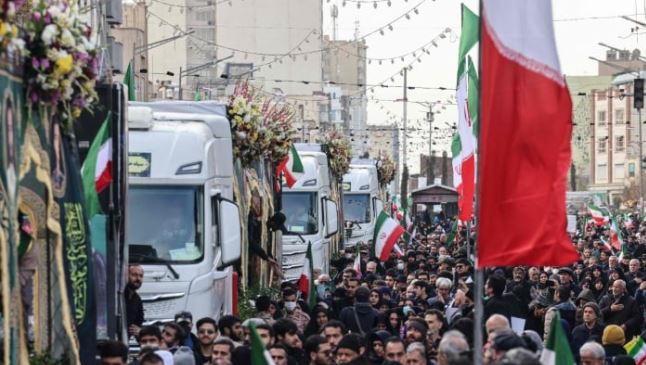
Iranian women hold portraits of Iran’s Supreme Leader Ayatollah Ali Khamenei during the funerals of security forces personnel killed in recent protests in Tehran on January 14, 2026. — AFP
The three diplomats told Reuters that some personnel had been advised to leave the US military’s Al Udeid Air Base in Qatar by Wednesday evening.

One of the diplomats described the move as a “posture change” rather than an “ordered evacuation”. There was no sign of a large-scale movement of troops off the base to a nearby soccer stadium and shopping mall, as took place last year in the hours before Iran targeted the base with missiles in retaliation for US airstrikes on Iranian nuclear targets.

The US embassy in Doha had no immediate comment and Qatar’s foreign ministry did not immediately respond to a request for comment.

Trump vows ‘very strong action’
Trump has been openly threatening to intervene in Iran for days, though without giving specifics.

In an interview with CBS News on Tuesday, Trump vowed “very strong action” if Iran executes protesters. “If they hang them, you’re going to see some things,” he said. He also urged Iranians on Tuesday to keep protesting and take over institutions, declaring “help is on the way”.

The Iranian official, a senior figure speaking on condition of anonymity, said Tehran had asked US allies in the region to “prevent Washington from attacking Iran”.

“Tehran has told regional countries, from Saudi Arabia and UAE to Turkiye, that US bases in those countries will be attacked” if the US targets Iran, the official said.

The official added that direct contacts between Iran’s Foreign Minister Abbas Araqchi and US Special Envoy Steve Witkoff had been suspended, reflecting mounting tensions.

A second Israeli source, a government official, said Prime Minister Benjamin Netanyahu’s security cabinet was briefed late on Tuesday about the chances of government or US intervention in Iran. Israel fought a 12-day war against Tehran last year, which the United States joined at the end.

The United States has forces across the region, including the forward headquarters of its Central Command at Al Udeid in Qatar and the headquarters of the US Navy’s Fifth Fleet in Bahrain.

Iran holds contacts with Turkiye, UAE, Qatar
Iranian state media reported that the head of Iran’s top security body, Ali Larijani, had spoken to the foreign minister of Qatar, and Araqchi had spoken to his Emirati and Turkish counterparts.

Araqchi told UAE Foreign Minister Sheikh Abdullah bin Zayed that “calm has prevailed” and Iranians were determined to defend their sovereignty and security from any foreign interference, state media reported.

Meanwhile, the flow of information from inside Iran has been hampered by an internet blackout, with internet monitor Netblocks saying on Wednesday that the blackout had lasted 132 hours.

“Metrics show #Iran remains offline as the country wakes to another day of digital darkness,” it said in a post on X.

Some information has trickled out of Iran however. New videos on social media, with locations verified by AFP, showed bodies lined up in the Kahrizak morgue just south of the Iranian capital, with the corpses wrapped in black bags and distraught relatives searching for loved ones.

Iranian authorities have accused the United States and Israel of fomenting the unrest, carried out by people it calls terrorists.

Iran’s chief justice urges swift actions
Visiting a Tehran prison where arrested protesters are being held, Iran’s chief justice said speed in judging and penalising those involved in violence was critical to ensuring such events do not happen again.

Judiciary chief Gholamhossein Mohseni Ejei said that “if a person burned someone, beheaded someone and set them on fire then we must do our work quickly”, in comments broadcast by state television.

Iranian news agencies also quoted him as saying the trials should be held in public and said he had spent five hours in a prison in Tehran to examine the cases.

State TV said that a funeral procession would take place on Wednesday in Tehran for more than 100 civilians and security personnel killed in the unrest.

Iranians attend the funerals of security forces personnel killed in recent protests in Tehran on January 14, 2026. — AFP
Pro-government rallies were held in Iran on Monday, a show of loyalist support for the current Iranian rulers. So far, there have been no signs of fracture in the security forces that have quelled other bouts of protest over the years.

While Iranian authorities have weathered previous protests, the latest unrest is taking place with Tehran still recovering from last year’s war against Israel.

Trump told reporters on Tuesday that military action was among the options he was weighing to “punish Iran”.

“The killing looks like it’s significant, but we don’t know yet for certain,” said Trump upon returning to the Washington area from Detroit, adding he would know more after receiving a report on Tuesday evening.

Trump on Monday announced 25% import tariffs on products from any country doing business with Iran — a major oil exporter. The US State Department on Tuesday urged American citizens to leave Iran now.

Tehran called the American warnings a “pretext for military intervention”.

Iran’s UN mission posted a statement on X, vowing that Washington’s “playbook” would “fail again”.

“US fantasies and policy toward Iran are rooted in regime change, with sanctions, threats, engineered unrest, and chaos serving as the modus operandi to manufacture a pretext for military intervention,” the post said.

Stay Connected

64FansLike
60FollowersFollow

Latest Reviews

Exchange Rates

USD - United States Dollar
EUR
1.14
GBP
1.34
AUD
0.70
CAD
0.71