LAHORE — The ‘selected’ PM has failed to solve the problems of Pakistan, said PML-N leader Shehbaz Sharif. He was addressing a press conference in Lahore on Wednesday.
“You made so many promises of developing the nation and bringing the prices down but everyone can see how much progress we have made,” he remarked.
The way things have been running needs to be changed. Otherwise, no one will be able to save Pakistan.
This is the height of injustice. The FIA and IB are active now and innocent people are being ‘harassed’ by the agencies, Shehbaz claimed.
ISLAMABAD, SEPT 23 – President Pakistan Businessmen and Intellectuals Forum and All Karachi Industrial Alliance, and former provincial minister Mian Zahid on Wednesday expressed apprehension that coronavirus can kill globalisation.
After the 2008 global financial crisis the US-China trade war has shaken the foundations of globalisation and the pandemic may be the last nail in the coffin of free-market mantra, he said.
Mian Zahid Hussain said that the concept is getting unpopular among people, US is not ready to play its due role due to financial difficulties, other nations are not well-placed while China is ready to go to any extent to safeguard its interests which can shatter globalisation.
Talking to the business community, the veteran business leader said that many countries have lifted or eased lockdown triggering economic activities but the movement of goods, services, immigrants, capital, services and flow of information may never gain pre-pandemic levels contracting global economy.
He said that the US is discouraging overseas investment and migration while it is pressurising companies to shift their manufacturing back to the US so that the maximum number of Americans can get jobs.
EU, Japan and other countries are also following the suit while India is trying to attract almost 1000 US companies which may leave China. Resultantly, China has also cut investment in the US which will be reduced gradually.
The emerging scenario will make goods and services costly in the developed world while efforts of the developing nations to defeat poverty will get a blow.
Nationalism and protectionism will create a gulf between nations hitting efforts to combat global problems. Many countries may allow trade and migration from only those nations where health similar protocols are followed which will be a doomsday situation for free trade.
He said that China will spend four trillion dollars on Belt and Road initiative (BRI) which has been accepted by 138 countries. Pakistan’s government, policymakers and business community should try to get maximum benefit from the opportunities arising from the Chinese move and adjust to the international market.
ISLAMABAD – PML-N Vice President Maryam Nawaz on Wednesday said that political decisions should be made in the parliament, not at the General Headquarters (GHQ).
Maryam, who was at the Islamabad High Court for a hearing of an appeal against her conviction in the Avenfield property reference, was responding to a question from a reporter about Army Chief Gen Qamar Bajwa and head of the ISI Lt Gen Faiz Hameed’s meeting with key opposition figures.
“I don’t know about a dinner, maybe it was not a dinner [but] I heard about the meeting. From what I understand it was called to discuss Gilgit-Baltistan which is a political issue, an issue of the people’s representatives, for them to solve and deliberate upon.
“These decisions should be made in parliament, not in GHQ,” she said.
When asked whether former prime minister and PML-N supremo Nawaz Sharif was aware of the meeting, she said: “I don’t know whether he was aware of [the meeting] or if he learnt of it later.
“But the political leadership should not be called nor should it go to discuss such issues. Whoever wishes to discuss these issues should come to the parliament.”
Earlier in the week, it emerged that the army chief and the head of the ISI had held a meeting with key opposition figures before their multiparty conference and counselled them to refrain from dragging the military into political issues.
The September 16 meeting was attended by about 15 opposition figures including Leader of the Opposition in the National Assembly Shehbaz Sharif, PPP Chairman Bilawal Bhutto-Zardari, Jamaat-i-Islami emir Sirajul Haq, ANP’s Amir Haider Hoti, JUI-F’s Asad Mahmood, PML-N leaders Khawaja Asif and Ahsan Iqbal, PPP’s Senator Sherry Rehman and a few government ministers.
Railways Minister Sheikh Rashid, while confirming the meeting and its participants in a conversation with Dawn, had said the meeting was held to discuss the impending changes in the constitutional status of Gilgit-Baltistan.
However, the opposition had used this opportunity to flag its concerns about other matters, especially the military’s alleged interference in politics and allegations of persecution of its leaders on the pretext of accountability.
The timing of the meeting and its disclosure was linked by the onlookers to the opposition’s multiparty conference held on Sep 20 in which Nawaz had bitterly criticised the Army, saying there was “a state above the state in the country”.
Rashid had said the army chief clearly told the participants of the meeting that the Army was not in any manner linked to the political processes and had no involvement in matters concerning election reforms and accountability.
The army chief, however, had said the military only responds to calls for assistance by the elected civilian government and it would continue doing so irrespective of who is in office.
Gen Bajwa had reportedly categorically conveyed that no one would be allowed to create chaos in the country.
Speaker National Assembly invited Qatari investors to bring their investments in Pakistan to benefit from the conducive environment for investment in Pakistan
Saifullah/DNA
ISLAMABAD: Speaker National Assembly Asad Qaiser says Pakistan attaches great importance to relations with Qatar and strongly desires to further cement them.
Talking to Ambassador of State of Qatar Sheikh Saud bin Abdul Rahman bin Faisal Al-Thani in Islamabad on Wednesday, he said Qatar has always stood by Pakistan in every difficult hour.
He opined that parliamentary cooperation between legislative bodies of both the brotherly countries would bring them more closer apart from benefiting from each other’s experiences.
The Speaker National Assembly invited Qatari investors to bring their investments in Pakistan to benefit from the conducive environment for investment in Pakistan.
Referring to the CPEC, he said the projects under the umbrella of CPEC will open new horizons for development in the region with creation of new investment and employment opportunities.
He said that cooperation between Pakistan and Qatar in energy sector had helped to meet energy deficit in the country.
Ambassador of State of Qatar Sheikh Saud bin Abdul Rahman bin Faisal Al Thani said that Qatar values its close ties with Pakistan.
He said that his country considers Pakistan, a brother and an important trading partner. He said that Qatar will continue cooperation with Pakistan in all fields.
He informed the Speaker that Qatari investors want to bring investment in Pakistan in all sectors specially energy sector.
He said that Qatar will continue all possible cooperation with Pakistan to strengthen its economy.
He further informed that collaboration in diverse sectors of economy was being actively pursued at state Level from both sides.
By Lieutenant Colonel Khalid TaimurAkram (Retd), Executive Director, Center for Global & Strategic Studies (CGSS), Islamabad
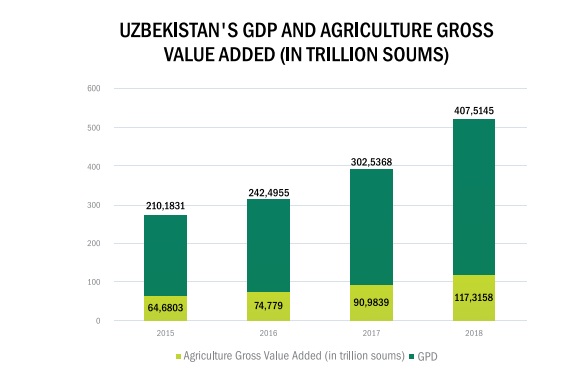
Agriculture is one of the basic and vital sectors of the national economy of Uzbekistan and is considered as a backbone of the social, economic, and cultural development of the country. The agricultural sector in Uzbekistan is not just associated with providing food for the populous, the sector also provides the raw material for the progress and development of various industries. It is crucial in providing employment opportunities for the nation, therefore holds immense significance for the economic development of the country. Being one of the biggest industries, the agriculture sector is one of the top priorities for key reforms in Uzbekistan. The government pays great attention to the progress and development of the agricultural sector and is continuously taking measures to further strengthen and enhance its efficiency.
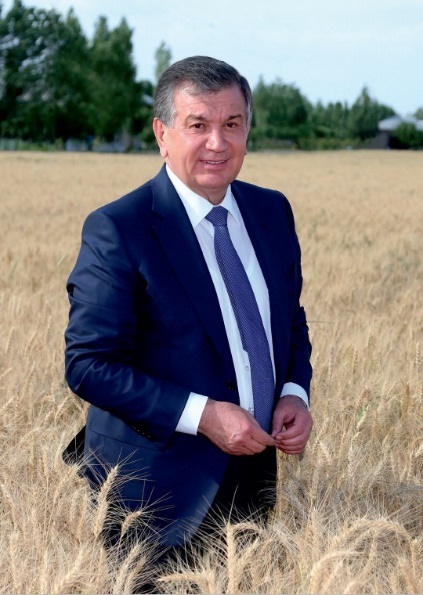
For the development in this extremely important sector, the Government in Uzbekistan under the meticulous and visionary leadership of the President of the Republic of Uzbekistan – His Excellency ShavkatMirziyoyev, has attempted to diversify agricultural policy and is extensively working on to bring radical reforms in the agricultural sector by transitioning into a liberal market economy. Efforts to optimize the effects of the reformed agricultural sector, new agribusiness enterprises, and industrial progress were the key achievements of public policy. As a result of the gradual transition strategy, Uzbekistan created its own expanding agricultural input-output market. To ensure food security in the country, the Government has increased wheat-growing areas and developed wheat production technologies, launched a quota-based system for cotton and wheat producers, reformed land ownership and tenure, and introduced a new type of farmers who acts independently under governmental support. The growing effect of economic diversification is mitigating the risk of the deterioration of the quality of life in the whole region. Over the last two decades, the agricultural sector in Uzbekistan has managed to maintain stable growth constituting an annual 6-7%. To diversify its economy, the country has adopted a more effective and competing strategy to overcome the issues faced by the agricultural sector.
Challenges to the Sector
The agricultural sector in Uzbekistan faces several challenges including population growth, climate change, desertification, deforestation, and scarcity of water for irrigation due to shared rivers among all five Central Asian Republics.The agricultural sector in Uzbekistan has experienced a significant slowdown in the recent past, however, due to progressive policies of the current leadership, the country has managed to raise the impetus for economic and agricultural development.
Food Security
Food security is another important challenge in Uzbekistan. Major factors affecting food security include population growth, low incomes, increased demand for land, water, and energy resources, and increased risk of climate-change-related threats from droughts, flooding, hail, etc. In recent years, as a result of a series of measures to bolster food security in the country, Uzbekistan has strengthened its position in the world, gradually improving its position in the Global Hunger Index for 2018, where Uzbekistan is now ranked 52nd out of 119 countries. However, there remain significant on-going challenges to ensure the stable supply of food for vulnerable segments of the population, increasing the purchasing power of low-income households, and preventing sharp fluctuations in prices and outputs.
High-Cost Low Profit
An important factor in ensuring agricultural competitiveness is the development of more integrated and efficient value chains. The current high costs for collection, transportation, storing, processing, packaging, and certification of products from the field to final consumers significantly reduce the competitiveness and profitability of Uzbek agricultural producers and processes. The low level of development of the food industry limits the capabilities for increasing the volume of production of high value-added products. To attract investment in agri-food market infrastructure there is a need to develop new financial instruments, improve the business climate and design targeted measures aimed at expanding the agri-food processing sector and promoting the development of more integrated and accessible value chains.
Irrigation
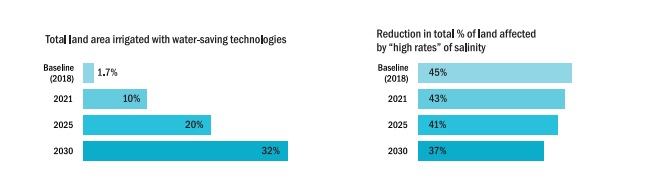
Only 20% of the 20 million hectaresof cultivated agricultural land is currently irrigated. Over the last 15 years, the availability of irrigated land per capita has declined by 24% (from 0.23 ha to 0.16 ha). This is the result of population growth, reduced water supply, and the transfer of agricultural land to other categories of land fund. According to forecasts, over the next 30 years, irrigated land may be reduced by another 20% to 25%.Approximately 80% of the country’s water resources come from transboundary watercourses. The existing water infrastructure is facing challenges however, the government is taking prudent measures to overcome these challenges by reconstructing these facilities and introducing effective policies. Currently, drip irrigation is implemented on only 1.7% of irrigated lands yet water supply expenses are being augmented to adopt water saving technologies.
Reforms
Agricultural development through multidimensional reforms in Uzbekistan underwent series of market-oriented reforms such as the introduction of business activity, different types of land ownership, permit to use natural resources for agricultural businesses, different types of agro-industrial plants, financial and technical support of the government. Multifaceted reforms have led to improvement in all aspects of the life of the population and an increase in economic performance. Crop diversification, yield maximization, and land use optimization frameworks were launched and have been operating in some parts of the country with considerable successes which can be seen in enhanced life quality of the population, market saturation, and ongoing industrial modernization programs. This allowed the diversification of the agricultural sector by developing animal husbandry, poultry farming, fish farming, horticulture, gardening, and beekeeping. Decreasing rate of poverty, quality growth, and economic activeness in people’s life reflects the socioeconomic wellbeing.
To bring a progressive change in the agricultural sector, several important reforms have already been introduced. This includes the abolition of the export monopoly of UzAgroExport which previously controlled all agri-food exports from Uzbekistan and the abolition of the system for the mandatory sale of 25% of hard currency earnings. Due to the introduction of a liberal economic system, today exporters are allowed to keep 100% of the value of their income. Liberalization of the transport service is another important aspect in this regard which has provided the agri-food exporters to use any form of transportation to move their products for export which was previously restricted to using only the national railroad system. to make the trade environment more conducive, the government in Uzbekistan has established a number of “green corridors” at various Uzbek border crossings, to ensure the smooth passage of agri-food products both into and out of the county. Furthermore, the elimination of minimum export prices; the removal of full prepayment requirements for export contracts; and a significant improvement in access to credit for horticulture agribusinesses to invest and modernize all are aimed at improving productivity, quality, and diversity of products grown and traded. All of these changes have significantly improved the efficiency of agri-food trade flows both from and to Uzbekistan.
Cotton Sector
Cotton production is of particular importance in achieving sustainable economic development of the country. It is known that Uzbekistan is one of the leading places in the production and export of cotton fiber. The government has also introduced a commercialization program that promotes the establishment of integrated private sector cotton clusters, and in 2019, these new cotton clusters were responsible for managing over 50% of the cotton-growing areas in Uzbekistan.
Wheat Sector
In the wheat sector, significant reform progress has also been made in recent years, including the removal of the state price subsidy for ‘social’ bread. This inevitably led to an increase in average household expenditures by 4% which was compensated for by the introduction of social measures to support targeted vulnerable households. To stabilize the market, wholesale market prices for flour were fixed in 2018. Subsequently, in 2019, the state wheat procurement price was increased, as part of a gradual policy of closing the gap between state and world market prices to be introduced over the next two years, thereby allowing for full liberalization of the wheat sector by 2022. Most significantly, the government launched a process for the design of a new agri-food development strategy.
Farming
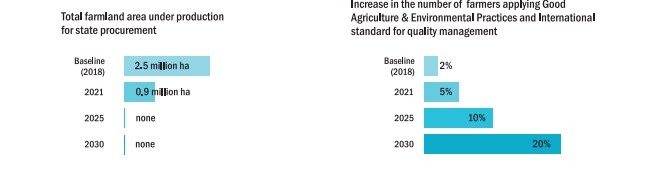
Uzbekistan has strived for self-sufficiency in production and food security fields and the recent trends suggest that the country has been able to achieve this goal. Uzbekistan’s agricultural policy has undergone significant changes after His Excellency Mirzeziyov became the President. The country adopted a more liberal economic approach and abolished state-controlled agricultural enterprises and the collective sector. The farmers were given more liberty by providing ownership to them and above all new technologies were adopted by the government to revolutionize this extremely important sector. Currently, more than 67,800 agricultural farms are operating in Uzbekistan. In the year 2018, 17500 new farms were established in the country and the agriculture sector provided employment opportunities to more than 250 thousand people. Uzbekistan has introduced a system of preferential crediting of agricultural projects and expanded service networks in rural areas. Under this, the government supplies fuel and lubricants, biological and chemical fertilizers, plant protection products, seeds, and others to the farmers.
Horticulture
The share of horticulture in agricultural exports has increased rapidly in recent years. In 2017 horticulture exports rose to 43% and in 2018, to over 60% of total agricultural exports, with much of this export growth coming from non-traditional markets in East and South Asia. This emerging trend signals the beginnings of a very significant opportunity for the agri-food sector which will be further accelerated through targeted policy reforms and the attraction of new investment.
Prime Minister Imran Khan on Wednesday appreciated Turkish President Recep Tayyip Erdogan for “once again raising his voice in support of the rights of the Kashmiri people” during his address to the United Nations General Assembly (UNGA).
“Turkey’s unwavering support remains a source of strength for the Kashmiris in their legitimate struggle for self-determination,” said the premier.
Leader of the Opposition Shehbaz Sharif also expressed gratitude to President Erdogan “for raising the Kashmir issue”. “Kashmiris will remember him as their great friend who advocated their right to self-determination at every forum of the world.”
Erdogan, in his address via video-link on Tuesday, called the Kashmir conflict — which he said was also key to the stability and peace of South Asia — “a burning issue”.
“Steps taken following the abolition of the special status of [occupied] Jammu and Kashmir further complicated the problem. We are in favour of solving this issue through dialogue within the framework of the UN resolutions and especially in line with the expectations of the people of Kashmir.”
Meanwhile, India’s Permanent Representative to the United Nations T.S. Tirumurti called Erdogan’s remarks “gross interference” in the country’s internal affairs.
“Turkey should learn to respect the sovereignty of other nations and reflect on its policies more deeply,” said Tirumurti.
Since Aug 5, 2019, when India illegally merged the occupied territory with it and imposed a communication lockdown as well as a curfew, Pakistan has raised the Kashmir issue three times inside the council with China’s support.
The Indians, however, argue that the merger — although illegal — has ended the disputed nature of occupied Kashmir and therefore it should be removed from the council’s agenda.
Turkey has repeatedly backed Pakistan’s stance on the issue as Prime Minister Imran called attention to India’s actions in occupied Kashmir on international platforms.
In a call with President Arif Alvi in August, Erdogan had assured his country’s support for Pakistan’s stance on the Kashmir issue.
The annual meetings of the United Nations began in New York on Monday with Kashmir on the agenda as an unresolved dispute. In doing so, the world body ignored India’s efforts to remove the 72-year-old issue from the UN Security Council’s agenda for this year.
The current session, which is the 75th session, is unique in the world body’s history with leaders not attending in person and other meetings being held online.
Islamophobia
The president, according to Daily Sabah, said racism, xenophobia, Islamophobia and hate speech have reached an “alarming level”.
“Muslims are the most exposed to these dangerous tendencies fueled by prejudice and ignorance,” he was quoted as saying.
“Those who are primarily responsible for this dangerous course are politicians who turn to populist rhetoric for the sake of votes, and marginal segments who legitimise hate speech by abusing the freedom of expression.”
He reiterated his call for March 15, the day of the terrorist attack perpetrated in New Zealand against Muslims, to be declared by the United Nations as ‘International Solidarity Day Against Islamophobia’.
Palestine
Speaking on the conflict between Israel and Palestine, he said it could only be solved with an “independent, sovereign Palestine with geographical continuity and east Jerusalem as its capital”.
“Countries that voice their intention to open an embassy in Jerusalem only serve to further complicate the (Palestine-Israel) conflict,” Erdogan was quoted as saying. “Turkey will not support any plan that the Palestinian people do not give consent to.”
According to the Turkish daily, Israel’s UN envoy who participated in the UNGA in-person meetings, walked out of the hall during Erdogan’s address.
His comments follow the signing of accords between Israel and the United Arab Emirates and Bahrain in Washington a week ago, which Palestinians view as a betrayal of their cause and a blow to their quest for an independent state in Israeli-occupied territory.
ISLAMABAD”: The embassy of Malaysia may start issuing visas to Pakistani from next year. For the moment the visa service is suspended due to corona virus pandemic.
According to diplomatic sources, a number of Pakistani including businessmen, media people and govt officials were keen to know as to when Malaysia shall start issuing visas.
Sources say according to Malaysian authorities the Corona restriction shall remain in force till December 31, 2020. After that the Malaysian govt will decide as to when to allow foreign visitors.
It may be mentioned here that the PIA is operating from Islamabad to Kuala Lumpur once a week, on every Friday. The frequency of flights is likely to increase after resumption of visa services.
Lahore, September 22, 2020: OLX, Pakistan’s number one marketplace, has introduced an advertising tool to help small and medium businesses in Pakistan to proficiently plan and execute their online marketing campaigns. This new tool named as ‘Self-Serve’, will allow small and medium businesses to promote their products and services to almost 950,000 daily active users visiting the OLX platform, which accumulates to over 12 million users in a month. Reaching out to such a huge audience in the most efficient and cost-effective way can enable these businesses to multifold their revenues by generating new customer leads.
The OLX Self-Serve tool lets SME advertisers flexibly design customized campaigns focused on achieving specific objectives. Besides, it also enables the advertisers to optimally plan their campaigns and tune their efficiency by using filters such as audience targeting, budget range and campaign duration, in a few simple steps. The OLX marketplace currently has 14 diverse classified categories, ranging from mobile phones and electronics to cars, property, home appliances, fashion etc. This helps advertisers target their online campaigns towards the most relevant category as per audience interest.
While speaking about this platform, Farhan Khan, Country Head Sales at OLX Pakistan said, “OLX Self-Serve platform has been designed to assist small and medium scale businesses promote their products and services to a large set of audience without hassle. Through this platform, SMEs will be able to target the right audience, generate leads and expand their business. Our support for these businesses to thrive and prosper using this platform will remain available at all times.”
Smugglers have long been using legitimate cargo to cover their illegal shipments. The high volume of global trade consignment movements makes it particularly hard for Customs and law enforcement officers to spot illicit loads tactfully concealed in an apparently legitimate consignment
A.M.BHATTI
ISLAMABAD: United Nations Office on Drugs and Crime (UNODC) Country Office Pakistan – the World Customs Organization (WCO) and the UNODC Container Control Program (CCP), in partnership with national counterparts Anti-Narcotics Force, Civil Aviation Authorities, and Pakistan Customs inaugurated its 3rd Air Cargo Control Unit (ACCU) at Islamabad Airport. The Unit is tasked to profile inbound and outbound air consignments and identify and stop those that may carry illicit substances.
Smugglers have long been using legitimate cargo to cover their illegal shipments. The high volume of global trade consignment movements makes it particularly hard for Customs and law enforcement officers to spot illicit loads tactfully concealed in an apparently legitimate consignment. To address this challenge, UNODC and World Customs Organization (WCO) developed the Container Control Programme concept and methodology which invests on human resource development and training profiling experts. The aim of the Programme is to bring the best of counterpart agencies together and streamline the focus of the Unit on risk analysis, joint profiling and targeting in an inter-agency setup.
The UNODC-WCO Container Control Programme was initiated in 2004 and Pakistan was among the first countries to join the initiative, with the first unit being established in Karachi seaport. With promising results of the Karachi Port Control Unit, Pakistan volunteered to be the host of the very first CCP Air Cargo Control Unit at Karachi International Airport. Thanks to contributions by the Government of Denmark, Karachi ACCU was established in 2016. Lahore ACCU followed in 2018 with Japan and United States of America being its major donors.
The inauguration of Islamabad ACCU marks the 3rd operational Air Cargo Control Unit in Pakistan after Karachi and Lahore, expanding the initiative to all three major airports of the country. The investments by both Pakistan, international donors, UNODC and WCO in setting up ACCUs started to payoff and show excellent results. In 2019, the Units in Pakistan stopped 40 attempts of narcotics trafficking resulting in seizures of total 128 kg Heroin, 25 kg Cocaine, 303 kg Ketamine and 9 kg Methamphetamines. Most frequent destination of these seizures were United Kingdoms (19 cases), Canada (5 cases) and Malaysia (3 cases).
“The success of the Container Control Programme in Pakistan is a result of the great commitment from national counterparts” said Mr. Jeremy Milsom, UNODC Representative for the Country Office in Pakistan during his opening remarks. “This is a great example where the joint initiative of UNODC and WCO flourishes through national counterparts’ reception, collaboration and appreciation” Mr. Milsom continued.
The event was also a venue to pay a sincere gratitude to the Governments of Japan and the United States of America, the major donors to the establishment of Islamabad ACCU.
H.E Mr. SHINDO Yusuke, Charge d’ Affaires ad interim of Japan to the Islamic Republic of Pakistan in his speech mentioned, “strengthening aviation security to prevent trafficking of illegal items is one of the major challenges not only for Pakistan but other countries as well. Here, I would also like to mention that stability and peace is one of the important pillars of the foreign policy of Japan. The Government of Japan continues to contribute to the stability based on laws and regulations in various countries.”
Other major donors of the Global Container Control Programme include Australia, Canada, Denmark, European Union, Germany, The Netherlands, Norway, and United Kingdoms.
ISLAMABAD, Sep 23 : Pakistan is planning to send around 100,000 skilled workers to Kuwait aims at boosting its remittances, for which a formal request has been made with the authorities concerned in the gulf state, Ministry of Overseas Pakistanis and Human Resource Development (OP&HRD) said on Wednesday.
“A formal request to this effect has been forwarded to the authorities concerned in Kuwait and reply is still awaited,” a senior officer of the ministry told.
Highlighting the ministry’s efforts for increased remittances in the country, he said Pakistan had great workforce potential in all trades and the government was exploring new avenues to create jobs for skilled manpower in different countries.
He said the government had also stepped up efforts for early signing of a Memorandum of Understanding (MOU) between Pakistan and Kuwait for enhancing and streamlining Pakistani manpower export to the country.
Special Assistant to Prime Minister on OP&HRD Sayed Zulfikar Abbas Bukhari had recently held a meeting with Labour Minister of Kuwait on the sidelines of 5th Ministerial Session of Abu Dhabi Dialogue (ADD) to discuss the issues faced by Pakistani workers and urged him to facilitate the Pakistani workers, he added.
To a query, he said Pakistani workers, even without signing of a state-to-state MoU between Pakistan and Kuwait, could go to Kuwait for employment under employer-employee agreement.
The officer said the government had recently signed an agreement with Kuwait to send its healthcare professionals to the gulf country.
He said Kuwait had already agreed to recruit as many as 444 Pakistani medical professionals including doctors, paramedics and nurses. Arrangements in that regard were being finalized to send the skilled workers to Kuwait at the earliest.
The officer said so far, particulars of some 80 medical professionals had been submitted to the Kuwait Embassy for finalization of their visas. “At the moment, we look forward to finalization of some 300 medical professionals’ visas so that a special flight could be arranged for sending them to Kuwait.”