
Home Blog Page 2962

Chinese Vaccine proved safe and effective: Says trial participants

ISLAMABAD, January 27 : Chinese Vaccine proved safe and effective, says a number of Pakistanis who recently went through its clinical trial, China Economic Net (CEN) reported on Wednesday.

The clinical Trials was conducted at solely public sector institution, the University of Health Sciences (UHS) officially approved by the government of Pakistan under strict guidelines of the World Health Organization (WHO).

“After 48 days of vaccination so far, my physical condition is 100 percent fit. My body has not observed any change,” said Mr. Hussain, 54, who is a test subject amongst total of 18000 trial participants who received shots of CanSino during Pakistan’s first-ever massive Phase-III (Last Stage) Clinical Trials.

“There was a bit sporadic feeling of nausea and throat nuisance but it lasted only a few seconds. Throughout the time span, my health stays uncompromised. Physical fitness is up and I am not running a fever or other medical issues,” he says loud and clear.

He appreciated organizers for staying in touch with trail participants seeking feedback to get well-informed about the day-to-day sensitivities of volunteers. “Such practices inculcate a sense of satisfaction among the trail participants that they are not used just as lab subject. This gives a sense that organizers prefer their wellness to other motives,” he added.

Another couple, trial participants, seeking anonymity say that before they were inoculated with China-made CanSino, they were skeptical about the medial impacts of the vaccination under the influence of a barrage of misinformation.

“Later having convinced by other trail participants and seeing healthy results, we prayed to God and got administered the shots. God be praised we are still hale and hearty,” the couple smiled.

UHS is the only state-owned institution in Pakistan that has been conducting the last stage Clinical Trial with participants belonging to different age groups, gender, social strata, and living environment.

The rest of the four are private medical research centers engaged in Phase-III Clinical Trial. They are Agha Khan Medical University, Karachi, Shaukat Khanam Hospital (Lahore), Shifa International Hospital (Islamabad), and Indus Hospital (Karachi).

Debunking myth and neutralizing mist of misinformation about Chinese drugmakers and their vaccines’ performance, Dr. Javed Akram, and Vice-Chancellor of UHS and member of Scientific Task Force on Covid-19 claims in an interview with CEN what has been swirling around to smear Chinese vaccines is a pack of lies.

“So far thousands of shots of CanSino have been administered, not a single case is detected with adverse illness and death,” he added.

About vicious propaganda to downgrade Chinese vaccines in comparison to US and European vaccines, he termed the debate invalid, saying every vaccine has its own merits and demerits and none of them could be given preference to one another. “It is misleading to say that some vaccines either Chinese or Western are unfit for humans,” he added.

When asked about the conspiracy theory that western countries released the vaccines’ results while China is shying away to do so fearing condemnation, he dubbed it all as nonsense, saying none of the drugmakers had made public their final findings of Phase-III Clinical Trial.

Dr. Shaheen Shah, the focal person on Pakistan Phase-III Clinical Trial, which is an essential part of global multi-country and multi-institutional Trials, says that unless peer-review procedure is completed, it is baseless to propagate about any percentage of the efficacy of either Chinese or Western vaccines. Under Good Clinical Practices (GCPs) enforced by WHO and global regulators, it takes more than one year to furnish the final findings, he added.He rubbished the rat race of “who is the best” saying “it is not a matter of China rather a global issue to produce vaccines for the protection of human beings against morbidity and mortality.“Apprehension should not be for vaccine-making techniques.

Matter of grace concern is how to make available vaccine so that each and every person become a recipient of shots without facing any prejudice of regionalism, ethnicity, race and wealth,” he added.

Diffusing another myth, he said that scientifically approved vaccines with all safety rules that carry the seal of global authenticity are yet to be produced and hence are not still in the market. “What is available and is being administered to people in many countries is those varieties of COVID-19 vaccines that are still unapproved by drug regulators but are allowed to market conditionally under Emergency Use Authorization (EUA),” he revealed. Given the global crisis and shortage of time, EUA is the order of the day, he added.

Recombinant Novel Coronavirus Vaccine Adenovirus Type 5 vector (Ad5-nCoV) has been developed by CanSinoBio and Beijing Institute of Biotechnology China.

It merits to mention that globally there is a strong voice to discourage conspirators for whipping up competition between China and other western countries.

In this regard, People’s Vaccine Alliance (PVA) is calling on all pharmaceutical corporations working on Covid-19 vaccines to openly share their technology and intellectual property so that billions of more doses can be manufactured and made available to everyone who needs them. This can be done through the World Health Organization Covid-19 technology access pool, it says.

Foreign Minister addresses the High Level Replenishment Conference

Islamabad27 Jan 2021 : Foreign Minister Makhdoom Shah Mahmood Qureshi has urged the United Nations to address the root causes of conflicts including injustice, inequality and the suppression of the right of self-determination of peoples under foreign occupation, in order to build and sustain global peace. The Foreign Minister made these remarks during the virtual High-Level Replenishment Conference of the UN Peacebuilding Fund (PBF) convened by Secretary General Antonio Guterres on 26 January 2021. PBF is the United Nations’ financial instrument of first resort to sustain peace in countries at risk or affected by violent conflict.
In his video statement, the Foreign Minister underscored Pakistan’s longstanding commitment to UN’s endeavors for peacekeeping and peacebuilding, recalling that over the last 60 years Pakistani troops and police had represented the UN in 46 peacekeeping missions across 4 continents of the world. He also announced a financial pledge as part of Pakistan’s contribution to PBF.

The Foreign Minister stressed that ‘national ownership’ must remain the core principle of peacebuilding and should determine all investment decisions of the PBF. He noted that a major handicap for the developing countries in mobilizing international investment was their inability to prepare commercially viable development projects. To address this issue, he recommended that the resources of the PBF be utilized to support these countries in bringing development projects to a bankable feasibility status. He further suggested that investment for such projects could be sought from other public and private sources, including Multilateral Development Banks as well as Private Equity and Sovereign Wealth Funds.

The High-Level Replenishment Conference took into account the UN Secretary General’s call for a ‘concrete increase’ in financial commitments to support conflict prevention and peacebuilding around the world.

Biden’s Balanced World View

Iqbal Khan

In a time of tumult and a confluence of crises, Joe Biden was sworn in as the president of the United States, at a US Capitol that, according to Jonathan Lemire, “had been battered by an insurrectionist siege just two weeks earlier” declaring that “democracy has prevailed” and summoning American resilience and unity to confront the deeply divided nation’s historic and cataclysmic woes.

Then, according to Associated Press, “taking his place in the White House Oval Office, he plunged into a stack of executive actions that began to undo the heart of his polarizing predecessor’s agenda on matters from the deadly pandemic to climate change”.

As Biden administration pushes forward on the coronavirus front,deadly virus continues to surge and states complain they are running out of vaccine doses.Enhanced production, better distribution and administration of the vaccine are the starting points to control the disease. Easier said than done!

It is heartening that despite domestic pressures, President Biden has orderedhisadministration to support projects to deploy COVID-19 vaccines, diagnostics and therapeutics to people in need around the world. Washington will cease reducing US staff counts at the World Health Organization and will pay its financial obligations to it.

Biden issued a strong repudiation of white supremacy and domestic terrorism seen on the rise under Donald Trump.Biden is the first president to directly address the ills of white supremacy in an inaugural speech.

According to Steve,Republicans are waking up to a Washington where Democrats control the White House and Congress, adjusting to an era of diminished power, deep uncertainty and internal feuding. At the heart of the Republican reckoning lies a fundamental question with no clear answer: Without Trump, what does the modern-day Republican Party stand for? Republicans have just begun to decide whether to continue down the road of Trump’s norm-shattering populism or return to the party’s conservative roots.

Lara Seligman and Bryan Benderhave brought to light a rare fault line of the US state system, regarding Pentagon’s resistance to Biden’s team during transition. “Defence has traditionally been a bipartisan business between and among professionals, and this is terrible optics for those who want to copy this pettiness in the future,” said Mackenzie Eaglen, a fellow at American Enterprise Institute. The effort to block the transition from key national security information is “useless, poor form, and horrible precedent.”According to POLITICO, briefings on some of the pressing defence matters never happened, some were delayed to the last minute, or were controlled by overbearing minders from the Trump administration’s side.

The Pentagon blocked incoming administration from gaining access to critical information about current operations, and the Covid-19 vaccine distribution programme as well. Effort to obstruct was led by senior White House appointees at the Pentagon, which is unprecedented in modern presidential transitions. Biden openly decried it calling it “nothing short, in my view, of irresponsibility”.

Tensions between the Pentagon and the Biden agency landing team emerged almost the moment the General Services Administration authorized the transition to begin in late November after an initial delay following the election. While the military side of— the Joint Staff and the geographic combatant commanders — were more cooperative, the civilian side set up roadblocks at every turn.“They really should not be allowed to get away with this. It’s just completely irresponsible and indefensible,” said one transition official. “To play politics with the country’s national security is just really unacceptable.”Transition “personnel are not government employees and thus limited to some extent on what they can receive,” Gough said. “Membership on a transition team alone is not a license to access confidential, privileged or classified government information.” But people with the transition said the outgoing team’s conduct went far beyond the norm and pointed to loyalists installed by the White House as the main reason for the obstruction.

During a time when the US is vastly divided, Biden’s words felt like the glue to seal it back together.There was no denying the overall sense of solidarity and hope within Biden’s speech. “This is America’s day. This is democracy’s day. A day of history and hope,” President Biden said. “Politics doesn’t have to be a raging fire, destroying everything in its path. Every disagreement doesn’t have to be a cause for total war. And we must reject the culture in which facts themselves are manipulated and even manufactured,” Biden said. “Our history has been a constant struggle between the American ideal that we are all created equal and the harsh, ugly reality that racism, nativism, fear, demonization have long torn us apart. The battle is perennial, and victory is never assured,” Biden added.But the answer is not to turn inward, to retreat into competing factions, distrusting those who don’t look like you do, or worship the way you do, or don’t get their news from the same sources you do. “We must end this uncivil war that pits red against blue, rural versus urban, conservative versus liberal”. “We can do this if we open our souls instead of hardening our hearts.If we show a little tolerance and humility.If we’re willing to stand in the other person’s shoes just for a moment.

Biden has kept his word. His spending proposal sets aside $400 billion to address Covid-19; $1 trillion in direct relief to families and individuals; and $440 billion to help communities and businesses hit the hardest by the pandemic. The proposal envisages: Topping up the $600 cash relief passed by Congress last month with $1,400 payments additionally;A hike in unemployment benefits from $300 to $400 per week through September;Fourteen weeks of paid sick and family and medical leave;A rise in the national minimum wage to $15 per hour;$160 billion earmarked for a broad range of programmess, including Covid-19 vaccination, testing, therapeutics, contact tracing and personal protective equipment;$170 billion for schools.It is an unabashedly progressive agenda that the left has been trying to advance for decades.

At least for the moment, the old ways are back: reverence of custom, rituals dating back two centuries, scenes of grace, calls for unity. Four years after Trump’s dark portrayal of “American carnage,” Biden set out his intent on the same platform of the flag-bedecked Capitol to write “an American story of hope,” Calvin Woodward writes.

Writer is a freelance contributor; e-mail: [email protected]

Commission On Science And Technology For Sustainable Development

CCCS-NMC Webinar 1 (1)

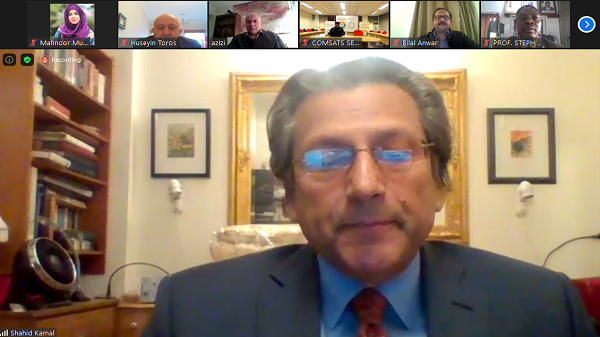
Islamabad,  27 Jan2021 : Integrating mathematical modeling and simulation in research could aide formulate climate change related policies at national and international levels to better deal with changing climate conditions. Such recommendations constituted the core of the deliberations of an international webinar of the Commission on Science and Technology for Sustainable Development in the South (COMSATS) held within the framework of Sustainable Development Goal 13 (SDG13 – Climate Action) titled: “Modeling and simulation on climate change and environmental pollution: Strengthening resilience in the Global South”

Organized by COMSATS Centre for Climate and Sustainability (CCCS), the event brought together intellectual inputs, ideas, experience, best practices and policy advice from Ghana, Iran, Nigeria, Pakistan, and Turkey. The event was held in collaboration with its Centre of Excellence on mathematical sciences, modelling and simulation – the National Mathematical Centre (NMC), Nigeria.
Moderated by Mr. Bilal Anwar, General Manager, Commonwealth Climate Finance Hub, the webinar highlighted the role of modelling and simulations in evidence-based knowledge to formulate policies and legislation to help reduce carbon emissions and increasing adaptation efforts in the Global South.
Addressing at this occasion, Dr. S.M. Junaid Zaidi, said that Commission through continuous support of the Chairperson of the Commission—- President of Ghana, who has been keen for development of Science and Technology, not in Ghana but all also in members states of the Commission having its membership for 27 countries from three continents including Africa, Asian and Latin America.
Mutlistakeholder partnerships, integrated approaches, mitigation and adaption strategies were recognized as the need of the hour to overcome the impacts of climate change in the Global South in terms of floods, heat waves, food security and extreme weather conditions.

First information platform launched for Pakistan-China agriculture

BEIJING, Jan.27 : The first information platform for China-Pakistan agricultural and industrial cooperation was launched, echoing the priority agenda of the second phase of CPEC, which is Pakistan’s agricultural and industrial development and improvement of social welfare.

Jointly initiated by China Machinery Engineering Corporation (CMEC) and China Economic Net (CEN), the platform will serve as a bridge between Pakistani and Chinese enterprises to enhance B2B cooperation.

According to Gwadar Pro, it will provide the latest news, research findings, and products in agricultural and industrial sectors, and share investment and cooperation opportunities for potential partners.

The platform, relying on its offline organization Pakistan-China Agriculture Corporation Exchange Center (PCACEC), will also organize forums, match-making meetings, and exchange activities for Pakistani and Chinese enterprises looking for business cooperation.

Addressing the launching ceremony, Chinese Ambassador to Pakistan Nong Rong said further agricultural and industrial cooperation between China and Pakistan will produce mutual benefits and win-win results for both countries.

He noted that the year 2021 marks the 70th anniversary of the establishment of China-Pakistan diplomatic relations. Over the past seven decades, the two countries have always been trusting and supporting each other regardless of the ever-changing international and regional landscape.

“We stand ready to take this opportunity to work with the Pakistani government and people to enrich and deepen the all-weather strategic cooperative partnership and continue to advance CPEC construction to bring more benefits to the two peoples.”

Pakistani Ambassador to China Moin ul Haque said the platform was important and momentous as Pakistan and China are celebrating the 70 years of establishment of diplomatic ties.

He thanked the Chinese government and enterprises for their support to Pakistan in the agriculture sector and looked forward to the role of the platform in facilitating Pakistan’s endeavour in agricultural and industrial modernization.

Chairman of CPEC Authority Lt Gen (r) Asim Saleem Bajwa hailed the inauguration of the Information Platform as a “historic event”. He said, “it couldn’t be a better time to initiate the program when we are now entering into a digital era and the Pakistani government is embarking on a reform in the agricultural sector, expecting to learn from China’s experience and technologies to improve the added value of agricultural products.”

Asim also acclaimed the achievements of the early harvest programs of CPEC, saying the agricultural development is gaining momentum due to the solid foundation laid in the first phase of CPEC.

On behalf of Pakistani Foreign Minister Shah Mahmood Qureshi, Director-General (China) of MoFA Muhammad Mudassir Tipu said, agricultural cooperation between China and Pakistan will promote the productivity of industries in both countries.

“In my recent exchanges with the Chinese Foreign Minister, I learned that the governments of the two countries attach great importance to the agricultural cooperation and further development of CPEC.

To this end, relevant departments of Pakistan, such as the Ministry of Agriculture, the Ministry of Foreign Affairs, and Chinese partners, have taken a series of efforts and measures,” Tipu said, quoting the Minister. “I hope the information platform can further utilize the respective advantages of China and Pakistan to further promote the development of CPEC.”

As one of the founders of the Platform, CMEC has a deep understanding of the Pakistani market and its development in the past four decades, a long time span CMEC has endured since it entered the country in the 1980s.

“Pakistan is a traditional agricultural country, but there is still a gap between its overall agricultural development and that of the international.

Therefore we established the Pakistan-China Agricultural Cooperation and Exchange Center in the first place in 2019 and now the Information Platform, in a wish to vitalize cooperation between the enterprises and research institutions of the two sides and promote Pakistan’s development in agriculture,” Li Kan, Assistant to General Manager of CMEC said at the occasion.

The representative of the Ministry of Agriculture and Rural Affairs of China Li Kaihang, while having reviewed the trajectories of agriculture cooperation between Pakistan and China, pointed out the two countries can further extend the cooperation to the sectors of crop varieties breeding, aquaculture technologies, agricultural products processing, and talents training etc.

He stressed the role of enterprises as a mainstay in the cause of Pakistan’s agricultural development.

Deputy Director-General of the Department of International Cooperation of CAAS Ms. Ke Xiaohua made a comprehensive review of Pakistan-China joint agricultural research programs, of which CAAS has undertaken the majority.

As per the introduction, CAAS has cooperated with Pakistani institutes, universities, and government departments to join the establishment of the China-Pakistan Joint Laboratory for Cotton Biotechnology,  the “Sino-Pak Hybrid Rice Research Center”, and the Pakistan-China Center for Sustainable Management of Plant Pests.

As China’s major organization for agricultural international cooperation, CAAS is committed to contributing more to Pakistan in the areas of biotechnological breeding, plant protection, animal disease prevention and control, and agro-product processing.

Experts from the agricultural sector, including Prof. Dr. Iqrar Ahmad Khan, Former Vice-Chancellor of the University of Agriculture, Faisalabad, Liu Guodao, Vice President of Chinese Academy of Tropical Agricultural Sciences, Liu Hanwu, Representative of China Agricultural Association for International Exchange, and representatives from enterprises.

Coronavirus kills 74 more, infects 1,563 in Pakistan

ISLAMABAD : The coronavirus claimed 74 more lives as another 1,563 people tested positive for the deadly disease during the past 24 hours across Pakistan.

According to the latest update released by the National Command and Operation Centre (NCOC), 1,563 new infections surfaced after 41,285 samples were tested.The total number of confirmed Covid-19 cases in the country has soared to 537,477 with addition of the fresh infections while the countrywide death toll jumped to 11,450. There are a total of 33,820 active cases.

Since the first Covid-19 case was detected in the country almost a year back, Sindh has reported a total of 242,793 infections, Punjab 155,214, Khyber Pakhtunkhwa 65,953, Balochistan 18,765, Islamabad 40,972, Azad Jammu and Kashmir 8,877, and Gilgit Baltistan 4,903.

Global cases surpass 100 million

Global coronavirus cases surpassed 100 million on Wednesday, according to a Reuters tally, as countries around the world struggle with new virus variants and vaccine shortfalls.

Almost 1.3% of the world’s population has now been infected with COVID-19, the disease caused by the novel coronavirus, and more than 2.1 million people have died.

One person has been infected every 7.7 seconds, on average, since the start of the year. Around 668,250 cases have been reported each day over the same period, and the global fatality rate stands at 2.15%.

The worst-affected countries – the United States, India, Brazil, Russia and the United Kingdom – make up more than half all reported COVID-19 cases but represent 28% of the global population, according to a Reuters analysis.

Pakistan opposes new permanent seats in UNSC

NEW YORK, JAN 26 (DNA) – Pakistan has opposed the creation of new permanent seats in the United Nations Security Council (UNSC).

Addressing the first meeting of Intergovernmental Negotiations Framework during the seventy fifth session of the UN, Pakistan’s Permanent Representative at the world body Munir Akram said creation of new permanent seats will make the Security Council less representative, less effective, more divided and erode the principle of sovereign equality of states.

“The Inter-Governmental Negotiations (IGN) remains the only credible platform for a comprehensive reform of the Security Council,” Ambassador Munir Akram said, while re-affirming that Pakistan’s strong opposition to creating new permanent members.

“Any attempts to undermine or derail the IGN process will prove counterproductive,” the Pakistani envoy said when the long-running IGN process resumed in New York on Monday.

Having failed to evoke support for their bid for permanent membership of the Council, he said that the G-4 members were trying to create the ‘fear’ that the opportunity for reform may soon be lost unless their procedural moves to short circuit the process were endorsed.

“We are prepared to breathe new life in the IGN but some states are bent upon killing the process,” Ambassador Akram said.

Full-scale negotiations to reform the Security Council began in the General Assembly in February 2009 on five key areas the categories of membership, the question of veto, regional representation, size of an enlarged Security Council, and working methods of the council and its relationship with the General Assembly.

Despite a general agreement on enlarging the Council, as part of the UN reform process, member states remain sharply divided over the details.

The G-4 have shown no flexibility in their push for expanding the Council by 10 seats, with six additional permanent and four non-permanent members.

On the other hand, the Italy/Pakistan-led Uniting for Consensus (UfC) group opposes any additional permanent members, saying it would make the Council less representative, less effective and more divided and will diminish the right of the vast majority of the UN membership to serve on the Council.

On its part, UfC has proposed a new category of members not permanent members with longer duration in terms and a possibility to get re-elected.

The Security Council is currently composed of five permanent members Britain, China, France, Russia and the United States and 10 non-permanent members elected to serve for two years.

In his remarks, Ambassador Akram said that the UfC proposal to add 11 new non-permanent seats would redress the ‘deficit’ of equitable representation in the Security Council, as it accommodates the interests of all groups.

In 1945, he said, the Council represented 20% of the membership of the United Nations today, it represents 8% of the membership. In 1945, there was one non-permanent seat for 8 member states today, there is one non-permanent seat for 19 member states.

A third of the UN members have never served on the Council Saint Vincent and the Grenadines, for example, is only the second Small Island Developing State (SIDS) to ever serve on the Council, it was pointed out.

The Pakistani envoy said UfC’s proposal can accommodate the aspirations of the African Group, the SIDS, and the Arab Group, & the OIC. The G-4, he said, was unlikely to apply Africa’s regional approach to their own regions.

The consensus-based African model is anchored in the twin imperatives of ‘representation’ and ‘accountability’, he pointed out.

Pakistan and the UfC are keen to build on the progress made during IGN’s previous sessions, Ambassador Akram said, adding that it was only through dialogue and consensus that a solution, enjoying the widest agreement of member states, could be achieved.

“We are ready and willing to work with you to promote this objective,” the Pakistani envoy said. = DNA

===================================

AIOU establishes facilitation desks for disable people

ISLAMABAD, JAN 26 (DNA) – Allama Iqbal Open University(AIOU) has established a facilitation desk at the main campus of the university to facilitate disable students so that they may not face any difficulty while applying for admission, degree/certificate or performing any other routine academic activity at the university.

Rana Tariq Javed, Director, Directorate of Students Affairs and Counseling Services has informed that the university has established this facilitation desk on the special directives of Prof. Dr. Zia Ul-Qayyum, Vice Chancellor, AIOU.

He further added that workers from his department will provide special assistance to these people and the Directorate has provided a wheelchair in the information lobby to support them. Such facilitation desks will also be established in the regional offices of the university, he informed.

It is pertinent to mention here that university provides special financial assistance to disable people to get education from the university. In order to avail this facility, disable students are advised to contact their respective regional offices for further guidance. = DNA

======================

Direct flight from Islamabad to Kyrgyzstan start

Ambassador of Kyrgyzstan to Pakistan while talking to daily Islamabad Post termed the move significant adding direct flight shall promote business and tourist activities between the two countries and Central Asia also

Ansar Bhatti

ISLAMABAD: Pakistan International Airlines (PIA) has started direct flight from Islamabad to Bishkek, Kyrgyzstan. The flight shall operate on weekly basis. Earlier another Central Asian Country Uzbekistan had direct flight from Lahore to Tashkent.

The direct flight from Islamabad to Bishkek shall be chartered in the beginning and may be run as commercial flight later on.

The estimated round trip fare for Bishkek shall be USD 600, which shall considerably be reduced once regular commercial flights start operations.

Ambassador of Kyrgyzstan to Pakistan while talking to daily Islamabad Post termed the move significant adding direct flight shall promote business and tourist activities between the two countries and Central Asia also.

It may be mentioned here that people wishing to visit Central Asian states, can now utilize this route.

Stay Connected

64FansLike
60FollowersFollow

Latest Reviews

Exchange Rates

USD - United States Dollar
EUR
1.17
GBP
1.35
AUD
0.72
CAD
0.73




