
Home Blog Page 2960

Azerbaijani FM: Armenian armed forces continue to grossly violate the agreement on a humanitarian ceasefire

DNA

BAKU, OCT 11 – Azerbaijan’s Foreign Ministry has issued a statement on Armenia’s violating the agreement on a humanitarian ceasefire.

“Despite the agreement reached during the meeting of the Foreign Ministers of the Republic of Azerbaijan and the Republic of Armenia in Moscow with the mediation of the Russian Federation, to observe a humanitarian ceasefire from 12:00 pm on October 10, 2020, the Armenian armed forces continue to grossly violate the agreement.

Immediately after the establishment of a humanitarian ceasefire, the Armenian armed forces fired on Aghdam and Tartar regions of Azerbaijan. A few hours later, Armenian armed forces tried to attack in the direction of Hadrut and Jabrayil.

A medical worker was seriously injured as a result of the shooting by the Armenian armed forces of a sanitary medical vehicle, clearly marked with a white flag, collecting the bodies of Armenian soldiers in the area of Sugovshan.
Capture 7

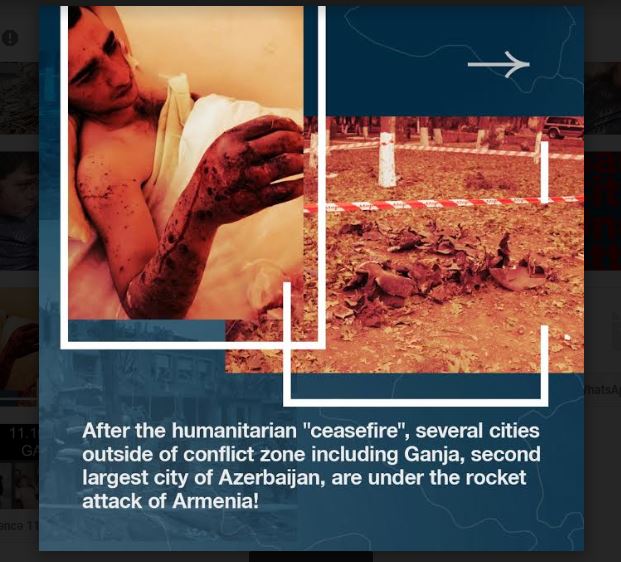
On the night of October 11, Ganja, the second largest city in Azerbaijan and far beyond the frontline, came under rocket fire by the Armenian armed forces. The attack killed seven civilians and injured 39 others, including minors.

The shelling of civilians and cities by the Armenian armed forces after the humanitarian ceasefire agreement is another clear example of barbarism and shows that the ceasefire calls of the Armenian leadership are nothing but hypocrisy.

Armenia’s deliberate firing on civilians, homes, civilian objects and medical personnel as part of its aggressive policy against Azerbaijan once again demonstrates the country’s disregard for fundamental norms and principles of international law, including international humanitarian law and the Geneva Conventions, as well as shows that it is clearly violating its obligations and is far from the principles of humanism.

We strongly condemn these acts of aggression by Armenia and call on the international community to take decisive steps to force the aggressor Armenia to comply with international law and its international obligations.

The full responsibility for the situation in the region lies with the Armenian political and military leadership.”
FEBR wants concrete measures to win investors’ confidence as FDI declines 37%

DNA

KARACHI, OCT 11 – Raising serious concern over the falling trend of foreign direct investment the Friends of Business and Economic Reforms (FEBR) has asked the government to win the confidence of foreign investors amidst deteriorating economic state of affairs in the country, as Foreign Direct Investment (FDI) has declined by 37 percent in Aug 2020 when compared with the corresponding month of 2019.

FEBR President Kashif Anwar, in a statement issued here on Sunday, observed that the FDI volume for Aug stood at $102.9 million against the level of $164.3 million recorded last year but the alarming thing is that the trend is not limited to just one month, as it has experienced a 23 percent cut in July and August – the first two months of the current financial year 2020-21.

According to reports, further bifurcation of this amount reveals that the actual new investment in private sector by foreign investors was $150 million, representing a decrease of $47.9 million against the corresponding period last year. On the other hand, the foreigners invested $59.8 million in government bonds and T-Bills (treasury bills) which is again a 16 percent reduction. Pakistan had reopened its economy from the lockdown for a long time and majority of the sectors in manufacturing and almost entire agriculture sector are operational now.

Kashif Anwar said that foreign direct investment figures of the previous year reflected the same poor scenario, which plunged to a nine-month low at $73.4 million in July 2019. The FDI was 59% lower than the $178.9 million received by different sectors of the economy, particularly construction and power, in the same month of previous fiscal year. The FDI had dropped to half at $1.66 billion in the last fiscal year compared to investment of $3.47 billion in FY18.

The FEBR President said that Pakistan has succeeded to improve its balance of payments with record remittances in FY20 while the FDI witnessed 88% growth last year. China has been the leading investor in Pakistan for few years and was a major contributor to the increase in the size of FDI in 2019-20. However, the new fiscal FY21 may drag down the inflows from elsewhere due to slowdown of economies in the developed countries, he warned.

Kashif Anwar said that Pakistan has remained a potential market for foreign investors, who still have plans to make fresh investment in the country, but they have continued to wait for the return of economic stability. He highlighted uncertainty in the rupee-dollar parity as one of the major concerns of foreign investors. He said that the central bank let the local currency depreciate by 47% to Rs168 against the US dollar during last two years.

He said a slowdown in the economy had badly impacted business confidence. It is must for the authorities concerned to first create an enabling environment for the local businessmen desiring to make new investment. According to reports, China has remained the single largest investor in Pakistan over the last couple of years. It has been mainly investing in power projects under its flagship and multi-billion dollar China-Pakistan Economic Corridor projects.

Mian Nauman seeks growth-friendly policies in consultation with stakeholders for sustainable development

DNA

ISLAMABAD, OCT 11 – The Pakistan Industrial and Traders Association Front (PIAF) Chairman Mian Nauman Kabir has said that Pakistan’s total debt and liabilities skyrocketed to around Rs36.3 trillion, which were rising at a high speed in the wake of a soaring budget deficit.

PIAF chairman Mian Nauman Kabir, in a joint statement with senior vice chairman Nasir Hameed and vice chairman Javed Siddiqi, said that Pakistan’s fiscal policy continued to focus primarily on macroeconomic stabilization instead of putting more emphasis on reforms to foster long-term growth through industrialization. He sought growth-friendly policies, upgraded tax and social spending, and active industrial strategies in close consultation with real stakeholders to achieve sustainable development goals.

Mian Nauman Kabir opposed the excessive borrowing policy of previous governments, as the present government has also added an additional Rs11.35 trillion in the total public debt during the first two years in power, which is more than the total debt the previous government has taken in its five-year term.

He observed that over 40 percent of the additional debt in the past two years is only because of debt servicing expenditures while about 30 percent due to rupee devaluation, which was depreciated almost 47 percent during this period. He flayed the economic managers for keeping the interest rate artificially high at 13.25 percent during this period, besides devaluing the rupee more than the requirements, contributing most to lift the public debt.

The PIAF Chairman lamented that if nation today decides to retire all its public debt, it would have to give up almost 87 percent of its gross domestic product, which is presently standing at Rs41.7 trillion, also indicating that government has violated the Fiscal Responsibility and Debt Limitation Act, which calls for limiting the debt to below 60 percent of the GDP.

PIAF senior vice chairman Nasir Hameed said that the external debt has increased by 54 percent to Rs13 trillion in the last two fiscal years, which were about Rs8.5 trillion at the end of the previous govt tenure, witnessing a net increase of Rs4.6 trillion in the external debt, mainly owing to currency depreciation and current account deficit financing. This external debt doesn’t include loans of $5 billion obtained from Saudi Arabia and the United Arab Emirates in this period, as these loans are the responsibility of the central bank.

He said that the government total domestic debt increased to over Rs23 trillion, up by 41.4 percent or Rs6.8 trillion in the last two fiscal years from domestic debt of Rs16.4 trillion reported in 2018.

PIAF vice chairman Javed Siddiqi said that the accumulation of debt is a direct result of the gap between expenditures and revenues, which is widening due to the inelasticity of debt servicing and the FBR failure to enhance revenue collection. Steep currency depreciation also contributed to the central government’s debt. The FBR suffered a record shortfall of around Rs1.55 trillion in tax revenues in the last fiscal year but the government did not hold anybody accountable. In just two years, the total public debt surged to 87 percent of the GDP from almost 72 percent of the GDP, which is very shaky, carrying huge risks for the economy and the country’s foreign policy.

The PIAF leadership called on the authorities to strengthen fiscal discipline through additional revenue measures especially of exports, besides efforts to contain current expenditure while protecting pro-poor spending.

Mian Nauman Kabir said that exports of goods and services are an injection into the circular flow of income leading to a rise in aggregate demand and an expansion of output, helping raise per capita incomes and reduce extreme poverty especially in developing economies like Pakistan.

Zubair Motiwala lauded endeavors for enhancing ease of doing business across the border

DNA

ISLAMABAD, OCT 11 – PAJCCI has been persistently following up improvements in bilateral trade and transit regime and presented a comprehensive draft of proposal to Special Task Force of National Assembly  that also highlighted disturbing issues hampering ties, especially amid COVID 19.

Chairman PAJCCI greatly welcomed the efforts of the task force in facilitating the ease of doing business and considering the recommendations presented by PAJCCI in this context. He highly welcomed the recent announcement of abolishing SRO 475 (5) that required marking of “In transit to Afghanistan”, which was one of the most pressing demands by PAJCCI lately.

He stated that this requirement was valid when loose cargo was in the movement, however, now as cargo is containerized having seals of shipping and customs, therefore this condition not only delayed the process but created undue distress.

He also instated that PAJCCI’s recommendation of operationalizing multiple border crossing points was also met with acceptance and recently fully rebating Ghulam Khan border and activating Angoor Ada and Kharlachi are endeavors in the right direction which would surely establish the trust across border and will help improving trade graph drastically.

Another important proposal that was also executed was abandoning the requirement of 100% scanning applied to transit amid COVID 19, which has not only created the backlog, but has caused significant financial loss due to time delays and wastage of perishable goods kept for longer duration due to this requirement. He showed confidence that other significant matters like waiver of detention and demurrage amid COVID 19 and revisiting APTTA and PTA draft will also be resolved soon, keeping in view the persistence and commitment of the task force in this regard.

Zubair Motiwala believes that the recent visit of H.E. Abdullah Abdullah and the subsequent planned visit from Pakistan shortly will enhance the confidence across the border and trade quantum with Afghanistan will soon surpass the past positive indicators. He welcomed the new visa regime announced for Afghanistan by Pakistan after the visit of H.E. Abdullah Abdullah and hope for the reciprocity. He staunchly believed that the results of these meetings will surely bring the positive outlook and strategic framework will be developed on an urgent basis to help stakeholders recover from the resulting devastating effects. He mentioned that Afghanistan is the only country with which Pakistan enjoys trade surplus and this trust deficit will critically affect economy of Pakistan more than Afghanistan, hence these issues must be sorted out on priority basis as Pakistan’s efforts in reaping potential benefits in Central Asia can only be substantiated by prioritizing resolution of Af-Pak trade and transit issues.

Motiwala also reinstated the matter of undue case filed by FBR against sugar importer from Afghanistan, which is pending since more than 10 months and has strained the relationship considerably. The importer upon the directives of the Directorate of Transit Trade (DTT), got the consignment verified from three entities as advised, subsequently the verdict was also passed in favor of the importer, by the High Court of Sindh, for the release of his containers on immediate basis, instead FBR unduly took this case to Supreme Court where case is pending. He urged the committee to raise this matter on an urgent basis and ensure that FBR should withdraw this case to save the importer from further loss and agony as further delay in this context would greatly devastate the trust and would nullify the positive impact of all efforts made by the Government till date.

Former rulers damaged economy for personal gains: Shahid Rasheed

DNA

ISLAMABAD, OCT 11  –  Former President ICCI Shahid Rasheed Butt on Saturday said former rulers have inflicted more harm to the economy than the enemies of Pakistan have.

Volumes can be written on the promises of former rulers which were never honoured as they depended on promises and claims while damaging national interest for their gains with the exception of a few, he said.

Shahid Rasheed Butt noted that a neighbouring country is destabilising Pakistan since decades with transforming our country into a desert high on her agenda but the rulers have ignored the threat for the last 50 years. Rather they have amassed billions in the name of overcoming energy scarcity.

There is not a single political party in Pakistan which can claim to have substantially improved area under cultivation, yield, irrigation system or quality of life of farmers.

Despite being an agricultural country our import of fruits and vegetables is more than what it was fifteen years back, he observed.

Mr. Butt said that nothing was done to boost industrialisation in the country to improve employment, production, exports resulting in unsustainable import bill.

Bringing the bleeding energy sector, PIA, Steel Mills, Railways and many other institutions were never considered a good decision by successive governments as reforms in the institutions have a political price no one is ready to pay.

The political struggle among politicians has taken the economy as hostage and masses have to pay the bill for uncertainty, he said, adding that majority of rulers were good in borrowing pushing up debt to over Rs 44000 billion and burdening country by foreign debt worth 112 billion dollars.

Capital transformation into model city anticipated with CDA gets civic depts back

ISLAMABAD, Oct 11 (DNA) : The local Members of the National Assembly (MNAs) Sunday said the government’s move of transferring the key civic departments to the Capital Development Authority (CDA) would mark a new beginning of transforming Islamabad into a model city under the vision of Prime Minister Imran Khan.

Welcoming the initiative, they said the initiative had enabled the government to carry out long-awaited development work for restoring the past beauty and glory of the federal capital.

The Interior Ministry has recently handed over four departments including water, sanitation, and environment again to the CDA reportedly on the request of Mayor Sheikh Anser Aziz to ensure smooth functioning of the civic bodies.

Talking to APP, MNA Raja Khurram Shehzad Nawaz said this step would bring all the civic departments under the umbrella of the CDA and ensure a clean and green environment in the city in line with the vision of the Prime Minister.

He said the condition of roads, solid waste system, streetlights and footpaths got deteriorated during the past years as Mayor Islamabad was only politicking instead of resolving the civic problems. No development work was carried out even in a single Union Council (UC) of Islamabad by the Metropolitan Corporation of Islamabad (MCI), functioning under the chairmanship of Sheikh Anser.

“It was the public who borne the brunt of his politics and slackness,” he added.

In such a situation, he said the departments were given back to the CDA to ensure the welfare of the citizens by fulfilling their water needs and timely lifting of garbage from sectoral areas.

He said the government had restarted multiple projects which remained in limbo for the last fifteen years. The work on Ghazi-Barotha water supply project would be initiated soon to resolve the water woes of the city residents. Other projects of road infrastructure development were also on the cards to improve the traffic system in the city.

So far, the MNA said the government had spent Rs 1.5 billion on improving the living standard of the people living in the capital’s rural areas. The initiatives included roads constructions, carpeting of streets and others.

Special Assistant to the Prime Minister on CDA Affairs Ali Nawaz Awan said the government was committed to restoring the capital’s glory by carrying out extensive development work in the Federal Capital.

In a tweet, he said the CDA after getting four civic departments from the MCI has initiated repair and maintenance works to ensure better civic services such as functional traffic signals and street lights, improved road infrastructure with proper signage, and upgraded green belts and parks across the capital city.

“After handing over of 4 key departments from MCI to CDA, repair and maintenance works have started to fix traffic/street lights, lane markings, road patch work, cleaning green belts & parks. We will return its glory & beauty to Islamabad,” he tweeted.

IEP holds seminar on promotion of ‘Safety Culture’

DNA

Islamabad, Oct 11 – An awareness-session for the young engineers to highlight their responsibilities in promoting ‘Safety culture’ in carrying out construction and industrial development was held here by Institution of Engineers, Pakistan Islamabad-Rawalpindi Centre (IEP-RIC).

It was the part of Continued Professional Development (CPD) being undertaken by the Center regularly. Engr. Dr. Khawar Naveed, Ex-Director General Nuclear Power Projects, PAEC was the Resource Person who shared his knowledge and experience with the graduate engineers on safety norms and SOPs.

Engr. Ahmed Shamim, convener of CPD conducted the session that was attended by around sixty engineers. Also present on the occasion were chairman IEP-RIC, Engr. Hafiz M. Ehsan ul Haq Qazi, Secretary IEP-RIC Gp. Capt. ® Engr. Najamuddin and chairman building committee IEP Prof. Dr. Sharif Bhatti.

It was an interactive get-to-gather as well of senior and young engineers who spoke about the importance of safety protocol for avoiding any mishap and loss of human life during operational process. They emphasized that all precautionary and protective measures must be taken while executing engineering job.

Engr. Dr. Khawar Naveed referred to various fatal incidents that happened home and abroad due to lack of proper safety measures during construction process.

He identified some common features that have been the cause of misfortunes. He was of the view that the accidents could be averted by adopting necessary rules and adopting standard procedures at managerial and individual levels.

Engr. Dr. Sharif Bhatti in his concluding remarks emphasized that the engineers while undertaking their job must follow a well-defined safety pattern.

A positive attitude and caring human-behaviour could be helpful to check any untoward incident during the construction and development. Safety culture could also well contribute to quality work, he added.

Pakistan appreciates China for repaid development in Xinjiang

DNA

ISLAMABAD, Oct. 11  – Pakistan highly appreciates China for its consistent policy carrying out repaid development and promoting social stability in Xinjiang region, Gwadar Pro reported on Sunday quoting senior officials.

Pakistan believes its Iron Brother China has brought Xinjiang at par with its other regions in contrast to the western countries propaganda.

China’s development strategy towards Xinjiang is highly successful.  “If someone visits Xinjiang, he will see it is not behind China’s major cities. The Chinese government and people live like one unit and as one nation.

Islamabad is happy with the development of the region that was once under-developed. “In fact we are learning from them (China) to develop our neglected areas. Xinjiang is an example (of fast development),” the officials added.

Some countries were raising Xinjiang and Hong Kong issues just to demonstrate animosity towards China. “This propaganda won’t work. China has developed fast and is carrying each of its region with the major cities. Pakistan is convinced (that) China is the future of the world,” they argued, citing Prime Minister Imran Khan’s policy.

Overall statistics show that China’s Xinjiang Uygur Autonomous Region has seen a positive trend in economic development and people’s livelihoods have significantly improved.

Noting that development is an important foundation for lasting peace and stability in Xinjiang, Chinese President Xi Jinping recently at the third central symposium on work related to Xinjiang underlined the need to fully and faithfully implement the CPC’s policies on governing Xinjiang for the new era.

Xi demanded law-based governance and long-term efforts to develop Xinjiang into a region that is united, harmonious, prosperous, and culturally advanced, with healthy ecosystems and people living and working in contentment.

Xinjiang’s Gross Domestic Product (GDP) has increased from less than $147 billion in 2014 to $205 billion by 2019, with an average yearly increase of 7.2 percent.

In mid-September, China’s State Council Information Office published a white paper titled “Employment and Labor Rights in Xinjiang”, which said that through proactive labour and employment policies, Xinjiang had continuously improved people’s lives and guaranteed and developed their human rights in every field.

Jan Achakzai, a geopolitical analyst and a politician from Balochistan, said western media will hardly report great strides of China’s success in development, grass root transformation and poverty alleviation of its once most underdeveloped Xinjiang.

“China has done marvels over the last decades by reducing poverty lifting over 100 million people out of misery. The governance has delivered in terms of creating an enabling environment through special focus on infrastructure development, energy self-sufficiency, and human development. And it matters for Pakistan,” he said.

He added, “For Pakistan, particularly Balochistan, the Chinese success in poverty alleviation and improving under developed areas is a role model.

Being the poorest of Pakistan’s provinces, Balochistan’s poverty level, according to UNDP estimates, is around 70%. As Islamabad is prioritizing fundamental pillars of the economic take off, investment in infrastructure, energy and human development, a development-led governance model should be adopted in smaller provinces like Balochistan.”

He said another field where Pakistan can learn from the Chinese experience in Xinjiang was tourism promotion. “Tourism could be lucrative for Balochistan as it boasts best places to attract tourists from the world. China has particularly focused on this sector in Xinjiang.
According to one statistic, more than 100 million tourists spent around ¥182 billion ($ 26 billion) last year in the region, boosting per capita income massively,” he remarked.

PM asks Tiger Force volunteers to regularly check eatables’ prices

ISLAMABAD, Oct 11 : Prime Minister Imran Khan Sunday asked the volunteers of the Prime Minister’s Tiger Force to regularly check the prices of eatables and post on their portal for discussion on upcoming Saturday.

On Twitter, the prime minister said that he would be meeting the volunteers on coming Saturday at Convention Center.

“From now till then I want our Tiger Force to regularly check prices of daal, atta, sugar, ghee in their localities & post on Tiger Force portal,” he said also sharing the portal link accessible at http://tigerforce.gov.pk.

He said he would be discussing with them the matter of eatables’ prices on Saturday (Oct 17).

Eariler, in another tweet on Saturday (Oct 10), the prime minister had resolved that his government would use all the resources at state’s disposal to bring down food prices.

He said from next week, the government would have its strategy in place and action would begin using all state organisations and resources to bring down food prices.

Danish Aziz propels Sindh to pull a victory over Central Punjab

Rawalpindi : Danish Aziz (59*) guided Sindh to a three-wickets victory against Central Punjab (CP) in 18th match of the National T20 Cup.

Danish along with Hassan Khan scored 57 runs to help Sindh chase down 171 runs in 19.1 overs. Hassan scored 36 runs off 15 balls with the help of two boundaries and four sixes.

Azam Khan also contributed well in his team’s total as the right-handed batsman smashed 32 runs off 23 balls laced with five boundaries and a six. He partnered with Danish to score 44 runs.

Waqas Maqsood bagged three wickets while Ehsan Adil and Zafar Gohar took two wickets each for CP.

Earlier, skipper Babar Azam scored 86 off 53 balls to help CP post 170-6 in 20 overs. Babar smashed nine boundaries and three sixes. Rizwan Hussain scored 23 runs off 17 balls with the help of a boundary and a six.

Sohail Khan bagged three wickets while Husnain and Anwar Ali shared a wicket apiece.

Stay Connected

64FansLike
60FollowersFollow

Latest Reviews

Exchange Rates

USD - United States Dollar
EUR
1.17
GBP
1.34
AUD
0.67
CAD
0.72




