Home Blog Page 2948

Regional Integration Center: An important milestone by University of the Punjab, Lahore

By Dr. Fouzia Hadi Ali, Incharge Director, Regional Integration Center, University of the Punjab, Lahore

Introduction

Regional connectivity is the key catchword in today’s political discourse and economic activities. Therefore, to overcome the impediments in the free flow of people, ideas, and services among the countries, there is a dire need for regional integration. Besides, such divisions also hamper economic growth among the developing countries.

So keeping in view the significance of the regional integration, there was a need to establish a platform that provides long-term opportunities for the regional countries to cooperate in academic, social, economic, political, and cultural domains.

For this purpose, the University of the Punjab, Lahore, in collaboration with the Center for Global and Strategic Studies (CGSS), Islamabad, has established the Regional Integration Center (RIC) on Eurasia. The Regional Integration Center (RIC) aims to enhance the connectivity with regional countries in spheres of education, culture, media, policymaking, economy, ecology, security, technology, research, sustainable goal development, human capacity development, and lawfare.

Eurasia: The Heartland Region

A theoretical underpinning to emphasize the enhanced cooperation and relations with Eurasia can be linked to Mackinder’s “Heartland Theory” which postulates Eurasia as the core and pivot area of the Heartland and proposes that whosoever wants to rule the world has to rule the heartland. Therefore, it is imperative to explore this region, which is rich in natural resources and cultural heritage. Besides this, it is substantial to highlight the Eurasian region’s emerging significance dating back to the ancient Silk Road.  The region has deep genetic, cultural, and linguistic links with the sub-continent.  It comprises the continental area with several distinct peripheral coastal regions, including the Middle East, South Asia, East Asia, Southeast Asia, and Western Europe, linked by Central Asia and Eastern Europe’s interior mass.

Moreover, the three Western, Eastern, and Southern Asia regions are developed around fertile river valleys. The civilizations in Mesopotamia, the Indus Valley, and China shared many similarities, i.e., exchanged technologies and ideas. Ancient Egypt has also shared this model. These civilizations were most likely in more or less regular contact with each other by the early versions of the Silk Road.

Belt and Road Initiative (BRI) and Regional Connectivity

China has taken various regional and sub-regional initiatives to develop better connectivity within Asia. China’s Belt and Road Initiative (BRI) is a mega project directed to promote regional integration and mutual economic development in Eurasia and beyond. It aims to promote the connectivity of Asian, European, and African continents and their adjacent seas, establish and strengthen partnerships among the countries along the Belt and Road, set up all-dimensional, multi-tiered, and composite connectivity networks, and realize diversified, independent, balanced and sustainable development in these countries.BRI approach encapsulates the pillars of multiple national, sub-national, regional, and local economies. Profound and ambitious in its reach and scope to ensure complementary advantages, BRI can influence sustainable development outcomes. It passes through 80 countries that generate 40 percent of the global gross domestic product (GDP) and account for 60 percent of the world population. The energy sector is deemed as the largest beneficiary of this project that accounts for 75 percent. The acceptance reflects the desire among the states to be a part of Beijing’s successful model of economic development, peace and stability, greater prosperity, and an idea of a community of shared future. Pakistan is optimizing benefits from the China Pakistan Economic Corridor (CPEC), which is part of the larger Chinese economic strategy (Belt and Road Initiative) based on inter and intra-regional connectivity with the mega projects.

The mission of the RIC

The RIC’s mission is to attract international students, enhance academic exchange, strengthen and broaden research on regional issues and cooperation between Pakistan and Eurasia. RIC aims to become a regional integration model that it seeks to acquire by actively collaborating with regional countries in various sectors and creating joint institutions for consultation and decision-making in the region and beyond. The center will develop a concept of a shared community for regional prosperity.

RIC Vision

The Regional Integration Center (RIC) envisions a prosperous, inclusive, resilient, and sustainable region with strengthened relations with the regional states to act as a bridge between Pakistan and Eurasia.

Core Objectives of the RIC

  • To attract international students in all departments, centers, colleges, and institutes of PU;
  • To provide one-window operations to facilitate international students seeking admissions at PU;
  • To initiate joint projects for mutual academic exchange and development, especially for the youth;
  • To sign agreements with various academic and professional organizations;
  • To organize various national and international conferences, workshops, and seminars, etc.;
  • Organize various national and international conferences, workshops, and seminars, etc.;
  • To introduce a research journal that publishes peer-reviewed articles relating to multifarious regional issues;
  • Engaging international experts/ analysts to provide their input in global socio-political and economic domains;
  • Promote cultural and linguistic ties within the region;
  • To enhance cooperation in the agricultural sector;
  • To excel in the multifarious research including Social Sciences, Law, Health, Education, Climate change, Peace and Security, Media, Technology, and so forth in collaboration with the regional countries;
  • To develop strategies and framework to counter the future regional and global security challenges and threats;
  • To study and provide possible solutions to regional disputes;
  • To develop a policy cell that can guide various Eurasian countries on developing multilateral connectivity; and
  • Explore the opportunities generated by BRI in the region.

RIC Mechanism

RIC has initiated a mechanism of cooperation with the neighboring states by establishing academic/research institutes with the capacity to award the graduate-level degree. RIC brings together highly qualified experts, intellectuals, analysts, and policymakers worldwide to deal with the emerging challenges and find venues of cooperation among states. Moreover, RIC is governed by Patron In Chief University of the Punjab, Lahore and will seek guidance from the Board of Advisors (Honorary Basis) for reviewing the academic and research activities of the Center. RIC has equal members from both the Center for Global & Strategic Studies (CGSS), Islamabad and the University of the Punjab, Lahore.

University of the Punjab, Lahore proudly announce Center for Global & Strategic Studies (CGSS), Islamabad as its collaborative partner for regional and international connectivity.

Also, RIC plans to engage higher education institutes and centers across Pakistan by collaborating with regional academic think-tanks, universities, and academic institutes.

This enhanced arrangement would allow to strengthening trade integration in the region by engaging relevant stakeholders. Furthermore, RIC will also initiate infrastructure programs to improve economic growth and regional integration. The collaboration would be facilitated by taking on board the Area study centers of the Pakistani universities, which would present the recommendations and suggested policy papers to the stakeholders in various subjects.

RIC will also study the socio-economic development models worldwide and identify best practices to develop an integrated model for relevant departments.

Major Projects: Activities under the RIC

The Regional Integration Center shall attract international students from the Eurasian region. It also aims to enhance academic exchange, strengthen and broaden research on regional issues and cooperation between Pakistan and Eurasia through joint Seminars, Conferences, and Roundtable Discussions with renowned regional universities. Furthermore, realizing a need for extensive research on the Eurasian Region, the center will promote research publications by publishing a research journal to make this region a single community with a shared future.

Moreover, to support academic collaborations, collaborative International Online Internship Programs are being initiated between RIC and renowned regional educational institutes. Furthermore, RIC also offers certified Courses and Diplomas in various regional languages to facilitate and enhance people to people connectivity in the Eurasian region.

Additionally, RIC’s major projects include Online and Physical lectures of famous regional scholars, establishing Chairs of regional countries in Pakistan and vice versa, and establishing a Eurasian E-Library.

CGSS, Uzbek embassy to work together to further enhance cooperation

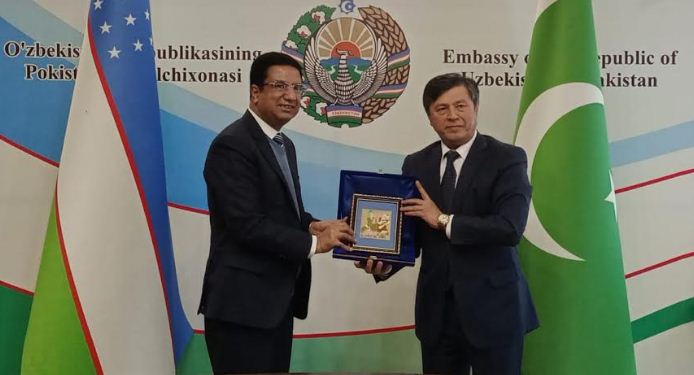
ISLAMABAD, FEB 3 (DNA) – Khalid Taimur Akram, Executive Dircetor, Center for Global & Strategic Stuides, Islamabad met with Oybek Usmanov, Ambassador of the Republic of Uzbekistan to Pakistan.

During the detailed meeting, it was discussed that CGSS and the Embassy of the Republic of Uzbekistan will work in collaboration in areas of mutual interest. Both, CGSS and the embassy agreed to enhance cooperation in the academic field to support academic linakges between various renowned universities of Pakistan and Uzbekistan. Also, it was decided that both the institutions will work together to improve people to people contact.

Furthermore, both parties will cooperate to facilitate bilateral ties of Pakistan and Uzbekistan. Furthermore, projects to promote socio-cultural dimensions of both countries were finalized. CGSS vowed its maximum support for such projects and initiatives.

Moreover, the ambassador acknowledged and appreciated CGSS’s efforts in enhancing the bilateral ties of Pakistan and Uzbekistan and expressed his keen interest in playing an active role in improving the already friendly realtions.=DNA

=============

Huawei’s Foldable Mate X2 Will Launch On February 22nd

Despite earlier rumors of Huawei possibly spinning off its consumer business, the company is still pushing ahead with a new flagship phone — a foldable one, even — later this month.

According to Huawei’s official Weibo account, the Chinese brand’s next foldable phone is simply called the Mate X2, and it’ll be unveiled on February 22nd.

Interestingly, the teaser image suggests that the flexible display will fold inwards this time, as opposed to how the Mate Xs and Mate X had outward-facing foldable screens. Considering that Huawei once shot down prototype designs similar to Samsung’s Galaxy Fold (and its successor), it’s interesting to see the company doing a literal 180 for its upcoming foldable.

As far as official info goes, that’s all we have for now. Huawei Consumer Business Group CEO Richard Yu added that he’s been using a Mate X2 “for some time,” and that it’s “full of surprises.”

The man sure likes to tease, but we do wonder how many units will his team be able to ship (not that Huawei ever shared such figures for its foldables), given the severe shortage of Huawei’s very own flagship mobile processors.

More importantly, though, is whether Huawei will have enough units to sell outside of China this time. Guess we’ll find out in a few weeks.

China’s biomass technology helps Pakistan alleviate energy shortage

BEIJING, Feb. 3 (DNA): Research and technologies on biomass energy and circular agriculture developed by Lanzhou University are being introduced to Pakistan, helping the country cope with insufficient energy supply and promote agricultural modernization, China Economic Net (CEN) reported on Wednesday.

The report says that biomass energy is the energy stored in biomass, which is non-fossil organic materials such as wood, straw, vegetable oils and wastes from forestry, agriculture and industry, as well as municipal solid waste.

As an important renewable source of energy, it contains stored energy from the sun. When biomass is burned, the chemical energy in biomass is released as heat.

Lanzhou University, located in Gansu Province in western China where there is drought with little rain, has focused on the development of circular agriculture and made innovations in the fields of planting, animal husbandry and biomass energy over the years. The fragile ecology in Gansu is quite similar to many areas of Pakistan, which lays a ground for applying related Chinese technologies to Pakistan.

In September, 2015, Lanzhou University and Pakistan Agricultural Research Council (PARC) established China-Pakistan Biomass Energy Technology R&D and Demonstration Center.

In October, 2016, Lanzhou University provided technological training to 20 Pakistani experts from PARC to share the university’s research achievements. Data from Lanzhou University’s official website shows that the university provided experimental equipment worth RMB 1 million, and PARC provided a 2000-cubic-meter experimental building with Rs. 920 million.

“Pakistan is a traditional agricultural country, and its huge agricultural base has provided abundant biomass materials. However, the country has suffered from energy shortage for a long period.

Our technologies can help solve the problems faced by Pakistan and improve the lives of local people,” said Prof. Li Xiangkai, School of Life Sciences, Lanzhou University, whose team has initiated cooperation with Pakistan since 2011.

Biomass energy, such as biogas, has become increasingly popular in developing countries because of its low cost and high efficiency. Up to now, agricultural biogas system and biomass energy conversion technology specifically applicable to Pakistan are under research. Four biogas demonstration bases including 50 biogas digesters have been built in Pakistan.

Latest information shows that the Chinese and Pakistani researchers have developed a technology of utilizing vegetable wastes for bioenergy generation, which is suitable for Pakistan with great potential to be gradually popularized, the report added.

China Cultural Center in Pakistan to host online programs for celebration of Chinese New Year

DNA

ISLAMABAD, FEB 3 – This year marks the 70th anniversary of the establishment of the diplomatic relation between China and Pakistan, to celebrate this significant event and in conjunction with upcoming Chinese Lunar New Year, China Cultural Center in Pakistan will host a series of cultural activities to celebrate online the Happy Chinese New Year in Pakistan. 

The Spring Festival, which is also known as Chinese New Year, according to the lunar calendar, is held by the Chinese as their most important festival and has a history of over 4,000 years. It is an occasion on which people pray for a good harvest, celebrate and enjoy themselves. Nowadays, the festival is celebrated from the evening of the last day of the 12th lunar month to the Lantern Festival on the 15th day of the new lunar year.

DNA 3-3

During the Spring Festival, Han Chinese and many of China’s other ethnic groups hold a variety of distinctive celebrations in order to honor deities and ancestors, symbolize the replacing of the old with the new, and to welcome the New Year and pray for a bumper harvest. People do everything in their power to spend Chinese New Year with their families so that they can welcome the New Year and the happiness that they wish it will bring with those closest to them. The Spring Festival in 2021 is on February 12. A series of online celebrations for the “Happy Chinese New Year” will be given by China Cultural Center in Pakistan from February 4th to February 26th. Our Center has prepared a variety of online programmes, such as “Paper Cut Animation Chinese New Year”, “Chinese New Year Virtual Exhibition”, “Longquan Celadon Experience Tour ” and “Ice Show”,“Animation Celebration Carnival”, to share the traditional Chinese concepts “Joy, Harmony, Sharing and Blessing” with you.

DNA 3-4

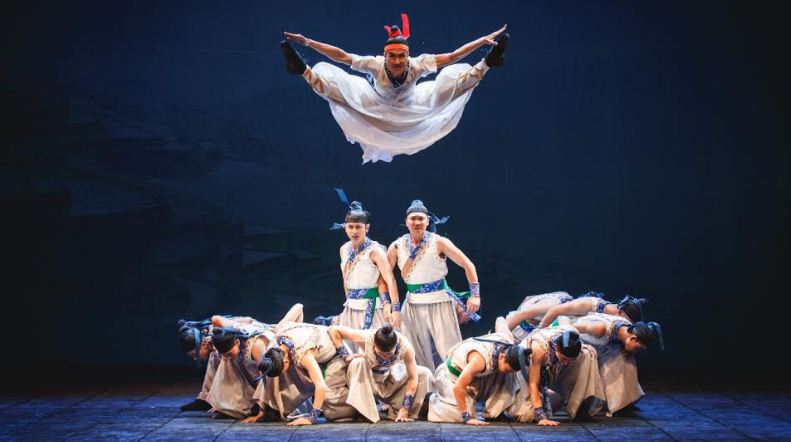
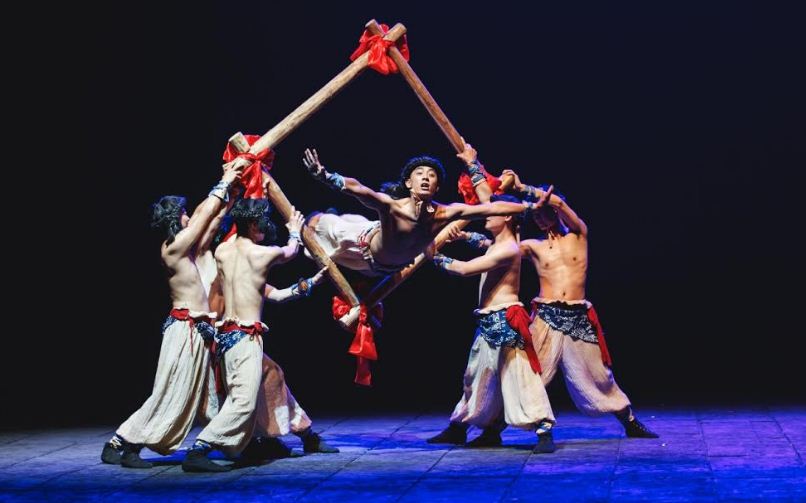
This year also marks the year for the cooperation between China Cultural Center in Pakistan and the Department of Culture and Tourism of south China’s Jiangxi Province, they have brought us Man of Hakka which you may browse on our center’s facebook and we will bring the Dream Night of ‘Baixi’, which is an acrobatic play that was created, rehearsed and performed by Jiangxi Acrobatic Troupe Co., Ltd., a subsidiary of Jiangxi Cultural Performance Group. And there’ll be more for your visual attractions.

DNA 3-1

 Moreover, to celebrate the 70th Anniversary of the establishment of bilateral relations between China and Pakistan, China Cultural Center in Pakistan will also host a series of rich and diversified cultural events.Online activities can be seen on below link from February 4, 2021 to 11 February 2021.

NCOC initiates national immunisation drive among all federating units

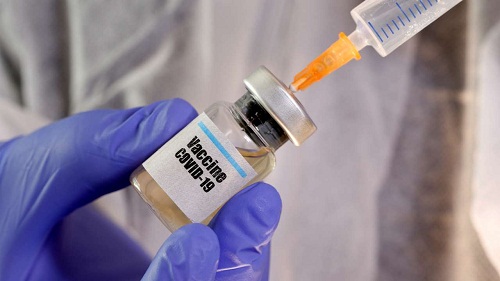
Islamabad, 03 feb 2021 : The National Command and Operation Center (NCOC) on Wednesday simultaneously initiated national immunisation drive against Coronavirus  across the country with all federating units including that of AJK and GB.

The NCOC held the inaugural ceremony of national Covid immunization program with Federal Minister for Planning, Development and Special Initiatives Asad Umar in chair flanked by National Coordinator NCOC Lieutenant General Hamood Uz Zaman Khan. Commercial Minister Counsellor China Xie Guoxiang was the chief guest where Federal Minister for Science and Technology Fawad Hussain Chaudhary, Special Assistant to the Prime Minister (SAPM) on Health Dr Faisal Sultan and SAPM on Poverty Alleviation Dr Sania Nishtar were also present on the occasion.

Speaking on the occasion, Federal Minister for Planning, Development and Special Initiatives Asad Umar lauded the sacrifices and meritorious services of Front line Healthcare Workers (FLHCWs) for serving the nation during the pandemic. “Front line Healthcare Workers are our real heroes. No doubt they have put their lives at risk in their fight against COVID-19 and we pay tribute to all of them.”
He also thanked the government of Peoples Republic of China for supporting Pakistan during crisis of the COVID-19.
He also paid tribute to the team NCOC and provincial authorities working in close liaison in fight against COVID-19 at the forum.
 Asad Umar said the simultaneous inaugural ceremony was the center of national effort highlighting the unified collaboration of the provinces and the federal government collectively fighting the contagion.

The vaccine was administered to Rizwana yasmeen. She is working as charge nurse in Pakistan Institute of Medical Sciences (PIMS) isolation unit, she and her team has been working tirelessly  in fight against Covid19 and she is representing all medical and paramedical staff of PIMS who have been involved in managing Covid19 patients.
The vaccinated individuals also included Javed Iqbal who is covid surveillance team member from DHO office Islamabad, he has been working in surveillance activities since first case of Covid19 was reported in Islamabad. He and his team has been working tirelessly and has diagnosed over 10,000 positive cases in Islamabad by contact tracing and sampling.
He was representing all Covid-19 Surveillance teams who were the backbone of Covid19 management in Islamabad. Fahad Mehmood was also inoculated with vaccine who was working in pathology department of Shifa international dealing with Covid-19 testing. Shifa international hospital has been testing a major bulk of Covid19 testing in Islamabad and has also been managing patients suffering from Covid19 infection. He was representing all people in Shifa international.

The Sindh ceremony was taken place at Dow university Ojha vaccination center where Chief Minister Murad Ali Shah was the Chief Guest.
The Chief Minister Punjab Usman Buzdar was the chief guest in the vaccination ceremony.In Khyber Pakhtunkhwa, Chief Minister Mahmood Khan was the chief guest of inoculation ceremony.The vaccination ceremony in Balochistan was held at Chief Minister Secretariat.
In Azad Jammu and Kashmir (AJK), the vaccination was held at the PM Secretariat whereas in Gilgit Baltistan (GB) inoculation was held at CS secretariat with Chief Minister GB as chief guest.

India’s Sham Covid-19 “Vaccine Diplomacy” & Vaccine Scarcity in IIOJK

Iqbal Khan

It is ironic that India continues to brandish its so-called vaccine diplomacy abroad while at the same time it has turned hospitals in Indian Illegally Occupied Jammu and Kashmir (IIOJK) into graveyards, choking essential medical supplies, let alone the Covid vaccine.Bigger aspect of the problem, however, is that it’s prioritising such exports at the expense of meeting “domestic” demand in the world’s second most populous country. The UN needs to step-in to quantify the exact requirement of Cobid-19 vaccine for IIOJK and institute requisite monitoring mechanism to ensure that inhabitants of IIOJK are not exposed to India’s vaccine terrorism through deprivation of medicine. After all India’s military and paramilitary forces deployed in IIOJK take pride in using rape as counterinsurgency weapon.

On March 23, 2020, UN Secretary General António Guterres issued an urgent appeal for a global ceasefire in all corners of the world to focus together on defeating COVID-19. He repeated the call at the start of the 75th UN General Assembly session in September. Since the first call, 180 countries, the Security Council, regional organizations, civil society groups, peace advocates and millions of global citizens have endorsed the Secretary-General’s ceasefire call. The world needs a global ceasefire to stop all “hot” conflicts, both inter-state and intra-state. While we endorse UN Secretary General’s intent for a global ceasefire, he also needs to make a specific call for ending atrocities in IIOJK.

Since the illegal occupation of Kashmir in 1947, killings of Kashmiris and aggression continues to this day. In 1947, at least 237,000 Kashmiri Muslims were killed just because they wanted to join Pakistan. Their enduring love for Pakistan is an unpleasant truth for India.The UN resolutions about Kashmir have not been implemented because of the Indian intransigence.

Hindutva regime has unleashed unspeakable brutality on the vulnerable Muslims of Kashmir. World powers have failed the people of Kashmir. Despite the presence of 900,000 troops, thepeople of Kashmir are continuing struggle for their self-determination and are peacefully opposing the alien rule. They are determined to carry on their struggle. They have been fighting occupation for 200 years and they will not give up.

On July 18, 2020,anIndian army CaptainBhoopinder Singhabducted three labourers, staged a gunfight, killed all three, and branded them as militants. All three were away from home to earn daily wages. According to police charge sheet, army captain staged this fake encounter inAmshipura,a village of Shopian,district Rajouri,just for paltry sum ofRs 20 Lakh.This is the value of civilian lives in Indian Illegally occupied Jammu and Kashmir (IIOJK).

According to the police charge sheet, Bhoopinder Singh had hatched a conspiracy along with two civilians,TabishNazir and Bilal Ahmed Lone,with the motive for “grabbing” a reward money.The charge sheet was submitted before the chief judicial magistrate of districtRajouri.Lone has since turned an approver and recorded his confession statement before a magistrate.Captain is currently in the custody of the Indian army, and is likely to face Court Martial proceedings.

After reports emerged on social media that the three youths were not associated with terrorism, the Army had ordered a Court of Inquiry which completed its probe earlier in September 2020. It had found “prima facie” evidence that the troops had “exceeded” the powers granted under the Armed Forces Special Powers Act (AFSPA). Following this, the Army had initiated disciplinary proceedings.General officer in Command of the XV Corps, Lt Gen B S Raju had said earlier that the Summary of Evidence had been completed and the Army will take the next course of action as per law.

The charge sheet submitted by the Special Investigation Team of Jammu and Kashmir Police has listed 75 witnesses in support of its findings and has also provided technical evidence including call data records of the accused persons involved in the case.The charge sheet also has the statements of four army personnel who were part of Captain Singh’s team. Singh and two other civilians also “purposefully destroyed evidence” of real crime that they had committed.The accused captain “furnished false information to mislead the senior officer and for getting” an FIR lodged to “tailor fit his motive for grabbing prize money in furtherance of criminal conspiracy”.

Hurriyat leaders and organizations in their separate statements sharply reacted to the IIOJK police charge-sheet. They urged the United Nations to set up a special tribunal to probe all such killings in the occupied territory.

Then there was another encounter in Srinagar onDecember 30, in which three innocent students were killed. According to Kashmir Media Service, IIOJK Bar has demanded an impartial probe into killing of 3 students.

Harassing of freedom fighters is a norm in IIOJK. On January 11, the special TADA/POTA court of Srinagar framed fake charges against illegally detained Jammu and Kashmir Liberation Front (JKLF) Chairman, Muhammad Yasin Malik in a three-decade-old fake case of RubiyaSayeed kidnapping.

The Jammu and Kashmir Peoples Liberation party, at a party meeting presided over by Chief Coordinator Dr Sarfaraz Ahmad Khan, reiterated the demand for immediate release of Mirwaiz Umar Farooq and all other political leaders and activists languishing in various jails in India and in IIOJK.

Moreover,International Forum for Justice and Human Rights Jammu and Kashmir Chairman Mohammad Ahsan Untoo has strongly condemned the authorities for keeping nineteen students in jail for the past four years in a fabricated murder case. Many of the detained youth are undergoing treatment for many ailments.

IIOJK Tehreek-e-Wahdat-e-Islami’sspokesman in a statement said that Indian troops had martyred hundreds of youth in fake encounters in different areas of occupied Jammu and Kashmir during the past 33 years. He demanded of the United Nations to set up a special tribunal to probe the killing of innocent Kashmiri youth in fake encounters by Indian troops.

The Jammu and Kashmir National Conference leader and Member of Indian Parliament Justice (retired) HasnainMasoodi has called for reversal of illegal annexation actions of August 05 2019, initialization of dialogue with all the stakeholders of the Kashmir dispute.He also rejectedModi-led fascist Indian government’s so-called industrial policy for IIOJK and emphasized that the scheme would not fetch any results in absence of an aggressive peace initiative to address the political aspirations of the people of Jammu and Kashmir. General Secretary of the All Parties Hurriyat Conference, Molvi Bashir Ahmed has said that the dark night of oppression imposed by India will end and the Kashmiris will see the dawn of freedom, one day. While addressing party workers in Pulwama, Bashir Ahmed said, the Kashmiris have never submitted to Indian machinations and will fight till end.

A Human tragedy is brewing in the IIOJK. International community can no longer afford to be indifferent towards this snowballing crisis. Kashmiris stay hopeful that one day their agony would end through exercise of right of self-determination leading to peace and prosperity.

The turbulent IIOJK region has long weathered violence and political strife. India’s security crackdown and the coronavirus have brought life in the tourist-dependent region to a near halt.

As the world continues its silence on the greatest human tragedy—Kashmir, it must also remain cognisant of the possible implications of the denial of basic human rights to the Kashmiris and their continued suffering at the hands of an extremist Hindutva regime in India.

Writer is a freelance contributor; email: [email protected]

Sony forecasts record profit after PlayStation 5 launch

Tokyo, Feb 3  : Sony said Wednesday it expects a record net profit this financial year, as fresh virus lockdowns continue to boost demand for games and consoles, including the recently released PlayStation 5.

Although the pandemic has hit many industries hard, the gaming sector has been one of the few to experience an unprecedented boom, with people seeking entertainment at home during successive rounds of restrictions.

The Japanese tech giant said net profit jumped 87 percent in April-December from the same period earlier, to 1.1 trillion yen ($10 billion).

Sony’s strong results led the firm to revise its full-year sales and profits forecasts upwards on the back of “higher-than-expected sales in all segments except for the pictures (movies) segment,” it said.

Full-year sales are now projected at 8.8 trillion yen, up from 8.5 trillion yen forecast in October.

Sony, which also revised its annual forecasts up last quarter, hiked net profit outlook to a record 1.1 trillion yen for the fiscal year to March, from an earlier estimate of 800 billion yen.

The much anticipated PlayStation 5 console hit shelves in November, kicking off a head-to-head battle for holiday sales with the new Xbox from US rival Microsoft.

PS5 sales reached 4.5 million units by end-December and Sony expects to sell 7.6 million by the end of March, hoping to beat the performance of the PlayStation 4.

But pandemic-related supply problems have left many would-be customers empty-handed.

The demand has led to chaotic scenes at electronic stores when supplies do become available.

“PS5 got off to a steady start in general, selling well in accordance with its plan,” said Hideki Yasuda, an analyst at Ace Research Institute in Tokyo.

New Zealand approves first COVID-19 vaccine

WELLINGTON, Feb. 3 : New Zealand’s pharmaceutical authorities on Wednesday gave provisional approval of the country’s first COVID-19 vaccine.

“The provisional approval of the Pfizer/BioNTech vaccine is a positive step in New Zealand’s fight against COVID-19. It means we can now begin preparations for the first stage in our vaccination roll-out,” Prime Minister Jacinda Ardern told a press conference.

“Medsafe provides independent advice to the government and approves all medicines and vaccines available in New Zealand. Approval has been a very carefully considered and robust process, with safety the key priority,” Ardern said.

“Medsafe’s decision is the culmination of a rigorous assessment process over many months to ensure the Pfizer/BioNTech vaccine is safe and effective to use here. It is informed by the most up to date medical and scientific data. We can have confidence in their decision,” she said.

Border workers and the people they live with are the first to be vaccinated, she said, adding that people such as cleaners, the nurses who undertake health checks in managed isolation facilities, security staff, customs and border officials, airline staff and hotel workers will be among the first to get the vaccine, to be completed within two to three weeks.

“Vaccinating our frontline staff will provide a critical additional line of defense to keep them well and to help prevent COVID-19 entering the community. It’s an extra layer to help protect New Zealanders and our economy against a future outbreak,” Ardern said.

COVID-19 Response Minister Chris Hipkins said the first Pfizer/BioNTech vaccines will be expected to arrive in New Zealand by the end of the first quarter.

Ardern said the government will be encouraging all New Zealanders to get vaccinated. “I have said 2021 is the Year of the Vaccine. It’s a full-year program we have only just begun,” she said.

Black Caps aim to purge Lord’s pain in world Test final

Wellington, Feb 3  : The Black Caps won’t let past agonies at England’s famed Lord’s cricket ground hamper their quest to win the inaugural World Test Championship final later this year, coach Gary Stead said Wednesday.

New Zealand earned a place in the decider — to be held at Lord’s from June 18 — after Australia withdrew from a Test tour to South Africa this week due to Covid-19 fears.

The London venue was the scene of the Black Caps’ cruellest defeat, the one-day World Cup final against England in 2019.

With scores tied after a nail-biting Super Over, an obscure tie-break rule — which has since been scrapped — meant the hosts were awarded the trophy because they had scored more boundaries than the Black Caps.

New Zealand have also managed only four wins from 23 completed matches at the ground in all formats, with only a single Test victory.

Stead insisted history would not weigh on his players as they seek to become the first Test team to be crowned world champions under the new International Cricket Council format.

“What’s happened back in 2019 has been and gone. We can’t change it, we can’t do anything about it,” Stead told reporters.

“Now it’s about us moving to what’s in front of us. I think our guys are professional enough and skilful enough that they’ll be able to do that.”

While denying 2019 was on the Black Caps’ minds, Stead did admit to having a peek at the rule book to see what would happen if the World Test Championship final was tied.

“There’s definitely no Super Over,” he said.

“If the match is a draw or a tie there are joint winners.”

New Zealand’s opponent in the final has not been decided, with India, Australia and England all possibilities under the ICC’s complex qualification criteria.

Stead refused to nominate a preferred opponent, saying they were all great Test-playing nations.

“I just think it’s magnificent we get the opportunity to play one of them,” he said.

New Zealand currently top the Test rankings but Stead said his veteran players remembered when they tumbled to eighth in the world after a humbling loss to South Africa in 2018, after being all out in the first innings for just 45.

He said winning the Test championship would be a fitting testament to their improvement.

“They’ve seen some dark days but turned that around,” he said.

“(It) would rank up there with some of the best achievements of their career.”

Stay Connected

64FansLike
60FollowersFollow

Latest Reviews

Exchange Rates

USD - United States Dollar
EUR
1.17
GBP
1.35
AUD
0.72
CAD
0.73