Home Blog Page 291

Crisis in Pakistan hockey deepens

Crisis in Pakistan hockey deepens

DNA

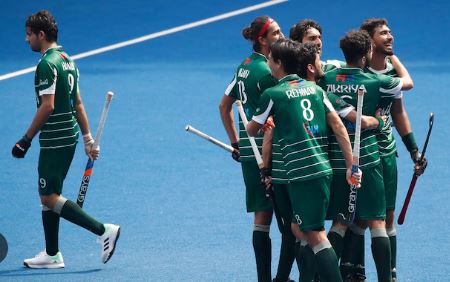
ISLAMABAD: The crisis in Pakistan hockey has deepened as political maneuvering continues to overshadow the sport. Reports suggest that Shehla Raza, who was herself a candidate for the presidency of the Pakistan Hockey Federation (PHF), now wants to bring in her own nominee from Sindh. Sources claim she is backing the President of the Sindh Hockey Association to take over the PHF leadership. This tussle has further destabilized hockey in the country, with critics pointing out that the government and the Prime Minister have shown little interest in resolving the matter, leaving the sport in decline.

The Pakistan Sports Board (PSB) has recently intervened, issuing a letter that rejected the unilateral scrutiny of hockey clubs. The PSB emphasized that such processes must be transparent and inclusive. Tariq Bugti, who had been tasked with overseeing club scrutiny and elections, controversially declared himself as President of the PHF. This move has been widely criticized, with the PSB raising serious questions about the financial credibility of the federation.

Observers note that the current PHF President is not elected through a transparent process but rather nominated, which undermines the legitimacy of the federation’s leadership. The ongoing disputes, personal ambitions, and lack of accountability have left Pakistan’s national sport in disarray. Once a source of pride and international recognition, hockey in Pakistan now struggles under the weight of mismanagement and political infighting.

Pak faces diplomatic dilemma over Gaza governance boards

Zardari in China: strategic diplomacy or political foresight?

Without Palestinian representation at the highest levels, any international effort risks being seen as imposed rather than inclusive a perception that could undermine its effectiveness in the long run

Asnar Mahmood Bhatti

Islamabad: The unveiling of two senior boards tasked with shaping the future governance of Gaza has sparked intense debate across the region. While the initiative is being presented as a step toward stabilizing Gaza and attracting international investment, the composition of these boards has raised serious concerns—particularly in Pakistan, which has been invited to participate alongside Qatar, Türkiye, and the United Arab Emirates (UAE).

So far, no Palestinian names have been included on the two separate senior boards. The first, called the Founding Executive Board, is designed to focus on high-level investment, diplomacy, and strategic direction. The second, the Gaza Executive Board, is responsible for overseeing the on-the-ground work of the National Committee for the Administration of Gaza (NCAG).

The NCAG itself is composed of technocratic, apolitical Palestinians, led by Dr. Ali Shaath, a civil engineer by training who has previously held ministerial positions within the Palestinian Authority. While this committee is meant to provide local legitimacy, its limited scope and lack of political representation have raised eyebrows among observers.

Despite the existence of the Gaza Executive Board and NCAG, analysts note that the real power lies with the Founding Executive Board. Of its seven members, six are Americans, including US Secretary of State Marco Rubio, Trump’s son-in-law Jared Kushner, and Steve Witkoff, the US Special Envoy to the Middle East and a close friend of President Trump. The only non-American member is former UK Prime Minister Tony Blair, who has long been involved in Middle East diplomacy.

The absence of Palestinian representation on this powerful board has been described as a glaring omission, raising questions about the credibility of the governance structure. Critics argue that decisions about Gaza’s future are being made without the direct involvement of Palestinians themselves.

President Trump has extended invitations to Pakistan, Qatar, Türkiye, and the UAE to engage with the boards. However, Saudi Arabia’s name is conspicuously missing. For Pakistan, this presents a diplomatic dilemma.

Islamabad’s foreign policy interests are closely tied to Riyadh, both economically and strategically. Saudi Arabia has historically been a major source of financial support, energy cooperation, and political backing for Pakistan. Any move by Pakistan to participate in a US-led initiative without Saudi involvement risks straining this critical relationship.

Diplomatic sources suggest that Pakistan will need to tread carefully, consulting not only with Saudi Arabia but also with Türkiye and Qatar, who have their own stakes in Gaza’s future. The UAE’s inclusion adds another layer of complexity, given its evolving ties with Israel and the United States.

Beyond the diplomatic balancing act, the structure of the boards themselves has drawn criticism. The fact that six of the seven members of the Founding Executive Board are Americans, with no Palestinian representation, has fueled concerns about legitimacy.

Observers warn that decisions made by a board dominated by US officials and business figures may prioritize investment and geopolitical interests over the needs of ordinary Palestinians. The presence of Tony Blair, while adding international credibility, does little to address the absence of Palestinian voices at the highest level.

Pakistan’s decision will likely hinge on consultations with Saudi Arabia, Türkiye, and Qatar. While Islamabad may be tempted to accept the invitation as a way to enhance its diplomatic profile, it cannot afford to alienate Riyadh.

Foreign policy experts argue that Pakistan should push for greater Palestinian representation on the boards before committing to participation. Doing so would not only strengthen the legitimacy of the governance structure but also provide Islamabad with a principled justification for its involvement.

At the same time, Pakistan must weigh the potential benefits of engaging with the US-led initiative, including opportunities for investment and diplomatic influence. However, any such engagement will need to be carefully calibrated to avoid undermining its long-standing ties with Saudi Arabia.

The unveiling of the Gaza governance boards has opened a new chapter in Middle Eastern diplomacy, but one fraught with challenges. For Pakistan, the invitation to join comes with both opportunities and risks. The absence of Saudi Arabia from the initiative complicates Islamabad’s decision, forcing it to balance its strategic interests with its alliances.

Ultimately, Pakistan’s path forward will depend on careful consultation with regional partners and a clear-eyed assessment of the legitimacy of the governance structures being proposed. Without Palestinian representation at the highest levels, any international effort risks being seen as imposed rather than inclusive a perception that could undermine its effectiveness in the long run.

Pakistan beat Scotland to register maiden win in U19 World Cup 2026

Pakistan beat Scotland to register maiden win in U19 World Cup 2026

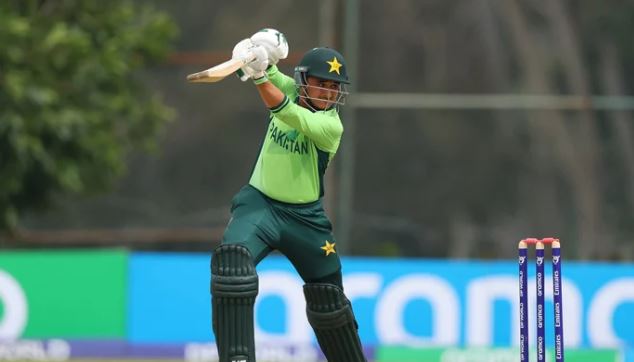
HARARE: Pakistan have registered their first win in the ongoing ICC Men’s U19 World Cup 2026 after defeating Scotland by six wickets on Monday at Takashinga Sports Club, Highfield.

Chasing 188, Pakistan reached the target in the 44th over after a steady start, with openers Sameer Minhas and Ali Hassan Baloch setting the tone and building a solid partnership.

The stand was broken when Ali Hassan was bowled by Ollie Jones for 15 off 33 balls, including one boundary, leaving Pakistan at 43-1 in 9.4 overs.

In the first delivery of the 12th over, Pakistan lost their second wicket as Jones struck again, dismissing the dangerous Sameer Minhas for 28 off 30 balls, which included three fours.

Usman Khan and Ahmed Hussain then joined forces, steadily adding crucial runs and forging a strong third-wicket partnership.

The duo added 50 runs, easing the pressure and taking Pakistan past the 100-run mark, setting the platform to chase down the target comfortably.

Usman was in top form with the bat, playing sensibly for the green shirts and guiding his side closer to victory by scoring a half-century.

The 111-run partnership was finally broken when Manu Saraswat struck, claiming the prized wicket of Usman Khan, who had played a gutsy innings of 75 off 85 balls, including five boundaries and two sixes, leaving the team at 159-3 in 38.1 overs.

Hussain was inching closer to his third Youth ODI half-century and a win for his side but was soon dismissed by Saraswat for 47 off 92 balls, including three boundaries.

Skipper Farhan Yousaf then hit the winning runs, remaining unbeaten on 18 off 11 deliveries, while Huzaifa faced nine balls without scoring.

After being asked to bat first, Scotland suffered early setbacks as pacer Ali Raza struck in the opening over, dismissing both openers — Theo Robinson for four off two balls and Max Chaplin for two.

Captain Thomas Knight and Rory Grant then steadied the innings, adding valuable runs and taking the total past the 50-run mark.

Their partnership was broken when Momin Qamar removed Grant for a vital 21 off 45 deliveries, including one boundary, leaving Scotland at 59-3 in 16.5 overs.

A few overs later, Momin struck again to claim his second wicket, dismissing Finlay Carter for 12 off 16 balls with the help of two fours.

Knight and Ollie Jones combined to rebuild the innings, forging a steady partnership that carried Scotland past 100 in the 26th over.

However, the 40-run stand ended when Ali Raza returned to hit the stumps and dismiss Jones for a crucial 30 off 35 deliveries, which included three boundaries, with the score at 115-5 in 28.4 overs.

Scotland came under further pressure in the next over as Momin Qamar claimed the prized wicket of skipper Knight, who top-scored with 37 off 72 balls, including three fours.

Manu Saraswat and Finlay Jones then added a fighting 50-run partnership for the seventh wicket, helping Scotland recover and push towards a competitive total.

The resistance ended when Ali Raza claimed his fourth wicket, dismissing Finlay Jones for a gritty 33 off 56 balls, which featured two sixes, leaving Scotland at 173-7 in 42.4 overs.

Mohammad Sayyam later joined the attack and picked up his first wicket, removing the set batter Saraswat, who scored an important 25 off 36 deliveries, including one six.

Ethan Ramsay became the ninth batter to fall after being run out by wicketkeeper Hamza Zahoor for five off 15 balls, while Jake Woodhouse was the last to be dismissed, bowled by Abdul Subhan for two off four deliveries.

For Pakistan, Ali Raza led the bowling attack with impressive figures of 4/37 in his 10 overs. Momin Qamar claimed three wickets, while Mohammad Sayyam and Abdul Subhan picked up one wicket apiece.

Squads

Pakistan: Farhan Yousaf (c), Usman Khan, Abdul Subhan, Ahmed Hussain, Ali Hasan Baloch, Ali Raza, Daniyal Ali Khan, Hamza Zahoor, Huzaifa Ahsan, Momin Qamar, Mohammad Sayyam, Mohammad Shayan, Niqab Shafiq, Sameer Minhas and Umar Zaib.

Scotland: Thomas Knight (c), Finlay Carter, Max Chaplin, George Cutler, Rory Grant, Finlay Jones, Ollie Jones, Olly Pillinger, Ethan Ramsay, Theo Robinson, Manu Saraswat, Ram Sharma, Shreyas Tekale, Shlok Thaker and Jake Woodhouse.

Pakistan, Indonesia FMs discuss regional developments in phone call

Pakistan, Indonesia FMs discuss regional developments in phone call

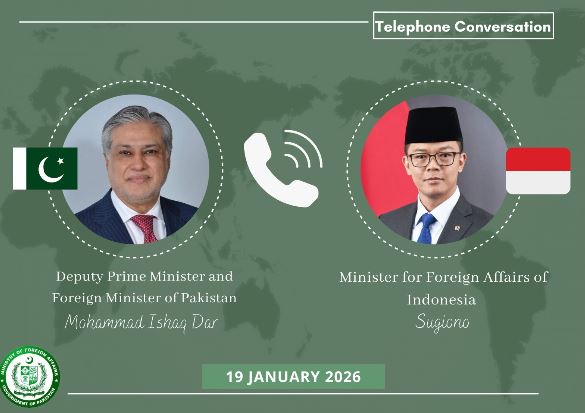
ISLAMABAD, JAN 19 /DNA/ – Deputy Prime Minister / Foreign Minister Senator Mohammad Ishaq Dar had a telephonic conversation with Indonesian FM Sugiono.

They discussed current regional & international developments, and matters of mutual interest. Both welcomed the opportunity to follow up on the sidelines of #Davos.

India Beat Pakistan in SAFF Women’s Futsal Championship

India Beat Pakistan in SAFF Women’s Futsal Championship

By our correspondent

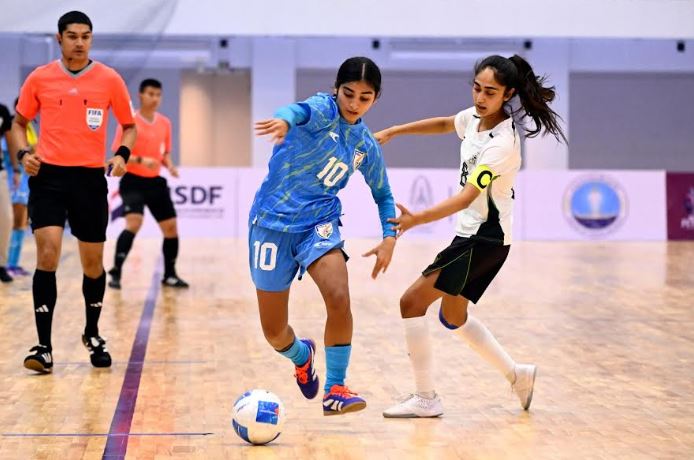
ISLAMABAD: Arch-rivals India defeated Pakistan 5–3 in a thrilling SAFF Women’s Futsal Championship 2026 encounter at the Nonthaburi Stadium on Monday, as the high-profile clash unfolded with a powerful display of unity and sportsmanship.

The match produced intense action from the outset, with both teams adopting a cautious approach in the first half, which ended level at 1–1. Pakistan took control early in the second half, scoring two quick goals to establish a 3–1 lead and demonstrating remarkable confidence and composure.

However, India staged an impressive comeback, netting four unanswered goals to turn the contest on its head and secure a dramatic 5–3 victory.

Despite the loss, Pakistan Women’s Futsal Team continued to impress in their maiden appearance at the SAFF Women’s Futsal Championship, earning praise for their fighting spirit and steady improvement against one of the tournament favourites.

Before kickoff, Pakistan captain Kaya Bokhari and Indian captain Jigmet Chunzen exchanged a warm handshake, symbolising the true spirit of the game. Bokhari also presented a traditional Sindhi Ajrak to her counterpart as a cultural gesture of respect and goodwill.

Pakistan will next face Nepal in their group match on January 21.

Socialist to face far-right candidate for Portugal’s presidency

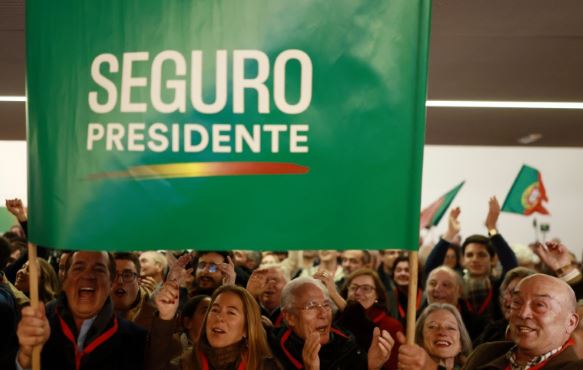
LISBON, JAN 19 (DNA): Portugal’s socialist candidate won the first round of the presidential election and will face the far-right candidate in the second round, near-complete results showed Sunday.

                  With votes from 95 percent of  constituencies counted, Socialist Antonio Jose Seguro was leading with 30.6 percent of the vote, while far-right contender Andre Ventura came in second with 24.2 percent.

                  The liberal candidate Joao Cotrim Figueiredo was in third place with 15.5 percent.

                  Ventura and Seguro will face off on February 8 to decide who succeeds conservative incumbent Marcelo Rebelo de Sousa.

                  Opinion polls in the run-up to the election had suggested that Ventura was the favourite for the first round.

                  This will nevertheless be the first time a far-right candidate has made it to the second round of the presidential race.

                  During the campaign, Seguro had argued that he was the only one capable of defeating Ventura’s “extremism” and had called on “all democrats” to unite behind him.

                  While the role of president is largely ceremonial, in times of crisis the incumbent can dissolve parliament, call elections or dismiss a prime minister.

                  Portugal’s prime minister, right-winger Luis Montenegro, said he would not be giving any advice on who to vote for in the second round.

                  His minority government already relies on Ventura’s Chega party for support to implement some of its policies.

                  – Ventura ‘confident’ –

                  This is the first time in four decades that no candidate has won outright in the first round by securing more than 50 percent of the vote.

                  Ventura said he felt “very confident” after casting his vote in the sunny capital.

                  “We cannot spend our time criticising things and then sit on the couch on the day we are called to make a decision,” he said.

                  “I believe in the good sense of the Portuguese,” said Ventura after voting in his home city of Caldas da Rainha.

                  As he finished his first-round campaign, he called on other parties on the right not to stand in his way if he makes it to the second round.

                  And in his final election rally he toughened his tone, saying he would refuse to try to please everyone and promising to “put some order” into the country.

                  Voting in Lisbon, Alexandre Leitao, a 50-year-old biologist, said he had voted left wing to stave off the “very negative shift toward the far right”.

                  “We young people are not happy with the country we have,” said 33-year-old Irina Ferestreoaru.

                  She said public approval of Ventura was “a warning sign for the country, because people are desperate to see change”.

                  – Far right shift –

                  Analysts say Ventura has his sights set on eventually running the country as prime minister.

                  “Andre Ventura is running to keep his voter base,” said Antonio Costa Pinto, a political scientist at Lisbon University.

                  Chega’s party emerged as the biggest opposition party in parliament after a general election last May, overtaking the Socialists.

                  “Another solid result for the far right would confirm its domination over the political landscape,” consulting firm Teneo said in a note.

                  EU and eurozone member Portugal accounts for around 1.6 percent of the bloc’s economic output.

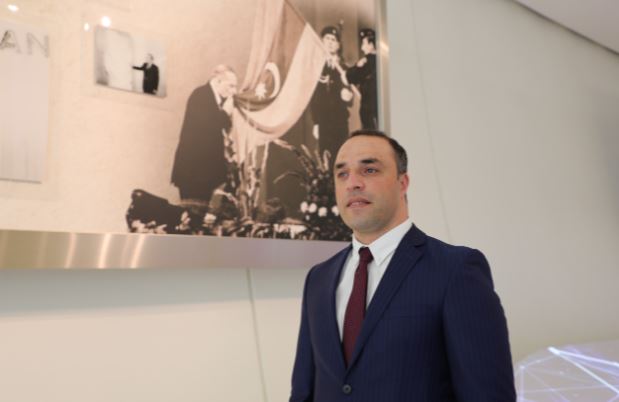
January 20 – Heydar Aliyev’s Political Signature

January 20 – Heydar Aliyev’s Political Signature

Fərid Mustafayev

One of the gravest trials endured by the Azerbaijani people in the twentieth century is associated with the events of the night of January 20. That night was not only remembered for the deployment of military equipment against unarmed civilians.

It entered history as a moment when the patience, will, and historical memory of an entire nation were deliberately targeted. The scale of the events, the nature of the violence employed, and the subsequent information manipulations demonstrated that the objective was not merely physical control, but also the creation of deep moral and psychological shock. Against the backdrop of these complex and contradictory processes, Heydar Aliyev’s position acquired particular significance.

He assessed the events not only in terms of their immediate course, but within a framework of cause-and-effect relationships. For Heydar Aliyev, January 20 was not confined to a single night. It represented the culmination of long-accumulated political contradictions, legal voids, and disregard for national will.

He categorically stated that armed intervention could under no circumstances be presented as a means of ensuring public order, because the concept of public order is founded upon law, security, and human dignity. On the night of January 20, all of these principles were trampled. Heydar Aliyev’s stance was formed precisely on this basis, and he substantiated it both politically and legally. The immediate analytical approach to the events was a clear reflection of Heydar Aliyev’s political mindset.

He did not limit himself to emotional reactions. On the contrary, he emphasized the necessity of a systematic evaluation of what had occurred. For him, the primary issue was not merely naming those responsible, but correctly identifying the essence of the events themselves. Without an accurate diagnosis, no sound conclusion could be reached. In his position addressed to the Soviet political leadership, Heydar Aliyev placed the concept of responsibility at the center. He believed that evading responsibility only aggravated the situation and further eroded trust between society and authority.

Therefore, he demanded that the events receive an objective legal and political assessment. For that period, this demand was not only courageous, but also deeply principled. The impact of the tragedy on individual human lives did not escape Heydar Aliyev’s attention. In his view, those who perished were not statistical figures. Each loss represented a family tragedy, the pain of a generation, and a profound shock to society.

From this perspective, he approached the events not solely through a political lens, but with humane and ethical considerations. This approach played a significant role in society’s acceptance of him as a moral leader. His attention to the families of the victims was a tangible expression of social responsibility. He openly declared that the state is not merely a structure of power institutions; above all, it must be capable of sharing in the suffering of its citizens. This position had a serious influence on shaping the public mood in the aftermath of January 20. In his addresses to the domestic audience, the primary objective was to prevent the deepening of panic and chaos within society.

Heydar Aliyev emphasized a reasoned stance, patience, and the idea of national unity. He understood that emotional fragmentation could lead to long-term consequences. For this reason, he presented national solidarity as a strategic necessity. His appeals to the international community, on the other hand, were aimed at ensuring global recognition of the events. Heydar Aliyev understood that an information vacuum could result in the loss of truth. Therefore, he considered it essential that the realities of January 20 be voiced on the international stage. This was an important step both in terms of political responsibility and the preservation of historical memory. A key element in his speeches was the strengthening of national self-awareness.

For Heydar Aliyev, January 20 was not merely the pain of the past; it was a serious message regarding how the future should be constructed. He believed that the people must draw conclusions from this tragedy and enter a stage of political maturity.

He associated January 20 with the concept of national responsibility. In his view, freedom is not only an aspiration, but also a responsibility—a responsibility borne by both political leaders and society as a whole. This perspective enabled the events to be perceived not merely as an emotional memory, but as a strategic lesson.

His analytical stance played a significant role in the transformation of public consciousness. Heydar Aliyev demonstrated that it is not enough to approach history solely through mourning; history must shape thought. It was precisely this approach that accelerated the understanding of the January 20 events within the context of national identity.

Over time, the historical significance of Heydar Aliyev’s position became increasingly evident. The assessment of the events did not change, but society’s perception of that assessment deepened. His principles evolved into a model of political conduct and, in later periods, became one of the foundational pillars of statehood thinking.

The events of January 20 revealed the unbreakable will of the Azerbaijani people, while Heydar Aliyev’s response to these events became the political expression of that will. His stance proved that national memory can be further strengthened through a leader’s position.Today, when we look back at the January 20 events, it becomes clear that Heydar Aliyev’s position was not merely a historical fact, but also a moral compass. His stance ensured that the events were not forgotten over time, that their essence was not distorted, and that they continued to live on in national memory in an accurate and dignified manner.

Thus, the January 20 tragedy remains in the history of Azerbaijan as both a period of pain and a moment of awakening. Heydar Aliyev’s assessment of this tragedy became one of the key factors defining its political and moral framework. This position played an important guiding role in the historical path of the nation and continues to retain its relevance today.

Fərid Mustafayev
Deputy Chairman of the Progress Social and Economic Research Public Union,
Member and activist of the New Azerbaijan Party Yasamal District Organization

Treasury, opposition agree on Nasir Abbas as Senate opposition leader

Senate opposition leader appointed

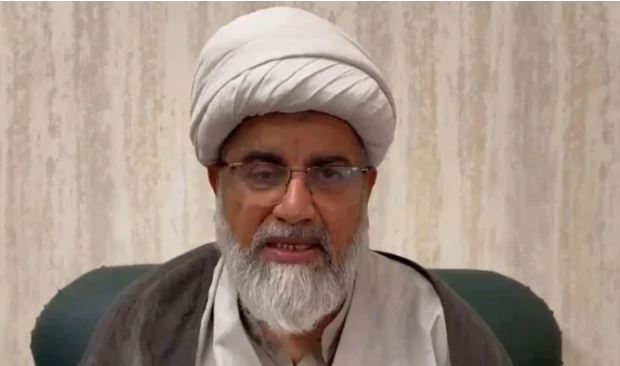
ISLAMABAD, JAN 19: The treasury and opposition benches have agreed on the name of Majlis Wahdat-e-Muslimeen (MWM) chief Senator Allama Raja Nasir Abbas as leader of the opposition in the Senate, Pakistan Tehreek-e-Insaf (PTI) leader Barrister Ali Zafar said on Monday.

This development came a week after Tehreek Tahafuz Ayeen-e-Pakistan (TTAP) chief Mehmood Khan Achakzai was appointed leader of the opposition in the National Assembly.

Talking to the media, the PTI leader said Senate Chairman Syed Yousaf Raza Gilani and senators from the treasury and opposition benches had consulted on the appointment of the leader of the opposition in the Senate.

Confirming the development, Federal Law Minister Azam Nazeer Tarar said the MWM chief — an ally of the PTI — would be the opposition leader in the Senate, adding that a notification in this regard was being issued.

The post has been lying vacant since August last year, when then-opposition leader in the upper house of the parliament Shibli Faraz was disqualified by the Election Commission of Pakistan (ECP) following his conviction in cases related to riots on May 9, 2023.

The PTI parliamentary leader in the Senate, earlier, penned a letter to the Senate chairman, urging the appointment of a leader of the opposition in the upper house of the parliament.

The PTI leader told the Senate chairman that his party has nominated MWM chief for the post and urged that he be appointed as the opposition leader in the Senate without any delay.

Zafar said the office of the opposition leader was crucial in a parliamentary democracy, adding that the position was essential for effective governance, constitutional oversight and transparency in the parliamentary system.

The vacant post of leader of the opposition in the Senate is raising questions about the parliamentary system, the PTI leader added.

He noted that without a leader of the opposition, the House remained institutionally incomplete.

Gas discovery provides boost to Philippines fast-dwindling reserves

Gas discovery provides boost to Philippines fast-dwindling reserves

MANILA, JAN 19: Philippines President Ferdinand Marcos said Monday that a “significant” discovery of natural gas had been made near the country’s sole producing offshore site.

About 98 billion cubic feet (2.8 billion cubic metres) of natural gas — enough to provide power to 5.7 million homes for a year — has been found east of the Malampaya Field near the island of Palawan, Marcos said.

The Philippines has some of the region’s highest energy costs and faces a looming crisis as the Malampaya gas field, which supplies about 40 percent of power to the archipelago’s main island, Luzon, is expected to run dry within a few years.

The discovery — five kilometres (three miles) east of the Malampaya Field  — is the first in more than a decade and suggested the potential to produce even more, Marcos said.

                  “This helps Malampaya’s contribution and strengthens our domestic gas supply for many years to come. Initial testing showed that the well flowed at 60 million cubic feet per day,” Marcos said in a statement.

                  The Philippines — regularly affected by electricity outages — relies on imported carbon-belching coal for more than half of its power generation.

                  Kairos Dela Cruz, executive director of the Manila-based Institute for Climate and Sustainable Cities, told AFP that while the find was “relatively small”, it could point the way to finding other nearby gas resources.

                  “The discovery of these other gas fields will provide new indigenous supply and increase energy security,” he said.

                  “It also helps extend the operating life of the 500-kilometre undersea gas pipeline, long enough for larger gas fields in the area to be discovered.”

                  A former industry executive who spoke on condition of anonymity estimated the new find could extend the Malampaya Field’s life by two to three years.

                  Long-term, the country will still need to increase its focus on renewables ranging from solar to hydro to offshore wind projects, Dela Cruz said.

                  In 2022, then-president Rodrigo Duterte called a halt to oil and gas exploration in areas of the South China Sea disputed with China.

                  Beijing has ignored a 2016 international tribunal decision that declared its historical claim over most of the South China Sea to be without basis.

2 Killed, 84 injured in factory blast in China

2 Killed, 84 injured in factory blast in China

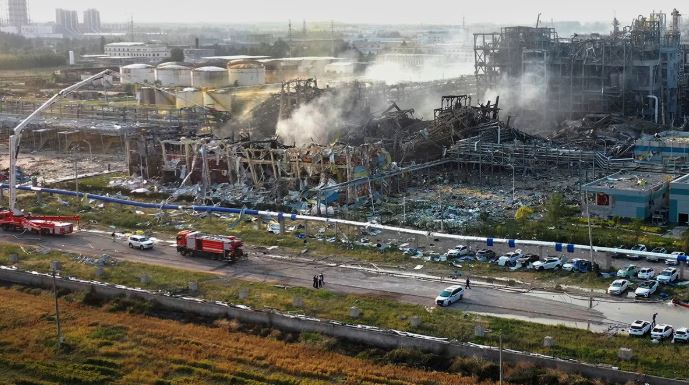
BEIJING, Jan 19: An explosion at a factory in north China’s Inner Mongolia Autonomous Region has killed two people, left eight missing and injured 84, local authorities said.

The explosion occurred at a plate plant of Baogang United Steel in western Baotou City, caused by the blast of a 650-cubic-meter saturated water and steam spherical tank. The incident resulted in a total of 84 injured people being treated in hospitals, and five in serious condition, executive vice mayor of Baotou told a press briefing.

The government has suspended production of the accident-hit plant and initiated city-wide safety overhaul of industrial and trade enterprises.

Investigations into the blast’s environmental impact are ongoing. Monitoring by environmental protection departments has so far detected no adverse effects on the surrounding air or soil quality.

Stay Connected

64FansLike
60FollowersFollow

Latest Reviews

Exchange Rates

USD - United States Dollar
EUR
1.14
GBP
1.34
AUD
0.70
CAD
0.71