Home Blog Page 2903

CGSS, HSF jointly organize roundtable discussion at Margala Hotel

DNA

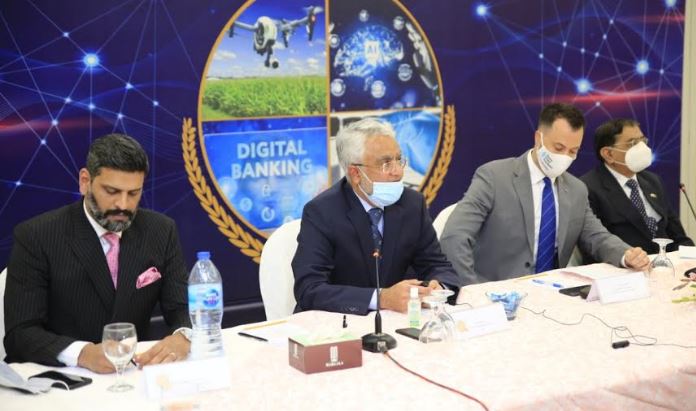
ISLAMABAD, NOV 9 – Center for Global & Strategic Studies (CGSS), Islamabad and Hanns Seidel Foundation, Pakistan jointly organized a Roundtable Discussion on “Technological Transformation in Pakistan: an Asset or Liability” at Margala Hotel, Islamabad.

The discussion commenced with the opening remarks of Mr. Ashfaq Ahmed Gondal, Former Federal Secretary of Information and Broadcasting & Senior Member Advisory Board, CGSS.

He stated that technological transformation has become a prerequisite for the development of a state. With the rapid developments in the field of science and technology along with increased digitalization across the globe, the traditional sphere of various sectors in Pakistan such as economy, governance, market-customer relations, healthcare, education and even security has largely transformed. It is therefore imperative to analyze these developments, discuss the challenges and their possible solutions equally.

DNA 9-6

Dr. Steffen Kudella, Resident Representative, Hanns Seidel Foundation, Pakistan in his welcome remarks stated that Artificial Intelligence will change the world more than anything else. This technological development is one of the greatest challenges of our future. Computers and robots are replacing more and more human jobs. If this trend continues, it could lead to an unequal society in which a very small elite of “technical experts” control the whole economy, and in which most humans become part of a huge unemployed mass. On the other hand, technological development provides a lot of reason to hope and has positive potential related to health care, traffic control etc. But the question arises, whom does technological development actually serve? Does it serve a tiny elite of people or does it serve all the people?

Mr. Tariq Malik, Former Chief Technology Officer, GHQ stated that the COVID-19 pandemic has accelerated change in Global economy. This pandemic is hastening digitization. When work is carried out remotely, it does not matter where it is done.  Consumers’ switch from physical retail towards e-commerce has quickened. Health-care and education services have shifted online. The world will emerge from 2020 into an era of more intense great-power competition. The labour market will adjust to a world with less spending in cities and more in suburbs, and off shore – online. We must invest in new ideas, AgriTech, Taxation, logistics, security and adopt digital technologies with built in security.

Mr. Ammar Jaffri, Director General, Center of Information Technology (CIT) stated that we need to have a bigger database to know who is doing what. COVID-19 has done something that we could never have done and digital transformation has been taken to next level. Block chain is seen skeptically today. It is like stopping food or electricity if the block chain is stopped. We need to ponder collectively, individual planning and work is not enough. Our digital footprints should be all over Pakistan including every village.

Barrister Waqas Aziz Qureshi, Senior Law Expert & Managing Partner, Transact Advisory Services stated that technology is unescapable. Technology is an ecosystem which has connectivity with other ecosystems. Pakistan Electronic Crimes Act is trying to catch anomalies in electronic transactions. But it is a new law which is trying to catch up. The technology is rampantly evolving but the law of Pakistan is struggling to match the pace with it.

Other panelists stated that we need to see where we stand in digital economy today. We need to create a culture of cyber security in Pakistan. We Pakistani’s are very good in the field of digitization. We have everything but the main thing that we are missing is that innovative people leave Pakistan. We just need to form a comprehensive policy in this regard. We also need to devise an emergency response team at national level. If we are not going to indigenous development than technological development can become a liability. Other panelists of the Discussion included:

  • Irfan ul Rehman, Former Head of Cyber Security Operations, PTCL
  • Shakeel Ahmad Ramay, Economic Expert
  • Ali Tanveer, Snr Cybersecurity Researcher, National Cyber Security Auditing and Evaluation Lab, NCSAEL
  • Tariq Khattak, Managing Director, Clan Strategies

The event was attended by approximately 30 participants and was moderated by Lt Col Khalid Taimur Akram (Retd), Executive Director, CGSS.

APNS President, Secretary General greet Mir Shakil-ur-Rahman on his release

DNA

KARACHI, NOV 9 – The APNS has congratulated Mir Shakil-ur-Rahman, Editor in Chief of the Jang /Geo group on his release on bail after 8 months by the Supreme Court of Pakistan.

Hameed Haroon President and Sarmad Ali Secretary General of All Pakistan Newspapers Society have stated that finally justice has prevailed and Mir Shakil-ur-Rahman has been granted bail by the Supreme Court.

Mir Shakil-ur-Rahman was incarcerated for over 8 months by NAB on trumped up charges of a 34 years old private property case.

His arrest and prolonged imprisonment was an attempt to muzzle the independence of media and silence the whistle blowers. It is appreciable that the media and human rights organisations strongly protested on the NAB action and finally the Supreme Court granted bail to him.

The APNS is confident that the freedom of press will be safeguarded and any attempt to encroach upon independence of media will be resisted in future as well.=DNA

====================

Biden begins transition as Trump refuses to concede

WASHINGTON, NOV 9 – US President-elect Joe Biden took the first steps on Sunday towards moving into the White House in 73 days, as Donald Trump again refused to admit defeat and tried to sow doubt about the election results.

With congratulations pouring in from world leaders and supporters nursing hangovers after a night of celebrations, Biden and Vice President-elect Kamala Harris announced they would receive a joint briefing on Monday in Wilmington, Delaware from their transition Covid-19 advisory team.

Biden would then deliver remarks on coronavirus and economic recovery. They also launched a transition website, BuildBackBetter.com, and a Twitter feed, @Transition46.

Meanwhile, Trump played golf at his course near Washington, the same place where he was on Saturday when news broke that Biden had secured enough Electoral College votes for victory.

“Since when does the lamestream media call who our next president will be?” Trump complained in a tweet on Sunday.

Trump, who has no public events scheduled for Monday, plans to file a string of lawsuits in the coming week, according to his lawyer Rudy Giuliani, who said he had “a lot of evidence” of fraud.

But former president George W. Bush said the “outcome is clear” and added that he had called “president-elect” Biden and Harris to extend his congratulations.

Bush said in a statement that “the American people can have confidence that this election was fundamentally fair […] We must come together for the sake of our families and neighbors, and for our nation and its future.”

Biden’s transition website lists four priorities: Covid-19, economic recovery, racial equity and climate change.

“The team being assembled will meet these challenges on Day One,” it said in a reference to January 20, 2021, when Biden will be sworn in as the 46th president of the United States.

Biden, who turns 78 on November 20, is the oldest person ever elected to the White House. Harris, 56, a senator from California, is the first woman, first Black person and first South Asian person to be elected vice president.

Biden plans to name a task force on Monday to tackle the coronavirus pandemic, which has left more than 237,000 people dead in the United States and is surging across the country.

He has also announced plans to rejoin the Paris climate accord and will reportedly issue an executive order on his first day in office reversing Trump’s travel ban on mostly Muslim countries.

Biden has vowed to name a cabinet that reflects the diversity of the country, although he may have trouble gaining approval for more progressive appointees if Republicans retain control of the Senate — an outcome that will depend on two runoff races in Georgia in January.

‘Accept the inevitable’

Biden, who after John F. Kennedy is just the second Catholic to be elected US president, attended church on Sunday morning in his hometown of Wilmington, Delaware.

He also visited the graves of his son, Beau Biden, who died of brain cancer in 2015, and his first wife and daughter, who died in a 1972 car accident.

The Trump campaign has mounted legal challenges to the results in several states, but no evidence has emerged of any widespread irregularities that would affect the results.

Giuliani told the Fox News show “Sunday Morning Futures” that Trump’s team would file a lawsuit in Pennsylvania on Monday against officials “for violating civil rights, for conducting an unfair election (and) for violating the law of the state”.

“The first lawsuit will be Pennsylvania. The second will either be Michigan or Georgia. And over the course of the week, we should get it all pulled together,” Giuliani said.

First Lady Melania Trump also chipped in Sunday, tweeting: “The American people deserve fair elections. Every legal — not illegal — vote should be counted.”

Speaking on CNN’s “State of the Union” on Sunday, senior Biden advisor Symone Sanders dismissed the court challenges as “baseless legal strategies”.

Biden received nearly 74.6 million votes to Trump’s 70.4 million nationwide and has a 279-214 lead in the Electoral College that determines the presidency.

Biden also leads in Arizona, which has 11 electoral votes, and Georgia, which has 16. If he wins both, he would finish with 306 electoral votes — the same total won by Trump in 2016 when he upset Hillary Clinton.

Only two Republican senators, Mitt Romney and Lisa Murkowski, have congratulated Biden. Democratic Representative James Clyburn of South Carolina said the Republican Party has a “responsibility” to help convince Trump it is time to give up.

Romney, who voted to convict Trump at his impeachment trial, said the president will eventually “accept the inevitable”.

The Utah senator added that he “would prefer to see the world watching a more graceful departure, but that’s just not in the nature of the man”.

‘Do not concede’

Trump ally Senator Lindsey Graham of South Carolina said the 74-year-old president should keep fighting.

“We will work with Biden if he wins, but Trump has not lost,” Graham said on Fox News. “Do not concede, Mr President. Fight hard.”

In a victory speech on Saturday, Biden promised to unify the bitterly divided nation and reached out to Trump supporters, saying, “They’re not our enemies, they’re Americans.”

“Let’s give each other a chance,” he said. “Let this grim era of demonisation in America begin to end, here and now.”

Financial markets welcomed Biden’s victory, with shares up in Tokyo and Hong Kong, and US futures up on Wall Street on Sunday evening.

The leaders of Britain, France, Germany, Italy, Spain and other European countries sent congratulations to Biden, along with Australia, Canada, India, Indonesia, Israel, Japan and South Korea.

Mexican President Andres Manuel Lopez Obrador said he would wait until all legal challenges are resolved, while Trump ally President Jair Bolsonaro of Brazil has yet to make any official comment.

PAF launches a new song Shaheen-o-Mahi on Iqbal day

DNA

ISLAMABAD – On the auspicious occasion of Iqbal Day, Directorate General Public Relations Air Force has launched a new motivational song “Shaheen-o-Mahi.”

The song is not only a tribute to the Poet of the East Dr. Allama Muhammad Iqbal but also depicts Iqbal’s vision for the guardians of aerial defence.

The main theme of this song is to acquaint the youth with the Iqbal’s philosophy of self-realization and bravery. The song has been sung by the renowned Pakistani vocalist Zaib Bangash.

World Science Day for Peace and Development promotes solidarity to ensure peaceful and harmonious development of humankind

SCO Secretary General, Vladimir Norov

World Science Day for Peace and Development is celebrated every year on November 10 to raise awareness about the benefits of science around the world, and also serves as a reminder to the international community for the need to use advancements in science and technology for peaceful and harmonious development for the benefit of human civilization.

By building bridges between science and society, World Science Day for Peace and Development aims to provide information on new trends in science to citizens, while highlighting the role of scientists in broadening our understanding of the planet, which we call our common home. Today, the Earth faces a threat from humans themselves as they are intensively engaged in such activities which pollute the environment with their products. For example, the Global Sustainability Report 2019 and the Sustainable Development Goals Report 2019 call for an urgent change in the relationship between people and nature.

Among the objectives of celebration of this Day are the renewal of national and international commitments to science for peace and development and the intention to emphasize the responsible use of science for the benefit of society; raising public awareness about the importance of science and closing the gap between science and society, involving the general public in discussions on emerging scientific issues. This day also emphasizes the importance and relevance of science in our daily lives.

Choosing the World Science Day: how it happened?

As the UN agency for education, science and culture, UNESCO (United Nations Educational, Scientific and Cultural Organization) strives for peace through international cooperation in these fields.

There are wonderful words in the Preamble of the UNESCO’s Constitution: “since wars begin in the minds of men, it is in the minds of men that the defences of peace must be constructed.”

The General Conference of UNESCO, took place in Budapest on 15 October 2001, and it examined the provisional agenda at its 3rd plenary meeting and decided, on the basis of report of its General Committee, to include in its agenda item 5.12 which was the “Proclamation of a world science day for peace and development”.

The national delegations advocating the celebration of World Science Day pointed out that the primary reason for celebrating World Science Day for Peace and Development was the enormous importance of the role of science and scientists in building sustainable societies.

Member States of UNESCO, recalling UNESCO’s ethical mission to achieve harmonious and peaceful development, pointed out that science has an impact on peace and development and that it should be used to build peaceful and sustainable societies.

The first World Science Day for Peace was celebrated worldwide under the auspices of UNESCO on November 10, 2002.

In his address on the occasion of the World Science Day for Peace and Development on 10 November 2002, UNESCO Director-General Koïchiro Matsuura addressed the important issues and challenges of ensuring peace and development in the world that have not lost their relevance, are on the agenda of all humankind today and could become even more acute in the current unprecedented scale and devastating impact of the coronavirus pandemic COVID-19.

“The true guarantee of peace is to ensure that the benefits of science are enjoyed by all nations and all peoples equally. It is my hope that the first “World Science Day for Peace and Development” will bring the ideas of unity, shared responsibility and joint action to harness science for peace and for the benefit of humanity as a whole, in a spirit of respect for cultural diversity and freedom. World Science Day is thus an opportunity to reaffirm science’s commitment to peace and development in the world,” said the then Director-General of UNESCO.

The theme for World Science Day for Peace 2020 is “Science for and with Society”.

In 2020, UNESCO World Science Day for Peace is dedicated to the theme “Science for and with society in dealing with the global pandemic”.

UNESCO states that the COVID-19 pandemic “has created a parallel pandemic of dangerous misinformation and rumors in the form of conspiracy theories that include fictitious stories about the origin of the virus, how it is treated and who is allegedly responsible for its spread.”

“Conspiracy theories cause significant harm to people, their health and also their physical safety. They reinforce and legitimize misconceptions about the pandemic and reinforce stereotypes that can fuel violence and violent extremist ideologies,” said UNESCO Director-General Audre Azule.

Throughout the unprecedented crisis associated with the Coronavirus pandemic, UNESCO, as a UN agency with a mandate in science, has sought to strengthen international scientific cooperation, which is a key factor in the fight against the global public health crisis.

According to UNESCO’s observations, more than 100 countries have closed schools throughout the country in the context of the pandemic, affecting more than half of the world’s students. That is why UNESCO makes every effort to introduce distance education, especially for developing countries.

As part of this year’s World Science Day celebration, UNESCO is organizing a round table on“Science for and with Society in dealing with COVID-19.”

The SCO attaches special importance to cooperation with the UN and its specialized agencies. The Memorandum of Understanding between the SCO and UNESCO signed on June 10, 2018, which touches upon important directions of joint work in the spheres of education, science and culture, is being successfully implemented. It should be noted that strong partnership between the SCO and UNESCO is expanding and strengthening each year, covering new areas.

Solidarity   of the International community in understanding the need to use science in the fight against COVID-19:

The need for solidarity of the international community in the more effective use of science and technology in the fight against the COVID-19 pandemic was strongly reflected in the statement of the United Nations Department of Economic and Social Affairs (UNDESA) on the occasion of the 50th anniversary of the Earth Day on April 22, 2020 at the UN headquarters in New York.

The response to the COVID-19 pandemic requires much closer cooperation between scientists and policymakers, and the fruit of scientific research, including potential vaccines, must be widely disseminated, UNDESA said in a statement.

Actions that ensure public confidence in science and refute harmful misinformation are crucial. According to UNDESA, the scientific assessments for COVID-19 are similar around the world, but the timing and response vary greatly from country to country. The functioning of the science-policy interface, where it exists, needs to be reviewed and created where it is weak or absent, in order to maintain public confidence in science and government.

Public trust in science is essential for successful science-based policies. Where public trust is high and where incorrect and harmful information is effectively challenged by scientists, action is likely to be most effective.

In the case of the COVID-19 pandemic, all people must trust scientific leadership if they want to change their behavior and reduce the rate of transmission. Continuous flow of public information has proven effective in encouraging people to stay indoors to limit the spread of the disease.

The pace of scientific discovery has been accelerated by progress in “open science”, including through barrier-free research publications, paid subscriptions and early sharing of research and data. For example, early public online sharing of the virus genome by scientists in China allowed researchers in Germany to quickly create polymerase chain reaction (PCR) test kits, which were then available worldwide by the World Health Organization (WHO).

The results of “open science” should lead to universal access to solutions. UNDESA also notes that earlier assessments by the scientific community contained warnings, and that responding to these recommendations would lead to improved preparedness within and between countries, accelerating an effective response to the current pandemic.

The pandemic thus stimulated the development of all forms of what is commonly referred to as “open science” – single platforms where observation and experimentation data are collected, open access to publications, open expertise, and even open (remote) access to scientific infrastructure. “Openness” in all its aspects has been actively promoted by international organizations, including UNESCO.

Scientific and technical cooperation within the SCO

Cooperation in science and technology is one of the key areas of SCO activities. It should be noted that the SCO member-states, recognizing the importance of the need to improve cooperation in science and technology, signed the Intergovernmental Agreement on Scientific and Technical Cooperation on September 13, 2013.

This document, in accordance with the national legislation of the parties, provides for cooperation in areas such as environmental protection and rational use of natural resources, life sciences, agricultural sciences, Nano systems and materials, information and telecommunication technologies, energy and energy conservation, earth sciences, including seismology and geology, etc.

In the “SCO Development Strategy 2025” it was specifically noted that the member states, in development of the Agreement between the governments of the SCO member states on scientific and technical cooperation in 2013, will give priority to programs and projects of innovative cooperation, improvement of the contractual legal framework, including the development and implementation of a plan of scientific and technical partnership within the SCO.

In November 2019, the fifth Meeting of Heads of Ministries and Departments of Science and Technology was held in Moscow to further develop scientific, technical and innovation cooperation between the SCO countries. The participants agreed to develop a new “Roadmap” for cooperation of research institutions of the SCO member states for 2021-2023 in order to intensify scientific and technical partnership in the SCO region.

In order to boost cooperation, the parties hold various contests and events to popularize science and technology among the youth and the younger generation.

In recent years, the SCO held a Youth Innovation and Entrepreneurship Contest for the SCO member states in 2018 and a seminar on technopark management in 2019 in China. In 2019 in Tashkent, the capital of Uzbekistan, the international Week of innovative ideas “InnoWeek” was held.

On October 27, 2020, the 1st online “SCO startup Forum” was held at the initiative of the Indian side. The event was attended by more than 1500 representatives from around the world, including the countries of the “SCO family”.

Taking into account the importance of joint development and promotion of scientific and technical cooperation, the Chinese side proposed to establish a Technology Transfer Center of the SCO member states in Qingdao. The sides agreed to jointly study the issue of establishing this Center.

The SCO attaches great importance to the development of youth, first of all, through accessible, high-quality, innovative education that allows to realize the full potential of the individual.

During the first organizational meeting of the SCO University Coordination Council held on June 30, 2020, the member states discussed cooperation in the educational sphere, taking into account the great potential of the SCO University as a reliable platform for the development of all forms of education in the SCO region.

It is known that the main mission of the SCO University is to provide coordinated training of highly qualified personnel in professions of priority interest to the economic and social development of SCO member states and to expand integration processes in education, science and industry.

During the fifth meeting of heads of ministries and departments of science and technology of SCO member-states, the initiative of holding youth events (forums, contests, etc.) on a regular basis was supported and the proposal of the Indian side to hold in 2020 the Forum of SCO Young Scientists and Innovators in India was supported.

In accordance with this decision, it is currently planned to hold the first SCO Conclave of Young Scientists in Hyderabad on November 24-28, 2020 within the framework of SCO Young Scientists Forum.

This Conclave is designed to bring together the innovative young minds of SCO member states on a common platform in a virtual format to discuss issues and means of implementing transformational change to address social problems through scientific and technological impact.

It will also facilitate the fusion of ideas to address specific problems of the SCO member states. Thus, the conclave counts on the scientific identity of the SCO through the formation of a network of young talents of these member states.

In today’s environment, scientific and technological cooperation will help strengthen the capacity to withstand global challenges and threats, including the emergence of infectious pandemics. Thus, in the Statement of the Heads of SCO Member States on joint counteraction to the threats of epidemics in the SCO region adopted at the SCO Summit in Qingdao in June 2018, the SCO leaders noted with deep concern that the threat of infectious disease epidemics remains relevant in the SCO region due to growing regional and global integration processes, increased cross-border movement of people, trade liberalization.

The document also noted that it is necessary to use mobile units, strengthen the capabilities of national laboratories, develop scientific centers, conduct joint scientific research and develop new means of diagnostics and prevention of infectious diseases to develop the anti-epidemic potential of member states.

At the meeting of the Council of the Ministers of Foreign Affairs of the SCO member states in Moscow on September 10, 2020, the ministers stated that under the conditions of a complex sanitary-epidemiological situation, the SCO, based on the principles of mutual trust, mutual benefit, equality, mutual consultation, respect for diversity of cultures and striving for joint development, convincingly reaffirmed its significant potential as an effective platform for responding to emerging challenges, building work to overcome the negative consequences of the COVID-19 pandemic.

The need to encourage the international community to follow a common course in jointly confronting the spread of coronavirus, opposing politicization and labelling was also emphasized.

The pandemic fostered a new form of international scientific and technical cooperation by making it online and by encouraging joint efforts to combat coronavirus. This practice of large-scale joint search for solutions in the conditions of developing open science can be preserved and expanded in the future.

At the SCO Heads of State Summit on November 10, 2020, it is planned to adopt a Comprehensive Plan of Joint Measures of the Shanghai Cooperation Organization Member States to counter threats of epidemics in the region, which provides for joint scientific research, including development of vaccines and diagnostic test systems for the most urgent infectious diseases in the region.

In addition, it is planned to develop a regional network of reference laboratories of SCO member states in the field of sanitary and epidemiological well-being, as well as, at the Meeting of Heads of Services of SCO member states responsible for ensuring sanitary and epidemiological well-being it was agreed to create a coordination mechanism to counter threats to sanitary and epidemiological well-being.

Chinese envoy praises Pakistan army’s efforts for regional peace

RAWALPINDI, NOV 9 (DNA) – Nong Rong, newly arrived Chinese Ambassador to Pakistan called on General Qamar Javed Bajwa, Chief of Army Staff (COAS) at GHQ.

Matters of mutual interest including regional security issues were discussed during the meeting.

The two noted the exceptional mutual relations between both countries and pledged to further improve the same.

Visiting dignitary acknowledged and appreciated Pakistan’s contributions for conflict prevention in the region.=DNA

Jannat Mirza Reveals The Reason For Moving to Japan – Details Inside!

Jannat Mirza is the social media sensation who gained popularity with her TikTok videos. Her beauty captures everyone’s attention instantly and that’s the reason she got more than 10 million followers on TikTok. Jannat Mirza hit the fame with her entertaining content including Bollywood lip-syncs, slow-motion clips, and parodies.

Right after the day she announced reaching a milestone of 10 million followers, the TikTok entertainment app got banned. However, Jannat Mirza then decided to move to Japan. The news surfaced on social media that Jannat has said goodbye to Pakistan due to the ban of TikTok app.

Here is Why Jannat Mirza Moved to Japan!

Jannat has posted a video with clarification about why she actually left Pakistan and moved to Japan. As soon as she took it to Instagram, the video has been going viral on social media. Check out here what she revealed in the video!

As per the details, Jannat Mirza expressed in this video that every channel broke the news that I have left Pakistan for good. Moreover, my statement was linked to the ban of TikTok and that had nothing to do with the reality.

While explaining her perspective further, Jannat said that I decided to go to Japan because Pakistan is an insecure place for women. She added that I got so much disturbed to learn how harassment and rape cases are dealt with in our society.

Moreover, Jannat said that she will be coming back to Pakistan soon and will be returning to Japan after 3 to 4 months. She has plans to continue with her studies in Japan with a major in Film. After completing her studies, she will be coming back to Pakistan and work behind the camera as well.

Sale of Pakistani gem products get increased in Chinese market

BEIJING, NOV 9 (DNA) – Building brands, selling goods of high quality and co-working with China to design and produce – Pakistani gem products have embarked on a different path of development in the Chinese market ever since the second phase of Pakistan-China Free Trade Agreement (FTA-II) came into effect.

” I use high quality raw stones and high standards of workmanship to make jewelry, providing consumers the best,” said Aqeel Ahmed Chaudhry, founder of WINZA from Pakistani gemstone firm Cosmo Enterprises,  while talking to China Economic Net (CEN) during the third China International Import Expo (CIIE).

Chaudhry, who has been living in China for more than a decade, launched WINZA jewelry store in Shanghai’s glitzy business district, producing crowns for champions of International Super Model Contest, Miss Earth and other competitions.

Seeking a foothold in the increasingly competitive jewelry market, Aqeel Ahmed Chaudhry has his own strategy. First is to build a brand. “80% of the establishment of a brand depends on people and 20% on products.

Branding is not only about selling things, but also about inheritance, which requires our team to make gems with high quality and high standards, and inject family culture into the inheritance from generation to generation. Our products are designed by my younger sister and 4 Chinese designers.”

“The second point is the strict selection of raw materials. We select the highest quality raw stone which must be natural, clean and of beautiful color; then we purchase them with high price.

Third, high standards of production, control of materials, design, etc. must be adopted. We dare to compete with the world’s big brands. Although our company is small, the quantity of products is limited, but it does not mean that the quality is poorer than others,” he added.

At present, the company’s main business is in China. “We import raw materials from Pakistan, Sri Lanka and other countries, and process and sell them in China.” Touching on the sales of Pakistani gems in China, Chaudhry said that Pakistani ruby sales in China increased by about 30% over the previous year.

Although the sales of emeralds are not as good as rubies, they are unique to Pakistan and we want to promote them more, he added. Chaudhry, also the director of the Jewelry Committee of Shanghai Mineral Fossil Association, wants to bring Pakistani jewelry culture to more people. “Pakistan is our IP; we want more people to know our country.”

He said that next year, he plans to open another 2-3 retail stores in China, and plans to open 20 retail stores in Beijing, Shanghai, Guangdong, Shenzhen and other big cities in the next five years.

In addition to relying on the brand strategy of climbing up the value chain, winning with cost performance is another path explored by Pakistani gems enterprises.

“We’ll take this,” a Chinese buyer said at booth 6.2 of Pakistan Gem Pavilion during the CIIE. The Chinese buyer told Economic Daily· China Economic Net that the jewelry products purchased from last year’s CIIE were good.

This time he specially bought one piece for his wife. He thinks that Pakistani tourmaline has both favorable price and good quality. “The tourmaline with good quality sold for more than RMB 10,000 at other booths, while our Pakistani brother sold this one for only RMB 2,000, it’s with relatively few impurities,” the buyer said.

“Chinese people prefer colorful tourmaline. This is the third time that we’ve attended CIIE. I saw the potential of gem products in the Chinese market when I attended the first CIIE and decided to participate in the second and third sessions,”Faizan Ahmed from Shakeeb Gems told Economic Daily·China Economic Net.

Faizan said he made RMB 70,000 in sales during the six-day CIIE last year. “More importantly, we have gained potential customers and signed memorandums of cooperation with three purchasers.” He said that since 2006, the company’s sales in the Chinese market have been increasing year by year, doubling from USD 30,000 in 2006 to USD 60,000 last year.

“We came to Shanghai from Pakistan just for the CIIE. Although we need to be quarantined for 14 days after arriving in China, we must come because we have not participated in any exhibitions for a long time, and we think China is safer than any other country in the current pandemic situation, so we come to look for business opportunities.” Faizan said.

This time Faizan brought Pakistan’s tourmaline, lapis lazuli, garnet, sapphire, ruby and other products to the expo. Speaking of the advantages of Pakistani gem products, he said that Pakistani products are handmade and the price is about 25%-30% cheaper than that in the Chinese market.

Second, the CPFTA Phase II reduces Pakistan’s gemstones export tariff from 17%-32% to zero, which brings benefits to Pakistan’s gemstone exports. Third, with many years of experience in gem sales in China, they have a better understanding of Chinese culture and consumer preferences, and can provide customization according to the needs of Chinese buyers.=DNA

=================

NEPRA increases power tariff by Rs0.48 per unit

ISLAMABAD : The National Electric Power Regulatory Authority (NEPRA) raised power tariff by Rs 0.48 per unit, putting an overall burden of Rs5 billion on the consumers.

According to NEPRA, the increase in tariff by Rs 0.48 per unit was made on account of variations in fuel charges for the month of August 2020.

The increase of Rs0.48 per unit will be applicable to all consumer categories except lifeline consumers of all distribution companies, said the power regulator. However, it will not be applicable to the consumers of K-Electric.“The said adjustment shall be shown separately in the consumers’ bills on the basis of units billed to the consumers in the month of August 2020 by the XWDISCOs. XWDISCOs shall reflect the fuel charges adjustment in respect of August 2020 in the billing month of November 2020,” read a notification issued by NEPRA.

Earlier on October 8, the National Electric Power Regulatory Authority (NEPRA) had notified an increase of Rs0.83 per unit in power tariff on account of variations in fuel charges for the month of July 2020.

The increase of Rs0.83 per unit would be applicable to all consumer categories except lifeline consumers of all distribution companies, according to the power regulator.

“The said adjustment shall be shown separately in the consumers’ bills on the basis of units billed to the consumer in the month of July 2020 by the XWDISCOs (Ex-Wapda Distribution Companies),” the notification issued by the NEPRA had read.

China’s cooperation sought in reforming Pakistan’s cotton Industry: PCGA

ISLAMABAD, NOV 9 (DNA) – In order to bring qualitative reforms in its acre per yield in Pakistan, China could help Pakistan by providing technology that can improvise seed production and promote mechanization, ex vice chairman Pakistan Cotton Ginners Association (PCGA) Asim Saeed said.

While talking to Gwadar Pro, he stated that the current challenge facing the Pakistani cotton industry is that it cannot obtain the latest technology from local researchers, nor can it attract international companies to settle in.

Technology in the seed, machinery, plantation and picking up process, and ginning of cotton are with low quality, which means Pakistan is still using 70 year-old technology in its ginning industry that leads to poor output.

Despite the decline in cotton production in Pakistan, the number of cotton yarn exported to China has still increased in recent months.

Asim Saeed explained that the CPEC has had a positive impact on it. “Raw materials of yarn are available in our country and Pakistani yarn is enjoying zero tariffs in the Chinese market meanwhile there is a lot of demand of Pakistani yarn in the Chinese market.

If we improve our quality and meet Chinese standards then, under the new tariff regime, we can substantially enhance our cotton products to China.”

Pakistan is emphasizing to reduce dependence on imported cotton by cultivating long-staple cotton. According to Asim Saeed, Pakistan is quite suitable for growing long-staple cotton.

“We have one of the best soil conditions and canal systems for growing cotton; the climate is favorable and we are hard-working nation that has rich experience in growing cotton from generations to generations.

We have all the capacity and potential to reach target of 20 million bales. Once international seed providers come to Pakistan, they will see a huge advantage.”

He further called on government, private sector and international supervision to make joint efforts to execute measures to enhance the cotton production. Policies for providing cotton farmers with enough profitability are also needed.=DNA

===============

Stay Connected

64FansLike
60FollowersFollow

Latest Reviews

Exchange Rates

USD - United States Dollar
EUR
1.17
GBP
1.35
AUD
0.67
CAD
0.72