
Home Blog Page 2898

Ministry cancelled 15 trade organisations ahead of FPCCI Polls on non compliance

DNA

KARACHI –  Federal Secretary Commerce Sualeh Faruqui has upheld the decisions of Director General Trade Organizations (DGTO) in its November 6th order regarding the cancellation of licences of Women Chamber of Commerce and Industry, Quetta, other eight Trade Associations of Balochistan.

Balochistan High Court in its order of Oct 2, contempt application directed that Secretary Ministry of Commerce should decide the appeals of Pakistan Transport Association, Ghee Exporter Association of Pakistan, Pakistan Scrap Association, Scrap Importer Association, Gas Heater Importer Association of Pakistan, All Pakistan Copper Exporter Association, All Pakistan Land Route Custom Agent Association and All Pakistan Glass Manufacturer Importers and Exporters Association by or before Nov 9, in accordance with law after hearing all concerned.

In pursuance of the order of Balochistan High Court hearing of appeals of four of trade organizations was scheduled on Nov 4, and hearing of other four trade organisations was scheduled on Nov 5. However, hearing of all the appeals was held on Nov 4, on the request made by the counsel for all the petitioners.

The background of the case is that all the eight trade organizations were granted licence by the DGTO in 2017 under the Trade Organizations Act (TCA), 2013

However, the licence of these trade organizations were cancelled by the office of DGTO in 2018 on the grounds that they had failed to meet the terms and conditions of the licence as stipulated in rule 6 of Trade Organizations Rules (TOR), 2013. During the hearing, the counsel for the trade organizations pointed out that the licence of the trade organisations were cancelled by the office of DGTO despite provision of all the requisite documents mentioned in the show cause notices issued by the DGTO. The representatives of the DGTO denied that the trade organizations had submitted all the required documents and the licences were cancelled due to the failure of these trade organisations to meet the terms and conditions of a licences as per rule 6 of ToR 2013. In order to adjudicate the competing claims, subsequently appeals of all trade organisations were considered individually.

The case of Gas Heater Importer Association of Pakistan was considered in the first instant. The Association was issued a show cause notice on March 13, 2018 under section 7 of TOA, 2013 stating that discrepancies were found in some of the documents provided by the Association, which relate to post licensing requirements of a trade organization under TOR 2013. Moreover, opportunity of hearing was also provided to the Association on February 27, 2018. However, the office of DGTO canceled the licence of the Association on April 04, 2020 mainly on the following grounds ;(i) Association had failed provide documents relating to opening of bank account in its name;(ii) Association had failed to provide minutes of the Executive Committee meeting in which the appointment of Secretary General approved;(iii) Association had provided some documents as provided by All Pakistan Glass Manufacturer Importer and Exporters Association, Pakistan Alloy Rim Association, Submersible Pump Importers Association of Pakistan and All Pakistan Copper Importer Exporter Association.

The Counsel for the Association pointed out that they had submitted the resolution of the HR committee regarding appointment of Secretary General along with notification of appointment of Secretary General Moreover, he argued that there is no requirements in the TOR, 2013 for submission of minutes of meeting of Executive Committee. During the hearing he also submitted a letter of Soneri Bank stating that the Association has been maintaining a bank account with them from November 22, 2019. He also clarified that the Association had not submitted same documents as provided by other Associations. The representatives of DGTO showed documents which were same as other Associations but they were submitted at the time of grant of licence and not after issuance of show cause notice.

Rule 6 of TOR 2013 stipulates that a trade organization has to maintain bank accounts in its name in a scheduled bank. It is evident that the Association had failed to open its bank account prior to cancellation of its licence as required under law. As rule 6/2 TOR, 2013 clearly stipulates that the violation of any

of the terms and conditions of the licence shall make the licence liable for cancellation, the decision of DGTO to cancel licence of Gas Heater importer Association of Pakistan is valid.

The cases of other Associations were also considered on the same pattern and found that they were not eligible for a licence.

After hearing the petitioners at length, examining the statements, official record and other documentary evidence, perusing the relevant provisions of law and rules and on the basis of facts and reasons, the decisions of the DGTO was to cancel the licences of Pakistan Transport Association, Ghee Exporter Association of Pakistan, Pakistan Scrap Association, Scrap Importer Association Gas Heater Importer Association of Pakistan, All Pakistan Copper Exporter Association. All Pakistan Land Route Custom Agent Association and All Pakistan Glass Manufacturer Importers and Exporters Association.

Regarding Women Chamber of Commerce and Industry, Quetta, it was informed that chamber president Sadia Baloch filed an appeal in BHC, under section 21(4) of the TOA 2013 against the order of the regulator of March 28, 2019. The High Court issued an order on October 7, 2020 which states that the appeal filed by appellant under section 21(4) of the Act is considered as an appeal under section 21(2) of the Act. The chamber was granted licence on Aug 31, 2010 which got renewed in 2013 for five years. Section 6(2) of TO Act, 2013 requires resubmission of all licence applications 90 days to expiry of licence. The cut-off date for submission of application for renewal of the licence was May 30, 2018. The Chamber did not apply for renewal of its licence for further five years within the time period. DGTO had cancelled the licence which was challenged in the BHC, which referred the case to Commerce Secretary for an informed decision. Secretary Commerce after hearing the party decided that the decision of DGTO was in accordance with the prevalent law.

Similarly Director General Trade Organisations (DGTO) also cancelled six trade bodies namely Pak Iran Joint Chamber, Chaghi Chamber of Commerce and Industry Musakhel Chamber of Commerce Industry, Qilla Saif ullah Chamber of Commerce and Industry, Pakistan Allowy Rim Association, Sumbersimble Pumps Importers Association and Pakistan Carbon Solvent importers associations due to non comply of Rule 6 of the trade organisations act in its November 5th order passed by the regulator under section 7 of the trade organisations act.
Pakistan, Iran to make joint efforts for regional peace and stability

DNA

ISLAMABAD, NOV 11 – Mohammad Javad Zarif, Minister of Foreign Affairs of Iran, who is in Pakistan for an official visit, met today with his Pakistani counterpart Shah Mahmood Qureshi.During the meeting, the two sides discussed the development of bilateral political, economic and international cooperation between the two countries.During the meeting, Dr. Zarif referred to the deep historical and cultural interests between the nations of Iran and Pakistan.

He expressed the readiness of the Islamic Republic of Iran to comprehensively develop relations with Pakistan. Referring to the decision of the Islamic Republic of Iran to develop border crossing points with Pakistan, the Minister of Foreign Affairs welcomed the decision of the government to open new border markets to develop trade relations between the two countries and announced his country’s readiness to agree on new models of trade.Referring to the importance of strengthening the security of the borders of the two countries, Dr. Zarif reminded the need for continuous consultations in this regard. 

Pakistani Foreign Minister Shah Mahmood Qureshi also mentioned Iran as an important friend and neighbor of Pakistan and informed His Excellency about the practical steps taken by the Pakistani government to develop trade and economic cooperation with Iran and said that the Pakistani government has decided to exchange And help cross-border exports between the two countries.

The Pakistani Foreign Minister stressed the importance of establishing peace and security on the Iranian-Pakistani border and stressed that the country would not allow hostile actions against Iran.Regional developments, issues of the Islamic world, countering Islamophobia, regional cooperation, especially the strengthening of the Economic Cooperation Organization (ECO), joint fight against terrorism and illegal immigration, and facilitating pilgrimages are among the other topics discussed by the two foreign ministers. The formation of a joint economic commission in the near future is among the other issues discussed and the agreement reached between the foreign ministers of Iran and Pakistan.

Initiative of President of Uzbekistan will open a new page in Afghan policy of SCO

The proposal of the President of the Republic of Uzbekistan ShavkatMirziyoyev to develop and adopt a Plan for the socio-economic reconstruction of Afghanistan as part of the practical implementation of the Roadmap for further actions of the SCO-Afghanistan Contact group will serve for further consolidation of the SCO countries’ efforts in promoting the long-awaited peace in Afghanistan.

The initiative of the President of Uzbekistan ShavkatMirziyoyev once again confirms the firm commitment of the Republic of Uzbekistan to achieving long-term and sustainable peace in the neighboring country, and is a logical continuation of a consistent friendly policy towards Afghanistan.

Being convinced that the security and economic prosperity in the entire vast SCO region are inextricably linked to peace and stability in this long-suffering country,Uzbekistan has always supported the Shanghai cooperation organization to play an important role in resolving the conflict in Afghanistan.

In 2004Uzbekistan as a chairman to SCO invited former Afghan President Hamid Karzai to the Organization’s summit in Tashkent. Since then, leaders of the Islamic Republic of Afghanistan have been participating every SCO summit. And as a logical continuation, Afghanistan received the status of an observer statein SCO in 2012.

It is symbolic that the initiative to establish the SCO-Afghanistan Contact Group, formalizedduringBeijing summit in November 2005, was announced in Tashkent during the summit of the SCO statesleaders in 2004.

The creation of the SCO-Afghanistan Contact Group made it possible to establish a specific consultative dialogue with the Islamic Republic of Afghanistan on the issues of the military-political situation in Afghanistan, its impact on regional security, assistance of the SCO member states to Afghanistan in ensuring peace, security and economic reconstruction, and enhancement of regional cooperation. Most signifficantly, due to this format of interaction, the SCO member states effectively coordinate effortsin containing challenges and threats emanating from Afghanistan, preventing their spread in the space of the SCO member states.

In addition, and most importantly, the regular dialogue within the Contact Group contributed to the development of a regional consensus in the SCO space on the basic principles for resolving the situation in Afghanistan, which, in turn, today plays a decisive role in the formation of common approaches of the international community regarding peacebuilding in the Islamic Republic of Afghanistan.

The consensus in the SCO space was enshrined in the «Road Map» of the “SCO-Afghanistan» Contact Group adopted in June 2019 in Bishkek, where all SCO member states declared their commitment to the key principles of resolving the situation in Afghanistan. It was noted that there is no alternative to resolving the conflict through political dialogue and the implementation of an inclusive peace process led by Afghans themselves. There was also highlighted importance of rebuildingthe afghan economy for establishing peace and stability in the country, provision of security and sustainable development of the region as a whole.

The Road Map has become an important political document that also confirmed the readiness of the SCO member states to support the efforts of the government and people of Afghanistan in such areas as ensuring peace, security, cultural and humanitarian development and economic reconstruction of the country.

In this regard, the adoption of the Plan for the socio-economic reconstruction of Afghanistan will undoubtedly open a new page in the SCO’s afghan policy and will make it possible to put into practice the implementation of the Roadmap of the SCO-Afghanistan Contact group.

First, uniting efforts within the SCO to help Afghanistan restore a peaceful economy through the implementation of social, economic and humanitarian programsand projects will help to achieve a long-term and sustainable peace in this country, to create the necessary socio-economic base for a peaceful solution to the afghan crisis. Consequently, there will be created alternative sources of income for the population, as well as the necessary incentives for the transition of the afghan people to a creative and peaceful life.

Secondly, consolidated regional support to Afghanistan in economic development will have an important role in maintaining the capacity of the government of Afghanistanto fulfill its social obligations to the population, meet the urgent needs of citizens for stability and security, and ensure peaceful development in the post-conflict period.

The creation of a viable afghan economy will guarantee the continuation of reforms that began 19 years ago in the area of rule of law, protection of human rights,strenghtening democratic institutions, civil society and modernization of public administration.

Third, the implementation of joint projects within the framework of the SCO will serve both stabilization of the situation in Afghanistan and restorationof the role of this country as a key link in ensuring the interconnectedness of the Eurasian continent. This, in turn, will further strengthen the consensus in the SCO space on the need to achieve further peace in Afghanistan. In addition, the effective implementation of the Plan for the socio-economic reconstruction of Afghanistan can become an exemplary model of multilateral interaction, turning the IRA into a platform for cooperation and opportunities.

Moreover, the initiative of Sh.Mirziyoyevcreates an opportunity to strengthen the important role of the SCO in the practical solution of the afghan issue. To date, there are many different platforms and formats for resolving the situation and economic reconstruction of Afghanistan, but their potential for objective and subjective reasons remains untapped in full.

In this context, the SCO is a unique structure where almost all countries that are interested in resolving the Afghan problem are represented: Central Asian States, China, Russia, Pakistan, India (full members), Iran (observer), and Turkey (dialogue partner).

It should be noted that the SCO has sufficient potential to make a significant contribution to restoring the peaceful economy of Afghanistan and achieving long-term and sustainable peace in this country. Currently, the total share of the SCO member countries’ GDP in the structure of world GDP is 22.5% ($18.4 trillion). This figure is expected to reach 40% in 2030. Moreover, in terms of foreign direct investments, the top twenty major investors include such SCO member countries as China (2nd place, FDI volume- $203.4 billion) and India (15th place, $41.2 billion).

Today the SCO countries are actively involved in supporting the afghan people in their quest for peace and prosperity. Thus, the SCO member States are among the main trade partners of Afghanistan. In 2019the volume of Afghanistan trade with SCO countries amounted to 54% ($6 billion) of its total trade turnover ($11 billion) with foreign countries.

If we take into account Afghanistan’s trade with the other SCO participants-Iran (observer, $ 2.5 billion) and Turkey (dialogue partner, $ 150 million), the figure will be 82.7%. In turn, the SCO space is the main market for afghan products. Thus, in 2019, the share of the Organization’s participants in the total volume of exports of Afghan goods ($728 million) was 94.5% ($688 million).

Special attention should be paid to the fact that the SCO member states provide significant assistance in ensuring the energy and food security of the IRA, covering more than 80% of electricity needs and more than 20% offood wheat and flour.

In general, the proposal of Uzbekistan to adopt the Plan for the socio-economic reconstruction of Afghanistan fully corresponds to its main tasks, which involve joint provision and maintenance of peace, security and stability in the region, strengthening mutual trustand good-neighborliness among the participating countries, and promotingtheir effective cooperation in the political, trade, economic and cultural fields. At the same time, the practical implementation of the Plan for the socio-economic reconstruction of Afghanistan will strengthen the economic component of the SCO, bring together the positions of the member countries in priority areas of restoring the country’s peaceful economy, and also contribute to more active involvement of the IRA in regional trade and economic processes.The SCO’s active participationin stabilizing the situation in Afghanistan will strengthen the organization’s potential and enhance its status as a responsible multilateral structure that makes a significant contribution to regional and international security.

First Deputy Director of the Institute for strategic and regional studies under the President of the Republic of Uzbekistan
Nematov Akramjon

US embassy in Islamabad apologises for sharing ‘unauthorised’ tweet against PM Imran

ISLAMABAD, NOV 11 – The United States embassy in Islamabad on Wednesday apologised for retweeting an “unauthorised” post about the premier by PML-N leader Ahsan Iqbal after it sparked outrage on social media.

“The US embassy Islamabad Twitter account was accessed last night without authorisation. The US embassy does not endorse the posting or retweeting of political messages. We apologise for any confusion that may have resulted from the unauthorised post,” the embassy said on its Twitter account.

The whole saga started after Iqbal on Tuesday posted a screenshot on the social networking site of an article by The Washington Post titled “Trump’s defeat is a blow for the world’s demagogues and dictators”.

“We have one in Pakistan too. He will be shown the way out soon,” Iqbal said in his tweet, in what was an apparent reference to Prime Minister Imran Khan.

The sharing of Iqbal’s tweet by the US embassy’s Twitter account quickly sparked outrage, as government officials, including a federal minister and the Sindh governor, called upon the embassy to respect diplomatic norms and issue an apology.

The hashtag #ApologiseUSembassy also started trending on Twitter on Wednesday.

“US embassy still working in Trumpian mode in support of convicted absconder and intervening brazenly in our internal politics,” said Minister for Human Rights Shireen Mazari.

“Monroe doctrine also died centuries ago! US embassy must observe norms of diplomacy — so if fake then clarify through a tweet; if not then apology tweet needed,” she said.

Sindh Governor Imran Ismail urged the Foreign Office to take action against the embassy.

“This is utterly absurd, how can the US embassy retweet something containing derogatory remarks against our premier? This is against diplomatic protocols. An apology is needed with immediate clarification if fake or hacked,” he said.

Azhar Mashwani, Punjab chief minister’s focal person for digital media, questioned whether this was how US embassies under State Secretary Mike Pompeo would behave for the next two-and-a-half months.

Head of PTI’s Digital Media Wing, Imran Ghazali, had also demanded an apology for the “embarrassing and disrespectful tweet” from the US embassy’s account.

Prime Minister’s Focal Person on Digital Media Dr Arsalan Khalid said strategic accounts are “very sensitive digital assets” and any mistake “should be rectified publicly”.

Kashmir silk carpet becomes a hit at 3rd China’s Expo

DNA

BEIJING, Nov. 11 – Handmade silk carpets from Kashmir became one of the best-selling products at the 3rd China International Import Expo, according to a report published by China Economic Net (CEN) on Wednesday.

“Unlike ordinary carpets, for me the Kashmir one is an artwork worth collecting. That’s the reason why I bought it almost without any hesitation despite the high price,” said a Chinese man who bought an exquisite Kashmir carpet with RMB 60,000 from Zahid Ahmad of Woven Cashmere at CIIE.

This is Zahid Ahmad’s third journey to CIIE. The Expo is an unparalleled high-end world event full of business opportunities for him.

“CIIE helped us a lot as our sales have got a 30% to 40% increase in China in the last three years. Our products are of superior quality, and via CIIE we have got potential customers well matched for our products,” he said.

The Chinese market now is their major focus because of the country’s giant business potential. “China is a big market with a huge population.

So even only 2% or 5% of the market is already a big number for us. ” Now they’ve opened two shops in the capital city Beijing.

This year Zahid Ahmad brought Kashmir carpets, scarfs and furniture with embroidery to CIIE. The carpets exhibited are made from silk rather than wool.

“Wool carpets are quite heavy. Silk carpets are smoother to the touch and their life span is longer than the woolen ones,” he talked about silk carpets’ unique strengths.

To further expand business in China, Zahid Ahmad is cooperating with the Chinese partner Xu Chunhua who was an enthusiast for Kashmir handmade carpets herself from the beginning.

“Kashmir carpets are artworks. As the mechanization in Kashmir improves, handmade products definitely will be more rare.

They have a chance to gain in value. Increasingly more Chinese people are becoming interested in it because of its cultural and artistic value,” Xu Chunhua said with deep affection for Kashmir products.

BRI countries reached a consensus to cooperate fighting COVID-19: CIIE

DNA

SHANGHAI, NOV 11 – BRI-countries reached a consensus to cooperate in fighting COVID-19, says a report published by China Economic Net (CEN).

The cooperation arrangement was agreed at the Silk Road Health Forum and launching of Global Health Link as sub-activities of CIIE that were held in Shanghai last week.

On the occasion, participants discussed the building of a healthy Silk Road and the community with a shared future. China- Paksitan Health Corridor also was mentioned as a successful and fruitful case.

Initiated by the Silk Road Cities Alliance, the forum is jointly organized by the Shanghai Public Health Clinical Center, China Reform Health Management and Services Group Co., Ltd., and Fudan Institute of BRI Global Governance.

Academic institutions, government agencies, enterprises and NGOs from countries along BRI, including Pakistan, took part in the event.

The participants reached a consensus that BRI countries should cooperate to fight against COVID-19 and overcome the global health crisis.

Shen Guofang, Chairman of the Silk Road Ark Health Forum, mentioned Pakistan China Health Corridor and praised the solid cooperation between Pakistan and China.

Raja Nushirwan Zainal Abidin, Ambassador of Malaysia to China, said at the event that we are all aware that the BRI aims at improving the quality of human physical interaction and movement.

It is therefore not only about the construction of roads, highways and railway lines, often called “hard infrastructure” alone. It is equally about “soft infrastructure” including regulations, standards, practices as well the culture of interaction.

Soft infrastructure will profoundly change in light of covid-19, with greater emphasis on public health.

I am heartened by the commitment by BRI countries to work closely together on the basis of science and the goodwill of humanity to build a “healthy community of human destiny.”

Sri Lanka and other South Asian countries thanked China for its help to the BRI countries in the fight against the epidemic, and praised China’s measures and achievements in the fight against the epidemic.

Massimo D’Alema, Former Prime Minister of Italy said that it is essential to strengthen the role of WHO, but also to promote exchange and direct cooperation between countries, in particular, within the framework of BRI.

Zhang Wenkang, Former Minister of Health of China, said that the Chinese government actively advocates the joint building of a community of human health and has put forward a series of proposals on international assistance and the use of vaccines.

China has taken concrete actions to participate in and support the global fight against coVID-19, demonstrating China’s sincere desire to build a community with a shared future for mankind.

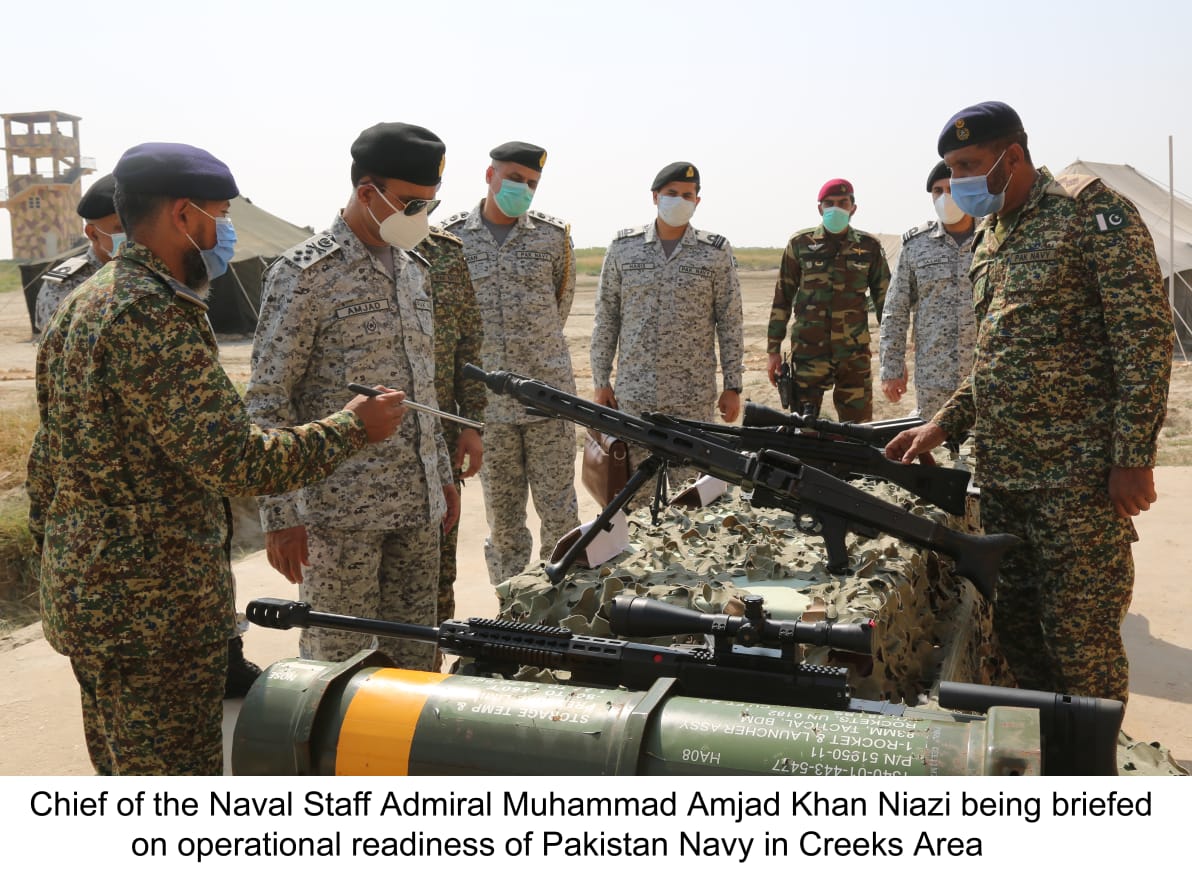
Chief of naval staff visits forward posts in creeks area

DNA

Chief of the Naval Staff Admiral Muhammad Amjad Khan Niazi visited Creeks Area to review operational preparedness of the deployed troops.

Upon arrival at Brigade Headquarters Sujawal, the Naval Chief was received by Commander Coast, Vice Admiral Zahid Ilyas. A comprehensive briefing was given to the Naval Chief on prevailing threat environment and combat readiness for the defence of Creeks Area that constitutes South Eastern maritime boundary with India. The Admiral also visited the forward defended locations and met with the deployed troops.

CNS VISIT TO CREEKS AREAS 2

The Naval Chief expressed full satisfaction over operational readiness of the troops. He appreciated professional prowess and dedication of officers and men in ensuring impregnable defence of motherland in the challenging environment of Creeks Area. The Naval Chief also directed to ensure optimal utilization of latest weaponry and equipment with motivation and alacrity in order to safeguard the maritime boundaries of Pakistan.

HEC awards 10 projects worth RS. 150 million for research on Covid-19

DNA

ISLAMABAD – In response to COVID-19 crisis, the Higher Education Commission (HEC) launched a focused Rapid Research Grant (RRG) in April 2020 to engage academia in research around the clinical management of this epidemic. The grant is aimed to encourage academic research to strengthen clinical management or public health response against this virus.

Under the specialised research initiative, potential project proposals were invited to contribute to the much-needed understanding of coronaviruses — the Severe Acute Respiratory Syndrome Coronavirus (SARS-CoV) and COVID-19.

Considering the time-crunch, a specialised panel was constituted and tasked to complete the shortlisting in 3-4 weeks. More than 300 applications were received for this grant. After independent reviews, 58 proposals were shortlisted based on already announced eligibility criteria and other necessary requirements. Later, these proposals were jointly reviewed by experts of Medical and Biological Sciences, Engineering and Technology and finally 10 quality projects made it to the last stage after rigorous scrutiny.

The budget for each of RRG award is up to a maximum of Rs. 15 million (USD 100,000) with a maximum project duration of 12 months. These research projects offer a variety of pragmatic solution-oriented research, ranging from early detection diagnostic kits to immune response and understanding the virus behaviour.

The proposals from 10 universities have been finalized. The University of the Punjab won two grants — one for an indigenous, low-cost production of ultra-pure Taq Polymerase and PCR mix for COVID-19 clinical diagnostic kits, and the other for development of a reliable, economical and high throughput serodiagnosis method for early detection of COVID-19.

COMSATS University Islamabad has won the grant for development of RT-LAMP Assay for early detection of COVID-19, while National Textile University, Faisalabad research will focus on development of bioactive hospital textiles and protective suits against viruses and bacteria by immobilisation of nanomaterials. The University of Veterinary and Animal Sciences, Lahore has won the research grant for epidemiological disease modelling and molecular surveillance of SARS-CoV-2, while DOW University of Health Sciences, Karachi will be working on IVIG production from convalescent plasma of COVID-19 survivors, a low risk, high efficiency passive immunisation strategy against SARS-CoV-2. Interestingly, the test results of DOW university research are already very promising.

Other project winners include the University of Health Sciences, Lahore (Immunological Virology and Genetic Basis of COVID-19 Patients), Lahore University of Management Sciences (Mapping Immune Response to SARS-COv2 using a multidisciplinary approach), Aga Khan University, Karachi (Phylo- and immuno- dynamics of SARS-CoV-2 infection in Pakistan: relating COVID 19 disease severity in with viral diversity) and Health Services Academy (HSA), Islamabad (Computational Modelling for COVID-19 Epidemic in Pakistan: Predictive Modelling of Disease Morbidity, Mortality and Assessment of Demands on the Intensive Care Units).

To ensure high quality of research, faculty members from these universities were encouraged to collaborate with private sector and industry, both within and outside Pakistan, as needed.

HEC funded thousands of research projects in the past, and this has led to more than 20,000 research articles published in recognised journals last year. With provision of RRGs, HEC hopes that academic researchers will come forward to contribute to better health systems coping with real-life challenges.

Biden in White House: America & the World are in Safe Hands

Iqbal Khan

Joe Biden’s platter is full, depends on where he wants to begin from. If he takes a course to un-Trump America, he would have achieved a lot if he is closer to retrieve the US to the status at which Obama-Biden duo handed it over to President Donald Trump.

Quick recommitment to Trump stampeded international treaties like Climate Change, Iran Nuclear deal, Oslo Accords, reinforcing commitments to negotiate lapsed arms control and disarmament treaties, addressing the concerns of EU, Nato, and other allies, stopping further settlements in the West Bank, reversing shifting of US embassy to Jerusalem etc. could be good starting point. Pacifying its neighbouring counties would ease out the anti-America sentiment in American continents.

More important issues are bridling China phobia, stabilising relations with Russia and rationalising India pampering. Due to erratic foreign policy trajectories, the US has embarked upon some lose-lose ventures. Impact of anti-China drive is consuming the US strategically and economically. Russia has assumed the role of a wild card in World politics and India is fast becoming a rogue don of South Asia. New York Times reported on November 10: “All along, China’s leaders showed indifference toward the presidential race, having concluded that no matter who won, the United States would remain irreconcilably opposed to the country’s rise”. According to NYT Beijing bureau chief, “Tensions between the two countries are likely to fester”. “They could even become more pronounced — over trade, tech, Taiwan and other issues”.

After four horrible Trump years, many Americans want to believe that the United States is on the verge of a new beginning. However, according to Daron Acemoglu: “Trump won’t be the last American populist [President]”. Trumpism is a way of life for a substantial number of Americans. “The roots of Trumpism didn’t begin or end with Trump or even with American politics—they are closely connected to economic and political currents affecting much of the world. Americans must understand and address these if they are to prevent similar forces from once again seizing the nation”.

These Elections have brought to fore a highly polarised US society on partisan lines; extraordinary high turnout and razor edge results portray a high intensity of the divisive sentiment. Above all, over 70 million Americans have endorsed Trump’s policies. For Biden, it’s an opportunity to provide healing touch to America society and reshape “Ugly American” image of the US abroad. And he is appropriately suitable for this task due to his prudence, maturity and balance.

In their victory speeches this weekend, Joe Biden and Kamala Harris declared that combating climate change will be one of their administration’s top priorities, alongside containing COVID-19, rebuilding the US economy, rooting out systemic racism, and bridging America’s political divides.

With change in guard at the White House, there won’t be any substantial change in the US policy towards Pakistan, beyond a symbolic euphoria of an ease-out in periphery matters.  At strategic tier, America’s policy towards Pakistan is a subset of its China phobia. Hence, Biden Administration will keep pumping in multi-dimensional strategic advantages to further empower India in the vain hope that one day it will fight and browbeat China on America’s behalf. Even though India had disappointed the US twice during Trump’s Presidency—Doklam and Ladakh crises.

Foreign policy experts expect that the Biden administration will be tougher on India”. PM Narendra Modi faces an American President whom he did not endorse, and whose opponent was extravagantly over projected in Texas, Houston, Texas and later in Gujarat, India. Twitter is a buzz with #HowdyModi  & #NamasteTrump tweets. Biden was instrumental in imposing travel ban on Modi in the wake of Gujarat pogrom of Muslims in 2002.

Like most of his predecessors, candidate Biden did a lot talk of solving Kashmir dispute; his Vice President Kamala Harris is also known for raising her voice for Human Rights violations in Indian Occupied Jammu and Kashmir. However, like many of their predecessors, both are likely to forget about it much earlier than their inaugural. Substantial portion of America’s Pakistan policy is hostage to India’s nod. Over the last decade or so, American articulations regarding Pakistan have been incrementally adopting Indian dictum and tenor. “Since Trump and Biden both have [been], generally speaking, similar views on Pakistan and the region, I don’t think we should overstate the election’s impact in South Asia,” said Michael Kugelman of Wilson Centre.

Though some Pakistan’s foreign policy experts believe that with Joe Biden in White House, a return to “normalcy” is expected, though with caveats. The Trump-era contempt for diplomacy would certainly come to a close. But “Pakistan shouldn’t raise the bar of expectation.” Biden is likely to restore the dignity of all international organizations that will help Pakistan because there will be a certain level of predictability.

Biden had been deeply involved in South Asian affairs from the time when he was Chairman of the Senate Foreign Relations Committee, and played an instrumental role in having the $7.5 billion Kerry-Lugar-Berman bill passed by the US Senate. Biden administration is expected to return the US to the international organisations abandoned by Trump and re-join the Paris Climate agreement. He is likely to invest more in its relationship with like-minded countries. “A Biden White House would have a better understanding of what is important for the region,” he said. Biden, who served as Obama’s deputy for eight years, experts believe, will have a more conciliatory foreign policy towards China and even Iran.

Over the decades, the US has invested very heavily in nurturing Hate-China sentiment amongst its own people. This roller coaster has attained its own critical mass, and it’s no longer possible to reverse it through a presidential wish. Anti-china is a bipartisan malice in the US—its fast turning into an industry, and it’s only a difference of shade whether it’s a Democratic President in the White House or a Republican. Anti-China sells well and bring political and economic dividends to politicians and businesses.

Biden, met Chinese President Xi Jinping several times when he was in government, has said that under his administration the US would lead by the “power of its example” rather than the “example of its power”. Analysts say while Biden’s tactics might change, the tougher US strategy towards China would remain if he took the White House given its broad bipartisan support.” “Getting tough on China has become a source of rare bipartisan consensus in a polarised political climate,” wrote Hui Feng, a senior research fellow at Australia’s Griffith University’s academic website, The Conversation: “a fundamental U-turn in US-China relations is still unlikely.”

Actually, America, as a nation, lost the 2020 presidential elections, it lost the race for decency, tolerance, and credibility of its government system. Lesson for contemporary democracy is: Country doesn’t matter, present era politicians are birds of same flock. Elections are perceived as free and fair only by the winning side. With the slightest chance of losing in sight, the effected ones start shouting of factual or fictional foul play. Losers are more often sour than gracious. Once a norm, now free and fair elections, and their bipartisan acceptance as such, are more of a fairy tale.

Election 2020 is over, but Trump-slinging [read mud-slinging] has just begun. President Trump’s post electoral results statement shows that he does not wish to quit gracefully.

America needs a heeling touch. It is refreshing that President Elect Joe Biden wishes to start working on that aspect immediately. His Victory Speech radiated hope that Americans are in safe hands.

Writer is a freelance columnist; email: [email protected]

Pak-US ties under Biden’s presidency

By Muhammad Omar Iftikhar 

Now that the US has elected Joe Biden as their President, the era of Donald Trump and the confusion he created is over. This heralds the US into a new era. However, the diplomatic affairs Washington has had with Pakistan, India, Afghanistan and other countries from South Asia, Asia, and Central Asia must be realigned under the Biden presidency. In the case of Pak-US ties, Pakistan needs to put a line in its relations with the US.Prime Minister Imran Khan and his regime would need to redefine the diplomatic objectives it needs to achieve as far as its ties with the US are concerned.

The mistakes made in the past from both sides must not be repeated. Biden must ensure that the chaos created by Donald Trump is neutralized at the earliest. When focusing on Pak-US ties, China automatically becomes an active part of this equation.Where Pakistan and China are all-weathered friends, they both are also moving forward with CPEC. During Trump’s era, US-China ties became sour to the extent that in 2019 Trump went on to call China’s president an enemy.

Biden, on the other hand, is expected to forge new ties with China where the two countries will be able to co-exist. Washington’s relations with Islamabad will play a vital role in keeping smooth sailing between Washington-Kabul ties. The US, under Biden’s presidency, will also focus on Afghanistan and Kashmir.The unwinnable war initiated by the US in Afghanistan in 2001 still haunts the US. Pakistan will play a key role in maintaining strong US-Afghanistan ties.

The issue of Kashmir will also be on Biden’s agenda. Biden and Kamala Harris have been sharing their opinion about Kashmir and they view that India should restore civil and political rights in Kashmir. This is where US-India ties will play a role. With the sensitive issue of Kashmir into the picture, Pakistan-India ties will surely be affected. It will be up to PM Imran Khan how he tackles the issue without creating any discontent.

Stay Connected

64FansLike
60FollowersFollow

Latest Reviews

Exchange Rates

USD - United States Dollar
EUR
1.17
GBP
1.35
AUD
0.67
CAD
0.72




