Pakistan welcomes release of Pak prisoners in Afghanistan
DNA
ISLAMABAD – Pakistan welcomed the decree by President Ashraf Ghani for the release of Pakistani prisoners in Afghanistan who have completed their terms but remain incarcerated due to non-payment of fines and those with up to or less than one month remaining in their prison terms.
Pakistan appreciates this humanitarian gesture which will provide relief to the individuals and their families covered by this decision.
Pakistan reaffirms its commitment to continue mutual engagement leading to facilitation and benefits for the people on both sides.
Pakistan squad arrives in Christchurch for 46-day New Zealand tour
Green Caps will face Kiwis in three T20Is, two Tests
Pakistan cricket team has arrived in Christchurch for their 46-day tour of New Zealand on Tuesday. The 34-member squad, which is led by star batsman Babar Azam, is now divided into four different groups, will now stay in isolation in a bio-secure bubble for 14 days.
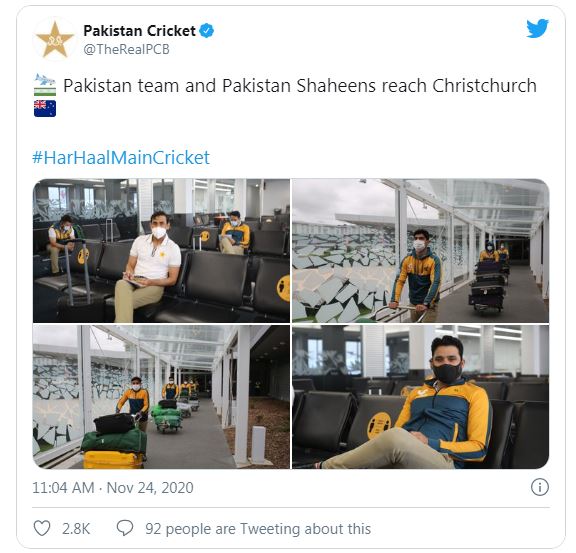
The players and staff members will be tested for the first time on November 25 and if the results return negative, they will be allowed to start training in the bubble.
The Men in Green will face the Black Caps in three T20Is and two Tests, starting with a 20-over contest on December 18.
GB elections: Official results reveal PTI as majority party with 22 seats in hand
ISLAMABAD, NOV 24 – The PTI is all set to form the government in Gilgit Baltistan after having secured 22 of its 33 seats, according to the official results announced by the region’s election commission on Tuesday.
The PPP and PML-N — both of which have levelled allegations of rigging — hold five and three seats, respectively.
In all, the GB Assembly has 33 seats — 24 of which are contested through directed elections; six are reserved for women and three others reserved for technocrats and professionals. Political parties can nominate their candidates to the latter through proportional representation.
In the elections, the PTI emerged victorious on 10 seats, while seven were won by independent candidates. The JUI and Majlis Wahdatul Muslimeen (MWM) won one seat apiece. Six of the independent candidates have joined PTI after the election and the party already had a seat adjustment arrangement with the MWM.
PPP’s GB chapter President Advocate Amjad Hussain was declared as the winner in GBLA-1 and GBLA-4. PPP also won GBLA-24 constituency. The party also got two reserved seats — one for women and the other for technocrats.
PTI’s Fatehullah Khan has been declared as the winner in GBLA-2, despite the constituency’s returning officer’s recommendation that a forensic audit of the ballots should be held. Earlier, unofficial results had indicated that PPP’s Jameel Ahmed would win the constituency with 8,817 votes against 8,200 secured by PTI’s Khan. But the recounting of votes turned the tables.
Yesterday, PPP workers and supporters took to streets to protest against alleged rigging in the constituency. The protest had turned violent following clashes between demonstrators and police and four vehicles and a building of GB’s forest department were torched by unidentified miscreants. Protests against alleged rigging and use of force by police yesterday are also being held today.
In GBLA-3, PTI’s Syed Sohail Abbas was declared as the winner, while GBLA-5 was grabbed by independent candidate Javed Ali Manwa.
GBLA-6 and GBLA-7 were both won by PTI, while GBLA-8 was taken by MWM candidate Muhammad Kazim. Meanwhile, GBLA-9 and GBLA-10 were won by independent candidates.
PTI also won GBLA-11, GBLA-12, GBLA-13, GBLA-14, GBLA-18 and GBLA-20 constituencies.
The ruling party also grabbed four seats reserved for women and two reserved for technocrats.
Meanwhile, PML-N was able to grab GBLA-16 and GBLA-21 and one seat reserved for women.
Israel drops Saudi Arabia from virus quarantine list
A day after Prime Minister Benjamin Netanyahu’s reported trip to Saudi Arabia, Israel’s health ministry added the kingdom to its list of coronavirus “green” countries, exempting returning travellers from quarantine.
The health ministry on Tuesday confirmed that Saudi Arabia had been added to the safe list a day earlier, but dismissed any link to Netanyahu’s reported visit to the futuristic Red Sea city of Neom on Sunday.
“The process is very simple and it happens once every two weeks,” health ministry director general Hezi Levi told public broadcaster Kan on Tuesday morning.
“On the previous list, Saudi Arabia was red,” he said. “The morbidity rates decreased. It’s now green. “It has nothing to do with anyone’s visit to any country.”
Israeli media reported that Netanyahu travelled to Neom for landmark talks with Crown Prince Mohammed bin Salman, the de facto ruler of Saudi Arabia, which has no official diplomatic ties with the Jewish state.
There has been unconfirmed speculation that Saudi Arabia might be seeking to become the latest Arab state to normalise ties with Israel.
An Israeli government source contacted by AFP confirmed the talks, which Riyadh firmly denied on Monday, and the kingdom has publicly said it will not establish diplomatic relations with Israel until the Palestinian conflict is resolved.
Had Saudi Arabia not been on Israel’s coronavirus green list, Netanyahu and his staff would technically been compelled to quarantine for 14 days upon return.
Another country turned “green” in the ministry’s latest listing was Bahrain, which along with its Gulf ally the United Arab Emirates have established ties with Israel, only the third and fourth Arab nations to do so.
On Tuesday, Netanyahu announced he had spoken with Bahraini Crown Prince Salman bin Hamad Al Khalifa and accepted an invitation to conduct “an official visit to Bahrain soon”.
FO says no possibility of recognition of State of Israel
DNA
ISLAMABAD, NOV 24 – Responding to media queries, the Spokesperson categorically rejected baseless speculation regarding possibility of recognition of the State of Israel by Pakistan.
The Spokesperson underlined that the Prime Minister’s statements in this context have been clear and unequivocal.The Prime Minister has made it clear that unless a just settlement of the Palestine issue, satisfactory to the Palestinian people, is found, Pakistan cannot recognize Israel.
Pakistan steadfastly supports the Palestinian people’s inalienable right to self-determination. For just and lasting peace, it is imperative to have a two-state solution in accordance with the relevant United Nations and OIC resolutions,with the pre-1967 borders, and Al-Quds Al-Sharif as the capital of a viable, independent and contiguous Palestinian State.
SCO Secretary-General: “Children’s rights are of universal value”
World Children’s Day was proclaimed by the United Nations General Assembly in 1954. It is celebrated on November 20 as a day of world brotherhood and understanding of children, dedicated to activities aimed at ensuring the welfare of children around the world.
November 20 is an important milestone in the formation of children’s rights. On this day in 1959 the General Assembly adopted the Declaration of the Rights of the Child, and in 1989 – the Convention on the Rights of the Child. Since 1990, World Children’s Day marks the anniversary of the adoption of these fundamental documents in the field of child rights protection.
Ensuring the rights of the child is one of the global issues of our time, in which the entire world community is interested. Each state is guided by the understanding that human progress and general development are impossible without improving the status of women and children and ensuring their rights. It is in the family that a child receives the physical and spiritual development that allows him or her to become a full member of society, capable of an independent life.
Today, more children and adolescents are enrolled in preschool, primary and secondary education than ever before. At the same time, according to the UN, about 113 million children in the world do not attend school for one reason or another. 97% (about 110 million) of them live in the so called “third world” countries: 48.5 million people – in countries of South and South-East Asia; 42.3 million people – in countries of Africa.
Shortages of qualified teachers, poor quality teaching materials, ad-hoc classrooms, and poor sanitation make it difficult for many children to learn. An estimated 617 million children and adolescents around the world are unable to achieve minimum levels of proficiency in reading and mathematics, although two-thirds of them are in school. Children in rural areas are more than twice as likely not to attend elementary school as their urban peers. In conflict zones, 27 million children are out of school. Without life-long learning skills, children face greater obstacles to potential employment at a later age. They are more likely to suffer adverse health outcomes and less likely to participate in decisions that affect them, compromising their ability to build a better future.
In addition, in the current situation, the closure of schools and universities due to coronavirus has disrupted the full educational process for approximately 1 billion students and schoolchildren in 160 countries. COVID-19 has also caused major disruption to child health services. According to UNICEF, a study in 77 countries found that in 68% of them, the pandemic affected the organization of regular child health checkups and immunization services.
SCO member states attach great importance to ensuring the rights of children and youth, and work is focused on ensuring the rights of young people, their self-expression, disclosure of their creative potential, as well as creating favorable social conditions and opportunities for education and employment.
Within the framework of relevant state programs, initiatives are launched to familiarize young people with modern knowledge, promote their interest in science and technology, art and literature, as well as legal education.
Close attention is paid to the development of children’s sport and physical activities, culture, increasing spirituality, education and upbringing of youth in the spirit of respect for such invariable values as patriotism, high morality and mutual respect.
The SCO countries are actively cooperating with international organizations such as UNESCO, UNICEF and civil society institutions in the field of child rights.
In the SCO member-states the issues of social protection and ensuring children’s rights are regulated by laws and other legal acts. In India, for example, the Constitution reflects the prohibition of all forms of discrimination and a separate emphasis on children’s rights and freedoms. Children’s organizations, both public and private, effectively carry out their activities to ensure that children have access to primary and secondary education, health care, and that they are not subjected to violence or forced to work. One of the main organizations is the National Commission for the Protection of Child Rights, which has expanded its activities to all states of India.
Kazakhstan continues to improve legislation to protect children’s rights, including children with mental and physical disabilities, children in vulnerable situations, and children in conflict with the law. In 2016, the institution of the Commissioner for Children’s Rights was established by presidential decree. In 2019, the President signed a law “On introducing amendments and additions” to some legislative acts of the Republic of Kazakhstan on issues related to the activities of organizations that perform functions to protect the rights of the child. In particular, the law provides for the establishment and operation of centers to support children in difficult situations, as well as the inclusion of these centers in the list of organizations that carry out functions to protect the rights of the child.
The practical implementation of the Convention on the Rights of the Child has contributed to positive changes in the lives of several generations of Kazakh children, namely, a more than fivefold decline in child mortality, the development of inclusive education, and improvements to the social protection system.
In 2011, the State Council of China approved the Child Development Plan for 2011-2020, which sets new goals and new measures for the development of children’s affairs by the Chinese government, marking a new stage in China’s work on child protection.
The Plan sets goals to be achieved in five areas: child health, education, welfare, social environment and legal protection. Under this document, focused work is being done to improve the basic medical and health system, improve children’s physical health, provide children with quality education, and expand child welfare.
Kyrgyz legislation on children’s rights and interests consists of the Constitution, the Convention on the Rights of the Child, and other normative legal acts. In 2006, Kyrgyzstan was the first country in Central Asia to adopt a Children’s Code. The code consolidated children’s rights and established principles and mechanisms to protect children. Kyrgyzstan is one of 62 countries which achieved the Millennium Development Goal of reducing child mortality by more than two thirds. Its early childhood development rate exceeded 72 percent. Pre-school education reaches 64 percent of children under 5. The rate of participation in organized pre-primary education programs reached 91 percent.
Pakistan’s existing legislative and policy framework for child protection includes commitments of the country that is a signatory to various international treaties and conventions, provisions of the national constitution, federal and provincial laws, including criminal and sharia law, and national policies and action plans related to children.
Pakistan has ratified a number of international treaties providing special protection for children, including the UN Convention on the Rights of the Child of 1989, the International Labour Organization’s Worst Forms of Child Labour Convention of 1999, the SAARC Convention on Preventing and Combating Trafficking in Women and Children for Prostitution of 2002 and others.
Russian legislation enshrines child rights at the federal level. All relations between children and parents are set out in the Family Code and a number of other legal acts. In 2009, a presidential decree established the post of the Presidential Commissioner for Children’s Rights. At the time of signing the decree, children’s ombudsmen were already functioning in 18 regions of the country. Exactly one year later there were 48 of them, and by the end of 2010 there were 62. Significant work was done to ensure that each region of Russia had a person in charge of children’s issues. And by the beginning of 2015 the establishment of the institute was almost completed in all 85 regions. The most important result of the Commissioner’s activity is real assistance provided to applicants in protecting the rights and legal interests of minors.
Children’s rights are also regulated by the country’s Constitution and other laws and regulations.
In Tajikistan the National Commission on the Rights of the Child was established, which coordinates the implementation of international obligations of the Republic in the field of children’s rights and within its authority implements the state policy to ensure the rights and interests of the child and regulates issues related to the education and upbringing of children.
Foundations and non-governmental organizations that provide social assistance to children are active in the country. One such foundation is the Lona Charitable Foundation, established in 2009, and throughout its activities provides practical assistance to sick children with cancer and children with body burns. The Foundation also provides material assistance to poor families, boarding schools, nursing homes and orphanages.
In the legal system of the Republic of Uzbekistan, more than 100 legal acts have been adopted related to rights and protection of children. In particular, the Law “On guarantees of children’s rights” reflects guarantees of children’s rights to life, freedom and personal inviolability, state support to families raising children, as well as to rest and leisure, health care, education and others.
Under the Constitution, the rights of minors are protected by the state. The post of Deputy Commissioner for Human Rights of the Oliy Majlis of the Republic of Uzbekistan (Ombudsman) – Commissioner for the Rights of the Child – has been introduced in the country. A single system of continuous education has been introduced in the country, aimed at radical reform of the education sector. In addition, Uzbekistan pays close attention to the development of children’s sports and creativity.
At the Bishkek summit of SCO in 2019, the SCO heads of state expressed their support to the initiative of the Uzbek side to prepare a draft UN Convention on the Rights of Young People and expressed their intention to conduct coordinated work on this issue.
According to experts, the significance of this UN Convention for the SCO countries is that it takes into account international and national experience in regulating current aspects of the protection of youth rights and aims to increase efforts at international, regional and national levels to meet the needs of young people, strengthen capacity and guarantees of rights, freedoms and support the interests of young people in all their diversity around the world.
The Convention will be a timely and effective response to the challenges and opportunities faced by states and the world community as a whole in harmonious development of young people, realization of their enormous potential for the well-being and sustainable development of the SCO countries.
As for the work carried out within the SCO, I would like to note that one of the main tasks of the SCO, according to its Charter, is to promote human rights and fundamental freedoms in accordance with the international obligations of member states and their national legislation.
In this regard, through the SCO Youth Council and other relevant mechanisms, extensive work has been initiated to develop youth cooperation aimed at promoting physical, mental and spiritual development of the young generation, involving them in large-scale plans for joint development.
On October 30, 2020 the Youth Council held its regular meeting, during which deep attention was paid to the prospects of development of volunteer movement in the SCO region, exchange of experience on the development of new formats of educational programs, including in the conditions of influence on these processes of pandemic.
Regular discussions, conferences, cultural and sporting events, as well as youth forums are held, aimed at revealing the creative, social, educational, spiritual and moral potential of the young generation, strengthening friendship and mutual understanding, as well as the development of good neighborly relations, strengthening interethnic and interfaith cooperation.
The project of the International Service “SCO Youth Map” is successfully implemented, international festivals “Student Spring of SCO and BRICS countries” and SCO Marathons are held annually. Within the “SCO Our Common Home” project the SCO Secretariat works with young people by providing them with technical support, as well as a platform for organizing various events, such as interactive games “Model SCO” and intellectual contests “Leader of the 21st Century”. Every year the SCO Secretariat organizes an “Open Doors Day” for students and schoolchildren.
For 15 years, “Children Fairy Tales” art exhibitions of children’s drawings on the themes of folk tales of SCO member states have been held. By holding such events, we introduce our young generation to the diversity of cultures in the SCO countries; encourage their interest in the history of classical and folk art.
I would like to emphasize the importance of the Exhibition of Children’s Paintings of the SCO countries held in June 2020 on the theme “Unity in the fight against the epidemic, protection of the common home”. In their works the participants not only revealed the theme of fighting the virus, but also reflected the ideas of peace, friendship, joint support and aspiration for development – the ideas of “the Shanghai spirit”. It is gratifying that the young generation of SCO shares the principles of mutual support from an early age and calls for solidarity.
The leaders of our countries also approved the Action Plan for the implementation of the SCO Development Strategy 2025, according to which the member states will consider the establishment of a mechanism of meetings of heads of agencies of the SCO member states responsible for the implementation of youth policy, as well as continue to develop youth exchanges and programs in the SCO region.
In addition, the SCO is taking measures aimed at counteracting the involvement of young people in terrorist, separatist and extremist structures. In particular, as a result of the SCO summit in Qingdao in 2018, the heads of state adopted a Joint Appeal to youth and the Program of Action for its implementation, which are focused on active involvement of young people in creating a decent future, promoting physical, mental and spiritual development of the younger generation. The documents emphasize the utmost importance of ensuring favorable social and economic conditions, availability of opportunities for education, self-expression, disclosure of creative potential and realization of work for young people.
I express confidence that the young generation of SCO member states will make a worthy contribution to the development and prosperity of their countries, strengthening regional and global stability and security, dialogue between peoples, cultures and religions.
Efforts underway to link Gujranwala with Motorway Link: Ajmal Awan
GUJRANWALA, NOV 24 /DNA/ – Ajmal Awan, Senior Vice President, Gujranwala Chamber of Commerce and Industry, said that efforts are underway to link Gujranwala with Motorway Link at all relevant forums under the leadership of President Gujranwala Chamber Ashraf.Mughal so that maximum opportunities for development of industry and trade could be provided in Gujranwala.
He said during a briefing that Gujranwala Chamber of Commerce and Industry is making all possible efforts to solve the problems of industrialists and traders by keeping liaison with all concerned Ministries and Departments. Efforts are being made to set up a project to solve the problems of traders and industrialists on priority basis. Former President of Gujranwala Chamber Sheikh Noman said that the reservations of allotiees of Industrial.Estate three regarding export processing zone industry should be removed and industrial necessary facilities should be provided in the state so that the industrial establishments established here can get the required facilities.
Former President of Gujranwala Chamber of Commerce and Industry Malik Azhar-ul-Haq said that along with industrial development, we should also give special importance to environmental protection. Abdul Sattar Mughal, executive member of the chamber, said that the atmosphere in which we breathe and the future of our future generations could be secured if all government agencies perform their duties honestly.
He said hardships of industrialists and businessmen of Gujranwala must be solved on priority basis then a true industrial and economic revolution can be brought in the country. Prominent business leader Noman-ul-Haq said that the industrialists of Industrial State III in Gujranwala are currently suffering from severe problems Serious efforts and effective measures are required to do so, he said, adding that Industrial Estate III was imposed after a high-level review to abolish taxes.
‘Fully prepared to thwart any misadventure,’ says Army chief
RAWALPINDI, NOV 24 (DNA) – The 237th Corps Commanders’ Conference presided by General Qamar Javed Bajwa, Chief of Army Staff (COAS) held at GHQ.
Forum reviewed geo strategic, regional and national security environment and discussed internal security, situation along borders, Line of Control (LOC) and atrocities in Indian Illegally Occupied Jammu & Kashmir (IIOJ&K). Forum also took a comprehensive overview of the positive progress in Afghan Peace Process.
Forum showed serious concern in the wake of irrefutable evidence of Indian state sponsored terrorism and efforts to destabilize Pakistan. Indian efforts to sabotage CPEC, involvement in financing and training of terrorist organizations for fomenting unrest in Pakistan, especially in AJK, GB and Balochistan are an affront to peace and security in the region, forum emphasised.
Deliberating upon recent surge in Cease Fire Violations (CFVs) by the Indian Army, forum resolved to take all measures necessary to protect innocent population living along LOC from Indian firing deliberately targeting civil population.
Forum expressed strong will, resolve and determination to defend the motherland against any misadventure.
Forum also deliberated upon the COVID-19 situation and measures required to confront the pandemic in the wake of 2nd wave. COAS specifically directed all commanders to ensure measures to support the national effort.
Pakistan Army with support of state institutions and the nation is fully prepared to thwart all internal and external challenges. It is our duty to transform these challenges into opportunities for the stability and prosperity of the people of Pakistan, COAS concluded.
COMSTECH Int’l workshop and exhibition on AI Starts inaugurated
ISLAMABAD, NOV 24 (DNA) – 2-day international workshop and exhibition of products of artificial intelligence developed and marketed by various institutions of Pakistan inaugurated today morning at COMSTECH.
Prof. Dr. M. Iqbal Choudhary, Coordinator General, COMSTECH, Dr. Shoab A. Khan, Chancellor, Sir Syed CASE Institute of Technology and Dr. Shahid Mahmud, Chairman & Group CEO – Interactive Group addressed the inaugural session.
Dr. Iqbal informed that we will have to live with new normal now. He said that the paradigm of development has changed and now we have to invest in human resources to accelerate the development of the country. He urged that now its time to fund innovation, and centers of excellence in artificial intelligence. Dr. Iqbal highlighted the role of COMSTECH in science diplomacy and informed about the recent launch of COMSTECH Consortium of Excellence, a joint initiative of Ministry of Foreign Affairs, Pakistan and COMSTECH.
Dr. Shoaid A. Khan, Chancellor, Sir Syed CASE Institute of Technology, talked about the current status and use of the artificial intelligence in his opening remarks. He highlighted the importance of the AI and showed the use and benefits of this technology in general and in the area of healthcare. He stressed the need to have a policy and strategy to nurture, adopt, develop, and implement AI in Pakistan to ultimately reap the benefits of this technology.
Dr. Shahid highlighted the importance of the artificial intelligence and its impact on the world. He mentioned that how AI technologies are changing the world. Dr. Shahid said that technology billionaire individuals are rich than many countries in the world due to the application of these modern technologies. He urged that Pakistan must have strategy to trigger the potential of artificial intelligence.
On the exhibition floor 11 exhibitors from Pakistan have their AI products on display and eight researchers have their products, ideas poster presentation. The workshop consists upon six technical sessions which are being conducted by eighteen experts from Pakistan, United Kingdom, and Austria. It is being attended by a large audience virtually from OIC member states and a certain number of people are attending it in-person at COMSTECH Auditorium as per COVID SOPs. This workshop and exhibition would conclude at 1700 hours tomorrow evening, Nov. 25.=DNA
=================