Home Blog Page 2655

Pakistan committed to peace, entire nation stands united against terrorism: CJCSC

DNA

KARACHI, JUN 26 – Course Commissioning Parade of 115th Midshipmen and 23rd SSC was held at Pakistan Naval Academy (PNA), PNS RAHBAR, Manora Island, Karachi.

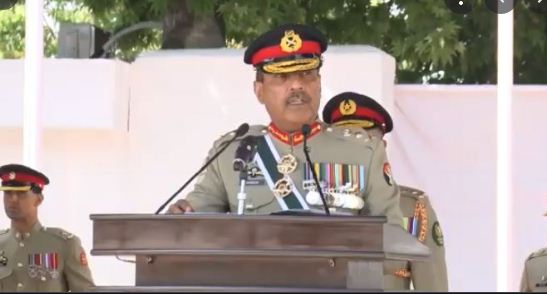
General Nadeem Raza, Chairman Joint Chiefs of Staff Committee was the Chief Guest at the occasion. Admiral Muhammad Amjad Khan Niazi, Chief of Naval Staff was also present at the parade.

The commissioning contingent also included midshipmen from Royal Saudi Naval Force and Bahrain Defence Forces.

Chairman JCSC congratulated the commissioning term for successful completion of the training and becoming guardians of Pakistan’s maritime frontiers.

CJCSC said that Pakistan is committed to peace and today, the entire nation stands united against terrorism and extremism. Chairman JCSC also said that the world must recognise Pakistan’s consistent peace overtures and take notice of the human rights violations in Indian Illegally Occupied Jammu and Kashmir.

CJCSC also gave awards to the distinction holders. Quaid-e-Azam Gold Medal was awarded to Lt Miraj Khalid Khan for his overall best performance. Midshipman Hamza Malik was awarded Sword of Honour, Officer Cadet Huzaifa Javed Niazi won CJCSC Gold Medal, Midshipman Aziq Baig clinched the Academy’s Dirk whereas Commandant Gold Medal was awarded to Officer Cadet Humera Maryam. Midshipman Nayef Ebrahim Mohamed Ebrahim Alsayyah from Bahrain Defence Forces won Chief of Naval Staff Gold Medal.

Earlier, upon arrival, CJCSC was received by Commodore Sohail Ahmad Azmie, Commandant Pakistan Naval Academy.

RAJA UMER ASSUMES CHARGE AS AIOU NEW REGISTRAR

ISLAMABAD, JUN 26 (DNA) – Allama Iqbal Open University (AIOU) has appointed Raja Umar Younis as the new Registrar of the university.

Raja Umer Younis assumed the charge of the office of Registrar of Allama Iqbal Open University after Executive Council, the supreme statutory body of the university, formally endorsed decision of the Selection Board in which Raja Umer Younis along with some other officers and academicians were appointed.

Representatives of Academic Staff Association (ASA), Officers’ Welfare Association (OWA) and Employees Welfare Association (EWA) of the university congratulated Raja Umer on assuming the charge of his new office and assured him of their full cooperation.

They expressed the hope that Raja Umar would strive hard to ensure progress of AIOU as well as welfare of its employees.

The Deans of all four academic faculties of the university as well as principal officers have also felicitated Raja Umer on becoming registrar of AIOU and  expressed their confidence on the recruitment policies of Prof Dr Zia UL-Qayyum, Vice Chancellor, AIOU to uphold principles of merit and transparency.

Raja Umer, also assured that Registrar Office will extend maximum cooperation for the mutual benefits of AIOU and its employees.

He, further, added that VC, AIOU’s vision of merit and transparency will be implemented in true letter and spirit without subjecting any employee to any discriminatory policy.=DNA

============================

Biden’s B3W too late to challenge BRI, CPEC: Experts

Devcom-Pakistan webinar highlights that the five big powers of the region – China, Russia, Turkey, Iran and Pakistan may come to a formal collaboration against the US hegemonic interventions in the region. The US shall learn from its defeat in Afghanistan and other wars and refrain from such adventures in future.   

Islamabad – Speaking at a webinar on Saturday, the experts said the US is making its utmost efforts to ignite a new cold war in the region and this time against China. The Build Back Better World (B3W) is apparently a copycat project of the Belt and Road Initiative (BRI) that has engaged 140 countries by now.  

They said the B3W partnership of G-7 countries would take longtime to mature any outline of actual interventions. The big question is where the huge money would come from whereas the G-7 nations and the private sector will not compromise their trade and economic ties with China. The other big issue with the US is credibility. Now even the long-time allies don’t trust the US anymore blindly. Over the decades, the world has seen the US as a war monger looking for an enemy all the time. In the circumstances, the B3W seems to be merely a political propaganda against China.

Development Communications Network (Devcom-Pakistan) and DTN organized the webinar on Saturday on the subject, “Biden’s G-7 Build Back Better World (B3W) and emerging situation in the region”. The panelists included chairman Senate Standing Committee on Defence Senator Mushahid Hussain Sayed, former chief ISI and geopolitical analyst Lt. General Retd Muhammad Asad Durani, political activist and geopolitical commentator Reham Khan (London), geopolitical researcher Soumya Awasthi (Delhi) and chairman Centre for Diplomatic and Political Affairs Tolga Sakman (Istanbul).

Geopolitical commentator and Devcom-Pakistan Executive Director Munir Ahmed hosted and moderated the webinar. While introducing the subject, Munir Ahmed said, “B3W is an apparent tool to challenge the deep-rooted BRI for obvious reasons. Through B3W, the G7 and other like-minded partners will coordinate in mobilizing private-sector capital in four areas of focus—climate, health and health security, digital technology, and gender equity and equality—with catalytic investments from the respective development finance institutions. As described, B3W will be global in scope, from Latin America and the Caribbean to Africa to the Indo-Pacific. Different G7 partners will have different geographic orientations, but the sum of the initiative will cover low- and middle-income countries across the world.”

Senator Mushahid Hussain Sayed the US has lost its credibility over the years. No one is willing to trust whatever plans the US offer in partnership with other developed countries. At the moment, the US is withdrawing from Afghanistan as a defeated country, and without any settled accord among stakeholders. The rise of the Taliban has increased the security concerns for the region. In this situation, no country is willing to trust G7 and the US. Pakistan has already refused the US for air-bases. The new Iranian President Ebrahim Raisi has already strongly condemned the US approach towards Iran.

He said the B3W will not be able to take off as a challenge to the BRI. Only India is expected to join it being the US ally against China despite its many economic interests associated with neighbouring China.

The Indian expert Soumya Awasthi said the B3W is expected to have more transparent and accountable mechanisms being a multipartite initiative to challenge BRI. Nothing is clear as to how it would compete with BRI or curtail China’s economic growth while the big question is where the money comes from? And why would the private sector invest in the social sector where the returns of the investment are not ensured. On the other hand, the G-7 countries did not work out anything post-Covid.

Lt General Retd Asad Durrani said the US did not learn from its mistakes in the previous wars and armed conflicts. Another cold war in the region will be another big mistake while all the big countries in the region are against the US hegemonic interventions in the region, and somehow are part of the BRI and CPEC. As many as five countries Iran, Turkey, Pakistan, China and Russia are on the same page and against the US except India. They all are opposing the US and at any time they may come together to collaborate with each other for the US aggressive designs.

The Turkish expert Tolga Sakman said the B3W as a G7 partnership is not attractive to Turkey and it has many geopolitical flaws. Turkey will not be against China in any case, rather will support by all means for regional connectivity and economic prosperity.

Reham Khan said the G7 countries have their own strategic and economic interests with China. Even if they were able to launch B3W most of the stakeholders and partners within the G7 and the US will not go against China. Biden’s B3W is not being supported by its Congress and what to expect from others.          

PAK HC DISCUSSES MULTIFACETED COOPERATION WITH POLITICAL, BUSINESS LEADERSHIP IN BIRMINGHAM

DNA

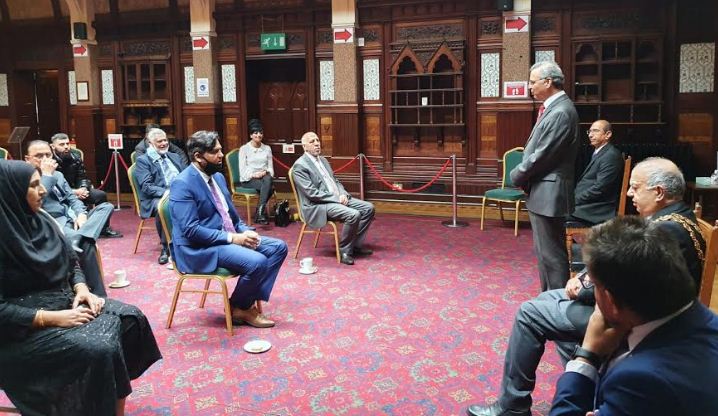
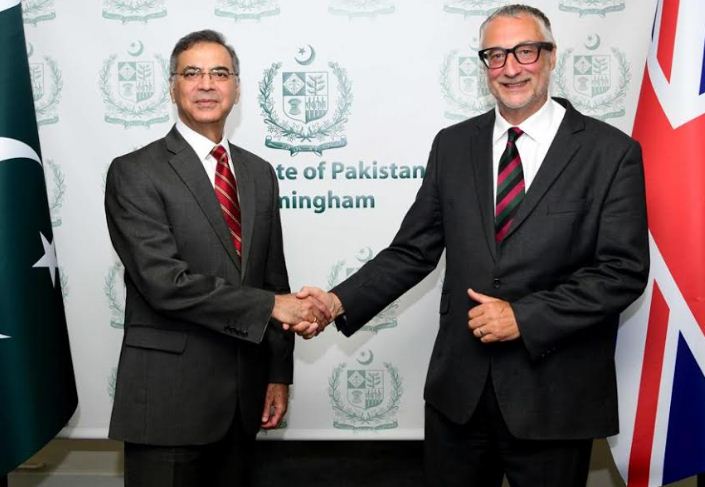
LONDON, JUN 26 – As part of his efforts to reach out to the community and explore avenues of multifaceted cooperation between Pakistan and the UK, High Commissioner Moazzam Ahmad Khan is currently visiting Birmingham and Wales.

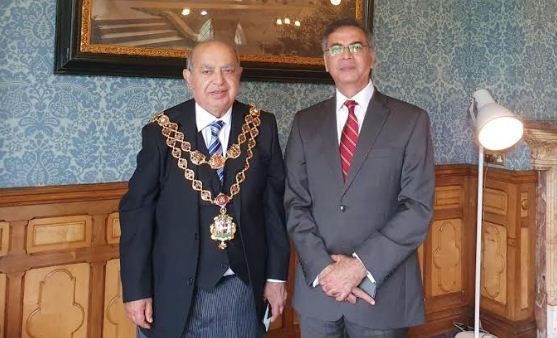
On the second day of his visit, the High Commissioner held detailed meetings with the Mayor of West Midland Combined Authority, the Lord Mayor of Birmingham, MP from Birmingham, local councillors, officer bearers of Greater Birmingham Chamber of Commerce, leading businessmen, CEO of Edgbaston Stadium, Senior Management of Birmingham City University and media persons.

In his virtual meeting with Mr. Andy Street, the Mayor of West Midland Combined Authority, the High Commissioner discussed issues of mutual interest including matters relating to Pakistani diaspora. While appreciating the close association of the Mayor with Pakistani diaspora in the West Midlands, the High Commissioner underscored the importance of further strengthening the bond through more avenues in the post Covid period. He also extended an invitation to the mayor for a visit to Pakistan.

In his talk with MP Khalid Mehmood and Mike Olley, Executive Director of Westside Business Improvement District (BID), the High Commissioner discussed possibilities of further fortifying the strong multifaceted relations between the two countries. The High Commissioner noted that the presence of a large Pakistani diaspora provides a strong base for special and strong bilateral relations. He also spoke on matters of business improvement with the Executive Director.

In his interaction with Mr. Muhammad Afzal, Lord Mayor of Birmingham, local Councillors and Mr. Stuart Cain, CEO of Edgbaston stadium, the High Commissioner discussed matters pertaining to youth, tourism and trade.

Meeting with business community and the office bearers of Greater Birmingham Chamber of Commerce including Mandy Hayes, Ms. Anjum Khan, Nasir Awan and Stefanie Bowes remained very productive in terms of identifying tangible steps for enhancing bilateral commercial relations. While highlighting Pakistan’s improved ranking in terms of ease of doing business, the existence of a huge market of 222 million people with large middle class, availability of English speaking economical skilled labour and business friendly legislative framework, the High Commissioner called upon the interlocutors to invest in and trade with Pakistan.  Discussing the role of a large number of UK companies in sustaining the strong commercial linkages between the two countries, he shared with the office bearers of GBCC the recent positive indicators of bilateral trade and investments.

The High Commissioner also visited Birmingham City University and discussed with Professor Dr. Hanifa Shah, Pro Vice Chancellor, Mr. Julian Bear, Deputy Vice Chancellor, and other senior faculty members, avenues and possibilities of enhancing cooperation in higher education and research. Creation of a framework for establishing linkages with sister institutions in Pakistan through the active support and facilitation of government, academia and industry was agreed as a founding step for a sustainable, productive and action oriented academic cooperation.

Anjum Nisar for further enhancing exports, as import growth likely to jump further

DNA

KARACHI, JUN 26 – As the country’s trade deficit has increased by almost 30% to $28 billion during 11 months (July-May) 2020-21, the FPCCI’s Businessmen Panel has asked the authorities to focus on further accelerating exports, besides keeping some check on unbridled imports of luxury items.

The Federation of Pakistan Chambers of Commerce and Industry’s Businessmen Panel Chairman Mian Anjum Nisar warned that the pace of growth in imports is projected to increase further in the coming months following the abolishment of regulatory duty on imports of raw materials and semi-finished products. He observed that the economic managers will have to chalk-out a long term plan for import substitution and increasing exports so that Pakistan could become self reliant. He also emphasized the need for adoption of international best practices for priority sectors and consultations with international experts to achieve success. He stressed upon the need to enhance inter-ministerial coordination and public-private partnership for increasing exports.

He said the low exports volume and rising trade deficit were chronicle issues which should be resolved permanently. He said exportable items should be produced in accordance with the international demand to fully exploit the benefit of GSP-Plus status. He said that several industries and sectors were neglected in past. He said decisions should be made in national interest, keeping aside the personal agenda. 

Mian Anjum Nisar stated that Pakistan’s trade deficit keeps on widening despite a much-trumpeted increase in exports, which were, in fact, not sufficient to match the huge surge in imports.

He said that the economic managers were boasting of their performance on the plea of current account balance, and observed that with a view to achieve consistency in current account surplus for a long period without compromising industrial growth the government will have to focus on increasing the exports and put the business and trade issues on priority, otherwise, the economic problems and balance of payment could further disturb with the growing trade deficit, he warned. The chairman of the BMP, the ruling group of the FPCCI, said that the situation is in control due to sustained increase in remittances.  

The FPCCI former president said the government has to formulate long-term and consistent policies for the revival of industry and considerable improvement in exports, as contrary to regional countries, Pakistan’s exports have remained stagnant during the past 40 years, and unless attention was paid to all factors that hamper industrial and exports growth, the country might not be able to achieve desired results.

Mian Anjum Nisar said the industrial production after suffering months of damage inflicted by the corona pandemic is now clearly reflecting a revival in economic activities in the country.

The long-term strategy needs structural reforms of the entire export sector, including high tech and innovative products, value-added exports commodities and market diversification towards unexplored markets like South America and Africa. 

Some of the impediments to industrial growth include cost of production, poor governance, obsolete technology, low productivity, lack of competitiveness, supply constraints, and energy issues.

He said that the current export portfolio is marred by a lack of diversification, as few products are exported by some exporters to limited markets. So, a major enhancement in exports requires huge and wide structural reforms. 

According to statistics, exports in May have declined by 25% as compared to April 2021 but on cumulative basis exports rose by $2.76 billion during the first 11 months of this financial year. However, country’s imports have witnessed growth of 22% to almost $ 50 billion during July-May 202-21. This implies that trade deficit of eleven months increased by 30% or $ 27.27, showing a difference of $ 6 billion.

In May 2021, imports grew by 77.8% to $ 5 billion against $ 2.86 billion. Trade deficit in May recorded a growth of 134% to $ 3.43 billion in May 2021 as compared to $ 1.96 billion in May 2020.

AMBASSADOR-DESIGNATE ASSURES TO PLAY ROLE FOR PROMOTING TRADE WITH NETHERLANDS

ISLAMABAD, JUN 26 /DNA/ – Suljuk Mustansar Tarar, Pakistan’s Ambassador-designate to Netherlands said that the current government was focusing on trade diplomacy to promote Pakistan’s trade and exports with foreign countries and assured that he would play a role in cooperation with the private sector for promoting Pakistan’s trade with Netherlands. He expressed these views while interacting with the business community during his visit to Islamabad Chamber of Commerce & Industry (ICCI).

Suljuk Mustansar Tarar said that though it was still uncertain how the European economies including Netherlands would shape up after Covid-19 pandemic, his focus would be to diversify Pakistan’s trade and exports with the Netherlands. For this purpose, he would share trade leads with the Ministry of Commerce and chambers of commerce & industry so that the business community of Pakistan could take advantage of available business opportunities in the Netherlands.

He said that he would also encourage investors of the Netherlands to explore Pakistan for JVs and investment. He said that extra efforts were needed to increase Pakistan’s export base and the private sector has to play an enhanced role to achieve this goal. He also shared his plans to find out new opportunities for Pakistan’s private sector in the Netherlands so that with joint efforts, exports of Pakistan could be further enhanced.

Speaking at the occasion, Sardar Yasir Ilyas Khan, President, Islamabad Chamber of Commerce & Industry said that the Prime Minister Imran Khan was passionate about promoting Pakistan’s trade and exports and stressed that relevant ministries and Pakistani missions should adopt a proactive approach to support the private sector in realizing actual export potential of Pakistan. He said that Pakistan’s bilateral trade with Netherlands was just around USD 1 billion, which was not reflective of the real potential of both countries and Pakistan’s embassy in Netherlands should identify new opportunities for exports promotion. He said that textiles were the main exports of Pakistan to the Netherlands, however, given the support of the government, we could export many other products to the Netherlands including pharmaceuticals, marble & granite, IT products, surgical instruments and others. He said that all Pakistani foreign missions should have upgraded books on Made in Pakistan that would help in further improving our exports.

Sardar Yasir Ilyas Khan said that a business friendly tax regime was needed to promote industrialization and exports of Pakistan. He said that a fixed tax regime for traders was the best option to make a significant increase in tax base and improve tax revenues, therefore, the government should give it a serious consideration. He said that tourism needed subsidies on imports for development and growth up to its real potential.

Fatma Azim Senior Vice President, Abdul Rehman Khan Vice President ICCI, Muhammad Naveed Malik and others also shared useful ideas for promoting Pakistan-Netherlands bilateral trade and economic relations.

PAKISTAN-CHINA YOUTH EXCHANGES IMPORTANT FOR BUILDING A SHARED FUTURE: CEO PCI

by Zhao Xiaopeng

ISLAMABAD, June 26 -“The 70th diplomatic anniversary of Pakistan and China is not just a state-to-state anniversary, but a celebration between the people of both countries.

Pakistan is now in a period of youth bulge, with over 60% of its population under the age of 35. So, when we talk about Pakistan-China friendship, we have to think about the next 70 years, the young generations, because we enjoy a shared future,” said Mustafa Hyder Sayed, Executive Director of Pakistan-China Institute, according to China Economic Net.

He added that, “although we have the China-Pakistan Economic Corridor, a lot of Pakistani youth don’t have the institutional memory of our friendship with China.

There is a lot of goodwill in Pakistan when it comes to China across all spectrums of society, but our youth are not as aware of the importance and history of our relationship with China. So, it’s very important to make them a stakeholder in this relationship.”

Mustafa published a thesis titled, The China-Pakistan Economic Corridor: A Case Study in 2019, with an aim to present a comprehensive and thorough picture of CPEC to ordinary people, especially the young generations so that they can really understand the essence of CPEC.

“The youth of Pakistan is ambitious and very patriotic. A lot of young people who go abroad for higher education are coming back to Pakistan, for they hold the aspiration of building a great Pakistan as what’s shared by the Chinese youth for their country,”

Mustafa stressed, “they know we have to take a journey towards a prosperous future, for which we need strong partners we can learn from and depend on. And that partner is China who has always been there for us no matter how the world changes.”

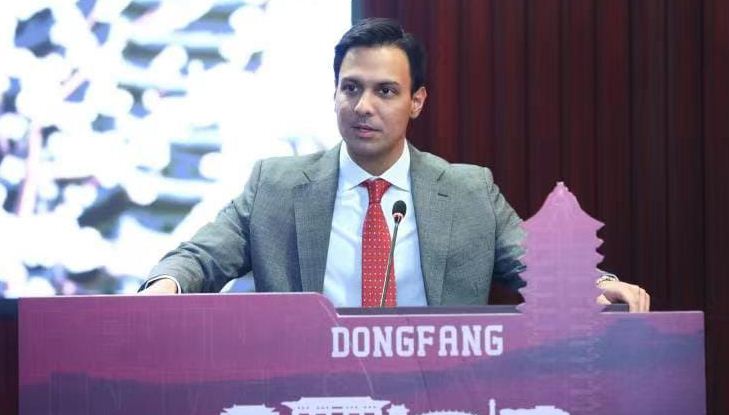
As a representative of an outstanding generation of Pakistani youth, Mustafa was awarded a Dong Fang scholarship on governance to Peking University in 2019 and had the experience of living in Beijing for one year.

Eating local cuisines, taking walks in nearby parks, and celebrating traditional festivals with his Chinese friends, Mustafa had immersed himself into the culture and gained more understanding of the Chinese society through close observation.

“With one-year experience in Beijing and over 30 visits, what I’m most impressed is the thriving artificial intelligence, big data, and E-commerce in this city, and that’s what Pakistan, especially the youth of Pakistan, should set their goal for.” Mustafa pointed out, “China is experiencing its fifth industrial revolution, and we in Pakistan can benefit from it as well through a skilled labor force.”

“Chinese universities offer numerous opportunities that can be especially beneficial to Pakistani students. I believe that in order to learn about a society, about a people, one must visit the country; and in this regard Chinese universities offer the best opportunity to experience the Chinese society up close.”

Pakistan China Institute (PCI) has been contributing a lot in this regard. Under the arrangements of PCI, two delegations of young leaders consisting of parliamentarians, journalists, and scholars had visited China.

For most of these participants, this was a first-of-its-kind opportunity to engage with the Ministry of foreign affairs, think tanks, and universities in China. Travelling from the capital city Beijing to the financial center Shanghai, while also visiting areas like Guangzhou, which had risen out of poverty owing to the reform and opening-up, the young leaders learned about the Chinese model of governance and gained first-hand experience in effective policy making.

During their trip, the participants were also able to enjoy themselves through their interaction with the local culture and special cuisines as well.

To promote the awareness of China-Pakistan friendship in a wider range, PCI had also organized an essay competition, in which people from all the provinces could participate and the first prize winners were awarded a fully sponsored trip to China.

A girl from Karachi and an Urdu journalist from Gilgit finally won the prize, who in their following trip did a tremendous job in representing Pakistan in China and made a lot of friends.

Pakistan to remain on FATF grey list

News Desk/DNA

PARIS: The Financial Action Task Force (FATF) announced on Friday that Pakistan will continue to remain on the watchdog’s “increased monitoring list”, also known as the grey list, till it addresses all items on the original action plan agreed to in June 2018 as well as all items on a parallel action plan handed out by the watchdog’s regional partner – the Asia Pacific Group (APG) – in 2019.

Announcing the decision in a virtual press conference after the financial watchdog’s five-day plenary meeting, FATF President Dr Marcus Pleyer said, “Pakistan has made significant progress and it has largely addressed 26 out of 27 items on the action plan it first committed to in June 2018.”

Pleyer, however, added that the item on financial terrorism still needed to be addressed which concerned the “investigation and prosecution of senior leaders and commanders of UN-designated terror groups”.

He also pointed out that “a separate process has been taking place over the past few years” insofar as Pakistan was concerned.

“Back in 2019, FATF regional partner, the Asia Pacific Group (APG), identified a number of serious issues during its assessment of Pakistan’s entire anti-money laundering and counter-terrorist financing system. Since then Pakistan has made improvements. This includes clear efforts to raise awareness in the private sector to money laundering risks and to develop and use financial intelligence to build cases.”

But, he said, Pakistan was still “failing to effectively implement the global FATF standards” across a number of areas.

“This means risks of money laundering remain high which in turn can fuel corruption and organised crime. That is why the FATF has worked with the Pakistan government to work on areas that need to be improved as part of the new action plan that largely focuses on money laundering risks. This includes increasing the number of investigations and prosecutions and making sure that law enforcement agencies cooperate internationally to trace, freeze and confiscate assets.

“This is about helping authorities stop corruption and prevent organised criminals from profiting from their crimes and undermining the financial system and legitimate economy in Pakistan,” Pleyer said.

‘6 more action items’

When asked about the new action plan after the APG evaluation, Pleyer said the plan had “six action items including enhancing international cooperation and demonstrating that assistance is being sought from foreign countries in implementing UN Security Council designations”.

He said “this is about demonstrating that supervisors are conducting both onsite and offsite supervision commensurate with the specific risks associated with the non-financial sector.”

“It’s also about demonstrating that sanctions are applied to all legal persons and arrangements for non-compliance with beneficial ownership requirements; increase in money laundering investigations and demonstrating that non-financial sector is being monitored for compliance with proliferation financing requirements,” he added.

‘Delisting only after both plans addressed’

The watchdog’s president, responding to a question, said all items on both action plans needed to be addressed and goals fulfilled for countries to exit the grey list.

For Pakistan, Pleyer said, even after the last remaining item on the original action plan was addressed, delisting would not occur as there was a parallel action plan that was also given.

He said this while responding to a question from an Indian journalist, who had asked if Pakistan would be delisted after addressing the single remaining item on the original action plan or if the five additional items added by the Asia Pacific Group would also need to be addressed.

“As soon as this last remaining item of the [original] action plan is largely addressed, the members will decide whether they will grant an onsite [assessment] for this action plan. Usually once an onsite [assessment] has been successfully completed, the membership can decide on delisting a country. “But in this case we have a parallel action plan with all the action items in the second action plan. Then Pakistan must also largely complete all the items on this action plan and then there will be a separate onsite [assessment] to decide on this action plan.

Pakistan not to face any sanctions: Hammad

Commerce Reporter

ISLAMABAD: Federal Minister Hammad Azhar said on Friday that Pakistan has been given the sternest action plan by the Financial Action Task Force while the FATF president has praised the performance of Islamabad regarding its implementation, media reported.

Hammad Azhar made the statement while addressing a media briefing regarding the FATF’s decision for retaining Pakistan on its grey list.

He clarified that Pakistan is not facing any danger to fall on FATF’s blacklist as the debate was made on the country’s placement on the whitelist. Pakistan will not face any sanctions after being retained in the grey list, he added.

Azhar said that FATF has given a new seven-point action plan to Pakistan and it is important to implement the previous and new action plan for getting out of the grey list. Islamabad has successfully completed the implementation of 26 out of 27 points of the previous action plan which primarily focused on counter-terrorism.

The federal minister said that FATF President Dr Marcus Pleyer has admitted that the Pakistani government has made substantial progress in making its counter-terrorist financing systems stronger and more effective. Azhar continued that FATF decided to retain Pakistan on its grey list besides granting two years for implementing the new action plan.

The country had complied with the 75 out of 82 points given by FATF in 2018 including 31 out of 40 recommendations made by the International Co-operation Review Group (ICRG), whereas, the new action plan is focused on anti-money laundering.

The latest action containing points for anti-money laundering and counter-terrorism is easier as compared to the previous one and the government will take less time to implement it, said Azhar.

Azhar said that the federal government will try to implement the new action plan within 12 months instead of two years. He added that the government had passed 17 bills related to curb money laundering and terror financing.

Azhar said that the real face of India has exposed after the neighbouring country tried to politicise the FATF platform which also came into observation by the representatives. India has attempted to convince FATF for placing Pakistan on the blacklist, however, New Delhi faced defeat due to effective steps taken by Islamabad.

Stay Connected

64FansLike
60FollowersFollow

Latest Reviews

Exchange Rates

USD - United States Dollar
EUR
1.14
GBP
1.34
AUD
0.70
CAD
0.71