Home Blog Page 2640

SHORT STORY: THE HONEST TAXI DRIVER

Zeenat Hussain

What all is involved in a taxi drivers life; physical labour and not much exercise for the grey matter. One such driver was Anwar. He got his driving license from the back door. He did not learn how to drive a car, neither was he aware of the traffic rules and regulations. He was however, a man with a generous heart, known for his hospitality. 

Overheard conversation, as he sat with his mates at a tea stall. “Tea keeps me on my feet”, have another, everything should be done in moderation”. “Tea is a milder addiction”. The conversation drifted to the price of petrol and passengers. “Things have become so expensive. I bought a kilo of meat for Rs. 150/-. It seems that if the price does not come down, it will be difficult for us to make ends meet”. 

One of the reasons why Anwar stood out amongst his mates was his wife. She never harassed him for extra money. The hard work that he put in was evident from his bronze rugged skin tone. Tanned from the hours, days, years that he had spent driving his cab, exposed to the 

merciless sun. He was so vigilant that he pierced the distance with the sight of an eagle soaring in the skies and nose-diving to pick up the prey from ground. Proof of his vigilance, “stop the thief, “ cried the lady, whose purse had been snatched. Nobody moved from amongst the onlookers. Anwar from a distance approached the scene of the theft; “move aside” he roared “corner the thief”. The thief was a smart cookie. Dodging Anwar he entered the alley and hid behind a rubbish can. To the thief’s misfortune a cat inside the can scared of the noise the thief made, leapt out of it. Anwar pounced on the thief and recovered the money from him. 

Like the lady above, his work led him to interact with persons from various stratas of society. Sometimes there were persons from affluent families also. One bright sunny day when fate was to take a turn for Anwar, Mr. and Mrs. Ahmed sat in his cab. “We want to go to Nazimabad. Will you take us?” “Hope in.” said Anwer. ”We are going to this place for the first time. I hope you will be able to follow our instructions,” said Mr.Ahmed. After clearing a few traffic jams, they finally arrived at the destination. They got off on the main road and said they would manage on foot the rest of the way.

To his utter surprise Anwar found a parcel on the back seat of his cab. This was when he stopped for a meal after dropping Mr and Mrs. Ahmed. The parcel had jewellery inside. He was somewhat anxious regarding how to locate them so that he could give them their parcel back. He searched for some form of identification, but to no avail. His friends tried to persuade him to keep the parcel. But he took pride in being honest and there was no way he would compromise over it. 

Little did he know that this parcel was to seal the fate of a couple about to be married? The couple was Ammar and Shagufta. Ammar and Shagufta had been engaged for a year. It was customary to give dowry to the daughter. Not to display wealth, but to support her in her new home, till she was self-sufficient. 

He reached home and asked his wife to keep the parcel in safe custody. Weeks passed, and lo and behold, he spotted Mrs. Ahmed. She was shopping in a market where he had just dropped a passenger. He hurriedly approached her and told her that she had forgotten a parcel in his taxi. She told him, she had searched for this parcel. She could not hold back her happiness and gratitude. “I was so worried. The parcel had jewellery, which was my daughter’s dowry. I had fallen sick due to the loss.”

This jewellery was an heirloom. It had been handed down from Shagufta’s grandmother to Shagufta’s mother and then to her. The grandmother was married to one of Ammar’s father’s uncles. Shagufta’s grandmother had grey eyes and brown hair and so had Shagufta. These qualities endeared Shagufta to Ammar.

Anwar arranged for the jewels to be returned to Mrs. Ahmed. “We will expect you and your family at the wedding”. Mrs. Ahmed’s happiness knew no bounds. The return of the jewellery meant a big load off her delicate shoulders. Mrs. Ahmed just could not stop praising Anwar. She told everyone she met, about how honest he was and how difficult, it was to find people like him. She thanked God, five times a day, when she prayed.

“Welcome Anwar”. Anwar was welcomed in a big way at the wedding. All the family were eager to know him, although he was not a rich man and the other guests were all, well, rich people. But who could deny, that Anwar was ‘rich at heart’. The richest in the gathering at the wedding. He walked, in with his head held high. He felt so good, after returning the jewels. Although he was in a gathering of rich people, he did not feel lost as he was bestowed with ‘wealth’ of honesty. 

And as Shagufta wore the wedding band, she looked at Anwar and smiled, a smile of gratitude, before she was whisked off to her new home. Her wedding was memorable right from the beginning to the end. A new life, lay ahead of her, and as she entered the threshold of her new home and prepared to remove the heavy necklace, she heaved a sigh of relief, recalling all that had happened.  

PAKISTAN NEEDS TO PRIORITIZE COOPERATION WITH ASEAN: FS

Pakistan ASEAN Experts Dialogue “Pakistan-ASEAN: Shared Future and the Way Forward” held at ISSI in collaboration with ASEAN group countries; dialogue concluded with remarks by Ambassador Tugio with a proposal for an interactive engagement between Pakistan and ASEAN

Staff Report

ISLAMABAD:  “ASEAN has transformed into a vibrant 10-member Organization, an increasingly integrated economic community, and a central pillar of regional architecture. Pakistan needs to prioritize five areas of cooperation with ASEAN, which include: strengthening of Pak-ASEAN connectivity, support for the business communities to comprehensively upgrade economic cooperation with ASEAN countries, focus on tourism, explore avenues of cooperation in Science & Technology, IT and higher education and lastly deepen our cultural exchanges.”

This was stated by Pakistan’s Foreign Secretary, Mr. Sohail Mahmood who was the Chief Guest at the Pakistan-ASEAN Experts Dialogue titled, “Pakistan-ASEAN: Shared Future and the Way Forward“, organized by the Centre for Strategic Perspectives (CSP) at the Institute of Strategic Studies Islamabad (ISSI), in collaboration with the Indonesian Embassy and the ASEAN Committee in Islamabad (ACI). 

The members of the ASEAN Committee in Islamabad included the Chairman of the Committee, Adam M. Tugio, Indonesian ambassador in Islamabad; Nguyen Tien Phong, Ambassador of Vietnam; Abdul Mubdi Osman, Charge d’Affaires, High Commission of Brunei Darussalam; Lutfee,  Charge d’Affaires, Embassy of Thailand; San Yu Kyaw, Minister Counselor, embassy of Myanmar; Dan Erwin Bagaporo, Third Secretary and Vice Consul, embassy of Philippines; and Deddy Faisal Ahmad Salleh, Charge d’Affaires, Malaysia who joined on zoom.

Speakers from Indonesia and Pakistan made short presentations on three dimensions of Pakistan-ASEAN cooperation including political and security cooperation; economic collaboration; and socio-cultural cooperation. The speakers included: Dr. Dewi Fortuna, Indonesian Academy of Sciences; Dr. Fithra Faisal Hastiadi, Executive Director of Next Policy; Dr. Shofwan Al Bana, Executive Secretary, ASEAN Study Centre; Ambassador Aizaz Ahmad Chaudhry, DG, ISSI; Dr. Usman Chohan, Director, Economic Affairs, CASS; and Ambassador Mian Sanaullah, former ambassador of Pakistan to Indonesia.

Director CSP, Najam Rafique moderated the dialogue and said that it seeks to bring together experts and practitioners of policy together to make recommendations for a comprehensive engagement between Pakistan and ASEAN under Pakistan’s Vision East Asia and Prime Minister Imran Khan’s desire for geo-economic engagement with regional countries.

Earlier, in his welcome remarks, Director General ISSI, Ambassador Aizaz Ahmad Chaudhry said that this is the start of a process, and that such dialogues help in generating ideas for future engagement. The Chairman of the ASEAN Committee in Islamabad, H.E.  Adam M. Tugio in his introductory remarks stated that this is a good forum to increase collaboration between ASEAN and Pakistan and it is time to extend the scope of this relationship by having multidimensional cooperation.

During Session-I, titled, ‘Pakistan-ASEAN: Political and Security Cooperation’, Ambassador Aizaz Ahmad Chaudhry, in his presentation, shed light on the changing world order, declining multilateralism, US-China rivalry in Asia-Pacific and its effects globally. He further stated that we require a delicate balancing act and that Pakistan must increase its cooperation with ASEAN and a quantum leap is required in this regard. Prof. Dr. Dewi Fortuna, in her presentation stated that we must look at the ASEAN’s vision of inclusivity and work on two areas of cooperation, the normative sphere and the technical areas. Dr. Dewi further said that there is great potential for Pakistan-ASEAN relations.

In the Session-II on ‘Pakistan-ASEAN: Dimension of Economic Cooperation’, Dr. Usman spoke at length about Pak-ASEAN economic relations. He appreciated Pakistan’s foreign policy shift to geo-economics and expressed his optimistic views on building deeper economic ties. Dr. Fithra Faisal Hastiadi offered a succinct analysis on effectively tapping the economic potential of ASEAN. He said that in the modern era, although the geographical distances have reduced to nothing yet the non-geographical distances do matter. He shed light on cultural and political barriers in this regard. He said that ASEAN region is highly dynamic and offers an interactive window to the interested players on the basis of soft and open regionalism. He suggested that an interactive strategy must be followed for productive and effective outcomes.

In the Session-III on ‘Pakistan-ASEAN: Future of Socio-Cultural Cooperation’, Ambassador Mian Sannaullah stressed upon considering the social network of ASEAN countries.  Talking about the concept of ASEAN community, he elaborated on its three main pillars: political-security, economic and socio-cultural. He said that the impact of social and cultural linkages cannot be ignored in Pakistan-ASEAN relations. Dr. Shofwan Al Banna in his presentation suggested that exchange of inspirational ideas and personalities are of critical importance. He referred to the works of Pakistan’s national poet, Muhammad Iqbal who is a well-known literary figure in Indonesia. He said that there is ample room for cooperation in the fields of academic exchange and people-to-people contacts.

The dialogue concluded with remarks by Ambassador Tugio with a proposal for an interactive engagement between Pakistan and ASEAN in order to analyze each and every aspect of Pak-ASEAN relations. In his vote of thanks, Chairman BoG, ISSI, Ambassador Khalid Mahmood thanked all the participants for making this dialogue a successful event while making a case for nurturing socio-cultural ties and economic linkages with the ASEAN countries.  

CHINESE LEADERSHIP IS MOST TRUSTWORTHY IN THE WORLD

R A Shiekh

In an era of post- truth, it is difficult to desilt truth from lies. Politicians hit emotions of the target audience to gain their sympathies and avoid telling them facts. A polarized society is ideal ground for propaganda. Bias of one group helps to spread fake news against other group. It is a chain reaction which results into chaos in a society. Chaos help the defeated echelon of politics.

EU DisinfoLab recently revealed in by exposing Indian propaganda against Pakistan since last one and a half decade. Indian are hitting soft power of Pakistan for global political gains. Populist demagogue all over the world will hit emotions and disguise the fact to influence their voters and no amount of fact checking will reduce their appeal. It is only when people feel alienated from a political system that they accept lies from a politician who claims to be a champion of the “people” against the “establishment” or “elite”.

This practice is prevalent in other parts of the world as well. Nawaz Sharif, Maryam Nawaz, Asif Ali Zardari, Modi (India), Kim Jong-Yun (N Korea), Trump (US), Johnson( UK), Duterte    (Philippine), Bolsonaro  (Brazil) believes in blatant disregard of facts. But they don’t know this type of behavior only gets approval in front of their supporters, nobody else. The immediate use of story for political use clearly manifest the people behind fake story.

Last four decade of politics in Pakistan has given nothing to masses except mistrust on the political system. Pakistani politics is marred with cloudy deals with external and internal power brokers, massive corruption, political vengeance, maligning and weakening of institutions. Only two families have ruled Pakistan except one semi military rule in which alternative political leadership was part of the government.  Hence there is no ideological politics in the country. Major political parties are outcome of the necessity of that particular time and frame and created for vested interests by internal and external players. Those in politics are in politics only to increase their wealth and power. This inward approach of politicians has left institutions at the mercy of Bureaucracy. The civil servants couldn’t have got more ideal environment to play their own games. Thus, this jigsaw puzzle has ultimately made a mockery of itself.

An international survey found that former US President trump shook the global trust on US leadership. Chinese leadership has 34% approval rating globally as compared with 31% of the US. Joe Biden will have to work at home and abroad to redo the image and enhance the influence of superpower in global politics.

Modi has earned disrepute for himself as well as his party to ignite Hinduism through lies put India in a bumpy ride. India is no more a secular state, it is now established Hindu state with no room for minority.There is no quick and easy recipe for this process. It is not surprising that inequality has been identified as one of the variables that has compromised the legitimacy of democracy in the eyes of so many people. To defang demagogues, and to make lying unacceptable again, requires that voters regain trust in the political system. A research showed that when people consider a political system to be legitimate and fair, they reject politicians who tell untruths and they resent being lied to. So the key to moving on involves pursuing politics that reduce the appeal of populist demagogues and that create incentives for politicians to be more honest.

It is encouraging to note that in other countries with different political structures and policies, voters do not tolerate politicians’ lies. In Australia voters reduce their endorsement of politicians if they are revealed to be dishonest. In Australia, voting is mandatory and preferential. Everyone must vote or risk being fined, and voters rank their preferences among all parties. These measures help contain political polarization, underscoring how the design of a political system can determine a country’s welfare.

CPEC HELPING PAKISTAN EXPENDING ITS AGRICULTURAL PRODUCTS TO INTERNATIONAL MARKETS

DNA

BEIJING, July 2: “The agricultural cooperation under China-Pakistan Economic Corridor (CPEC) has three main goals. First, to help Pakistan improve agricultural research sustainability. 

Second, according to a China Economic Net’s report to promote the development of Pakistan’s export-oriented economy. 

Third, to introduce more advanced agricultural production factors into Pakistan,” said Dr. Gu Wenliang, Agricultural Commissioner at the Chinese Embassy in Pakistan, on what is happening in the agricultural sector under CPEC to further boost China-Pakistan cooperation in a webinar themed by “COVID-19 and Higher Education: 

Addressing about food Security through Policy Support and Research”, he said “Pakistan’s economy is basically export-oriented and the majority of the exports are agricultural products. We’d like to promote value-added processing to help more Pakistani products up to the international standards, entering more markets globally.

Now, rice, mango, citrus, dry nuts, honey and seafood, etc. from Pakistan are being exported to China. Besides, it’s learned from Dr. Gu in the webinar that next year Pakistani onion has the chance to enter the Chinese market as the two governments are dedicated to signing more protocols to let more Pakistani products like cherry, potato, etc. be exported to China.

“I always think that Pakistan’s meat products have the greatest potential to be exported to the Chinese market because China is importing numerous meat products from all over the world, and the livestock sector in Pakistan is producing a lot of meat products,” Dr. Gu said. 

However, due to the food and mouth disease, Pakistan’s meat products currently haven’t got permission to be exported to China. “We’re trying to build free zones to encourage more Chinese enterprises to invest in building cold storage, cold logistics and food processing to let Pakistani products enter China,” Dr. Gu added.

According to Dr. Gu, the two governments are negotiating about an memorandum of understating (MOU) in animal disease control to help Pakistan improve the livestock sector as well as lift Pakistan’s export of meat products.

On January 26, 2021, under the coordination of the Chinese Embassy in Pakistan, China-Pakistan Agricultural and Industrial Cooperation Information Platform was launched by China Economic Net and China Machinery Engineering Corporation. 

“On the platform, we’ve held three online webinars on seed industry, animal husbandry, fishery and agricultural product processing, etc. ”

To further boost Pakistan’s export to China, Dr. Gu suggests Pakistani traders think more about what the Chinese market needs most. “China is a vast country which also is producing lots of agricultural products itself. Let’s take mango for example. 

Southern China abounds with mangoes. Therefore, Pakistani mango exporters may focus more on western areas of China like Xinjiang,” said him. “The Embassy is the bridge of sharing information from both countries to effectively and precisely enhance the bilateral cooperation, ” he said.

In the webinar, a Chinese technology named ‘maize-soybean strip intercropping technology’ attracted much interest and attention. 

“In China, the population is increasing day by day while the land is decreasing constantly. So they decided to go for intercropping to grow two or more crops at the same time. Actually Pakistan is facing similar conditions with China. 

The prospects for adopting intercropping in Pakistan is bright as well,” said Muhammad Ali Raza, post-doc at Sichuan Agricultural University.

“At present, Pakistan is importing about 1.7 to 1.9 million tonnes of soybeans from other countries. By using this technology which greatly improves use efficiency of land, water and radiation, we can reduce our imports by 76% via locally producing soybeans up to 0.9 to 1.3 million tonnes, without decreasing the production area of maize,” said Dr. Muhamamd Ali Raza. 

“Notably soybean is three times the value of maize in the local market,” he added. Therefore, intercropping soybeans into current maize fields will create much more economic benefits for farmers as well as safeguard food security.

It may be mentioned here that on June 25, Prof. Athar Mahboob, Vice Chancellor of the Islamia University of Bahawalpur and Dr. Muhammad AliRazahad a meeting with Dr. Gu Wenliang at the Chinese Embassy in Pakistan. Possible future cooperation between the Islamia University of Bahawalpur and Chinese universities, especially inagriculture, engineering, and information technology were discussed.

“Now, maize-soybean strip intercropping technology project by Sichuan Agricultural University (SAU) and the Islamia University of Bahawalpur (IUB) has been included in the CPEC projects, which will ultimately increase the cereals and legumes production in Pakistan,” Dr. Muhammad Ali Raza told CEN.

EU LAUNCHES A NEW RULE OF LAW PROGRAMME IN KP, BALOCHISTAN

ISLAMABAD, JUL 2 (DNA) – The European Union and its partners launched a programme that aims to promote the rule of law and enhance the criminal justice system in Pakistan, with a specific focus on the provinces of Khyber Pakhtunkhwa (KP) and Balochistan.

Jointly implemented by United Nations Development Programme (UNDP), United Nations Entity for Gender Equality and the Empowerment of Women (UN Women) and United Nations Office on Drugs and Crime (UNODC), the programme aims to support reform processes to ensure delivery of people-centered justice, enhance access to justice for all, particularly women and less privileged/marginalized groups; and improve service delivery of the security sector in line with constitutional safeguards and international standards. The project will provide technical assistance to legal reforms and the Rule of Law roadmaps in KP and Balochistan. Special focus will be set on access to justice through free legal aid and alternative dispute resolution, as well as legal literacy for citizens. On the institutional side, the project will assist in upgrading facilities and processes to enhance citizen friendly service delivery.

The launch event was held in a socially distanced setting, with many participants and key stakeholders attending virtually. Honourable Chief Justice of Pakistan Mr. Justice Gulzar Ahmed graced the occasion as Chief Guest, along with Her Excellency Ms. Androulla Kaminara, EU Ambassador to Pakistan and Representatives of the three UN Agencies.

EU Ambassador to Pakistan H.E. Ms. Androulla Kaminara thanked the UN agencies, provincial and federal government, and other important stakeholders for their support in strengthening the Rule of Law in Pakistan.  “Inclusive access to justice for all is an important prerequisite for a peaceful and just society. Today’s programme builds on the long-term commitment of the EU to improving the Rule of Law and access to justice for all in Pakistan. The new program is part of the priorities of the EU-Pakistan Strategic Engagement Plan 2019 and financed under the EU Multi-Annual Indicative Program 2014-2020. Both strategic documents support the implementation of the Vision 2025 in the focal areas: rural development, education, good governance, human rights, and Rule of Law.”

Advisor to Chief Minister on Information, Government of Balochistan, Mr. Liaquat Ali Shahwani, thanked the EU and UN agencies for their continued support towards the justice system in Pakistan. “The Rule of Law programme is indeed an important milestone in advancing the provision of an enabling environment, peace, and security for the citizens of Balochistan and we are most grateful for this support.”

UNDP Resident Representative Mr. Knut Ostby said that the programme provides UNDP with the opportunity to work closely with UN WOMEN and UNODC, and other key government counterparts. “This will help us contribute to the effective functioning of the District Legal Empowerment Committees, women’s access to justice, in particular on domestic violence, child marriage and inheritance and property rights, and gender-responsiveness, among other important areas.”

UN Women Pakistan Country Representative Ms. Sharmeela Rassool stated that, “In Pakistan, women constitute of almost 50% of the entire population. Yet they are not represented proportionately in receiving or delivering of basic and critical services including effective service delivery in the justice sector. UN Women is committed to deepening our efforts to ensure inclusion of women in formal justice delivery mechanisms in Khyber Pakhtunkhwa and Balochistan to ensure their rights are safeguarded for promotion of a fair, efficient, gender-responsive and inclusive society.”

UNODC Pakistan Country Representative Mr. Jeremy Milsom hailed the programme as a milestone achievement and reiterated that, “UNODC is committed to working as a strategic partner to the Federal and provincial Government of Balochistan, implementing and strengthening transformative reforms across the chain of rule of law institutions towards delivery of a free and fair justice for all, including vulnerable and marginalized groups to support inclusive, just and citizen-friendly rule of law for the people.”=DNA

=========

US DONATES 2.5 MILLION DOSES OF THE MODERNA COVID VACCINE TO PAKISTAN

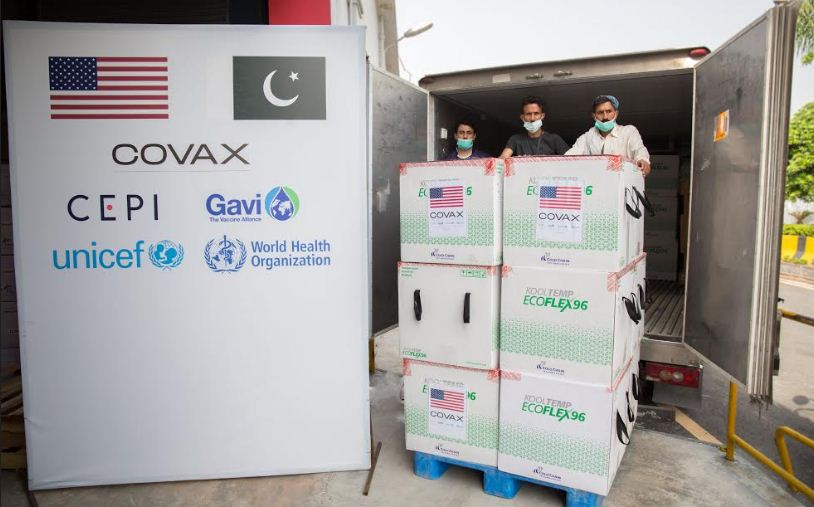
ISLAMABAD, JUL 2 /DNA/ – Today, 2.5 million doses of the Moderna COVID-19 vaccine donated by the United States arrived at Islamabad International Airport.  These vaccines are being delivered to the Pakistani people in partnership with the COVAX global vaccine initiative, UNICEF, and the Government of Pakistan.

This donation is part of the 80 million doses the United States is sharing with the world, delivering on our pledge to facilitate equitable global access to safe and effective vaccines, which are essential to ending the COVID-19 pandemic.  As President Biden has said, the United States is committed to bringing the same urgency to international vaccination efforts that we have demonstrated at home.

“The United States Mission to Pakistan is pleased to share these safe and effective vaccines with the people of Pakistan,” said U.S. Embassy Chargé d’affaires Angela P. Aggeler.  “These vaccines will save lives and help Pakistan emerge from this crisis, which has devastated so many families and communities in both our countries.  A vaccinated public will also help bring back the economic and social interactions we all welcome.  We appreciate the ongoing collaboration with the Pakistani government and our international partners to make this delivery and these goals a reality.”

In addition to today’s vaccine donation, the United States has delivered nearly $50 million in COVID assistance through our partnership with the Pakistani government.  Since the start of the pandemic, we have worked together to improve infection prevention and control, enhance patient care, expand laboratory testing, disease monitoring, and case tracking in all districts, and support frontline healthcare workers.

Separately, the United States has pledged $4 billion to support COVAX with the purchase and delivery of COVID-19 vaccines to 92 low- and middle-income countries.  This contribution is supporting equitable access to vaccines for the world’s most vulnerable and at-risk populations, including frontline healthcare workers.  In May, Pakistan received 1.2 million doses of the Astra Zeneca vaccine as part of the COVAX effort.=DNA

===============

WHO urges West to recognize Chinese vaccines

In addition to vaccines by Pfizer-BioNTech, Moderna Inc. AstraZeneca and Johnson & Johnson, the WHO has also given the green light to the two Chinese jabs, made by Sinovac and Sinopharm

GENEVA: The World Health Organization (WHO) said on Thursday that any Covid-19 vaccines it has authorized for emergency use should be recognized by countries as they open up their borders to inoculated travelers.

The move could challenge Western countries to broaden their acceptance of two apparently less effective Chinese vaccines, which the UN health agency has licensed but most European and North American countries have not.

In addition to vaccines by Pfizer-BioNTech, Moderna Inc. AstraZeneca and Johnson & Johnson, the WHO has also given the green light to the two Chinese jabs, made by Sinovac and Sinopharm.

In its aim to restore travel across Europe, the European Union (EU) said in May that it would only recognize people as vaccinated if they had received shots licensed by the European Medicines Agency — although it’s up to individual countries if they wish to let in travelers who have received other vaccines, including Russia’s Sputnik V. The EU drug regulator is currently considering licensing China’s Sinovac vaccine, but there is no timeline on a decision.

“Any measure that only allows people protected by a subset of WHO-approved vaccines to benefit from the reopening of travel … would effectively create a two-tier system, further widening the global vaccine divide and exacerbating the inequities we have already seen in the distribution of Covid-19 vaccines,” a WHO statement said on Thursday. “It would negatively impact the growth of economies that are already suffering the most.”

The WHO said such moves are “undermining confidence in life-saving vaccines that have already been shown to be safe and effective”. In its reviews of the two Chinese vaccines, the UN health agency said both were found to significantly reduce the risk of hospitalizations and deaths.

The two Chinese shots are “inactivated” vaccines, made with killed coronavirus, whereas the Western-made shots are made with newer technologies that instead target the “spike” protein that coats the surface of the coronavirus.

Although Western countries have largely relied on vaccines made in the US and Europe, such as Pfizer-BioNTech and AstraZeneca, many developing countries including Pakistan have used the Chinese-made shots.

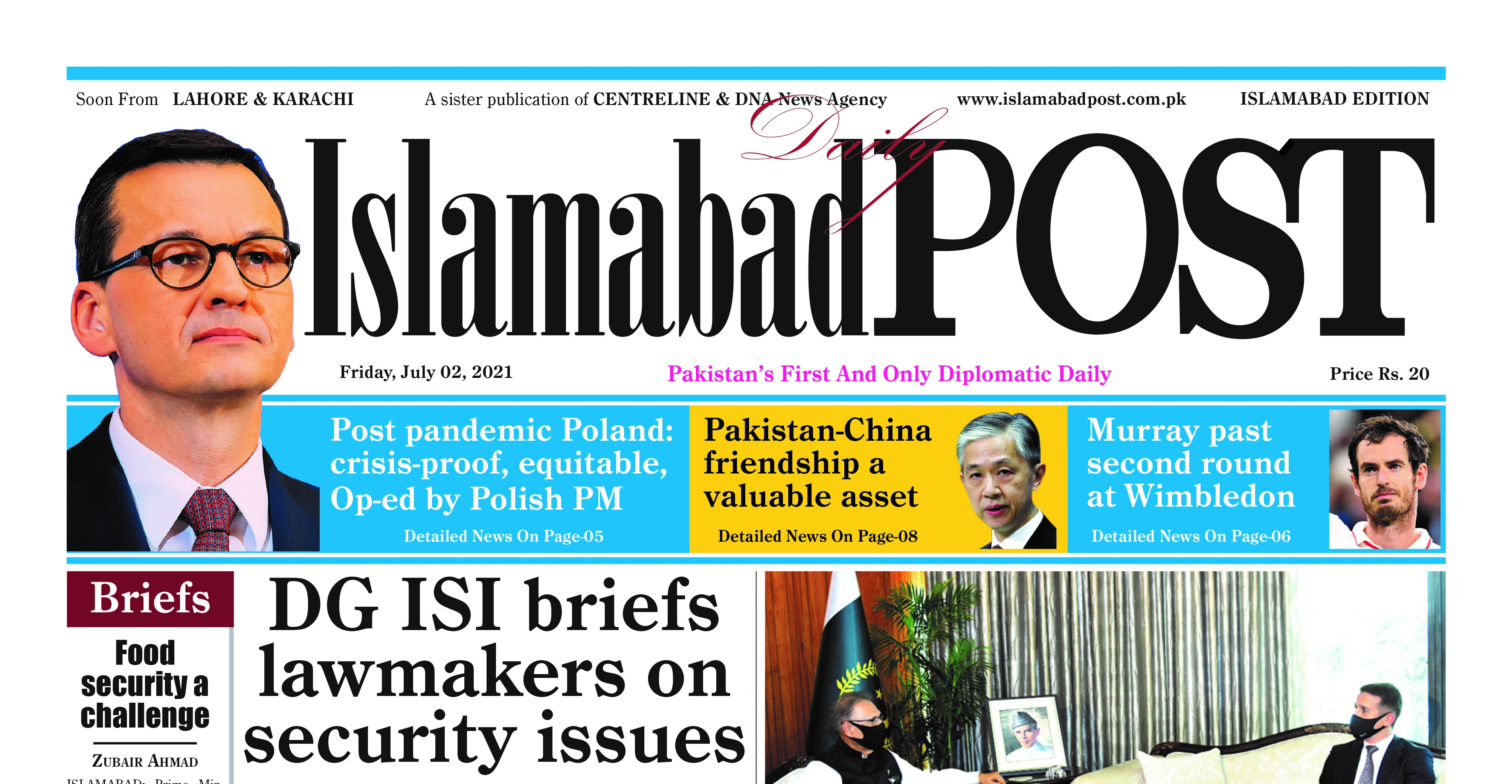
DG ISI briefs lawmakers on security issues

Members briefed on internal and external security paradigm in the ever evolving environment, PM Imran did not attend the meeting

ISLAMABAD: A special in-camera session of the Parliamentary Defense Committee on National Security was held with Speaker National Assembly in the chair. Besides members of the committee, representatives of all major political parties were also invited for the briefing.  DG ISI comprehensively briefed the members on internal and external national security paradigm in the ever evolving geo-political / strategic environment.

The meeting was told that Pakistan had honestly played a “very positive and responsible” role in the Afghan peace process, according to a statement released by the information ministry.

“Due to Pakistan’s efforts, not only was the path paved for talks between different Afghan factions and warring groups, but meaningful dialogue between the United States and Taliban was also started,” the lawmakers were told.

“We believe in the fact that lasting peace and stability in Afghanistan will actually result in stability in South Asia,” the ministry’s press release added.

The meeting was told that Pakistan will welcome the true representative government of the people in Afghanistan “at every level” and continue its role for the Afghan peace process.

“Pakistan’s land is not being used in the conflict going on in Afghanistan and the hope was expressed that Afghanistan’s soil will also not be used against Pakistan,” according to the statement.

Lawmakers were informed that 90 per cent of the fencing at the Afghan border had been completed, while an effective system for customs and border control was being formulated.

Briefing covered the national core interest including Afghanistan and Kashmir besides diplomatic relationships. Members appreciated the efforts of COAS and DG ISI in identifying various challenges and providing clarity on the issues confronted by Pakistan through a detailed and informative briefing. Briefing has helped in building consensus on core challenges confronting the country. 

Important leaders of the Opposition parties in Parliament had been invited to attend the meeting as they were taken into confidence with regards to the recent developments in Afghanistan and national security, according to Foreign Minister Shah Mehmood Qureshi.

The Opposition leaders included the Leader of the Opposition in the National Assembly Shehbaz Sharif, Leader of the Opposition in the Senate Senator Syed Yusuf Raza Gilani, PPP Chairperson Bilawal Bhutto Zardari, JUI-F Parliamentary leader Maulana Asad Mahmood, and ANP leader Ameer Haider Azam Khan Hoti. Prime Minister Imran Khan did not attend the meeting.

Opposition satisfied with the briefing

ISLAMABAD: Leader of the Opposition in the NA Shahbaz Sharif, talking to media during a break, said he was satisfied by the briefing given during the meeting, but refrained from sharing any details.

Shahbaz, responding to a question on whether Gen Bajwa answered questions asked during the meeting, said: “Yes, he did.”

Speaking to media at the Parliament House, former Prime Minister Shahid Khaqan Abbasi said Shahbaz had spoken on behalf of the PML-N.

“We were not informed that US has demanded a base,” said the prime minister. “Nobody is going to give anyone any bases and neither has anybody asked for them,” he added.

Abbasi said decisions and policy making were not underway during the meeting, rather information was being provided, adding that politics was “not a circus” that one should expect new details every day.

The former prime minister said the military brass had put forward its opinion, and now the political leadership would make its decision.

Stay Connected

64FansLike
60FollowersFollow

Latest Reviews

Exchange Rates

USD - United States Dollar
EUR
1.14
GBP
1.34
AUD
0.70
CAD
0.71