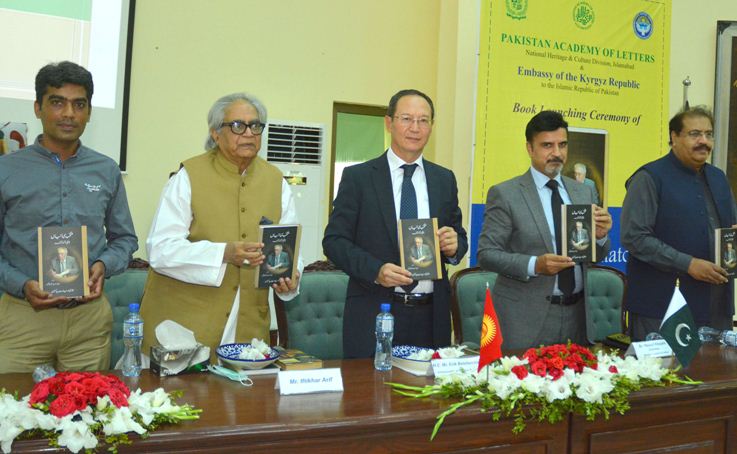
ISLAMABAD: A Book Launching Ceremony of Chingiz Aitmatov’s selected stories “Jamila”, “Farewell, Gyulsary” and ” Spotted dog running by the edge of the sea” translated and published into Urdu by the Academy of Literature of Pakistan, at the initiative of the Pakistan was held in Islamabad.
Embassy of the Kyrgyz Republic showed a documentary film about Chingiz Aitmatov and also organized a Photo Exhibition and a performance on a Kyrgyz song.
The event was attended by writers, scientists, representatives of the diplomatic corps and the media.
Ambassador Erik further said, he was glad to note that Kyrgyzstan enjoys excellent bilateral relations with Pakistan since establishment of diplomatic relations in 1992. During last 30 years our countries exchanged presidential visits twice, Kyrgyz Prime Ministers visited Pakistan twice, Pakistani Prime Ministers came to Kyrgyzstan four times, Speakers of the Kyrgyz parliament visited Pakistan twice and Ministers of Foreign Affairs of our countries exchanged visits. In June 2019, the Prime Minister of Pakistan Imran Khan met his Kyrgyz counterpart on the sidelines of the SCO Summit in our capital Bishkek. During conversation, they reviewed bilateral relations and agreed to hold Joint Ministerial Commission and Bilateral Political Consultations, to comprehensively upgrade mutual cooperation in diverse fields and strengthen the land and air connectivity between the two countries, to enhance people-to-people contacts and boost tourism cooperation through friendly visa regimes. Prime Minister Imran Khan invited Kyrgyz President to visit Pakistan.
Talking about trade the ambassador said, the existing trade volume between Kyrgyzstan and Pakistan is not up to the actual potential that exists and both countries should work towards increasing it.
In order to promote trade and economic relations Intergovernmental Kyrgyz-Pakistani commission was established in 1994, which held its third meeting on 11-12 January 2017 in Islamabad. Now we are expecting the Pakistani delegation to come to my country for the next meeting of the commission.
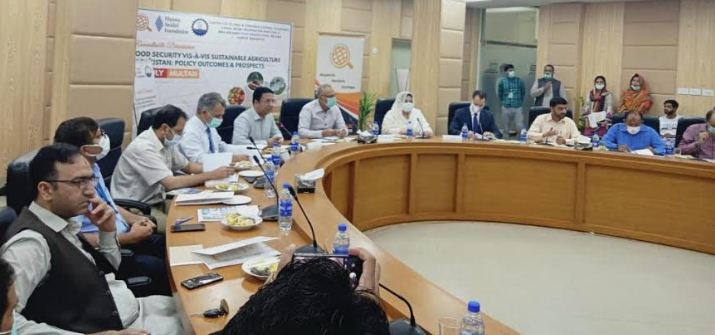
MULTAN: A Roundtable Discussion on “Food Security vis-à-vis Sustainable Agriculture in Pakistan: Policy Outcomes and Prospects” was jointly organized by Center for Global & Strategic Studies (CGSS), Islamabad, Hanns Seidel Foundation Pakistan and MNS University of Agriculture, Multan at Multan.
The Discussion commenced with the opening remarks by Mr. Khalid Taimur Akram, Executive Director, Centre for Global& Strategic Studies, Islamabad. He welcomed the panelists and participants of the discussion. He appreciated and acknowledged the hard work of the university particularly in the domain of food security. He stated that a follow up Conference on food security will also be organized inIslamabad.
Dr. Steffen Kudella, Resident Representative, Hanns Seidel Foundation Pakistan, in his welcome remarks, stated that the climate is changing, we are facing a global water crisis, land is degrading, the global population growing, diseases affect livestock and crops, food prices are rising – all at the same time: food is often being wasted, the environment is stressed – all these factors are influencing our food security.
He highlighted the UN’s definition of food security as “all people, at all times, have physical, social, and economic access to sufficient, safe, and nutritious food that meets their food preferences and dietary needs for an active and healthy life.” He also mentioned the 1948 UN Declaration of Human Rights, where the UN recognized the “Right to Food.”
Dr. Kudella stressed that food is a necessity for the survival and well-being of people, and therefore, this necessity must be ensured by the people. Moreover, adaptation strategies and policy responses to food security risks must be developed. Food security is one of Pakistan’s non-traditional security challenges and today’s roundtable discussion at the MNS University of Agriculture, Multan, which is located in the agricultural heartland of Pakistan, provides the perfect setting for experts to discuss food security and sustainable agricultural production.
Prof. Dr. Asif Ali (TI), Vice Chancellor, MNS University of Agriculture, Multan was the Chief Guestat the occasion. He welcomed the worthy panelists. He stated that there are several non-traditional security challenges that Pakistan is facing. However, food security remains on top while climate change is second on the list. He ensured specialized research and development in different domains of nontraditional security challenges particularly food security and climate change. He vowed to work together in collaboration with CGSS & HSF in the sectors of nontraditional security challenges. He highlighted several initiatives that are being undertaken by the University in this regard. He stated that MNS university has built models for water security, clean and green environment and climate change.
Ms. Palwasha Nawaz, Project Executive, CGSS presented a brief overview on the working of CGSS. She gave presentation on Food & Agriculture Security: An Emerging Nontraditional Security Challenge for Pakistan. She stated that food security is a multidimensional concept.There must be sufficient supplies of affordable food throughout the year to ensure a healthy and productive life. She highlighted the four components of food security that are physical availability of food, economic access, utilization of food in body and stability. Furthermore, she also described in detail the situation of food security after the COVID-19 pandemic.
The discussion was conducted in two sessions. The theme of the first session one was “Understanding Food Security in Pakistan: Incorporating New Techniques and Policy Recommendations”. This session was chaired by Prof. Dr. Sajjad Ahmad Khan, Vice Chancellor, Cholistan University of Veterinary and Animal Sciences, Bahawalpur. He thanked all the participants for their contribution. He stated that we must highlight the potential of Pakistan in the agriculture sector on various forums.
The panelists of the first sessionstated that food security is about making food available to everyone at all times. Around 820 million people go to bed hungry at night. In Pakistan, the future of our nation i.e. children are suffering from hunger and do not have sufficient nutrition. During session one, overview on the 2030 agenda for sustainable development and the zero hunger agenda was also presented. It was discussed thatby 2030, there would be end to all forms of hunger and malnutrition. People–especially children will have sufficient and nutritious food all year. Furthermore, it was stated that there is a need to promote sustainable agriculture, supporting small-scale farmers, technology and markets. There must be international cooperation to ensure investment to improve agricultural productivity. The role of academia was also discussed in the perspective of food security, nutrition, and sustainable development. During the discussion food security, sustainable Development Goals (SDGs) and policy measures adopted in South Asian countries were also discussed. The panelists also presented facts and figures of food security in Pakistan including food utilization, food access and availability.
The panelists of session one included the following:
· Dr. Umar Saeed, Food and Agriculture Organization (FAO), Pakistan
· Dr. Zulfiqar Ali, Director ORIC, MNS University of Agriculture, Multan
· Dr. Saeed Akhtar, Department of Food Science and Technology, Bahauddin Zakariya University Multan
· Ms. Rabia Sultan, Progressive Grower / Director Gurmani Foundation
· Dr. Khalid Bashir, Assistant Professor, Institute of Agricultural and Resource Economics, University of Agriculture Faisalabad
The theme of the second session was Critical Analysis of the Agriculture Sector in Pakistan: Ramifications and Policy Recommendations and the session was chaired by Syed Ibne Hussain, IGPolice (Retd), Member, Punjab Public Service Commission. He thanked the panelists for their contribution. He stated that the panelists elaborately covered their topics. The panelists also presented innovative ideas and techniques.
The panelists of the second session discussed agriculture and economic cooperation for ensuring sustainability. It was stated that there is a need to fully understand the major strategic importance of accelerating scientific and technological innovation and accelerate the resolution of some key issues restricting the development of scientific and technological innovation. The panelists also discussed agriculture development issues and policy ramifications in Pakistan. It was stated that agricultural sector is indispensable to Pakistan’s economic growth, food security, employment generation and poverty reduction. Pakistan is essentially an agricultural country, generating more of its export from cotton, rice, and fruits. Most of the people, i.e. 64% lives in rural areas depending on agriculture for livelihood. Several recommendations as the way forward were presented by the panelists. It was stated that food security must include nutritional security. The political economy of food security must not compromise profitability of the farmer. It was also stated that water is an indispensable ingredient to agricultural production and without water, farmers would not be able to grow their crops and feed their animals. Therefore, water insecurity means food insecurity.
The Panelists of the second session included:
· Dr. Muhammad Ashfaq, Project Coordinator, MNS University of Agriculture Multan
· Dr. Sofia Anwar, Dean, Faculty of Management Sciences, Govt. College University, Faisalabad
· Dr. Ayesha Hakim, Assistant Professor, MNS University of Agriculture, Multan
· Dr. Asif Kamran, Economists, Nuclear Institute of Agriculture and Biology (NIAB), Faisalabad
· Prof. Dr. Irfan Ahmad Baig, Dean Faculty of Social Sciences, MNS University of Agriculture Multan
Mr. Barak Ullah, Additional Secretary Agriculture (TF), South Punjab presented the concluding remarks. He congratulated MNS University, CGSS and HSF on organizing a successful discussion. He was thankful to the farmer community who have reduced the usage of pesticides and have shifted towards bio-science.
The discussion was attended by approximately 70 participants including experts of the relevant fields, deans, faculty members and students.
Pakistan Olympic Association on Wednesday announced 22-member Pakistan contingent which will take part in Tokyo Olympic being held later this month.
“ As many as 22 Athletes, Athlete Support Personnel, Officials and Medical Support Personnel will be part of the contingent which includes in particular two Covid Liaison Officers for point of contact between contingent, POA and organizers”, said Muhammad Khalid Mahmood, Secretary, POA here. Apart from those joining from overseas, all the contingent of Pakistan has been vaccinated and have submitted their Vaccination Certificates to the POA, he added.
The contingent details are as under with sports event, names of athletes, their date of departure for Japan,
Athletics, 200 M, Najma Parveen
Athlete 22 Jul, 2021 (Islamabad).
Shagufta Noreen, Athlete Support Personnel ,
Javelin Throw, Arshad Nadeem
Athlete, Syed Fiaz Hussain Bokhari
Athlete Support Personnel , Badminton, women singles, Mahoor Shahzad
Athlete,16 Jul, 2021 (Islamabad), Wajid Ali Chaudhry, Athlete Support Personnel , Judo
-100KG, Shah Hussain Shah
Athlete , Athlete Support Personnel,
, Shooting , 10M Air Pistol , Gulfam Joseph, Athlete 16 Jul, 2021 (Islamabad), 25 M Rapid Fire Pistol
Muhammad Khalil Akhtar,
Athlete , Ghulam Mustafa Bashir
Athlete, Shooting Team , Muhammad Farrukh Nadeem
Athlete Support Personnel , Swimming ,
100 M Freestyle, Syed Muhammad Haseeb Tariq , Athlete , 16 Jul, 2021 (Islamabad) , Ahmed Ali Khan
Athlete Support Personnel , 50 M Freestyle , Bisma Khan
Athlete , Mubasharah Bano Raza
Athlete Support Personnel, Weightlifting
67 Kg , Talha Talib , Athlete
Hafiz Imran Butt , Athlete Support Personnel.
Following are the contingent ,
Chef De Mission ,
Brig Muhammad Zaheer Akhtar, Vice President POA,COVID Liaison Officer, Javaid Shamshad Lodhi, Rep of Olympic Sports POA (Shooting), COVID Liaison Officer – Doctor, Dr. Asad Abbas Shah, Secretary POA Medical Commission, Admin Official, Muhammad Nasir Ijaz Tung, Member POA HR & Admin Committee.
POA official said it is pertinent to add that POA have long been in contact with Pakistan Sports Board and Ministry of Foreign Affairs and Embassy of Tokyo Japan for safe and secure arrangements for the contingent.
“ Our special thanks to the concerned National Sports Federation(s), Army, Navy, WAPDA, all the athletes and their coaches and officials for their support and cooperation enabling us to timely arrange their travelling arrangements and submission of Activity Plan at least thirty days before their departure. “, said Khalid Mahmood adding, “Our commendations and best wishes to IOC, Tokyo 2020 Organizing Committee, Government and People of Japan for organizing the Olympic Games in very difficult times of Covid-19 – unbelievable job is being done”.
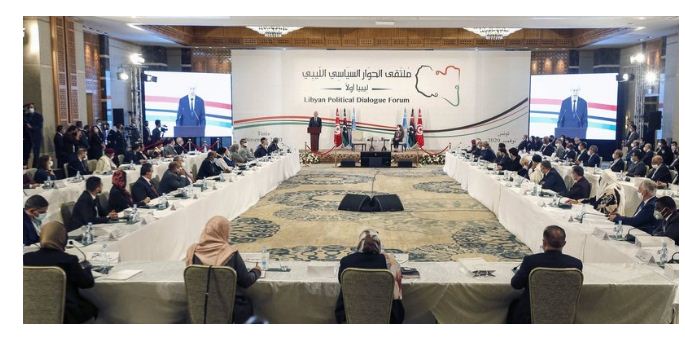
The recent disagreements on reaching a compromise to hold elections in Libya in December threaten the roadmap that aims to finally end a decade of chaos in the war-torn country, analysts said. 75 delegates from the war-torn North African country aired their differences at rowdy meetings in Geneva last week.
But despite an extra day of unscheduled talks, they remain divided over when to hold elections, what elections to hold and on what constitutional grounds – a blockage that threatens to hurl Libya back into crisis.
“No consensus was reached among the LPDF (Libyan Political Dialogue Forum) members” on the contentious question of a constitutional basis for the previously agreed December 24 polls, the U.N. acknowledged Saturday.
Oil-rich Libya was plunged into chaos after dictator Moammar Gadhafi was toppled and killed in a 2011 NATO-backed uprising.
Two rival administrations later emerged, backed by a complex patchwork of militias, mercenaries and foreign powers.
While Turkey supported the U.N.-recognized government in Tripoli, eastern-based putschist General Khalifa Haftar enjoyed backing from the UAE, Egypt and Russia.
Under a U.N.-backed cease-fire agreed last October, an interim administration was established in March to prepare for presidential and parliamentary polls on Dec. 24.
The U.N.’s Libya mission UNSMIL, in its statement Saturday, warned that “proposals that do not make the elections feasible” on that date “will not be entertained.”
BACK INTO POLITICAL CRISIS
Analysts say that foreign parties are pushing Libya‘s rival camps apart.
“The differences which emerged in Geneva were to be expected,” said Khaled al-Montasser, professor of international relations at the University of Tripoli.
He identified three tendencies.
“A first group called for elections to be postponed to next year, a second only wants parliamentary elections and a third remains committed to the roadmap” that envisions both legislative and presidential polls.
The LPDF members were supposed to have agreed by July 1 on the constitutional basis for parliament to adopt an election law.
“We had a consensus on a draft text … but right from the start of the (Geneva) meetings, it was brought into question by certain members who made new proposals,” one delegate told Agence France-Presse (AFP), asking not to be identified.
They tried to “evade their commitment to holding elections” on schedule, he said.
‘ORCHESTRATED IN ADVANCE’
But Jalal al-Fitouri, a law professor, said the divisions were “orchestrated in advance.”
“It’s not a secret to anyone that the (foreign) states monopolizing the Libya file … put pressure on those who represented them within the LPDF in Geneva,” he said. “Each state supports a particular side and has a position on how to hold the vote and on conditions for candidacy.”
By manipulating the process, foreign players are hoping to ensure their favorites come to power and can represent their interests in Libya’s lucrative post-war reconstruction, he added.
Since last year’s cease-fire, the security situation in Libya has slowly improved, but progress has stalled, notably on another key prerequisite for the polls – the withdrawal of all foreign forces. The United Nations has estimated that 20,000 foreign forces, including Russian mercenaries, are still on Libyan territory. Turkey refuses to withdraw its military, saying its presence is based on an agreement with the previous unity government in Tripoli.
Turkey’s Defense Ministry notes that the Turkish presence in Libya is based on the invitation of the legitimate U.N.-recognized government and the security agreement signed between the two parties. As part of the deal, Turkish soldiers continue to provide military training and consultation in coordination with their efforts to help the Libyan Army to professionalize and reach international standards with ongoing education in five training centers.
Turkey‘s support for the war-torn country prevented it from plunging into further conflict and paved the way for the U.N.-led political solution process between the warring parties.
Turkey announced its support for U.N.-led talks in Geneva on Oct. 19-23, which resulted in a declaration of a cease-fire, as it supported the talks in Istanbul and Moscow.
Ankara continues to support the country’s territorial integrity, a sustainable cease-fire and ensuring lasting peace and stability in Libya.
Starting a business in an online market is not tough if one has a fabulous business idea. Here’s a list of 8 profitable online businesses ideas that you can start with a minimum investment of Rs 25,000.
Starting a business may seem like a mammoth task, especially when the capital is limited. Thoughts like managing inventory, logistics, marketing etc., often shake a beginner’s confidence.
It’s a long arduous journey, but when the plans are right, it reaps benefits for the founders, stakeholders, and several others who depend on it for their livelihood.
Today, starting a business in the online medium with a small investment is not hard. SMBStory has made a list of eight profitable online businesses ideas, which can be started with a minimum investment of Rs 25,000.
Artificial jewellery
Image credits: Pexels
Jewellery never goes out of style neither its demand. Even during the COVID-19 lockdown, when most businesses were shut down, the demand for artificial minimalist jewellery pieces remained in constant demand.
Setting up an artificial jewellery business is doable with an investment as low as Rs 25,000. Chinu Kala, Founder of Rubans — a Bengaluru-based jewellery brand — says launching an imitation jewellery business is a great idea, and suggests one can invest between Rs 15,000 and Rs 20,000 in buying products in bulk.
“There are portals like TradeIndia, where people can get connected to good manufacturers for procuring jewellery and selling by setting up an online shop,” Chinu says.
She adds that the first customers of the business can also be friends and family who can endorse the products in their circle and urge them to buy online.
Home bakery
Image credits: Pexels
Setting up a basic home bakery business doesn’t require a hefty investment but a strong intent to bake and a handful of money to procure an oven and buy ingredients for baking.
Mariam Mohuideen, Founder of Baker’s Treat, Mangalore, started from a small bakery set built out of passion. She says baking is a craft, and to set up a business in this industry, “one has to think out of the box to succeed.”
“There’s no need of doing branding when starting from a small scale, but focus on the quality and delivering a flavour that customers would relish,” she adds.
A home bakery can be started with an investment between Rs 15,000 and Rs 25,000.
Homemade candles
Image credits: Pexels
In the last few years, people are taking to buying more candles, especially scented candles, to enhance their home interiors and for gifting purposes.
One can start a candle business with a minimal investment either by making it at home or procuring it from a third party.
The raw materials used to start the business include wax, wick, moulds, thread, aroma oils, and more.
Besides, you also need to have some candle-making equipment, which includes a melting pot, thermometer, pour pot, weighing scale, hammer, and an oven (to melt wax).
Many beginner candle-makers can start by listing their products on Itsy Bitsy — a one-stop shop for art and craft manufacturing to retail to D2C stack in the country.
It has 26 stores across the country, including Mumbai, Bengaluru, Hyderabad, Chennai, Pune, Panjim, Ahmedabad, Mysore, Shimoga, and Delhi.
Bedsheets
Image credits: Pexels
Starting an online bedsheet business is quite pocket-friendly for founders as the products can be bought in bulk and at a cheaper cost from manufacturers.
Entrepreneurs can connect with manufacturers through Indiamart or can directly buy from cities like Panipat, Jaipur, Delhi, Surat, and Kolkata, which are famous for their bedsheets.
Jabalpur-based entrepreneur Rekha Sabharwal said she started a bedsheet business from home by sourcing products from Delhi’s Sadar Bazaar.
She started selling via WhatsApp groups, and today, she is running a successful business, selling in and around Jabalpur.
Papad
Image credits: Shutterstock
A papad business can be profitable, owing to the small investment required. One can start the business at a micro-level by making papad at home or can collaborate with papad manufacturers in Amritsar, Guruvayoor, and Bikaner to get started.
Papads come in many varieties — from rice papad, urad dal papad, moong dal papad, aalu papad, or phool papad — one can select the SKU basis the demand prevalent in the region.
Ludhiana-based entrepreneur S. Amanpreet Thind’s grandfather started the Amritsari papad business in 1937 with Rs 100. Today, if one wants to start the business, a minimum investment of Rs 25,000 is sufficient to source papads and start selling online through social media channels or on ecommerce.
Disposable cutlery
Image credits: Pexels
From plastic, areca to bamboo spoons, bowls, and plates, the market for disposable cutlery has a constant demand in India, especially from Quick Service Restaurants (QSRs), retail, and from customers for several occasions.
The disposable cutlery business is a low investment and a high-profit business, given the items procured are from local wholesalers or manufacturers.
Spices
Image credits: Pexels
India is a big market for spices, with major demand coming from across the country. Earlier, we used to use fresh spices made at home, and continue to do so. Many spices, including garam masala, jeera masala, paratha masala, etc., are made at home and there is a constant demand for them.
Mother-daughter duo Urmila and Aarti Samant started Masala Tokri, a Mumbai-based spices brand, which they started by selling in their circle of family and friends.
In a span of a little over two years, the duo now aims to touch the turnover of Rs 1 crore.
The business is profitable and requires a small investment for procuring raw materials.
The masalas are carefully curated by Urmila. Aarti says that their background of running a family business of masala chakkis helped them connect to premium raw material vendors from across the country.
Buttons
Image credits: Pexels
Either in menswear, kidswear, or womenswear, buttons always enhanced the elegance of an outfit. The button business requires bare minimum investment and can be started from home to set up an online shop for selling.
From plastic to fabric and steel buttons, there are various categories in this niche that you can select depending upon your choice of business.
For selling purposes, creating a local group online on social media channels or messengers can be an initial step. SMB entrepreneurs can also set up their personalised online store within minutes on the MyEasyStore platform.
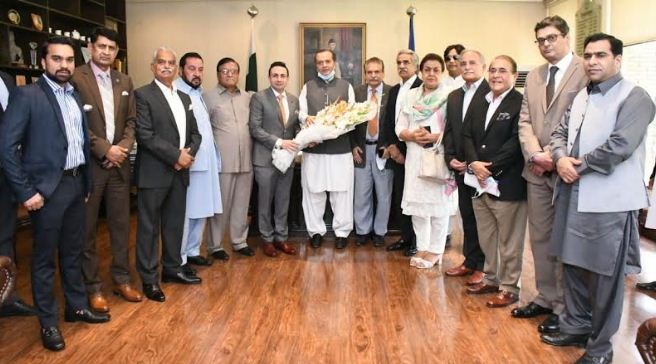
ISLAMABAD, JUL 7 (DNA) – Sardar Yasir Ilyas Khan, President, Islamabad Chamber of Commerce & Industry (ICCI) along with a delegation visited CDA Headquarters and congratulated Amir Ali Ahmed on his permanent appointment as Chairman CDA.
Sardar Yasir Ilyas Khan said that after a long time, CDA under the leadership of Amir Ali Ahmed has become proactive for uplifting the infrastructure in the city including commercial and industrial areas by carpeting of roads, repair of footpaths and restoration of streetlights.
Therefore, his permanent appointment as Chairman CDA would give more confidence to the business community and the residents for better development works in Islamabad. He said it was for the first time that Chairman CDA along with President ICCI had paid visits to various markets to see the needs of development works and subsequent to these visits, CDA has taken initiatives to address the highlighted issues, which was commendable.
The ICCI President said that still many issues of the business community needed the close attention of Chairman CDA for redress.
He stressed that CDA should streamline the lease renewal process of commercial and industrial plots as the business community was facing great inconvenience due to its current difficult procedure while making it easier would facilitate the business and investment activities.
Fatma Azim Senior Vice President and Abdul Rehman Khan Vice President ICCI, Mian Akram Farid Chairman Founder and others also expressed best wishes for the Chairman CDA and hoped that he would continue to work with ICCI for resolving key issues of the business community.
Speaking at the occasion, Amir Ali Ahmed, Chairman CDA thanked ICCI delegation for visiting to congratulate him. He said that the business community was playing key role in the economic development and CDA would take all possible measures to address their outstanding issues and to complete the remaining development works in commercial and industrial areas.
He said that ICCI has always cooperated with CDA for resolving the major issues of business class and reiterated that he would keep ICCI in loop on important matters to work jointly for the betterment and welfare of the business community of the federal capital.=DNA
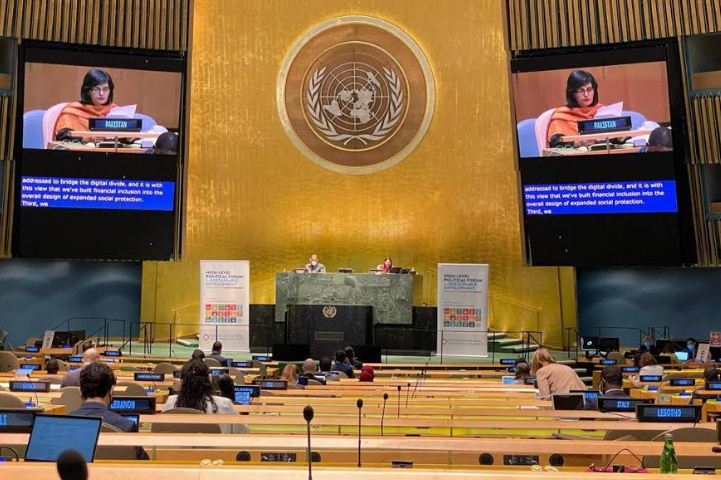
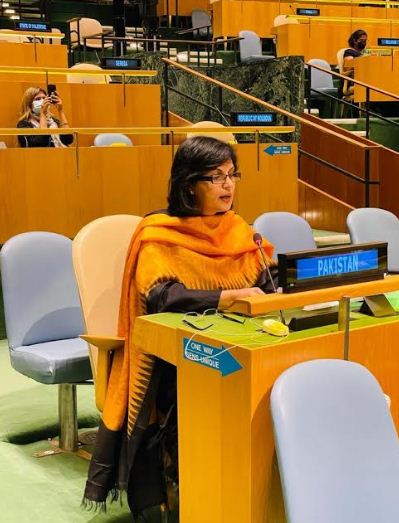
NEW YORK, JUL 7: Sania Nishtar was invited to speak at UN’s high-level Political Forum (HLPF) on Sustainable Development. The session on, “The SDGs in time of crises: A sustainable, inclusive and resilient recovery from COVID-19 as an opportunity to realise the SDGs” had a town hall format to accommodate many high-level speakers given the importance of topic and various dimensions that needed to be covered for a sustainable, inclusive and resilient recovery from COVID-19 pandemic. This session was convened by ECOSOC, under the Presidency of Pakistan. (Ambassador Munir Akram is the current president of ECOSOC)
Bringing Pakistan’s perspective to the table, Dr. Sania highlighted that the Pandemic has unearthed an opportunity to recast the role of the welfare state, which needs to be a major part of the re-commitment to agenda 2030.“In Pakistan, we believe the social protection of today is the human capital, the resilience, and the economic inclusion of tomorrow. Investing in social protection is both a response to current needs as well as preparedness for and insurance against future crises. We are humbled that through Pakistan’s social protection program, Ehsaas—led by our Prime Minister—strong acceleration towards this goal is underway” she said.
The session was moderated by Achim Steiner, Administrator of UNDP. The session brought together Liu Zhenmin, Under-Secretary-General of Economic and Social Affairs of the United Nations, UNDESA; Senator Dr. Sania Nishtar, Prime Minister of Pakistan’s Special Assistant on Social Protection and Poverty Alleviation; Lord Tariq Ahmad, Minister of State for the Commonwealth and United Nations, United Kingdom; Henrietta H. Fore, Executive Director UNICEF; Sigrid Kaag, Minister of Foreign Affairs of Netherlands; s. Marsha Caddle, Minister of Economic Affairs and Investment of Barbados; Rola Dashti, Executive Secretary of ESCWA; Ndagijimana Uzziel, Minister of Finance and Economic Planning, Rwanda; Isaac Alfie, Director of the Office of Planning and Budget of Uruguay; Sofía Sprechmann Sineiro, Secretary General of Care International; Dominic Waughray, Managing Director, Centre for Global Public Goods, Member of Managing Board, World Economic Forum; and Jomo Kwame Sundaram, Visiting Senior Fellow at Khazanah Research Institute, Visiting Fellow at the Initiative for Policy Dialogue, Columbia University.
Referring to Ehsaas Emergency Cash, she shared three lessons with the international audience. “First, our experience has taught us that data innovations, delivery systems, and a commitment to integrity, transparency, and accountability are crucial to address the long-standing fault lines, that have plagued public sector delivery. Today, Pakistan’s reform hinges on these attributes. Secondly, gaps in financial and digital literacy must be addressed to bridge the digital divide and it is with this in view that we have built financial inclusion into the overall design of expanded social protection” she said further adding “Third, we must protect human capital from negative coping strategies that are inevitable as a result of the pandemic—and in this regard, Pakistan is amongst the first few countries that acted concretely”.
Building on the report of the Secretary General on, “Progress towards the Sustainable Development Goals” and the relevant General Assembly and ECOSOC meetings related to COVID-19 pandemic, the session took stock of the SDGs’ overall progress taking into account the impact of the pandemic and the experiences and responses of countries at various development levels. The session focused on exchange of experiences on policies and integrated approaches that are being implemented to address the socio-economic impact of the pandemic, while ensuring that recovery from pandemic is sustainable and resilient, putting countries back on track to realize the 2030 Agenda for Sustainable Development.
The high-level political forum on sustainable development is the core United Nations platform for follow-up and review of the 2030 Agenda for Sustainable Development and its 17 Sustaina
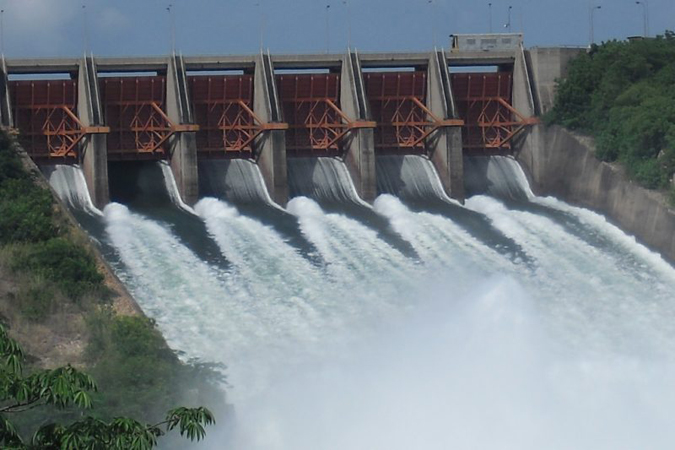
ISLAMABAD, Jul 7:Indus River System Authority (IRSA) Wednesday released 261,800 cusecs water from various rim stations with inflow of 258,200 cusecs.
According to the data released by IRSA, the water level in the Indus River at Tarbela Dam was 1436.70 feet, which was 52.70 feet higher than its dead level 1386 feet.
The water inflow and outflow in the dam was recorded as 132,100 and 132,500 cusecs respectively.
The water level in the Jhelum River at Mangla Dam was 1154.35 feet, which was 116.35 feet higher than its dead level of 1040 feet whereas the inflow and outflow of water was recorded as 36,800 and 40,000 cusecs respectively.
The release of water at Kalabagh, Taunsa and Sukkur was recorded as 160,400, 142,200 and 30,200 cusecs respectively.
Similarly, from the Kabul River a total of 37,000 cusecs of water was released at Nowshera and 18,400 cusecs released from the Chenab River at Marala.
Pakistan High Commissioner to Canada Raza Bashir Tarar has called the success of Roshan Digital Accounts (RDAs) a ringing endorsement of the policies and vision of Prime Minister Imran, saying the investment of overseas Pakistanis into this scheme speaks volumes for their trust in the government.
He noted that Prime Minister Imran Khan and Foreign Minister Shah Mahmood Qureshi had consistently laid emphasis on allowing seamless opportunities to overseas Pakistanis to access hassle-free lifestyle banking in Pakistan, and the introduction of RDA scheme had provided the overseas Pakistanis a much-needed cushion and a secure and credible avenue to invest and participate in the growth of Pakistan.
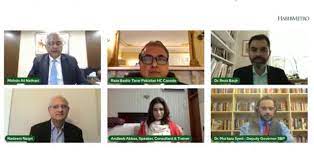
The High Commissioner made this comment while addressing a webinar arranged by HABIBMETRO Bank on the subject of ‘Roshan Digital Accounts: Steering Towards a More Roshan Pakistan’. MNA and Parliamentary Secretary for Foreign Affairs Andleeb Abbas, State Bank of Pakistan Governor Dr. Reza Baqir, President and CEO HABIBMETRO Bank, Canada Pakistan Business Council Vice President and former Pakistan Stock Exchange MD Nadeem Naqvi, Arif Habib Corporation Chairman Arif Habib and Pakistan Canadian investor and philanthropist Col (retd) Nazar Hussain also attended the webinar and spoke on various aspects of the RDA scheme.
Speaking on the occasion, SBP President Dr. Reza Baqir said the RDA scheme had proved to be a success for a wide variety of products and services offered through innovative technology under lifestyle banking at attractive rates with ease of repatriation of assets. He also attributed the success of the scheme to stable foreign exchange reserves which had more than doubled from US$ 7 billon two years ago to over US$ 16 billion now, and the current account deficit that stood at US $ 19 billion two years had become a surplus now, allowing the exchange rate to stabilize and provide greater cushion to overall success of the RDA scheme.
Reza Baqir told the participants over 180,000 accounts had been opened so far by overseas Pakistanis from 171 countries and an amount of US$ 1.56 billion had been invested with US$ 621 million invested in Naya Pakistan, US$429 million in Islamic Naya Pakistan certificates and a healthy US$490 million or 31 % of the entire investments in the account balance, transactions or bill payments for which the government was not required to pay mark-up.
Parliamentary Secretary for Foreign Affairs Andleeb Abbas credited the success of Roshan Digital Accounts scheme to the able and dynamic leadership of Prime Minister Imran Khan and the bold decisions he took during the COVID-19 pandemic to keep the economy and the businesses afloat and tide over the economic difficulties inherited from the past regime. She also lauded Dr. Reza Baqir and his team for the success of Roshan Digital Accounts.
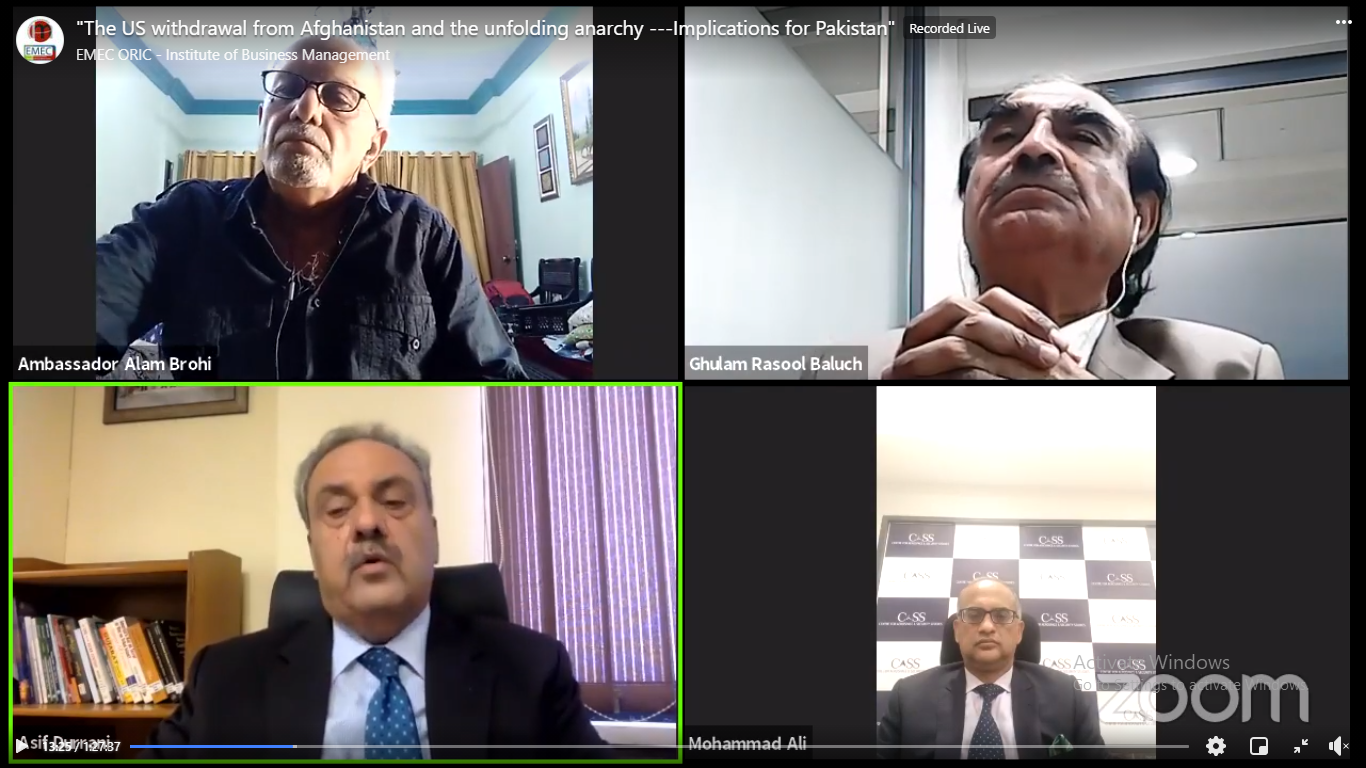
The Global and Regional Studies Center at the Institute of Business Management (IoBM) recently held a webinar on the “US withdrawal from Afghanistan and the unfolding anarchy – Implication for Pakistan.” The panelists included Ambassador Asif Durrani, Ambassador Alam Brohi, and Syed Muhammad Ali, Director, Strategic Affairs, Centre for Aerospace and Security Studies (CASS). Ambassador Ghulam Rasool Baluch was the moderator. Mr. Asif Durrani said that if the Taliban control Afghanistan, the region and the world will anticipate how the warlords will pursue their activities and what will be the fate of the drug money. The US will continue to influence Afghanistan’s politics despite its exit. Amb. Brohi said that the Taliban are trying to capture Afghanistan’s rural areas while encircling urban centers. If the Afghan military secures urban centers, the civil war is expected to be fiercer than before. He called upon Pakistan’s Foreign Affairs and military establishment to curb any possible crisis that may arise.
Mr. Muhammad Ali said that the US is leaving Afghanistan, not because of war fatigue but Biden administration’s objective to return to great power competition. The US will reduce its engagements in the developing world to contain China’s rise as a superpower. He shared that the Taliban, after acquiring power, should convert their hard power success into political legitimacy and international diplomatic recognition. Pakistan should be prepared to handle a major exodus of Afghan refugees from Afghanistan. Mr. Ali added that regional neighbors should work towards Afghanistan’s nation-building by offering security assurance for their collective interests. Amb. Baluch opined that the Afghan crisis is yet to reach its crescendo. The challenge for Afghan leaderships primarily, and the neighbors and the world in general, is how to prevent this calamity. The world will help Afghanistan once there is internal peace. In his closing remarks, Amb. Baluch said that diplomatic initiatives should engage regional countries such as China, Turkey, Iran, Russia, and even India to ensure they will not exploit any turmoil that transpires in Afghanistan. He asserted that the UN and international communities must be brought into the framework to prevent humanitarian disaster which might occur due to unfolding anarchy in Afghanistan.