Home Blog Page 2533

Chinese modern technology favorable for rice production in Pakistan

BEIJING, Aug. 26 : The production of high-yielding hybrid rice receives a notable boost in Pakistan, from the startup of modern color sorter machines and seeds given by China to Pakistan to facilitate the sowing of this grain.

Michael Guo, sales manager of Hefei Meyer optoelectronic technology international told China Economic Net that they started to sell the color sorter to the Pakistan market in 2008, it’s very hard to promote the Chinese Brand at the very beginning, as many people prefer to buy European and Japanese Brand.

He said that in the first five years they only sold not more than 50 machines, but after 2013 rice mills owners have experienced the Chinese Brand, saying it’s not only cheap but also has good quality and stability.

“Up to now, Meyer has sold more than 600 color sorter machines in the Pakistani market with a share of 40%. Most rice exporters are using Meyer color sorter machines, and they are very satisfied with it. MEYER color sorter provides the greatest guarantee of food security for all over the world”, he added.

According to the General Customs Administration of China, data about Pakistan sales of color sorter machines increased over the past four years, and the next three years are an estimate as per previous experience.

“Meyer color sorter machines can meet all of the customers’ requirements, whatever kinds of rice, such as Basmati rice, brown rice, parboiled rice, steam rice and it can remove the light yellow/ dark yellow, pin-points, chalky, even it can remove the foreign materials like glass, plastic, stones, etc.”, he stated.

Guo said they have an authorized agent and professional service team in Pakistan providing the local service within 24hours. Meanwhile, the machine can be connected with WIFI. They have remote services and users can check problems on computers from China.

“Meyer will try the best to provide better technology to serve more and more enterprises and escort the local food security”, he added.

Shamsul Islam Khan, vice president of Karachi Chamber of Commerce & Industry (KCCI) told CEN that there are three tiers in China to ensure the safety of the market. China should increase Pakistan’s quota of rice and give it more market access to reduce the trade deficit gap between the two countries.

“We imported hybrid rice seeds, especially IRRI-6, IRRI-9 from China, and the advantage of hybrid rice is that it can be grown anywhere. Secondly, where the production of Basmati rice was low, the production of hybrid rice is more than double”, he specified.

Prime Minister meets Executive Director of United Nations World Food Programme (WFP)

The Executive Director of the Rome-based United Nations World Food Programme (WFP), Mr. David M. Beasley, called on Prime Minister Imran Khan.

The Prime Minister appreciated the role of WFP as the leading international humanitarian organization for delivering food assistance in emergencies and for working with nations worldwide to improve nutrition and build resilience.

The Prime Minister underlined that Pakistan has been a beneficiary of various WFP projects that are being implemented in the country, and values its partnership with the Organisation.

Views were also exchanged on the evolving situation in Afghanistan. The Prime Minister reiterated that formation of an inclusive government and positive engagement of international community with Afghanistan, is the way forward to avert any humanitarian crisis and secure peace and stability in Afghanistan.

Executive Director Beasley expressed gratitude for Pakistan’s role in facilitating the work of the United Nations World Food Programme in providing food assistance to Afghans. He also discussed with the Prime Minister the ways of facilitating the continued provision of humanitarian assistance to the Afghan people.

Counter productivity of foreign invasions

Wajeeha Bilal

Military solutions and foreign interventions have never fixed political and societal

problems. In occupied countries many peopleprefer their own rulersover foreigners

as a means to preserving their freedom, culture and identity. Sirin Ebadi, a Nobel

prize winning human rights activist, argues against western intervention. She implies

that despite a regime’s poor human rights record, gender discrimination and lack of

democracy, any involvement by foreign powers would be undesirable and unhelpful.

It would simply make matters worse. Instead, she insists that change must come

from within, and points to the relatively strong women’s movement in Iran compared

with other Islamic states.

The recent results of foreign invasions are a proof of their failure in building

trustworthy institutions through outside interventions. Both in Iraq and Afghanistan,

the main aim was on engaging and training people and not on constructing strong,

loyal organizations. As the people were trained by international forces to fight their

own, corruption and exploitation prevaileddue to the lack of trust, purpose and

identity. Lack of moral and crisis of identity was strong enough to convince everyone

to give up once the decision of withdrawal had been made.

One thing that has been common in all the recent global invasions and their military

trainings is a deep-rooted sense of instability, as a consequence of their downfall.

America had faced great disgrace in Vietnam many years ago followed by other

military blunders that it had staged since then, and as a result Afghanistan, Iraq,

Libya, among others have suffered the consequences.The countries, their people and

the neighboring states have been made to suffer for superpower’s follies. Always

presuming that it will be better than before, foreign powers have not been able to

derive a lesson from their mistakes. The scale of tragedy has worsened every time.

Now after spending two decades and more than trillion dollars, the US abandoned

Afghanistan just to be handed over to the very people it had resisted in the first place.

In a matter of days the Taliban retook a country, loaded with American weapons,

corrupted with traitors, and filled with unsafe individuals. A professional soldier’s

potential is not just physical ability, but mental conditioning and discipline and most

importantly his sense of loyalty. In the Ottoman Empire, the most elite and admired

unit, theJanissaries were the private army of the Sultan. Well trained, lavishly

dressed and of iron discipline. They were mostly converts who were often members

of the Bektaşi order. A Janissary’spower was not just in his physical strength but

also in keeping ranks, following orders, and standing against all odds. It was about

fencing skills, following discipline, and staying faithful to the empire. A strong

faithful unit was set as a basis for the loyalty of the Janissaries who led the Turks to

many victories including that of Constantinople’s. The Turks made a loyal,

disciplined and highly trained unit that set an example across the world. A preference

was laid over loyalty before their training to compose a strong unit of army for the

empire.

The Afghans who had been fighting one another, their neighbors and the Soviets for

centuries are born in a fighting zone. But the US had always declared that its mission

in Afghanistan was to train the Afghans to fight for their country. It seems apparent

now that it was not about training the people but more about making the superpower

image look good through media. The US intended on showing an ideal liberal

platform and funded the free media projects that appeal to the audience who hold

their campaigns. These ideas are a means of manipulating one’s way to sustaining

the superpower image and having leverage over any country through its aid. The

resulting trained army and government lacked trust, loyalty and stronger will for

their nationalism.

Nowadays every country and their media stand in a fight against terrorism and its

effects. The focus of every news and their analysis is on finding a solution to

extremism and on building a more peaceful world. Studies have shown that the use

of military force by foreign powers to subjugate or reform societies serves only to

promote a larger number of suicide terrorists than would otherwise be the case.The

birth of terror organisations like the Islamic State and al-Qaeda are byproducts of

foreign invasion policies.Robert A. Pape, a professor of political science at the

University of Chicago specializing in international security affairs, had compiled

evidence to suggest that suicide terrorismis in fact a secular tactic rather than a

religious one, and forms part of a broader campaign to remove an occupying force

from the area perceived by the perpetrators to be their homeland. Pape’s research

found that every terrorist campaign and more than 95 percent of all suicide

bombings had the objective of national liberation at their heart. He argues that

suicide terrorism is not the result of an existing supply of fanatics but is a demand-

driven phenomenon. And thanks to the failed interventions by more powerful

countries who focus on their leverage rather than strengthening the local

governments, it is a rising concern.

The global power politics has left Afghanistan and its people at a major humanitarian

crisis. While the rest of the world needs to find a way to interact with them on

fighting terrorism and acknowledging human rights,the best that can be wished for

the sake of humanity is that the new Taliban government is more rational, with a

realization for global recognition and aid. Matters cannot be made worse by blocking

or discontinuing foreign aids just because there is no leverage through foreign

intervention. Whether the Taliban swept an easy takeover due to the lack of morale

or loyalty, any American or western sanctions will only prove counterproductive for

the humanity and world peace. Supporting local governments for the sake of their

people to avoid uprisings and regional chaos is one hope for humanity and global

peace.

The Role of Republic of Kazakhstan in Bridging Gap between World Religions

Professor Dr. Muhammad Zia-Ul-Haq

****

Increasing religiosity has made faiths very important in global affairs. Faith has become a

significant force in the global society. Religion is a force of conflict resolution but it has

been portrayed as a reason for conflict creation. In contemporary international

circumstances religion has returned as a powerful force for construction or destruction.

The effectiveness of religious is particularly felt in the area such as Kashmir, Bosnia,Iraq,

Afghanistan, Kosovo, Chechnya, Pakistan,India, Northern Ireland, the Middle East, sub-

Saharan Africa, and other parts of world which are acute zones of conflict.It is reported

that Muslims, Catholic Croats and Orthodox Serbs of Balkan all are from same ethnic

background and all three speak the same language and share the same race but divided by

the religion. Religion is often considering at the fault-line along which the sides divide in

global conflicts. The reason for tensions on the name of religion is its role in defining the

identity. The twentieth century was dominated for ideology while the 21 st century will be

famous by the identity. The turn of focus from ideology to identity brought religious

affiliations at the center stage of contemporary world.

Various types of regional, economic and ethnic conflicts are oftenturning towards

religious dimensions which help exclusivists and extremist to use ‘them and us’ mentality

for controlling attitude of the people on the name of religion and kilning the innocents on

the name of religion. No theology is legitimizing their actions but the causes and

consequences of their action determining that how and where religions will be dealt in

twenty-first century. Incidents such as 9/11 have illustrated us the ability of a few persons

to bring their entire civilizationinto a conflict with other civilizationswhether their fellow

majority agrees or does not agree with their thinking or actions.Present circumstances

disclose that extremism is not limited to any specificrace, religion, or region. It is a global

phenomenon and extremists are present everywhere. Some theorists are of the view that

2

religions are as they were before and contemporary religiosity is simply a modern version

of the old theory of despotism and some fanatical religious subscribe this theory. In our

view the real dichotomy is not among world religions, but between exclusivistsand

extremists, on the one hand, and pluralistsand inclusivists on the other.

Due to this dominating position of religions, Professor Hans Kϋng has rightly observed

‘No peace among the nations without peace among the religions. No peace among the

religions without dialogue between the religions. No dialogue between the religions

without investigation of the foundation of the religions.’

First time in the historyon this scale and frequency, there are the serious effortsat a global

level for mutual understanding among world religion. In these global efforts the most

effective and serious consideration to world religions was given by the HE Nursultan

Nazarbayev, Founding President of Republic of Kazakhstan. After the independence, in

the formative period of the republic of Kazakhstan, he realized that sustainable economic

development is dependent on peace and pace is not passable without bringing world

religions closer and bridging gap among their followers.For this great task President

Nursultan Nazarbayev invited leaders of world and traditional religions to Astana in

2003.The First Congress of Leaders of world and traditional religions was held

on September 23-24, 2003 in Astana. Leaders and eminent representatives of religions as

well as honorable guests from 13 countries of Europe, Asia and Africa participated in the

forum. It was decided in this first congress that a permanent secretariat of the congress of

world and traditional Religionscomprises of representatives of leaders and eminent

personalities of religions should be established to promote following goals and

objectives:

 promoting global dialogue among religions and cultures

 deepening and strengthening mutual understanding and respect among

different religious communities

 development of the culture of tolerance and mutual respect as opposed to the

ideology of hatred and extremism;

3

 cooperation and interaction with all international organizations and structures that

pursue the goals of promoting dialogue between religions, cultures and

civilizations. 

To achieve these goals and objectives the Secretariat has organized up to know several

congresses.As already mentioned first Congress of Leaders of world and traditional

religions was held on September 23-24, 2003 in Astana. The participants of the First

Congress decided to hold inter-religious summit on a regular basis and set up a working

body. The Second Congress of leaders of world and traditional religions was held

on September 12-13, 2006 in Astana on the theme of ‘Religion, society and international

security.’ This Congress was held at the state of the art purposely built forum’s

permanent venue ‘Palace of Peace and Harmony’. The second congress, which brought

together 43 delegations from 20 countries of Europe, Asia, Africa and Americas, adopted

‘The Principles of Inter-religious Dialogue’ as core theme. On the basis of the

recommendations the second congress International Centre for Cultures and Religions

was established. ‘The Role of Religious Leaders in Building a World of Tolerance,

Mutual Respect and Cooperation’ was theme of third Congress which held on July 1-

2, 2009 in Astana. In this congress visionary leader of Republic of Kazakhstan proposed

creation of a Council of Religious Leaders that would coordinate the activities of the

Congress, engage in interaction and cooperation with other forums and

international organizations that pursue the goals of promoting dialogue among cultures

and religions. The Fourth Congress of leaders of world and traditional religions, was held

on May 30-31, 2012 in Astana with the theme ‘Peace and harmony as the choice of

mankind.The Council of Religious Leaders – which brings together leaders and eminent

representatives of world and traditional religions was set up in this congress.The

members of the Council have founded an alley called ‘Rukhanijarasym’ (Spiritual

harmony) in the capital city of Kazakhstan.5 TH Congress of Leaders of world and

Traditional Religions held on 10-11 June 2015 at Astana, Kazakhstan. It acknowledged

the important role of the Congress and the contribution of the Republic of Kazakhstan to

the promotion of inter-religious and inter-civilizational dialogue to build a peaceful, just

and safe world in the XXI century. The VI Congress of Leaders of World and Traditional

4

Religions in Astana officially ended on October 11,2018. The Congress united

representatives of more than 80 delegations from 46 countries, including politicians,

religious leaders of Islam, Christianity, Judaism, Buddhism, Hinduism, Taoism,

Zoroastrianism, as well as representatives of international organizations. The participants

adopted the final declaration outlining the role of the political and religious leaders in the

maintenance of peace and stability.

All the initiatives of the republic of Kazakhstan through secretariat of world and

traditional religions under the patronization of HE Kassym-Jomart Tokayev , President of

Kazakhstan are contributing to bridge gap among the followers of world religions. It has

not only created instructional framework for peace among world religion but also

engaged religious leaders from all over the world representing all major religion in this

great task. The substantive achievement of the secretariat is mutual respect and friendly

relationship among the representatives of the world religions. The achievements of the

pioneer work of the Republic of Kazakhstan are contributing in changing the differences

into diversities.

The themes and sub themes that have been adopted in various interfaith meetings affirm

that the present developments in science and technology require parallel progress in the

relationship of followers of various religious and cultural traditions. The time has

acknowledgedthe need for joint efforts by all major civilizations to promote a culture of

dialogue on the basis of diversity,difference, plurality tolerance, freedom of

expression,mutual respectand sincere readiness at the grass root level. Agreement on the

agenda on the basis of common interests such as trans-cultural norms,spiritual

satisfaction, justice and submission to the creature of the universe will lead dialogue to

succeed. The dialogue is the only hope for saving the world from clashes and conflicts

among world civilizations; otherwise, hatred, violence andworldwide conflicts will

continue taking religious dimension after feeding from misunderstandings,

misconceptions, and misrepresentations. Confidence of human beings on the movement

of dialogue lead us ahead and we will be able to talk on other matters that are important

to all nations, such as holy places, ecology,food technology, medical ethicsetc.

Worldwide efforts against hunger, disease and natural disasters can be unified only after a

better understanding, harmony and peace among the faiths through dialogue.

President lauds Army’s services for Pakistan

President meets COAS, discusses regional developments and matters of national security

Nehal Miraj

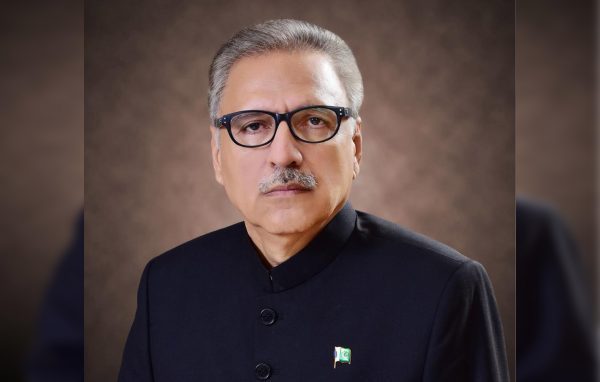
RAWALPINDI: President Arif Alvi on Wednesday acknowledged the army’s unparalleled contribution and sacrifices rendered towards the external and internal security of Pakistan.

The president’s comments came during a meeting with the Chief of Army Staff (COAS) General Qamar Javed Bajwa at the General Headquarters (GHQ) in Rawalpindi, a statement from the Inter-Services Public Relations (ISPR) said.

During the meeting, both leaders discussed regional developments and matters of national security, the military’s media wing said.

The president was apprised of the army’s operational preparedness and a briefing on cyber security by the Communication and Information Technology Branch was also given to him, the ISPR said.

The ISPR’s statement mentioned that the president commended the army’s prowess in the field of information technology and coordination mechanisms with other stakeholders.

Earlier, upon arrival at the GHQ, the army chief had received President Alvi, where he was later presented guard of honour, the ISPR said.

The president had also laid a floral wreath at the Martyrs Monument and offered prayers, the military’s media wing added.

PM, Russian President discuss Afghan situation, bilateral ties

ISLAMABAD: Prime Minister Imran Khan and Russian President Vladimir Putin in a telephonic conversation on Wednesday exchanged views on the evolving situation in Afghanistan and bilateral relations.
The Prime Minister, who received a telephone call from the President of Russian Federation, stressed that a peaceful, secure and stable Afghanistan was vitally important for Pakistan and regional stability.
Besides ensuring safety, security and protection of rights of Afghans, an inclusive political settlement was the best way forward, he added.
The Prime Minister underscored that the international community must stay positively engaged in support of the people of Afghanistan, to help address the humanitarian needs and ensure economic sustenance.
He underscored the importance of coordinated approaches in addressing the evolving situation and noted that Pakistan attached high importance of the role of the Troika Plus format.
The Prime Minister expressed satisfaction at the upward trajectory of Pakistan-Russia relations, with increased high-level exchanges and growing cooperation in diverse fields.
He reiterated the government’s resolve to strengthen trade relations as well as bilateral collaboration in energy sector, including early realization of the Pakistan Stream Gas Pipeline Project.
The two leaders agreed to closely cooperate within the Shanghai Cooperation Organization (SCO) for promoting regional peace and security.
The Prime Minister reiterated his invitation to President Putin to visit Pakistan.

FM discuses Afghan issue with Tajikistan President

President Emomli says he is looking forward to receive Prime Minister Imran Khan at SCO Summit in September

News Desk /DNA

DUSHANBE: Foreign Minister Makhdoom Shah Mahmood Qureshi called on President of Tajikistan Emomli Rahmon today in Dushanbe.

The meeting took place in the Palace of the Nation.

A wide range of issues related to the development and further expansion of bilateral cooperation of mutual interest were the main items on the agenda. Preparations for the upcoming official visit of the Prime Minister of the Islamic Republic of Pakistan Imran Khan to Tajikistan was also touched upon.

Officials also paid special attention to certain pressing items on the international and regional agenda, in particular the current situation in Afghanistan.

Today, one of the major threats to regional security is the current situation in Afghanistan, which is on the brink of a humanitarian catastrophe as a result of the withdrawal of coalition forces.

The dangerous situation that has developed in this country in recent days is not only the problem of the Afghan people, but also one of the most pressing regional and global issues today. Taliban’s rise to power has further complicated the geopolitical process in the region.

Evidence clearly shows that the Taliban are abandoning their previous promises to form an interim government with the broad participation of other political forces in the country and are preparing to establish an Islamic emirate.

Tajikistan strongly condemns all forms of lawlessness, murder, looting, and persecution of the Afghan people, especially Tajiks, Uzbeks, and other national minorities.

The officials stressed that Afghanistan should not be dragged back into the whirlpool of bloody imposed wars.

As a close neighbor, Tajikistan has always supported the restoration of lasting peace and stability in Afghanistan and remains committed to this position. In order to urgently address the political and security problems of the neighboring country, it is necessary to establish an inclusive government with the participation of all national minorities, especially Tajiks in Afghanistan, who make up more than 46% of the population.

The state structure in this neighboring country should be determined by referendum and taking into account the position of all citizens of the country.

Tajikistan will not recognize any other government that is formed in this country through oppression, without taking into account the position of the entire Afghan people, especially all its minorities. They also stressed that Tajiks have a worthy place in the future government of Afghanistan.

Tajikistan calls on the international community to take urgent measures to ensure peace and stability in Afghanistan and to stabilize its difficult political and security situation through negotiations as soon as possible.

The international community’s indifference to the current situation in Afghanistan could lead to a protracted civil war.

Tajikistan is committed to the restoration of peace, stability and security in the neighboring Afghanistan as soon as possible, and believes that the United Nations should play a key role in advancing this process.

On the basis of the experience of civil war, peace, and national unity of Tajikistan, President Rahmon has proposed a number of ways to the Pakistani side for ensuring peace, stability, and further sustainable development of the neighboring country.

Islam provides panacea for all problems

The Prime Minister Imran Khan blames rise of sex crimes on the negative side of the use of mobile phones

Bureau Report

LAHORE: Prime Minister Imran Khan on Wednesday said it “pained” him to see the Minar-e-Pakistan incident in which hundreds of men assaulted a woman on Independence Day, and called it a source of “shame” for the country.  “The Minar-e-Pakistan incident, when I saw it, I was ashamed, it pained me to see it.

“No one could have imagined such an incident taking place [in Pakistan] when I was growing up,” PM Imran Khan said, during an event in Lahore, where he stressed on educating the country’s youth in line with Islamic teachings. The premier said he has travelled across the world, and while he was growing up, he had observed that Pakistanis respected women much more than the Western world.

“The downfall that we are witnessing is because our children are not being educated in the right manner. This is not a part of our culture and neither of our religion,” he said, referring to the behaviour that was displayed by the mob, at the Greater Iqbal Park in Lahore on August 14.

The prime minister said “sex crimes” in Pakistan were on the rise, and blamed it on the negative side of the use of mobile phones. “In human history we never witnessed the kind of exposure to things that children have nowadays,” he said. 

He noted that to curb such incidents, “there is only one way”. “Children must be taught about the life of Prophet Muhammad (PBUH),” he said, adding that he was the “greatest human being, the likes of which will never again be seen”.

The prime minister said people read about successful people to learn of the secrets of their success — and no one in history is as successful as Prophet Muhammad (PBUH). “Which is why we have been told in the Holy Quran to learn from his life.”

“[The children must be taught] how he brought about a historic revolution. What his qualities were. How he was honest and trustworthy — and how no person has become a great leader without these qualities,” the prime minister said.

The premier said Quaid-e-Azam Muhammad Ali Jinnah and former president of the South African Republic Nelson Mandela were regarded as honest and trustworthy even by their rivals. “So these qualities, which made him so great, should be taught to our children in schools. 

WHATSAPP TO LAUNCH NEW MESSAGING FEATURE SOON: REPORT

ISLAMABAD, AUG 25: As per news reports, WhatsApp has started working on a new message feature that will allow users to send reactions to messages. 

According to WABetainfo, the instant messaging platform’s move is an unexpected one, considering how WhatsApp has been working on introducing new features over the past few months but has not done the same for its messaging functions. 

“You already know what is a reaction: it’s usually an emoji that you can place on a message to express emotions. Instagram, Twitter, iMessage already support message reactions and today we can start to discover the progress of their development,” read a post on WABetainfo. 

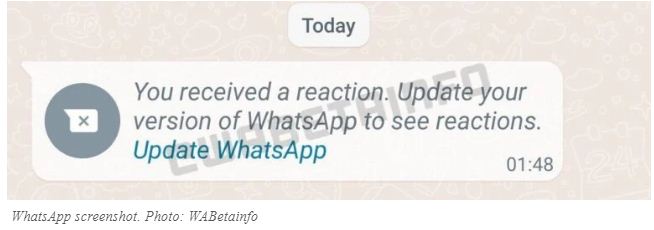
WhatsApp, as per WABetainfo, is working on introducing a message to present when the user is using an outdated version of the app that does not support receiving reactions. 

 In this case, the user cannot see the reaction but WhatsApp will present a different message, asking to update WhatsApp to see the reaction:

Since the screenshot taken above is from a WhatsApp beta for Android, WhatsApp will obviously implement this feature on WhatsApp for iOS and Web/Desktop as well.

Stay Connected

64FansLike
60FollowersFollow

Latest Reviews

Exchange Rates

USD - United States Dollar
EUR
1.15
GBP
1.35
AUD
0.70
CAD
0.71