The Prime Minister discussed bilateral ties as well as Afghan situation with Arab and Gulf leaders
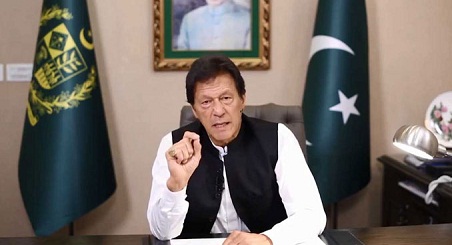
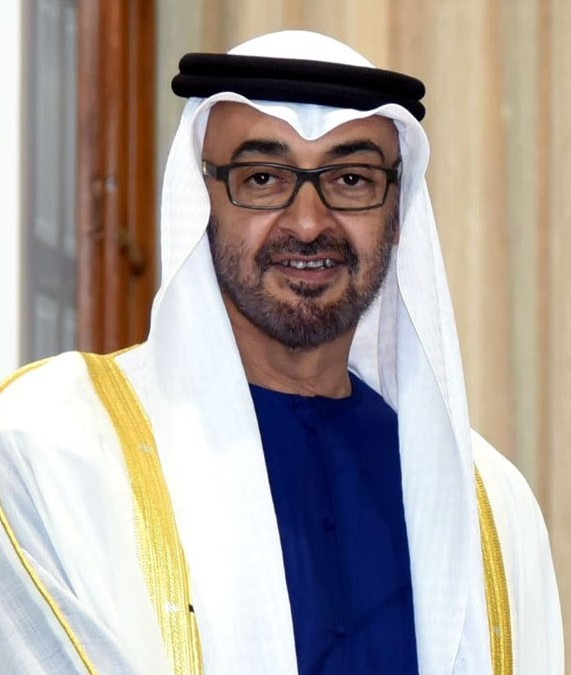
ISLAMABAD: Prime Minister Imran Khan had telephone conversations with Crown Princes of Saudi Arabia and Abu Dhabi, and Emir of Qatar, separately. In his conversation with His Highness Mohamed Bin Zayed, Crown Prince of Abu Dhabi and Deputy Supreme Commander of the UAE Armed Forces, the two leaders exchanged views on the issues of bilateral interest as well as regional developments, in particular the latest situation in Afghanistan.
The Prime Minister reaffirmed the importance Pakistan attaches to its strong fraternal ties with UAE and close cooperation between the two countries.
Prime Minister Imran Khan stressed that the world community must remain engaged, in order to support the Afghan people, economically and to help rebuild the country. He emphasized the need to address the dire humanitarian needs and to ensure economic stability of Afghanistan.
The Prime Minister congratulated the Crown Prince for making excellent arrangements for the upcoming Expo 2020. He conveyed his best wishes for the resounding success of the mega event.
Prime Minister Imran Khan also held a telephone conversation with the Saudi Crown Prince, Deputy Prime Minister and Defence Minister, His Royal Highness Mohammed bin Salman.
The two leaders discussed bilateral relations and exchanged views on the latest situation in Afghanistan.
Prime Minister Imran Khan conveyed warm wishes for the Custodian of the Two Holy Mosques, His Majesty King Salman bin Abdulaziz.
The Prime Minister reaffirmed Pakistan’s desire to further fortify the historic fraternal ties with Saudi Arabia and reaffirmed Pakistan’s support for the Kingdom’s sovereignty and territorial integrity.
The Prime Minister stressed that the international community had the responsibility to stand by the Afghan people and support them economically as well as to help rebuild the country. It was further agreed that the international community must step up its engagement in order to avert any humanitarian and refugee crises.
The PM and HRH Crown Prince agreed to work together to further augment and diversify bilateral ties in all spheres.
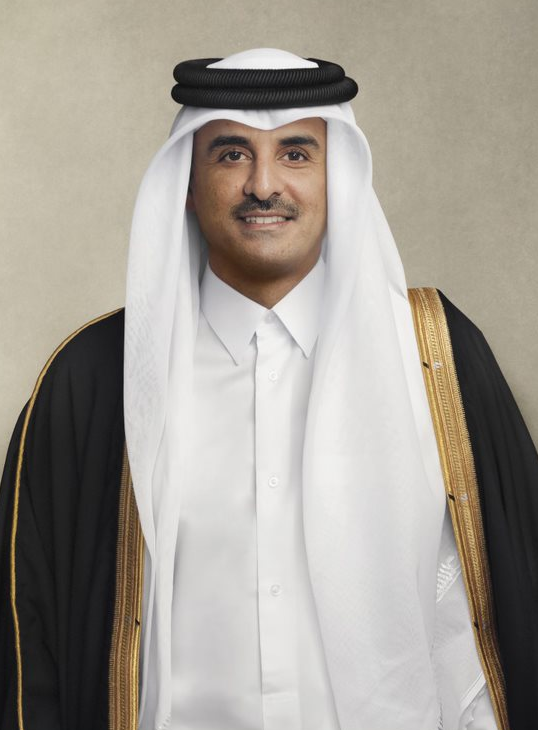
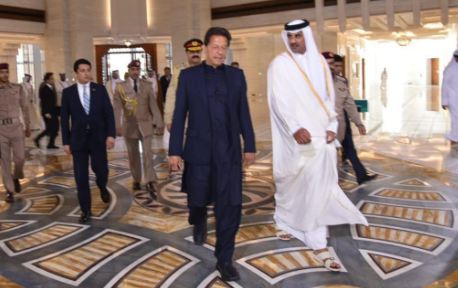
Later, Prime Minister Imran Khan held a telephone conversation with the Amir of the State of Qatar, His Highness Sheikh Tamim Bin Hamad Al Thani.
The two leaders discussed bilateral relations and exchanged views on the evolving situation in Afghanistan.
The Prime Minister reaffirmed Pakistan’s desire to further strengthen political and economic partnership with Qatar. He appreciated Qatar’s assistance to Pakistan during the pandemic, in particular the care afforded to more than 200,000 Pakistani expatriates working for progress and development of both countries.
The Prime Minister underscored that a peaceful and stable Afghanistan was in vital interest of Pakistan and the region. He underlined that after 40 years of conflict and instability, there was an opportunity to establish lasting peace in Afghanistan.
Prime Minister Imran Khan emphasized that the world community must remain positively engaged and support the Afghan people at this crucial juncture – both economically and to help rebuild the country. This, he stressed, was crucial to avert humanitarian and refugee crises in the country.
The two leaders agreed to remain in close contact on bilateral matters as well as regional and international issues of mutual interest.
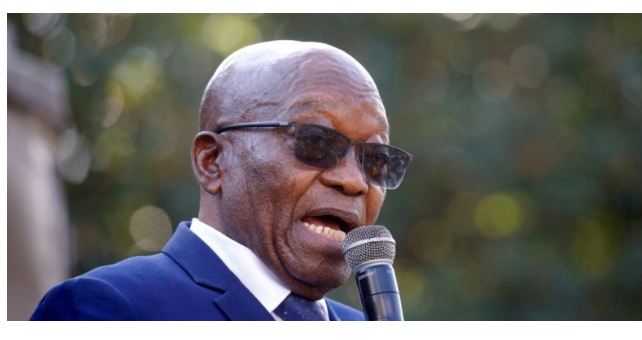
South Africa’s jailed former president Jacob Zuma has been placed on medical parole because of his ill health, the government’s correctional services department said on Sunday.
Last month prison authorities said Zuma underwent unspecified surgery and was in hospital with more operations planned.
EU Delegation would launch Business Forum to facilitate Pakistani SMEs, Promote trade with EU, EU Ambassador in Pakistan Androulla Kaminara said
ISLAMABAD: Preparations have been completed for EU Pakistan Business Forum – with Abdul Razzaq Dawood, Assistant to the Prime Minister of Pakistan as Special Guest. The EU Pakistan delegation is all set to launch the first EU-Pakistan Business Forum in Islamabad on September 8, 2021.
EU Delegation would launch a Business Forum to facilitate Pakistani SMEs, Promote trade with the EU, EU Ambassador in Pakistan Androulla Kaminara said. She said opportunities would be provided to the European Union and Pakistani businesses to increase bilateral trade.
The opening ceremony of the EU-Pakistan Business Forum for Small and Medium Enterprises (SME) is expected to be attended by representatives of local SMEs covering four key sectors:, jewelry and mining, information technology, handicrafts and during the first session in Islamabad, along with fashion travel and tourism, participants will be briefed on the EU’s GSP + scheme and how to benefit from the scheme.
GSP + provides duty-free access to two-thirds of the tariff lines in the EU market, with the rest on preferential duties. The subsequent meetings of the EU-Pakistan Business Forum later this year will cover more sectors, including agriculture and auto parts manufacturers.
She said the EU will take full advantage of the Pakistan Business Forum and establish the right links to expand its trade. The EU market while the EU has given GSP + concessions. Later this year there will be meetings in Lahore and Karachi as well.
The session, chaired by Pakistan’s Muhammad Sadiq was attended by China, Iran, Tajikistan, Turkmenistan and Uzbekistan
ISLAMABAD: Pakistan on Sunday hosted a virtual meeting of Special Representatives/Envoys of neighbors of Afghanistan including the Islamic Republic of Iran, a foreign ministry statement said.
“Special Representative for Afghanistan, Ambassador Mohammad Sadiq, chaired the session. China, Iran, Tajikistan, Turkmenistan and Uzbekistan participated,” it said.
It added during the meeting, views were exchanged on the latest situation in Afghanistan.
Ambassador Sadiq, welcoming his counterparts, highlighted the importance of evolving a regional approach to address common challenges and to realize the new opportunities arising from a stable Afghanistan.
He added that a prosperous and peaceful Afghanistan would provide impetus to economic integration, strong people-to-people linkages, enhanced trade and regional connectivity.
The Special Representatives/Envoys of neighbours of Afghanistan agreed to remain in close contact.
Mohammad Sadiq in a tweet said colleagues from Iran, China, Turkmenistan, Uzbekistan and Tajikistan were unanimous that peace in Afghanistan is vital for security, stability and prosperity of the entire region. Foreign Minister of Pakistan Shah Mahmood Qureshi has recently held a telephonic conversation with his Iranian counterpart Hossein Amirabdollahian and exchanged views in detail about the latest developments in Afghanistan.
The Pakistani Foreign Minister also visited Iran on September 25 where he met with President Ebrahim Raisi and the Foreign Minister Amirabdollahian to discuss regional developments in Afghanistan and strengthen bilateral relations.
ISLAMABAD, SEPT 5 /DNA/ – Prime Minister Imran Khan held a telephone conversation with the Amir of the State of Qatar, His Highness Sheikh Tamim Bin Hamad Al Thani, today. The two leaders discussed bilateral relations and exchanged views on the evolving situation in Afghanistan. The Prime Minister reaffirmed Pakistan’s desire to further strengthen political and economic partnership with Qatar. He appreciated Qatar’s assistance to Pakistan during the pandemic, in particular the care afforded to more than 200,000 Pakistani expatriates working for progress and development of both countries. The Prime Minister underscored that a peaceful and stable Afghanistan was in vital interest of Pakistan and the region. He underlined that after 40 years of conflict and instability, there was an opportunity to establish lasting peace in Afghanistan. Prime Minister Imran Khan emphasized that the world community must remain positively engaged and support the Afghan people at this crucial juncture – both economically and to help rebuild the country. This, he stressed, was crucial to avert humanitarian and refugee crises in the country. The two leaders agreed to remain in close contact on bilateral matters as well as regional and international issues of mutual interest.
Tehreek-e-Taliban Pakistan (TTP) claims responsibility for the suicide attack
QUETTA: Four security personnel were martyred and twenty people were injured Sunday morning when a suicide bomb blast took place at an FC checkpost located at Mastung Road.
The Balochistan Counter-Terrorism Department (CTD) confirmed the suicide attack had targeted the Sohana Khan FC checkpost at Mastung Road.
Prime Minister Imran Khan, in a tweet, condemned the Tehreek-e-Taliban Pakistan (TTP) for the suicide attack.
The outlawed group took responsibility for the blast, according to media.
“My condolences go to the families of the martyrs and prayers for the recovery of the injured. Salute our security forces and their sacrifices to keep us safe by thwarting foreign-backed terrorists’ designs,” he tweeted.
Federal Human Rights Minister Shireen Mazari also held the outlawed group responsible, condemning the attack in strong words.
“Condemnable TTP attack today on FC checkpost in Quetta today. Condolences and prayers go to the families of the martyrs – our brave security forces continue to thwart the designs of terrorists esp the RAW-funded TTP,” she tweeted.
Balochistan CTD spokesperson said that the CTD team had arrived at the spot and had started a probe into the incident.
Police, law enforcement agencies and rescue officials had soon arrived at the area after the blast. The injured were shifted to the Sheikh Zaid hospital, confirmed police.
Police said the suicide bomber had rammed his motorcycle into the vehicle of a law enforcement agency at the checkpost.
Shortly after the blast, a bomb disposal unit had arrived at the scene to conduct an investigation into the attack.
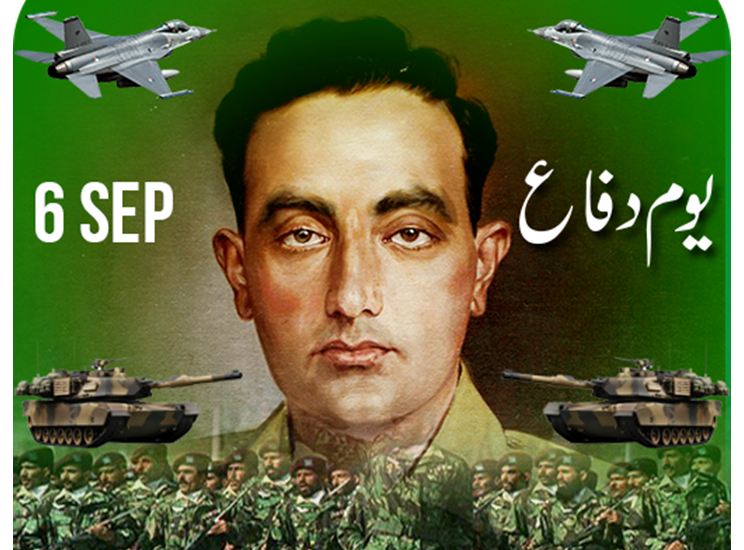
6th September is marked as Defence Day of Pakistan which is celebrated each year across the nation to pay tribute to the brave sons of the soil, who sacrificed their lives while defending Pakistan during the 1965 War. It was a momentous day in the history of Pakistan when the war-mongering India invaded our motherland. But our armed forces with the people of Pakistan on their backs, stopped the Indian attacks dead in their tracks and the dream of the Indian Army to celebrate the evening at one of Lahore’s most well-known addresses, was broken into pieces.
In order to familiarize the young generation with the history of Pakistan and the sacrifices of their forefathers, the achievements of Pakistani forces must be recounted so that the younger ones may not be misled by false information propagated purposely by Pakistan’s enemies and opponents.
Pakistan’s armed forces have always played a substantial role in protecting its territorial integrity by rigorously dealing with any emerging threat or inimical situation. In fact, they know very well how to payback our enemies. The Indian side has been presenting severe challenges to Pakistan since 1947, but the acquiring of strategic capabilities has helped Pakistan turn back India’s malign intentions. The Pakistan Navy, along with the Pakistan Army and Air Force, defended the territorial water zones both during war and peace. Pakistan Navy’s history is filled with glory and eminence, exquisite skills and calamitous maneuverability, and tactical feats to defeat even the larger naval forces.
In the Indian offensive that began on 6th September, the joint action of the Pakistan Army, Navy, and Air Force effectively fended off the offensives and taught her a hard lesson on land, air, and maritime fronts. Two days after the initial attack, India employed its armored division and other striking formations to take Sialkot on 8th September. Resultantly, a large tank battle followed the largest since World War II. There were casualties on both sides in this bitter and long-lasting conflict fought over many days and nights. Eventually, the Indians were mauled and held. A very high loss of both men and materials forced India’sarmored division into withdrawal. Immediately after the Sialkot attack, Pakistan waged a counter-attack in the south of Lahore and seized Indian territories of Khem Karan and beyond. As a result, the rear of the Indian troops facing Lahore was greatly threatened. In these two days, Pakistan Air Force also gave the enemy a tough time by launching continuous airstrikes from Pathankot to Agra. Besides the collateral damage caused during the night bombing, PAF destroyed 50 Indian aircraft and damaged eight for the loss of only six Pakistani aircraft.
On sea fronts, Pakistan Navy, despite having a comparatively lesser size and offensive capability, conducted several operations in order to create strategic deterrence and respond to the Indian Navy appropriately. As a result of the Pakistan Navy’s nautical prowess, the sea lanes and waters surrounding Pakistan remained open to incoming ships.
The major role Pakistan Navy played in the 1965 Indo-Pak War was launching the ‘Operation Dwarka. On 7th September, PN sailed battle-tested and capable seven ships with 24 guns for Dwarka. Dwarka was enforcing a blackout and only identifiable by radar, but the lighthouse provided a very good point of reference in terms of positioning for the task force. Executing the ‘Operation Somnath’ every ship was authorized to fire 50 rounds of high ammunition. The ships opened fire from a distance of 5.5 to 6.3 miles, still closing the range. Approximately, four minutes was all it took to fire the allocated number of shells, and quickly alter course to exit the area.
On checking damage at Dwarka on 8th September, Indian navy officials acknowledged the damage caused as a result of this action. They found the radar station destroyed; the naval air station’s runway for test flights of INS Vikrant damaged; about 50 persons dead and a nearby cement factory also damaged. This official version of the Indian naval officials confirm that the Pakistan navy’s raid on Dwarka had been a stunning success as not only a massive material and psychological damage was done to the enemy but also Indian air raids on Karachi ceased, implying the radar station was knocked out.
The Pakistani fleet arrived back in home waters minutes after the attack, assumed their patrol stations 100 miles off Karachi, and ready for a possible Indian response, which through possible radar contacts were observed, never materialised. The sole Indian warship in the area, the Whitby Class frigate Talwar, had been undergoing repairs to her condensers in Okha and had not challenged the raid.
The Pakistani Navy’s strategic thinking and war planning cornered the Indian Navy as their operational plans were adversely affected. The PN had undertaken Operation Dwarka to achieve multiple objectives: destructing the Indian radar, and provoking its war craft stationed at Mumbai (then Bombay) port approach the Arabian Sea, where PN’s submarine ‘Ghazi’ was awaiting to engage and destroy Indian ships namely INS Vikrant and INS Mysore.
Having already proven its operational readiness, the Pakistan navy does not fall short when it comes to meeting the regional and international obligations in maritime security. The Pakistan Navy, as a member of the Coalition Maritime Campaign Plan under UN mandate, has actively participated in maritime security and counter-piracy operations after 9/11. The Pakistan Navy has the highest share in maritime security campaigns after the United States, despite being a small naval force. Through its coordinated efforts, the PN has excluded merchant ships from the danger zone which had previously been paying war risk surcharge due to piracy. As a further step to support the international effort in the region, the Pakistan Navy has established Regional Maritime Security Patrols (RMSP), aimed at ensuring maritime security at sea to protect trade. Such PN’s initiatives have enabled Pakistan to manifest its role at large as a reliable regional and international maritime player.
The exemplary role played by Pakistan’s armed forces in general and the Pakistan Navy in particular in showing the world that Pakistan’s defence is invincible makes it inevitable to emphasize that soldiers need their people’s support to fight the enemy with courage and bravery. So, this Defence Day, we should pledge as a nation that we will always remember the sacrifices of our brave soldiers and will stand by their side in the war and peace. We should also study the modern tactics used by the enemy to weaken our state, and pray that may God give us the strength, ability, and courage to protect our freedom and the honor of our motherland at all costs.
The historical accounts reveal that proxy wars were used in medieval states like the Byzantine Empire warfare as a foreign policy tool by intentionally cultivating conspiracy among hostile rivals and then backing them when they go to war with each other.Proxies could be introduced by an external or local power and most commonly take the form of irregular militias those could be used to achieve their sponsor’s goals in a disputed region. Relationship between proxies and their sponsors usually takes the form of funding, military training, arms, or other forms of material assistance that provide backing to a belligerent party in sustaining its war effort.Fear of nuclear holocaust thru a conventional war between the United States and the Soviet Union, motivated proxy warfare throughout Cold War. This proxy warfare was rendered by the use of ideological proxies taken as a safer way of exercising hostilities; which is truly debatable. Let us examine a dimension of proxies in present and past Afghan situation.
Two suicide attacks on a crowds of Afghans flocking to Kabul’s airport paintedterror and horror in the toughest times airlift for those fleeing the Taliban takeover. The attacks killed at least 60 Afghans and 13 US troops. The Khorasanchapter of Islamic State group popularly known as ISIS, claimed responsibility for the killings on its Amaq news channel.The ISISaffiliates in Afghanistan are seen as more extremistthan the Taliban. Though the Taliban were not believed to have been involved in the attacks and condemned the blasts, but many blame Taliban to use ISIS as their proxy. Such blame has its rational bases, as ISIS also belongs to the ideology of SalafiJahadism. Moreover Abu Musab al-Zarqawi; the founder of ISIS and popularly known as Sheikh of the slaughterers, was trained and then run a Jihadi camp in Afghanistan before moving to Iraq. In order for a conflict to be considered a proxy war, there must be a direct, long-term relationship between operatingactors and the belligerents involved. So the argument of blaming Taliban to use ISIS as proxy, acquires strength. The 20 years’ war has definitely left a plenty of learning for all the stakeholders. Besides the art of guerilla war, Taliban has shown a huge development in their art of diplomacy, therefore the possibilities of learning the art of being used as a proxy or to use the proxy cannot be totally ignored.
As the Taliban attempt to secure control over Afghanistan, history appears set to repeat itself. The Panjshir Valley;in northeast of Kabul, remains the only part of the country not under the Talibans’ control.Though the valley is largely surrounded, communications channel have been cut down, and fierce fighting continues on its outskirts.Ahmad Massoud has stepped into Ahmed Shah Massoud’s shoes and establishing himself as the leader of a promisingresistance movement against the Taliban. His father ensured that the Panjshir Valley was never taken by the Taliban during their 1996-2001 rule, but he was killed by al Qaeda two days before 9/11; what a planned coincidence. Now young Massoudwants to keep alive the spark of resistance through National Resistance Front, in the historic valley.juniorMassoud asks for a fully representative government, justice, and equality for all ethnic and religious groups in Afghanistan. Though he claims no outside support but US recognition for Massoud and former Afghan Vice President AmrullahSaleh,negates the claim. It apparently seems that Massoud may serve as a proxy for US presence in Afghanistan but this might be a deception too. Seeing from a different lensthere is a possibility that earlier sponsors of northern alliance back in 1990s might be thinking of keeping the resistance alive to maintain a balance and do not let Taliban enjoy the absolute power, because absolute power can breeds absolute breach.
In 1990s the advance of Taliban alarmed the Russia, Central Asian States and Iran, though for somewhat different reasons. Some in former Soviet states feared that if Taliban sweep north of Kabul they will intensify their effort to create chaos in Tajikistan and threaten the former Soviet border: now is the security border of the Commonwealth of Independent States (CIS) created in 1991 and later called Common Economic Space (CES) in 2003. Iran was observing this extremist emerging faction of Sunni force that could completely exclude Shia in Afghanistan from power and as being US/ KSA strategy could encircle and contain Iran. Convincingly the then leadership of Panjshir valley was funded and supported by the concerned countries to maintain the unrest in Taliban regime. ShahMasoudis said to be used as a proxy of CIS and their political allies.
As junior Massoud mentions in his write-up in Washington Post published on Aug 18, 2021, that they have stores of ammunition and arms those have patiently collected since his father’s time, because they knew this day might come. He also stated that northern alliance have the weapons carried by the Afghans who, over the past 72 hours, have responded to their appeal to join the resistance in Panjshir. Moreover the soldiers and former members from the Afghan regular army and Afghan Special Forces who were disgusted by the surrender are also making their way to the hills of Panjshir with their equipment. The write-up by junior Massoud is published to portray an image of self-reliant fight, but it also resonates the feeling of camouflaging its sponsors.
The writer is a columnist and broadcast journalist. He teaches at UVAS Business School in Lahore and can be reached at [email protected]
The national symbols and ceremonies, for instance the flag, the anthem, the national days, and war memories etc., demonstrate deeper strands and meanings of the nation and serve as an integrating force within a polity. Symbolism, in view of its characteristic to raise collective consciousness, a prerequisite for a nation to thrive, is perceived as important as the economic and political factors. The national symbols constitute essential building blocks of a nation and, in other words, provide expressions to the nationhood. They bind the people together by reminding them of their nation’s history. Moreover, they communicate a message, on the one hand, to its citizens about the loyalty, allegiance, devotion and sacrifices a nation demand, and, on the other hand, to the external forces through demonstration of power and unity. Likewise, the national days to commemorate national memories and heroic initiatives undertaken by the members of a community are included among the oldest instruments to reflect the collective identity as a nation. Owing to their crucial role in a nation’s formation, Emile Durkheim, a renowned French Sociologist, terms the national symbols as determinants of a society’s conduct. In this context, the heterogeneous societies are more inclined towards adopting Durkheimian approach to bridge the chasms and inculcate a sense of collective identity among their assortedconstituents.
The Defense Day is a manifestation of the national symbols of Pakistan. It is very unfortunate that we often take independence for granted, while ignoring the sacrifices rendered by our forefathers to achieve it. Likewise, the military and security agencies of the country are serving round the clock to protect motherland from the threats posed by foreign adversaries and domestic peace spoilers. In this backdrop, Defense Day, as the name suggests, marks the commemoration of valor, bravery, courage and professionalism demonstrated by Pakistan’s armed forces against the Indian treachery and aggressive designs during the 1965 war. Despite the surprise attack by Indian forces, the dauntless military personnel, with the whole nation on their back, not only successfully defended the sovereignty and integrity of Pakistan, but also struck back with unparalleled zeal and crushed the Indian forces as well as their aggressive dreams. The Defense Day is celebrated to remember the sacrifices rendered by Pakistan armed forces and pay tribute to all the martyrs of 1965 war. In fact, the brave soldiers of Pakistan military services, backedby
a unified nation against Indian aggression, objectified Jinnah’s affirmation that, “There is no power on earth that can undo Pakistan.”
The entrenched rivalries between India and Pakistan are largely embedded in the Kashmir conflict, an unresolved agenda of partition of Subcontinent. The Kashmir issue instigated a few military maneuverings from both sides during the early years; however, they remained confined to the disputed State of Jammu and Kashmir, with no spillover effects at the shared international border. Nonetheless, on September 6th, 1965, Indian armed forces, in utter violation of International Law, attacked Pakistan across the international border near Lahore without any declaration of war. India, the claimant of being the largest democracy, rebuffed the UN Charter and norms of civilized behavior in international relations to pursue its hegemonic designs in the region. Although Indian army chief Gen. J. N. Chaudhry was confident of Indian success to the extent that he announced to have a peg of whisky in Lahore Gymkhana Club on eve of September 6th; however, Pakistan Army, with the support of Pakistan Air force, repelled the Indian attack causing heavy losses to the aggressors. Later, on September 8th, the Indian army launched its major attack at Sialkot border, which also ensued the largest tank battle following World War-II. The brave soldiers of Pakistan army fought back and firmly mauled a numerically strong Indian army, forcing it to withdraw after heavy physical and material losses. On the other hand, Pakistan army, in the meantime, also launched a counter offensive in South of Lahore and captured Khem Karan and its surroundings. On September 22, 1965, the war ended after both sides accepted the UN administered ceasefire.
Indian army, despite of its large numbers and being equipped with advanced US weaponry – the US, while ignoring Pakistan’s security, concerns augmented defense support to India after the latter’s defeat in the Sino-India war of 1962 – had to face humiliation at the hands of Pakistan army. The brave soldiers of Pakistan army sacrificed their lives but did not allow enemy to damage the integrity of motherland. Likewise, Pakistan Air Force provided significant support to the cadres of Pakistan army. Despite their first engagement in a war with India, the PAF pilots demonstrated extravagant skills and caused heavy losses to Indian Air Force. On the other hand, although the war was being fought on Lahore and Sialkot borders, Pakistan Navy, in view of strategic deterrence, conducted some tactical operations, which not only dented the Indian naval power but also underlined professionalism of Pakistan Navy. In this context, operation
“Dwarka”, which caused irreparable losses to Indian Navy, marks the devotion, dedication and commitment demonstrated by Pakistan Navy during the war. The enemy, much constrained by the news of Pakistan Navy submarine Ghazi out at sea, could not put its naval combatants to action. In effect all naval units had bottled up at harbour through a classical example of blockade by a single sub surface platform against a numerically superior enemy. On 6 September 1965, one destroyer, two new and two old frigates were deployed on the eastern coast of India. The Carrier Vikrant and Delhi were under refit at Bombay while most of the remaining destroyers and frigates had just returned to Bombay after completing their exercises at Vishakhapatnam. It so happened that Indian Navy was caught unguarded right at the outset of an impressive naval action. It was an operational compulsion that Karachi harbour be defended and radar station at Dwarka was providing vital info to enemy air raids aimed at this asset. It was therefore planned to carryout naval bombardment at Dwarka to serve following objectives: To draw the heavy enemy units out of Bombay for the submarine to attack, to destroy the radar station at Dwarka, to lower Indian morale, to divert Indian air effort away from north. The bombardment commenced when ships were around 6 miles away from Dwarka and it took only four minutes to complete the firing with altogether 350 rounds on the target. It is a marvelous achievement that all personnel of Pakistan Navy endear and hope to repeat such feats in all future naval endeavours. Thus, the Defense Day is celebrated to pay tribute to the bravery the armed forces and to honor those who sacrificed their lives to defend and protect the integrity ofPakistan.
On the other hand, every citizen of the country demonstrated unblemished support for armed forces during the war. The people of Pakistan set aside their political, ethnic and sectarian differences and came forward as a unified nation against Indian aggression. National unity at the back of armed forces is considered an essential element for success in wars. Hence, Pakistan emerged as a unified, self-confident and proud nation at the end of 1965 war. In this context, the Defense Day also communicates a message of unity and solidarity among the youth class. Thus, the Defense Day is commemorated to renew our pledge that we are a unified nation and that we would not be daunted by foreign aggressions.
The sociologists hold that national memories manifesting the valiance and sacrifices during wartimes are potent because they not only connect the past heroes with the existing and future generations, but also reestablish and reinforce the sense of nationhood and inculcate a devotion and loyalty among its members. The Defense Day not only marks the valor and courage displayed by Pakistanis as a nation, with unprecedented sacrifices rendered by valiant armed forces and the masses on their back, but also illustrates the spirit envisioned by the father of nation; Muhammad Ali Jinnah, while addressing the military personnel in Karachi on February 21, 1948, stated, “With faith, discipline and selfless devotion to duty, there is nothing worthwhile that you cannot achieve.” Here, it is pertinent to recall that the Kashmir Conflict, a primary cause of deep-rooted rivalries between India and Pakistan, has still been lingering after the lapse of some 74 years. The situation in Indian Occupied Kashmir has further worsened after India, infringing from the successive UNSC resolutions and bilateral agreements, unilaterally revoked the special status of the disputed region on August 5, 2019. This has added a new chapter in the history of Indian brutalities and suppressions against innocent Kashmiris. Thus, on this Defense Day, apart from thanksgiving to our valiant soldiers, there is also a need to renew our pledge for the Kashmircause.
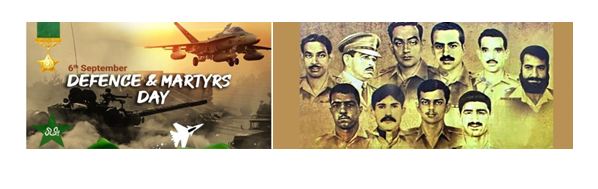
Like every year since 1965 Pakistan is all set to observe the Defence and Martyrs Day on 6th September to pay tribute to the martyrs of the nation who had laid down their lives for Pakistan. It is the day to renew our pledge that no power on earth can undo Pakistan and we are a powerful, self-driven nation. Our defenders are the sign of solidarity, honest, and discipline with the purity to sacrifice their lives for their homeland. We observed the day to honor the martyrs of the September 1965 war which was imposed on Pakistan by India. The country has started observing this day to remember both civilians and military personals who had sacrificed for Pakistan. Defence Day is the day for celebrating and remembering all that so we can be strong and pass the message of courage and honesty to the youth of our country. It was the early 1960s when India was showing aggression. India wanted to change Kashmir’s status and denied all the UN resolutions on the Kashmir issue. Among all these Kashmiri people were continuously raising their voices for freedom. In August 1965, severe clashes happened at LOC, and both countries started exchanging fire. On 6th September India attacked Pakistan hoping that it would win, but our well-organized army and our defense towards the attack had shocked them. Then on 7 September, single Pakistan airforce pilot M.M. Alam shot down five Indian airforce aircraft, which became a world record. M.M.Alam was flying F-86 aircraft. Hence Soldiers of Pakistan defended the country so that you and I till this year can celebrate this Day with freedom in our homeland.
We remember you on this Day
Our region has a history of producing one of the bravest of its time. Every year by celebrating this Day we pledge to protect our country and people. Aitazaz Hasan, Principal Tahira Qazi, Flight Lieutenant Marium Mukhhhtiar, and Arfa Kareem are all the greatest examples of that pledge and the sacrifices they have made for their people has set a great example of patriotism, sacrifice, and love for the people of Pakistan who are united under one ideology that is Islam.
Tahira Qazi, Principal of Army Public School is a name one can never miss. She had lost her life while protecting the students when the school came under attack on 16th December 2014. She was awarded Sitara-e-Shuja’at by the Government. Her bravery and sacrifice are an example of selflessness and love for her students. On the other hand, if we see the story of Aitaza Hasan, a 15-year-old boy, we came to know that this 15-year-old student had sacrificed his life while stopping a suicide bomber from entering his school in District Hangu KPK.His act of bravery saved the lives of 2000 students who were gathered for a morning assembly in the school in village Ibrahimzai of District Hangu. Marium Mukhtiar was a PAF flying officer, she is the first female pilot to die in a mission. When a trainer jet crashed and she embraced martyrdom. According to her parents, she always wanted to do something different The Government of Pakistan awarded Marium with Tamgh-e- Basalt. If we look into the contribution of Arfa Kareem we came to know that she became the youngest Microsoft Certified Professional at the age of nine in 2004. She was personally invited by Bill Gates to visit Microsoft Headquarters in the USA. Arfa left us in 2012 following a cardiac arrest.
If we talk about the celebration of 6th September, we got to know that various military parades and celebrations are arranged on Defence Day. In military parades, we see innovations and advancements in the latest tactics. The main aim of all this is to celebrate our veterans and to honor and celebrate our military strength. Social media and TV channels play a pivotal role to boost and honor these celebrations on Defence Day.
We all must remember the sacrifices given by our soldiers and civilians for our homeland . Every Pakistani citizen’s vision should revolve around the progress and prosperity of Pakistan.