Home Blog Page 2194

PAKISTAN FOR IN INCLUSIVE SETTLEMENT OF AFGHANISTAN ISSUE: HAMID ASGHAR

Addresses a press conference; says PM Imran Khan had categorically stated that there was no military solution

DNA

RABAT: Pakistan as a responsible member of the international community and also being an immediate neighbor is deeply concerned at the unfolding situation in Afghanistan.

We deem it essential that Afghanistan must move towards peace and stability. We deeply regret the loss of precious lives due to the un-controlled situation at Kabal airport yesterday.

We hope that no further loss of lives nor violent acts will take place and that the human and civil rights of all citizens, especially women and children shall be safeguarded.

Pakistan had always maintained, as repeatedly articulated by the Prime Minister of Pakistan, Mr. Imran Khan that there was no military solution to the Afghan situation.

Pakistan over the years has suffered the most from the negative spillover of the conflict in Afghanistan. We expect that in future Afghan soil will not be used to perpetrate terror in Pakistan, and that 3.5 million Afghan refugees will be able to return home with dignity.

Pakistan is fully committed to working with the International community for a negotiated, inclusive, political settlement that will allow Afghanistan peace. This will also allow for much needed regional integration and development.

We note that President Biden in yesterday’s address also underlined many of the same points, emphasizing that governance deficit, corruption, a non inclusive approach and the absence of will characterized the Ghani government.

These are the actual factors that contributed to the collapse of the Ghani regime and created an enabling environment for the Taliban. Any other irresponsible and unfounded assertions, falsely attempting to lay blame elsewhere such as on Pakistan have been laid to rest by President Biden’s address.

PAKISTAN, SAUDI ARABIA ENJOY CORDIAL RELATIONS: AIR CHIEF

ISLAMABAD, AUG 17 /DNA/ – General Fayiadh Bin Hamed Al-Rowaily, Chief of General Staff, Kingdom of Saudi Arabia called on Air Chief Marshal Zaheer Ahmed Baber Sidhu, Chief of the Air Staff, Pakistan Air Force in his office today. During the meeting, both the dignitaries discussed matters of professional and mutual interest.

General Fayiadh Bin Hamed Al-Rowaily commended the professionalism of PAF and acknowledged its rising indigenous capacity in aviation industry. The Air Chief said that Pakistan and Saudi Arabia had longstanding religious, cultural and historical bonds which were manifested through strong ties between both the Air Forces. Air Chief highlighted that both the countries enjoy cordial relations and reiterated his resolve to further enhance the existing bilateral cooperation between the two brotherly countries. 

PM IMRAN RECEIVES DELEGATION OF POLITICAL LEADERS FROM AFGHANISTAN

ISLAMABAD, AUG 17 /DNA/ – Prime Minister Imran Khan received a delegation of political leaders from Afghanistan today. Welcoming the delegation, Prime Minister Imran Khan expressed strong support and solidarity for the fraternal people of Afghanistan, linked to the people of Pakistan through immutable bonds of faith, history, geography, culture and kin-ship. 
The Prime Minister underlined that no other country is more desirous of peace and stability in Afghanistan than Pakistan. 
The Prime Minister added that in the current situation, great responsibility rested on the Afghan leaders to work constructively together to lead Afghanistan on the path of sustainable peace, stability and development. 
The Prime Minister underscored the importance of all sides working to secure an inclusive political solution. 
Reaffirming Pakistan’s commitment to a peaceful and stable Afghanistan, Prime Minister Imran Khan assured of Pakistan’s steadfast support for efforts in this direction. 
The delegation members thanked the Prime Minister for receiving them and appreciated Pakistan’s support for the peace efforts. They emphasized the multi-ethnic nature of Afghan society and the importance of an inclusive dispensation. The Afghan delegation also reiterated the desire to further strengthen the brotherly relationship between Afghanistan and Pakistan.

WEBTALK ON “ISSUES AND DEBATE AT THE CONFERENCE ON DISARMAMENT (CD): A VIEW FROM PAKISTAN”

ISLAMABAD, AUG 17 /DNA/ – “From Pakistan’s perspective, the Conference on Disarmament (CD) does not operate in isolation. It is affected by the geopolitical developments at the national and international levels, policy choices of major powers and how the CD members perceive these developments impacting their national security.” This was said by Ambassador Khalil Hashmi, Permanent Representative of Pakistan to UN, Genevaat thewebtalk on “Issues and Debate at the Conference on Disarmament (CD): A View from Pakistan.” The webtalk wasorganised by the Arms Control and Disarmament Centre (ACDC) at the Institute of Strategic Studies Islamabad (ISSI) on August 17, 2021. Various distinguished national and international experts attended the webtalk. Ambassador Aizaz Ahmad Chaudhry, Director-General ISSI welcomed the participants.

Ambassador Hashmi pointed out the CD’s membership and its composition of militarily significant countries, the rules of procedures and mechanisms,the agenda of achieving nuclear disarmament and absence of civil society’s participation are major and constant internal variables that affect CD’s working. There are ongoing debates regarding further extension of membership, revision of agenda and amendment of rules and procedures. Numerous proposalshad been tabled but they did not get much attention, he said.  While underlining the external variables, he said that the primary rationale behind CD was to negotiate the treaty of nuclear disarmament, however, the indefinite extension of the NPT somehow legitimised the possession of nuclear weapons and sowed the seeds of existing stalemate at the CD. Other variables are the longstanding and well-founded frustration due to non-compliance of legal obligations, lack of forwarding movement on the issue of Negative Security Assurances (NSA), deliberate disregard for established norms of global arms control and disarmament regime, growing mistrust among member states and contest for prioritising the issues among major powers.

While highlighting the prospects, he opined that the progress at CD in terms of negotiating any treaty is difficult to achieve due to renewed global arms race, doctrinal shifts and growing competition and antagonism among major powers. Therefore, there is a need to reverse the policies that caused the stalemate and revive the old global consensus on the issue of nuclear disarmament. He also drew attention to theintegration of AI with existing weapons, nanotechnologies, synthetic material, militarisation of cyberspace, hypersonic missile race as matters of serious concern, whichmust be brought to the CD agenda. However, there is little appetite among major powers to bring them to the agenda. “Currently, there are no clear solutions and the global landscape for arms control and disarmament is not bright,” he said.

Earlier in his introductory remarks, Malik Qasim Mustafa,Director ACDC-ISSI, said thatthe CD succeeded in negotiating the NPT, CWC, BWC and CTBT, however, the Conference is facing deadlock for more than two decades for not reaching a consensus on its programme of work. The new nuclear arms race, the demise of arms control treaties and agreements, military modernisation and weaponisation of outer space, militarisation of emerging technologies and new emerging realities are going to impact this impasse at the CD. He said that the CD should adopt a comprehensive, objective and rule-based approach to break the deadlock and deal with the existing and emerging challenges.

In her remarks, Ambassador Tehmina Janjua, former Foreign Secretary of Pakistan, said that CD should notbe seen as ineffective and irrelevant. The CD is a forum where Pakistan’s views are sought, heard, understood and greatly valued. It is an important strategic forum where Pakistan can bring to attention the security challenges it is facing in the region because of the special treatment given to India. Pakistan is focused on NSA and PAROS but the western countries view the non-proliferation and FMCT as the only negotiable issues, she said.

The Webtalk was followed by an extensivequestion and answer session.

In his concluding remarks, Ambassador Khalid Mahmood, Chairman BoG ISSI, said that CD made major progress when conditions were rights but from the last two decades, it is in a stalemate. However, the CD remains an important multilateral body as it could play a greater role in dealing with the challenge of emerging technologies. 

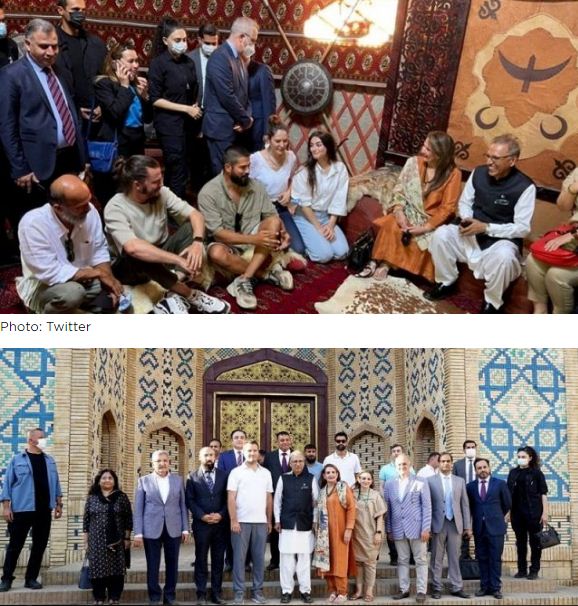
PRESIDENT ALVI, WIFE VISIT THE SET OF KURULUŞ: OSMAN

ANKARA, AUG 17: Photos of President Arif Alvi visiting the sets of Turkish historical series Kuruluş: Osman with his wife are doing the rounds on social media.

Kuruluş: Osman is the sequel to the popular series Diriliş: Ertuğrul. The photos show the president and his wife having a chat with the cast and taking photographs in tribal clothes and jewellery shown in the series.

President Alvi was on a three-day visit to Turkey.

Dirilis: Ertugrul, comprising 179 episodes, was dubbed in Urdu and aired on PTV last year daily at 9:10pm on the instructions of Prime Minister Imran Khan. The series is based on Ertugrul, father of Osman I, who founded the Ottoman Empire. It instantly became a massive hit in Pakistan, crossing millions of views on YouTube.

Kurulus started airing in Pakistan in Ramazan this year. The new episodes were announced by Senator Faisal Javed.

The lead actors, Engin Altin and Esra Bilgiç, have visited Pakistan. Esra has been the brand ambassador for Peshawar Zalmi in the sixth edition of the Pakistan Super League as well.  

Why the US-trained Afghan army failed to fend off Taliban

After quickly overrunning smaller administrative districts and provincial hubs, the Taliban on Sunday entered the Afghan capital Kabul and seized power, dramatically taking the country’s reins for the first time in almost 20 years.

The group’s rapid advances took many by surprise, with US President Joe Biden later acknowledging that his administration was caught off guard by the rapid deterioration of the Afghan military.

As late as last month, however, he had expressed public confidence that the US-trained Afghan National Security Forces had “all the tools, training, and equipment” to hold off a Taliban takeover of the country.

He said he had trust in the capacity of the Afghan military, calling it “better trained, better equipped, and more competent in terms of conducting war” than the Taliban.

In words that may come back to haunt him, Biden said the Afghan government and leadership “clearly have the capacity to sustain the government in place.”

But instead, the Taliban took over Afghanistan in a matter of weeks, even before the complete withdrawal of foreign troops from the war-torn country. The government quickly folded, with President Ashraf Ghani other key officials fleeing for safety abroad.

Yet over the last two decades, the US spent a whopping $89 billion to train and equip the Afghan military. So, the question remains: Why did Afghan soldiers collapse so quickly in the face of the Taliban advance?


LOST FAITH, CORRUPTION, WEAK LEADERSHIP

Rich Outzen, a retired US colonel who has worked in Afghanistan, chalked up the surrender to a lack of “sustainment support” (air support, logistics, transportation, communications) once the US military and contractors left, “weak political leadership,” and “insufficient national ethic.”

“Commanders and troops lost faith in Kabul and wouldn’t fight for it in the end,” he told Anadolu Agency. “Corruption also affected soldiers’ pay, morale, and availability,” he said, adding that there were “ghost” soldiers as well-those who did not report to work but were on the books “so a commander could pocket the pay.”

“Corruption in logistics and contracting was rampant too,” said Outzen, now a geopolitical consultant.

Reiterating that a lack of air support is one of the factors leading to Afghan forces’ failure, Murat Aslan, a political scientist at Turkey’s Hasan Kalyoncu University, said that in a country like Afghanistan, scattered across the Hindu Kush mountains, the ground forces were heavily dependent on this air support, which could only be provided by the US.

Personnel “retreated because they could not feel the backing of the central (Afghan and US) forces,” he told Anadolu Agency. “This is a military interpretation of the overall collapse.”

Aslan added: “The failure on the ground is not only about the inability of Afghan forces but the psychological effect of the US withdrawal.”

According to him, the Afghan forces were “more motivated to have a job rather than a committed stance to (serve) the country”-perhaps in contrast to the more dedicated and driven Taliban.

He also said that the personnel were selected on the basis of ethnicity rather than merit.

FUTURE OF TIES WITH AFGHANISTAN

Asked how the world, especially the US, will deal with the country’s new Taliban leadership, Outzen said the US “cannot develop a close relationship with the new government.”

“It will issue warnings and threats to keep them from crossing red lines on terrorism (open support or tolerance of al-Qaeda, etc.) It will criticize human rights abuses such as the repression of women and minorities,” he explained.

“For the remainder of the Biden administration, they will try to minimize frictions, though, and avoid public scrutiny of what many consider a massive policy and strategy failure,” he argued.

Aslan, on the other hand, went on to say that in fact the Taliban were first legitimized by the February 2020 Doha agreement with the US, adding that the “absence of a legitimate government in Kabul and military enforcement of Taliban makes them legitimate.”

POWER VACUUM IN AFGHANISTAN

Many believe that the departure of US troops from Afghanistan has left a power vacuum in the country that may be filled by other major powers, especially China and Russia.

Telling how just last month China accepted a visiting Taliban delegation and promised them support, to the detriment of the Muslim Uyghurs of northwestern China, Aslan said this effectively means “China pledged recognition to the Taliban.”

China has already thrown its weight behind an “Islamic government” in Afghanistan, urging the Taliban to honor their commitments for a negotiated settlement in the country.

Pointing out to Russia’s relative silence since the fall of Kabul, Aslan said this is “because they see that there’s an opportunity in the existent gap after the withdrawal of the United States.”

“It is crucial that the international community first agrees on a solid agreement on how to deal with the Taliban at the expense of recognition,” he said.

He added that all actors, including Turkey, Pakistan, and Iran, “can then urge Taliban … to comply with the universal norms, and international politics.”

Alluding to Afghanistan’s reputation as the “graveyard of empires,” Outzen said, “Afghanistan is not the sort of place where any external power has ever dominated or even profited for an extended period of time.”

But, he added: “Russian and Chinese influence will rise somewhat, as that of the US disappears.”

He said that Turkey’s role will be interesting, given its close ties with neighboring Pakistan, which is said to have an influence over the Taliban, and also as a longstanding member of NATO.

But he cautioned that the war may not simply end, as the Taliban have “not shown the ability to run a large country or economy,” and foreign influence will depend upon whether the “situation stabilizes or sparks new fighting.”

AMBASSADOR OF VIETNAM MEETS DEPUTY CHAIRMAN SENATE

ISLAMABAD, AUG 17 /DNA/ – Ambassador of Vietnam Nguyen Tien Phong called on the Deputy Chairman Senate Mirza Muhammad Afridi at Parliament House on Tuesday.

Deputy Chairman Senate Mirza Muhammad Afridi underscored that Pakistan values its relations with Vietnam. “Pakistan and Vietnam can learn a lot from each other’s experiences in the field of trade and economic cooperation.” said Deputy Chairman Senate during his meeting with the Ambassador of Vietnam.

Deputy Chairman Senate acknowledged Vietnam efforts to take steps for economic development. He said that cooperation can also be promoted in textile, agriculture and other fields. Mirza Afridi highlighted that diplomacy at the parliamentary level can take bilateral relations to new heights. He believed that accelerating the exchange of parliamentary delegations will further strengthen bilateral ties.

During the meeting emphasis was laid on trade and economic cooperation between the two countries to further strengthened people to people contact

Deputy Chairman Senate Mirza Muhammad Afridi reiterated that Vietnamese investors need to take advantage of Pakistan’s improved business environment. Mirza Muhammad Afridi highlighted that Pakistan is providing visa on arrival facility for citizens of Vietnam.

Deputy Chairman Senate Mirza Muhammad Afridi acknowledged that Pakistan appreciates Vietnam’s rapid economic growth. The two countries need to promote cooperation in the fields of tourism and education. Special Economic Zones under CPEC are very important for regional connectivity and development.

Deputy Chairman also emphasized that Vietnamese investors can take advantage of investment opportunities in Balochistan, especially in Gwadar.

While speaking on the Kashmir Issue Deputy Chairman Mirza Afridi said that the international community should play its role in resolving the Kashmir issue. The Kashmir issue should be resolved in accordance with the aspirations of the Kashmiri people and UN resolutions.

The Deputy Chairman Senate also extended his well wishes to the Government, Parliament and people of Vietnam. The Deputy Chairman Senate assured the Ambassador of all possible cooperation for further strengthening of Pak-Vietnam relations. Nguyen Tien Phong thanked the Deputy Chairman Senate for a warm welcome at the Parliament House. The Deputy Chairman Senate presented a bouquet to the Ambassador of Vietnam.

The Ambassador said that that we are proud of the friendship between Pakistan and Vietnam which spans over 50 years. The ambassador showed pleasure that the Pakistani people are filled with hospitality. He said that the two countries have excellent cooperation at the international level. The ambassador believed that there is scope for further enhancement of trade and economic cooperation. He informed that contacts are being made with various chambers of commerce and business community to promote trade and explore opportunities for multi-dimensional cooperation and linkage.

UZBEK ENVOY, CGSS OFFICIALS DISCUSS CENTRAL AND SOUTH ASIAN CONNECTIVITY INITIATIVE

ISLAMABAD, AUG 17 /DNA/ – A meeting was held between Aybek Arif Usmanov, Ambassador of the Republic of Uzbekistan to Pakistan and Senior Management of CGSS with Ms. ShaheraShahid, Secretary, Ministry of Information & Broadcasting, Government of Pakistan.

Aybek Arif Usmanov discussed the Central and South Asian Connectivity initiative taken by President of Uzbekistan, Shavkat Mirziyoyev. He also appreciated the active participation and suggestions presented by H. E Imran Khan, Prime Minister of Pakistan in the conference held at Tashkent, Uzbekistan.

It was decided that measures will be taken to enhance the cultural connectivity of Uzbekistan and Pakistan.

The Secretary of Information & Broadcasting assured the support and assistance to promote the historical and cultural similarities of both countries.

It was also decided to initiate projects for the collaboration of media from Pakistan and Uzbekistan. It was agreed that these kinds of cooperation’s will enhance people to people contact and ensure strong bilateral ties of both countries.

The meeting was also attended by Mr. Ashfaq Ahmed Gondal, Former Federal Secretary & Vice President (Federal Region), CGSS and Mr. Khalid TaimurAkram, Executive Director, CGSS.

77 shopkeepers fined over profiteering

FAISALABAD, Aug 17 :The price control magistrates imposed a fine on 77 shopkeepers

over profiteering in the district on Tuesday.

A spokesman for the district administration said price control magistrates inspected 879 shops

in different markets and bazaars of the district and found 77 shopkeepers involved in profiteering.

The magistrates imposed a total fine of Rs 89,000 on them.

Afghanistan is ‘Talibanistan’

Dr M Ali Hamza

An international combat mission with a ruthless enemy and a corrupt as well as perplexed Afghan government partner has at last reached to an end.The Taliban’s summer-long military campaign has forced surrenders and retreats by Afghan government forces.Six hundred fifty troops that were left behind to secure US embassy and international airport in Kabul appear to be helpless.  Since 2018 the quarterly reports by SIGAR (Special Inspector General for Afghanistan Reconstruction) have been pointing out the footprint of Taliban on 65% of the rural land of Afghanistan. But now all rural and Urban Afghanistan is Talibanistan.

Mr. Biden admitted that after nearly 20 years of war; America’s longest war on foreign soil, it was clear that the US military could not transform Afghanistan into a modern and stable democracy.This confession seems unacceptable over the deaths of thousands of innocent civilians in the region and around the world. Surprisingly Mr. Biden appears to be a president of a naive country that never had such poor war decisions in the past. The deaths of US soldiers, and causalities of civilians in Vietnam war belongs to some alien forces, and got nothing to do with US war experiences.   More surprisingly the trillions of dollarscost of lives and money on training, reconstruction and providing ammunition to Afghan National Security Forces (ANSF), Afghan National Army, Afghan Air Force could not resist a blow of Taliban; apparently untrained and poorly armed. A natural question arises that ‘did US stabbed Ghani’s government?’

In December 2001, Taliban offered an unconditional surrender. US rejected the offer. Nearly 20 years later, the world witnessed that US assembled on negotiating table with the Taliban to agree on a political settlement with the USbacked Afghan government. Let us recall the memories of this interesting voyage.   Almost exactly two decades back, junior Bush ordered to launch attacks against the Taliban.The publicized purpose was to disrupt the use of Afghanistan as a terrorist base of operations, and to attack the military capability of the Taliban regime. US demanded to hand over Al Qaeda leaders who planned 9/11. “Now Taliban will pay a price. Operation Enduring Freedom would entail a lengthy campaign unlike any other we have ever seen” said the then US president Bush, on refusal to the US demands. By December 2001, the Qaeda leader Osama bin Laden and other top commanders fled. American forces did not pursue them rather inside Afghanistan US troops quickly toppled Taliban government and crushed its fighting forces as 2001 drew to a close.In May 2003, Defense Secretary Donald Rumsfeld announced an end to major combat operations in the country. Now US and NATO designed rebuilding a failed state and establishing a Western-style democracy. A pro-Western government was installed. Resources were spent to build schools, hospitals and public facilities. Then Barack Obama came into power. He promised towithdraw US troops from the foreign lands by 2014, but on the contrary the deployment kept increasing.  On the other side Taliban did not just kept quiet. They often engaged with the foreign forces, captured the most of the rural land, developedsecret diplomatic ties, got stronger and smarter. In May 2011, a US Navy SEAL team claimed to kill Ousama Bin Laden; wasn’t it face saving tactic? In or around 2014 the Pentagon realized that Afghanfighters defeated the British army in the 19th century and the Russian military in the 20th century, thus war could not be won militarily and only a negotiated settlement could end the battle. What a quick realization.Nearly three years after this realization, the Trump administration held talks with the Taliban, leading to formal negotiations that excluded the Afghan government, led by President Ashraf Ghani. In February 2020, the Trump administration signed an agreement with the Taliban that called for all American forces to leave Afghanistan by May 1, 2021. Objectives of the 2020 deal were for Afghan leaders and the Taliban to negotiate a political road map for a new government and constitution. Though the objectives were not met in letter and spirit, but after some hiccups finally the US troops abandoned the Ghani’s government. And Afghan forces that were trained on modern weapons could not hold their land for good.

US exit could have been better executed. If neutralizing the threat from al-Qaeda and denying them safe haven in Afghanistan had actually remained the yardstick of success, USand its allies could have left the country a decade ago. It is a long-term strategic competition with China that forced US to prolongeffort in Afghanistan.Trump and Biden administration recognized that the unnecessary rift with China is distracting the USfrom necessary shift. Once again the realization is too late. We must expect that China and Russia will fully take advantage of this episode and willstrategically use to diminish US standing in the world and undermine its leadership of the free-market world order. Comprehending this most probable fact can help Pakistan to re-energize some of its diplomatic relations, such as with Russia.

Stay Connected

64FansLike
60FollowersFollow

Latest Reviews

Exchange Rates

USD - United States Dollar
EUR
1.17
GBP
1.35
AUD
0.67
CAD
0.73