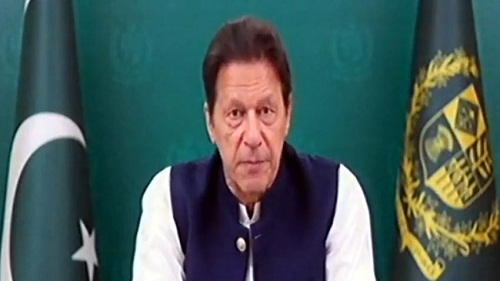
Islamabad : Prime Minister Imran Khan has expressed his strong commitment to international cooperation aimed at poverty alleviation, sustainable growth and addressing climate change.
Addressing virtually a forum on 20th Anniversary of Juncao Assistance and Sustainable Development Cooperation being held in Beijing, he said COVID-19 has triggered an economic meltdown and slowed down global progress. The extreme poverty rose last year for the first time in over 20 years.
Imran Khan said achievement of food security, and improved nutrition, have become an even greater challenge for developing countries. Sustainable ways of achieving economic recovery, growth and development are critical, during the pandemic.
He said Juncao technology is one such way which helps small-scale farmers to develop low-cost and commercial-scale mushroom cultivation.
The Prime Minister said China is a role model for developing countries in poverty alleviation. He said its stellar growth has brought eight hundred million people out of poverty over the last four decades. He said China’s leadership role in climate change is also highly appreciated.
He commended President Xi’s vision of a prosperous, clean and beautiful world and initiative to achieve carbon neutrality by 2060.
The Prime Minister said poverty alleviation and tackling climate change are his government’s key priorities. We have launched a wide ranking social safety program Ehsaas with an objective of uplifting marginalized people, eradicating poverty and supporting vulnerable households.
Imran Khan said our Ehsaas Emergency Cash program cushioned the most vulnerable part of population from the economic shocks of the COVID-19 pandemic.
He said Pakistan being one of the most climate vulnerable countries, fully supports international efforts to combat this scourge. He said we are progressing towards a Clean and Green Pakistan. We have already planted a billion trees as part of our ten billion tree project as part of one of the most ambitious efforts to expand and restore forests.
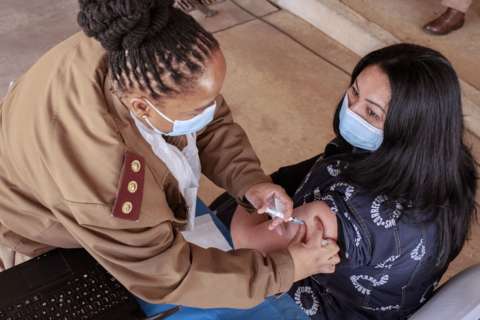
The European Union will return millions of Johnson & Johnson vaccine doses made in South Africa to the continent.
African Union’s special envoy Strive Masiyiwa told reporters that all the vaccines being produced in Africa “will stay in Africa and be distributed to Africa”.
“This issue has been corrected and it has been corrected in a very positive way,” he said
It follows criticism that vaccines were being shipped away from a continent that has the lowest vaccination rates in the world.
Less than 3% of the continent’s population has been vaccinated.
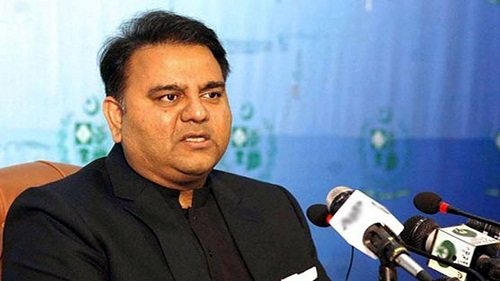
Islamabad : Minister for Information and Broadcasting Chaudhary Fawad Hussain has said Pakistan desires stability in Afghanistan.
In a statement on Friday, he said there is no new influx of Afghan refugees to Pakistan. He said the situation is not such that the Afghan people flee their country.
He said Pakistan has influence on the Taliban but does not control them. He said we are trying that the Kabul airport reopens at the earliest.
Tokyo: Pakistan’s Haider Ali has become the first Pakistani to win a gold medal in the Paralympic Games.
In the Men’s Discus Throw competition of Paralympic Games 2020, Haider threw a 55.26 metres throw in his fifth attempt out of the total six which is also his personal best.
The silver medal was bagged by Ukraine’s Zhabnyak with a 52.43 metres throw, while Brazilian Teixeira de Souza won bronze with a 51.86 throw.
Haider, who suffers from cerebral palsy, also competed in the discus throw at the World Para-Athletics Championship in Dubai in 2019 and won a silver medal for Pakistan.
Cerebral palsy is a disorder because of which one part of a person’s body becomes weakened as compared to other parts. All para-athletes with cerebral palsy participate in the F37 category.
Remember, Haider had competed in the long jump at the Paralympics, winning a silver medal in 2008 and a bronze medal in 2016.
He was the last hope for Pakistan to win a medal after the other Pakistani athlete, Anila Izzat Baig, had been disqualified.
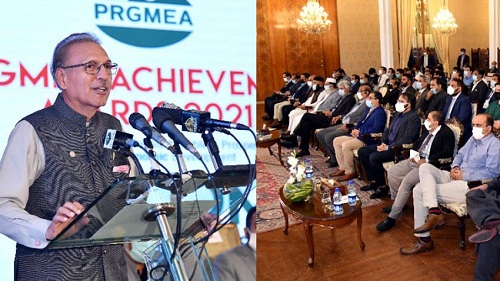
Islamabad : President Dr Arif Alvi has urged the business community to tap the export potential of Pakistan and put the country on a new path of progress and prosperity.
He was speaking at awards ceremony of Pakistan Ready-made Garments Manufacturers and Exporters Association in Islamabad.
The President said measures are required to manufacture value added products and raise the production of cotton and other agricultural commodities.
The President said now Pakistan should embark on the next phase of export-oriented growth and the exporters should take advantage of the incentives offered by the government.
He said Pakistan would benefit the most from peace and stability in Afghanistan.
Dr Arif Alvi said that expertise of Pakistani businessmen and professionals would be needed for reconstruction and development activities in Afghanistan.
Islamabad, 03 Sep, 2021: On September 2, the United States Embassy in Pakistan announced it will award an additional 700 graduate-level scholarships to Pakistani women in partnership with the Higher Education Commission of Pakistan (HEC). These two-year scholarships, which begin this year and last until 2023, will be awarded to outstanding women to earn master’s degrees in agriculture, business, engineering, health sciences, and social sciences. Since 2003, the United States has granted 5,300 merit- and needs-based scholarships to financially disadvantaged, but academically successful students throughout Pakistan.
Through the partnership with the HEC, the U.S. Agency for International Development’s Merit- and Needs-Based Scholarship Program (MNBSP) awards scholarships to academically talented and financially disadvantaged students for university study. The program targets young people from remote and rural areas of Pakistan, especially northern Sindh, Balochistan, southern Punjab, Khyber Pakhtunkhwa, and the former Federally Administered Tribal Areas. Since 2013, USAID has increased the number of scholarships and allocated 50 percent of all scholarships to women to increase gender parity and access to higher education for women. Today’s announcement brings the total of MNBSP scholarships awarded to Pakistani students to 6,000.
“These additional 700 fully-funded graduate-level scholarships will be awarded to some of the most talented Pakistani women to help meet their higher education goals,” said USAID Deputy Mission Director Michael Nehrbass.
Dr. Sania Nishtar, Special Assistant to the Prime Minister on Poverty Alleviation and Social Protection, and the Executive Director of the HEC Dr. Shaista Sohail thanked USAID for expanding the MNBSP and acknowledged that the investment made in women’s scholarships and their recruitment are important steps to further women’s empowerment and their access to higher education, a shared objective of HEC.
Islamabad : Prime Minister Imran Khan says the present government is reforming civil and criminal laws so that relief could be provided to the common man.
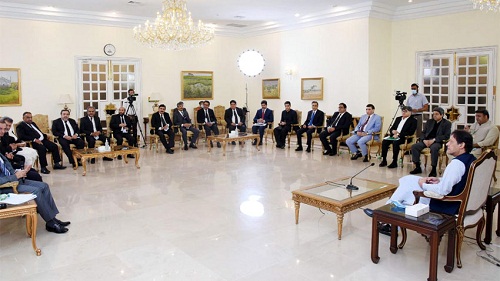
He was talking to the members of the Executive Committee of Supreme Court Bar Association who called on him in Islamabad.
The Prime Minister said services of lawyers’ organizations are invaluable in promoting and strengthening democracy.
He said legal reforms will reduce case load on the courts.
Imran Khan said that support of lawyers’ representative bodies was required in the government’s agenda of legal reforms.
The Prime Minister said the government is cognizant of problems faced by lawyers and every effort will be made to resolve them .
He directed immediate removal of hurdles in the establishment of housing colony for lawyers, inclusion of lawyers in Naya Pakistan Housing Program, provision of health cards, inclusion of young lawyers in Kamyab Pakistan program.
The delegation fully endorsed the government’s legal reforms agenda.
ISLAMABAD: COVID-19 has claimed 57 more lives in Pakistan during the last 24 hours, pushing the nationwide tally of fatalities to 26,035.
According to the latest figures issued by the National Command and Operation Center (NCOC), 3,787 persons tested positive for COVID-19, lifting the overall number of infections in the country to 1,171,578.
Pakistan has conducted 59,745 tests in the past 24 hours out of which 3,787 persons tested positive for the disease. The country has conducted overall 17,931,365 tests to diagnose the deadly virus.
The COVID positivity ratio was recorded at 6.33 per cent as compared to yesterday’s 6.65%.
The NCOC said 5,606 people are in critical condition.
So far, a total of 58,156,714 vaccine doses have been administered to the masses across the country.
Out of 58,156,714, the number of fully vaccinated people against the coronavirus is 18,004,529, while 44,701,679 partial doses have been administered to date.
On Thursday, Federal Minister for Planning and Development, Asad Umar had appealed to the public to adhere to the COVID-19 standard operating procedures to avert the chances of any other wave in the country.
In a tweet, the NCOC head urged citizens to follow Standard Operating Procedures (SOPs) to contain the spread of COVID-19 as the hospital inflow and critical care COVID patients, both reached the highest level since the start of the pandemic.
The Taliban have won the war, but can they lead the peace?
EXCLUSIVE
Ishtiaq Ahmad
(Ishtiaq Ahmad is the former Vice Chancellor of Sargodha University and Pakistan Chair at Oxford University. In his previous career as a journalist, he reported the rise of the Taliban in Afghanistan in the mid-1990s. This is his exclusive write-up for The Islamabad Post.)
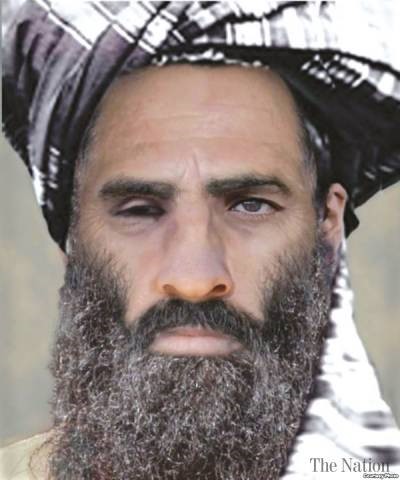
Mullah Omar, former Supreme leader of Taliban
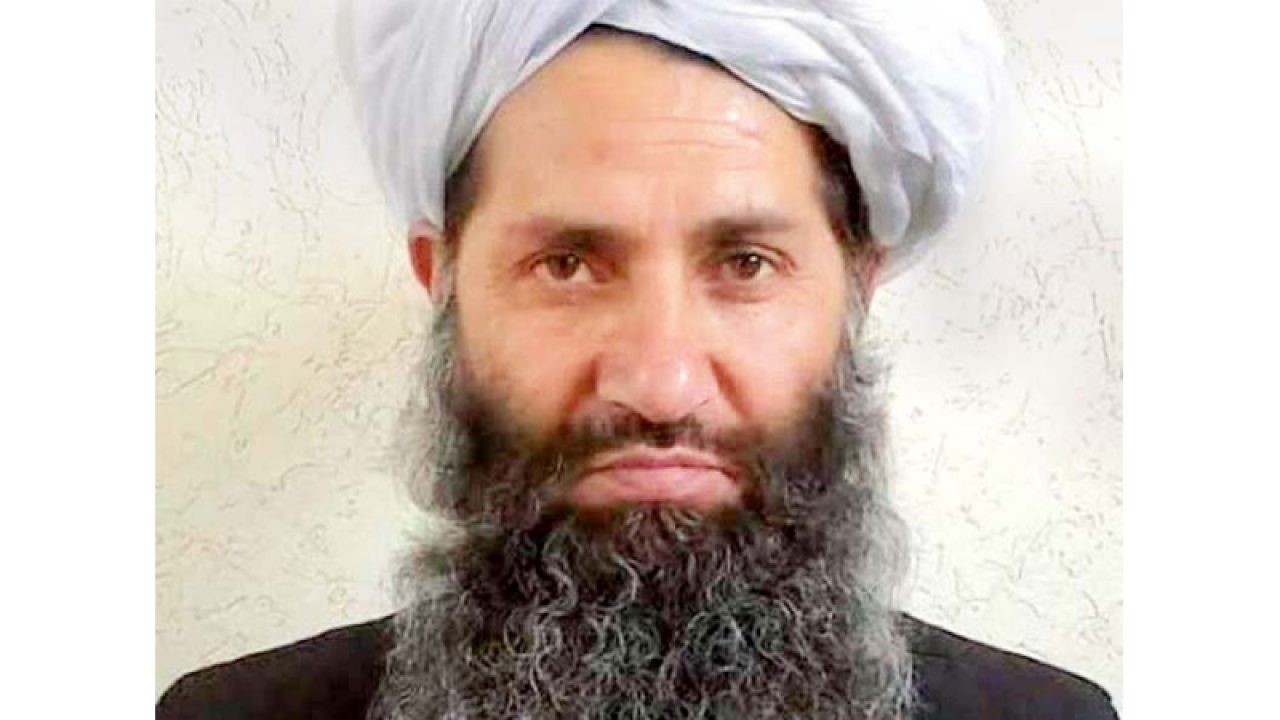
Mullah Hibatullah Akhundzada, the current supreme leader of Taliban
Now that the 20-year American imperial project in Afghanistan has become a footnote of history, it is time to focus on the victors of this war: The Taliban. Two comparisons are worth making here, one, the fundamental difference between the Taliban’s debut rise to power and their current conquest; and, two, their expected conduct in power this time around like or unlike the previous one. History, current and past, provides the answer.
‘Who are the Taliban?’ So was titled my first news story from Kandahar in mid-1990s for an English daily in Pakistan. I was then a journalist and on a reporting assignment to travel to southern Afghanistan and investigate the instant rise of this Afghan militia. The Taliban had emerged as a ragtag group of madrassa militants under the leadership of Mullah Omar in response to years of Mujahideen infighting and oppressive rule. A major factor that contributed to the Taliban’s rise was the support from the war weary Afghan public for their swift enforcement of justice, disarmament and rule of law in the areas under their control.
The Inside Story
However, as the following snippets from the inside story of the Taliban headquarter in Kandahar city during the month Ramadan in 1995 shall reveal, the actual tale about this religious militia was even then quite different from its public portrayal:
“It’s Friday afternoon (Feb.17). As we enter the exit gate of the headquarter, I see a dozen or so people standing along the driveway, as if waiting for some important guests to arrive. Ali, my Taliban companion from Quetta, alerts me that the Emir-ul-Azeem (as Mullah Omar was titled then) is among them.I ask Ali to request his leader for a short interview, introducing me as a journalist from Pakistan.The message is passed. Mullah Omar looks at me and murmurs in Pashto asking whether I am fasting or not. Ali translates this to me. As soon as I say‘yes,’ the Taliban leader utters something in Pashto, and the entire group bursts into laughter. Ali is quick to tell mewhy: ‘Emir-ul-Azeem says these Pakistanis always lie.’ A chill runs down my spine, as the Qazi court is in session next door, awarding instant Islamic punishments.
“The conversation stops there, and I prefer to step aside. Soon the convoy of guests arrives. Mullah Abdul Salam Rocketi and his brother –recently released from the Quetta prison in a prisoners exchange deal with Pakistani authorities – aregreeted with warmth and love.After brief conversation with him, Mullah Omar writes down war instructions on a paper foil taken out of a Silk Cut cigarette packet, which Mullah Rocketi then passes on to his commanders ready for the battlefront in Ghazni, the ninth Afghan province under Taliban attack.
“It rains heavily that evening. So, I take refuge in a Taliban barrack, but it is crowded and scary. Lucky enough, I find refuge inside the headquarter. Following Traveeh prayers,in a side room, I sit with some Taliban Shoora members on the carpet. The discussion over Afghan tea is mostly about whether to attack Kabul now or capture more Afghan provinces.All of them hate Hekmatyar, the Hizb-e-Islami leader, and are impatient to destroy his Charasyab stronghold to reach Kabul. They want to establish the true Islamic Emirate in Afghanistan and also replicate it in neighbouring Muslim countries. A Shoora member from the North proudly claims that over 100 Taliban have already joined the Islamic fight against Russian occupation in Chechnya.
“Maulvi Amir Muttaqi (who would later serve as Information Ministerin the Taliban government is currently a senior Taliban leader) and Mullah Mansoor (who succeeded Mullah Omar as Emir-ul-Momineen and was later killed in a US drone strike in Baluchistan)) also join in later. The discussion moves to more substantive issues. Both of them say, their leader is very clear about enforcing Hanafi form of Sunni Islam in Afghanistan, which is also an ideal system of government for other Muslim nations. From Taliban conversations, I can easily guess that they carry a deep sense of pride, for defeating the communist Soviet Union; mixed with a deep sense of betrayal by the Americans, for using and then abandoning the Mujahideen. Hence, now they want to defeat the remaining superpower. When asked why they partnered with America before, they rationalise it by saying: ‘We joined the lesser evil to defeat the bigger evil, now we shall defeat the lessor evil.”
Hence, it is apparent from the anecdotal evidence presented above that the Taliban were quite clear at the initial stage of their debut rise to power about their political objective of establishing the Islamic Emirate in Afghanistan. They also shared the Al Qaeda’s agenda of exporting violence across the Afghan frontiers at the world stage, which is why the international terrorist outfit eventually found a safe haven under the Taliban rule. Moreover, the Taliban were also clear about their military strategy. Realising that mere public support was not enough to conquer the rest of Afghanistan, the Taliban were willing to forge unholy alliances with notorious Afghan warlords like Mullah Rocketi.
Yet, it took seven months for the Taliban to capture the south-western province of Herat in September 1995 due to the fierce resistance from its largely Shia Hazara population. And, it would take another year for the Taliban to conquer Kabul in September 1996. The last stronghold in the outskirts of the Afghan capital to fall was Charasayab, where the HizbeIslami forces of Gulbuddin Hekmatyar fought hard against the Taliban.The Taliban had first entered Mazar-e-Sharif in May 1997, but were routed within couple of days. They were finally able to capture this capital cityof the ethnically Uzbek-dominated northern province of Balkh in August 1998. Moreover, even while ruling Kabul, the Taliban were never able to conquer almost 10 percent of northern Afghanistan, where the Northern Alliance retained control, with its ethnically Tajik-dominated leadership intact in the north-eastern Panjshir Valley.
The Swift Victory
The stark difference between the rise of the Taliban then and now is the sheer speed with which they have conquered entire Afghanistan within a fortnight – surprisinglystarting the major military push from the north this time before the final assault on Kabul.
The Taliban also pursued an effective military strategy, which was to choke the Afghan regime by denying it trade revenues, and energy and communication means, then encircle Kabul from the north and the rest of the sides. Well before the Afghan capital swiftly fell to the Taliban on August 15, they had established control over almost all the provincial capitals, except the Panjshir Valley, including Jalalabad in the east. Mazar-e-Sharif also quickly fell, despite President Ashraf Ghani’s last-ditch effort to shore up alliance with the Uzbek militia of Rashid Dostum, who himself chose to flee.
Clearly, the hasty withdrawal of foreign forces – under the US-Taliban agreement that was signed last year without securing a ceasefire –emboldened the Taliban to reconquer the war-ravaged country without much resistance. With the US air support, the Afghan National Army was able to resist the Taliban for years, sacrificing tens of thousands of its soldiers. The denial of this support demoralised this army to the extent that its soldiers volunteered to surrender before the advancing Taliban combatants.
Despite this, the incapacitation of the Afghanistan National Defence and Security Force was a factor that contributed to the Taliban’s blitz. With widely known corruption, ineptness and factionalism, especially its rank-and-file dominated by the erstwhile Northern Alliance, there was no chance that it would act as the last resort for the beleaguered Ghani regime’s survival from the impending Taliban onslaught on the Afghan capital.
Once the Taliban reached the gates of Kabul, Ghani had no choice but to flee. First, he was betrayed by the old foxes like former President Hamid Karzai and the chief Afghan interlocutor for talks with the Taliban and his political rival, Abdullah Abdullah. Both are said to have played an instrumental role in persuading the provincial commanders not to resist the advancing Taliban en route to Kabul. Hence, it is no surprise that they are currently trying to reap the reward of this service by negotiating their role in the Taliban-led government.
Second, it is also believed that President Ghani had set up various meetings for August 15, and that he was forced to take the flight out of Afghanistan only after being told that a Taliban death squad had entered the city to execute him the same way as the Taliban had publicly hung the former Afghan president, Najibullah, by the pole in a Kabul square back in 1996. Thus, he simply feared or his life. Obviously, he had to subsequently create the pretence of “avoiding the bloodshed” for an act that was actually motivated by basic human instinct – and understandably so.
Like before, in the Taliban’s current conquest of Afghanistan, Panjshir Valley remains in the hands of their only opponents: Amrullah Saleh, the Afghan Vice President who has now declared himself as the President in Ghani’s absence and Ahmed Massoud, the son of legendry Afghan commander Ahmad Shah Massoud and the head of the National Resistance Front of Afghanistan. The Taliban may again find it hard to capture this remote and inaccessible place. However, the fact the Taliban are in control of the entire country and turncoats like Abdullah have betrayed the cause of the Shura-e Nazar founded and led by late Massoud in the valley, means the odds are in the Taliban’s favour.
To be continued
The author can be reached at [email protected]Twitter: @ahmadishtiaq