Home Blog Page 1532

China’s Zonergy, Shanghai Electric contribute to Pakistan’s flood relief efforts

ISLAMABAD, Sept. 10 (DNA): Chinese solar energy conglomerate Zonergy and the electricity generation equipment manufacturer Shanghai Electric will contribute a total of Rs19 million for the people affected by devastating floods in Pakistan, Gwadar Pro reported on Saturday.  

Zonergy has donated RMB100,000 to the Pakistani Embassy in China for the flood relief efforts in Pakistan, according to a senior official of the Zonergy Solar Development Pakistan Ltd. 

The company will also provide Rs 6.4 million worth of portable solar energy devices and Rs 2.4 million worth of food supplies for the flood-hit people, the official said. The total package is worth Rs 12 million, he added.

Zonergy is a major player in Pakistan’s solar energy sector, having installed a 300 megawatts solar power plant in Bahawalpur Punjab. The company also intends to install another 300MWs solar power plant in Quaid-e-Azam Solar Park in Bahawalpur, according to an official of Private Power and Infrastructure Board (PPIB).

Meanwhile, sources said that Shanghai Electric will also contribute Rs 7 million worth of relief goods for the people of Mitthi Sindh. The cheque has been drawn and relief goods are being put together by the company officials, the sources said. The company will make a formal announcement in this regard on Friday or Monday, the sources added.

Shanghai Electric is the owner of Sino-Sindh Resources Ltd. (SSRL), a special purpose vehicle to operate a 7.8 million tons per annum lignite coal mine in Thar Coal Block-I in Tharparker district of Sindh. 

The firm also owns the Thar Coal Block-1 (TCB-1) Power Generation Company, another special purpose vehicle to operate the 1,320 MWs integrated mine-mouth power plant in Thar Block-1. The company has already excavated first layer of coal from their site and works of the power plant are also near completion. 

The cost of both projects stands at nearly $4 billion. The TCB-1 coal power plant involves ultra-supercritical technology to minimize pollution and enhance output.

GRSC, IoBM organizes a webinar on Global Power Politics and Kashmir Issue

KARACHI, SEP 10: A webinar on the topic of “The Changing Global Power Politics and the Kashmir Issue – Policy Options for Pakistan” was organized by the Global and Research Studies Center (GRSC), IoBM on Thursday, September 8, 2022. The panelists included Ambassadors Javid Hussain and Mr. Farrukh Pitafi, Senior Analyst and Television Host. Ambassador Ghulam Rasool Baluch was the moderator.  During his opening address, Ambassador Baluch said that South Asia will become a zone of prosperity unless the Kashmir Issue is resolved. He added that India’s policies go against all social and international norms especially after it abrogated the status of Kashmir.

Ambassador Javid said that the world is undergoing a radical transformation led by China. He predicted that China will become the leading power in the world with its military expenditure exceeding that of the US by the year 2035. He added that India is also emerging as a power. Pakistan’s foreign policy is dependent on what actions India takes. He said that the center of gravity of global power politics will shift from the Atlantic Ocean to Asia. Out of 32 leading countries, 12 will be from Asia accounting for 44% of the world GDP. This calls for Pakistan’s foreign diplomats to concentrate on the emerging power centers in Asia. He shared that we cannot neglect the actions of the US and Europe but we need to position our manpower and resources to capitalize on the future of Asia. Ambassador Hussain added that legality and morality are not going to help Pakistan get out of its predicament especially in providing a solution to the Kashmir issue. When talking about the Pakistan-China policy on Kashmir, Mr. Pitafi said that Pakistan was able to submit its resolution for the Kashmir issue to the United Nations Security Council with China’s support. He suggested that we should keep a constant narrative for Kashmir. Mr. Pitafi added that Pakistani authors seldom write books that explain their side of the picture on the Kashmir issue. Moreover, Pakistanis are not dominating social media when discussions on this topic are conducted. He said that the cause of Kashmir can be disseminated when we pursue two things: stay confident when presenting our narrative and never give up on the cause.

In his closing remarks, Ambassador Baloch said that Pakistan should use its soft power in general and when taking steps to resolve the Kashmir issue. He said the Kashmiri culture must be revived and the example of Kashmir must be taken as an example of development while continuing to collaborate with friendly countries that include our point of view. He was hopeful that South Asia along with Kashmir becomes a region of peace and prosperity.  

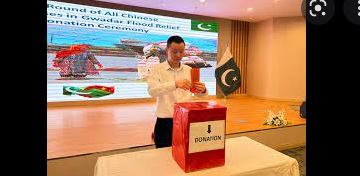
Chinese firms make second donation to Gwadar

ISLAMABAD, Sept. 10 (DNA): Chinese companies in Gwadar donated Rs 5.884 million in the second round of fund raising at China Business Center in Gwadar.

During the first round of fundraising drive, a whopping sum of Rs 15 million was collected and donated by Chinese companies working in Gwadar.  

According to Gwadar Pro, COPHC donated Rs. 2.36 million, followed by entities such as New Gwadar International Airport project Rs 100,000, China Harbour Engineering Company Rs 700,000, China-Pakistan Friendship Hospital Rs. 600,000, Gwadar Hua fa Expo Center Rs 200,000, CCCC-FHDI Engineering Company Rs. 200,000, Linyi Trade City Rs. 150,000, CCCC-PICL Rs 110,000, HK Sun Rs 100,000, Yu Lin Holdings Rs. 100,000, Professor Wang Sen from South Central University of Forestry and Technology Rs. 100,000, Hang Geng Trade Company Rs. 100,000.  

Apart from individual and private aid, the government of China has already pledged ¥100 million.

Earlier in recent week, the Chinese Foreign Ministry Spokesperson, Zhao Lijia had announced that China has provided 4000 tents 50,000 blankets and 50,000 pieces of tarpaulins to Pakistan under the social and livelihood Cooperation Framework of the China-Pakistan Economic Corridor (CPEC).

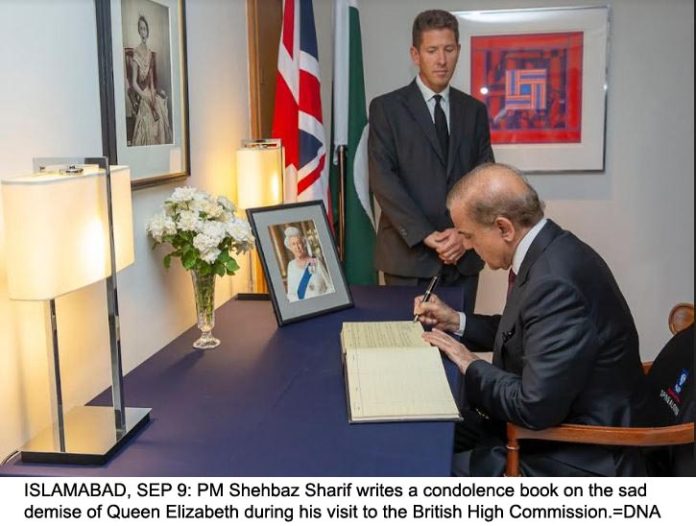
PM VISITS UK HIGH COMMISSION TO CONVEY CONDOLENCE OVER QUEEN’S DEMISE

ISLAMABAD, SEP 9: PM Shehbaz Sharif writes a condolence book on the sad demise of Queen Elizabeth during his visit to the British High Commission.=DNA PHOTO

ISLAMABAD, Sep 9: Prime Minister Shehbaz Sharif on Friday visited the British High Commission in Islamabad to convey condolence over the demise of Queen Elizabeth-II.

The prime minister met the UK High Commissioner in Pakistan Christian Turner and expressed grief over the Queen’s death, on behalf of the government and people of Pakistan.

He also penned his remarks in the condolatory book placed at the high commission paying tribute to the services of the late Queen Elizabeth-II.

On his arrival, the British high commissioner received the prime minister along with other officers of the high commission. Minister for information and Broadcasting Marriyum Aurangzeb accompanied the prime minister.

Earlier, the prime minister also wrote a letter to the British Prime Minister Liz Truss and conveyed his condolence to the Royal Family, the British government and the people.

He said that besides her services for the public interest, Queen Elizabeth remained a symbol of unity and brotherhood. Aged 96, Queen Elizabeth, Britain’s longest-reigning monarch for seven decades, died on Thursday.

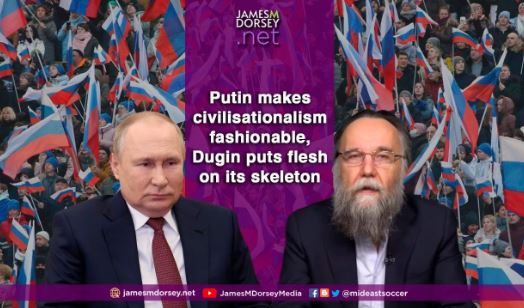
Putin makes civilisationalism fashionable, Dugin puts flesh on its skeleton

Russian President Vladimir Putin has inspired civilisationalist leaders to emerge from the woodwork and publicly define their states as civilisational rather than national entities.

These leaders speak of civilisational or ethnic worlds with borders that transcend national frontiers, not nation-states. How far they may wish to push claims that challenge the nation-state-based international order is likely to be heavily influenced by whether Mr. Putin achieves his civilisationalist goals in Ukraine.

Last month, Hungarian Prime Minister Victor Orban became the latest leader to redefine the nation-state he governs.

Speaking on Romanian territory in the predominantly ethnic Hungarian town of Baile Tusnad in Transylvania, a onetime Austro-Hungarian possession that is home to a Hungarian minority, Mr.Orban left no doubt that his definition of the Hungarian motherland included Transylvania and other regions in the Carpathian Basin beyond Hungary’s borders populated by ethnic Hungarians.

Serbian Interior Minister Aleksandar Vulin articulated a similar view of Serbia’s borders a year earlier.

“The task for this generation of politicians is to form a Serb world, that is to unite Serbs wherever they live,” Mr. Vulin told a political gathering in Belgrade in 2021 attended by President Aleksander Vucic.

Widely viewed as ‘Moscow’s man in Belgrade,’ Mr. Vulin said, “for the ‘Serb world’ to jell, Serbia needs to be economically successful, well-led and have an army that is able to protect Serbia and Serbs, wherever they live.”

Speaking the same day on television, Mr. Vulin went further by insisting that all Serbs should be united in one state. However, he later modified his statements by saying that unification would have to occur peacefully as it happened in post-Cold War Germany.

Even so, the thinking of far-right ideologue Alexander Dugin reverberates in positions adopted by Mr. Vulin as it does in the civilisationalist framing of geopolitics by Messrs. Orban and Putin.

“This is a war of ideas. We are not part of the global civilisation. We are a civilisation by ourselves. … We had no other possibility to prove that Huntington was right without attacking Ukraine,” Mr. Dugin asserts.

He was referring to the late Harvard University political scientist Samuel P. Huntington who controversially predicted a post-Cold War clash of civilisations that would be fought not between countries but between cultures.

The degree of Mr. Dugin’s influence on Mr. Putin is a matter of debate. Often dubbed in the media as ‘Putin’s brain’ and a Rasputin-like character, Mr. Dugin appears to be in and out of favour in the Kremlin’s innermost circles. Similarly, Mr. Dugin has influenced Central European, but to what degree may be debatable.

Nevertheless, even those sceptical describe the far-right ideologue as one of Russia’s foremost political theorists.

Mr. Dugin wrote a hugely influential ultra-nationalist tome, The Foundations of Geopolitics: The Geopolitical Future of Russia, which Russian military academies use as a textbook. The book envisions a clash of civilisation between the West and a Eurasian bloc supported by Russia. It also insists that “Serbia is Russia.”

“There is no doubt that especially that 1990s work on global geopolitics with its various distinctions profoundly influenced the Russian military and set the stage for a lot of the country’s geopolitical ambitions going forward,” said political theorist Matt McManus.

While there is no or, at best circumstantial evidence of direct contact between Mr. Dugin and Messrs. Vucic and Orban, it is clear that their political environments interact with one of civilisationalism’s leading ideologues.

For example, Mr, Vulin hosted Mr. Dugin on his visit to Belgrade in 2019 at a moment when the Serb capital was rife with reports about Russian spying.

Going back in history, journalist Predrag Popovic recalls meeting Mr. Dugin twice in Belgrade in the 1990s with the help of Mr. Vucic at the headquarters of the far-right Serbian Radical Party of which he was a member at the time.

Mr. Popovic quotes Mr. Vucic as describing Mr. Dugin as “the most important thinker and political strategist of modern Russia” and “Serbia’s greatest friend.”

Mr. Popovic notes that recently Mr. Vucic refrained from sending Mr. Dugin his condolences when the ideologue’s daughter, Darya Dugina, was killed in a car bombing in Moscow in August.

Mr. Vucic has often used Mr. Vulin as his frontman in relations with Russia in an effort not to provoke US and European ire.

Ironically, Mr. Orban, in his more liberal days, banned a 2014 far-right gathering in Budapest organized by the Montana-based National Policy Institute at which Mr. Dugin was scheduled to keynote.

However, the Hungarian capital has since become a hub for the European and American far-right. Akrtos Media, a key node in the far-right Budapest-based network, published the first full-text English translations of Mr. Dugin’s books.

The threat posed by the civilisationalist ambitions of men like Messrs. Putin, Orban, and Vulin, goes beyond the challenge to the rule of law and the notion of territorial integrity enshrined in the United Nations charter.

It has fuelled racism and bolstered exclusionist ideologies like Indian Prime Minister Narendra Modi’s anti-Muslim Hindutava Hindu nationalism. It has also emboldened the Myanmar junta that, according to human rights group Fortify Rights, is waging “genocide by attrition” against the beleaguered Rohingya communities of Rakhine State.

Mr. Orban recently took a leaf out of Mr. Dugin’s book on geopolitics when he declared in his widely denounced speech in Romania that he doesn’t want Europeans mixing with non-Europeans.

“This is why we have always fought: We are willing to mix with one another, but we do not want to become peoples of mixed race,” Mr. Orban said.

Speaking days later at a news conference, Mr. Orban insisted that “this is not a racial issue for us. This is a question of culture. Quite simply, our civilization should be preserved as it is now.”

In his book, Mr. Dugin argued that “it is especially important to introduce geopolitical disorder…encouraging all kinds of separatism and ethnic, social and racial conflicts, actively supporting all dissident movements – extremist, racist, and sectarian groups.”

Mr. Orban and Mr. Vulin’s civilizational worlds apply the bill to countries that increasingly only nominally fall within the orbit of the United States and the European Union.

Dr. James M. Dorsey is an award-winning journalist and scholar, an Adjunct Senior Fellow at Nanyang Technological University’s S. Rajaratnam School of International Studies, and the author of the syndicated column and blog, The Turbulent World of Middle East Soccer.

Norway to provide further support for victims of Pakistan flood disaster

DNA

ISLAMABAD: ‘Norway is providing an additional NOK 55 million to alleviate humanitarian needs in the wake of the catastrophic flooding in Pakistan,’ said Minister of Foreign Affairs Anniken Huitfeldt.

This brings Norway’s humanitarian support in response to the recent floods to NOK 80 million.

‘The situation is desperate for many millions of people, and our partners are working tirelessly to reach those who have been hardest hit,’ said Ms Huitfeldt.

Pakistan has been hit by the most devastating flooding it has experienced for many years, and vast areas of the country are under water. According to the UN, more than 33 million people are affected and over 1300 may have died. The flood has caused widespread damage to civilian infrastructure such as schools, health clinics and water and sanitation systems. Many roads and bridges have also been destroyed, making humanitarian relief efforts more difficult.

‘The flooding highlights the urgent need to adapt to climate change and safeguard food security, particularly in the countries most vulnerable to climate change and natural disasters,’ said Minister of International Development Anne Beathe Tvinnereim.

Some NOK 13.5 million of Norway’s support for the flood victims will be channelled through the World Food Programme (WFP) to be used for food security measures, including cash transfers.

‘This funding will help to alleviate the immediate food needs of the most vulnerable people, and support efforts to establish more climate-resilient food production,’ said Ms Tvinnereim.

The disaster has had a major impact on health needs, and has for example increased the risk of waterborne diseases such as cholera and diarrhoea. Already vulnerable groups are now facing even greater health risks, and the support Norway is providing will therefore be targeted towards protecting those most in need.

Norway’s support will be channelled through Norwegian Church Aid, Norcap, the World Health Organization (WHO), the United Nations Population Fund (UNFPA), and the International Red Cross and Red Crescent Movement, including the Norwegian Red Cross, in addition to funding provided through the UN Central Emergency Response Fund (CERF). Norway is one of the largest donors of core support to UN organisations working to provide assistance to flood victims in Pakistan. Core support enables these organisations to prepare for emergencies and to respond as soon as a disaster strikes. In addition, Norway is providing support for education efforts via the UN Children’s Fund (Unicef) and the World Food Programme to ensure that children affected by the flooding can continue to attend school.

The impacts of the flooding have been most severe in the southern and western provinces of Sindh, Khyber Pakhtunkhwa and Balochistan. According to UN reports, over a million homes and 18.000 schools have been completely or partially destroyed. The flooding has caused widespread damage to agricultural land and infrastructure in the affected areas.

‘Both the immediate and the longer-term needs are enormous. Effective follow-up by the Pakistani authorities will be crucial to build more resilient livelihoods for the people in these areas,’ said Ms Huitfeldt.

The UN estimates that over 16 million children are affected by the flooding. The long-term psychosocial impact of the flood disaster in Pakistan is cause for great concern.

‘I am particularly worried about the children who do not have access to schooling during the crisis. We must provide support to protect these children and enable them to return to school as soon as possible,’ said Ms Tvinnereim.

The UN is already working with the Pakistani authorities and international organisations to ensure a coordinated response and provide humanitarian aid to flood victims. The International Red Cross and Red Crescent Movement is working closely with the Pakistan Red Crescent Society to respond to the rapidly expanding needs, particularly for health care, in the affected provinces. Norway considers it important to channel funding through international humanitarian organisations that have relevant insight and experience and a local presence on the ground.

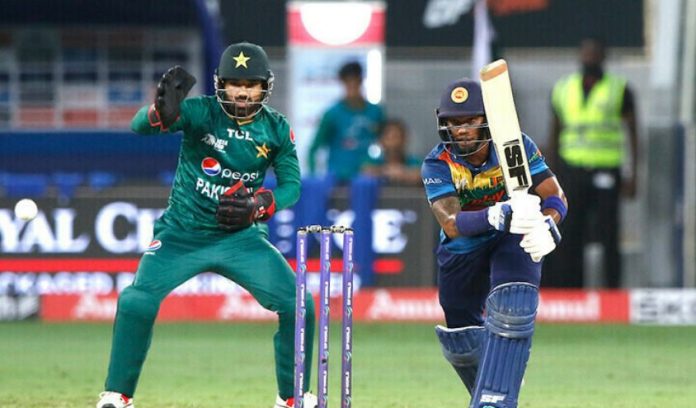
Clinical Sri Lanka beat Pakistan by 5 wickets in Asia Cup fixture

Dubai: Sri Lankan opener Pathum Nissanka smashed a half century, helping his team beat Pakistan by five wickets in the Asia Cup Super Four match at the Dubai International Cricket Stadium on Friday.

Leg spinner Usman Qadir dismissed Bhanuka Rajapaksa to break a 51-run partnership between him and Nissanka in the 12th over, however the latter kept the scoreboard ticking with boundaries and singles.

Earlier in the first innings, leg-spinner Wanindu Hasaranga claimed three wickets as Sri Lanka bundled out Pakistan for 121 in their dress rehearsal for the Asia Cup final.

Both teams have already booked their place in Sunday’s title clash and are playing the last Super Four match of the tournament, which serves as a warm-up to the T20 World Cup in October-November.

Sri Lankan bowlers kept the Pakistan batters in check after they elected to field first.

Hasaranga soon took charge to return figures of 3-21 including the key wicket of skipper Babar Azam for 30.

Openers Mohammad Rizwan and Babar found it tough to score and debutant fast bowler Pramod Madushan struck in his first over.

He sent the in-form Rizwan, who is second to Virat Kohli in the tournament’s run-scoring charts, back to the pavilion for 14.

Chamika Karunaratne ended Fakhar Zaman’s stay on 13 and Pakistan slipped further when Hasaranga bowled Babar.

Babar, who has struggled in the tournament with scores of 10, 9, 14 and nought in his previous innings, began with a delightful straight drive for four but could not produce a match-defining score.

Pakistan kept losing wickets and Hasaranga finished his spell with two successive wickets to flatten the Pakistan batting, which survived only 19.1 overs despite a late cameo of 26 by Mohammad Nawaz.

Spinner Maheesh Theekshana and Madushan took two wickets each.

Pre-tournament favourites India, who lost two of their three Super Four matches, crashed out after Afghanistan lost to Pakistan on Wednesday.

Pakistan XI: 1 Babar Azam (captain), 2 Mohammad Rizwan, 3 Fakhar Zaman, 4 Iftikhar Ahmed, 5 Khushdil Shah, 6 Asif Ali, 7 Mohammad Nawaz, 8 Haris Rauf, 9 Mohammad Hasnain, 10 Usman Qadir, 11 Hasan Ali

Sri Lanka XI: 1 Pathum Nissanka, 2 Kusal Mendis (wk), 3 Dhananjaya de Silva, 4 Danushka Gunathilaka, 5 Bhanuka Rajapaksa, 6 Dasun Shanaka (capt), 7 Wanindu Hasaranga, 8 Chamika Karunaratne, 9 Pramod Madushan, 10 Maheesh Theekshana, 11 Dilshan

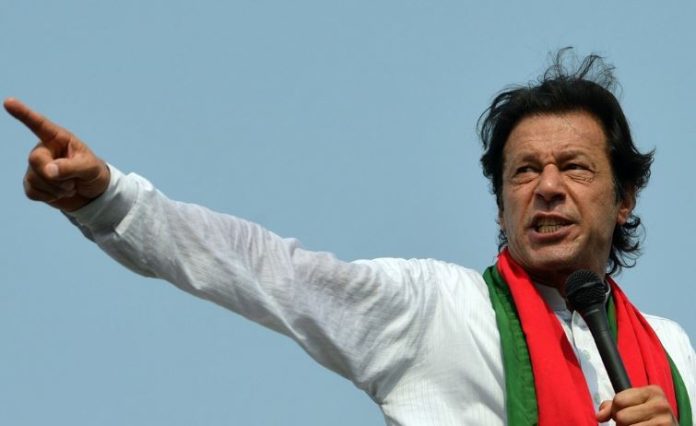
PTI to kick off countrywide protests today to express solidarity with PTI Chairman: Fawad

Minus one, technical knockout of Imran Khan:

PTI to kick off countrywide protests today to express solidarity with PTI Chairman: Fawad

ISLAMABAD, SEP 9, /DNA/ – Pakistan Tehreek-e-Insaf (PTI) announced second phase of real independent movement under which the party would hold protest rallies across the country from today (Saturday) against the attempts to technically knockout PTI Chairman Imran Khan and against the imported government’s nefarious plan of ”minus one formula”.

Central Vice President Fawad Chaudhry made the announcement during a press talks following a PTI political committee meeting held with Imran Khan in the chair here on Friday.

He announced that the PTI would launch second phase of their protest movement from today (Saturday) to express solidarity with Chairman PTI Imran Khan, urging the people to come out against the government’s bid of “minus one formula”.

Fawad Chaudhry said that efforts were being made to knock Imran Khan out politically, as FIRs were being registered against him at a time when there were floods in the country, adding that the incumbent government did not have a public mandate.

During the meeting, the party leadership expressed their full confidence in the leadership of Imran Khan.

He expressed hope that the entire nation would participate in the rallies unitedly against the campaign of technical knockout against Imran Khan and against the postponement of the by-elections, adding that the imported government wanted to push Imran Khan out of the political arena.

Fawad expressed his surprise that the ECP deferred the by-elections when there were no floods.

However, he stated that the imported government was a dummy and real decisions were being made somewhere else, adding that PTI was only one political party that was in the opposition.

Fawad Chaudhary made it clear that keeping in view the political and economic situation, the cabal of crooks could not be given much time to rule anymore, as elections were inevitable, adding that the real freedom movement was in its final phase and soon the people’s elected government would take the power.

Fawad Chaudhry revealed that the PTI would take about back-breaking inflation, unscheduled prolonged power outages and other unabated miseries inflicted by this government of crooks; however he added that at present they were focus on defeating the minus one agenda against Imran Khan.

He said that the ECP’s decision to delay the by-polls further strengthened the perception and the people would jointly protest across the country to foil the nefarious plan.

He stated that at the time when Pakistan was confronting with myriad issues amid the devastating floods that wrought havoc across the country, the imported government were filing terrorism cases against PTI Chairman and attempts were being made to disqualify him.

He said that look at Bilawal Bhutto who made a mockery of his own party-led government in Sindh on whose recommendation the elections were postponed and he raised as to why the election was postponed. Was Bilawal sleeping when his government made the recommendations?

Fawad Chaudhary noted that the incumbent government was unlawful and illegal and it sole way to maintain was to out Imran Khan of politics and then hold elections, which he said that was impossible and unacceptable.

Fawad Chaudhry said that Pakistan’s politics was currently running on Imran Khan and anti-Imran Khan and if he was being disqualified democracy cannot be maintained in the country and Pakistan would become a “Banana Republic” and people would never accept it come what may.

He said that all the parties except PTI were in the government, and pushing the only opposition party against the wall was alarming adding that Imran Khan would announce his next phase of real independent movement in PTI’s Gujranwala public gathering.

Fawad Chaudhry stated that they realized that the imported government could not be given much time as they already destroyed the country politically and economically.

Fawad Chaudhry said that they explained the issues to a sufficient extent in the reply submitted to the Islamabad High Court and now it was up to the lawyers to satisfy the judges, adding that the lawyers would chalk out their plan of action in this regard.

He strongly condemned the mistreatment of journalists by the Prime Minister’s security staff and said that CM KP and other cabinet members of Punjab and KPK were present on the road, but the registrar denied them enter, which was also condemnable.

Fawad revealed that in the Punjab Assembly, some PTI members told that they were asked to change their allegiance, but PTI Punjab government was still stable. However, he warned that before changing the Punjab government, they would change the federal government.=DNA

===========

Recipe: Chicken wings with sweet and spicy plum chutney

Check out this yummilicious recipe of ‘Chicken wings with sweet and spicy plum chutney’. Don’t forget to try this recipe out as it is easy to prepare and will surely turn out delicious.

Ingredients:

For chicken wings

Chicken wings 16

Butter (melted) 1 tbsp

Garam masala powder 1 tsp

Green onions (slivered) for garnishing

Sweet and spicy plum sauce 3/4 cup

Salt as required

For sweet and spicy plum chutney

Butter or oil 3 tbsps

Fennel seeds (saunf) 1/2 tsp

Nigella seeds (kalonji) 1/4 tsp

Red chilli flakes 1/2 tsp

Black mustard seeds (rai) 1/2 tsp

Plums, (fresh or dried – pitted and quartered) 11/2 kg

Raisins 1/2 cup

Brown sugar (adjust according to taste) 1/2 cup

Salt 1/4 tsp

Coconut (fresh or dried – cut in ribbons or grated) 1/4 cup

Ginger (minced) 2 tbsps

Method:

Start off with preparing the chutney.

Heat butter or oil in a large saucepan over moderate low heat until hot.

Add fennel seeds, nigella seeds, black mustard seeds and chillies. Fry until mustard seeds pop and turn grey.

Add the plums, raisins, sugar, salt and simmer until thick for about 30 to 40 minutes.

Remove from heat and stir in the coconut and ginger. Turn off the stove and let it cool down. Fill into jars and refrigerate.

Now that the chutney is ready, start preparing for the chicken wings.

First of all preheat the oven to 375 degrees F.

In a foil lined baking pan, arrange chicken wing in a single layer. Bake for 20 minutes.

Now in a pan combine plum sauce, melted butter, and garam masala powder. Mix well.

Add chicken pieces and stir to coat with sauce.

Cover and cook on low heat for 30 to 40 minutes.

Sprinkle with slivered green onions and serve.

Erdoğan to ask Putin to send Russian goods through Black Sea corridor

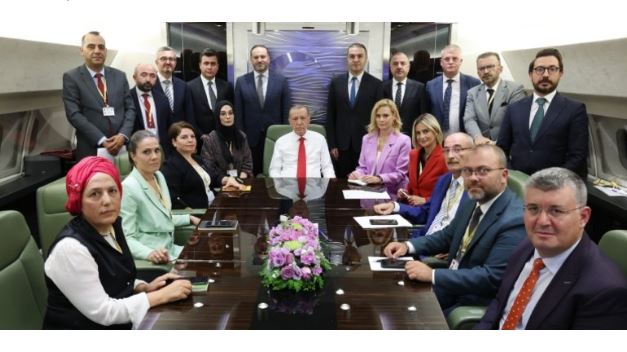
Turkish President Recep Tayyip Erdoğan said he would ask his Russian counterpart Vladimir Putin to send Russian goods through the Black Sea corridor set up by the grain deal.

“Export of Russian grain and other goods will help poor countries in a difficult situation,” Erdoğan stressed in his comments on Friday while speaking to reporters on his plane returning from a trip to the Balkans.

Türkiye will send grain and other relevant products to African countries in need if Russian grain also begins to arrive, the Turkish president said on Friday.

Speaking to reporters on the plane after his three-day Balkan tour, Erdoğan echoed his Russian counterpart Vladimir Putin, saying the Ukrainian grain is exported to wealthy countries, not to those in need.

He said a “system in the most ideal way” will be established to send grain and other products to African countries in need once Russian grain also starts to arrive under the landmark grain deal.

Türkiye, the UN, Russia, and Ukraine signed an agreement in Istanbul on July 22 to resume grain exports from three Ukrainian Black Sea ports, which were paused after the Russia-Ukraine war began in February. A Joint Coordination Center with officials from the three countries and the UN was set up in Istanbul to oversee the shipments.

The Kremlin said on Friday that President Vladimir Putin and his Turkish counterpart Erdoğan will discuss the implementation of a deal on Ukrainian grain exports, which both have criticised, when they meet in Uzbekistan next week.

Putin said on Wednesday Russia and the developing world had been “cheated” by the terms of the deal and he would seek amendments before it is due to be extended in November.

Erdoğan also said he had discussed natural gas prices with Putin and said he aims to secure a positive outcome for the well-being of the Turkish public.

This winter will not be easy for Europe, Erdoğan said, adding that it will be very problematic, with financially heavy pay.

On Greece’s recent hostile acts against Türkiye, the Turkish president noted Athens‘ “constant complains to NATO” about Ankara, and said they try to work “threat mechanisms, so we speak in a manner they would understand.”

Stay Connected

64FansLike
60FollowersFollow

Latest Reviews

Exchange Rates

USD - United States Dollar
EUR
1.17
GBP
1.34
AUD
0.67
CAD
0.73