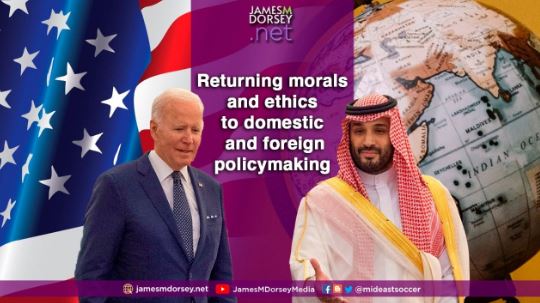
The Biden administration is mulling whether to grant Saudi Crown Prince Mohammed bin Salman sovereign immunity in a case related to the 2018 killing of Jamal Khashoggi. The journalist’s fiancé and a non-profit organization he helped found filed the lawsuit in a Washington district court.
The court has extended its original August 1 deadline until October 3 for the administration to advise Judge John Bates on whether it believes that Mr. Bin Salman qualifies for sovereign immunity, a status usually reserved for heads of state, heads of government, and foreign ministers.
It is hard to believe that the administration would refuse the crown prince immunity following US President Joe Biden’s July pilgrimage to the kingdom and the energy crisis sparked by sanctions imposed on Russia in response to its invasion of Ukraine.
Mr. Biden’s visit intended to repair relations with a country that he had described as a “pariah” state during his election campaign. Moreover, it came after Mr. Biden had refused to deal directly with Mr. Bin Salman in the president’s first 18 months in office.
It is equally unlikely that the court would go against the probable advice of the administration to grant immunity to Mr. Bin Salman.
One consideration in the administration’s deliberations may be whether Mr. Bin Salman would want to be more cooperative in addressing the energy crisis by pumping more oil and pressuring the Organisation of Oil Exporting Countries (OPEC) and its partners to increase their production levels in a bid to reduce prices in return for immunity.
Mr. Bin Salman has, so far, given little, if anything, in response to Mr. Biden’s pilgrimage but has benefitted from the boost the president gave to the crown prince’s rehabilitation in the United States and Europe.
The killing of Mr. Khashoggi and the Yemen war turned Mr. Bin Salman into a tarnished, unwelcome figure in Western capitals. In the wake of Mr. Biden’s pilgrimage, Mr. Bin Salman has made his first trip to Europe with stops in Greece and France. In addition, the crown prince is expected to travel to London in the coming days to offer his condolences for the death of Queen Elizabeth.
Whatever the judge decides, the stakes go far beyond the legal aspects and the political fallout of his eventual ruling.
Double standards
The likely ruling in favour of Mr. Bin Salman will spotlight double standards in politics and policymaking and the lack of a moral and ethical yardstick.
Too often, opportunism, in the absence of inclusive moral and ethical standards, allows leaders, officials, policymakers, and politicians to prioritise their interests rather than those of the nation or affected people elsewhere.
The likely ruling will also raise the question of why governments, leaders, and officials should be held to a different standard before the law.
The issue of double standards is closely related to a debate about the principle of universal jurisdiction that legal systems like those of Spain and Belgium have appropriated for themselves and how they relate to the mandate of the International Criminal Court (ICC) in The Hague.
In 2014, the Spanish parliament curtailed the country’s universal jurisdiction after a Spanish judge issued arrest warrants for former Chinese president Jiang Zemin and four senior Chinese officials on charges of human rights abuses in Tibet. The jurisdiction enabled the prosecution of Chilean dictator Augusto Pinochet that has yet to establish a standard for accountability.
A Hippocratic Oath
A recent special edition of International Affairs, an academic journal, implicitly approaches the debate about the lack of a moral and ethical yardstick that undergirds politics and policymaking by suggesting that academics, analysts, and practitioners revisit the maxim of seeking to replicate past policy successes as the basis for the crafting of new policies.
Instead, contributors to the journal argue that examining how to avoid catastrophic failure might be a better way of going about it. In doing so, the editors of the special edition, Daniel W. Drezner and Amrita Narlikar, again implicitly, call for out-of-the-box thinking. They propose the application of the medical sector’s Hippocratic Oath to international relations. The oath obliges doctors to avoid doing harm.
“The Hippocratic Oath principle in IR (international relations) serves as a cautionary warning against action merely for action’s sake. There is a bias in politics towards ‘doing something’ in response to an event. Doing something, however, is not the same as doing the right thing,… A Hippocratic Oath asks policymakers to weigh the costs and risks of viable policy options before proceeding,” the editors argue in their introduction to the special edition.
Responding to former White House chief of staff and onetime secretary of State and of the Treasury James Baker’s observation that policy solutions often create problems that need to be ameliorated at a later stage, Mr. Drezner and Ms. Narlikar note that this is an “endemic problem created by the mismatch between the grand arc of international relations and the powerful short-term incentives that political leaders face.”
Inclusive Morals and Ethics
The issue of inclusive morals and ethics in politics and policymaking has been further pushed to the forefront by the fact that recent international events and trends, including the controversy over the 2020 US presidential election; Britain’s exit from the European Union; the Russian invasion of Ukraine; ethnoreligious nationalism in Russia, China, Hungary, Serbia, India, and Israel as well as among American Christian nationalists; and bloodshed in the Middle East, involve civilizational choices and policies that often violate international law and challenge a world order based on heterogeneous nation-states and/or propagate exclusionist policies.
Inclusive morals and ethics come into play when conservatives claim civilizational superiority based on allegedly more advanced development and argue that the “fundamental foreign policy blunder of our times (that) has been at the root of the West’s promotion of wrong policies in LCL (Lower Civilizational Level) societies — such as parliamentary democracy, religious freedom, excessive liberties, etc. — that have proven highly destructive to the stability and advancement of many LCL societies that were not ready for them.”
Morals and ethics also become essential in countering the argument by conservatives and segments of the left that immigration and multiculturalism spark “civilizational trauma and severe terror attacks.” The implicit equation of Islam and terrorism ignores the fact that Christian nationalists account for a fair share of recent violent attacks, including the 2011 killings in Norway by Anders Behring Breivik, the 2018 Pittsburgh synagogue shooting, and the 2019 mosque murders in New Zealand.
Culture vs. Racism
Conservatives and civilisationalists frame their politics and policies as a cultural battle rather than an expression of racism. For example, Hungarian Prime Minister Victor Orban argues that his opposition to mixing Europeans and non-Europeans and pursuing a homogenous Christian Hungary “is not a racial issue for us. This is a question of culture. Quite simply, our civilization should be preserved as it is now.”
Mr. Orban’s philosophy echoes far-right Russian ideologue Alexander Dugin who asserts the cultural battle “is a war of ideas. We are not part of the global civilisation. We are a civilisation by ourselves. … We had no other possibility to prove that Huntington was right without attacking Ukraine.”
He was referring to the late Harvard University political scientist Samuel P. Huntington who controversially predicted a post-Cold War clash of civilisations that would be fought not between countries but between cultures.
In his hugely influential ultra-nationalist tome, The Foundations of Geopolitics: The Geopolitical Future of Russia, published in the 1990s, Mr. Dugin envisions a clash of civilisation between the West and a Eurasian bloc supported by Russia.
The ideologue further argues that “it is especially important to introduce geopolitical disorder…encouraging all kinds of separatism and ethnic, social and racial conflicts, actively supporting all dissident movements – extremist, racist, and sectarian groups.”
In doing so, Mr. Dugin unwittingly argues for re-introducing inclusive morals and ethics into politics and policymaking. Their absence and the lack of a consensus on an inclusive definition of national interest has led to a world in which gaps in income distribution have become ever more yawning, and more and more societal groups are marginalised and disenfranchised. Racism and repression are on the rise and have become mainstream, and the world is moving ever closer to the abyss of a third global war.
Shared responsibility
Discussing the attempted killing in August of Salman Rushdie and his own experience of being surrounded by bodyguards, Turkish Literature Nobel Prize winner Orhan Pamuk puts a share of the responsibility for greater adherence to inclusive morals on ethics on journalists and writers who have the luxury to work in an environment of freedom.
Mr. Pamuk noted in an article in The Atlantic that Mr. Rushdie’s assailant was a 24-year-old clerk in a department store. “If we hope to see the principle of freedom of expression thrive in society, the courage of writers like Salman Rushdie will not suffice; we must also be brave enough to think about the sources of the furious hatred they are subjected to,” Mr. Pamuk wrote.
“What we need to do is use our privilege of free speech to acknowledge the role of class and cultural differences in society—the sense of being second- or third-class citizens, of feeling invisible, unrepresented, unimportant, like one counts for nothing—which can drive people toward extremism,” he went on to say.
“In many cases, these differences in class and social status have become taboo subjects that nobody wishes to hear or dares speak about. The news media, reluctant to appear to be somehow condoning violence, don’t dwell on the fact that the people who turn to it tend to be poor, uneducated, and desperate,” Mr. Pamuk said.
A utopian task
Key questions dominate discussions about civilisationalism and the importance of inclusive morals and ethics for politics and policymaking. These questions include what does it mean to be a nation? What do citizens need to agree on to be or become a people? And must the ‘people’ be united, or can they be divided?
In a twist of irony, Islam scholar and public intellectual Shadi Hamid notes that debate in the 21st century about existential issues of culture, identity, and religion initially emerged in the Middle East during the 2011 popular Arab revolts and only several years later in other parts of the world.
“During the heady, sometimes frightening days of the Arab Spring, the region was struggling over some of the same questions Americans are contending with today,” Mr. Hamid says. In the absence of a strong liberal trend and/or a secular-liberal consensus, the debate was dominated by illiberal Islamists who “were carrying the banner of anti-liberalism before anti-liberalism was cool.”
Kickstarting the process
Changing the foundations on which policies are crafted, and politics are conducted is an almost utopian task. It is likely to be a generational endeavour driven by religious and non-religious, independent civil society groups that harness a combination of activism and education rather than governmental non-governmental organizations that do a regime’s bidding.
To kickstart the process, media, including social media platforms, would have to play an essential role in changing what voters and the public expect from their leaders, whether elected or not.
Similarly, public relations, crisis management, and lobbying firms would have to be held accountable to a code of conduct that emphasizes truthfulness, transparency, and ensuring that campaigns are fact-based rather than built on knowingly false or manufactured information and on genuine grassroots organizations instead of special purpose proxies created to promote a narrative.
That was the motto of the late, controversial American strategic advisor, Arthur Rubinstein, credited for the electoral victories of Richard Nixon, Ronald Reagan, Benyamin Netanyahu, and Victor Orban.
Filmmaker Edo Zuckerman, a close association of Finkelstein, who was dubbed ‘Arthur the Terrible’ by his opponents, quoted the strategist as saying: “During the campaign, you don’t lie in anything that you publish. There must be a tested and true basis of truth to what you do,”
In addition to a measure of honesty, stakeholders and the public would have to push for a return to civil interaction in which opposing parties listen to one another rather than increasingly seek to repress, intimidate, and crowd out divergent and dissident voices.
One example of an effort to restore inclusive morals and ethics to policy and policymaking is Christian opposition to Christian nationalism.
“Christian nationalism creates this false idol of power and leads us to confuse political authority with religious authority, And in that way causes us to put our patriotism, our allegiance to America, above our allegiance to God,” says Amanda Tyler, the executive director of the Baptist Joint Committee for Religious Liberty and the lead organizer of Christians Against Christian Nationalism. Moreover, she argues that Christian nationalism violates the teaching of loving your neighbour as yourself.
Ms. Tyler’s activism underscores the likelihood that morals and ethics embedded in respect of human dignity and rights as the organizing principle of politics and policymaking will be grounded in shared values derived from religion, irrespective of one’s attitude towards religion or religiosity.
No alternative to religion
No alternative to religion has emerged as a moral and ethical yardstick for societies and systems of governance, whether religious or secular.
Major attempts at creating a yardstick, for example, by Communism, Kemalism, the philosophy on which Mustafa Kemal Ataturk carved the modern Turkish state out of the ruins of the Ottoman empire, or Zionism that sought to transform an amorphous religious and national identity into a more clearly defined Jewish identity, lost their relevance once they were no longer fit for the purpose.
As a result, almost no contemporary state, no matter how different, has a societal moral and ethical yardstick that is not inspired by religion.
Take, for example, the United States and Saudi Arabia. Both have religiously inspired moral and ethical yardsticks. In the United States, Christianity is the overriding inspiration; in the kingdom, it is Islam.
Of course, one significant difference is the positioning of the yardstick.
In the United States, it was historically a benchmark rather than a hard and fast rule to which adherence was voluntary. A commitment was, by and large, regulated socially rather than legally. In the kingdom, the yardstick is the religious law that authorities harshly enforced.
Perhaps surprisingly, China too fits the bill. It does so in its recognition of the centrality of religion by seeking, often brutally, to control, if not repress, religion.
Laying out a roadmap
Infusing morals and ethics into politics and policy and tackling double standards in applying the law come together in Judge Bates’ court case and Mr. Biden’s effort to defend democracy at home and abroad. The ability to do so depends on the US administration and civil society.
One approach may be that the administration lays out a roadmap that tackles the legitimate charge that US policy is hypocritical by establishing criteria for maintaining morals and ethics in domestic and foreign policy to justify instances where that is not immediately possible. Civil society would have to hold the administration and business’ feet to the fire.
A draft of the Pentagon’s 1992 Defense Planning Guidance seemed to take a stab at crafting a roadmap. The draft stipulated that “while the U.S. cannot become the world’s ‘policeman’ by assuming responsibility for righting every wrong, we will retain pre-eminent responsibility for addressing selectively those wrongs which threaten not only our interests, but those of our allies or friends, or which could seriously unsettle international relations.”
Irrespective of its merits, the proposed definition was problematic because it was put forward in the context of a strategy that called for a permanent US military dominance in much of Eurasia that would allow the United States rather than the United Nations Security Council to act as the ultimate guarantor of international peace and security.
The strategy envisioned achieving that goal by “deterring potential competitors from even aspiring to a larger regional or global role” and by pre-empting the proliferation of weapons of mass destruction.
Key elements of that strategy have guided US foreign policy ever since, even if the draft in its final form was watered down after a leak sparked a public uproar because of its overarching imperial character. Those elements were reinforced in the wake of the 9/11 Al Qaeda attacks two decades ago on New York and Washington with devastating consequences.
As a senator at the time, Mr. Biden ridiculed the draft as “literally a Pax Americana… It won’t work. You can be the world superpower and still be unable to maintain peace throughout the world,” he quipped.
A layered approach
Another approach argues that the solution is not an overarching doctrine or construct for American foreign policy because, unlike in the Cold War, the world is confronted with too many challenges that cannot be squeezed into one ideological construct. Moreover, America’s rivals, Russia and China, command natural resources, economic heft, and centrality to global commerce that the Soviet Union could only have dreamt about.
“That does not mean that the United States should simply wing it and approach every foreign policy issue in isolation. But instead of a single big idea, Washington should use a number of principles and practices to guide its foreign policy and reduce the risk that the coming decade will produce a calamity,” says Richard Haass, the president of the New York-based Council on Foreign Relations and former senior State Department and National Security Council official.
Mr. Drezner and Ms. Narlikar, the editors of the International Affairs special edition, make a similar point by suggesting that “the margin for policy error is getting thinner across the globe. States in the twenty-first century will be confronting an array of Machiavellian and Malthusian threats: great power competition, political polarization, pandemics, climate change, and so forth.”
The problem with Mr. Haass’ approach is that it amounts to repackaging realpolitik without the guidance of morals and ethics but by the notion of stability rather than principle.
Starting at home
Mr. Haass may be right that democracy promotion needs to start in the United States, where democracy is on the defensive.
“The biggest risk to US security in the decade to come is to be found in the United States itself. A country divided against itself cannot stand, nor can it be effective in the world, as a fractious United States will not be viewed as a reliable or predictable partner or leader. Nor will it be able to tackle its domestic challenges,” he says.
To be sure, Mr. Biden’s positioning of the preservation of democracy and the strengthening of ‘democratic resilience’ abroad is the one pillar of his foreign policy that dovetails neatly with his struggle at home to hamper efforts to undermine democratic norms and the principles of fair elections and peaceful transition of power. Mr. Biden has dubbed his domestic endeavour “a battle for the soul of this nation.”
In effect, Mr. Biden’s emphasis on preservation rather than the promotion of democracy constitutes a finetuning of liberal internationalism that revolves around the idea that global stability comes from democratic systems, free markets, and participation in American-led multinational organizations.
While not surrendering the principle, it implicitly suggests that stability can be achieved in a world where democratic and non-democratic systems of governance can cohabitate and compete simultaneously.
Winning friends
Scholar and journalist C. Mohan Raja suggests that one prerequisite for successful cohabitation is a US return to the classical diplomatic effort of winning friends and influencing people.
That, Mr. Mohan Raja says, would have to “involve a decisive shift away from the Western preachiness of the last three decades.” Instead, the United States would have to “focus…on the individual concerns, vulnerabilities, and interests of key states in the developing world.”
The Biden administration’s framing of the Ukraine war as a confrontation between democracies and autocracies is a case in point. The administration would have likely found greater resonance in Asia, Africa, and Latin America had it portrayed the conflict in less ideological terms and narrowly stuck to what the war was about: the defense of Ukraine’s sovereignty and territorial integrity as a matter of international law.
Even so, the question remains whether cohabitation and competition are a sufficient basis in the 21st century for ideological and geopolitical rivals to cooperate in tackling global problems such as global inequality, environmental calamity, economic recovery, nuclear proliferation, and emergencies like a pandemic.
The administration’s problem is that the line between democracy preservation and democracy promotion is potentially blurry and could be, at best cosmetic. Mr. Biden has requested hundreds of millions of dollars from Congress for pro-democracy initiatives, including two programs to support anti-corruption efforts, independent journalism, elections, and pro-democracy activists. Whether there is a difference between preservation and promotion is likely to be determined by how and where those funds, if allocated, are distributed.
Reversing course
The example of Saudi Arabia in the runup and the aftermath of Mr. Biden’s July pilgrimage to the kingdom pinpoints the pitfalls of crafting a foreign policy that embraces morals, ethics, and realpolitik.
Mr. Bin Salman has stepped up his crackdown on dissent and civil society activism since the Biden visit. For example, two Saudi women arrested in 2021 were sentenced in August by terrorism courts to respectively 34 and 45 years in prison for tweets that allegedly “used the internet to tear the social fabric” of the kingdom and “violated public order by using social media.”
Furthermore, Saudi Arabia executed 81 people in March when the United States and the kingdom were likely already negotiating the visit.
Meanwhile, Mr. Biden departed Saudi Arabia with little, if anything, to show for himself in terms of geopolitical, energy, or human rights gestures, not even the release of US nationals held for political reasons in Saudi prisons or banned from leaving the kingdom.
This is not to say that Mr. Haas is incorrect in arguing that democracy promotion often leads to a push for regime change that either backfires or fails. Instead, he suggests a foreign policy that favours multilateralism.
It is “better to pursue realistic partnerships of the like-minded, which can bring a degree of order to the world, including specific domains of limited order, if not quite world order,” Mr. Haass says.
Political scientist Igor Istomin bolsters Mr. Haass’s argument by pointing out that foreign interference in the politics of a country by supporting proxies is unlikely to enable those groups to gain power. If they do, they are more likely than not to encounter “difficulties in converting such accomplishments into benefits for an interfering state.” Moreover, they will be hindered by “the emotional grievances from unfulfilled expectations.” The forever US wars in Afghanistan and Iraq are exhibit one.
At first glance, much of this may seem to be pie in the sky. Returning to a modicum of inclusive morals and ethics-infused policy and policymaking is not a process that will produce results overnight.
However, the fact is that the current concept of politics and policymaking has put the world, irrespective of individual political systems, on a debilitating and dangerous downward spiral. A healthy debate about the foundation of politics and policymaking is one way to kickstart attempts to reverse course.
Dr. James M. Dorsey is an award-winning journalist and scholar, an Adjunct Senior Fellow at Nanyang Technological University’s S. Rajaratnam School of International Studies, and the author of the syndicated column and blog, The Turbulent World of Middle East Soccer.