Home Blog Page 1484

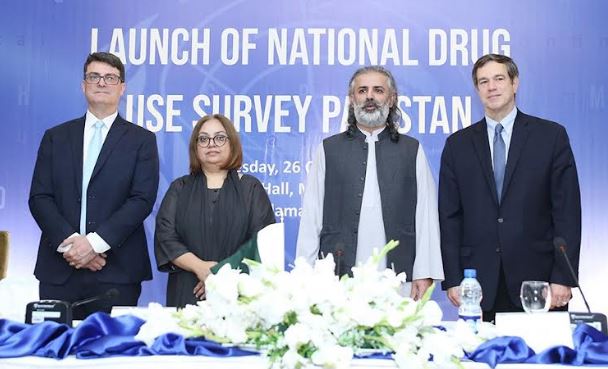
National Drug Use Survey Pakistan 2022-24 launched

The survey has been made possible with the support of U.S. Department of State’s Bureau of International Narcotics and Law

Mahnoor Ansar

ISLAMABAD, OCT 26 /DNA/ – Today, the Ministry of Narcotics Control, Government of Pakistan, U.S. Department of State’s Bureau of International Narcotics and Law Enforcement Affairs (INL) and the United Nations Office on Drugs and Crime jointly launched the National Drug Use Survey Pakistan 2022-24 in Islamabad.

In 2012 and 2013, UNODC in collaboration with the Ministry of Narcotics Control, the U.S. Department of State’s Bureau of International Narcotics and Law Enforcement Affairs (INL), and other national stakeholders conducted a national survey on drug use to estimate the extent and patterns of drug use in Pakistan.

The overall results of the survey revealed that approximately 6 percent of the population – 9 percent of the adult male population and 2.9 percent of the adult female population – equivalent to 6.7 million people – had used a substance other than alcohol and tobacco in the preceding year.

This year the World Drug Report 2022 revealed an estimated 284 million people worldwide had used drugs in 2020. Cannabis remains by far the world’s most used drug, and the report also notes an increase in use of amphetamines.

Globally, the report estimates that 11.2 million people worldwide injected drugs during the period of the study. Around half of this number were living with hepatitis C, 1.4 million were living with HIV, and 1.2 million were living with both.

Since the previous survey, there have been changing trends of drug use in the region, especially anecdotal information of a rapid increase in the use of synthetic drugs such as methamphetamine. To have scientific data on the current situation of drug use in Pakistan, the national drug use survey 2022-24 will be conducted to provide reliable evidence of the extent to which the population is using drugs and suffering from drug use disorders.

This survey will be comprised of a household survey and high-risk drug use study that will have national coverage, including the major districts in each province.

This survey is being carried out jointly by the Ministry of Narcotics Control and UNODC with financial support from U.S. Department of State’s Bureau of International Narcotics and Law Enforcement Affairs.

Dr Jeremy Milsom Representative UNODC in his welcome remarks thanked Mr Nawabzada Shazain Bugti, Federal Minister for Narcotics Control, and his Ministry for their support in taking lead on the survey and U.S. Department of State’s Bureau of International Narcotics and Law Enforcement Affairs (INL) for their gracious financial support to conduct the national drug use survey and drug prevention and treatment interventions in the country, he also mentioned that the comprehensive data on drug use patterns and trends is key to developing effective prevention, treatment and rehabilitation programmes and the Survey report will serve to promote thoughtful discussions, inform policies and strengthen national cooperation.

Mr Andrew J. Schofer – Deputy Chief of Mission, U.S. Embassy Islamabad in his speech thanked the Federal Minister for Narcotics Control, UNODC, and other dignitaries for their partnership. DCM Schofer further stated that, “through this project, the U.S. Embassy’s International Narcotics and Law Enforcement Affairs (INL) will support the Government of Pakistan to provide evidence-based information to shed light on changing patterns of drug use and allow for stronger implementation of programs and refinement of policies.

The launch of the survey is an important milestone in the availability of evidence-based information on drug use in Pakistan, filling an often-overlooked gap.  The information and recommendations contained in the completed survey report will help to save lives by informing the development of drug prevention and treatment programs and suggesting needed policy or regulatory changes.

The United States is proud to partner with the Government of Pakistan on drug demand reduction efforts.  To date, INL has provided $24 million U.S. dollars – that’s 522 million Pakistani rupees – of support for drug treatment and prevention efforts in Pakistan.  I am also pleased to share with you that this year we celebrate the 75-year anniversary of the partnership between the United States and Pakistan.

The U.S. government, through INL, has invested more than $1 billion dollars over the last 40 years to improve citizen security and enhance law enforcement capacity across Pakistan.”

Ms Giovanna Campello Chief of prevention, treatment and rehabilitation section UNODC Vienna office in her speech thanked the Ministry of narcotics control, INL and the participants for showing their concern on the drug situation and importance of the national drug use survey in Pakistan, she talked about the importance of drug survey in understanding the on-ground drug situation, the gaps and challenges to address the drug prevention and treatment interventions.

She also talked about the efforts that are being made in collaboration with the government of Pakistan in developing a mechanism to ensure quality drug treatment services and also scaling up the capacity of drug treatment professionals to deliver quality drug treatment services that are in line with the international standards for drug treatment.

Ms Humaira Ahmed Federal Secretary Ministry of Narcotics Control in her speech appreciated UNODC for their technical assistance in conducting the national drug use survey and U.S. Department of State’s Bureau of International Narcotics and Law Enforcement Affairs for their generous support for the national drug use survey and drug prevention and treatment interventions in the country.

The Federal Secretary in her speech mentioned that drug use problem has emerged as a serious threat to health and security of the people of Pakistan especially the youth with tendency towards drug use emerging even in educational institutions.

She emphasized that the drug problem requires a comprehensive multisectoral response from various departments/sectors to address the drug problem.

Mr Nawabzada Shazain Bugti, Federal Minister for Narcotics Control, in his closing remarks

thanked UNODC for the technical support and the U.S. Department of State’s Bureau of International Narcotics and Law Enforcement Affairs for the financial support to carry out the National Drug Use Survey.

The Federal Minister emphasized on the need for being strategic in the drug prevention and treatment approaches and hoped that this Survey will help by providing information to take stock of drug situation in the country and facilitate in chalking out strategies to effectively combat the challenges of drug abuse.

He stressed upon the importance of cooperation across borders to counter the growing drug use problem and urged all stakeholders to remain steadfast in their efforts to achieve the goal for a ‘drug free’ nation.

The ceremony was attended by the dignitaries from Government Ministries, departments, foreign missions, UN organizations, Civil Society organizations etc.

The survey has been made possible with the kind support of U.S. Department of State’s Bureau of International Narcotics and Law Enforcement Affairs (INL).=DNA

=========

Stoinis blitz propels Australia to seven wicket win over Sri Lanka

PERTH: Marcus Stoinis bludgeoned Australia’s fastest T20 half-century on Tuesday as his side crushed Sri Lanka by seven wickets to secure their first win at the T20 World Cup.

After being beaten by New Zealand in the opening match of the Super 12, Australia elected to field and restricted Sri Lanka to 157-6.

They had to make do without the services of leg-spinner Adam Zampa, who was ruled out at the 11th hour after testing positive for COVID-19.

The hosts replied with 158-3 in 16.3 overs, led by Stoinis who powerfully struck six sixes in his unbeaten 59 from 18 balls.

“It was good slogging,” man-of-the-match Stoinis told reporters.

“I was actually quite nervous, to be honest. The intention was to go and put an impact on the game and probably provide a bit of energy for the boys.”

The Perth Stadium deck could have been mistaken for a WACA pitch as Australia’s seamers combined for three wickets with a barrage of pace and bounce which set Sri Lanka back.

Top-order batsmen Pathum Nissanka (40) and Dhananjaya de Silva (26) found boundary-scoring difficult but showed urgency running between the wickets.

An outstanding flick-back on the boundary by David Warner in the 11th over deprived de Silva of a six, and five balls later the batsman departed after lofting a catch to the same fielder at long-off.

Mitchell Marsh ran out Nissanka and triggered a mini-collapse, only arrested by a late onslaught from Charith Asalanka (38 not out off 25 balls) in the final overs.

Fast bowler Lahiru Kumara made good use of the surface when Sri Lanka had their turn in the field, repeatedly beating Aaron Finch (31 not out) for pace.

It was off-spinner Maheesh Theekshana (1-23) who struck first though, inducing a false shot from Warner (11).

Innovative strokeplay from Glenn Maxwell (23) injected impetus into Australia’s response, but Stoinis delivered the knockout blow as spinner Wanindu Hasaranga, the third-ranked T20 bowler, conceded 53 runs in three wicketless overs. 

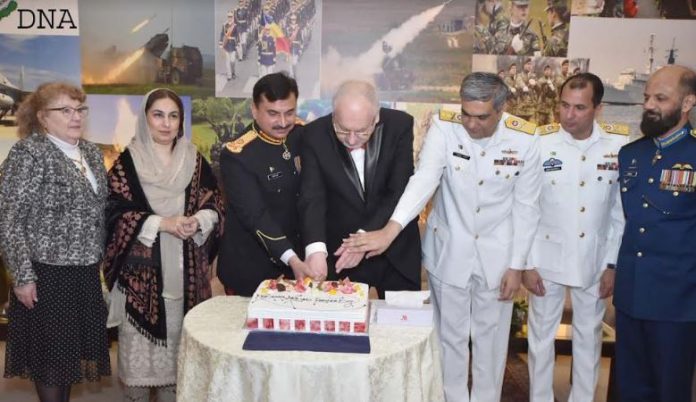
Defence Day of Romania celebrated: Romania, Pakistan Cooperation in defence expanding

Ambassador of Romania Nicolae Goia acknowledged the excellent professionalism of the Pakistani army

Asnar M Bhatti

ISLAMABAD:   Ambassador of Romania Nicolae Goia has said   Romanian Armed Forces, completely reformed and modernized up to the NATO and European Union standards are assigned to foreign missions, contributing alongside of the allied and partner countries to the common effort of keeping peace and stability worldwide.

 In compliance with the commitments deriving from the international treaties, agreements and memoranda whose signing party is, Romania had contingents of different sizes from all services – Army, Air and Naval Forces – available to multinational coalitions authorized to carry on peace support, humanitarian assistance, collective or individual operations in the framework of UN, NATO, OSCE and EU-led Observing, Monitoring, Liaison and Training teams.

Ambassador Goia expressed these views while speaking on the occasion of the Armed Forces Day of Romania. He along with Defence Attache Col Cristian Raducu hosted a reception. Mal Gen Fiaz Hussain Shah was the chief guest.

The ambassador further said Romania celebrates each year, on October 25th, the Day of the Romanian Army. October 25, 1944, the Romanian Army Day, signifies the date of complete liberation of north-western Transylvania from foreign ruling and administration.

‘The liberation of the entire national territory of Romania was achieved by the heroic fights in the World War II of over 525,000 fully employed troops between August 23 and October 25, 1944. Nearly 58,000 of them were killed or injured. Losses incurred on the enemy stood at 89,934 troops, 76,275 of whom were taken prisoners. It is worth mentioning that after 25th of October the Romanian army had continued to fight until the end of the war contributing substantially to the liberation of Hungary and Czechoslovakia’.

Ambassador Goia said, the years of contribution to foreign missions meant for the Romanian Armed Forces the maintenance, almost continuously, of a military force of variable sizes, integrated into UN, OSCE, NATO and EU missions carried out in Africa and Asia, in the theatres of operations in Afghanistan, Iraq and Western Balkans. Almost 40,000 Romanian troops took part in different operations and missions out of national borders, gathering a valuable professional experience extremely useful in the transformation, operationalization and interoperability enhancement process of the Romanian Armed Forces with their NATO and EU counterparts.

Romanian Armed forces wisely and skilfully planned their combat forces to fight the war on terror far away from the national borders, proving their capability and determination to fully carry out their missions. Romania remained consistent with its commitments to support the international community in the fight against terror.

The contribution of the Romanian troops to the collective defence, peace keeping and restoration missions to enforce the stipulations of the UN Security Council Resolutions, of the international legislation and law reveals that the Romanian state complies consequently and in full faith with the commitments agreed with the allies and partners, according to the international legislation and treaties whose signing party is Romania. By performance and professionalism, dedication and determination, the Romanian Armed Forces are a true ambassador for Romania’s image worldwide!

He said, unfortunately, we are living in a very complicated security environment. The world of today, the security challenges we have to deal with every day, along with the war going on at NATO and EU borders, as well as Romania’s border with Ukraine – all these prove that we need to be ready to defend our common values and freedoms and grant security and stability. Moreover, Ukraine’s security means European and Euro-Atlantic security.

In line with the NATO and European Union’s policy, Romania stands in full solidarity with the people and government of Ukraine in the heroic defence of their country, helping Ukraine to uphold its fundamental right to self-defence with unprecedented levels of support as a response of Russia’s full-scale, brutal, unprovoked and unlawful invasion of Ukraine

 ‘I am very pleased to underline the excellent cooperation existing between Romanian and Pakistani armies which have developed over the years into a true and mutual beneficial partnership. Since there is not time to elaborate on the multifaceted and complex character of the cooperation, I will only mention that on October 12th this year, during his official visit in Romania, the Chief of Naval Staff Admiral Muhammad Amjad Khan Niazi performed symbolically the initial welding work on the keel of the third vessel built for Pakistani Navy at Damen Shipyard Galati and cut the first plates of steel for the construction of the second batch two Damen OPV 2600 multi mission patrol vessels’.

Ambassador Goia said those vessels will provide the Pakistan Navy with a highly effective search and rescue capability, and allow it to play an important role in safeguarding international trade routes from piracy and other threats like drugs and human trafficking and terrorism.

‘Also, between 10-12 November, the 3rd session of Joint Military Committee will take place in Bucharest and I am sure that during this activity new domains of cooperation will be identified’. 

He acknowledged the excellent professionalism of the Pakistani army, the deep patriotism of its men and women in uniforms, the sacrifices they made in fighting terrorism, their presence in multiple international coalitions authorized to participate in maintaining peace, humanitarian assistance and other operations meant to ease the sufferings of the people in different regions of the world, he added.

Imran Khan announces October 28 as date for PTI’s long march

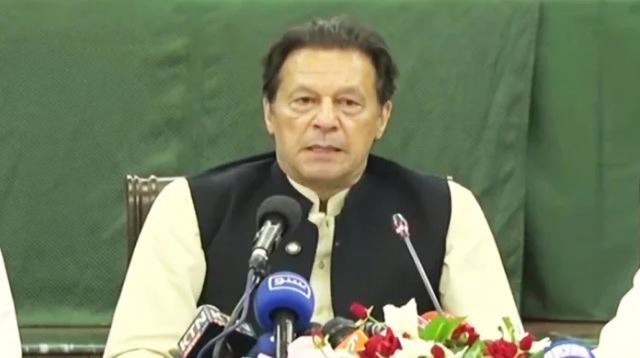
LAHORE: PTI  Chairman Imran Khan on Tuesday announced the date for his party’s much-awaited long march and said that it will start on Friday, October 28.

The announcement came while Khan was holding a press conference at the Chief Minister’s House in Lahore, during which he said that the march will start from Lahore’s Liberty Chowk at 11am.

The former prime minister termed PTI’s long march “far above” politics and said that the move was “jihad as it was now a decisive moment for the people of Pakistan to choose their sides.

“This march will decide whether the people want to do slavery of these “thieves” or not. There is our march for Haqeeqi Azaadi and it has no timeframe. We will reach Islamabad from the GT Road and the nation will come from across Pakistan to Islamabad,” he maintained.

Shedding light on the way the government issued warnings to the PTI in relation to the long march, Khan said that when he was the premier, JUI-F chief Maulana Fazlur Rehman, PML-N’s Maryam Nawaz, and PPP’s Bilawal Bhutto-Zardari held two long marches.

“At that time, they disregarded the economic situation of the country,” he said.

The government approached the Supreme Court earlier to stop the PTI’s long march. However, the apex court rejected the request to issue an interim order for stopping the PTI’s planned long march — giving a boost to the Khan-led party.

Before it approached the top court, the government issued repeated warnings to the PTI chief, with a top official saying that the authorities would multiply their May 25 policy by 10 if Khan announces another long march.

If the PTI holds another long march, then it would be the second time they would be coming to Islamabad. The last march was held on May 25 and ended with Khan abruptly calling off the march after reaching Islamabad.

Khan, during the presser, added that he was supposed to start the long march much earlier but the government created hindrances for the party.

“On May 25, our peaceful marchers were attacked and we had to call it off just for the sake of the country. Horse trading took place in Sindh House and our government was forcefully toppled. And when I won the July by-elections, I was bombarded with court cases,” the PTI chief lamented.

He added that so far, the coalition government had registered 24 first information reports (FIRs) against Khan. 

Syed Naveed Qamar meets Vice President of EU Parliament

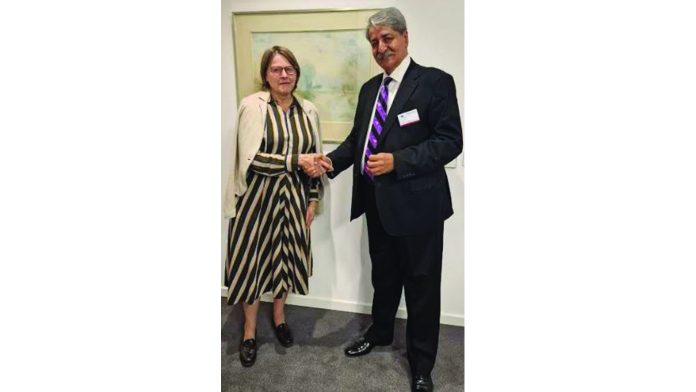
Brussels, OCT 25 /DNA/ – The Federal Minister for Commerce and Investment, Syed Naveed Qamar, who is on an official visit to Brussels met the Vice President of the European Parliament MEP Heidi Hautala, in Brussels today. 

The Ambassador of Pakistan to Belgium, Luxembourg and the European Union, Dr. Asad Majeed Khan and other officials were also present during the interaction.

The Minister briefed Vice President Hautala about the climate-induced catastrophe in Pakistan which has caused unprecedented loss of lives and destruction to infrastructure. Minister Qamar highlighted that the floods have inundated one third of country, affecting 33 million people and killing 1,725 people including 643 children. He added that the catastrophe has caused an economic loss of over US$ 40 billion and has pushed the country’s development agenda back by years.

Minister Qamar emphasized that Pakistan is at ground zero of the climate crisis, despite contributing less than 1 percent of global greenhouse gases. He elaborated that the country has been suffering extreme weather events and has suffered from droughts, forest fires, severe and prolonged heat waves as well as unprecedented and prolonged monsoon rains, which resulted in catastrophic floods.

The Minister also expressed gratitude on the overwhelming expressions of solidarity and support by the EU and its member states in the aftermath of the destruction caused by the climate-induced disaster in Pakistan.

In his interaction with the European Commissioner for Crisis Management Mr. Janez Lenarcic, the Commerce Minister thanked him for his visit to the flood affected areas in Pakistan, earlier this month.

The Minister also conveyed appreciation for the EU and its member states for collectively providing the largest humanitarian assistance of Euro 133 million as well as for activating the Civil Protection Mechanism and provision of Copernicus emergency satellite service following the devastating floods in Pakistan.

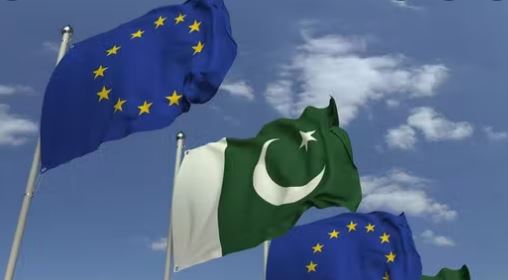
Later in the day, the Minister held separate meetings with several key Members of the European Parliament (MEPs), including MEP Tomas Zdechovsky, MEP Fabio Massimo Castaldo and MEP Helmut Scholz. During the meetings, he exchanged views with the Parliamentarians on a broad range of issues, including Pakistan- EU trade and investment relations.

The Members of the European Parliament thanked the Commerce Minister for his briefing on Pakistan’s relations with the EU and agreed to enhance parliamentary exchanges with Pakistan.

EU Ambassador discusses cooperation promotion with CM Parvez Elahi

LAHORE, OCT 25 (DNA) — Ambassador of the European Union (EU) Dr Riina Kionka called on Punjab Chief Minister Chaudhry Parvez Elahi at his office on Tuesday and discussed the promotion of cooperation in various fields, especially the construction of new water reservoirs and small dams. They discussed measures taken for workers’ and minorities’ welfare, elimination of child labor and human rights situation.

The CM thanked the EU for its support during the corona pandemic and termed it a major trade partner of Pakistan. He said that the Punjab government had planned to build two dams on the river Chenab. Similarly, small dams would be built for the hill torrents of Koh-e-Sulaiman to save the rainwater for agricultural purposes. The EU’s technical support for these projects would be appreciated, he maintained.

The Punjab government had also planned to build houses for the flood victims through Akhuwat Foundation and the EU can also support this project. Meanwhile, road repair work had been started in the flood-affected areas, the CM added and pointed out that laws were enacted to eradicate child labour. The government was making laws more stringent to curb this menace.

Alongside this, the implementation of labor laws had also been ensured while taking steps to protect workers’ rights and the welfare of their children. Social security hospitals have been built for the workers and their families, where the treatment was free, he noted. The children of the workers were given a marriage grant and the amount of the grant had also been increased, the CM said.

The government was working to provide necessary facilities to the detainees in the jails, he said adding that the food menu for the prisoners had been improved. Schools have been built to educate children confined with their mothers in jails and a free legal aid system had been introduced for hapless inmates, the CM added. The jail reforms package would be approved by the cabinet and its bill would be approved by the Assembly, he added.

The CM said that the Punjab government had taken effective steps to protect human rights. All minorities have equal rights in Pakistan and special funds have been allocated for their welfare. A quota had been fixed for minorities’ educational admissions and jobs. The CM said that Pakistan and the EU countries have very friendly-relations and the government values the EU’s cooperation regarding the improvement of social sectors.

The EU ambassador expressed regret over the loss of life as well as properties in floods and said that assistance in the dams projects would be reviewed. Cooperation with the Punjab government in the fields of textiles, manufacturing, and small and medium enterprises (SMEs) would be increased.

The first consular of the EU Daniel Clauss, Advisor Hasnain Iftikhar, Principal Secretary to Chief Minister Muhammad Khan Bhatti, finance secretary and other officials were also present. =DNA

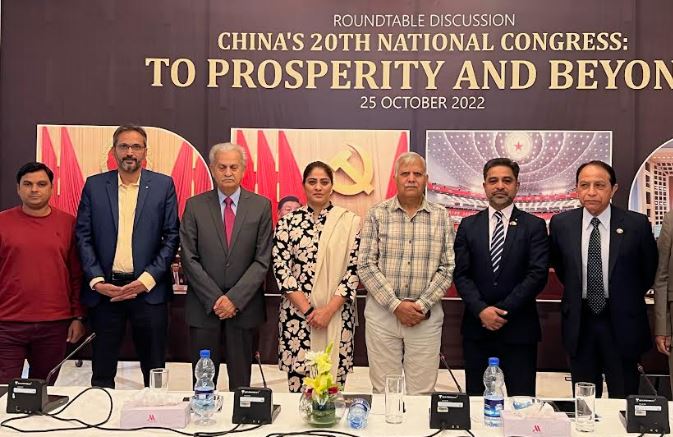
IICR organizes round table on “China’s 20th National Congress: To Prosperity and Beyond”

ISLAMABAD, OCT 25 /DNA/ – Islamabad Institute of Conflict Resolution (IICR) organized round table on “China’s 20th National Congress: To Prosperity and Beyond”. The roundtable was in continuation of IICR’s Round table discussion based on Chinese National Congress.

The eminent speakers included Prof. Dr. Zhou Rong, Prof. Engr. Zameer Ahmed Awan, Dr. Tahir Mumtaz Awan, Dr. George I.H. Cooke, Mr Shakeel Ahmad Ramay. The session was moderated by Ms. Sabah Aslam, Founder IICR.

Speaking to the audience from China, Prof. Zhou Rong said that western social setup is deteriorating with ever increasing wealth gap in the society. Whereas the Chinese model of development based on socialist system encourages cooperation, mutual learning and peaceful development.

Furthermore, Prof. Rong added that Chinese development model is indigestible for the west due to which it is engaged in massive propaganda against China and its leadership. Adding further he said that west is leading an organized campaign against China in order to hinder the progress it is making.

The next speaker on the panel was Prof. Engr. Zameer Ahmed Awan who highlighted the effectiveness of the CPC for Chinese development. Prof. Ahmed said that China is contributing in world economy with its shared progress ideology.

It silently worked on organizing its internal dynamics and then aspire to lead the world. Adding further he said that world is acknowledging the Chinese progress whereas west feel threatened by it. The key of Chinese socio-economic miracle lies in the trust of people towards its leadership. People trust president Xi and supports his ideology.

Speaking next, Dr. Tahir Mumtaz described the Chinese socialist model which is the backbone of Chinese progress and its global footprint. Dr. Mumtaz said that China is pursuing socialist modernization through integrating Chinese characteristics to the country.

Adding further he said that China is comprehensively working on human development at home and abroad and there is a lesson for countries in it. Discussing lessons for Pakistan Dr. Mumtaz said that Pakistan should learn and implement Chinese development model and Pakistan needs to move ahead from subsidiary issues it is facing.

Joining from Sri-Lanka Dr. George I.H. Cooke who discussed China’s foreign policy and multilateralism. Dr. Cooke said that China’s role in all international organization is significant. Adding further he said that China has positively contributed to global organization either politically or financially. Dr. Cooke further highlighted the importance of regional organization and Chinese role in it.

The last speaker on the panel was Mr. Shakeel Ramay who talked about Challenges to China and CPC. Speaking to the audience Mr. Ramay said that the biggest challenge to China is to counter Xi-Phobia of the west. West is propagating an organized campaign against President Xi to paint him in every negative way possible. Furthermore, he said that China would also have to counter propaganda against China as a whole. While talking about CPC, Mr. Ramay said that there is a need of reforms in CPC in coming years because China has to play major and complicated role in coming years. It already is changing a lot with the inclusion of more professionals in the central committee and CPC.

The session was ended with concluding remarks by Dr. Tahir Mumtaz Awan.

Investigation should be conducted as to who forced Arshad Sharif to leave Pakistan: DG ISPR

Investigation should be conducted as to who forced Arshad Sharif to leave Pakistan: DG ISPR

RAWALPINDI, OCT 25 – Inter-Services Public Relations (ISPR) Director General Lieutenant General Babar Iftikhar on Tuesday while reacting to the assassination of senior journalist Arshad Sharif said that investigation should be conducted as to who forced him to leave Pakistan as the institution is targeted for no reason.

Speaking to a private TV channel on Tuesday, he said that a high-level investigation should be conducted into the tragic incident of the killing of senior journalist Arshad Sharif, while speculations and accusations are deplorable.

The DG ISPR went on to say that legal action should also be taken against those making false accusations, adding that the allegations are hurled against the institution for no reason and who is trying to take advantage of the unfortunate incident.

Lt Gen Babar Iftikhar further said we have requested an investigation from the government of Pakistan and action should be taken against those levelling allegations. “Arshad Sharif was a professional journalist and he also reported during Zarb-e-Azb,” he added.

He said, “All the factors of this tragic incident need to be looked at and Prime Minister Shehbaz Sharif has also contacted the Kenyan President regarding the incident.

Earlier today, General Headquarters of Pakistan Army had written a letter to the federal government to form an inquiry commission to investigate the murder of senior anchorperson and journalist Arshad Sharif.

The GHQ has also asked the federal government to take action against elements involved in leveling baseless allegations against the institution.

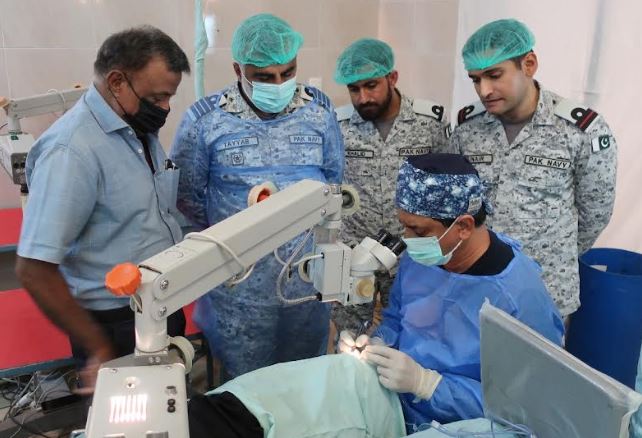
Pakistan Navy establishes free eye camp at Gwadar, Ormara

DNA

KARACHI, OCT 25: In continuation to efforts of Pakistan Navy for uplifting to provide standard health facilities along the Coastal/ Creek areas especially under COVID-19 and Dengue Fever scenario, Pakistan Navy established free eye camp at Gwadar and Ormara, Balochistan

Free eye camp was established in collaboration with philanthropic organization. Hundreds of patients including women and children were provided free medical & eye treatment at the eye camps. A dedicated team of eye specialists from Pakistan Navy and Haji RazzakJanoo Memorial Trust examined the patients and provided them with free consultation.

The patients were provided free of cost medicines and minor surgical procedures were carried out at the camps. Additionally, the local populace were enlightened on common eye diseases, infections, hygiene, child healthcare and sanitation of living areas.

Pakistan Navy is committed to provide continued quality medical facility for the people settled along the Coastal belt in Balochistan. The establishment of medical camps at Gwadar and Ormara are practical manifestation of Pakistan Navy’s resolve for socio-economic uplift of coastal community.

Global North urged to fulfil its commitment of carbon reduction

ISLAMABAD, OCT 25 /DNA/ – Adil Najam, Dean Emeritus at the Boston University, USA has said that the richer countries in Global North must fulfil their commitment of carbon reduction while the poor countries like Pakistan needs to adapt to climate change and develop resilience to natural disasters. 

He was delivering a lecture titled, ‘From Indus to Sharm El Sheikh: A Desi Perspective on Climate Change’ here at Sustainable Development Policy Institute.   He said climate is no longer a future issue, so the use of future connotation for climate makes people believe that they have more time whereas recent extreme climate events proved otherwise. The context of climate change for Pakistan is not the same as it is for rest of the world, particularly the global north, he said, adding that  “we have lost  the window of opportunity where we together could control climate change and now the impact on every country is different.”

For Pakistan, he maintained, the real barometer is Indus. How climate change interacts with us is not the same as rest of the world, therefore, we must be the providers of agenda on climate change, and not the receivers.

He said it’s the time to go for adaptation, as the onset of climate change has fundamentally changed the nature of climate policy and climate politics. 

Dr Najam recalled that Paris Agreement had promised very low emissions, as it made climate action and commitments a voluntary action rather than a legal compulsion like Kyoto Protocol.  Since the first COP held 27 years before, financing commitments have been made but not made available. 

No country ever demonstrated commitment to 1.50C temperature and there is no scientific way to achieve the commitment, he said and added that now even 20C is no longer achievable for climate change mitigation. 

He said Pakistan is essentially the Indus Basin that can sustain a thriving civilization from its source to its delta. “Indus tells us that we are facing a civilizational challenge,” he said, adding that the Indus has sustained the civilization and may not do so for the next 100 years.

He further said 90% of the country’s population lives on Indus Basin; every 9 out of 10 cities are within 50 kilometers range of Indus, which is causing changes in Indus and which is a demographic challenge as well. He suggested improving the efficiency of use of water for enhanced crop per drop. 

He said the first casualty of COVID-19 was multilateralism; cooperation in crisis was challenged and failed. He said this has revealed that even in the face of a global crisis, we should not be expecting cooperation rather states will prioritize their interests above all. 

Dr Adil said the notion of lack of finances is a blatant lie; there is a lack of belief in climate change being an existential threat. “Cost of US war on Afghanistan was 2.6 trillion, cost of US financial crisis bailout was 4. trillion and cost of US fight against COVID-19 was 6.2 trillion, these finances were mobilized in 8

days and spent in 5 days.“  Rather than climate finance and sharing technical assistance, he suggested exerting pressure on leading global emitters to meet their climate commitments. 

He said that after every climate catastrophe, economic activity will continue as victims will pour from their savings and pump into the economy for their survival which reiterates that money is not an issue. 

He urged Pakistan’s climate diplomacy must move from “additionality to talk on loss and damage, from mitigation outsourcing to climate adaptation as development and from climate assistance to climate justice.” “The market for climate disaster expands and the margin for relief is shrinking, he concluded.

Earlier, in his opening remarks, SDPI Executive Director Dr Abid Qaiyum Suelri said Pakistan is chairing group of 136 countries at COP 27 and with these countries onboard Pakistan will push the global north for their lack of commitment to climate action. 

Kyoto Protocol was binding on emission reduction targets for the entire global community on board, but it was set aside from the USA. He said that in COP 20 held in Paris, the US played a winning move by removing the binding nature of commitments on emission reduction and climate action, which removed the aspect of accountability. 

Global South is looking towards global North to meet its commitment on financing, which is to meet climate justice, he maintained.=DNA

=========

Stay Connected

64FansLike
60FollowersFollow

Latest Reviews

Exchange Rates

USD - United States Dollar
EUR
1.17
GBP
1.34
AUD
0.67
CAD
0.72