Home Blog Page 1478

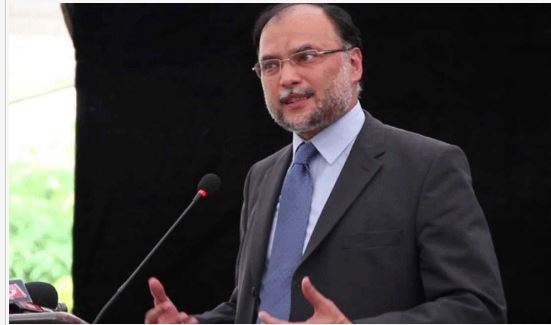
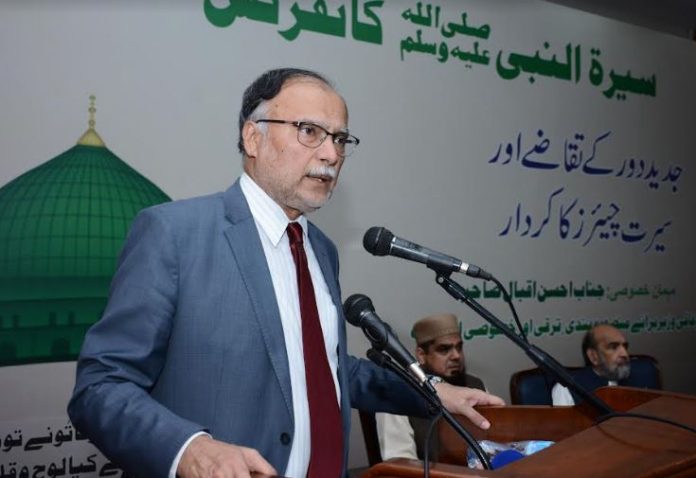
Seerah of Prophet “P.B.U.H” presents solution to all prevailing challenges of muslim ummah: Ahsan Iqbal

Islamabad, OCT 21 /DNA/ – The way of life (Seerah) of the Holy Prophet ﷺ is as relevant to resolving the contemporary challenges of the Muslim world as it was over 1400 years ago.

This was stated by Federal Minister for Planning Development & Special Initiatives Ahsan Iqbal while addressing Seerat Conference: Contemporary Challenges and the Role of Seerat Chairs held at Higher Education Commission (HEC) here on Friday.

Executive Director HEC Dr. Shaista Sohail, Chairman Council of Islamic Ideology (CII) Dr. Qibla Ayaz, Director General Dawah Academy Dr. Muhammad Ilyas, and Associate Professor Dr. Ayesha Rafique graced the occasion with their presence. The conference was also attended by a large number of Vice Chancellors, faculty members, and students from the higher education institutions located in Islamabad/Rawalpindi.

In his remarks, Mr. Ahsan Iqbal shed light on the concept of establishing nine Seerat Chairs on themes, including interfaith and communal harmony, education and knowledge, social justice and welfare, human rights and social justice, leadership and governance, sustainable development, business commerce and property rights, global peace and gender studies, and rights of women. He underlined the important role of Seerat Chairs in finding solutions in the Seerah of Holy Prophet Muhammad ﷺ to the challenges facing the Islamic world. He said that remembrance of Holy Prophet ﷺ and his teachings is the best utilisation of time, adding that the Prophet ﷺ is a role model for the Muslims in all spheres of national and individual lives.

The Minister said that no development can ever be made without peace and peace is not possible without interfaith harmony. He said that the Holy Prophet ﷺ demonstrated the qualities of a great leadership, adding that the attractiveness of his message of social justice paved the way for a wide acceptance of Islam in the world. He emphasised the need for renaissance of the legacy of knowledge across the Muslim world, as education and knowledge are pivotal for real development and prosperity of the entire Ummah. He also highlighted the importance of good governance, protection of human rights, business, commerce and property rights, women rights, and sustainable development.  

Mr. Ahsan Iqbal informed the audience that the Government is setting up Centre of Excellence in Gender Studies in Lahore to carry out research work. He expressed a strong hope that the Seerat Chairs will play a significant role in making the understanding of Seerah easier and will help find solutions to the challenges facing the Pakistani nation.

Chairman Council of Islamic Ideology (CII) Dr. Qibla Ayaz delivered a detailed address on the role of ulema and religious scholars in promoting religious harmony. He said the teachings of Holy Prophet ﷺ are the beacon of guidance to address religious and sectarian challenges. He hoped that the Seerat Chairs will fulfil the expectations associated with them in letter and spirit. He said that Islam discourages any discrimination based on religion and religious freedom is an Islamic value that needs to be protected.

Director General Dawa Academy Dr. Muhammad Ilyas said that the Holy Prophet ﷺ was sent a teacher and he demonstrated with his high moral ethics and character as to how his followers need to ensure peaceful coexistence. He also underlined the importance of tolerance, politeness, and courteousness in social dealings.

Dr. Ayesha Rafique dilated on the need for following the teachings of Prophet ﷺ in public dealings and interactions. She was of the view that the challenges facing the Islamic world have a history, as the followers of Islam has been facing hatred, stereotyping and Islamophobia since long. She emphasised that the Seerah of Hadhrat Muhammad ﷺ provides a complete solution to all such hardships and challenges.

In her welcome address earlier, Executive Director HEC Dr. Shaista Sohail said that the objective of the conference is to shed light on various aspects of the life of the Holy Prophet ﷺ and sort out solutions to the emerging issues. She also shared her viewpoint on the role of Seerat Chairs in promoting the true Prophetic teachings and action upon them. She cited the Charter of Medina as a basis of the future Islamic world. She said the Seerat Chairs need to focus on mandatory community service, utilising the potential of students for positive social change, empathising with needy brothers and sisters, improve the living condition of slums, and waste disposal etc. She stated that, “Every small effort counts.”

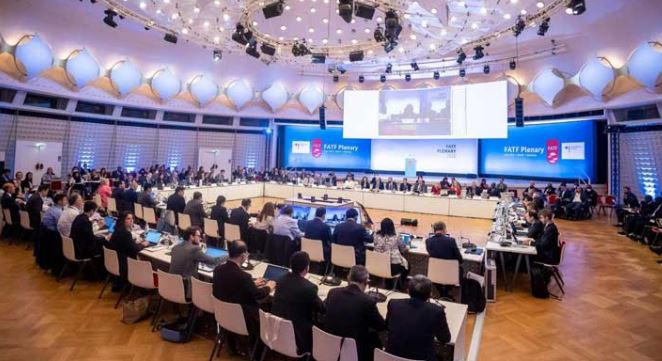
Hina greets nation upon Pakistan’s removal from grey list

PARIS, OCT 21 /DNA/ – Minister of State for Foreign Affairs, Hina Rabbani Khar has said ​I wanted to share with the nation much-awaited good news regarding Pakistan’s engagement with FATF.

As you are aware, I, together with our very able and professional team, came here to represent Pakistan in FATF’s ICRG and Plenary meetings that have concluded today. During these meetings, the report of the FATF’s On-site Visit to Pakistan, which took place in the first week of September 2022, was discussed.

Alhamdolillah, I am pleased to announce that as a result of our sustained efforts during last four years, acknowledgement of our unwavering political commitment and the successful On-site Visit, FATF has fully recognized completion all substantive, technical as well as procedural requirements of Pakistan’s 2018 and 2021 Action Plans.

Consequently, FATF has unanimously decided to remove Pakistan from the “list of jurisdictions under increased monitoring”. In simpler terms, Pakistan has been whitelisted by FATF. FATF has already issued a formal public statement announcing this decision.

I would request you to refer to FATF’s Public Statement on Pakistan. Let me highlight its main points:

• FATF has welcomed Pakistan’s significant progress in improving our Anti-Money Laundering and Countering Financing of Terrorism (AML/CFT) regime.

• It has been recognized that Pakistan has strengthened the effectiveness of its AML/CFT regime and addressed technical deficiencies and commitments of its Action Plans comprising of total 34 action items.

• Pakistan has addressed all strategic deficiencies that FATF identified in June 2018 and June 2021.

• Pakistan completed the 2021 Action Plan in advance of the deadlines.

• Pakistan is no longer subject to the FATF’s increased monitoring process, which means, Pakistan has been whitelisted by FATF.

• To advance and promote international cooperation, Pakistan will continue to work with APG to further improve its AML/CFT system.

This truly is a result of a whole-of-country efforts and demonstration of our resolve to improve our domestic systems to counter money laundering and financing of terrorism and bring them at par with the international standards. This would not have been possible without complete national consensus across political spectrum.

I would like to take this opportunity to especially thank our leadership for providing strategic direction, confidence and support to all institutions throughout the process to achieve this key national objective. The success we have achieved today is indicator of what we can achieve when we work together with sense of purpose and commitment.

During last four years, Pakistan has undertaken broad-based and comprehensive legal, administrative and procedural reforms to improve all aspects of our domestic AML/CFT regime. This includes amending laws related to anti money laundering and countering financing of terrorism. We also increased synergy in the system, streamlined the processes, improved inter-agency coordination, enhanced international cooperation with other jurisdictions and organizations, instituted supervisory structures, created necessary administrative protocols and allocated sufficient financial and human resources to improve our compliance with the FATF Recommendations.

​As a result of all this effort and hard work, Pakistan is now in a position where we can not only sustain the trajectory of these reforms without any international monitoring or pressure but can also share our expertise and resources with our countries in our region and beyond.

​Taking this opportunity, I would especially like to appreciate the tireless and dedicated efforts our national FATF team who have done a tremendous job during last four years to meet all FATF targets. Multiple departments and agencies, both at the Federal and the Provincial levels, have contributed to this national cause. All of them deserve our appreciation and gratitude.

We have said all along that our partnership and association with FATF, and the wider international community, is rooted in our strategic objective of strengthening our economy and further improving its integration with the international financial system. We want to be seen as a responsible and active member of the international community that is well aware of its international obligations.

If there is one lesson that we should take as a country from the last four years is to build on this momentum of reform and not allow the gains to be reversed. We need to sustain the efforts for our own benefit and for the growth and development of our country.

In fact, we must now become a role model for the world. I have already directed my team to start exploring ways in which we can enhance our cooperation and partnership with FATF and the wider international community, especially on the issue of Anti Money Laundering and Countering Financing of Terrorism (AML/CFT).

Pakistan has come a long way in improving our domestic AML/CFT framework and bringing it at par with the global standards. In many areas, we are now more compliant with global standards than most of the developed countries.

16.​I am confident that this remarkable progress and the announcement of Pakistan’s exit from the FATF’s Grey List would give a much-needed boost to our economy and increase our economic and financial engagement with the outside world.

​This is also a part of our wider focus on economic diplomacy. As you are all aware, economic diplomacy features very high on our agenda. We, at the Foreign Office, are placing a lot of focus on it so that we can utilize immense potential of our country and play a befitting role in the overall growth and development of Pakistan.

Together with other initiatives taken by the Government to attract foreign investment and promote ease of doing business, Pakistan’s white listing will usher in a new era of economic growth and activity.

I want to stress that the Foreign Office, and all other relevant stakeholders, would continue this momentum and work with renewed zeal to bring foreign investment in Pakistan and reap other economic dividends on Pakistan’s exit from the FATF’s Grey List.

FATF removes Pakistan from grey list

ISLAMABAD, OCT 21 – The Financial Action Task Force (FATF) on Friday removed Pakistan from its grey list. The decision was made in a meeting of the Financial Action Task Force (FATF), a global money laundering and terrorism financing watchdog, starts a two-day meeting in Paris and is expected to take up removal of Pakistan from a list of countries under “increased monitoring”.

In a meeting in June, the FATF said it was keeping Pakistan on the list – also known as the “grey list” – but said it might be removed after an on-site visit to verify progress.

Last month, Pakistan s foreign office said a FATF technical team had conducted a “successful” visit and Islamabad was expecting a “logical conclusion” of the evaluation process in October.

Army chief visits National Defence University (NDU)

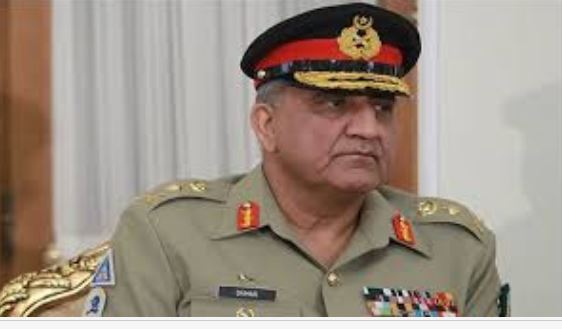
RAWALPINDI, OCT 21: /DNA/ – Chief of Army Staff, General Qamar Javed Bajwa visited NDU today. COAS delivered a talk to the participants of 24th National Security Workshop.

While talking to participants, COAS spoke on various challenges to national security and response measures. COAS said that national cohesion and unified response to guard and promote Pakistan’s national interests is imperative for progress.

Pakistan has faced many challenges but came out stronger every time. Our fight against terrorism is one such example which only succeeded due to whole of the nation approach, COAS reiterated.  Peace and stability can only be achieved if rule of law and state’s writ is established, COAS emphasised.

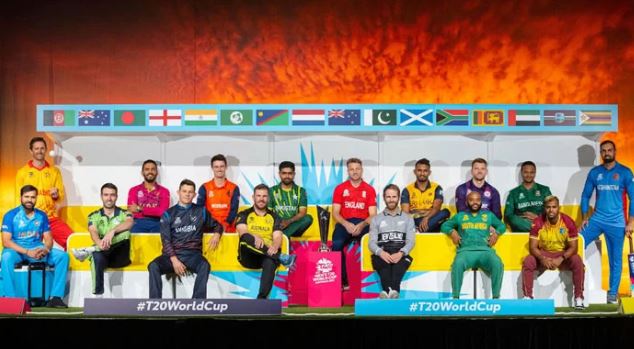
Squads for the Super 12 round of the T20 World Cup

SYDNEY: Squads for the eight teams that will begin their World Cup campaigns in Australia from Saturday after automatically qualifying for the Super 12 stage:

Super 12 Group 1

Afghanistan

Mohammad Nabi (capt), Najibullah Zadran, Rahmanullah Gurbaz, Azmatullah Omarzai, Darwish Rasooli, Farid Ahmad Malik, Fazal Haq Farooqi, Hazratullah Zazai, Ibrahim Zadran, Mujeeb ur Rahman, Naveen ul Haq, Qais Ahmad, Rashid Khan, Salim Safi, Usman Ghani.

Australia

Aaron Finch (capt), Ashton Agar, Pat Cummins, Tim David, Cameron Green, Josh Hazlewood, Mitchell Marsh, Glenn Maxwell, Kane Richardson, Steven Smith, Mitchell Starc, Marcus Stoinis, Matthew Wade, David Warner, Adam Zampa

England

Jos Buttler (capt), Moeen Ali, Harry Brook, Sam Curran, Alex Hales, Chris Jordan, Liam Livingstone, Dawid Malan, Tymal Mills, Adil Rashid, Phil Salt, Ben Stokes, David Willey, Chris Woakes, Mark Wood

New Zealand

Kane Williamson (capt), Tim Southee, Ish Sodhi, Mitchell Santner, Glenn Phillips, Jimmy Neesham, Daryl Mitchell, Adam Milne, Martin Guptill, Lachlan Ferguson, Devon Conway, Mark Chapman, Michael Bracewell, Trent Boult, Finn Allen

Super 12 Group B 

Pakistan

Babar Azam (capt), Shadab Khan, Asif Ali, Haider Ali, Haris Rauf, Iftikhar Ahmed, Khushdil Shah, Mohammad Hasnain, Mohammad Nawaz, Mohammad Rizwan, Mohammad Wasim, Naseem Shah, Shaheen Shah Afridi, Shan Masood, Fakhar Zaman

Bangladesh

Shakib Al Hasan (capt), Mehidy Hasan Miraz, Afif Hossain, Mossadek Hossain, Liton Das, Yasir Ali, Nurul Hasan, Mustafizur Rahman, Taskin Ahmed, Ebadot Hossain, Shoriful Islam, Hasan Mahmud, Najmul Hossain, Nasum Ahmed, Soumya Sarkar

India

Rohit Sharma (capt), KL Rahul, Virat Kohli, Suryakumar Yadav, Deepak Hooda, Rishabh Pant, Dinesh Karthik, Hardik Pandya, Ravichandran Ashwin, Yuzvendra Chahal, Axar Patel, Bhuvneshwar Kumar, Harshal Patel, Arshdeep Singh, Mohammad Shami

South Africa

Temba Bavuma (capt), Quinton de Kock, Heinrich Klaasen, Reeza Hendricks, Keshav Maharaj, Aiden Markram, David Miller, Lungi Ngidi, Anrich Nortje, Wayne Parnell, Kagiso Rabada, Rilee Rossouw, Tabraiz Shamsi, Tristan Stubbs, Marco Jansen

Planning Ministry kicks start implementation of major Youth Development Initiatives

Prime objective is to empower the youth of country: Ahsan Iqbal

ISLAMABAD, OCT 21 /DNA/ – The Ministry of Planning Development & Special Initiative has geared up the process to implement the five major Youth Development Initiatives announced by Prime Minister Shahbaz Sharif on Thursday.  

“Empowering the underprivileged youth by drastically increasing opportunities for their education, training and employability is critical for the future of Pakistan,” said the minister after the launch of these initiatives.

The five ‘Young Development Initiatives’ were launched to commemorate the 75th anniversary of Independence Day of Pakistan. The five key initiatives include 200,000 Internships for Young Engineers, Uplifting of the 20-poor Districts of Pakistan, Establishment of 250 Mini Sport Complexes, Establishment of Pakistan Innovation Fund, and 75 National Top Talent Scholarships Programme.

“Only by privatizing the state investment in the young people, we can turn Pakistan’s youth bulge from a liability into an asset, ” said Professor Ahsan Iqbal, while highlighting the significance of the initiatives.

Under the National Development Internships Programme, 20,000 young engineers will be hired in PSDP funded projects to improve their skills and employability. The programme envisages paid on-the-job training for fresh young graduates in various fields. 

Similarly, the uplifting of 20 Poorest Districts of Pakistan is the second key initiative of the minister.  Under this programme, the 20 poor districts of the country particularly, Balochistan and FATA will be uplifted and a package of Rs 40billion has been allocated this year.

Under the Youth Development Initiatives, the construction of Mini Sports Complexes is also a major step aimed to increase the facilities of sports for the youth and Rs 1000 million have been allocated in PSDP 2022-23 for this project, said the minister, while highlighting the importance of the initiative.

Pakistan Innovation Fund to be established and the objectives of the project include; to prepare a framework for effective innovation policy for the country including identification of factors that lead to positive and effective innovative regulatory processes. In this regard, an Innovation Support Project has also been initiated under PSDP 2022-23 for which Rs 10 billion has been allocated.

The fifth initiative is the 75 National Top Talent Scholarships Programme which provides Pakistani students with Master and PhD degrees in top 50 universities of the wo\rld.  In this regard, Rs 4.7b has been allocated for this project to encourage and prepare talented students from low-income families who aspire for higher education but cannot apply for the admission in top universities due to lack of finances.

The PM Shahbaz Sharif appreciated the minister for taking this great initiative, and asked him to expand such projects across the country. I assure you my complete support to finance such projects which actually empowers the youth, he concluded.  

Pak players disappoint in CAS-Serena Hotels Mens Int’l Squash C’ship

AFZAL JAVED

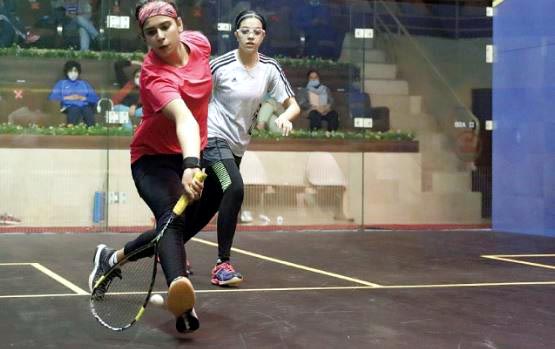
ISLAMABAD: Very disappointing performances were shown by Pakistan’s squash players as no one is capable of reaching in the semifinal round of ongoing Chief of Air Staff-Serena Hotels Men’s International Squash Championship and Serena-Combaxx Sports International Women Squash championship here at Mushaf Squash Complex Islamabad.

It is never seen in the history of Pakistan hosting international squash tournaments and no Pakistani player failed to qualify for the semi-final round of international championship as last hope of Pakistan Farhan Zaman also not succeeded in the quarter final round of the championship. Mohamed ElSherbini from Egypt who is the second seed of the championship outclassed Farhan Zaman from Pakistan by 11-7, 11-7, 6-11, 13-11 in 37 munities match duration.   

Pakistan Squash Federation (PSF) in collaboration with PAF, Serena Hotels and Combaxx Sports, is organizing the Chief of the Air Staff-Serena Hotels International for Men and Serena Hotels-Combaxx Sports International Squash Championship for Women to be concluded on October 23, 2022.

Quarter Finals of Men & Women were played on Friday and detail results are appended below.

Men Event

World Ranked-27 Mustafa El Sirty (EGY) bt WR-87 Ibrahim Elkabbani (EGY) 9-11, 11-5, 11-8, 11-5 (40 Min), WR-65 Balazs Farkas (HUN) bt WR-80 Yassin Elshafei (EGY)      11-4,   7-11, 11-8, 11-3 (43 Min), WR-45 Yahya Elnawasany (EGY) bt WR-69 Curtis Malik (ENG)  7-11, 11-6, 11-9, 11-6 (48 Min) and WR-28 Mohamed ElSherbini (EGY) bt WR-144 Farhan Zaman (PAK) 11-7, 11-7, 6-11, 13-11 (37 Min).

Women Event

World Ranked-157 Nour Heikal (EGY) bt WR-118 Haya Ali (EGY) 6-11, 11-7, 11-7, 11-3  (32 Min), WR-82 Malik Khafagy (EGY) bt WR-101 Au Yeong Wai Yhann (SIN) 11-4, 12-10, 11-5 (22 MIN), WR-73 Fayrouz Aboelkheir (EGY) bt WR-106 Katerina Tycova (GER) 11-5, 11-4, 12-10 (34 Min) and WR-70 Marta Dominguez Fernandez (ESP) bt WR-114 Jacqueline Peychar (AUT) 11-8, 4-11, 8-11, 11-4, 11-2 (32 Min).

The Semi Finals would be played on Saturday (Today) with following fixtures:-

MENS’ SCHEDULE

Moustafa El Sirty (EGY) VS Balazs Farkas (HUN) 1345 Hrs

Yahya Elnawasany (EGY) VS Mohamed ElSherbini (EGY) 1500 Hrs

WOMENS’ SCHEDULE

Nour Heikal (EGY) VS Malak Khafagy (EGY) 1300 Hrs

Fayrouz Aboelkheir (EGY) VS Marta Dominguez Fernandez (ESP) 1500 Hrs

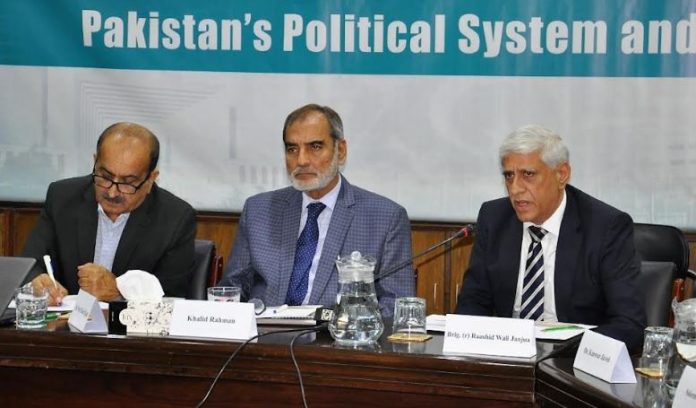
Experts call for end to civil-military duality in political system, governance

ISLAMABAD, OCT 21 /DNA/ – Governance weaknesses and problems in Pakistan are direct outcome of prevalent duality in its power structure, run by different de jure as well as de facto entities. This duality bearing on civil and military establishments, in non-compliance with constitutional obligations, has thrown the democratic political system out of equilibrium.

This aspect of the political system, along with several others, was discussed in the Grand National Dialogue on Pakistan’s political system and governance, organized jointly by the Institute of Policy Studies (IPS), Islamabad, and the Islamabad Policy Research Institute (IPRI).

The dialogue was chaired by Khalid Rahman, chairman IPS and moderated by Dr. Syed Tahir Hijazi, senior academic and former Member (Governance), Planning Commission of Pakistan chairman IPS.

The speakers and discussants included Brig. (r) Raashid Wali Janjua, director research, IPRI, Ahmed Bilal Mehboob, president, Pakistan Institute of Legislative Development and Transparency (PILDAT), Ambassador (r) Syed Abrar Hussain, vice chairman IPS, Syed Abu Ahmad Akif, former federal secretary and senior research fellow IPS, Dr. Rashid Aftab, director, Riphah Institute of Public Policy, Riphah International University, Zaheeruddin Dar, founder, Centre for international Entrepreneurship and Trade and political economist, Nazeer Ahmad Mahar, executive director, The Research Initiative, Dr. Riaz Inayat, Member NADRA, Dr Muhammad Saleem, senior economic and former Member, Competition Commission of Pakistan (CCP), Mirza Hamid Hasan, former federal secretary and senior fellow at IPS, and Naufil Shahrukh, IPS’ GM Operations.

The trichotomic power branches have failed to fulfil their constitutional obligations as a result of the pseudo-parliamentary system of Pakistan, which has some presidential features. This, along with the lack of political will and duality of the political system, doesn’t befit the constitutional values, argued Ahmad Bilal.

This has resulted in a weakened governance system, as indicated by the low position of Pakistan in governance indicators, including the Corruption Perception Index (CPI), where Pakistan ranks at 140/180, and the World Justice Project’s Rule of Law Index 2021, where Pakistan ranks 130/139.

The solution demands a constitutional framework with objective criteria to measure the performance while the military’s role in the political processes should be adjusted according to constitutional and democratic values.

In addition to these fissures, as indicated by Abu Ahmed Akif, there are inherent flaws in political practices and the organizational structure of the system, leaving little or no space for governance. The anomalies of the system, ranging from the buildup of elitist capture to the electoral flaws and the bureaucratic role, have removed any margin for reforms and governance strategy, he pointed out.

Reckoning on this, Dr. Rashid Aftab rested his view that within the three-tiered governance structure – federal, provincial, and local government – a prominent trend has been the absence of devolution of power according to change in time, due to reluctance of the provinces.

While it goes against the 18th Amendment, which has validated Article 140-A, obliging the provincial government to devolve power, a participatory governance system, focusing on empowering local government institutions, must be achieved.

As the economy forms a major part of this organizational and governance structure, Zaheeruddin Dar shared his insights on economic governance while giving denotation to ease of doing business, which has been hitting the skids because of increasingly higher return expectations from investors due to increasing war, political instability, cultural, and corruption risks.

Another factor is the government ownership of businesses. He viewed this as a route to the creation of monopolies and hostile takeovers. He further stressed focusing and pushing forwards the private sector with a visionary approach to build successful economic governance and a welfare-oriented system.

Particularly relevant, or rather the foundation, of the political system, is the electoral process, the reform of which is pivotal to democratic governance. Nazeer Ahmad Mahar shared his findings on electoral reforms, and stated that the 2018 elections, conducted under a rather empowered ECP, saw a 30% increase in voter registration and turnout.

However, there is still a gap in women and youth participation in selecting a representative for the governance and political system. According to the 2017 census, youth form 64% of the population while the 2018 election saw a 13% deficit in youth voters.

These findings signify the development of the Election Amendment Bill, which has been pending in the Parliament since 2020, innovative approaches to mobilize women and youth participation, and electoral reforms targeting trust deficit among the public, elections credibility, and ECP strategic leadership.

For electoral and other reforms, e-governance is becoming inexorable. If not employed, it can increase cyber security and other risks. Although Pakistan has improved in the EGDI Index by three spots ranking at 150/193, there is still a lot more space for improvement in Telecom Infrastructure Index (TII) and Human Capital Index (HCI), in which Pakistan stands at a medium spot. He asserted the need to develop an integrated e-governance framework based on barriers and enablers and people-centered services with an inclusive design.

In the backdrop of these aspects, Raashid Janjua, while highlighting the military’s stance, suggested that the country needs to develop a model or framework entailing the public, civil, and military concordance based on a new social contract. He further recommended a reconceptualization of civil-military relationship.

Concluding the session, Khalid Rahman stressed the timely recognition of the problems, while accepting the issues with a strong willpower to combat them. There has been a lack of proactive and positive energy, and more blame game on institutional failures. Though global indexes provide general indications, Pakistan needs to develop indigenous ranking systems and performance measures for development, he argued. For political and governance improvement, citizen training, strengthening of value-based framework, opportunity-seeking approach in crises situations, and local government empowerment serves as effective solutions.=DNA

================

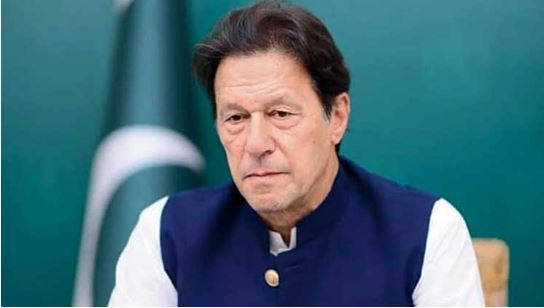
Imran Khan disqualified for time being

Disqualification under Article 63 P means disqualification for the remaining period of the National Assembly or whenever fresh elections are called

Ansar M Bhatti

ISLAMABAD, OCT 21 /DNA/ – The  Election Commission of Pakistan (ECP), in a consensus verdict in Toshakana reference, disqualified former prime minister Imran Khan and ruled that the PTI chairman is no more a member of the National Assembly.

The ECP stated that Imran Khan submitted a false affidavit and was found involved in corrupt practices under Article 63(1)(p).

Under the said article, a lawmaker is disqualified for the time being from being elected or chosen as a member of the Majlis-e-Shoora (Parliament) or of a provincial assembly.

The decision was taken unanimously by the ECP’s five-member bench but the Punjab member Babar Hassan Bharwana was not present as he was unwell.

“As the respondent has made false statements and incorrect declarations, therefore he has also committed the offence of corrupt practices defined under Sections 167 and 173 of the Elections Act,2017, punishable under Section 174 of the Elections Act, 2017. The office is directed to initiate legal proceedings and to take follow-up action under Section 190(2) of the Elections Act, 2017.”

The verdict was announced amid tight security in the Red Zone where at least 1,100 police officials were deployed under the command of a senior superintendent of police to control the law and order situation in the area. The officer was assisted by five superintendents and six deputy superintendents of police.

Imran Khan disqualified for 5 years: law minister Meanwhile, Federal Law Minister Azam Nazir Tarrar said that Khan has been disqualified for five years by the Election Commission.

Speaking after the ECP ruling in the Toshakana case, the federal minister said Khan provided “wrong information” to the electoral body.

“The Election Commission showed restraint otherwise a separate action could have been taken against him.” He said that Imran Khan’s aides are calling the verdict unjust, which is wrong.

Meanwhile, reacting strongly to the party chairman’s disqualification, PTI leader Fawad Hussain Chaudhry slammed the ECP and said that the election body’s attitude had been the worst. “We never pinned any hopes on it.”

 “This is a shameful decision. They have disgraced the 220-million-strong-nation.”=DNA

=============

FBR working to simplify tax system for facilitation of taxpayers – Ayesha Khalid

Islamabad, OCT 21: /DNA/ – The Federal Board of Revenue is working to simplify the tax system and minimize direct interaction with tax collectors in order to facilitate the taxpayers. Tax collectors and taxpayers are working for the common goal of improving Pakistan’s economy, therefore, there is a need to develop a relationship of confidence and understanding to further enhance tax revenue of the country. This was said by Ayesha Khalid, Chief Commissioner Inland Revenue, Regional Tax Office, Islamabad while addressing the business community at Islamabad Chamber of Commerce & Industry (ICCI). Adnan Inamullah Khan Commissioner-IR (WHT), Ms. Adeela Yousaf Khan Commissioner-IR (Ops) South Zone and Ms. Aisha Asad Deputy Commissioner RTO Islamabad also accompanied her at the occasion.

Ayesha Khalid said that RTO has set up a Grievances Cell to address the tax complaints of taxpayers and said that ICCI should nominate a focal person for coordination with it to address the tax grievances of the business community. She said that RTO Islamabad would consider the request for a Help Desk at ICCI to facilitate its members in filing of tax returns. She said that such Desks can also be set up in major markets to facilitate the traders. She assured that RTO Islamabad in collaboration with ICCI would try to address the tax issues of the business community in order to achieve the set tax targets.   

Speaking at the occasion, Ahsan Zafar Bakhtawari, President, Islamabad Chamber of Commerce & Industry said RTO Islamabad should provide a list of top 100 taxpayers to host a ceremony at ICCI to recognize their tax contribution and the Federal Finance Minister would be invited as chief guest to the event. He said that all Chambers of Commerce are playing a positive role in broadening the tax base as no business person can get their membership without registration in the tax system and stressed that FBR should develop close liaison with major chambers of commerce to identify the new taxpayers instead of milking the existing taxpayers. He said that RTO Islamabad should take ICCI on board before sending its inspectors to markets to address tax matters with joint efforts. He said that the business community should be given representation in the policymaking process of FBR to promote a tax system that should facilitate the growth of business and investment activities. He said that attractive benefits to taxpayers would remove fear factor and attract more people towards the tax system. He said that a Committee comprising representatives of ICCI and RTO Islamabad should be considered to address the tax issues of the business community.

Azhar ul Islam Zafar Vice President ICCI thanked Chief Commissioner RTO for visiting ICCI and said that ICCI would work in close liaison with RTO to facilitate the taxpayers.

The representatives of various markets and sectors including furniture, jewellery, real estate, overseas employment and others highlighted their tax issues and stressed that RTO Islamabad should play a role to address them. Zafar Bakhtawari, Zahid Maqbool, Baser Daud, Khalid Chaudhry, M. Rizwan Chheena, Ashfaq Chatha, Khalid Mehmood, Hamayun Kabir, Ch. Muhammad Ali, Raja Imtiaz, Maqsood Tabish, Faizan Shehzad, Ms. Munizeh Majid and others also highlighted various tax issues for the attention of Chief Commissioner RTO, Islamabad.  

Stay Connected

64FansLike
60FollowersFollow

Latest Reviews

Exchange Rates

USD - United States Dollar
EUR
1.17
GBP
1.35
AUD
0.67
CAD
0.73