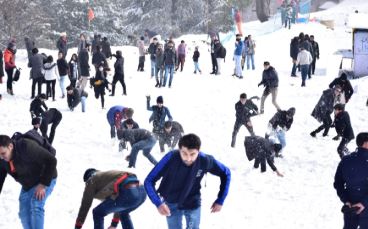
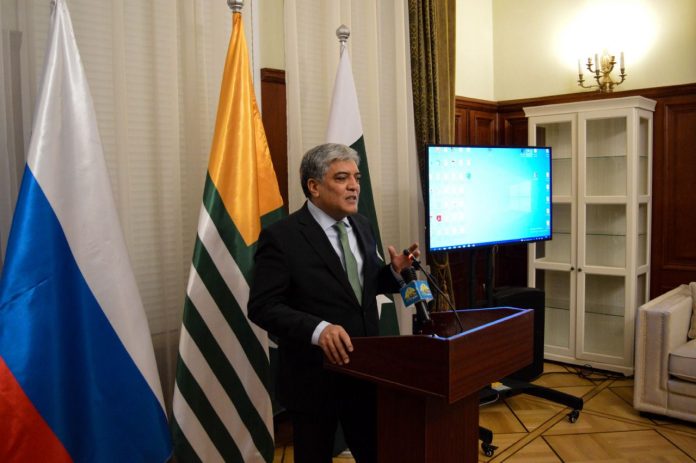
Kashmir Black Day observed at the Embassy of Pakistan in Moscow
Moscow: October 27, 2022
“Pakistan’s only objective is the fulfilment of the legitimate aspirations of our Kashmiri brethren,” said the Ambassador of Pakistan to Russia, H.E. Shafqat Ali Khan while addressing a gathering on the occasion of Kashmir Black Day at Pakistan Embassy Moscow premises today.
The event was organised by the Embassy of Pakistan in Russia in connection with the observance of 27th October as Kashmir Black Day by Pakistanis and Kashmiris across the world. The event was attended by Pakistani community members, Diplomatic officers and staff.
The Ambassador noted that the brave struggle of the Kashmiris for their right to self-determination has proven that India’s brutality and military might can never suppress the Kashmiris. He underscored that the people of Kashmir have already chosen their path, and Pakistan will continue to extend moral and political support to the indigenous Kashmiri struggle. Ambassador Shafqat Ali Khan expressed hope that the difficult days of Kashmiri people are numbered and light can be seen at the end of the long dark tunnel.
A documentary about the 75-year-long resistance to the Indian occupation and brutality in Jammu and Kashmir was screened on the occasion.
Messages by the President and the Prime Minister of Pakistan were read by Deputy Head of Mission, Rana Summar Javed and Second Secretary, Muhammad Tayyab respectively.
A photographic exhibition depicting atrocities of Indian occupation forces in the Illegally Occupied Jammu and Kashmir and the freedom struggle was also arranged on the occasion.
Kashmir Black Day observed at the Embassy of Pakistan in Moscow
Malaysian envoy given a warm send-off
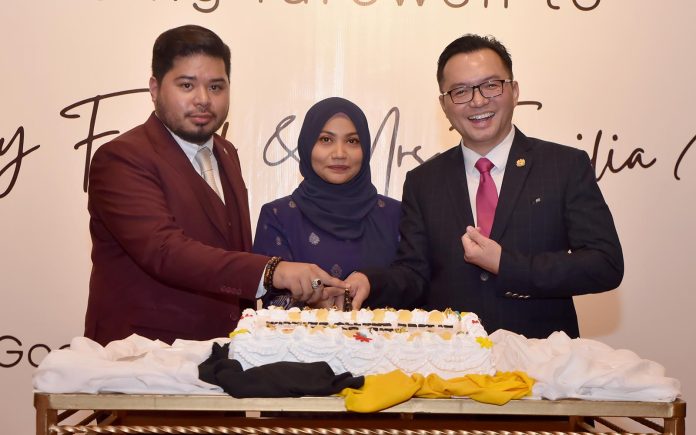
Abdul Mubdi Osman, Acting High Commissioner of Brunei Darussalam hosted the reception
DNA
ISLAMABAD: A reception was held in Islamabad Serena Hotel on 26 October 2022 to bid farewell to the Malaysian envoy, Mr Deddy Faisal bin Ahmad Salleh. It was hosted by HE Abdul Mubdi Osman, Acting High Commissioner of Brunei Darussalam.
Mr Deddy Faisal is leaving on Friday, 28 October 2022 at the end of his diplomatic posting. He arrived in Islamabad on 19 August 2019 and has served as Minister Counsellor at the Malaysian High Commission in Islamabad for 3 years 2 months and 10 days.
The reception was attended by the who’s who of the Islamabad community including High Commissioners of the Commonwealth countries, Ambassadors, Senators, Parliamentarians, prominent businessmen and members of the Chambers of Commerce. Those who attended the reception expressed their appreciation and admiration for the friendship and great cooperation extended by Deddy Faisal during his posting to enhance and strengthen the relation between Malaysia, Pakistan and also countries around the region. They also commended that the Malaysian envoy is an exemplary diplomat who is always proactive and maintains a close network with all layers of the Pakistani society.
Reminiscing about his good time spent in Pakistan, Deddy Faisal said one good thing about being a diplomat was that you make friends and establish networking wherever you go. The job was made easier with Pakistan being Malaysia’s good friend especially in both bilateral and multilateral platforms. Pakistan and Malaysia he said enjoyed deep, cordial, friendly bilateral relations and the people here have always been generous, hospitable and friendly.
He remarked that he looked forward to an enhanced and more intense economic activities between the two countries as Pakistan has been taken out of the list of jurisdictions under increased monitoring or often externally referred to as the “grey list” of FATF in which Malaysia has often provided valuable support to Pakistan. Malaysia and Pakistan will further strengthen and expand the bilateral economic, trade and investment ties in the traditional and non-traditional sectors, including by leveraging on the strategic location of both countries to serve as a trade gateway to the vast market in the Southeast Asian, East Asian and the South Pacific regions, and the South Asian, West Asian, Central Asian and Southern Chinese regions, respectively, he added.
Throughout his posting in Islamabad, Mr Deddy Faisal said that his country’s bilateral relations with Pakistan have witnessed an upward trend which was reflected in exchange of visits at the highest political level and signing of important agreements. Mr Deddy Faisal reaffirmed the strong and enduring bonds between the two fraternal countries marked by warmth, cordiality and mutual trust.
It must also be noted that bilateral trade between Pakistan and Malaysia saw remarkable uptick as the country’s exports increased to US$460 million – the highest figure ever in 2021-22 taking total trade volume to US$ 1,723 millio
Arshad Sharif shot at from close range, murder premeditated: Faisal Vawda
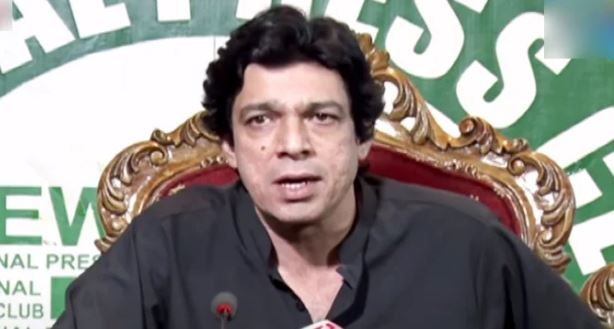
ISLAMABAD: PTI leader Faisal Vawda on Wednesday claimed that as against the version of the Kenyan police, journalist Arshad Sharif was shot at from a close range, therefore, his murder was “premeditated.”
Holding a press conference at the National Press Club in the federal capital, Vawda, who claimed that he was a close friend of the slain journalist, said that irrespective of how a probe into his murder is launched, evidence related to his killing — including his mobile phone, laptop, and documents — will “never be found as they have been erased.”
He dismissed the version of the Kenyan police — that had maintained that Arshad was killed in a case of “mistaken identity” after the local law enforcement fired about 20 bullets at his car — and said that only two bullets were fired at him.
“In my opinion, two bullets were fired at him, one to the head and the other to the chest by a person either sitting in the car or present at a very close range,” he stated.
Vawda explained that bullets cannot be fired from a long distance when it directly hits the head and chest, adding “if it would have been from far away, then 8-10 bulled would have been fired.”
“The story that has been narrated regarding the mistaken identity case should have been plotted well because no matter which country is in question, the police would never open fire if they had (as they claim) doubts of a child being present in the car,” he added, stating that in this case, only Arshad died as a part of this “cold, planned, brutal murder that was conspired.”
He lamented about the procedure of justice in Pakistan as well as Kenya — where he said conditions were worse than that of Pakistan — and claimed that Arshad was “chosen to be killed in Kenya by those who want to break the country.”
‘Not a mere accident’
The PTI leader said that the journalist’s murder is now a matter of Pakistan’s dignity and honour, so “I will speak the truth without fearing the consequences because his martyrdom was a pre-conspired murder, not a mere accident.”
He also said that “conspirators” blackmailed and threatened Arshad to leave Pakistan, so he went to Dubai.
“Later, it was claimed that either the establishment or some unknown institutions pressurised him and asked him to leave Dubai, but this information is false. I will give you details of it later.”
The PTI leader said that Arshad completed his stay in Dubai until the expiry of his visa and later, it was reported that he went to London. “However, he did not go to London either.”
Vawda asserted that a person was “conspiring” against the slain journalist and he has informed PTI Chairman Imran Khan about this “conspirator”.
“Arshad was an honest person, but the conspiracy that he was informed about had another conspiracy behind it”, the PTI leader said.
Vawda added that a common man could not send Arshad to Kenya from Dubai. “Those are the people who wish to see instability and chaos in the country. This wasn’t a plain death. It was a cold-blooded murder,” he reiterated.
‘I was constantly in contact with Arshad’
The PTI leader said that the journalist was in contact with the establishment and he was ready to come back to the country, but some people were feeding him a “conspiracy”.
He went on to say that Arshad was ready to come back to Pakistan, but the “conspirators” thought that it was better to have him killed as his presence would lead to several truths being unfolded.
“You might ask how would I know such things? Well, I was in contact with Arshad Sharif until the very last moment and I am ready to hand over my phone for forensic analysis to any global agency to authenticate the veracity of my statement,” the ex-minister said.
Vawda said that the players behind the “conspiracy” were in Pakistan, adding that Sharif had a positive relationship with the establishment — “and I was a part of these conversations.”
The PTI leader said the people behind this “conspiracy” were not far from his reach.
‘Bloodshed, death, and funerals’
The former minister said that PTI’s long march — set to kick start from Lahore on October 28 (Friday) — would “witness bloodshed, death, and funerals.”
“These funerals will definitely be held, but I will try until my dying breath to save my Pakistanis from sacrificing their lives for a conspiracy hatched by some people. I will try to end this politics of death and bloodshed in this country.”
Vawda said that “important and common” people’s deaths will take place in the long march, adding that there were “ulterior motives” behind the march to Islamabad.
He said that several deaths will take place before and during the long march as the motive is to “divert the attention” so that the nation “would start seeing things in black as white”.
‘Will share evidence with military intelligence’
Vawda stated that he is ready to share evidence with the Military Intelligence and Inter-Services Intelligence, adding that he would share further details related to Arshad’s murder in the coming days.
Claiming that neither the establishment nor any politician was involved in this, he said that the current establishment would be “very foolish if it would have planned something.”
Ankara monitoring Sweden’s compliance on deal for NATO bid: Erdoğan
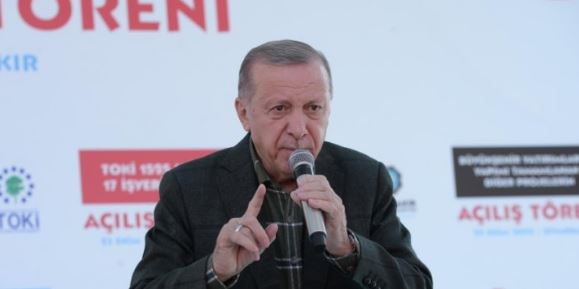
Ankara is monitoring Sweden’s commitment to a deal they signed on the Nordic country’s bid to join NATO, Türkiye’s president told the Swedish prime minister in a phone call Wednesday.
The trilateral agreement Türkiye signed in June with Sweden and Finland will guide the process of those two countries’ potential NATO accession, with Ankara following statements coming out of Stockholm, Recep Tayyip Erdoğan told Ulf Kristersson, according to a statement by the Turkish Communications Directorate.
In a phone call, Recep Tayyip Erdoğan told Ulf Kristersson that Ankara was monitoring statements coming out of Stockholm on Sweden’s commitment to the agreement.
Erdoğan said it was in both Türkiye and Sweden’s common interest to prevent terror groups from taking the Nordic country’s bid to enter NATO, as well as its bilateral ties with Türkiye, hostage.
They discussed Türkiye-Sweden relations during the call, with Erdoğan congratulating Kristersson on his new role as premier.
In response to a letter from Kristersson on Oct. 19, Erdoğan declared that he would welcome a visit to Türkiye by the new Swedish prime minister.
The Turkish leader said they were ready to advance bilateral ties with the Swedish government in every field.
Malik Ahmad warns of martial law if country’s situation worsens

LAHORE, OCT 26 – Prime Minister s Assistant Malik Ahmad Khan on Wednesday warned if the situation in the country deteriorates, then martial law will be imposed, saying that the martial law is not the solution to any problem.
Talking exclusively on program “Nuqta e Nazar”, Malik Ahmad Khan said that the situation is very unusual as around 100 PTI lawmakers have resigned. Saying that he believes in talks with the political parties, Malik Ahmad claimed that the objective of Pakistan Tehreek-e-Insaf (PTI) is not to hold elections, but something else.
Citing the statement of PML-N supremo and former premier Nawaz Sharif, Malik Ahmad stated that he [Nawaz] said that the PTI wants to appoint an army chief of its choice. It is the authority of the government to appoint the COAS, added Malik.
The SAPM said that he had a conversation with PTI leader Fawad Chaudhary yesterday, adding that what will be more degradation than this if the politicians will not hold talks with each other.
Questioning the PTI leadership, Malik Ahmad went on to say what objectives the party [PTI] wants to achieve by staging a long march. The Special Assistant further said that if the situation worsens, then the result will be martial law, but martial law is not the solution to any problem. The current leadership of the military institutions also believes that the solution to the country s problems lies in the continuation of democracy, he added.
Believing that the charter of the economy is the only solution to the country’s problems, Malik Ahmad said that the country will face economic challenges, unless one formula is fixed.
Earlier, in news conference Special Assistant to Prime Minister (SAPM) Malik Ahmed Khan Wednesday said the mysterious death of Anchorperson Arshad Sharif in Kenya must not be politicized. He said government was with the family of late Arshad Sharif in this hour of sorrow. The government wanted to bring out the facts regarding the death of Arshad Sharif, he added.
He urged avoiding speculations regarding the unfortunate death of senior journalist and not use the issue for political gains. Denouncing institutions over Arshad Sharif’s murder was condemnable, he said adding that baseless allegations against institutions were not right.
No one would be allowed to make the country hostage for their nefarious purposes, he added. He said questions were being raised regarding Arshad Sharif’s leaving the country. The people are also questioning why Arshad Sharif left the country, Imran Khan had admitted that he recommended him to leave the country, he added. He questioned whose orders did Imran Khan advise Arshad to leave the country? His advice to Arshad might also be investigated, he added.
He added that the Kenyan police and government had given a statement regarding the incident and further investigations were underway.
Gold rises on political uncertainty in Pakistan
KARACHI: Gold continued to glitter in Pakistan on Wednesday on political worries, but was trading in a tight range in the absence of any fresh clues ahead of the PTI’s long march and as the market looked to economic cues for more direction.
The price of the precious metal rose by Rs1,800 per tola and Rs1,542 per 10 grams to settle at Rs150,200 and Rs128,772, data released by the All Pakistan Sarafa Gems and Jewellers Association (APSGJA) showed.
Gold is often seen as an alternative investment during times of political and financial uncertainty. Cumulatively, the precious commodity has gained Rs3,800 per tola during the last two sessions.
The price for local markets is determined by keeping in view its prices in world markets, rupee-dollar exchange rate, and demand and supply in domestic markets.
In the international market, the price of the yellow metal surged by $24 per ounce settling at $1,668 as the dollar and bond yields weakened amid expectations that the US Federal Reserve could slow its rapid pace of interest rate hikes.
While the Fed is still widely expected to deliver a rate increase of 75 basis points in November, it is also likely to debate how much higher it can safely push borrowing costs.
Gold is sensitive to rising interest rates, which increase the opportunity cost of holding bullion that does not pay interest.
The precious commodity’s rates in Pakistan are around Rs1,000 below the cost compared to the rate in the Dubai market.
Meanwhile, silver prices in the domestic market remained unchanged at Rs1,580 per tola and Rs1,354.60 per 10 grams.
No choice except indictment if Imran fails to appear in contempt case: ECP
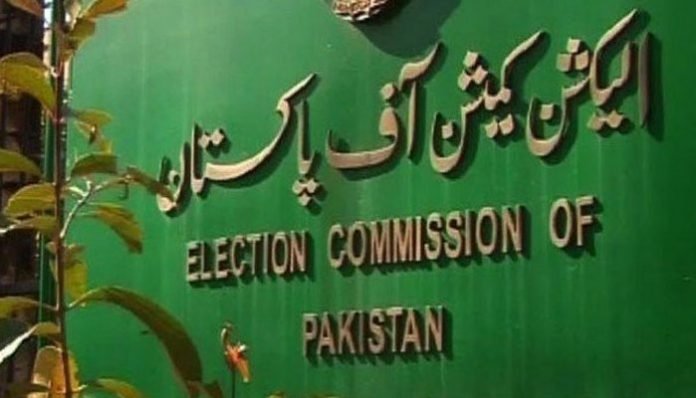
ISLAMABAD, OCT 26 (DNA) — The Election Commission of Pakistan (ECP) on Wednesday said that it will have no other choice but to indict PTI Chairman Imran Khan, leaders Asad Umar and Fawad Chaudhry if they fail to appear in the contempt case.
A four-member bench headed by ECP member Nisar Durrani conducted a hearing on the contempt case filed against Imran Khan and other PTI leaders, while Advocate Anwar Mansoor appeared on the party s behalf.
During the hearing, PTI’s counsel contended that the notices were issued by the ECP s secretary and not by the electoral watchdog itself. “The show-cause notice is illegal until this issue is solved. The show-cause notice has the signature of the director general of law,” he said.
At this, an ECP member of the bench denied the claim and said that it was the Commission that issued the notices and instead of the secretary, who has “just informed” about the notices. However, the PTI s lawyer urged the ECP to issue its charge sheet after October 31 as the Lahore High Court (LHC) was hearing a similar case on the said date.
He said that Umar has received threats last night and there is no security for him. At this, the ECP s member said that they would have no other choice but to issue the charge sheet after November 10. =DNA
Authorities seemed scared even of Arshad’s dead body: Fawad
DNA
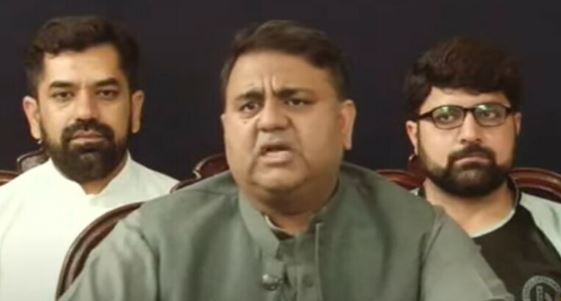
ISLAMABAD: Pakistan Tehreek-e-Insaf (PTI) Senior Vice President Fawad Chaudhary lashed out at the imported government and said that the authorities seemed so terrified of the dead body of Arshad Sharif because they were constantly changing location of the ambulance as if he would stand up.
In a statement on Wednesday, Fawad Chaudhary said that late at night, he was waiting for the dead body of Arshad Sharif at the airport but the authorities were constantly changing location of the ambulance so as the people could not gather there.
He said that it seemed that the authorities were so scared of the corpse of Arshad Sharif, as they were not only making films but also repeatedly changing location of the ambulance so that people did not gather there.
Fawad Chaudhary went on to say that the fear was reflected on their faces.
The Qatar World Cup: Footballing for soft power

Former Qatari emir Hamad bin Khalifa Al Thani, the father of the Gulf state’s current ruler, Tamim bin Hamad Al Thani, learnt a lesson from the 1990 Iraqi invasion of Kuwait.
A US-led military coalition liberated Kuwait while many conservative Kuwaitis fled to Saudi Arabia. Less conservative Kuwaiti nationals sat the war out in the casino of the Cairo Hilton hotel.
Mr. Al Thani recognized that, like Kuwait, his country with a citizenry of 300,000, sandwiched between two regional behemoths, Iran and Saudi Arabia, would never be able to fend off a conventional military attack on its territory, no matter how much and how sophisticated the weaponry is that it acquires.
To ensure that Qatar was relevant to the international community and had the necessary public empathy to support intervention on the Gulf state’s behalf in a time of need, Mr. Al Thani concluded that Qatar’s defence strategy would have to focus on soft rather than hard power.
In more than 30 years since, Qatar, one of the world’s top gas producers, has developed a highly sophisticated, multi-pronged soft power policy.
It involves ensuring a diversified customer base for its gas; a fast-paced, mediation-driven foreign policy; and the Al Jazeera television network that competes with the likes of the BBC and CNN.
Qatar’s creation of an air transport hub with an award-winning airline and airport, the opening of world-class museums, and high-profile investments in real estate in world capitals and blue-chip companies were also part of the strategy.
But none of these building blocks attracted more attention and more controversy than the sports leg of the Qatari strategy, with next month’s World Cup at the top of the list.
The positioning of sports as part of defense strategy shines a different light on controversies over the integrity of the Qatari bid, conditions of predominantly Asian migrant labour that built World Cup-related infrastructure, and potential risks for members of the LGBT community visiting a country where same-sex relationships and pre-marital sex constitute criminal violations of the law.
As a result, the stakes for Qatar, against the odds, in endearing itself to soccer fans, are high. It hopes to do so by being lenient towards violators of Qatari law, including activists wanting to make a point during the World Cup.
This week, in an indication of what that could mean, Qatari police stopped British activist Peter Tatchell from protesting the country’s anti-LGBT laws but did not detain him.
Mr. Tatchell said in a video clip on Twitter that he had been interrogated for 49 minutes.
The activist stood outside Qatar’s national museum for at least 35 minutes wearing a T-shirt emblazoned with “#Qatarantigay” and holding a placard that read “Qatar arrests and subjects LGBTs to conversion” before uniformed and plainclothes policemen arrived.
The police folded up Mr. Tatchell’s placard, took photos of his passport, questioned him, shook his hand, and left him standing on the sidewalk.
The handling of Mr. Tatchell contrasts starkly with the treatment of LGBT Qataris as described in a Human Rights Watch report, denied by Qatari officials.
The report asserted that at least six LGBT Qataris had been arrested and abused since 2019 and as recently as last month, two months before the World Cup. The six Qataris interviewed by the human rights group included four transgender women, one bisexual woman, and one gay man.
The group said they were held in an underground prison in Doha and forced to sign pledges indicating that they would ‘cease immoral activity.’
The transgender women detainees were ordered to attend conversion therapy sessions at a government-sponsored clinic. A Qatari official insisted that the Gulf state does not “license or operate ‘conversion centres.’”
From a Qatari and Kuwaiti perspective, the stark reality is that little has changed in their hard power defence capabilities in the more than 30 years since the Iraqi invasion of Kuwait.
“Unfortunately, as Gulf countries, we do not have options. Our capabilities do not deter Iran, do not deter other powers… We do not have other practical solutions,” Kuwaiti international relations scholar Abdullah al-Shaji told a recent conference in Doha.
Speaking against the backdrop of the worst crisis in US-Saudi and potentially US-UAE relations since the 1973 Arab oil boycott, Mr. Al-Shaji noted, “Russia is not going to be here, neither China. They do not have the intention or the capability. The US knows that the US is the only kid in town. Take it or leave it.”
This is where Qatar’s image among soccer fans takes on national security and geopolitical significance.
How Qatar handles issues such as activists seeking to capitalize on the opportunity to make a point, potential fan rowdiness, and culturally sensitive issues such as intoxication, public expressions of affection, and sexual diversity will shape how fans perceive and remember the 2022 World Cup, the most controversial in the history of world soccer body FIFA.
In a world of rising nationalism and popularism, in which Americans are war-weary after two decades of fighting in the greater Middle East, fan attitudes could make or break public support if Qatar ever needed the international community to come to its aid.
An analysis by social media and mis-and disinformation expert Marc Owen Jones illustrated the centrality of the World Cup in reporting on Qatar in British media in the 12 years between Qatar’s winning of its hosting rights in 2010 and the tournament itself in 2022.
Forty per cent of 1,735 Qatar-related headlines in newspapers such as The Guardian, The Times, Daily Express, The Sun, Daily Mail, The Telegraph, and Metro UK referred to the World Cup.
Of the approximately 685 World Cup-related articles, 454, or 66 per cent, were critical, 201, or 29 per cent, were neutral, and 33, or five per cent, were positive. Most of the negative articles focused on human rights.
By contrast, at most three per cent of articles about Russia in the period between Russia’s winning of its hosting rights alongside Qatar in 2010 and the Russian World Cup in 2018 focused on the tournament. In Russia’s case, the country’s 2014 intervention in Ukraine and its annexation of Crimea dominated media coverage.
If public opinion surveys are anything to go by, Qatar is losing the battle for the hearts and minds of fans in the United States and Europe, despite having enacted far-reaching reforms of its erstwhile labor system that put workers at the mercy of their employers and seeking to assure fans and activists that all irrespective of sexual orientation or marital status would be welcome.
Qatar may also have a mixed reputation in labour-supplying nations, although there is a dearth of data available from those countries. Equally, there is a lack of data on fan attitudes toward Qatar in much of Africa and a large swath of Asia.
However, a recent US survey suggested that 41 percent of Americans, 51 percent of American sports fans, and 61 percent of avid fans said Qatari human rights violations reduced their interest in the World Cup.
In addition, a YouGov poll commissioned by Amnesty International found that 67 per cent of the 17,477 participants in the survey in Europe, Central and Latin America, the United States, and Kenya wanted their national soccer associations to speak out publicly about human rights issues associated with the Qatar World Cup.
To counter negative perceptions, Qatar has invested heavily in making its World Cup an unforgettable experience.
However, New York Times soccer correspondent Rory Smith cautioned that the Qatari investment might miss the plank.
“It is not the soccer that makes the World Cup, not really… The World Cup, at heart, is a feeling… What made Russia 2018…was Nikolskaya, the street in central Moscow that became a hub for fans from all over the world, full of flags and bunting and song. It was the sight of thousands upon thousands of Peruvians on the streets of Saransk, a red sash across their hearts. It was the sense that, even in a vast land of steppe and mountain and forest, you were never more than six feet from a Colombian,” Mr. Smith said.
That feeling that touches not only those who travel to the World Cup but also those who follow it on screens at home “cannot be forced. It cannot be commanded into an existence. It has to gestate, develop, ferment.”
That is where Qatar’s apparent targeting of a high-end audience with its emphasis on pricy, luxury accommodation during the tournament could backfire and undermine its goal of engendering empathy for the Gulf state.
Many of those sitting at home, particularly in Europe, Africa, and Asia, may feel that cost and regulated access prevented them from attending.
“It is hard not to worry that many of those fans will have been priced out of Qatar or excluded by virtue of not being allowed into the country without a ticket for a game and that with them, the feeling will change, turning the tournament into an ersatz version of itself, a tribute to all the things money can buy…and all of the things that it cannot,” Mr. Smith warned.
In the final analysis, the litmus test of Qatar’s sports strategy will be whether the World Cup helps Qatar reproduce its geopolitical success, achieved as much on its own steam as with the unintended help of its erstwhile detractors, the United Arab Emirates, and Saudi Arabia when it defeated a 3.5-year-long economic and diplomatic boycott. The UAE and Saudi Arabia lifted the embargo in early 2021.
Ultimately, to fully benefit from the tournament’s reputational value, Qatar will, post-World Cup, have to push forward with social, economic, and political reform, even if activist attention moves on and focuses on countries such as Saudi Arabia and Egypt that are likely to bid for forthcoming sports megaevents such as the 2027 Asian Cup and the 2030 World Cup.
Qatar’s ability and willingness to move ahead with reforms may make the difference in how the tournament is remembered, particularly in the United States and Europe, which are likely to be crucial to the Gulf state’s military defence when the chips are down.
The problem is that human rights, labour, and LGBT groups may lose leverage. Qatar may not remain as receptive to criticism as it was in the run-up to the World Cup.
In a speech this week, Qatar’s emir, Sheikh Tamim, lamented that since winning hosting rights, Qatar had been “subjected to an unprecedented campaign that no host country has faced.”
The emir went on to say that “we initially dealt with the matter in good faith, and even considered some of criticism as positive and useful… (But) it soon became clear that the campaign tends to continue and expand to include fabrications and double standards that were so ferocious that it has unfortunately prompted many people to question real reasons and motives behind this campaign.”
An earlier version of this story appeared as a RSIS Commentary
Dr. James M. Dorsey is an award-winning journalist and scholar, an Adjunct Senior Fellow at Nanyang Technological University’s S. Rajaratnam School of International Studies, and the author of the syndicated column and blog, The Turbulent World of Middle East Soccer.
Thank you to all who have demonstrated their appreciation for my column by becoming paid subscribers. This allows me to ensure that it continues to have maximum impact. Maintaining free distributions means that news website, blogs, and newsletters across the globe can republish it. I launched my column, The Turbulent World of Middle East Soccer, 12 years ago. To borrow a phrase from an early proprietor of The Observer, it offers readers, listeners, and viewers ‘the scoop of interpretation.’ If you are able and willing to support the column, please become a paid subscriber by clicking on Substack on the subscription button and choosing one of the subscription options.
Biden, Sunak reaffirm ‘special relationship,’ agreed Ukraine support
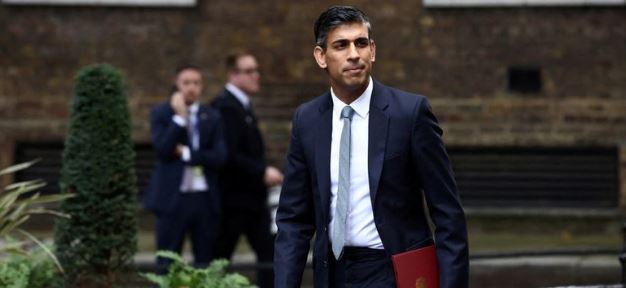
LONDON, OCT 26: U.S. President Joe Biden and new British Prime Minister Rishi Sunak, in a phone call on Tuesday, reaffirmed their two countries’ “special relationship” and agreed on the importance of supporting Ukraine, the White House said in a statement.
Biden and Sunak also agreed on the importance of working together to address the challenges posed by China and to secure sustainable and affordable energy resources, the statement said.
They also discussed their commitment to the Belfast/Good Friday Agreement, it said.