The Qatar World Cup kicks off a week from now. It is the most controversial World Cup in the history of global soccer body FIFA and has been enveloped in controversy from the moment Qatar won its hosting rights in December 2010.
The controversy is as much about rights – human rights, workers’ rights and LGBT rights – in Qatar as it is about the integrity of global sports governance. Qatar won its hosting rights at a moment in which FIFA was shaken to its core by the worst corruption scandal in its history.
The controversy is also about the fact that the Qatar World Cup in many ways symbolizes the transition of soccer, the world’s most popular form of popular entertainment, from a people’s sport into big business.
The hike in airfares because of the pandemic and the energy crisis sparked by the Russian invasion of Ukraine coupled with the cost of accommodation in Qatar has made the World Cup inaccessible for many, even if the Qataris expect up to 1.5 million fans to attend matches in the Gulf state.
In some ways, Qatar was at the wrong place at the wrong time when it won its hosting rights. The FBI raided a luxury hotel in Zurich in 2011 where FIFA delegates were staying shortly after Qatar secured its hosting rights.
Multiple executive committee members were detained and scores of global, regional, and national soccer executives were indicted in the United States on corruption charges largely unrelated to Qatar.
In other words, the degree to which Qatar’s bid lacked integrity doesn’t make the Gulf state unique. There is little doubt that corruption in FIFA was endemic as it was in many of the past World Cup bids.
Even so, former FIFA president Sepp Blatter, who oversaw the awarding of Qatar and was forced to step down because of the corruption scandal, recently declared it a mistake.
Counter intuitively, one could argue that Qatar did world soccer governance a favour by becoming a catalyst for the unravelling of the scandal.
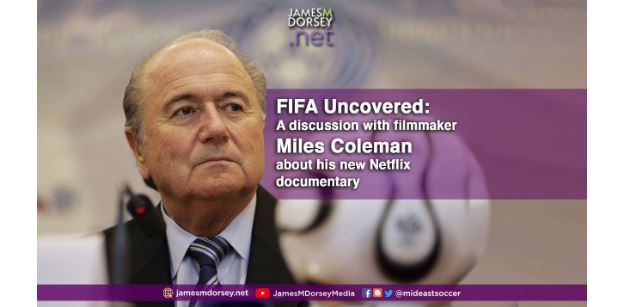
A four-part documentary, FIFA Uncovered, that has just premiered on Netflix, documents much of this and links the Qatar controversy to the broader issue of the soccer body’s corrupt culture.
It features fresh interviews with several former officials, among them some of the allegedly most corrupt sports officials of our age, saying they did nothing wrong. Several of these officials speak extensively in public for the first time.
I should note that I make an appearance in the documentary.
Miles Coleman, the producer and writer of the documentary, is here to discuss all of this.
Dorsey (00:00:08):
Miles, thank you for taking the time and welcome to the show.
Coleman (00:03:39):
Thank you for having me James. And I was worried for a minute. In your excellent introduction, you would not mention your own role, which was fantastic in contextualizing Qatar and Middle Eastern football for our audience, which spans experts but also people who are coming to the subject for the first time. So I’m glad you pointed that out.
Dorsey (00:03:59):
Thank you, I appreciate it. We do what we can. I noticed that the gies have dismissed your documentary as yet another example of singling out gutter and seeking to paint it in a negative light. I’m curious why you produced the documentary and why now, given that much of what you have is very beautiful in cinema cinematographic terms, but has long been in the public domain.
Coleman (00:04:27):
So I think that is something that has come up a few times for those people who know this story very well. They will look at our documentary and say, Actually a lot of this was out there. Well, it’s remarkable to me is the fact that yes, while a lot of this was out there, not all of it, but a lot of it for many sports fans, they don’t know this story. They don’t know the players and they don’t know the ins and outs. And with the World Cup coming up that as you point out, is going to be more discussed, more debated in terms of its hosting and its governance in any World Cup in history. We wanted to produce something that sort of acted as a way of bringing everyone up to speed to make every football fan and every non-football fan into many experts whether we succeeded. I’ll have to stop scrolling Twitter and ask people and find out, but I think that was one of our real motivations was making sure that when people do discuss how Qatar won the World Cup, they do so with accurate information. I have heard a lot of misconceptions and a lot of half-truths and a lot of exaggerations and we just wanted to get everyone up to the same page.
Dorsey (00:05:37):
No, I think it’s extremely important, particularly because there was any number of criticisms of gutter that were legitimate, change was needed and the World Cup was a catalyst or a driver of that. But at the same time, and perhaps we can get into that a little bit later in my mind, you also had a discussion in which lines were blurred between what was legitimate criticism and what was really prejudice, biased, sour grapes. And I would even at sometimes argue racism, but perhaps it’s would be, it’s a good way to start if you could walk us through how FIFA was corrupted and how that framed the Qatari bid.
Coleman (00:06:23):
Absolutely, and before I do that, I think it’s really important to sort of address from a documentary making point of view that criticism, the criticism you mentioned from the Qataris with regards to our documentary in general criticism, what we are trying to do when we make a documentary is not necessarily insert our beliefs but almost try to weave together a tapestry of what are the different opinions that are out there? What was the timeline of this saga as it played out? When we feature a voice, it’s not necessarily us saying we agree with this voice, but rather saying this was a voice that was out there or this was an indicative opinion that was out there. This is the kind of thing that people were saying. And I think sometimes when people watch documentaries, they assume that we as documentary makers all sit around together and say, This is my opinion and I want to insert it.
(00:07:13):
What we try to do with this is gather the people who were in the room to tell with a kind of kaleidoscopic effect, what were their perceptions, and the Qatari voices are one of them. So having said that, let me talk about what we talk, when we talk about corruption at FIFA, it’s actually a very tangled and naughty issue. I think people assume it’s all brown envelopes and there were brown envelopes. We’ve seen a photo of them in a hotel room in Port of Spain and that was one of the ones we had a photo of. There were probably more but when we talk about corruption at FIFA, we’re talking about high level corruption, low level corruption and everything in between. There were marketing contracts that were skimmed off and money went into executives pockets. We know that to be the case now. But also, and this is, we could even argue whether this is corruption, is it corrupt for Michelle Pla to have lunch with President Sarcozi and members of the Qatari Royal family and discuss the purchase of fighter jets and Paris Andrew Mann in exchange for a World Cup vote and potentially votes from other UA for members?
(00:08:18):
Is that corruption or is that simply deal making? That’s one of those questions that we’ll sort of rumble on. I suppose in the moral gut of a lot of football fans, they would look at that and say whether or not it’s legally defined as corruption. They don’t want that kind of thing impacting where the World Cup is played. Footballers themselves, the ones who go kick the ball and score the goals and on whose efforts all of this is built upon, they don’t necessarily want fighter jets to be part of how their workplace is decided essentially.
Dorsey (00:08:56):
I think there are two issues here. One will come back to in a moment, which is the whole definition of corruption and particularly on the one hand you have the financial corruption, but whether there’s also not a whole issue of political corruption, but we can come back to that in a minute. It strikes me that one of the things about the whole Qatari bid was that Qatar basically walked into a and that was true for members of the executive committee, particularly I think Mohammed bin Hammam who will talk about in a second. They walked into a environment that they were very familiar with because the way gut business is done in Qatar does not essentially live up to international standards of conflict, of interest, of transparency and what have you. The problem for the Qataris as for it strikes me as for members of certain members of the former executive committee, was that in QATAR there was no sort of Damocles, if you wish. So with other words, within FIFA the standards were not maintained, but they could be used against you at any given moment if the powers that be wanted to do so.
Coleman (00:10:30):
Absolutely. So there are plenty of examples in the history of FIFA of people being declared to be corrupt or banned for corruption, who it felt like this was a legal technicality and it was much more about getting the right people out of the way than it was about whether or not they were corrupt. And conversely, there were plenty of people who were clearly nakedly corrupt but who weren’t being banned from FIFA, who some of whom died in office in some cases. And I think in terms of your point about Qatar finding themselves an environment that felt sort of familiar to them or I think the converse is also true. I think that England, for example, where I’m calling from now, they bid for the 2018 World Cup and sort of made a hash of what they were getting themselves in for. On the one hand, they knew absolutely that you need to wine and dine execs that putting together the best bid technically on paper wasn’t enough.
(00:11:28):
And in fact, in the end wasn’t even a fact. It doesn’t matter what the fee for inspectors wrote about the bids, it was about how you treated the executives and how you messaged them that voting for your bid was in their best interest. And I think many of many nations did this particularly clumsily in the case of the English bid, they knew it was a good idea to give executives wives handbags, but they thought that would be enough. They thought that that was a sufficient way of getting their loyalty. And in some ways that comes across as naive and cartoonish and one of the accusations that’s inevitably going to be put at the documentary is we were made, we are a western crew, we’re not Qatari and that we have some sort of agenda. And I have no particular pride at how the England bid conducted itself. It was made a hash of it and didn’t necessarily play by the rules themselves. They were just not very good at it.
Dorsey (00:12:26):
Yeah. I think there’s also the other, to actually strengthen your point, which is that if one leaves aside the amounts that were involved, particularly in the Qatari bid, fundamentally gutter gutter wasn’t doing anything different from what happened, for example, in the awarding of the 2006 World Cup to Germany or the 2010 South African tournament, which you actually document in the documentary.
Coleman (00:12:58):
Absolutely. And I think when we were putting together the documentary, we went back quite a far away and tried to figure out when the first World Cup was awarded in sort of nefarious terms. And really it goes all the way back. We are looking at the Mexico 19 19 84 World Cup and sorry, I beg pardon? 1980 Mexico, 82 Mexico 86, let me start that again.
Dorsey (00:13:24):
No, Mexico was 86.
Coleman (00:13:26):
1986 when we were putting together the documentary, we tried to piece a timeline of World Cup bids and figure out at what point did politics and nefarious stuff behind the scenes come into it. And really it goes all the way back. We look at Mexico 1986 where there’s an executive who’s supported by the FIFA, then FIFA President Jar have Alan who has all the TV contracts from Mexican tv and that plays a big role in taking the World Cup to Mexico 86. And really the point is Qatar didn’t invent the idea of corruption and World Cup bids. It was always there. And I think that slightly explains in some ways in credibility on the Qatari side when they say, Well, we are doing what we were are doing what everyone else was doing. I think to quote Hasan semi directly, I may not get the exact words right, but to quote Hasan Al-Thawadi, he says, We played by the FIFA rules and we played by our own moral standards as far as he and they are concerned.
(00:14:27):
They did nothing different To quote the esteem James Dorsey, it’s their money. They can do what they want with it. There was no rules saying, Oh, you can’t take an executive committee member out for dinner. And when you look at the history of actual cash in hand bribes, it’s really hard to trace when the first cash bribe for a World Cup happened. But it was many, many years prior to the Qatari bid. So I think I understand, I may not sympathize with, but I understand the Qatari position of, well, it was okay when this slot did it. It was okay when there was a slush fund for the Germany bid, but why isn’t it okay when we do it? Is it because simply the sums involved were greater than any had ever anyone had ever seen before that that may be it.
Dorsey (00:15:14):
There’s also the aspect which you sort of touched on, and I would actually go back before Mexico four years earlier to the World Cup in 1978 in Argentina, which was really a World Cup or Argentina certainly saw it that way as a way to polish the image, tarnished image of a military, a brutal military hunter. Which leads me to the fact, and you speak about that in the documentary also, that FIFA has enormous power that is derived from the power of football and the World Cup and increasingly of course it has the financial muscle that it derives from the revenues of the World Cup. And you describe in the documentary the leverage FIFA can marshal in dealing with countries and author authorities across the globe. Overall, one gets the impression that FIFA had a choice. It could use its leverage to push for fundamental rights in autocratic or authoritarian World Cup hosting countries, or it could support existing repressive structures despite adopting a human rights policy in the past, FIFA seems to have opted for continued support of adequacy.
Coleman (00:16:37):
One of the things that we found incredibly interesting when we went back into the annals of FIFA history was around that the 1978 World Cup. So to contextualize, we are in the avalanche. He’s relatively new to the job and he’s keen for FIFA to start bringing in more money. FIFA at this point is a small organization in terms of employees, but also in terms of revenue. And the Argentina World Cup was given to Argentina before the hunter. The hunter comes in and FIFA our faith with a crossroads moment. Do they take it away based on human rights values or do they turn this crisis into an opportunity? And what it seems that Avalanche and the people who worked with him did, and that included by the way, Seth Blatter who joined in the very early days, what they realized was with this authoritarian regime, if they could sell the idea to the Argentine hunter that it would be great pr, the hunter would be incredibly efficient in allowing FIFA to get what they wanted out of the World Cup sponsorships that basically hunters and military regimes and authoritarian regimes bring discipline.
(00:17:42):
They bring order and they don’t allow for much dissent. So if people were to protest, say sponsorship or anything or cause any sort of problems, that wouldn’t happen. And what we saw is actually a little flurry of tournaments being given to countries with authoritarian regimes in the late seventies. You have the FIFA Youth, Coca-Cola World Cup, the first ever sponsored tournament at that level, a brand-new FIFA tournament was given to Tunisia under a military regime in 77 you have what was called the Mundi ATO in Uruguay in 1980. Now we don’t get into this in the documentary, but it’s a fascinating tournament because have a large essentially of the success of Argentina starts going to countries like Uruguay again under a military dictatorship and saying to them, Look what it did for Argentina. Look at the brilliant PR it had. Don’t you want to start doing this yourself?
(00:18:33):
And this is a complete sea change in the mentality of authoritarian regimes today. Sports washing were familiar with it, but back then authoritarian regimes wanted to fly under the radar. They didn’t want journalists coming into their country, they didn’t want media, they didn’t want attention. They simply wanted to fly under the radar and not be spoken about. But suddenly in Argentina, 78 and whole new sports washing industry emerged and you have this flurry of tournaments, Munito in 1980s being another one where dictatorial regimes were actually very happy for the pr, very happy for the journals, very happy to put their best foot forward.
Dorsey (00:19:09):
We spoke briefly about Mohamed bin Hammam. Obviously he complicated discussions about Qatar. He was a Qatari national. He was a FIFA executive committee member and the president of the Asian Football Confederation. But he complicated things because he was on the one hand appointment of the Qatari bid and on the other he had ambitions of his own. He wanted to succeed except letter as FIFA president, a move that was not necessarily supported by the Gulf State. You had the enormous success of having him speak publicly for the first time since he was ousted and banned for life for professional football.
Coleman (00:19:58):
Yes, he was a remarkable interview, not least because like you say, it’d been 11 years since he’d spoken to the press and really I don’t think anyone including us thought that he would speak, not because he doesn’t have a good story to tell, but because all of the noises we heard was that for the reasons you’ve mentioned, he wouldn’t be speaking Nevertheless, he did. We’re very happy he did. And we think he has a very interesting story to tell partly because I think on face value at first, look, his role is very commonly misunderstood and there are plenty of articles and books out there that discuss Mohamed bin Hammam and in my opinion, get the analysis on him and his role very far off base. There is an assumption that Bin Hammam as a Qatari citizen would always have supported sort of loyally the bid.
(00:20:50):
And as you say, the story he tells and the story that other people have told us is that he was rather miffed when the Qatari started to bid and certainly miffed when that bid started gathering momentum because he probably knew that it wasn’t going to reflect well on him that actually a failed bid was going to be very bad for his president’s presidential campaign. But a successful bid could even be worse. Why? Because everyone would look at Qatar and Qatar winning and go, Well, they probably didn’t play fair to get it. And that would just throw his own ethics into question. It seems that he came on board the bed relatively late in the day and there are certainly things that he did to sell the bid that were direct contraventions of ethical standards in any sort of good governance. For example, when Ray Tamari from Tahiti is found in a Sunday time sting to be accepting money for a vote he’s banned, Tamari is then banned from voting on the World Cup Mohammad bin Hammam pays his legal fees.
(00:21:50):
He does. So Tamari can appeal that decision and his seat won’t be filled and his seat could have been filled by someone who is unfriendly to the QAR bid. And everyone, the analysis from outside is that it was beneficial to the QAR bid to simply have that seat empty. That’s one voter fewer to try sway. Why Mohamed bin Hammam does that as such a kind of, to me it’s such a sort of obvious misstep. I’m not quite sure because it’s ultimately one of the things that leads to his downfall. But Mohamed Binman is a very complicated figure in all of this and I think the Qatari bid see him as such. He’s someone who they were never fully trusting of. He was someone who was a bit of a thorn in their side and I think when he initially didn’t get on the bid, it just made them look bad. Your executive committee member should be supporting you.
Dorsey (00:22:45):
Yeah, I think that’s absolutely true. And there were two issues of course. One is double standards and the other is that Bin Hammam was typically one of these figures who didn’t understand the difference in the way you do business internationally, in the way you may do business in Qatar. So in the documentary in terms of double standards, you have a situation where Bin Hammam wants to run a challenge. The presidency of Sepp Blatter, he is barred from entering the United States for a congress of the Caribbean Football Federation, except Blatter does attend that conference publicly, gives a million dollars for the development of football in the region, clearly in the expectation that he will win the Caribbean votes with that and sort to then bin Hammam in the an effort to level the playing field holds his own conference in the Caribbean and that’s where he hands out the envelopes.
(00:23:59):
And on the other side in, if you look at the way that Bin Hammam was ousted from football basically using a audit of the funding of the Asian football confederation, the accounting for the financing was murky but at the same time the Asian Football Federation was cash short salaries had to be paid and they were advanced by Bin Hammam. The problem is that instead of advancing them and them being paid for a loan, he gave all kinds of gifts to all kinds of people. And basically my guess is that if you did the accounting, you probably would come out at zero. It was not about enrichment, it was simply about going about it wrongly.
Coleman (00:24:58):
To put it really simply, I think Mohammad Bin Hammam has sat there a bit baffled as to why he is seen as someone who’s corrupt when he was worse off as a result of spreading money around that as far as he sees it, corruption is when you enrich yourself and not when you give money away. And I think it also speaks to the culture of FIFA at that time where it’s almost sort of a murder in the sense that everyone had some dirt on, you couldn’t have risen to where you were in that world at FIFA without having some dirt. So it in guaranteed a culture of silence with your colleagues. If one of us folds, we all fold, which is exactly what happened. That’s not a wrongful perception. That is basically what happened. But it also allowed the FIFA senior leadership to hold that sort of dam is like you said over everyone, we’ve all done something was the mentality we’ve all done something that we could be taken down with.
(00:25:56):
The FIFA ethics code is not applied fairly and universally and it can be a very blunt object when we need it to be. So if for example, Mohammed bin Hammam advances money to pay the school fees of the football association head of Mongolia’s child, I mean that’s a real example. We could if desired spin that in such a way that makes ’em look corrupt. And I’m not even saying that is or isn’t corrupt. I certainly think the optics of that aren’t good, especially taken on an international standard. But again, I think Mohammad bin Hamma, has sat there at home in Qatar thinking, But I paid for someone’s child’s school fees. I bought someone a car so they could drive around their country and scout football players if they so desired. How is that making me a bad person? And I think in some ways that’s a reality of a football organization that spans the entire world. You’re going to have different standards of governance running up into one another. I suppose, again, I’m repeating myself, but the important thing was not a kind of morally universalist judgment as to what is good or bad, but simply the idea that if you step out of line, we all have dirt on you. So step outta line and we can make sure that you leave your position, which is exactly what happened to Mohamed bin Hammam.
Dorsey (00:27:13):
No, I absolutely, I think that’s spot on you. In the documentary you essentially portray Seth bla as an emperor. He comes across as unrepentant even though it all happened on his watch. In fact, he admits the horse trading when he and the documentary confirms for the first time that GTOs bid was essentially sealed at a meeting in late 2010 between the French president Nicolas Sarkozy, Michel Platini, the then head of the European football, Sheikh Tamim, the emir of Qatar who was then crown prince, and the erstwhile American owners of French Club Paris St. Germain. So basically one of the things that you get here is that political interests, commercial interests as well as the interests of the Qatari bid, all sort of came together in a mesh that almost by definition blurred the lines of transparency, blurred were fundamentally corrupt.
Coleman (00:28:29):
Yes. And what you realize is when you lay that story of the how vote ended up going to Qatar and we’ve sort of looked into that story, spoken to people who know an awful lot about it. When you contrast that with someone like Phaedra Almajid’s story about how she was asked to translate in a meeting between the Qta did,
Dorsey (00:28:52):
She was a whistleblower who basically reported that she had witnessed the buying of votes if you wish something that the Qatars have flatly denied, consistently
Coleman (00:29:10):
Flatly denied. And her story certainly was out there. We not the first outlet she’s spoken to, it was out there that she said that she was in a hotel room and that the Qatari bid offered 1.5 million to three African executives as development money. She stresses that this was not money in your pocket, but development money, although many people who’ve followed FIFA over the years note cynically that often development money does not have sufficient auditing attached to it. So it could be interpreted, it could be interpreted as a wink and a nudge. And I suppose my point in linking that to the Platini thing is we see this incredible spectrum of corruption. We see this incredible spectrum of all the way from governmental deals, deals done at a huge governmental level all the way down to a meeting in a hotel room where supposedly allegedly cash was offered.
(00:30:10):
And that for me shows that the Qatari bid was able to play various different games at once. It was able to speak to each executive committee member in a language that would be persuasive to that committee member, but it also showed the sheer governmental backing for the bid. If I compare that to say the England bid, and I’m choosing England as an example just cuz that’s where I’m calling from. Prime Minister David Cameron went to the bid and sort of recorded a little video for them, but he wasn’t operating at that level wasn’t, people weren’t talking about these kinds of things at that level of power in the uk. And that was where the Qatari bid to my mind will forever be a watershed moment in the history of sports is this is the point where it’s a Pandora’s box moment where I don’t think we can step back from that kind of governmental involvement in how a sports tournament is awarded.
Dorsey (00:31:08):
Yeah, I think also of course that comparing David Cameron and Britain to gutter and the place of sport within those countries really is also the difference between democracy and inadequacy and
Coleman (00:31:27):
Absolutely.
Dorsey (00:31:28):
And it also speaks to FIFA’s political corruption if you wish. As a matter of principle, you could argue on those grounds that gutter should never have gotten the World Cup or for that matter any other autocratic state because the sports authorities are by definition the government, the FIFA rule that the government cannot interfere in the affairs of an independent sports govern. National sports governing body are violated by definition.
Coleman (00:32:06):
Absolutely. We look at, for example, the Russia bid for 2018 and the Russian executive committee member of the executive committee was deputy prime minister of Russia. And I’ve said, I’ve noticed that when we look at the statement sports and politics shouldn’t mix more often than not, that’s a platitude that’s trotted out when the sports and politics mixing is uncomfortable or creates a difficult question. And it’s something that is said as a sort of dead cat in the room to distract people from the fact that what is actually happening is sports and politics are mixing in a way that we don’t like. And I would also say I’ve been possibly to a fault looking at what people have been saying about our show on Twitter. Forgive me, it’s been three years of our lives. So we’re interested in the feedback and I’ve noticed, and I’ve paid particular attention to what people are saying about it in the Middle East because this is a show that is dealing with the Middle East and as much time and interest as we have, I’m not Middle East and myself, so I’m always going to have that sort of outsider perspective.
(00:33:12):
And this is of course I’m talking to you about on a show about the Middle East and Middle East soccer, that’s your area of expertise. The thing that is of great interest to me is a line of argument. I’ve seen a lot about our show and just about criticism of the World Cup in general. How can America criticize this World Cup if they invaded Iraq? What leg do the Brits have to stand on because of colonialism? How can they criticize our World Cup? And for me, the reason that I can’t quite agree with that line of criticism is what you said, James, is America did not bid for this World Cup to try and whitewash their image around the Iraq war. That might be a corollary effect, but ultimately that’s not at the heart of the bid. Britain is not trying to host a 2018 World Cup to make people forget about colonialism.
(00:34:07):
The difference with the Qatari bid is it is a profound part of their nation building strategy in the 21st century to be a sports broker for the whole world. It is not a corollary of that strategy, it is the strategy. And that for me is a fundamental difference. And the second thing I found very interesting reading comments coming from the Middle East about our documentary in a more broadly about criticism of qar, a very common line of argument goes, your government invaded Iraq, your government colonized people, and who are you to say that we shouldn’t have a World cup? And I suppose the difference there is our government and our sporter are pretty separate and also our government and our people are pretty separate. So lots of people didn’t vote for the war in Iraq, lots of people were very upset by it. We protested, we marched, I marched, and we would look at that governmental action and say, that doesn’t really represent me or my values.
(00:35:12):
We didn’t want that war. Many of us. And by contrast I would say the World Cup coming to Qar, was it governmental project. And in a state like Qatar, while I understand that not everyone a hundred percent supports the government of Qatar, given that it’s not a sort of liberal democracy in the Western sense, it’s much harder to untangle from my perspective where there is dissent and where there isn’t dissent from the government and to what extent the government represents the people. So given that government and politics and sport are much more entangled in Qatar, I think it is potentially more valid to look at Qatar’s governance when it comes to hosting the World Cup then it is to say look at the UKs because ultimately who’s in power in the UK won’t massively affect how the tournament is run. Those two things will be pretty separate, but it will in Qatar
Dorsey (00:36:09):
No, I think that’s absolutely true and I think that there are three points here basically. One is of even four points if you wish. One is that what the response reflects is really a failure to understand the way democracy works which is not surprising. There are an autocracy. That’s one. I think the second thing that I would argue is that yes, this was a governmental project, but what makes Qatar different from any other World cup and certainly from any other World Cup that was hosted by an authoritarian or autocratic regime is that this is not simply about nation branding, it’s not simply about creating economic opportunity. It’s not simply about garnering soft power. This is part, it’s a multi-pronged policy, but it’s part of God’s defense and security policy. God’s a tiny country, it can’t defend itself and it’s sandwiched between two countries that are both partners but also threats Saudi Arabia and Iran.
(00:37:32):
And what that also means is that to the degree that there is what’s been now commonly termed sports washing with other words, an effort to polish a tard image that really is a minor part of this, it’s not the main driver despite the fact that many of Qatar’s critics think it is. So I think that’s very important. And the last point I’d make is in terms of double standards, the Qataris have a point in a sense, but they’re pointing to the wrong thing. So with other words, it’s not the invasion of Iraq that makes this a double standard. What makes it a double standard is that western countries, whether the United States or Europe are not consistent in their human rights policies and have never been able to explain on what grounds they choose to act on human rights in one country but not in another. And so you get the perception and not incorrect of double standards.
Coleman (00:38:51):
Absolutely. And I agree with that point about double standards and like you say, I think they’re sort of pointing at the wrong thing. The double standards will be there. Whether the UK hosts a Euro’s final in Wembley or not, I applaud those double standards just as I pour the war in Iraq. I think what I slightly have an issue with is the sort of the ad ho rebuttal that I hear coming from the Middle East, not dealing with the criticism itself, which is this World Cup may have been bored, but rather who are you to tell me that? And I think what’s a shame because a lot of the criticism is very valid and could potentially lead to society reforming. I think the criticism that for example migrant labor was not fairly treated during the building of the infrastructure of the World Cup, it seems to have actually that criticism has mounted and mounted to the point where the kafala system is at least on paper, not law anymore.
(00:39:54):
So that criticism, regardless of whether it’s coming where it’s coming from, seems to have potentially got through in a positive way. And I suppose I’m a little disappointed that a lot of that rebuttal, like I said, is focused on where these people are coming from because I don’t put on my Britain hat when I make this and think my country’s wonderful and I want to talk down to other countries far from it. I come at it from a point of view is if I have any hat on, it’s a football fan and I simply want to see the game that I love treated and respected the best it can be. But I also wanna talk about something that you mentioned, which is you are absolutely right to point out that this goes beyond sports washing. And I think it’s something that people perhaps oversimplify that this is a simple popularity contest and you are right to say goes far beyond that.
(00:40:45):
The Qataris have been spending, for example, more money than ever before in entertaining British MPs. And one thing that struck me when I visited Qatar for the filming was we were shown around the stadiums and when we were shown around the stadiums, we were sort of whizzed through where the fans would go and shown where the VIPs would go in much more detail. When we were shown the stadiums, we were meant to be blown away by the opulence and the wonderfulness of the VIP areas. And to one extent I think they didn’t read the room right because me as an ordinary football fan who wouldn’t be able to afford a V I P ticket, I only look at that and think, well that’s an area that could have been saved for real football fans. But I think what they give away when they show that is who are they targeting with this World Cup?
(00:41:33):
Again, little claims that I’ve heard quite a few times, this is the first world cup where you can see multiple games in a day to a football fan. You want to go see your team play and either celebrate their win or commiserate their loss. You don’t want to go see more than one team. It’s a complete, it’s an athema to a football fan to go watch different team play. The people that they are targeting with this World Cup will stay in incredible hotels. They will get in sofa driven cars, they will drive right up to the game, they won’t arrive and soak up the atmosphere or contribute to the atmosphere. They’ll have a meal, they’ll have half an eye on the game talk business and onto the next one. And I don’t think that’s a mistake. I think that’s very deliberate to your point. They are targeting highly influential people, high net worth individuals, politicians, heads of state, and they wanna show them that Qatar is an ally and understands how they live and understands them much more than Qatar understand your average football fan on the street. So that, like you say, when push comes to shove, these are people with decision making capacities who have positive ground spring of positive feelings towards Qatar.
Dorsey (00:42:41):
I think that’s absolutely true. I also think to be fair to the Qataris, first of all this is most mega sporting events really leave a lot of debt and white elephants. This is a sporting event that on a number of fronts has produced or generated social change. It may not go far enough, it may have been too little too late it may have been the Qataris grudgingly getting into the change, but nonetheless it has produced change. I think that’s one thing. The other thing that strikes me with regard to what you were describing in terms of the response coming out of the Middle East to the documentary are two things. One is that they’ve gotta be careful what they say they can’t admit given that they live in an environment in which freedom of expression is restricted and it can be dangerous to express an opinion. So they don’t have that freedom. But I also think there’s an issue with regard to feeling on the defensive to feel feeling having been continuously under attack at times under unfair attack. And in some ways you could argue that the way the critics of QATAR handle this, they in some ways their whole campaign on the one hand produced change, but on the other hand backfired. So you’ve not seen QATARs critics take public distance to those who who’ve really been prejudiced and biased and racial in their comments.
Coleman (00:44:34):
Absolutely. And it’s something that I think I would, having gone to Qatar, I’ve seen this firsthand and having spoken to people on the ground, I’ve seen this firsthand. There is a perception in the west certainly a perception here in Britain that people in places like Kaha, Dubai and Saudi are sort of clamoring desperately for Western affection and that’s why they’re buying football clubs and hosting boxing matches and so on. And that more to the point that society’s a monolith than doing so. And you go there and you realize that for a start, society is very split on whether they should do this. There’s a great degree of great deal of qy society who does not want drunk fans rolling around their streets for all the controversy about LGBTQ rights.