LUSAIL: Unheralded Saudi Arabia notched one of the biggest shocks in World Cup history on Tuesday with a 2-1 win over Lionel Messi’s Argentina thanks to a scintillating second half come back.
On his fifth and final quest for the only major trophy to elude him, the 35-year-old Messi scored a 10th minute penalty in a dominant first half display where he and Lautaro Martinez also had three goals disallowed for offside.
But Saudi Arabia, the second-lowest ranked team in the tournament after Ghana, threw caution to the wind at the start of the second half, charging at Argentina’s defence in front of a frenzied 88,012 crowd.
Saleh Al-Shehri squeezed in a low shot in the 48th minute while Salem Al-Dawsari curled in a scorching strike from the edge of the penalty area in the 53rd minute to leave Argentina and Messi looking utterly shell-shocked in the Group C opener.
Despite plenty of possession after that, Argentina were unable to penetrate Saudi Arabia, who were competing in their sixth World Cup but had never previously won an opening game.
The entire game was played in an extraordinary atmosphere at the Lusail Stadium, with Argentina’s traditionally massive and raucous following matched by the thousands of Saudis who had come over the border to cheer on their team.
“Our team fulfils our dreams!” and “Where is Messi? We beat him!”, the green-clad Saudis chanted over and over in the Lusail Stadium, on their feet and greeting every clearance from their defence with a deafening roar.
Messi’s dream in doubt
Both teams have Mexico and Poland to come, with Argentina needing an immediate reaction if Messi is to have a realistic chance of matching Diego Maradona’s immortality in his homeland by bringing home the World Cup.
The result revived old question marks over Argentina’s defence and broke their amazing 36-match undefeated run. That stopped them from matching the previous international record of 37 games unbeaten held by Italy.
It also marred Messi’s achievement of becoming the first Argentinian to score in four World Cups on his 20th appearance in the tournament. Only Maradona has played more games for Argentina at the World Cup, 21 in all.
“This hurts a lot. We were dreaming of starting the World Cup with a win,” said Messi’s strike partner Martinez. “But it’s happened and now we have to train and think forward.
“We lost this game because of our own mistakes, most of all in the second half. There are details that make a difference and we need to correct our mistakes.”
It had all looked so different at the start when the marauding Messi nearly scored in the opening seconds, celebrated joyfully after sending Saudi goalkeeper Mohammed Al-Owais the wrong way with his penalty, then had another goal disallowed.
For the Saudis, the result buried their dismal history at the start of tournaments, including a 5-0 thrashing by hosts Russia in 2018 and an 8-0 pummelling by Germany in 2002.
Their feat against the twice World Cup-winners and current South American champions was all the more remarkable given the departure of their influential captain and midfielder Salman Al Faraj just after halftime, clutching a hamstring.
Argentina’s last defeat was by Brazil in the semi-finals of the Copa America in July 2019. They are ranked third, 48 places above Saudi Arabia, by world football’s governing body FIFA.
Argentina’s last defeat in their opening match at a World Cup was against Cameroon in 1990.
KARACHI, NOV 22 /DNA/ – Ambassador of Morocco Mohamed Karmoune has said that the existing trade volume was not enough so Morocco and Pakistan need to do more through enhanced interaction between the Chambers of Commerce and the business communities with a view to improve trade volume between the two brotherly countries.
Speaking at a meeting during his visit to the Karachi Chamber of Commerce and Industry (KCCI), the Moroccan Ambassador informed that preparations were underway for sending a Pakistani business delegation to Morocco in the month of December, which in addition to exploring opportunities for improving trade and investment cooperation, would also see how the Morocco and its economy have evolved. “I hope you’ll join this important delegation so that you could spread the message about trade and investment potential upon your return”, he added.
President KCCI Mohammed Tariq Yousuf, Senior Vice President Touseef Ahmed, Vice President Mohammad Haris Agar, Honorary Consul General of Morocco Mirza Ishtiaq Baig and KCCI Managing Committee Members also attended the meeting.
The Ambassador said that the kingdom of Morocco was one of the best destinations for tourism hence, Pakistan can learn greatly from Morocco’s experience in this area to promote its tourism opportunities. “Tourism is the driver of any economy in the world and same was the case with Morocco where tourism sector is performing very well and it also carries good investment opportunities for the business community of Pakistan”, he added.
He informed that Morocco holds around 70 percent of world’s phosphate reserves that was the main attraction towards the kingdom of Morocco which was also become a champion of solar energy. “This is particularly an area wherein our brotherly country can benefit from Moroccan knowhow in solar energy as Pakistan is also gifted with good summer season”, he said, adding that Pakistani business community can also take interest in Moroccan automobile sector which has been growing and most of the automobile products and spare parts were being exported to African countries which was rising at a pace of 10 percent every year.
He hoped that the existing relations and valuable trade will be enhanced more in the coming months in order to reinforce the bilateral relations between the two countries.
Earlier, President KCCI Tariq Yousuf, while welcoming the Moroccan Ambassador, stated that Pakistan views Morocco as an important partner which was the gateway to Africa and was an emerging market having free trade agreements with USA and Turkey. “In order to enhance and deepen connectivity between both countries, Pakistan’s Look Africa policy can help accelerate trade and strengthen economic ties which would pave way for Pakistan & Morocco’s businessmen to explore new dimensions for boosting bilateral trade.
He was of the view that Morocco was a potential market for Pakistani textiles and fabrics as it enjoys duty-free access from USA & EU. Both countries can exploit the available opportunities to boost trade and economic development.
Stressing the need for undertaking joint ventures, President KCCI said that Moroccan investors can capitalize on exciting investment opportunities in Pakistan’s various sectors such as agriculture, textile, renewable energy, food security, industrial & infrastructure development, sports, tourism and hospitality.
“Both countries can exchange innovative ideas in the field of tourism to promote and develop tourism economy through joint ventures & exploring the economic opportunities”, he added.
He noted that as Moroccan economy has a well-established Tangier port with a handling capacity of 9 million containers a year, Pakistan can learn from Moroccan experience to develop Gwadar port, which is the gateway to regional economic transformation.
Tariq Yousuf said that Pakistan has tremendous investment opportunities in Energy, Transport Infrastructure, Gwadar, Socio-Economic Development, Science & Technology & Agriculture Cooperation. “We want to further enhance, promote and deepen the business, trade and economic relationships of multi-domains between the two countries.”
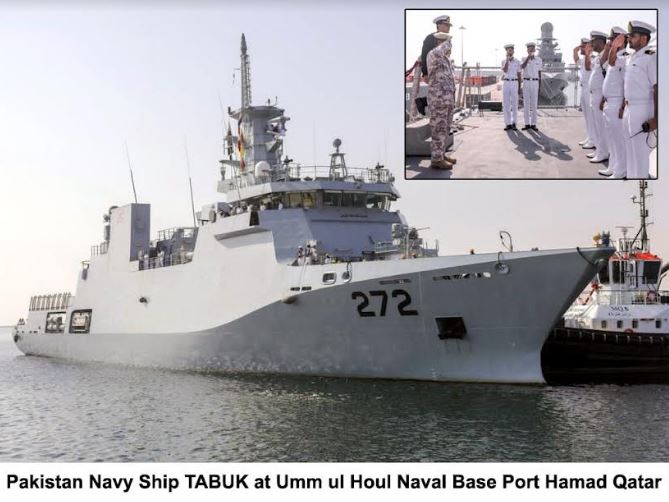
ISLAMABAD, NOV 22: Pakistan Navy Ship TABUK visits Doha, Qatar for maritime security during FIFA World Cup 2022. Upon arrival at Doha, PNS TABUK was warmly received by officials from Qatari Emiri Navy and Pakistan Embassy at Qatar.
During the port visit, Commander Qatar Emiri Navy Maj Gen Abdullah Hassan Al Sulaiti visited aboard PNS TABUK. During the meeting with Commanding officer PNS TABUK, matters of mutual interest and cooperation in maritime domain were discussed.
Cdr Qatar Emeri Navy appreciated the efforts of Pakistan Navy in promoting peace and security in the region. On the occasion Commanding Officer of PN ship conveyed well wishes from Chief of the Naval Staff Admiral Muhammad Amjad Khan Niazi for the people of Qatar in general and Qatar Emeri Navy in particular for safe and successful conduct of FIFA World Cup 22.
Visit of PNS TABUK provided an opportunity to further enhance the existing close diplomatic ties and cordial relations with Qatar.
ISLAMABAD, Nov 22 (APP): The Election Commission of Pakistan (ECP) on Tuesday announced holding local government elections in Karachi and Hyderabad divisions on January 15, 2023.
Chief Election Commissioner (CEC) Sikandar Sultan Raja announced the verdict which was reserved on November 15. ECP directed the Sindh and federal governments to complete the security arrangements in this regard. ECP directed Sindh government, Inspector General police, Chief Secretary, Interior ministry, to ensure security arrangements for holding free, fair and impartial elections.
The federal government through Secretary, Ministry of Interior is directed to provide a sufficient number of security personnel from other law enforcement agencies.
The LG polls in Karachi were postponed in July due to the flash floods. The Sindh government had repeatedly sought the rescheduling of dates for the elections.
The elections were initially scheduled for July 24, but they were delayed due to “bad weather and rains”. Then, polling was set to take place on August 28 and October 24, but the provincial government refused to provide security.
In its judgment on the pleas of Pakistan Tehreek-e-Insaf and Jamat-e-Islami, the Sindh High Court directed the commission to announce a new schedule for the local body polls in both cities.
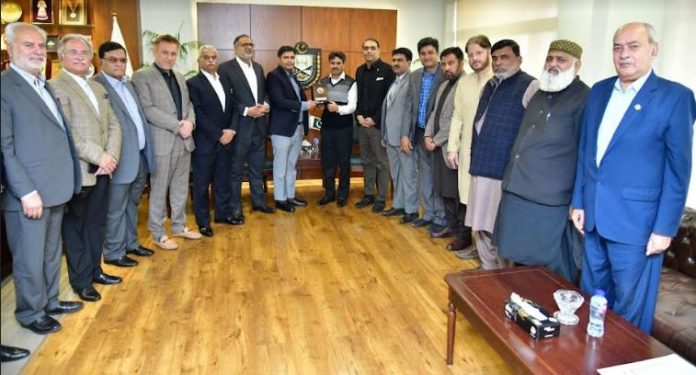
Islamabad, NOV 22 /DNA/ – Ahsan Zafar Bakhtawari, President, Islamabad Chamber of Commerce and Industry said that ICCI is the premier representative body of the business community of Islamabad and urged that the government should give permanent representation to the sitting President ICCI in the CDA Board to represent the voice of business community in CDA affairs that would help resolve their issues and facilitate the growth of business activities. He said this while exchanging views with a delegation of CDA Officers Association during their visit to ICCI led by Ch. Amir Shehzad, President. Riaz Khan Chairman, Ch. Kamran Bakhat Senior Vice President, Syed Asghar Imam, Tariq Mehmood Chaudhry, Abdul Rahim, Aftab Hussain Khan and others were in the delegation.
Ahsan Zafar Bakhtawari said that all the markets and industries of Islamabad are represented in ICCI, therefore, its permanent representation in the CDA Board will be very helpful in resolving the issues of the business community. He said that a 50 percent quota in CDA Officers should be given to the residents of Islamabad to address the issues of the city. He discussed many other matters with the Association including better development of markets and industry, removal of encroachments from markets, improving sanitation, and beautification of Islamabad. He assured that ICCI will cooperate with the Association in its efforts to protect the interests of CDA officers.
Speaking at the occasion, Ch. Amir Shehzad, President, CDA Officers Association fully supported the ICCI proposal for representation in CDA Board. He stressed that the government should review the constitution of CDA Board by including the representatives of ICCI and CDA Officers for the better development of the city. He said that a Committee comprising the representatives of ICCI and CDA Officers Association should be constituted to work jointly for the welfare of the business community and better development of the city. He said that the heads of Administration and CDA should be different persons for better administration and development of the city. He assured that their Association will cooperate with ICCI in resolving issues of the business community.
Faad Waheed Senior Vice President, Azhar ul Islam Zafar Vice President ICCI, Khalid Iqbal Malik Group Leaders, Zafar Bakhtawari, Ejaz Abbasi, Khalid Chaudhry, Maqsood Tabish, Ch. Muhammad Ali, Malik Mohsin Khalid and others also shared ideas on matters of mutual interest.
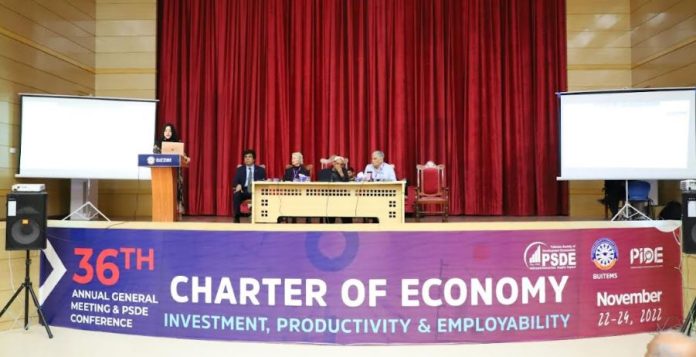
Quetta, NOV 22: /DNA/ – Today is the 1st day of the 36th AGM and Conference of the Pakistan Society of Development Economists (PSDE) on “Unleashing Tomorrow: Investment, Productivity, and Employability,” hosted by the Pakistan Institute of Development Economics (PIDE), in collaboration with the Baluchistan University of Information Technology, Engineering, and Management Sciences (BUITEMS), Quetta.
Very refreshing and invigorating welcome remarks by the Chief Guest at today’s inaugural session of the Conference. Acting Governor Baluchistan, Mir Jan Muhammad Jamali, talked about the need for Baluchistan to have access to power and resources but limited institutions and thought on utilizing those most effectively to make Baluchistan a key province of Pakistan. Guidance from the rest of the country and from experts is needed to assist Balochistani institutes in policy making.
The Honorable Acting Governor acknowledged the focus on provinces after the 18th Amendment but put forward the question of whether provinces have the capacity to carry out this responsibility?
Considering all this, Mir Jan Muhammad Jamali said it is essential that all policy think tanks and intellectuals come together to guide and help the provinces, including Balochistan, in formulating their policy.
Earlier, Dr. Iftikhar Ahmed, former head of the PIDE School of Public Policy and currently serving as the secretary of PSDE, delivered the address and said that the AGM was the most prestigious and important gathering of economists and public policy researchers in the country. He shed light on the theme of the Conference while acknowledging the crucial economic crisis and political polarization the country was going through.
The secretary thanked the sponsors of the 36thg AGM, which is one of the biggest and most prestigious events where economists, academicians, and researchers from across the country and abroad meet and discuss ideas. Research paper presentations, panel discussions, and guest lectures from Nobel laureates and esteemed academics further ornament the Conference. The PSDE has been organizing it since 1982, and currently, the 36th AGM is underway in collaboration with BUITEMS Baluchistan.
It is my first time in Quetta and Baluchistan province since I arrived here in Pakistan at the end of June. Therefore, I could not think of a better occasion than this Conference, which is coming at a challenging time for Pakistan, expressed Her Excellency Riina Kionka, Ambassador of the European Union to Pakistan as a guest of honor of the opening session of the Conference.
She stated that these are challenging times. The world is continuing to cope with the consequences of COVID-19 and high energy prices, inflation and the onslaught of climate change. Climate is changing faster than we can adapt. Pakistan has witnessed a damaging impact in recent floods. In this context, Team Europe has also put in action the assistance of 138 million euros for Pakistan to alleviate immediate problems emanating from flooded areas, including Sindh and Balochistan.
You all must have been closely watching the developments of the COP27 Conference in Sharm el Sheikh, Egypt, HE Kionka asked the audience. Pakistan and its negotiators have played a critical role in harnessing a convergence point where a loss and damage fund for climate change mitigation has been agreed upon. You should be proud of it, as this is a historic moment. EU is also doing its part. It is responsible for 9% of global emissions but contributes 30% of global public financing for the climate.
She further said that Pakistan and the European Union are celebrating 60 years of bilateral relations this year. Both countries engage in political and economic issues – particularly on trade and migration, climate change, development cooperation, etc. So, all these things make up what we call a partnership of strategic nature.
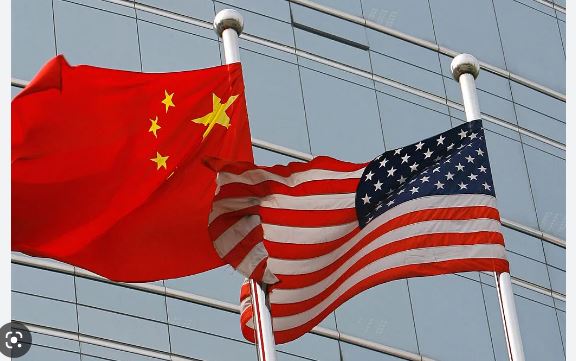
ISLAMABAD: /DNA/ – China and the US were looking for grounds to continue their collaboration. For Pakistan, easing of tensions between the two countries that it wished to engage with, was a glad tiding, said Ambassador Tariq Fatemi, Special Assistant to Prime Minister (SAPM). He was addressing a roundtable discussion titled US-China Relations Amid a Shifting Global Order at the Institute of Regional Studies (IRS). The recent meeting in Bali, was reflective not only of both countries’ intention to engage but mainly to lessen the temperature in order to fit the requirements of diplomacy. The Biden-Xi meeting was the subject of serious analysis by the media and members of the policy circles in both Washington and Beijing.
He said that the rapprochement between China and the US under President Richard Nixon was a very constructive development in the global diplomacy. Following 2000, the US and China had entered the stage of economic engagement and that ever since China’s economic growth had been remarkable.
Reminiscing the trajectory of US- China relations, Ambassador Fatemi said that by the time of Obama’s election, Chinese economy had grown to become the second largest in size. Hence, Obama redirected the ‘pivot’ towards Asia which was formerly towards Europe. It is this pivot that had blossomed into regional and cross-regional arrangements like QUAD and I2U2 etc. He added that there were serious convergences in Trump’s and Obama’s policies on China and also that, Joe Biden was pursuing similar strategy with regard to China. He said that India was being asked to play a more active role in the Pacific where the US was already present.
October 27 is observed as a ‘Black Day’ every year. On this day in 1947, Indian forces landed in Srinagar and illegally and forcibly occupied Jammu and Kashmir. Each year, Pakistan observes this ‘Black Day’ along with supporters of the Kashmiri people around the globe — to remember the sacrifices of the brave Kashmiri brothers and sisters, to reject and condemn the inhuman atrocities being committed by the Indian security forces, and to express Pakistan’s steadfast and unwavering support to the fundamental right of the Kashmiri people to self-determination.
For over seven decades, the illegal occupation of Jammu and Kashmir by India continues. India has denied the Kashmiri people their fundamental and inalienable right to choose their own future as promised to them by the international community through the Security Council resolutions. All this while India has used indiscriminate force and a wide range of illegal methods to suppress the brave Kashmiri people. Three generations of Kashmiris have resisted the illegal Indian occupation.
Through massive sacrifices, the message of the Kashmiri people is loud and clear: the Kashmiris do not wish to live under Indian occupation. The occupation of the State by the Indian forces was a violation of the Partition Plan, which required ascertaining the wishes of the people of Kashmir as to whether they wanted to join Pakistan or India. Examined against all the principles that formed the basis of the British plans to partition the subcontinent in 1947, the people of Jammu and Kashmir would surely have become a part of Pakistan as it was a predominantly Muslim majority State — was geographically contiguous to and had close and essential economic and cultural linkages with territories that were to constitute Pakistan. India maliciously claims that it had signed an ‘Instrument of Accession’ with the Maharaja of Kashmir on 26 October 1947 and that the Maharaja had called for India’s military help against the popular uprising of the Kashmiri people — a claim rejected by the people of Kashmir and Pakistan.
There are doubts about the very existence of the Instrument of Accession. The United Nations also does not consider the Indian claim as legally valid, instead considering Jammu and Kashmir as a disputed territory — as does the whole world — except India. In 1947, India and Pakistan went to war over Kashmir. During the war, it was India that first took the Kashmir dispute to the United Nations on 1 January 1948. Several UN Security Council resolutions called for the holding a plebiscite to ascertain the wishes of the Kashmiri people.
The UNSC Resolution 47 (1948) of 21 April 1948, one of the principal UN resolutions on Kashmir stated that ‘both India and Pakistan desire that the question of the accession of Jammu and Kashmir to India or Pakistan should be decided through the democratic method of a free and impartial plebiscite’. Subsequent resolutions of the UN Security Council (UNSC) and UN Commission for India and Pakistan (UNCIP) reinforced the same standpoint. India refuses to comply with the United Nations by holding a free and impartial plebiscite. After several delaying tactics, India reneged from its position and started calling the State an integral part of India. 2 Around three years back, on 5 August 2019, India moved to alter the disputed status of Occupied Jammu and Kashmir and to change its demographic structure by abrogating Articles 370 and 35A of the Indian constitution.
These illegal and unilateral Indian actions have been vehemently rejected by the Kashmiri people, by Pakistan, and by the international community for being in violation of International Law, relevant United Nations Security Council (UNSC) resolutions, and India’s solemn commitments made bilaterally to Pakistan as well as to the people of occupied Jammu & Kashmir. Since then, the security situation has further worsened.
At present, India has stationed 900,000 troops, turning the Indian Illegally Occupied Jammu and Kashmir (IIOJK) into the world’s largest human prison. The Indian forces are engaged in the brutal and indiscriminate use of force, torture, illegal detentions, and custodial deaths. Thousands of innocent men, women, and children have been martyred. The Indian forces are systematically perpetrating such atrocities under draconian laws to rob the Kashmiri people of their distinct cultural and religious identity.
Sabre Rattling by the Indian Defence Minister In an intended insult to the Kashmiri people, Indian Defence Minister Rajnath Singh visited Srinagar on 27th October 2022 to ‘commemorate the arrival of Indian troops in 1947’. In a statement threatening Pakistan, Singh said that Gilgit Baltistan will become a part of India in the not-too-distant future. He added, ‘we have just begun our development journey in Jammu, Kashmir, and Ladakh. This mission will be completed only when we reach the remaining parts such as Gilgit and Baltistan in line with Parliament’s resolution’.
He was referring to a resolution of the Indian Parliament of 1994 that demanded Pakistan ‘vacate’ what India termed as ‘the Pakistan occupied territories of Kashmir’. The Indian Defence Minister also praised the Modi governments’ action to abrogate Article 370 of the Indian constitution according special status to the disputed territory, thus annexing Jammu and Kashmir in 2019. Indeed, the 5 August 2019 annexation of Jammu and Kashmir is an extension of Hindutva-driven policies of the Modi government that espouses the extremist, genocidal Rashtriya Swayamsevak Sangh (RSS) philosophy.
This is an alarming situation for different minorities living in India. India’s hegemonic behaviour and sabre rattling by its leaders is a source of concern for Pakistan as well as other smaller countries of the region. India’s image as a secular and democratic country is tanking. Pakistan’s response Pakistan’s Foreign Office’s responded: • Strongly rejected and condemned the highly irresponsible, provocative remarks made by the Indian defence Minister at a public event on Kashmir Black Day in Indian Illegally Occupied Jammu & Kashmir (IIOJK). • Regarded the Indian Minister’s delusional remarks as farcical and reflective of India’s characteristic hostility towards Pakistan. • Reminded the Government of India that, ‘The ground realities in IIOJK and Azad Jammu & Kashmir (AJK) are diametrically different.
While AJK is free, open, and accessible to the world, India has forcibly occupied IIOJK for the last seventy-five years and manages it as a vast prison.’ 3 • Underlined that ‘since India’s illegal and unilateral actions of 5th August 2019, Indian occupation forces have extra-judicially killed more than 690 innocent Kashmiris. In a flagrant violation of relevant UN Security Council resolutions, international law, and the 4th Geneva Convention, India has been also seeking to change the demographic structure of the occupied territory’.
• Further reminded India that ‘Jammu and Kashmir remains an internationally recognized dispute on the agenda of the United Nations since 1948’. It is an irrefutable fact that India is ‘an occupation force in IIOJK’ in clear violation of the relevant United Nations Security Council resolutions. • Once again called upon the international community to shoulder its responsibility with regards to IIOJK. India must not be allowed to alter the demography of IIOJK and must be held responsible for its brutal repression of innocent Kashmiris. • Stressed that the only resolution of the Jammu and Kashmir dispute lies in ensuring that the Kashmiris are able to exercise their right of self-determination through the democratic method of holding a UN-mandated free and impartial plebiscite as espoused in the relevant UNSC resolutions, and in accordance with the wishes of the Kashmiri people.
Suggested Additional Steps Pakistan must reinvigorate its efforts to further raise the political cost for India for its reprehensible actions in Jammu and Kashmir. Pakistan must focus where it hurts India the most — namely its ‘secular’, ‘democratic’, and so-called ‘tolerant’ image. In addition to the ongoing endeavours to highlight the Indian atrocities and illegal actions in IIOJK, an effective way may be to enhance the use of social media substantially and systematically as an effective tool to show the true face of India to world leaders and opinion makers. Targeted audience, among others, may be: • Those who wield influence in the corridors of power in the US. • Parliamentary members in leading EU countries.
• Major Human Rights Organizations at the United Nations as well as major international NGOs dealing with human rights abuses. • Major global press and media houses Wherever US and EU media targets human rights violations and imposes sanctions e.g., Russian excesses in Ukraine, we should make an effort to juxtapose Indian brutalities in Kashmir.
Muhammad Haroon Shaukat Ambassador (retd.) is Director Foreign Affairs at the Centre for Aerospace and Security Studies (CASS), Lahore
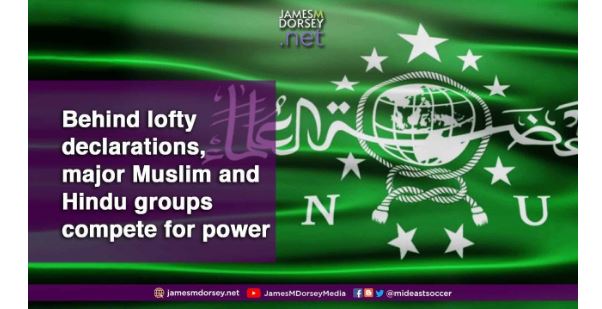
As Indonesia passed the chairmanship of the Group of 20 (G-20) to India earlier this month, major Muslim and Hindu organisations, some backed by their governments, are battling to define the role of religion in global politics and whether the world’s significant faiths need reform to harness the power of their convictions.
The battle’s outcome could determine what constitutes religious moderation, the state’s role in defining what religion stands for, and whether notions of reform will involve significant jurisprudential and doctrinal reforms aimed at erasing concepts of supremacy and enhancing principles of pluralism and greater freedom.
The stage for the battle was set at the Religion Forum-20 (R-20), a gathering of religious leaders in Bali, earlier this month in advance of a summit of the Group of 20 that brought together leaders of the world’s major economies.
Like the summit that positioned Indonesia, the world’s most populous Muslim-majority country and the world’s largest Muslim democracy, as a rising power, the religious gathering positioned Nahdlatul Ulama, the world’s largest and most moderate major Indonesian Muslim civil society organisation, as a leading force in defining moderate Islam and promoting concepts of genuine religious reform not only of Islam but also of other major faiths such as Hinduism.
From Nahdlatul Ulama’s perspective, jurisprudential reform of religious law is the key to positioning religion “as a source of solutions, not problems.”
Nahdlatul Ulama puts forward a strong proposition that it hopes will inspire other faith groups as the world continues to grope for a socially and politically pluralistic version of Islam in the wake of the 9/11 Al Qaeda attacks on New York and Washington.
The movement promotes what it dubs Humanitarian Islam, that in contrast to state-driven attempts at moderation in autocracies such as Saudi Arabia, home to Islam’s two holiest cities, Mecca and Medina, and the United Arab Emirates, unambiguously embraces the Universal Declaration of Human Rights as well as the principle of religious and political pluralism.
Moreover, Nahdlatul Ulama advocates reform of what it terms “obsolete” elements of Islamic jurisprudence.
On the back of being a grassroots movement with an estimated 90 million followers, 18,000 religious seminaries, 44 universities, tens of thousands of Muslim scholars that constitute a religious authority independent of traditional centers in the Middle East, and a political party that is part of Indonesian President Joko Widodo’s coalition government, Nahdlatul Ulama throws down a gauntlet for proponents of a state-controlled, autocratic Islam as well as religious nationalists in other faith groups.
Its proposition was bolstered in 2019 when the group took the first step towards jurisprudential reform with a ruling issued by 20,000 religious scholars that eliminated the category of the kafir or infidel in Islamic law.
Nahdlatul Ulama had hoped that gathering religious leaders in advance of this month’s G-20 summit would position reformist religious leaders as an institutionalised engagement group of the world’s most powerful political leaders and spark a movement that based on shared civilisational values would promote moderate and pluralistic expressions of religion across faith groups.
Less than a month after the religious gathering, that is proving to be easier said than done.
Rather than creating real buy-in from other major Muslim organisations, like Saudi Arabia’s state-controlled Muslim World League, whom Nahdlatul Ulama invited to co-host the religious summit, and Rashtriya Swayamsevak Sangh (RSS), the right-wing Hindu nationalist group, that constitutes the ideological cradle of Indian Prime Minister Narendra Modi and his ruling Bharatiya Janata Party (BJP), the summit appears to have sparked a subtle power struggle below the semblance of a common goal.
The RSS and the BJP are widely seen as attempting to hollow out Indian democracy and secularism while instigating anti-Muslim sentiment in India, which is home to 200 million Muslims, the world’s largest Muslim minority.
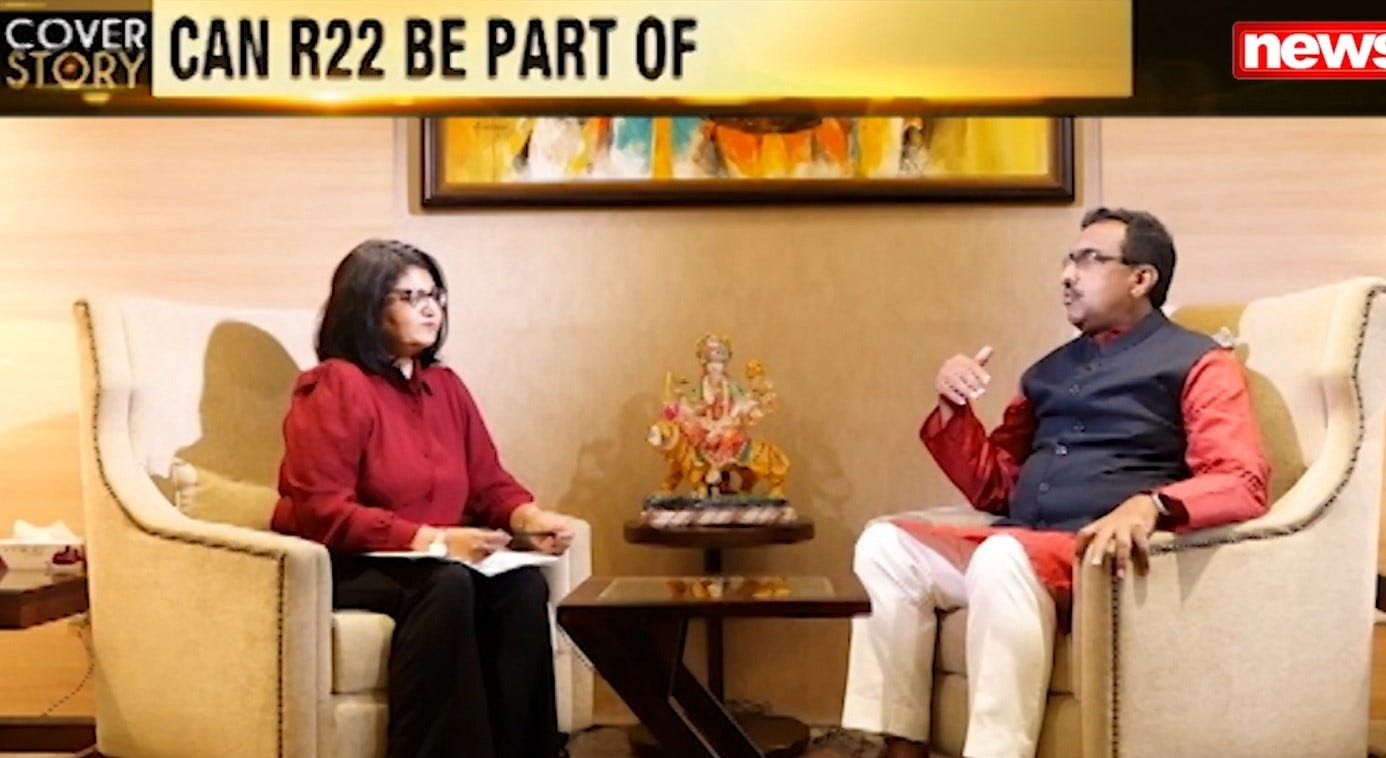
Barely back from the religious summit, Ram Madhav, an RSS national executive member and close associate of Mr. Modi whom many see as a moderate, fired the first Indian salvo in the inter-faith power struggle as Indian officials and religious leaders conceptualise what they want to achieve at next year’s G-20 and what role religion and religious leaders may play.
Chipping away at Indonesia’s designation of the Religion Forum-20 as an official G-20 engagement group with a permanent secretariat hosted by Nahdlatul Ulama’s Jakarta and North Carolina-based Center for Shared Civilization Values (CSCV), Mr. Madhav was non-committal in his first public remarks after returning from Bali to India.
Mr. Madhav expressed a personal preference for maintaining the Religion Forum with the caveat that it remained unclear whether the gathering would be allowed to retain its official G-20 status.
“The (Indian) government will take an appropriate decision,” Mr. Madhav said in a television interview.
Mr. Madhav dodged the issue of religious reform, insisting that the “R-20 per se is not necessarily about religion, it’s about humanity.”
Spinning the R-20’s slogan of ensuring “that religion functions as a genuine and dynamic source of solutions, rather than problems,” Mr. Madhav suggested that religion could help solve global problems such as climate change and tackle what he described as “woke” issues “like LGBTQ; issues related to family, marriage, even gender;” rather than exercise introspection to eliminate problematic religious tenants as advocated by Nahdlatul Ulama.
“This forum was intended to discuss…global issues. In that sense, the focus of this…religious forum was and will not be religions alone… It will be not religion-centric but humanity-centric. So, an effort to bring religions together on larger issues,” Mr. Madhav said.
Similarly, the Muslim World League has used the R-20 to tout its own horn while paying lip service to lofty values Mr. Bin Salman would like to be identified with but has yet to embrace wholeheartedly.
“Leaders participating in the #R20Summit express their appreciation of the great efforts and quality work of the Muslim World League, under the leadership of His Excellency the Secretary General, Sheikh Dr. @MhmdAlissa, the founder of R20, whose efforts contributed to its success,” the League said in a tweet that falsely took credit for an initiative that belonged wholly to Nahdlatul Ulama.
The Indonesian group invited the League after the Saudi government asked Indonesia to assist in carving out a role at the summit for Mr. Bin Salman’s chief propagator of a socially less restrictive but autocratic interpretation of Islam that demands absolute obedience to the ruler.
The invitation fit into a bold but risky strategy that also underlies Nahdlatul Ulama’s engagement with Hindu nationalism.
In the League’s case, Nahdlatul Ulama hopes the alliance will undercut Saudi and League support for an Indonesian political party associated with the Muslim Brotherhood, the Prosperous Justice Party (PKS).
Some analysts and pundits believe that a PKS-backed candidate could do well in the presidential elections scheduled foR-2024.
Moreover, like in the case of the Hindu nationalists, Nahdlatul Ulama aspires against all odds to persuade the League to adopt a genuinely moderate vision of Islam rather than one that serves Saudi Arabia’s autocratic rulers. However, that is a long shot, if not pie in the sky.
Instead, the League has since the religious summit capitalized on Nahdlatul Ulama’s dubious recognition of the Saudi government vehicle as an allegedly non-governmental organisation.
Furthermore, the League presumably seeks to prevent Nahdlatul Ulama from becoming a serious competitor for hearts and minds in the Muslim world through a policy of cooptation that fits into a broader Saudi and UAE effort aimed at seducing Indonesia with financial incentives.
Saudi Islamic Affairs Minister Abdullatif Al-Asheikh made no bones about the purpose of the funding. Mr. Al-Sheikh, according to Arab News, said the funding was in “the Kingdom’s interest in serving Islam and Muslims, based on its leadership in the Islamic world.”
Thank you to all who have demonstrated their appreciation for my column by becoming paid subscribers. This allows me to ensure that it continues to have maximum impact. Maintaining free distributions means that news website, blogs, and newsletters across the globe can republish it. I launched my column, The Turbulent World of Middle East Soccer, 12 years ago. To borrow a phrase from an early proprietor of The Observer, it offers readers, listeners, and viewers ‘the scoop of interpretation.’ If you are able and willing to support the column, please become a paid subscriber by clicking on Substack on the subscription button and choosing one of the subscription options.
Dr. James M. Dorsey is an award-winning journalist and scholar, an Adjunct Senior Fellow at Nanyang Technological University’s S. Rajaratnam School of International Studies, and the author of the syndicated column and blog, The Turbulent World of Middle East Soccer.
The Hindu nationalist project, as conceived by its founders in the 1920s, aims to create a Hindu state in which there is congruence between the main cultural force in Indian society and political power. Since the 1980s, this goal has been sublimated into policies to build a Ram temple in place of the Babri Masjid in Ayodhya, repealing article 370 of the constitution, which grants special status to Jammu and Kashmir, and creating a uniform civilian body code that would abrogate Muslim personal law.
While previous BJP-led NDA governments have preferred to put these policies on the back burner, rather than promote cultural nationalism, the valorization of Hindu majority religion, language and history in everyday practices, under Modi there has been a clear shift in the valorization of Hindu majority religion, language and history in everyday practices, a redefinition of the sphere public, the secular space between state and society, in the language of Hindu nationalism.
In contrast to Nehru secularism, the post-independence India ideology associated with Jawaharlal Nehru, and the socialist outlook of the Congress, the icon of the contemporary BJP is Sardar Vallabhbhai Patel, whose Unity Charter was inaugurated by Modi in October 2018. These norms have been taken further by the Modi government in trying to control dissent. Feminists, radicals, writers, intellectuals, social activists and human rights defenders who have opposed government policies have been marginalized or physically attacked. Directly or indirectly, the government has used its influence in the media, particularly the burgeoning digital media, to unleash a tidal wave of sectarian Hindu nationalism as the official state ideology in which opponents are regularly labeled as anti-national. Sedition laws have been used against women, students, and political activists. Sangh parivar street activists: the family of Hindutva organizations that includes the Rashtriya Swayamsevak Sangh (RSS), Vishva Hindu Parshad (VHP), Bajrang Dal (BD), Akhil Bharatiya Vidyarthi Parishad (ABVP) and Bharatiya Mazdoor Sangh (BMS). ), and a wide variety of vigilante groups, have been regularly employed to discipline opponents, often resulting in physical confrontations or death.
There have also been intensive efforts to redefine citizenship by restricting the right of Indian citizenship to immigrants from Pakistan, Afghanistan and Bangladesh to non-Muslims only. A bill proposing this change failed only because the BJP was unable to secure a majority in the Upper House State institutions have also been used to foster crude jingoism. In 2014, RSS chief Mohan Bhagwat’s annual speech was broadcast live on the national television network, Doordarshan; and in October 2016, the College Scholarship Committee, in an official circular, called on affiliated universities and colleges to make a security pledge on Patel’s birth anniversary to commit to “preserving the unity, integrity, and security of the nation” in the presence of a freedom fighter who would speak of nationalism. This initiative came simultaneously with the government’s attempt to make it compulsory to play the national anthem in all cinemas before a film screening; and although this decision was overturned by the Supreme Court, it created an atmosphere of collective vigilantism against movie-goers who did not follow up the ruling with a reported case in Tamil Nadu. In seeking to redefine the public sphere as a non-secular space of majoritarian nationalism, the BJP and its ideologues argue that they are acting within the spirit of the constitution. So far, the initiatives taken by the government to water down Article 370, Muslim Personal Law, and to build a Ram temple on the site of the Babri Masjid, within the framework of the constitution, but the political results are sought out in line of the Hindutva agenda. Even the most key feature of the constitution, its state secularism, in the logic of Hindu nationalism, is being redefined from being “pseudo-secular” to “genuine secularism”. Gradually but inevitably, a new Hindutva republic is emerging in which there are no profound constitutional changes but where the “political processes” have already “begin to change”. The main antagonistic “other” of Hindu nationalism has been the religious minorities Christians, Muslims, Buddhists, Jains, Sikhs and Zoroastrians against whom the ideology of an ethnicized nation has been built. Traditionally, by making a distinction between religious minorities for whom India is a ‘holy land’ and ‘homeland’, and others, Hindu nationalists have tried to ‘assimilate the former within the broader pantheon of Hinduism and politically and socially exclude the latter as alien to India. This strategy has been applied vigorously in the BJP government’s policies towards minorities since 2014. Funding for minority development programs has been significantly reduced; policy initiatives undertaken by the previous United Progressive Alliance (UPA) government to improve equality and equity, especially for Muslims, in service delivery have been abandoned; Socioeconomically disadvantaged Christian and Muslim communities have been deliberately excluded from affirmative action, while that provision has been expanded to include the “poor” upper castes; and steps have been taken to restore legislative protections for scheduled castes and tribes against violence, in contrast to the denial of any equivalent protection to religious minorities, especially Muslims. These policies have also been carried out in an atmosphere of hostility, often emanating from the government itself. The Minister for Minority Affairs openly stated that “Muslims are not a minority and that the community’s concerns about security stemmed largely from a “psychosis of fear” that had taken hold of the Muslims of India. Similarly, the BJP’s Scheduled Caste Cell Secretary has urged poor Christians and Muslims to “convert back to Hinduism” if they wanted the benefits of the reserves. The campaigns orchestrated by the BJP mass organizations have had a far more debilitating impact on India’s religious minorities, particularly Muslims. Love Jihad was launched in Uttar Pradesh ahead of the and captured the national imagination as a fight against sexually rapacious Muslim youth who convert Hindu women to Islam through false declarations of love. Orchestrated by Yogi Adityanath, who later became the state’s Chief Minister in 2017 in a sweeping victory in the state’s elections, the campaign demonized interfaith marriages, framing it as an affront to traditional notions of patriarchy, family and community. Ghar wapsi emerged shortly after the election of the BJP government to convert Christians and Muslims to Hinduism, often with incentives such as ration cards to access state assets. It quickly turned into a debate about the need for national anti-conversion legislation to reinforce the highly restrictive freedom of religion legislation passed by many BJP state governments. Now it is time for the countries of the region to raise the issues arising from the Hindutva-driven policy in international and regional forums. The world community should not turn a blind eye to the continuing violations of human rights in India and Jammu and Kashmir.