Home Blog Page 1416

Saudi Arabia signs Huawei deal, deepening China ties on Xi visit

RIYADH: Saudi Arabia and China showcased deepening ties with a series of strategic deals on Thursday during a visit by President Xi Jinping, including one with tech giant Huawei, whose growing foray into the Gulf region has raised US security concerns.

King Salman signed a “comprehensive strategic partnership agreement” with Xi, who received a lavish welcome in a country forging new global partnerships beyond the West.

Xi’s car was escorted to the king’s palace by members of the Saudi Royal Guard riding Arabian horses and carrying Chinese and Saudi flags, and he later attended a welcome banquet.

The Chinese leader held talks with Crown Prince Mohammed bin Salman, de facto ruler of the oil giant, who greeted him with a warm smile. Xi heralded “a new era” in Arab ties.

The display stood in stark contrast to the low-key welcome extended in July to US President Joe Biden, with whom ties have been strained by Saudi energy policy and the 2018 murder of Jamal Khashoggi that had overshadowed the awkward visit.

The United States, warily watching China’s growing sway and with its ties to Riyadh at a nadir, said on Wednesday Xi’s trip was an example of Chinese attempts to exert influence around the world and would not change US policy towards the Middle East.

A memorandum with China’s Huawei Technologies, on cloud computing and building high-tech complexes in Saudi cities, was agreed despite US unease with Gulf allies over a possible security risk in using the Chinese firm’s technology. Huawei has participated in building 5G networks in most Gulf states despite US concerns.

Prince Mohammed, with whom Biden bumped fists instead of shaking hands in July, has made a comeback on the world stage following the Khashoggi killing and has been defiant in the face of US ire over oil supplies and pressure from Washington to help isolate Russia.

In further burnishing of his international credentials, Saudi Arabia and the United Arab Emirates said on Thursday that the prince and the UAE president jointly led mediation efforts that secured the release of US basketball star Brittney Griner in a prisoner swap with Russia.

In an op-ed published in Saudi media, Xi said he was on a “pioneering trip” to “open a new era of China’s relations with the Arab world, the Arab countries of the Gulf, and Saudi Arabia”.

China and Arab countries would “continue to hold high the banner of non-interference in internal affairs”, Xi added.

That sentiment was echoed by the crown prince, who said his country opposed any “interference in China’s internal affairs in the name of human rights”, Chinese state broadcaster CCTV said.

Xi, due to meet other Gulf oil producers and attend a wider gathering of Arab leaders on Friday, said China would work to make those summits “milestone events in the history of China-Arab relations”, and that Beijing sees Riyadh as “an important force in the multipolar world”.

Saudi Arabia and other Gulf states like the United Arab Emirates have said that they would not choose sides between global powers and were diversifying partners to serve national economic and security interests.

‘Trusted partner’

China, the world’s biggest energy consumer, is a major trade partner of Gulf states and bilateral ties have expanded as the region pushes economic diversification, raising US hackles about Chinese involvement in sensitive Gulf infrastructure.

The Saudi energy minister on Wednesday said Riyadh would stay a “trusted and reliable” energy partner for Beijing and the two would boost cooperation in energy supply chains by setting up a regional centre in the kingdom for Chinese factories.

Chinese and Saudi firms also signed 34 deals for investment in green energy, information technology, cloud services, transport, construction and other sectors, state news agency SPA reported. It gave no figures, but had earlier said the two countries would seal initial agreements worth $30 billion.

Tang Tianbo, Middle East specialist at the China Institutes of Contemporary International Relations (CICIR) – a Chinese government-affiliated think tank – said the visit would result in further expansion of energy cooperation.

GCCI delegation meets ambassador Raza Bashir in Tokyo

TOKYO, DEC 9 /DNA/ – Pakistan’s Ambassador to Japan Raza Bashir Tarar in a meeting with visiting delegation of Gujranwala Chamber of Commerce & Industry.

Ambassador-designate, Raza Bashir Tarar emphasized the importance of finding indigenous solutions to energy, waste management & water treatment challenges faced by business communities in Pakistan.=DNA

Ethiopia adheres to equitable and reasonable utilization of transboundary water: Envoy

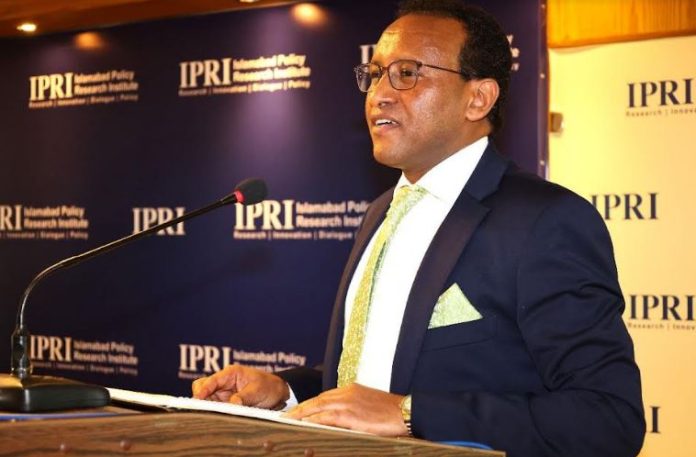
ISLAMABAD, DEC 9 /DNA/ – Ambassador Extraordinary and Plenipotentiary of the Federal Democratic Republic of Ethiopia to the Islamic Republic of Pakistan Jemal Beker Abdula has said that his country fully adhered to the international rule of equitable and reasonable utilization of transboundary water.

“As far as, the Nile River water is concerned, Ethiopia is determined to follow international rules, treaties and conventions, but we do not recognize any treaty to which Ethiopia is not the party,” the ambassador said while delivering a lecture on international water law, hydro-politics and hydro-diplomacy at a workshop titled “Winter School for International Law”.

The “Winter School for International Law” was hosted by the Islamabad Policy Research Institute (IPRI) in collaboration with the Research Society of International law.

At the outset of his lecture, the ambassador elucidated the terms of hydro-politics and hydro-diplomacy and shed light on this subject’s evolution in the last couple of decades.

He also informed the audience about the existing international water laws and treaties, the United Nations Watercourse convention, and theories regarding the use of shared transboundary water resources. 

Around the world, he said three-quarters of UN Member States shared rivers or lake basins with their neighbors. “There are more than 270 shared river basins, which provide freshwater for almost 40% of the globe’s population, including the Nile, the Indus, the Ganges, the Euphrates-Tigris, and the Mekong.”

As regards the inter-state relations of the African continent in the context of shared water resources, he said the Nile River was the longest transboundary river in the world whose water was shared among 11 countries including Tanzania, Uganda, Rwanda, Burundi, The Democratic Republic of the Congo, Kenya, Ethiopia, Eritrea, South Sudan, Sudan, and Egypt.

The ambassador said during the last two centuries, several treaties were concluded in respect of the Nile River, which Egypt has been invoking to justify their ‘right’ to the use of the waters of the Nile River. 

He said Ethiopia was not the party to any of these treaties, however, it directly and actively participated in the Nile Basin Initiative (NBI) forum which was established in 1999 to “achieve sustainable socio-economic development through equitable and reasonable utilization of, and benefit from the shared Nile Basin water resources.”

The ambassador said the NBI produced a draft agreement called the Cooperative Framework Agreement (CFA) after a decade-long extensive negotiation among the riparian countries with the help of WB, UNDP, and other donors.  The Comprehensive Framework Agreement entailed, reflected, and contained the international water laws and principles such as equitable, reasonable, and fair utilization of water, do no harm rule, the obligation to protect the ecosystem, the principle of cooperation, and the obligation to share information and exchange data that end the monopoly of Nile River and begin the new era of cooperation.

He said the upper riparian countries of the Nile River including Ethiopia, Tanzania, Kenya, Uganda, Rwanda, and Burundi had signed the CFA and agreed to utilize more of the Nile’s water resources based on the international water laws, instruments, and principles mentioned above. To this end, Ethiopia has taken a decisive measure of confidence restoring by establishing an International Panel of Expert, and a National Independent Scientific Research Group (Egypt, Ethiopia, and Sudan) to conduct scientific studies on the impacts of the Dam in which Ethiopia accept the outcome of the study.  

The ambassador said Ethiopia had built the Grand Ethiopian Renaissance Dam in line with international water laws, the UN watercourse convention, NBI, CFA, and the Declaration of Principles (2015). It was the largest hydro dam in Africa and 10th in the world which would eventually generate 6500MW of clean energy.

He said the Grand Ethiopian Renaissance Dam would be a game changer for the entire African region as it would promote regional integration through the transfer of clean energy. It would also hold sedimentation in the countries such as Egypt and Sudan and also help avert drought and flood low riparian states with huge storage capacity while it also reduces evaporation.

He also shared Ethiopia’s perspective on the Nile River dispute and presented an analysis of the transboundary issue in the Nile River Basin and the benefits of the Grand Renaissance Dam for all the states in the African region.

H.E. Jemal Beker Abdula said Ethiopia was ready to uphold and continue the trilateral negotiations under the auspices of the African Union. “There is no agreement restricting Ethiopia’s right to exploit the water within its territory, including the construction of a dam taking into account the principles of equitable and reasonable utilization and do no significant harm principles.”

He said Ethiopia believed that all the riparian countries in the Nile River were connected through the Nile blood and would work together to achieve win-win cooperation that will transform the entire region and form the whole Nile Community. 

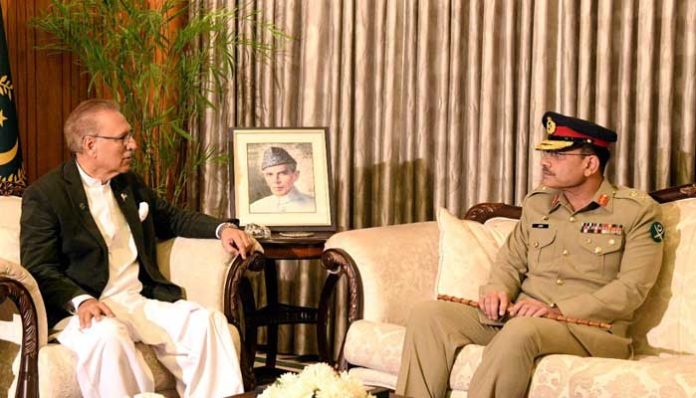
President Alvi hopes COAS will reduce trust deficit among institutions

President Dr Arif Alvi Wednesday hoped that newly-appointed Chief of Army Staff (COAS) General Syed Asim Munir would help reduce the trust deficit among institutions, saying the military leadership is committed to steer clear of politics.

In an interview with a private news channel, President Alvi praised the army chief and his viewpoints. “The matter [appointment of army chief] has been settled nicely for the next three years,” he said, maintaining that the COAS appointment was done on merit.

Commenting on his meeting with Pakistan Tehreek-e-Insaf (PTI) Chairman Imran Khan ahead of the crucial military appointment, the president said that the former prime minister was informed about being consulted after the summary is received, therefore, he added that the consultations were held accordingly.

The president, however, said that he should avoid commenting on the army chief’s appointment as this is the right of parliament.

Gen Munir was handed over the command of the military by General (retd) Qamar Javed Bajwa in a ceremony held at the General Headquarters in Rawalpindi on November 29.

‘Double-game’ 

Regarding Imran Khan’s remarks on former chief of army staff (COAS) General Qamar Javed Bajwa, President Alvi said: “Khan’s comments on ex-COAS Gen Bajwa’s double-game would be based on his own experience.”

Last week, for the first time since spending three-and-a-half years with ex-army chief Gen Bajwa, the PTI chief said: “Giving an extension to him [Gen Bajwa] was my biggest mistake.”

“I would trust whatever General Bajwa said. I would tell him that both of us are [thinking about] the country; our purpose is one — to save the country,” Khan had said.

The former prime minister added that he didn’t know how he was being lied to and betrayed.

‘Dar tried to make things better’

Shedding light on the ongoing debate between the PTI and the coalition government, the president said Finance Minister Ishaq Dar has the talent to reconcile things.

“During the PTI’s sit-in [back in 2014] Dar tried to make things better,” he said, revealing that during his meeting with the financial czar today he was apprised about the economic situation.

Earlier, sources told Geo News that Dar has sought President Alvi’s help in winning over the PTI for the implementation of the International Monetary Fund (IMF) programme.

The sources also said that the finance minister requested the president for the PTI’s cooperation in bringing political stability to the country and the implementation of Pakistan’s agreement with the IMF.

Meanwhile, President Alvi reiterated Dar’s stance that Pakistan will not default. “I gave a proposal to Dar regarding energy conservation. Markets should be closed earlier in order to save three-four thousand megawatts of electricity.”

Dissolution of assemblies

The coalition government and the PTI should sit down and hold talks about the general elections, the president added.

Earlier today, PTI Vice Chairman Shah Mehmood Qureshi said that Imran Khan has decided to dissolve Punjab and KP assemblies within the next few days.

Qureshi revealed that the PTI wants to form new governments in the two provinces before Ramadan.

As per reports, the incumbent government and the opposition have been holding talks regarding the date of general elections as the PTI has been constantly piling up pressure on the government to conduct snap polls.

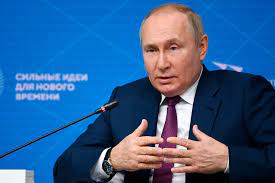
Putin acknowledges Russia’s war in Ukraine could be a long one

LONDON/KYIV: Russian President Vladimir Putin has acknowledged that his army could be fighting in Ukraine for a long time, but said for now there will be no second call-up of soldiers.

Putin has rarely spoken about the duration of a war that he began more than nine months ago but told loyalists in a televised meeting on Wednesday it could go on for some time yet.

“This can be a long process,” he said.

Russia has been forced into a series of significant retreats in the face of Ukrainian counter-offensives, waged with increasing stocks of Western weaponry, in the east and south since July.

Russia launched what it calls its “special military operation” in February, saying Ukraine’s deepening ties with the West posed a security threat. Ukraine and its allies say the invasion amounts to an imperialist land grab.

Putin, in his remarks, said the risk of a nuclear war was growing but Russia would not recklessly threaten to use such weapons.

“We haven’t gone mad, we realise what nuclear weapons are,” Putin said. “We have these means in more advanced and modern form than any other nuclear country … But we aren’t about to run around the world brandishing this weapon like a razor.”

German Chancellor Olaf Scholz said in an interview published on Thursday that the risk of Putin using nuclear weapons had decreased in response to international pressure.

‘No sense’

About 150,000 of the 300,000 reservists called up in September and October had been deployed in Ukraine, 77,000 in combat units, Putin said. The remaining 150,000 were still at training centres.

“Under these conditions, talk about any additional mobilisation measures simply makes no sense,” Putin said.

Russia’s economy has overcome the short-term slump caused by the partial mobilisation order, but the disinflationary impact it had in reducing consumer demand has practically disappeared, the central bank said on Wednesday.

Despite recent retreats on the battlefield, including the loss of Kherson, the one Ukrainian provincial capital Russia captured, Putin has said he has no regrets about launching a war that has become Europe’s most devastating since World War Two.

He said Russia had achieved a “significant result” with the acquisition of “new territories” — a reference to the annexation of four partly occupied regions in September that Ukraine and most members of the United Nations condemned as illegal.

Russian shelling killed 10 people and wounded many in the town of Kurakhove in eastern Ukraine on Wednesday, President Volodymyr Zelenskiy said in his nightly video address.

“These were peaceful people, ordinary people,” said Zelenskiy, who was on Wednesday named Time magazine’s 2022 “Person of the Year” for his leadership.

Fighting was fierce around the nearby town of Bakhmut.

“The enemy has become very active recently, it is on the offensive, their aviation is more active, there are continuous air intelligence missions,” said a Ukrainian unit commander using the nom de guerre Bandera.

“All day yesterday, our positions were being shelled, their unmanned aerial vehicles were in the air all day.”

‘Apocalypse’

Ukrainian military analyst Oleh Zhdanov said Russia had resumed using Iranian-made drones, with Ukrainian forces downing 14 of them in 24 hours as they attacked settlements in west and central Ukraine.

UN Secretary-General Antonio Guterres said the United Nations was examining “available information” about accusations Iran supplied Russia with drones as he faces Western pressure to send experts to Ukraine to inspect downed drones.

Iran denies supplying the drones to Russia, which has denied its forces use Iranian drones to attack Ukraine.

Russian forces have fired more than 1,000 rockets and missiles at Ukraine’s power grid, which is still working despite taking major damage, Interfax Ukraine news agency reported on Wednesday, citing the chief executive of the Ukrenergo grid operator.

Eight recent waves of Russian air strikes on critical infrastructure have seriously damaged the grid and led to emergency and planned outages across the country, including in the capital Kyiv, a city of three million.

Mayor Vitali Klitschko warned of an “apocalypse” scenario without power, running water or heat this winter if Russian air strikes on infrastructure continue. He said there was no need for residents to evacuate now, though they should be ready to do so.

Kyiv could be left without central heating at a time when temperatures can fall as low as -15 Celsius (5 Fahrenheit), Klitschko said in an interview with Reuters.

Japan provides US$ 3.87 million new grantsfor polio eradication effortsin Pakistan

Mahnoor Ansar

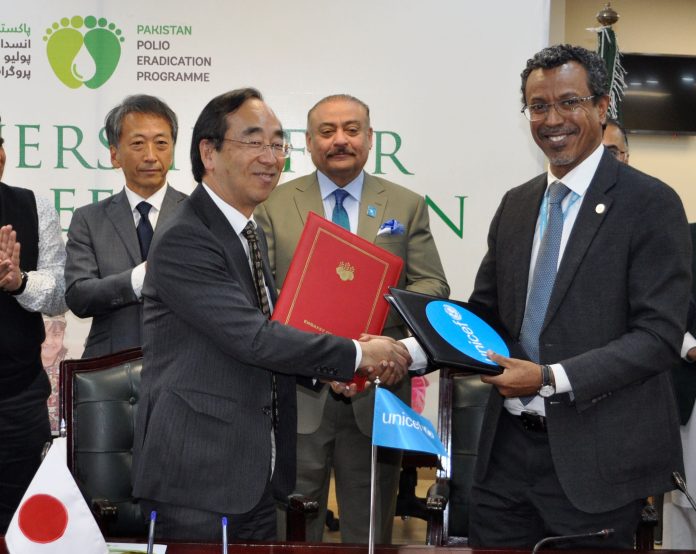
ISLAMABAD, 08December 2022 –The Government of Japan extended its support to the Pakistan Polio Eradication Programme by providing more than US$ 3.87 million as a grant.  The grant will be used for the procurement of essential oral polio vaccine, which will reach more than 18.61 million under five years old children in Pakistan living in endemic and outbreak districts.

The notes of the grant were signed and exchanged between the Government of Japanand the United Nations Children’s Fund (UNICEF)and between Japan International Cooperation Agency (JICA) and UNICEF.Minister Abdul Qadir Patel, the Ministry of National Health Services, Regulation and Coordination and other dignitaries were present during the signing event.

“Pakistan has come a long way in the last 30 years. From thousands of children paralyzed by poliovirus in the 1980s and 1990s, we have managed to reduce the number of cases and affected communities drastically,” said Health Minister Abdul Qadir Patel.Referring to the commitment of the government to polio eradication, the Minister said, “TheProgramme has successfully restricted virus circulation to endemic districts in Khyber Pakhtunkhwa; we are committed and optimistic about eradicating polio by 2023.” The Minister extended his sincere appreciationfor the support of the Government of Japan and partners for their unwavering commitment to Polio eradication.

The Government of Japan has been supporting the Polio Eradication Programme in Pakistan since 1996. The long-standing partnerships have helped to reach millions of children with life-saving vaccines over the years.The grant and loan contribution from the Government of Japan to date has amounted to more than US$ 238.66 million dollars to support the Polio Programme in Pakistan through UNICEF.

H.E. WADA Mitsuhiro, Ambassador of Japan commended the Government of Pakistan and UNICEF for their tireless efforts in emergency vaccination campaigns in southern KP and establishing transit points in North Waziristan to limit the spread of Wild Polio Virus. He also reiterated his continuous support for eradicating poliovirus, by saying that “I would like to renew my commitment to achieve the polio-free world. Japan will continuously support the Government of Pakistan and UNICEF in this regard. I sincerely hope that the national and sub-national campaigns of the next year will be safe and successful.”

“It is very appreciative that polio program has supported the flood relief efforts in the flood affected districts. Health camps have been opened to provide basic clinical services, treatment of water-borne, vector-borne diseases and immunization for children and women of reproductive age. The Government of Pakistan, UNICEF and Japan has a strong target to achieve polio-free in Pakistan by the end of 2023. I would appreciate the continuous and unwavering leadership and commitment of the Government of Pakistan and UNICEF, with the highest respect to the frontline workers,”saidKINOSHITA Yasumitsu, Chief Representative, JICA Pakistan Office.

While polio remains a challenge for Pakistan, the country is facing extraordinary challenges due to recent floods.

“Already these children and families have lost so much, it is imperative that we safeguard them from this deadly disease,” said Abdullah Fadil, UNICEF Representative in Pakistan, highlighting the situation of children and families living in endemic and outbreak districts following the devasting recent floods. “Through the unwavering support and generosity of the people and Government of Japan, more children can now be immunized to prevent the devastation of paralysis and even death. We are now closer to securing a polio-free future for all.”

The programme has made concerted efforts, including working with families at the household level by engaging parents and caregivers and consistently focusing on persistently missed and refusal families. Over 339,521 trained and dedicated polio front-line workers go door-to-door during every national campaign and inoculate vaccines to eligible children. Despite challenges, the PolioProgramme has successfully limited the transmission of poliovirus to the endemic region of southern Khyber Pakhtunkhwa (KP), which is a substantial gain.  Following the new risk categorisation, the next 13 months are critical for the Programme to sustain the gain and eradicate polio from Pakistan.The timeline for stopping all poliovirus transmission in the current global polio eradication strategic plan is the end 2023.

As a partner of the Global Polio Eradication Initiative, UNICEF has been working with the Government of Pakistan, the Bill and Melinda Gates Foundation, WHO and other partners to make sure the national polio eradication and vaccination programmes reach every child in Pakistan.

German envoy highlights cooperation with Pakistan

Staff Report

ISLAMABAD: The week-long exhibition is showcasing the efforts of integrating the Merged Areas into Khyber Pakhtunkhwa, the region’s rich culture and potential as well as Germany’s support to its Pakistan counterparts in local governance, health and education.

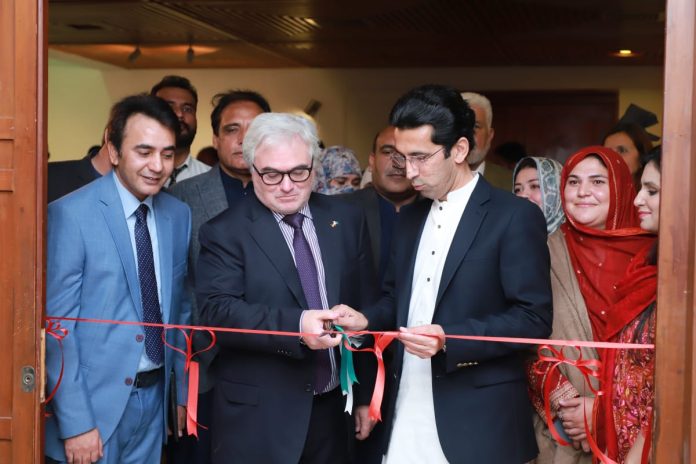
To mark the development cooperation between Pakistan and Germany, GIZ Pakistan and the Embassy of Germany in Islamabad jointly launched a photo exhibition on the Merged Areas of Khyber Pakhtunkhwa in Islamabad. The exhibition is being held at the Pakistan National Council of the Arts (PNCA) from the 8th to 13th of December.

Some 150 representatives and officials of the Khyber Pakhtunkhwa (KP) Government and its line departments, the German Embassy, the European Union, donor agencies, Members of KP’s Provincial Assembly, implementing and development partners, academia as well as the media attended the inaugural ceremony of the photo exhibition.

Various photographers have contributed to this photo exhibition, most notably Mr. Abdul Majeed Goraya of Peshawar and Mr. Alamgir Khan of Mohmand in the Merged Areas. Their pictures show people following their trades, earning their livelihoods and striving to provide their children with a better future. The photographs also illustrate an emerging local governance system, community development initiatives, women standing up for their rights, and improvements in the education and health sectors.

Speaking at the inaugural ceremony, guest of honor, Mr. Shahram Khan Tarakai, Minister of Elementary & Secondary Education of Khyber Pakhtunkhwa expressed his gratitude to the German Government and the European Union for their support to the province in various fields of development. “The Government of Khyber Pakhtunkhwa is highly valuing the partnership with GIZ Pakistan and the joint work in areas such as good governance, education and health. This has lead to major changes in the lives of the people in the Tribal Districts and has contributed to reduce the development lag. Our cooperation has also enhanced public trust in government institutions and has helped to improve public services.” Among the important achievements, he listed improved school curricula, the training of over 5,000 members of Parent’s Teacher Councils, capacity development for over 3,000 managers in the health and educations sectors, as well as training of several hundred officials of the Local Government Department.

In his opening remarks, Ambassador of the Federal Republic of Germany, Mr. Alfred Grannas, highlighted that “the photo exhibition and its catalogue not only offer vibrant insights into the regions’ history, its rich and diverse culture and traditions, but also into the lives of the of the people and their development needs.” He pointed out the long-standing and successful development cooperation between Germany and Pakistan over a period of 60 years during which countless development projects have been implemented. This cooperation has over the decades been continuously adapted to meet new challenges and changing social, economic and ecological conditions, he said. “The FATA Development Programme is also an example of joint European efforts in the field of development. Over the years the program with its budget of almost 40 million Euro was co-funded by the Government of France, the Government of Switzerland and currently by the European Union.”

In his address to the audience, Mr. Karim Kettani, Head of the Finance and Audit Section at the European Union Delegation to Pakistan, outlined that the European Union’s programme “Aid to Uprooted People”, which has been implemented by the GIZ’s FATA Development Programme since 2017, has supported the KP Education Department in improving education for internally displaced and host communities in the Merged Areas. “With the programme’s support, the Government of KP has allocated 2.544 billion rupees for school improvement through community-driven development”. He added that EU support to Pakistan amounts to around 172 million Euros to boost sustainable and inclusive growth, modernizing agriculture and improving inclusive access to resources.

Mr. Irfullah Wazir, Special Secretary of the KP Local Government, Elections and Rural Development Department said that following the merger of erstwhile FATA into KP Province, the Provincial Government has been striving to bring these areas at par with the Settled Districts. “It is challenging to inspire the trust of the 5.5 million people living in the Merged Areas in the recently introduced Local Governance System. I am thus extremely thankful for the extensive support of our international partners, including the German Government and the European Union, for their contributions in making local government’s more efficient. GIZ’s FATA Development Programme has supported us in improving sector governance in the fields of health and education and in training the newly elected councillors to assume their responsibilities in developing their constituencies.”

Dr Peer Gatter, Head of the GIZ-implemented FATA Development Programme, thanked the programme’s counterparts in KP’s government and in civil society for 13 years of trustful cooperation. “We have assisted the Provincial Government in the challenging task to make the Merged Areas’ integration into the Province of Khyber Pakhtunkhwa a success. With development plans launched for all administrative divisions of the Merged Areas, with an education strategy being implemented and the infrastructure of over 5,000 schools having been improved, with girls’ education being fostered through Parent-Teacher Councils, and with quality standards in place in health centres across the Merged Areas, I believe that together we have achieved significant results”. The aim of the exhibition, Peer Gatter explained, is to allow the Pakistani public and the donor community insights into the tribal districts of Pakistan, a region that in the national and international press alike, is often reduced to violence and conflicts. “The lives of the people, their hopes and aspirations and their struggle to develop their communities, is often forgotten”.

Dr Riffat Sardar – Chairperson of the Khyber Pakhtunkhwa Commission on the Status of Women in her remarks expressed her appreciation to GIZ for its support in empowering women in the province of KP.

In her closing remarks, Ms. Stoyanka Stich, Deputy Country Director and Head of the Energy and Climate Change Division of GIZ Pakistan, confirmed GIZ’s commitment to further support local governance reforms in the country.

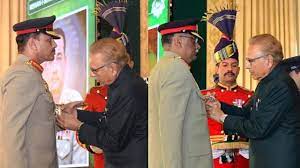
COAS Gen Munir, CJCSC Gen Mirza conferred with Nishan-e-Imtiaz (Military)

President Dr Arif Alvi on Thursday conferred Nishan-e-Imtiaz (Military) upon Chief of Army Staff (COAS) General Syed Asim Munir and Chairman Joint Chiefs of Staff Committee (CJCSC) Sahir Shamshad Mirza.

The new COAS and CJCSC were conferred with the awards in a special investiture ceremony held at the Aiwan-e-Sadar.

Prime Minister Shehbaz Sharif, Senate Chairman Sadiq Sanjrani, National Assembly Speaker Raja Pervaiz Ashraf, federal ministers and others attended the ceremony.

Last month, Gen Munir assumed command as the new COAS after Gen Qamar Javed Bajwa hung up his boots, while Gen Sahir Shamshad Mirza replaced Gen (retd) Nadeem Raza.

The generals took charge of their new posts after Prime Minister Shehbaz promoted them as generals and named them for the new offices.

Who is Gen Asim Munir?

Gen Munir was commissioned in the 23rd Frontier Force Regiment in 1986. He passed out with the 17th Officers Training course, Mangla and was awarded the coveted sword of honour.

Before taking charge, he was posted as the quartermaster general at the General Head Quarters (GHQ).

In 2018, Gen Munir was appointed as the director-general of the Inter-Services Intelligence (ISI) and later transferred as corps commander Gujranwala.

The general also has M Phil in Public Policy and Strategic Security Management from National Defence University.

Gen Munir became the first army chief who headed both — MI and ISI. He is also the first army chief awarded the Sword of Honour.

Who is Gen Sahir Shamshad Mirza? 

Gen Mirza hails from the Sindh Regiment and has had an impressive career in the army, particularly in senior leadership positions during the past seven years.

Gen Mirza came to prominence as the director of general military operations during the last two years of Gen (retd) Raheel Sharif’s tenure. In that role, he was part of Gen (retd) Sharif’s core team at the General Headquarters, which led the military operation against the TTP and other militants in North Waziristan.

Moreover, Gen Mirza was closely involved in the Quadrilateral Coordination Group that brokered intra-Afghan talks involving Pakistan, China, Afghanistan and the United States. He was also a member of the Sartaj Aziz-led committee on reforms for Gilgit-Baltistan.

IHC bars authorities from arresting Suleman Shehbaz upon return

ISLAMABAD: The Islamabad High Court (IHC) on Thursday ordered Suleman Shehbaz to surrender before it on December 13 and barred authorities from arresting Prime Minister Shehbaz Sharif’s son till then.
The court while issuing the directives also asked the authorities not to arrest the petitioner at the airport. The orders were given by IHC Chief Justice Aamer Farooq while hearing a plea filed by the prime minister’s son for protective bail.
During the hearing, Suleman’s lawyer Amjad Pervez told the court that his client is abroad since October 2018 and all the cases were registered after that.
However, the court informed the lawyer that it cannot grant bail in absence of the petitioner.
At this, Pervez urged the bench to stop the authorities from arresting his client, adding that his client will reach Islamabad on December 11. He also shared Suleman Shehbaz’s air ticket with the court.
The court accepted the lawyer’s request and directed Suleman to appear before the bench on December 13 and barred the authorities from arresting the prime minister’s son on his arrival.
The son of PM Shehbaz had approached the IHC through his counsel Amjad Pervaiz a day earlier to seek two-week protective bail in a money laundering case registered against him, as he decided to end his London exile.
Suleman had prayed the court to grant him a protective bail so he could appear before the relevant forum upon his return to the country.
Suleman ends London exile to return to Pakistan
Suleman Shhebaz is set to return to Pakistan after ending his exile of over four years in the British capital.
The prime minister’s son is currently in Saudi Arabia — to perform Umrah — on his way to Pakistan. He will be arriving in Pakistan on Saturday with his wife and children.
Suleman had reached London from Pakistan ahead of the 2018 general elections when the National Accountability Bureau (NAB) registered several cases against him.
He was also named in several cases along with his father, the current prime minister, his brother Hamza Shehbaz, and other Sharif family members.
The Assets Recovery Unit (ARU), headed by Imran Khan’s former accountability aide Shahzad Akbar, had Suleman investigated in London in Shahbaz’s money-laundering and misuse of public office case by the UK’s National Crime Agency (NCA) but he was given a clean chit after two years of investigation by the UK’s top anti-corruption sleuths.
Suleman claimed he was forced to leave Pakistan after fake and manipulated cases were against him and his family in order to facilitate a new political order.
He said that nobody goes into exile, leaving their homeland behind, out of their free will and it’s only under unfair circumstances that he was left with no choice but to “leave Pakistan for safety”.
“There was no chance of any justice at that time when a whole system was put in place to bring in the hybrid system, displacing us as a family and as a political party. The whole system was based on injustice and this system relied on lies, manipulations, and victimisation. The whole system was geared to target us using fake cases and using the state machinery.”
He said in a statement from Madinah: “These cases were the worst example of a political witch-hunt and political victimisation. There was no truth and not a scintilla of evidence of corruption in the cases cooked up by the National Accountability Bureau under the former NAB chairman Javed Iqbal and the Assets Recovery Unit.”
“The former NAB chairman was blackmailed through a relationship scandal and scandalous videos by the previous regime in order to frame cases against me and my family.”
“He was told that he would be kicked out of the job if he didn’t frame these cases to provide non-stop lies to the media to assassinate our character. We will never wish this kind of cruelty to even our worst enemies in politics.”

US warns of action if terrorists regroup in Afghanistan

WASHINGTON: The US State Department on Wednesday warned of action if international terrorists regroup in Afghanistan, fearing the Taliban-ruled country may become a haven for militants again.

The concerns were raised during a press briefing by the State Department Spokesperson Ned Price while speaking about the worsening situation in the region after an attack on Pakistan Embassy in Kabul.

The Taliban failed to live up to their commitments in counterterrorism as well, the spokesperson said. 

“We also have capabilities when it comes to counterterrorism in the region that does not leave us entirely beholden to the Taliban. We demonstrated those capabilities in recent months with the killing of the now-deceased al-Qaida emir, Ayman al-Zawahiri, making good on the pledge that you have consistently heard from President Biden since the withdrawal of military forces from Afghanistan last year, that we will take action if we see international terrorists regrouping in Afghanistan. We will take action in a way that protects our interests.”

Ned Price added that the broader goal of the US is to ensure that terrorists and others aren’t able to use Afghanistan as a launch pad for attacks on Pakistan. 

“Of course, we’ve seen other groups also active. You mentioned the TTP, among others. We are determined to work with our partners in the region, including Pakistan, to do what we can to take on the threat of terrorism in the region, and certainly the threat of terrorism that extends well beyond the region.”

When asked about the security cooperation with Islamabad, the spokesperson said Pakistan is an important partner in a number of respects.

He said that Pakistan receives grant assistance from the International Military Education and Training programme which provides professional military education, operational and technical courses that in turn strengthen Pakistan’s own abilities to take on the threats – whether it’s counterinsurgency, counterterrorism – as well as skills courses that improve institutional capacity and resource management. 

“It continues to strengthen military cooperation between our two countries.”

Asad Majeed as Foreign Secretary 

The US official was also asked to comment on the appointment of the former envoyto the US, Asad Majeed, as the foreign secretary whose cable to Islamabad was at the center of cypher controversy.

Responding to the query, Ned Price said, “We have consistently refuted these false and scurrilous rumours. Our only interest is in the interest of the Pakistani people and Pakistan’s constitutional system. We don’t favour any one candidate or any one personality over another. What we favour is Pakistan’s constitutional system.”  

Afghanistan situation

Responding to a query regarding the public execution in Afghanistan, the State Department’s spokesman Ned Price said, “We have seen reports that the Taliban has ordered judges to impose their interpretation of Sharia law. That includes public executions, amputations and floggings.”

“It was an affront to the dignity and the human rights of all Afghans then; it would be an affront to the dignity and the human rights of all Afghans now, he said.

He said Afghans continue to reject these actions by the Taliban, and the US is closely watching the Taliban’s treatment of the people of Afghanistan. The Taliban government’s relationship with the US and the international community depends entirely on their own actions, he explained. “It depends largely on their actions when it comes to human rights, when it comes to the rights of all Afghans, especially women, girls, minorities, and other marginalised communities in Afghanistan.”

The spokesman said that it is undeniable that the Taliban continue to seek relations with other countries and Afghanistan needs relations with the rest of the world. 

“This is a country that has been able to subsist for decades now with a hefty dose of international aid, development assistance, and humanitarian assistance. The people of Afghanistan – and Afghanistan itself—would not be in a position to have prosperity and stability, stability without continued international assistance,” he said.

The United States is doing its part by providing humanitarian assistance to the people of Afghanistan, he said, adding the Taliban recognise and know that they will need relationships with countries outside of Afghanistan to lend any degree of prosperity, of stability to their country, whether they like it or not.

If the Taliban wish to have any semblance of improved relations with the US, it will depend entirely on their conduct, the State Department’s spokesman said. “It will depend entirely on what they do when it comes to those areas that are in our national interest. Human rights is a core interest of ours; the rights of women and girls, it’s a core interest of ours.”

The Taliban have demonstrated that they are unwilling or unable to live up to the commitments they have made, not only to the international community but most importantly, to the people of Afghanistan, he said.

Stay Connected

64FansLike
60FollowersFollow

Latest Reviews

Exchange Rates

USD - United States Dollar
EUR
1.17
GBP
1.35
AUD
0.67
CAD
0.72