Home Blog Page 1408

Govt asked to focus on innovative housing solutions to bridge gap of housing shortage

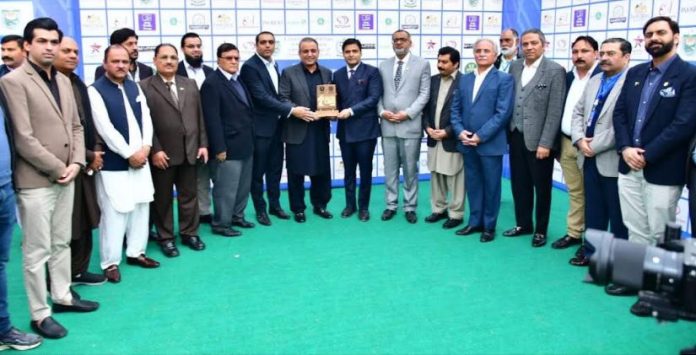
ISLAMABAD, DEC 11 /DNA/ – Abdul Aleem Khan, Chairman Vision Group said that Pakistan needs innovative and creative housing solutions to bridge the gap of rising housing shortage and stressed that the government should amend building byelaws to encourage innovative constructions as current building laws were a major hurdle in vertical growth, which is the future need of the country. He said that the condition of real estate is the yardstick to judge the growth of a country as when real estate grows the country grows and when the real estate is in slump, it means that the economy is in trouble. He said this while addressing as Chief Guest at the Awards Distribution ceremony of the 1st International Housing EXPO 22 organized by Ministry of Housing & Works in collaboration with Islamabad Chamber of Commerce & Industry at Jinnah Convention Centre, Islamabad from December 8-11, 2022, which ended on a high note.

Abdul Aleem Khan said that Dubai has achieved historic development in the last 20 years by encouraging vertical growth in construction and said that Dubai should be the role model for Pakistan. He said that Abu Dhabi, Sharja, Qatar etc. have achieved great economic growth by focusing on the construction industry and said that Pakistan needs a vision to promote the construction industry to revive its economy as this industry boosts the growth of roughly 100 allied industries. He appreciated the Ministry of Housing & Works and ICCI for organizing such a wonderful housing expo.

Speaking at the occasion, Ahsan Zafar Bakhtawari, President, Islamabad Chamber of Commerce & Industry said that many big players of the housing and construction sector are developing good housing projects and the purpose of organizing the Expo was to provide them a good platform to market their projects. He said that the Expo has also provided the people an excellent opportunity to see the housing products of latest trends that help them in building smart and energy efficient houses. He said that the Expo has come up with very good recommendations during breakout sessions to provide shelter to all and hoped that the government would consider implementing them to provide affordable housing options to low-income people. He thanked the platinum, diamond and gold partners and all the exhibitors for making the Expo a successful event. He also thanked the Ministry of Housing & Works for partnering with ICCI to organize the 1st International Housing Expo in these tough economic conditions.

Iftikhar Ali Shallwani, Secretary, Ministry of Housing & Works said that organizing the 1st International Housing Expo in the current difficult economic times was a great challenge and thanked ICCI for joining hands to make it a successful venture. He said that the housing and construction industry has a vital role in the development of the economy and vowed that this Expo would be made an annual feature of the Ministry.  

The first exclusive award was given to Ch. Abdul Rauf, Chairman, Fair Group. From the platinum partners, the top five awards recipients included Grana.com, Gandhara City, Star World, Star Marketing, Fair Deal Marketing. From diamond partners, the top five award recipients included Taj Residencia, Movida, KK Enterprises, Property Enclave and Crescent Lake Tower. From gold partners, the top five award recipients included AMS Group, Amar Builders, Gulberg Mall, R. Power, Chawla Aluminum. The awards were given to various other categories including exhibitors and universities. 

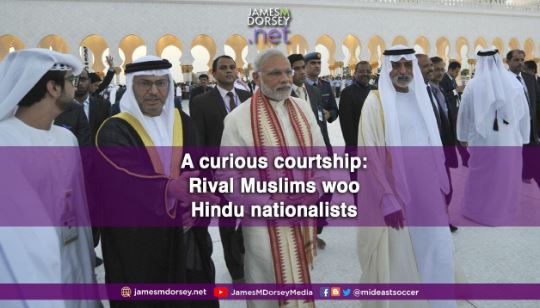
A curious courtship: Rival Muslims woo Hindu nationalists

Muslim religious soft power rivalry, a battle for the soul of Islam, just got hotter. The rivalry’s latest battlefield is not Mecca, Medina, Cairo, Tehran, or Istanbul. It’s Hindu nationalist Delhi.

That is because, for the next year, India chairs the Group of 20 largest economies in the world.

At stake for the Muslim rivals, proponents of rival pluralistic and autocratic forms of Islam, is who will help shape a gathering of religious leaders in advance of the September 2023 Delhi summit of G20 leaders.

The gathering would follow a first Religion Forum 20 meeting in Bali in November, where Indonesia, the world’s largest Muslim-majority country and democracy, declared the R20 an official engagement group with a permanent secretariat in Jakarta.

If the Bali R20 involved an attempt by its rival co-organisers, Indonesia’s Nahdlatul Ulama and Saudi Arabia’s Muslim World League, to coopt one another, Delhi promises to be a three-way competition with the United Arab Emirates joining the fray.

The competition for who will be the primary Muslim player in an R20 Delhi summit is part of a larger Muslim struggle that is likely to define Islam in the 21st century.

Senior Indian officials favour embracing the R20 as an official engagement group. But some are concerned that a religious gathering could turn into a platform that takes India to task for its perceived anti-Muslim policies.

The inter-Muslim struggle pits Nahdlatul Ulama’s socially and politically pluralistic and reformist interpretation of Islam against the Muslim World League and the UAE’s autocratic version that embraces social change, rejects political liberalization, and avoids jurisprudential and doctrinal reform of supremacist attitudes that Islam shares with other major religions.

Part of a bold and risky strategy, Nahdlatul Ulama’s partnership with the League that formally ended in late November raised questions about the group’s legitimisation of the Saudi-government agency as a non-governmental organisation.

The League is a de facto branch of Mohammed bin Salman’s government tasked with propagating the crown prince’s insistence that a socially liberal Islam demands absolute obedience to the ruler.

Nahdlatul Ulama’s silence over a new Indonesian criminal code that parliament recently passed unanimously has sparked further questions on how that squares with its unconditional endorsement of the Universal Declaration of Human Rights – a significant differentiator in its rivalry with state-sponsored autocratic versions of moderate Islam.

The law bans extramarital sex and curbs freedom of expression by, for example, outlawing insulting the president, but puts major limitations on who can file a complaint.

Privately, influential Nahdlatul Ulama sources defend the socially restrictive aspects of the law but concede that freedom of expression concerns are legitimate. The sources expect the law to be modified in challenges likely to be filed with the Constitutional Court.

The competition for India’s favour in shaping a religious summit in Delhi is as much a power struggle between rival interpretations of moderate Islam as between the UAE and Saudi Arabia for religious soft power in the Muslim world.

The competition also involves a battle for influence between a G20 legacy group, the G20 Interfaith Forum Association (IF20), that long dominated the G20’s informal religious tack, and Nahdlatul Ulama.

Nahdlatul Ulama’s R20 sidelined the Utah-based IF20, creating an opportunity for the UAE to step into the breach on the back of its convening power and financial muscle.

Organised by the IF20 and the Interfaith Alliance for Safer Communities, a UAE-based group, the Emirates this week is sponsoring a two-day conference of Muslim, Jewish, Christian, Hindu, and Buddhist figures under the patronage of Emirati President Mohamed bin Zayed.

Entitled “Engaging Faith Communities: G20 Agendas and Beyond,” the conference aims to take the wind out of the sails of the Bali gathering and to position the UAE as an autocratic player alongside the Muslim World League.

Little surprise that neither Nahdlatul Ulama nor the League, despite the Emirates’ alliance with Saudi Arabia, are represented at the Abu Dhabi conference.

More surprising is the absence of longer-standing building blocks of the UAE’s religious soft power campaign, such as the Forum for Promoting Peace in Muslim Societies led by Abdallah bin Bayyah, a Mauritanian Islamic scholar, and Hamza Yusuf, one of the most prominent Western Muslim figures.

The contrast between the R20 Bali’s focus and the agenda of the IF20 in Abu Dhabi says much about the difference in objectives and approaches of Nahdlatul Ulama and the UAE.

While the R20 focused on coming to grips with the problematic histories of various religions, including Islam, to generate genuine religious reform, the IF20 is geared towards themes likely to curry favour in Western capitals.

The Abu Dhabi focus is key to the UAE’s continuous effort to ensure that it is a relevant partner that the United States and Europe would want to defend against attack, particularly in the way they did in 1990 when Iraq invaded Kuwait.

As a result, the IF20’s themes include interfaith dialogue, tolerance, conflict resolution, freedom of religion, refugees, the food crisis, trafficking, health care, and social protection whereas the R20 was about shared religious and civilizational values and historical grievances, truth-telling, reconciliation, and forgiveness.

Key sessions of R20 panels sought to answer questions such as “what values do our respective traditions need to relinquish to ensure that religion functions as a source of genuine solutions, and not problems, in the 21st century,” and “what values do we need to develop to ensure peaceful coexistence, and why?”

To put flesh on the skeleton, the R20 secretariat is organising working groups to formulate detailed responses to these questions that could be debated at a second meeting in Delhi.

Also, timed to coincide with Nahdlatul Ulama’s centennial, the R20 is organizing in February a gathering of Islamic scholars, to which Messrs. Bin Bayyah and Muhammed al-Issa, the Muslim World League secretary general, are being invited.

The meeting is designed to kick off a discussion that would result in jurisprudence that would recognize the legitimacy of the United Nations and its charter as well as the principle of the nation state and anchor them in Islamic law.

In doing so, Nahdlatul Ulama hopes to counter notions of a transnational Islamic state advocated by militants such as Al Qaeda and the Islamic State and make the UN Charter legally binding for its Muslim signatories, according to religious law.

The questions posed during Bali R20 challenge Nahdlatul Ulama, given its involvement in the 1965 massacre of perceived communists in Indonesia, as well as the Muslim World League that has failed to account for its past as a primary vehicle of decades of global Saudi propagation of an ultra-conservative, supremacist, and sectarian interpretation of Islam.

The questions also challenge the UAE’s willingness to go to any lengths to impose an autocratic interpretation of Islam that brooks no political or religious dissent.

Speaking at the Bali gathering, Sri Swapan Dasgupta, an Indian journalist, politician, and close associate of Prime Minister Narendra Modi argued that “obfuscation and denial (of traumatic historical events) has only worsened the situation.”

Mr. Dasgupta was referring to Hindu nationalist grievances dating back to the Muslim conquests in the Indian subcontinent in the 13th to 17th centuries that fuel Mr. Modi’s Hindutava ideology.

Mr. Dasgupta did not say that Hindu nationalist India needs to come to grips with the subcontinent’s history in ways that do not boil down to a campaign of revenge against India’s 200 million Muslims, the world’s largest Muslim minority.

The challenges for Muslims in the rivalry to shape the Delhi G20’s religious agenda are no less daunting.

Muslims can choose between taking the high or the low road to coming to grips with history.

The high road involves confronting painful truths in a quest for a healthier, more pluralistic, and socially cohesive society. The low road allows autocrats to either rewrite history or sweep it under the table and opportunistically bend it to their will.

India is not where the battle for the soul of the world’s major religions, including Islam and Hinduism, will be decided, but it is the battle’s next arena.

Thank you to all who have demonstrated their appreciation for my column by becoming paid subscribers. This allows me to ensure that it continues to have maximum impact. Maintaining free distributions means that news website, blogs, and newsletters across the globe can republish it. I launched my column, The Turbulent World of Middle East Soccer, 12 years ago. To borrow a phrase from an early proprietor of The Observer, it offers readers, listeners, and viewers ‘the scoop of interpretation.’ If you are able and willing to support the column, please become a paid subscriber by clicking on Substack on the subscription button and choosing one of the subscription options.

Dr. James M. Dorsey is an award-winning journalist and scholar, an Adjunct Senior Fellow at Nanyang Technological University’s S. Rajaratnam School of International Studies, and the author of the syndicated column and blog, The Turbulent World of Middle East Soccer.

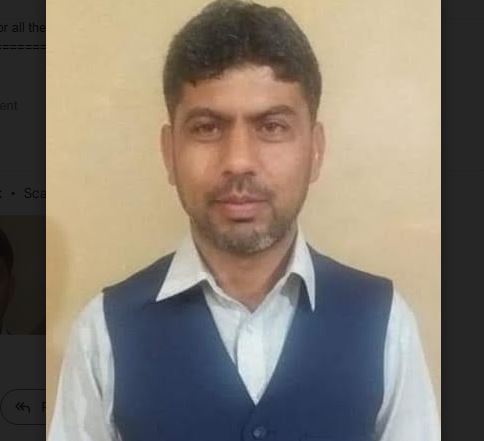
Pothohari language should be included again in NADRA database: Faisal Irfan

By Faisal Munir / DNA

ATTOCK, 11 Dec: Journalist, poet and umpire Faisal Irfan has said on
Sunday that No progress could be made on the registration of Pothohari
language. Speaker National Assembly Raja Pervaiz Ashraf has the
application for one and a half months. Nadra Chairman Tariq Malik had
registered the Pothohari language in the NADRA library this year on my
motion, but removed it from the system after 10 days for unknown
reasons.

Talking to newsmen, he said that  Raja Pervaiz Ashraf became the
Speaker of the National Assembly, he appealed to him in several
applications. Last time submitted written application with all
necessary documents on 18th October but till now no progress has been
made.

He said that the people of Pothwar region demand the Speaker of the
National Assembly to take notice of the matter and add the Pothohari
language to the database of NADRA. Not giving its rightful place to
the mother tongue of millions of people is not only sad but also a
matter of concern for all the ruling classes of Potohar region.

Japan, Pak Economic, Cultural Association formed to strengthen business, cultural ties

DNA

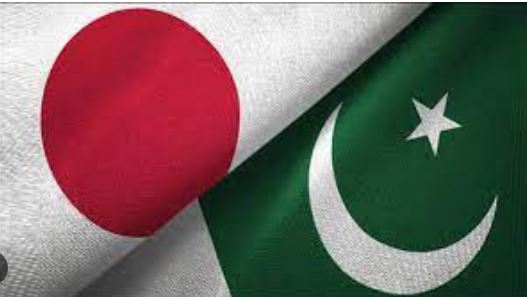
LAHORE, DEC 11: Japan, Pakistan Economic & Cultural Association (JPECA) has been established to facilitate the business and cultural activities between Japan and Pakistan, also having the objective of bringing both countries’ business leaders, social organizations, chambers of commerce, and industrial associations on a united platform.

The two countries’ new joint association, in a ceremony held here today, announced its office-bearers, appointing Takeo Kawamura and Mirza Asif Baig as Co-Chairman while Ijaz A. Khokhar and Jawwad A. Chaudhary were nominated as Vice-Chairman and Senior Coordinator respectively.

JPECA Co-Chairman Mirza Asif Baig, while addressing the ceremony, observed that our key endeavor and thrust is on easing barriers for Pakistani businesses in Japan, as we seek a flourishing and prosperous Pakistan with sustained economic growth ensured through effective and continued policies.

Mirza Asif Baig said that the JPECA’s mission is to provide the best platform for two countries’ public-private sector dialogue on the role and needs of business in achieving inclusive, resilient and sustainable development. The Association has already held its launching ceremony in Japan, where it attracted participants from business, government, academia and civil society from Japan as well as Pakistan.

Mirza Asif Baigh briefed the audience about this Association, which is registered and incorporated in Japan, aiming to strengthen the social and economic values between Japan and Pakistan. He said that JPECA would collaborate to develop a framework of cooperation and undertake actions aimed at strengthening bilateral trade and cultural activities between Pakistan and Japan.

JPECA Vice Chairman Ijaz A. Khokhar, who is also the PRGMEA former chairman, addressing the ceremony, said that  JPECA has recently signed a MoU with PRGMEA to open new avenues for Pakistan value-added apparel industry for liaison with Japan buyers and other leading brands.

Ijaz A. Khokhar said that the JPECA has been formed with a view to cover a wide range of activities for collaboration between Japan and Pakistan such as exchange of information on trade and culture, co-hosting seminars, exhibitions and business delegations, and advocating for enabling business environment and creating soft image among each other countries.

JPECA Vice Chairman said the promotion of mutual trade and investment between two countries was needed to ensure the synergy between the two countries is strengthened. He said that the new organization would be emerged as the leading voice of the private sector through a sustained public policy advocacy, stakeholder engagement, trade and cultural promotion activities both locally and internationally.

Ijaz Khokhar said that this Association would address major issues being faced by the industry of Pakistan and bring those issues to limelight, including compliance, gender training and exchange of delegation.

“ JPECA will pursue the goal of promoting cooperation between Pakistan and Japan cultural societies to realize common development of both countries,” he added.

Our aim is to find how we get SMEs introduced in Japanese market, by promoting Pakistan’s soft image there, he said and added that at the first stage we are planning to take a high powered delegation to visit Japan to interact with the business community of Japan where we would visit Different Chambers.

“We will also invite Japanese counterparts to Pakistan so that we could show them manufacturing of different products in our factories. We will also expand the JPECA activities to the other parts of country. JPECA also plans to start a membership campaign of different product manufacturers produced in Pakistan while its Japan side will provide us the list of items being imported in Japan from different countries which will give an idea to Pakistani manufacturers to focus these items for exports to japan. Our ultimate goal is to get extraordinary concession which japan is already offering to our regional competitors like India and Bangladesh.

Christmas tree lighting ceremony at Islamabad Serena Hotel

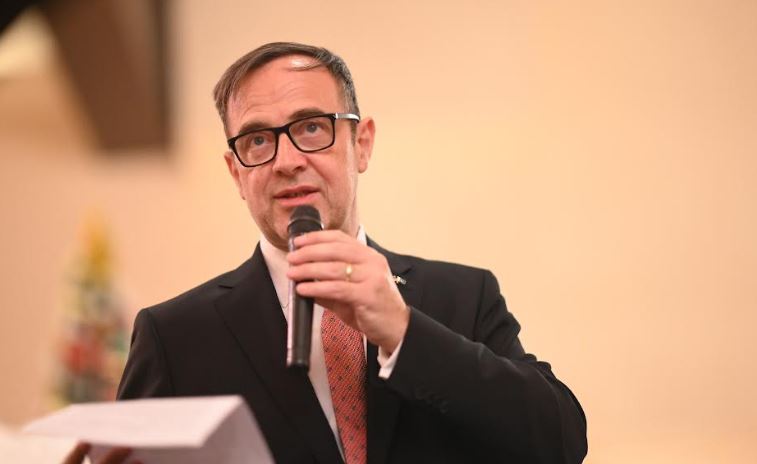
General Manager of the Islamabad Serena Hotel Otto Kurzendorfer welcomes guests; assures to continue this tradition

ISLAMABAD, DEC 11 /DNA/ – The General Manager of the Islamabad Serena Hotel Otto Kurzendorfer has said a year had passed since his predecessor Michel Galopin had stood here to open the festive season at the ISH.  He said they all had missed that in 2020 and 2021 due to the pandemic. Christmas is such a celebration by itself but I guess together with the people from near and far it is more meaningful and nice again.

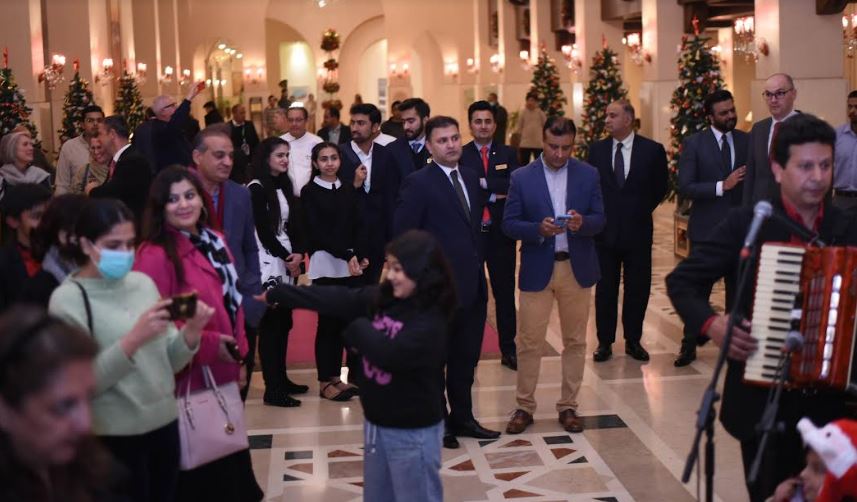
He expressed these views on the occasion of the Christmas Tree Lightning ceremony held in the lobby of the ISH. Diplomats and members of the civil society attended the ceremony in large numbers. Tree lighting ceremony is a regular feature of Serena Hotels Christmas celebrations.

The GM further said, we remember those who celebrated with us in the years before fondly, be it here in beautiful Pakistan or as for example with my family in Kuwait where I had spent the past 4 years.

‘Please allow me as well to thank each of us for your loyalty over the past 12 months, your loyalty to our hotel and the people who come every day to make Serena such a special place. He also thanked guests for helping them in making this place a better place for all’, he added.

Mr. Otto said 2022 had its dark moments as Pakistan witnessed devastating floods but as Christmas is sometimes celebrated as a festival of light and hope, I did witness in the past 4 months such hope and light with our individual contributions to our hotel wide charity drive still ongoing.

 ‘As you must know each mean room night or service you avail here offers on chargeable basis the opportunity to donate 5 percent of its value to our flood relief charity and as we try to help as we can this amount is matched to 100 percent by the hotel. Thank you for making the dark moment a means of joint efforts for the benefit of those who are affected by the flood’.

He also thanked the artists and the priest for being a part of the Christmas celebrations.

Finest Hotel in Quetta

Munaza Kazmi

Famous as the “Fruit Garden of Pakistan” Quetta, city district and division of Baluchistan province and the 5th largest of Pakistan. Quetta is a variation of Kwatkot, a Pashto word meaning ‘Fort’, as it is encircled by the four imposing hills namely Chiltan, Takatu, Zarghoon and Murdaar, which really gives it a status of enchanted valley, that surely engulf the visitor is its charm. The city enjoys rich history dating from 11th Century when Sultan Mahmud Ghaznavi conquered it, and on top it is a love land for all Pakistanis because it’s the region where founder of Pakistan Quaid-e-Azam Muhammad Ali Jinnah, have spent last of his memorable his days.

The only high-altitude city of Pakistan, Quetta situated at 1,680 meters above sea level, having total population of 2.8 million. Local language is Pashto, but don’t worry as some people can even communicate in English, otherwise we have option open for sign language. Climate is dry and temperate is chilly where you would find a rich diversity of dry fruits. Moreover, the valley is abundant with juniper and pistachio forests and diverse wild life. Also, if anyone is obsessed with horses, it’s the right place to be, as horse breeding is thought to be the passion of locals.

Next, I would suggest you pay a visit to the colorful bazars where you would found yourself in brightest of colors of silk, handmade coppers, precious jewels, luxurious rugs, and mesmerizing perfumes, not less than that of the Arabian Nights. I would say, it’s hard to describe the Quetta valley without getting carried away.

However, I landed Quetta in the later afternoon, where I was surprised with the hospitality of locals who went so far to communicate with me even in signs as I don’t understand Pushto, to tell me about the beautiful surroundings and their rich culture. However, it was just a little episode as the hotel driver was waving the board with my name and the shuttle was waiting outside with a basket full of fruits and assorted fritters for my aftar. Really grateful for the hospitality of Serena.

I checked into the Quetta Serena Hotel, as is Serena is my favorite, reasoning its remarkable hospitality and the best services, moreover you can find them all over the country.

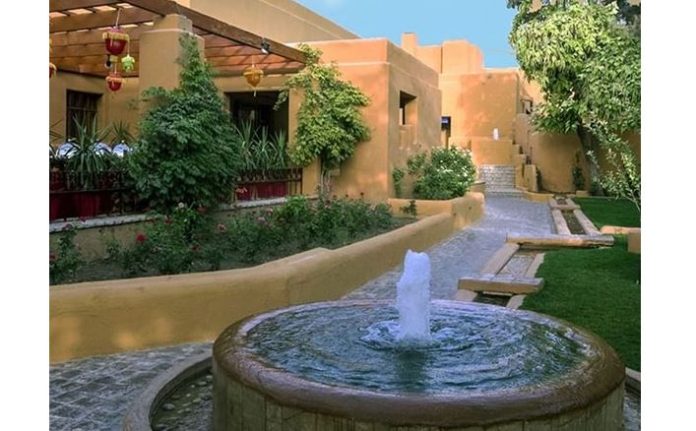
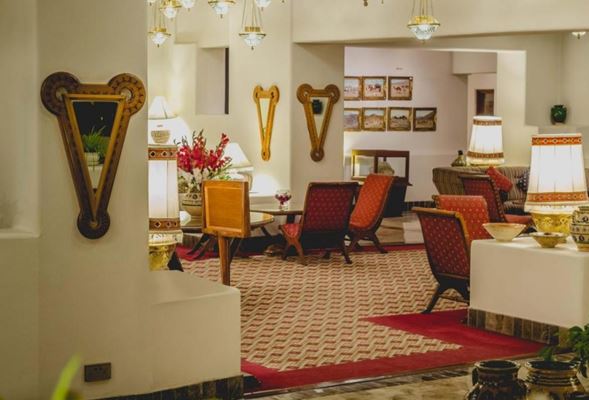
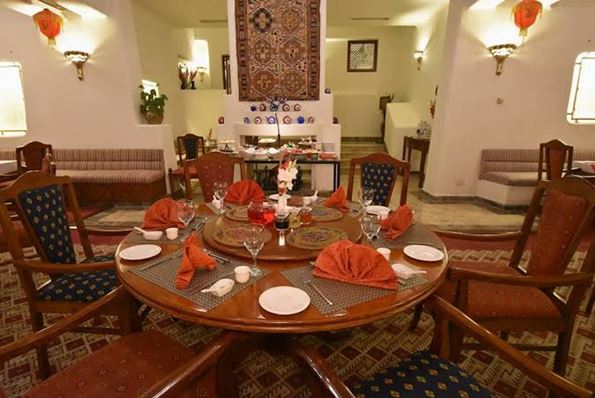
Quetta Serena Hotel, Quetta’s plushest hotel by a comfortable margin, the Serena is unusual among top-end hotels in that it looks like it actually belongs to its surroundings – its design echoes local architectural styles, with Baloch textiles, woodwork and local marble continuing the decorative theme inside. The rooms (all with wi-fi) are suitably refined with high-quality service from staff, plus there are two good restaurants, a food court, a coffee shop, a tennis court, outside pool also a good bookshop from where am planning to fill some left place in my personal library.

Quetta Serena has 140 rooms set in beautiful landscaped grounds. Yet despite the recent unrest all the rooms were booked, and the uniformed staff have been kept on the normal day to day business and some of the rehabilitation task, and they were truly delighted in warmly welcoming me. It surprised and equally delighted me to find out the unbending spark and encouragement in the hotel staff that is truly reflected in their hard work.

By the by it was dinner time, so after making myself easy, I went straight to the Xuelian Restaurant. The handsome restaurant with a wonderfully opulent dining area and an outdoor terrace overlooking the gardens, the manager told me Xuelian Restaurant is known for serving the best Chinese and Thai food in Quetta.

“Would you like to order dinner, madam?” a saffron-suited waiter asked on my first night.

I mumbled something about whatever they could rustle up in the kitchen being fine. His face registered surprise. “We have everything listed on the menu, madam. Fish and chips with mushy peas, sizzling beef fillet, traditional Chinese or Pakistani cuisine.”

“How can you?” I asked. “Hotel must be busy in rehabilitation”.

“But we are a five-star hotel madam,” he said proudly. “We must maintain standards at all times.”

A few minutes later a steaming plate of delicious Shashlik and Egg Fried Rice with Mint Margaretta arrived at my table.

Next morning, I woke up for Sahoor by a polite wakeup call and avail myself with the room service menu that has everything from the classic club sandwich to delicately spiced curry.  Later I spent much of the day in the handsome garden filled with numerous roses and beside the pool with a book that I bought from the hotel book shop.

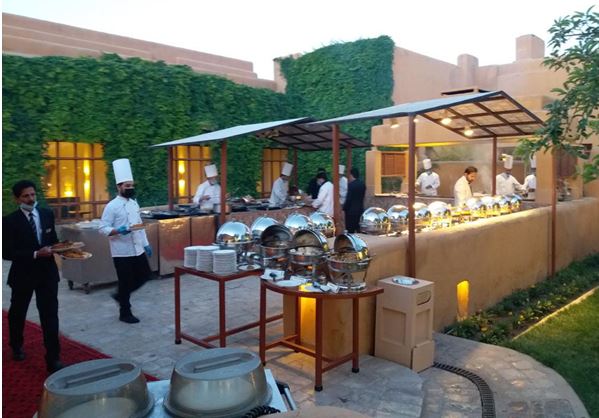
By the time of late afternoon my appetite was getting increased later evening I was ravenous equally by the day pass and by the increasingly tasty smell of cooking from the hotel food court, which made me slip from the luxury of book to the live kitchen. And there what I seen is worthy of national award, the sight of hotel staff working with much diligence was a feeling of intense proud and delight, besides it was a massage enclosed in their behaviors that “we are strong enough to resist any storm, because we have the unity, faith and discipline”.

PTI MPs convey messages to not accept resignations: NA speaker Raja Pervez Ashraf

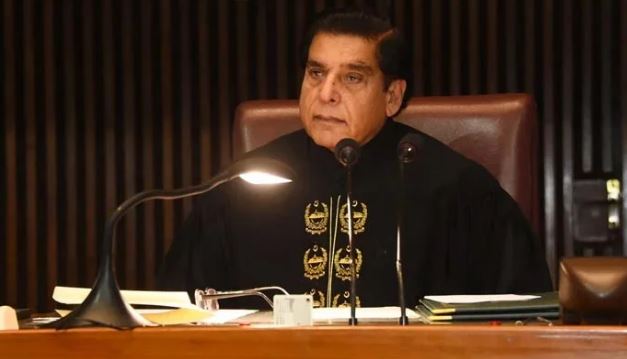
LAHORE: National Assembly Speaker Raja Pervez Ashraf on Sunday said that Pakistan-Tehreek-e-Insaf (PTI) lawmakers’ convey messages to him to not accept their resignations.

The PTI lawmakers had tendered their resignations en masse after the Imran Khan government was ousted through a no-confidence motion back in April.

The PTI has claimed resignations were accepted by former deputy speaker Qasim Suri in absence of the speaker after Asad Qaiser’s resignation.

However, once Raja Pervez Ashraf was elected as the speaker, he decided to verify the resignations by interviewing lawmakers individually.

Later, the resignations of PTI members were de-sealed and Raja accepted only 11 of them.

Speaking to the media persons after visiting Pakistan Peoples Party (PPP) leader Hasan Murtaza residence for breakfast, Speaker Ashraf said that such situations require a lot of thought process, adding that he will not accept the resignations until he is satisfied.

“There is a process to accept resignations with some rules and regulations,” he said. “If a lawmaker gives a statement regarding his resignation and I get to know that he has done it under pressure then I will not accept it.”

Speaking about the current political situation in the country, the NA speaker hoped that the PTI lawmakers return to the Parliament and represent themselves, expressing he wants that the assembly completes its term.

Speaker Ashraf said that the Parliament is for legislation, law and order and election reforms. He said that it is time to put the matters aside and come together for a bigger purpose.

“We cannot move forward by ignoring the Parliament,” he added.

“Asif Zardari is the one who solves and takes things forward,” said the speaker, adding that all political parties should handle matters by consensus. He also said that there is always a back door channel as well.

He called the political parties to work together, saying that all the problems are solved within the Parliament and not outside of it.

“The government will be stable if a country has a strong Parliament,” he stressed.

Talking about the elections, the PPP leader said that the election will be fair and transparent only if the legislation is made better.

“There is no time left for the elections as the fifth year has started,” he added.

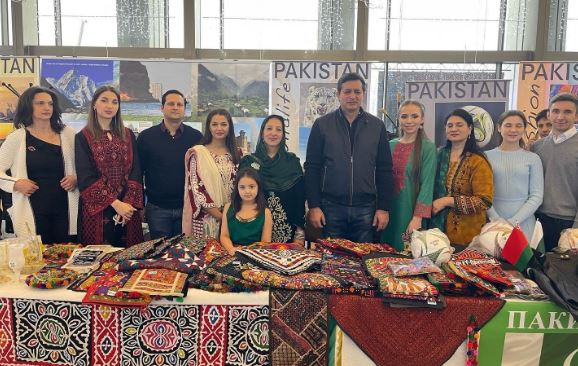
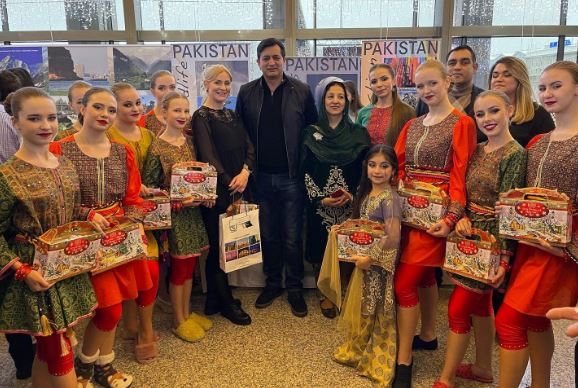
Embassy of Pakistan participates in Annual Charity Bazaar of Minsk Int’l Women’s Club

Minsk, DEC 10 /DNA/ – The Embassy of Pakistan Minsk participated in the Annual Charity Bazaar of the Minsk International Women’s Club held on 10 December 2022 at Palace of the Republic. Several other embassies and private sector organisations also took part in the event.

Thousands of visitors witnessed the presentations spread over the whole day. The Pakistan Embassy’s presentation included beautiful traditional artefacts, select cuisine, live singing of Pakistani songs and dance performances by children of Tamazur Dabce School Minsk.

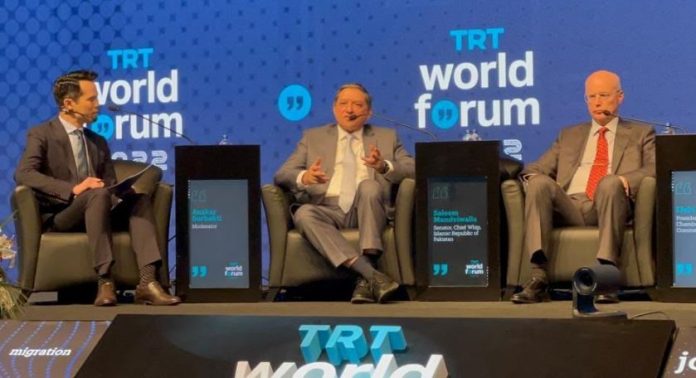
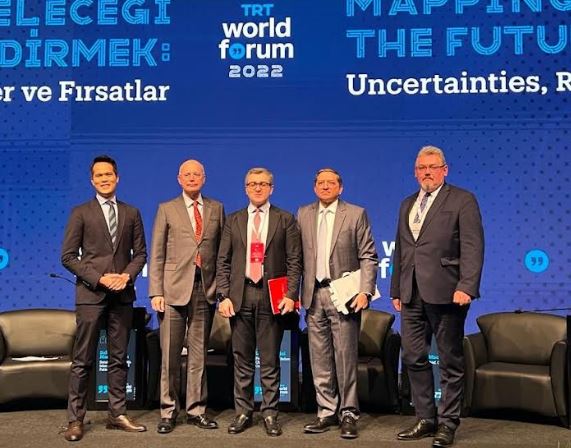
Mandviwalla emphasizes on combined global efforts to avoid post pandemic economic recession

ISTANBUL, DEC 10 /DNA/ – Senator Saleem Mandviwalla, Chairman Senate Standing Committee on Finance and Revenue participated in TRT World Forum held in Istanbul today.

Speaking at a panel titled, ‘Between Recession and Stagflation: The World Economy at the Crossroads’, the Senator elaborated on the dynamics of post pandemic global economy. He stated that the pandemic created pressure on already weak economies, therefore widening economic and social gaps. However, digital globalization offers multifold and multidimensional digital solutions for the boost of economy and other sectors.

The Senator highlighted that it would be impossible for many countries to avoid recession under current risks of stagflation. Therefore, it is imperative that production is encouraged, trade restrictions are avoided and debt relief efforts are enhanced to avoid recession; with debt distress spreading to middle-income countries, the risks to the global economy will amplify.

Learning from the past experiences, it is important to balance the need to ensure fiscal sustainability and mitigating the effects of overlapping crisis. In an extraordinary era of overlapping global crises, policymakers need to focus their efforts on countering inflation, boosting the supply of key food and energy commodities and clean energy to reduce dependency on fossil fuels, Senator Mandviwala added. The Senator reiterated that significant financial and investment commitments towards creating climate-smart regulatory frameworks, adjustment of incentive structures, and strengthening land-use regulations are need of the hour.

In a nutshell, the Senator emphasized on combined global efforts to protect the most vulnerable economies from surging oil and food prices, and considering mechanism for debt relief, to avoid a repetition of economic conditions of 1970s, He added that against the challenging backdrop of higher inflation, weaker growth, tighter financial conditions, and limited fiscal policy space, governments need to prioritize spending toward targeted relief for vulnerable populations. DNA

COAS visits Quetta, Turbat

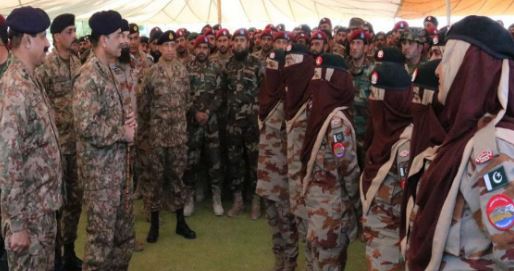
QUETTA, Dec 10 (DNA): Chief of Army Staff (COAS) General Syed Asim Munir paid a two-day visit to Balochistan where he visited Quetta and Turbat, said a statement issued by Inter Services Public Relations (ISPR).

On the first day, COAS visited Corps Headquarters and laid a floral wreath at Yadgare Shahuada and offered Fateha. Later, COAS was given a detailed update on operational, training and other matters of the formation.

COAS also visited Command and Staff College Quetta and the School of Infantry and Tactics and interacted with young officers and instructors and advised them to focus on professional excellence to meet future battlefield challenges.

On the 2nd day of the visit, COAS visited Turbat. IGFC South Balochistan briefed COAS on the prevailing security situation in Southern Balochistan and the measures in place to ensure a safe and secure environment.

COAS said that every effort will be made for the security and safety of the people of Balochistan to ensure a conducive environment for socio-economic development resulting in sustainable peace and prosperity. Earlier, on arrival at Quetta, COAS was received by Lieutenant General Asif Ghafoor, Corps Commander Quetta.

Stay Connected

64FansLike
60FollowersFollow

Latest Reviews

Exchange Rates

USD - United States Dollar
EUR
1.16
GBP
1.34
AUD
0.67
CAD
0.72