Home Blog Page 1400

No plans to enter politics, says ex-DG ISI Faiz Hamid

ISLAMABAD: After being invited to join Pakistan Tehreek-e-Insaf (PTI), former chief of the Inter-Services Intelligence (ISI) Lt Gen (retd) Faiz Hamid has said that he will never join politics, reported The News.

Talking to the publication, the former director general of the ISI said that all speculations about him joining politics or becoming part of PTI were totally false.

“I will not join politics after two-year bar nor afterwards,” the former spymaster told the paper.

A day earlier, a video had gone viral where the former three-star officer of the Pakistan Army was invited by the local PTI leadership in Chakwal to join the Imran Khan-led party.

The video showed Hamid attending a gathering in his native village in Chakwal. In it, an unidentified person, addressing the gathering, praised the former spy chief for his services in the military and the development of the area.

The speaker urged the retired lieutenant general to join politics and play his role in the development of the country.

The speaker thanked him for his active involvement in development works worth millions of rupees in their area during his years in service.

Lt Gen (retd) Faiz had retired from service after General Asim Munir took command of the Pakistan Army as the chief of army staff.

The former DG ISI had requested early retirement after the prime minister had approved Gen Asim Munir and Gen Sahir Shamshad Mirza’s elevation to the four-star rank.

His application for early retirement was approved on December 2 after the Defence Ministry forwarded his request to the premier.

Lt Gen (retd) Faiz was promoted to the three-star rank in April 2019 and was appointed as the adjutant general at the General Headquarters (GHQ). Before his elevation, he was serving as the head of the Counter Intelligence Wing of the ISI.

In June of the same year, Lt Gen (retd) Faiz was posted as the director general of ISIreplacing Gen Asim Munir, the incumbent chief of army staff.

In October 2021, Lieutenant General Nadeem Ahmed Anjum was appointed as the ISI chief while Hamid was transferred as the Peshawar corps commander.

But the appointment became a serious controversy when the then prime minister Imran Khan declined to relieve Hamid from the post. However, he later agreed to it.

In August of this year, Lt Gen (retd) Faiz was transferred and appointed Bahawalpur corps commander, a post he held till his retirement.

The former army officer was targeted by Imran Khan’s political opponents, particularly the PML-N, for his interference in political matters.

One of the reasons behind the PDM’s no-confidence motion against Imran Khan, political observers believe, was their fear that if Khan remains prime minister, then he would appoint Lt Gen (retd) Faiz as the army chief and would then fix the opposition to prolong his rule by manipulating the 2023 general elections.

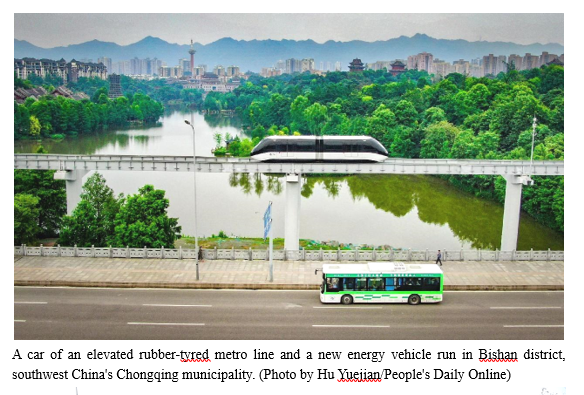
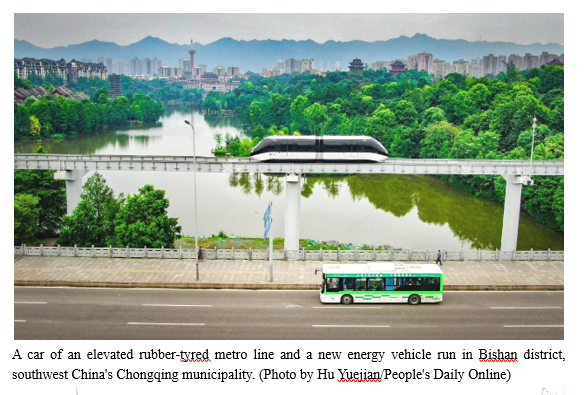
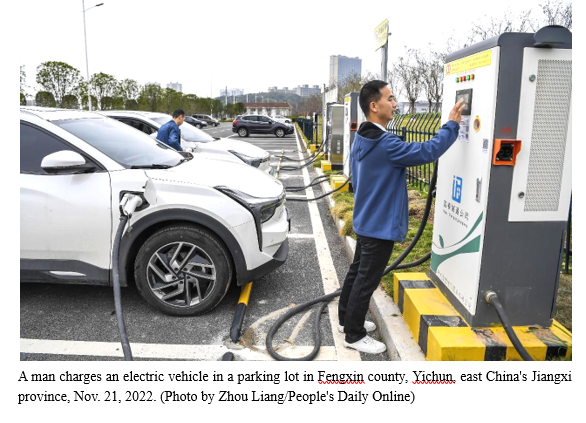
China works vigorously to advance green transportation

By Wang Haonan, Li Junjie, Wang Mingfeng, People’s Daily

By 2030, no less than 70 percent of travel will be conducted through environmentally friendly means in cities with permanent populations of one million or more, said an action plan for carbon dioxide peaking issued by China’s State Council.

Over the recent years, cities across the country have made intensive efforts to advance green transportation, adopting various measures to improve the green mobility experience of citizens and contribute to low-carbon development.

For instance, they have paved bicycle-only lanes, widely put new energy buses into use and built tightly woven rail transit networks.

Beijing’s first bicycle-only lane opened to traffic on May 31, 2019. It extends 6.5 kilometers from Huilongguan, a densely populated community in the northern part of the city, to Houchangcun Road, where a large number of high-tech companies are located. It has become a prioritized choice of commuting by bicycle for many citizens.

A man surnamed Zhang works for an internet company in Beijing. Cycling is his hobby.

“It took me at least an hour to drive to my office if I was caught up in traffic jams, but now I can ride to my office in around 30 minutes,” he told People’s Daily, wearing a helmet, a pair of cycling gloves and a cycling suit, which made him look like a very professional rider.

According to Liu Shuang, head of the bicycle-only lane managing center of Beijing’s Changping district, around 11,600 people ride on the lane every day. As of the end of November this year, a total of 6.49 million trips had been made on the lane, with an average ridership of 4,000 to 9,000 per day.

“Bike riding saves 32 percent and 50 percent of the commuting time respectively compared with driving and taking buses, and it cuts carbon emission by over 1,500 tons per year,” Liu said.

Currently, the bike-only lane in Beijing is undergoing expansion projects, Liu said. Upon completion, it will form a “slow transport” network with a broader coverage linking Changping, Haidian and Xicheng districts, and offer citizens with more choices of low-carbon and efficient transportation.

To put into practice the philosophy of green transportation, Hefei, capital of east China’s Anhui province has vigorously promoted new energy buses over the recent years.

An official with the passenger transport management office of the city’s municipal transport department told People’s Daily that all new and updated buses joining the city’s bus fleet since 2018 are pure electric.

As of the end of 2020, all operating buses running in downtown Hefei were powered by new energy, the official added.

Statistics showed that currently there are 3,440 new energy buses in operation in Hefei, or 98 percent of the city’s bus fleet.

Yang Haibing, general manager of the technical management department of Hefei Public Transport Group Co., Ltd., said that buses in the city reduced 155,700 tons of carbon dioxide emission in 2021, which was equivalent to planting 8.5 million trees based on the criteria that a tree absorbs 18.3 kilograms of carbon dioxide a year.

Apart from optimizing the energy structure of the bus fleet, Hefei also worked to upgrade its bus network with digital means.

In an intelligent bus dispatching center of the city, there is a huge screen that displays real-time information about all the bus stations, passenger volume and operating vehicles in the city.

“By analyzing the data, we are able to manage our capacity in a targeted manner, which brings the maximum convenience to citizens and contributes to the reduction of carbon emission,” said Bu Zexiang, head of the operation management department of the company.

Urban rail transit is favored by citizens, too. Chengdu, southwest China’s Sichuan province, has opened 13 rail transit routes with 558 kilometers of operation in total. According to statistics, the city’s urban rail transit network reported a total of 9 billion passenger trips as of August this year, and over 60 percent of residents opted for public transport.

Besides, Chengdu’s metro system has also worked to better integrate rail transit with bus services. It launched five tourism metro routes and connected over 20 bus routes to the metro network. In addition, it also improved the connection between metro stations and their surrounding transport facilities and commercial areas, to practically optimize the mobility experience of citizens.

‘This is the right time’: Emotional Azhar Ali bids adieu to Test cricket

Batter Azhar Ali has announced that Pakistan and England‘s Test match in Karachi will be his last for the country.  

“Everything has its time. This is the right time, tomorrow will be my career’s last Test,” said Azhar in a press conference, adding that it was an honour for him to represent Pakistan.

The former captain said that there were many people who he was grateful to in the “strenuous, yet beautiful journey”.

“I want to make a special mention of my family without whose sacrifices; I would not have been where I am today. My parents, wife, siblings, and children have been my strength throughout,” said Azhar. 

The batsman said that he was blessed to share dressing room with some of the most outstanding cricketers with whom he shared a “strong bond”. 

“I feel much richer by calling these people my friends. I am also blessed to have played under some wonderful coaches to whom I will always remain grateful,” said the batsman. 

The skipper said that he is retiring from “international cricket as a fulfilled cricketer who ticked most of the goals” he had set for himself. 

“Not many cricketers go on to lead their countries, and that I was able to captain Pakistan is a matter of great pride for me. From being a kid who started as a leg-spinner to becoming a mainstay in the Test batting line-up, I had the loveliest moments of my life that I will cherish forever,” said Azhar. 

Pakistan Cricket Board (PCB) Chairman Ramiz Raja termed Azhar “one of the most committed and loyal servants of Pakistan cricket”. 

“While it is sad that Pakistan will not have a player of his experience in the dressing room to draw upon, it only reflects the circle of life. I hope to see Azhar continuing to play a role in the development of Pakistan cricket and sharing his vast knowledge and experience with budding cricketers,” said Raja. 

The 37-year-old made his debut in 2010 in England against Australia at Lord’s and scored his maiden Test half-century in only his second match. 

He would score 34 more half-centuries and went past the 100-run mark on 19 instances. 

Azhar, one of the most successful batters for the country, scored 7,097 runs in 96 matches at an average of 42.49. 

He is Pakistan’s fifth leading Test run-getter behind Younis Khan, Javed Miandad, Inzamam-ul-Haq and Mohammad Yousuf.

Among his accolades, Azhar is the only Pakistan batter to score a triple-century in a pink-ball Test. He had achieved the feat against the West Indies at Dubai in 2016. That unbeaten 302 remains his highest score in Test cricket.

Azhar captained Pakistan in nine Tests in two separate tenures from 2016 till 2020.

The batter had also ready retired from One-Day Internationals in 2018 – a year after helping Pakistan win the ICC Champions Trophy 2017. 

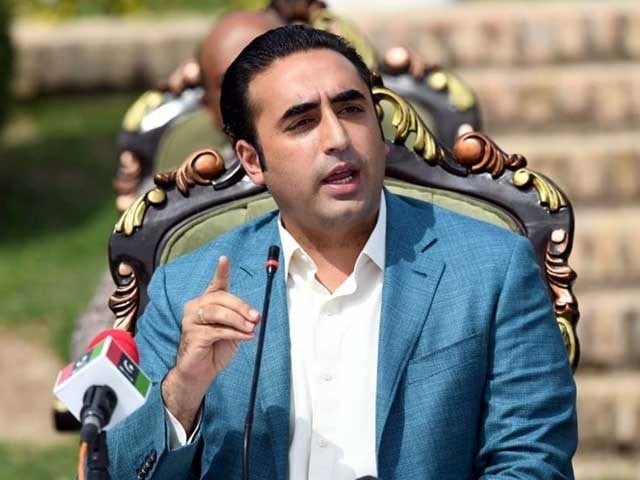
Bilawal Bhutto denies reports of Pakistan getting discounted energy from Russia

Foreign Minister Bilawal Bhutto Zardari denied reports that Pakistan is “pursuing or receiving” any discounted energy from Russia, saying that the country does have energy insecurity and it is exploring various avenues to expand areas to get energy.

The foreign minister’s statement is in contrast to his cabinet colleague, who, after visiting Moscow earlier this month, had claimed that Pakistan is seeking oil at discounted rates from the energy-rich country.  

On December 5, Minister of State (Petroleum Division) Musadik Malik said Russia had agreed to provide crude oil as well as petrol and diesel to Pakistan at discounted rates.

Speaking during an interview with PBS NewsHour on Wednesday, Bilawal said: “We are facing an extremely difficult economic situation, inflation, pump prices. We do have energy insecurity and we are exploring various avenues to expand the areas where we can get energy from. Any energy we receive from Russia will take a long time for us to develop.” 

When asked if Pakistan can have a relationship with the United States as well as have strengthening ties with China and do business deals with Russia, the foreign minister said that as far as Pakistan’s relationship with China is concerned, China is its neighbour with a long history between the two countries.

Pakistan has a lot of cooperation with China, particularly on the economic front, he said, adding that Pakistan has a historical relationship with the US that stretches back to the 1950s. 

“We have partnered over the course of history and I believe whenever the United States and Pakistan have worked together, we have achieved great things. And whenever there’s been a distance developed between us then we’ve faltered.”

“I believe we are now heading in a positive direction with increased engagement on both sides. I think it’s more important, in a world that offers a multitude of challenges, for us to find areas in which we do on to work together. We are doing that on climate, health, we’re finding business and economic opportunities, particularly for women.”

Bilawal said that Pakistan and the US are cooperating in a whole host of areas, calling it a healthy sign. He said that the cooperation between the two countries was narrow and specific within the context of the war on terror in the past, however, Pakistan and the US are now building a more broad-based partnership.

False impression of PTI popularity

When asked if former prime minister Imran Khan would win if the government decides to hold early elections, Bilawal said that he wouldn’t win.

The PPP chief said that removing Khan through a no-confidence motion was a cornerstone of democratic development. 

“Every other prime minister before Khan was either removed through a military coup or the orders of the Supreme Court. This is the first time through a democratic constitutional procedure a prime minister was removed from Parliament.”

He said as far as the by-elections are concerned, Khan resigned from seats that he held himself. He said he believes that there’s a false perception that’s been created about Khan’s popularity and falsely portraying winning by-elections in his own seats as some sort of testament to his popularity across Pakistan.

Bilawal said that the government will not call for snap polls, saying that it is not a justifiable reason for Pakistan to break the precedent of completing its five-year term just because Khan hasn’t been in power for the last six months.

Afghanistan 

Speaking about equal freedom for women and for girls to go back to school in Afghanistan, Bilawal said he has been insisting the world to engage with the Taliban leadership. “We insist that not only Pakistan but the international community must engage with Afghanistan.”

“As far as women’s rights and women’s education is concerned, we believe that women have the right to education and a right to equal space in society at all levels.”

He added that the Taliban have been in power for over a year and one year is not a very long time for them to be able to deliver in Afghanistan. “It is a long time, however, for girls to go without an education. We continue to raise it with them. We encourage the fact that primary education for girls is allowed in Afghanistan, tertiary education for girls is allowed in Afghanistan and we look forward to the day when secondary education will also be allowed.”

When asked if politics should be a family affair, Bilawal said that he agrees that it shouldn’t be a family affair. “In the last 55 years of my party’s existence, we have gone through three generations of leadership. It should still be the first generation of my family doing politics, let alone the second being lost and me having to step up and fill the role that I am fulfilling today.”

He added that his party pursues democracy and has done in the past.

Pakistan summons Afghan diplomat, strongly condemns cross border shelling

Pakistan on Friday summoned Afghanistan’s chargé d’affaires in Islamabad and “strongly condemned” the recent unprovoked cross-border shelling by its border security forces.

“Pakistan’s strong condemnation over recent incidents of unprovoked cross-border shelling by Afghan Border Security Forces in the Chaman-Spin Boldak area, resulting in loss of life, injuries and damage to property, was conveyed,” said Foreign Office Spokesperson Mumtaz Zahra Baloch in a statement.

Islamabad reiterated to the Afghan side that the protection of civilians remained the responsibility of both countries and that the recurrence of these incidents must be prevented.

“It was agreed to use established institutional mechanisms in this regard. Pakistan remains committed to maintaining fraternal relations with Afghanistan. Peace along the Pak-Afghan border is intrinsic to this end,” said the spokesperson.

Normalcy returns to Chaman border

A day after clashes, the Pakistan-Afghanistan border at Chaman was operating routinely amid a high-security alert, security officials told Geo News Friday, adding that a ceasefire is in place with border crossing open at the Friendship Gate.

On Thursday, one person was killed and 15 people were injured when Afghan border forces opened indiscriminate fire on a civilian area on the Pakistani side after which security forces responded befittingly, Levies and hospital officials had shared.

According to local administration, the border area was evacuated after clashes and an emergency was declared in DHQ Chaman.

Levies officials reported that multiple artillery rounds were fired upon the civilian population around the Boghra Road and Custom House areas from the Afghan side. They added that the Pakistani forces have given a befitting response to Afghan shelling.

Authorities had said that the clashes broke out over the intervention of Afghan forces during the repair of the fence in the Sheikh Lal Muhammad sector of the border.

Afghanistan apologises

This was the second time within a week that the Afghan border forces opened unprovoked and indiscriminate fire, using heavy weapons, at the civilian area in Balochistan’s Chaman city.

The border was reopened after Defence Minister Khawaja Muhammad Asif said that the neighbouring country apologised for the incident.

During the previous attack, six people were martyred and 17 others were injured, a statement issued by Inter-Services Public Relations (ISPR) said.

According to the military’s media wing, the Afghan border forces had used artillery and mortar in the attack.

The ISPR said that Pakistan’s troops at the border gave a befitting albeit measured response against the uncalled-for aggression, but avoided targeting innocent civilians in the area.

On December 2, Pakistan’s Head of Mission to Kabul Ubaid-ur-Rehman Nizamani escaped an assassination bid.

In a statement, the Ministry of Foreign Affairs (MoFA) said the embassy’s compound in Kabul came under attack targeting the head of mission, but “by the grace of Allah Almighty, the head of mission is safe”.

However, a Pakistani security guard Sepoy Israr Mohammad had been critically injured in the attack while protecting Nizamani, the Foreign Office said.

China’s Gansu province powers water conservancy with digital twin technology

By Fu Wen, People’s Daily

“The ‘digital wings’ has significantly improved our work efficiency,” said Li Yujun, an official with the management office of the Shule River irrigation district in northwest China’s Gansu province.

According to him, it only takes 10 minutes now to finish a patrol mission of all the irrigation canals with a total length of nearly 80 kilometers, while the work used to cost a few days.

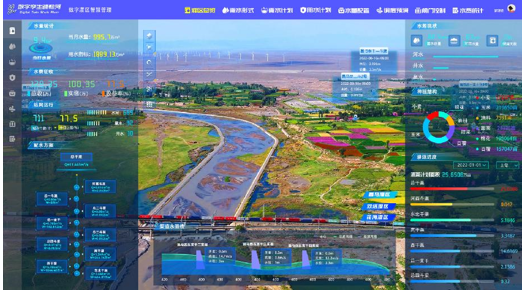
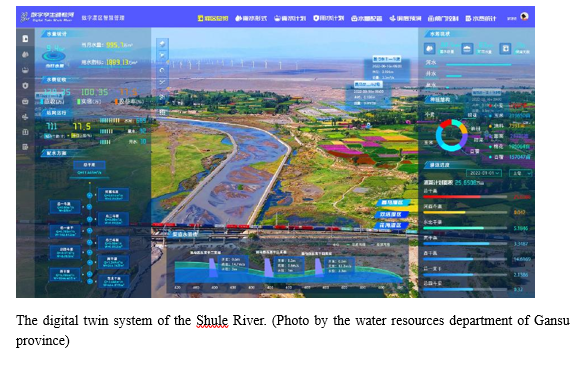
The “digital wings” is a digital twin system of the Shule River, a national pilot project launched by China’s Ministry of Water Resources in February this year. The project has created a virtual version of the Shule River in the digital world, which simulates all factors of the physical river and the whole process of water management based on the physical river basin, spatial-temporal data, mathematical models and water conservancy knowledge.

“To make it simple, it is a ‘twin’ of the river and water conservancy projects in the virtual world. The sensors deployed along the water course and on the bank slopes can ‘feel’ what’s happening like a neural network,” said Xia Tian, director of the cyber security office of the information center of Gansu province’s water resources department.

He told People’s Daily that the digital twin system is like a brain of the river and water conservancy projects, which can not only forecasts potential hazards and predicts the development of possible emergencies such as floods, but also makes dynamic emergency response plans.

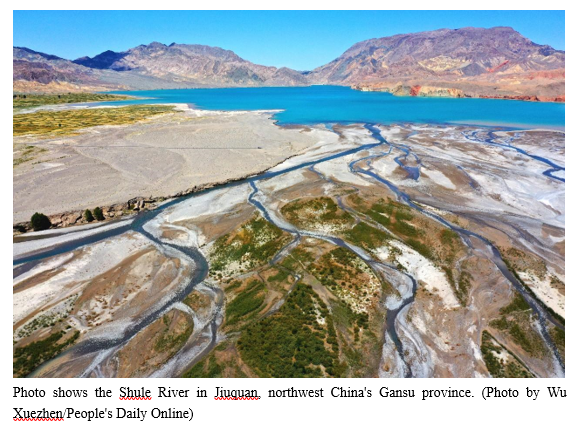
The Shule River is a typical inland river in the arid region of northwest China. The Shule River irrigation district is the largest surface irrigation area in Gansu province, which covers 89,333 hectares of farmland.

Li said a digital management platform has been established for the Shule River irrigation district, which includes 698 monitoring sites of end-canal metering, 106 sets of controlling and surveying gates and 28 radar monitors for water level measurement. The platform is able to track real-time water information from the source of the reservoir to end-canals.

The water resources department of Gansu province has also built a monitoring and warning system for flash flood disasters in the Zhouqu section of the Bailongjiang River, a tributary of the Jialing River, which runs through many counties and districts.

“So far, we have set up a real-time monitoring network and an automatic warning system in the 123-square kilometer densely populated area in the Bailongjiang River basin,” said Xia.

The system can offer pre-warning for outlet cross sections of 53 small watersheds and key cross sections along the 66-kilometer main river course.

In addition, the digital twin technology is also contributing to a water diversion project designed to deliver water from the Taohe River, a major tributary of the Yellow River in Gansu province.

As the longest cross-river water diversion project in Gansu province, the project has canals totaling nearly 1,070 kilometers, almost 400 kilometers longer than the main stream of the Taohe River.

“For the water diversion project, which features a long distance, large quantities of tunnels and ceaseless operation, we have built a whole-process intelligent management system that creates a real-time digital twin, thus improving the project’s operation safety and dispatching capability,” said a manager of Gansu Water-Saving Technology Development Co., Ltd., the company that built the system.

According to him, the system has significantly lowered the energy consumption of water distribution facilities and improved the utilization of water supply to over 95 percent. Besides, it also lowered operational and management cost, and largely quickened failure response.

Juncao contributes to treatment of saline-alkali land in Jiangsu province

By Bai Guangdi, People’s Daily

Yancheng, which literally means the “City of Salt” in Chinese, is located in east China’s Jiangsu province. It is home to more than 455,000 hectares of coastal mud flat, which accounts for 70 percent of the total saline-alkali land of Jiangsu province.

Juncao, which in Chinese literally means “mushroom” and “grass”, can be used to grow edible and medicinal mushrooms. In 2019, Zhang Quanxing, academician of the Chinese Academy of Engineering and professor at the School of Environment of Nanjing University, visited a demonstration base of Juncao in Pingtan county, southeast China’s Fujian province, and learned about the plant’s strong vitality, as well as its high economic and ecological value.

Later, he shared with Lin Zhanxi, chief scientist of the China National Engineering Research Center of Juncao Technology, the idea of planting Juncao grass on the coastal mud flat of Jiangsu province.

In April 2021, Yancheng started growing Juncao grass. Over the past year, the plant has brought about positive changes to the coastal mud flat in the city.

A Juncao test field in Caomiao township, Dafeng district, Yancheng, has planted 10 hectares of Giant Juncao grass, a Juncao grass variety that can grow about five to six meters tall.

The test field was once a piece of salty and barren land where nothing was able to grow.

The Juncao grass is sweet itself, but it tastes salty now because it absorbs the salt in the soil and thus lowers the salt content in the soil, according to Liu Bobin, professor at the Yancheng Teachers University.

Good news from Pingtan county confirmed the impact of Juncao grass. In June this year, a piece of mud flat in Pingtan county saw its salt content drop from 14.7 per mille to 1.3 per mille since it was planted with Juncao grass three years ago by a research team led by Lin.

Yancheng, which has a different climate from Pingtan county, has a higher requirement for the cold hardiness of Juncao grass. At present, researchers are working to cultivate a new variety of Juncao grass that suits the natural environment in Yancheng, so as to better solve the issue of soil salinization in the city.

Apart from improving soil ecology, Juncao grass has also laid a solid foundation for enriching biodiversity in Yancheng.

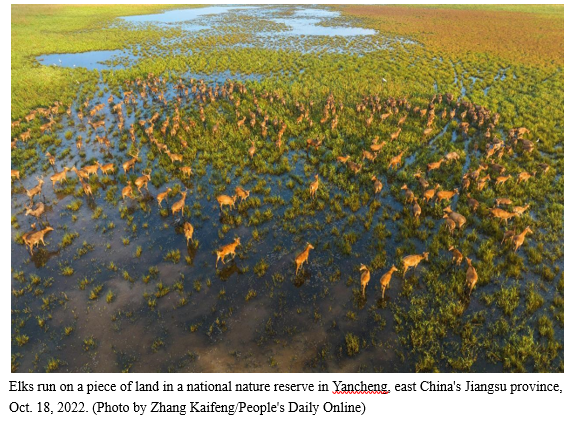
Yancheng has the world’s largest nature reserve for the protection of elks. Statistics show that over 7,000 elks inhabit the areas along the coastal mud flat in the city, including some 3,000 wild ones.

To ensure the source of food for the animals has always been a topic studied by the nature reserve over recent years, and Juncao grass is considered a substitution for traditional feed.

The nature reserve designated a piece of land as a Juncao test field, and the grass harvested there is fed to some of the elks.

According to Jia Yuanyuan, deputy head of the Yancheng research institute of elks, the animals enjoy eating the Juncao grass. However, it takes further scientific experiments to prove whether Juncao grass can be taken as daily feed for elks, she added.

If the result is positive, it will not only significantly reduce the feeding cost of elks, but also enrich the source of food for wild elk populations, Jia said.

Besides, Juncao grass is also a rich reserve of food for migrant birds staying, breeding or wintering in the city.

The strong capability of Juncao grass in nitrogen and carbon fixation has opened up even bigger prospects for the plant.

It is learned that different from other crops that take in nitrogen from the outside, Juncao grass is able to fix nitrogen in the soil through its photosynthesis, which improves the fertility of the soil and lowers the consumption of fertilizers. It is beneficial to the development of ecological agriculture.

Juncao grass can reduce greenhouse gases as well. “Based on experimental data, the photosynthesis efficiency of Giant Juncao grass is 4 to 21 times higher than that of broad-leaved trees. Each hectare of Giant Juncao grass can absorb more than 100 tons of carbon dioxide each year,” said Lin.

Yancheng would see broad prospects of carbon fixation if it plants Juncao grass on all of its mud flats, the scientist added.

Off the pitch, Morocco emerges a winner in the World Cup

France defeated Morocco 2:0 on the pitch, but off the pitch Morocco is up 4:0. Ultimately, the effects of Morocco’s off-the-pitch success may ripple much longer than the fallout of its stellar performance in the stadium.

To be sure, Morocco shares its off-the-pitch success with others, including France, its on-the-pitch history-laden rival, as well as Qatar and Qatari activists.

Fielding squads populated to large degrees by immigrants and their descendants, Morocco and France put migration in a different light at a time when Europe struggled to control immigration.

Migration helped make both teams what they are, one of the world’s top four soccer squads.

The symbolism was not lost on the day four people died when a boat carrying dozens of would-be migrants from France to Britain capsized in the English Channel.

The incident boosted calls for policies that offer migrants safe and legal pathways rather than focus primarily on law enforcement and border protection.

Imagine that France and Morocco had duelled four days later on December 18, International Migrants Day and the day of France’s World Cup final against Argentina. The symbolism would have been even starker.

Even so, the Morocco-France match added texture to the identity aspect of the migration debate and the symbolism of Morocco’s on and off-the-pitch performance.

Many Moroccans and non-Moroccans took pride and joy in the North African state’s Cinderella-like march through the tournament against the backdrop of colonial history, decades of Islam having been put post-9/11 on the defensive amid rising Islamophobia, and as an expression of the rebalancing of global power between West and East.

“Morocco’s semifinal pairing with France has…taken on outsized geopolitical dimensions, seemingly pitting the once colonized against its former colonizer, the Global South taking on the Global North, East against West, David versus Goliath,” said Paul Silverstein, an anthropologist, focused on North Africa.

On one level, the support of a predominantly Muslim Arab and African nation constituted a rejection of militant, politically violent expressions of Islam that sought to exploit the World Cup to divide rather than bring people together in a fleeting moment of solidarity.

An Islamic State poster accusing Jews and Christians of using sports to distract Muslims from waging jihad failed to resonate with fans in Doha and elsewhere.

Sports scholar Mahfoud Amara and political scientist Youcef Bouandel noted that “even the most radical and conservative wings in Islam have not been successful in distancing these populations with their (quasi–religious) passion for football. Which for many is one of the few sources of entertainment when confronted with daily socio-economic difficulties.”  

Likewise, the empathy with Morocco’s sporting success and spotlighting of the Palestinian cause fuelled rather than resolved debates about Moroccan identity, visible gaps between Arab elites and publics, and rivalries among Gulf states that continue to play out despite an end to open animosity.

Little noticed in the celebration of the Moroccan fete as an Arab and African success was Moroccan goalkeeper Munir Mohammed el Kajoui’s gesture when he put his Amazigh identity on public display by wrapping the ethnic group’s tricolour around his waist during celebrations after Morocco defeated Spain.

Amazighs or Berbers account for 40 per cent of the Moroccan population. They saw their identity buried under the Arab African label. To assert themselves, Amazighs celebrated Mr. El Kajoui’s gesture on social media, prompting discussion about whether Morocco is an Arab country.

The complexity of the identity issue at times sparked confusion.

In one incident, in a twist of irony, Qatari security prevented fans from bringing the blue, green, and yellow Amazigh tricolour into the stadium in the mistaken belief that it represented the LGBTQ rainbow.

In another, Moroccan striker Hakim Ziyech listened, impatiently drumming his fingers, to a journalist asking questions in Arabic. A speaker of Dutch, English, and Tarfit, a Berber language, Mr. Ziyech responded, “Now in English, please.”

Most Moroccans speak darija, a spoken rather than a written language widely classified as an Arabic dialect that most Arabic speakers beyond the Maghreb, the western part of North Africa that also includes Algeria, Libya, Mauritania, and Tunisia, are unable to understand.

As a result, BeIn, the Qatari sports broadcaster, adds Arabic subtitles when it broadcasts interviews with darija-speaking Moroccan players and fans.

As genuine as World Cup fans’ support of the Palestinians was, the emergence of Palestine as a touchstone for the gap between elites and public opinion constituted a throwback to the days when Palestinians were a lightning rod for widespread frustration with non-performing, autocratic Arab regimes.

In a subtle, or perhaps not so subtle way, Palestine served Qatar’s purpose.

It allowed Qatar to point the finger at its Gulf rivals, particularly the United Arab Emirates and Bahrain. These two Arab states were at the forefront of the 3.5-year-long UAE-Saudi-led economic and diplomatic boycott of the Gulf state that was lifted in early 2021 and recognized Israel in 2020.

To be sure, the subtext of animosity encountered by Israelis in Qatar was a far cry from the call on Muslims by the Islamic State to “cut…(the) necks of Christians and Jews and kick their heads through the battlefields… rather than surrender your heads to be played with in the soccer arenas.”

Implicitly, fans were taking to task those governments that had recognised Israel for failing to link normalisation to resolving the Israeli-Palestinian conflict.

In doing so, the fans unwittingly projected Qatar as a more open society. They further positioned the Gulf state as being on the right side of history by refusing to normalize relations with Israel before the Jewish state engaged in a constructive solution to the Palestinian problem.

Qatari tolerance of public support for the Palestinians contrasted starkly with the UAE’s banning of critics from travel and restrictions on expressing pro-Palestinian sentiment in Bahrain.

Emphasis on the Palestinians allowed Qatar to portray itself as a country that enables civil society, albeit only if groups align themselves with the Gulf state’s policies and only when the timing of their activities suits the government.

One group that played a key role in galvanizing fan support for the Palestinians, Qatar Youth Opposed to Normalization (QAYON), discovered that early on as the government sought to bend the group to its will through coercion and intimidation.

Founded in 2011 at the time of Qatari support for popular revolts in the region, QAYON saw in the World Cup an opportunity to bolster its campaign against engaging with Israel.

The government rejected the group’s initial World Cup-related demand that it bars Israelis from attending the tournament in violation of the rules of world soccer body FIFA.

FIFA obliges host countries to allow fans to attend a World Cup irrespective of whether they are from nations the tournament host does not recognise or is at odds with the host country.

Nevertheless, in contrast to spectators whom Qatari security prevented from wearing to matches OneLove armbands favouring LGBTQ rights, a sensitive issue in Qatar, or paraphernalia in support of anti-government protesters in Iran, authorities did nothing to stop QAYON from galvanizing fans attending the World Cup.

Qatar justified its banning of the OneLove armband and anti-Iranian paraphernalia by pointing to FIFA’s ban on all political expression on the pitch.

It’s unclear whether FIFA extended the ban to the pro-Palestine campaign or whether Qatar chose to ignore the FIFA rule selectively.

In the final analysis, Qatar, unlike Morocco, never made it out of the World Cup’s group stage. But like Morocco, it emerges from the World Cup, an off-the-pitch winner.

Thank you to all who have demonstrated their appreciation for my column by becoming paid subscribers. This allows me to ensure that it continues to have maximum impact. Maintaining free distributions means that news website, blogs, and newsletters across the globe can republish it. I launched my column, The Turbulent World of Middle East Soccer, 12 years ago. To borrow a phrase from an early proprietor of The Observer, it offers readers, listeners, and viewers ‘the scoop of interpretation.’ If you are able and willing to support the column, please become a paid subscriber by clicking on Substack on the subscription button and choosing one of the subscription options.

Dr. James M. Dorsey is an award-winning journalist and scholar, an Adjunct Senior Fellow at Nanyang Technological University’s S. Rajaratnam School of International Studies, and the author of the syndicated column and blog, The Turbulent World of Middle East Soccer.

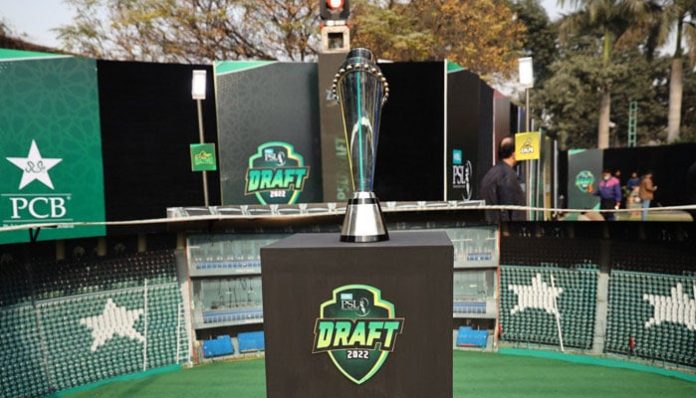
All you need to know about PSL 2023 Draft

KARACHI: The players’ draft for Pakistan Super League (PSL) 2023 will be held in Karachi today, with around 1,000 local and foreign players available to be picked by six franchises for 61 slots.

Five out of six PSL teams had retained eight players, while Peshawar Zalmi retained seven players last month when the retention and transfer windows were closed.

These teams will now complete a squad of 18 — which will have three players each in platinum, diamond, and gold categories, five in silver category, two in emerging and up to two in supplementary categories.

Teams can have up to three foreign players in the first three categories — platinum, diamond, and gold — among them one overseas player is mandatory in platinum and diamond.

In a squad of 16, teams have to pick five overseas players, while in 18, they can have six foreign players.

As many as 517 foreigners and 491 Pakistani players are available for selection tomorrow.

Defending champions Lahore Qalandars will make the first pick in the draft. Quetta Gladiators and Multan Sultans will have second and third picks.

The fourth and fifth picks will be done by Karachi Kings and Islamabad United, while Peshawar Zalmi will make the sixth pick in the opening round.

Qalandars, who had retained Rashid Khan and Shaheen Shah Afridi in the platinum category, would pick one more player in the platinum round. All other five franchises will have two picks available in the platinum category.

Qalandars will have one pick in diamond and two in the gold round, and three in the silver category. They can also add one player from the emerging category to their squad of 16 before adding two supplementary players to the squad.

Karachi Kings had retained Mohammad Aamir, Shoaib Malik, and Imad Wasim in the diamond category, and they will not pick any player in this round but they’ll have all three picks available in the gold round.

Multan Sultans have also retained all three diamond players — Shan Masood, Khushdil Shah and Rilee Rossouw — and have retained two players — Tim David and Shahnawaz Dahani — in the gold category.

Sultans have three picks in the first nine rounds and for them, it is also mandatory to pick at least one foreign player in the platinum category. They also have all five silver picks available.

Henry Cavill says he will not return as Superman

Henry Cavill on Thursday left millions of his fans disappointed when he announced that he will not be returning as Superman.

“I have just had a meeting with James Gunn and Peter Safran and it’s sad news, everyone. I will, after all, not be returning as Superman,” the actor said in a statement.

He said, “After being told by the studio to announce my return in October, prior to their hire, this news is’nt easiest, but that’s life. The changing of guard is something that happens.”

The “Man of Steel” actor said, “For those who have been my side through the years…We can mourn for a bit, but then we must remember…Superman is still around. Everything he stands for still exists, and the examples he sets for us are still there.”

“My turn to wear capes has passed, but what Superman stands for never will.”

Stay Connected

64FansLike
60FollowersFollow

Latest Reviews

Exchange Rates

USD - United States Dollar
EUR
1.17
GBP
1.35
AUD
0.67
CAD
0.72