Home Blog Page 1397

China further optimizes COVID-19 response with new measures

By Zhong Yin, People’s Daily

Local authorities across China have soon made specific policies to implement the 10 new prevention and control measures recently rolled out by the country on further optimizing the COVID-19 response, so as to contain the epidemic in a more science-based and targeted manner.

According to the 10 new measures, China will optimize nucleic acid testing, and quarantine measures imposed on high-risk areas must be lifted if no new infections are reported for five consecutive days. Besides, quarantine measures for COVID-19 patients and response measures at certain locations will be optimized.

The new measures ensure people’s basic needs to purchase medication and underline the need to accelerate vaccination rates especially for the elderly. They will also ensure smooth logistics and enhance the efforts to protect groups at higher-risk .

Over the recent three years, China has been closely monitoring the changes in the virus and the disease, continuously optimizing the prevention and control strategy and measures based on the situation and looking for the best plan..

China has issued nine editions of COVID-19 control protocols, rolled out a series of measures to optimize pandemic control, and effectively responded to more than 100 regional outbreaks at home and five global resurgences. The country has effectively coped with the uncertain pandemic with stable strategies and flexible control measures.

China’s practice fully indicates that its COVID-19 response has to a very large extent protected the lives and safety of the Chinese people and facilitated people’s life, production and investment.

With the weakening pathogenicity of the Omicron, increasing uptake of vaccination and growing disease response experiences, China’s COVID-19 prevention and control work is facing new situations and new tasks.

The 10 new measures represent further optimization of the country’s ninth edition of COVID-19 control protocols and part of the 20 measures announced in November this year based on the features of the virus and the development of the pandemic.

The optimized measures, which match the new COVID-19 dynamics and the features of the Omicron variant, are expected to make China’s COVID-19 control more science-based and targeted. They will make more efficient use of prevention and control resources, better coordinate epidemic prevention and control with economic and social development, and better ensure people’s life and production as well as the demand for healthcare.

It must be realized that these measures are made proactively, rather than passively. The don’t mean relaxation of COVID-19 control, let alone the so-called “lying flat.”

China has a huge population and a large number of senior residents, as well as massive patients of chronic and underlying diseases. It doesn’t have sufficient medical resources and the distribution of such resources remains uneven between regions.

The new measures target at the features of the dominant variant of the coronavirus in China as well as the epidemiological characteristics. They take into consideration the current COVID-19 dynamics and the assessment on the effectiveness of the current control measures. They also learn from the beneficial experiences accumulated across China.

The 10 new measures are exactly a concrete step taken to implement the people-centered philosophy that puts people and their lives and health in the first place, as well as a step that further optimizes prevention and control measures.

By ramping up the vaccination drive, especially among the elderly, and preparing more medical and healthcare resources, the new measures will enhance China’s capacity in pandemic prevention and control and lay a solid foundation for further optimization.
China, Arab states drawing blueprint for future development

By Chen Weiqing

Chinese President Xi Jinping arrived in Riyadh, Saudi Arabia on Dec. 7 to attend the first China-Arab States Summit and the China-Gulf Cooperation Council (GCC) Summit, and pay a state visit to Saudi Arabia upon invitation.

He had in-depth exchanges of views with leaders of Arab states on comprehensive cooperation as well as major international and regional issues.

Together, they jointly charted the course for China-Arab states, China-GCC and China-Saudi Arabia relations, and worked to build a China-Arab community with a shared future in the new era.

China and Arab states have deepened and consolidated their political mutual trust.

China firmly supports Arab states in upholding their sovereignty, security and stability, and supports them in pursuing a development path suited to their national conditions. Arab states have always shown their staunch support for China on issues related to its core interests and major concerns.

Both sides support and safeguard the international system with the United Nations at its core and the international order underpinned by international law. They stand against all forms of hegemony and power politics.

Arab states have actively responded to the vision of building a community with a shared future for mankind, the Global Development Initiative (GDI) and the Global Security Initiative proposed by Xi. As of October 2022, 17 Arab states have voiced support for the GDI, and 12 have joined the Group of Friends of the GDI.

China and Arab states have yielded fruitful achievements in mutually beneficial cooperation.

China is the largest trading partner of Arab states. Their trade volume reached some $330 billion in 2021. To date, China has signed Belt and Road cooperation agreements with 20 Arab countries and the Arab League.

The two sides see bright prospects in their cooperation on 5G communication, aerospace and satellite, renewable energy, artificial intelligence, big data and other high-tech sectors.

Together, they have fought against the COVID-19 pandemic with solidarity and cooperation. Their efficient cooperation on vaccine development, joint pandemic prevention and control, experience sharing and pharmaceuticals has set a good example for global anti-pandemic cooperation and vividly mirrors the China-Arab community with a shared future.

China and Arab states are seeing increasingly frequent people-to-people exchanges.

The two sides have been bound by a long history of friendly exchanges along the ancient Silk Road. As an envoy of friendship and knowledge, Chinese navigator Zheng He in the Ming Dynasty (1368-1644) paid multiple visits to the Arab world.

Both Chinese and Arab civilizations embody the common ideals and aspirations of mankind for development and progress, and they both champion such values as moderation, peace, forgiveness, tolerance and self-restraint.

Over recent years, learning Chinese has become a trend in Arab states. As of October this year, four Arab states had declared to include Chinese in their national educational system and 15 had set up Chinese language majors in their universities. Besides, China had built 20 Confucius Institutes and two independent Confucius Classrooms in 13 Arab states.

China-GCC relations have grown from strength to strength.

Over the recent years, China-GCC relations have maintained healthy, stable and comprehensive development, and have been at the forefront of China’s relations with Arab countries.

The two sides have established a strategic dialogue mechanism and maintained close coordination and communication in international and regional affairs.

China has remained the GCC’s largest trading partner, and the two sides’ trade volume surged 44 percent last year.

At present, China-GCC cooperation is being gradually expanded from the traditional sector of energy to high-tech and emerging industries.

Under the current circumstances, China and GCC countries, as good brothers, friends and partners, will keep supporting each other and offering each other mutual assistance.

China-Saudi Arabia relations have embarked on a fast lane of development.

China takes the development of its relations with Saudi Arabia as a priority in its overall foreign relations, in particular its diplomacy in the Middle East.

During Xi’s state visit to Saudi Arabia in January 2016, China and Saudi Arabia established a comprehensive strategic partnership and decided to set up the China-Saudi Arabia High-level Joint Committee.

Saudi Arabia is the largest trading partner of China in West Asia and North Africa, with bilateral trade volume reaching $87.31 billion last year, up 30.1 percent year on year.

China will keep synergizing the BRI and Saudi Arabia’s Vision 2030, to build a high-level cooperation pattern in energy, economic and trade, and high-tech sectors.

It is believed that Xi’s trip will bring China-Arab, China-GCC and China-Saudi Arabia relations onto a new level. China and Arab states, drawing a blueprint for their future development, will make new contributions to safeguarding world peace and stability and promoting global development.

(Chen Weiqing is the Chinese Ambassador to Saudi Arabia)

Imran Khan pulls the trigger: what next?

Comment

Ansar M Bhatti

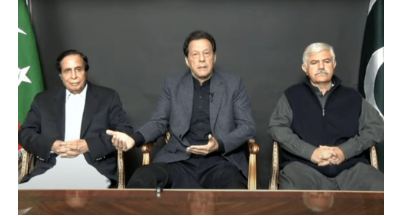
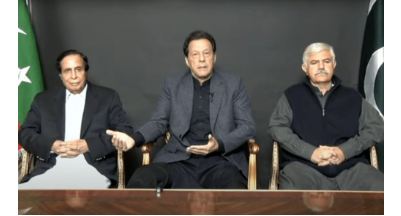
Despite all ifs and buts and a veiled resistance from the chief ministers of the Punjab and KPK provinces the PTI Chairman Imran Khan has finally decided to call it a day. During a televised address on Saturday, he announced to dissolve both these assemblies on December 23 saying he had decided to ‘sacrifice’ his governments in the larger interest of the country. While a mixed reaction continues to pour in about this decision, Imran Khan seems to have failed those who believed he might take a big U-turn again by avoiding dissolution of the assemblies. Interestingly, the government officials have been pressing him to leave assemblies and try his luck in the elections and when he has done it, the entire official machinery is now seen taking U-turn by cursing Imran’s decision. As Imran Khan would put it, the PDM is scared of elections anticipating an ignominious defeat. That is why it wants to gain more time or at least drag the elections till October next year.

PTI Chairman was flanked by the chief ministers of Punjab and KPK, which prima facie means his decision, has a clear backing of both the heads of the provincial government. Nevertheless, the decision to dissolve assemblies on December 23 and not immediately has cast some doubts albeit Imran Khan is quite sure things will go as per his choosing come what may. While the PTI seems to link this delayed decision to the acceptance of resignations in the National, those well-connected to power corridors are of the view it was Punjab Chief Minister Peraiz Elahi who had wished to continue for at least a week if not more in order to settle his ongoing projects. The Punjab government has launched huge projects incurring a cost of billions of rupees. The Punjab CM and his cohorts perhaps were dead sure they will bring Imran round for a delayed dissolution, at least till February next year. In this case they would have enough time to execute their projects and thus make their fortunes. The KPK CM however did not lay any preconditions for the dissolution despite, or he had no guts to do so, despite the fact an early dissolution may deprive him and his team of making fortunes. Ostensibly, running a government happens to be a profitable business for those at the helm of affairs hence nobody would like to leave power.

The PDM has four days if it really wants to stymie this dissolution. They have legal options including tabling a no-trust move against the chief ministers, though legal experts believe they cannot do it when the assembly is in session. Another option turns out to be the imposition of the Governor’s Rule. The government indeed can do it but the move may backfire since there are not solid grounds available for the government to take this extreme step. The third option, which appears to be more relevant, is –re-engagement with the PTI leadership to evolve a consensus on an acceptable date for the general elections. That may be perhaps another reason that Imran Khan postponed the decision till Friday with a view to giving the dialogue another chance.

 The PML N and its allied parties are not ready for early elections simply because with the baggage of nearly eight months of governance or bad governance, they cannot face the electorates. All their tall claims made before ousting the Imran government regarding turning around the fate of this country have evaporated in the air. Going to elections under these circumstances may turn out be suicidal for the PDM.

But then that is the only way forward. Now it is up to the sitting government to rise to the occasion by sensing the gravity of the situation. By-elections in two provincial assemblies and on 123 National Assembly seats would mean about 70 percent of Pakistanis would be taking part in the electoral drill. In this scenario it would be difficult for the federal and Sindh governments to continue. As Imran Khan claimed in his speech that the former army chief Gen. ® Bajwa was solely responsible for the removal of his government and bringing in these ‘thieves’. The incoming Establishment has made it clear it would not meddle in political affairs, so when it would be PTI Vs rest of the political parties then of course PTI would have an upper hand and that is exactly where the shoe pinches. In the prevailing political situation it would be next to impossible for the PDM to defeat the PTI without any ‘alien’ support, as was the case with the PTI in the 2018 elections.

There is also a strong likelihood that the Federal govt would like to prolong a caretaker set up in case it is not able to stop the dissolution of both assemblies. The PTI chairman however warned about this during his speech saying there was no constitutional provision to linger on the by-elections beyond a period of 90 days.  We still believe holding early general elections is the only way out. Any other adventure or misadventure would only multiply the economic woes and take political instability to new heights.  Without political stability the economic stability would remain a distant dream.

All said and done, we know how quickly intentions, fortunes and alliances change in Pakistan’s politics. Therefore the PTI leadership needs to keep its fingers crossed till the time the dissolution finally takes place!!

Croatia, Morocco make several changes for third-place playoff

DOHA – Croatia and Morocco made several changes to their starting lineups for their World Cup third-place playoff at Khalifa International Stadium on Saturday, with both coaches giving opportunities to players benched during the tournament.

Morocco will be without skipper Romain Saiss who lasted only 21 minutes in the semi-final defeat by France before he was substituted, with head coach Walid Regragui saying it was a risk worth taking at the time but not for the playoff.

“We won t be taking risks… especially Saiss. He s been ruled out. But I m confident and trust in our group,” Regragui had said on the eve of the game.

In defence, Achraf Hakimi and Jawad El Yamiq retain their place, with Achraf Dari and Yahya Attiat-Allah coming in for the injured Saiss and Nayef Aguerd.

Croatia skipper Luka Modric starts in midfield alongside Mateo Kovacic, but Marcelo Brozovic sits out with Lovro Majer coming in. Marko Livaja and Mislav Orsic start in attack.

TEAMS

Croatia: Dominik Livakovic, Josip Stanisic, Ivan Perisic, Lovro Majer, Mateo Kovacic, Andrej Kramaric, Luka Modric, Marko Livaja, Mislav Orsic, Josko Gvardiol, Josip Sutalo

Morocco: Yassine Bounou, Achraf Hakimi, Abdelhamid Sabiri, Jawad El Yamiq, Sofyan Amrabat, Hakim Ziyech, Soufiane Boufal, Youssef En-Nesyri, Achraf Dari, Bilal El Khannouss, Yahya Attiat-Allah

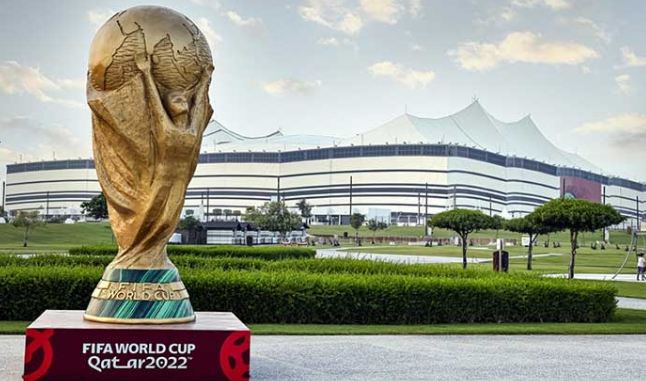
Whatever the ending, Qatar World Cup duly delivered

DOHA – A World Cup that has defied all expectations reaches its climax on Sunday when Lionel Messi could join Diego Maradona in Argentine immortality by taking the south Americans to the title or France could become the first nation to retain it since 1962.

Both scenarios would be an appropriate final act to the first World Cup staged in an Arab country.

But whatever happens, a tournament ridiculed in the build-up and which began a little awkwardly delivered an exhilarating rollercoaster ride that even the cynics leapt on board.

Millions of words were written criticising the choice of Qatar as host to the world s second-largest sports event and the debate will continue long after the last ball is kicked.

But for a month the so-called beautiful game did, in the words of FIFA president Gianni Infantino, spread some joy.
The marquee names of Messi, Kylian Mbappe, Neymar and Cristiano Ronaldo delivered storylines. Saudi Arabia, Japan, South Korea and Tunisia delivered shocks. New heroes emerged.
Yet the abiding memory for many will be Morocco s shake-up of football s hierarchy.

Thousands of their fans painted the desert red and turned Doha s souq into a corner of Marrakesh as the Atlas Lions roared into the semi-finals.

Harnessing the energy of their followers, Walid Regragui s men scored victories over European aristocrats Belgium, Spain and Portugal on the way to becoming the first African and first Arab country to reach the last four.

France proved a match too far as they set up a showdown with Argentina in the spectacular Lusail Stadium where nearly four weeks earlier Argentina s 2-1 defeat by Saudi Arabia lit the blue touchpaper for an extraordinary tournament.

In five second-half minutes Saleh Al-Shehri and Salem Al-Dawsari wrote themselves into Saudi sporting folklore by scoring the goals to overturn a Messi penalty and seal the biggest statistical shock in World Cup history.

Infantino, who raised eyebrows on the eve of the tournament with a passionate monologue defending the Qatari organisers, described the group phase as the best ever. Few would disagree.

The 48 games produced 120 goals, only two red cards, and enough head-spinning moments to garnish three tournaments.
A day after Saudi Arabia s win, Japan came from a goal down to beat Germany — a result the four-time champions never recovered from as they went home early.

Iran, against a backdrop of widespread anti-government protests at home, were smashed 6-2 by England, then beat Wales with goals in the eighth and 11th minutes of stoppage time.
Late goals and hasty re-writes for the world s written media were a recurring theme and the last three nights of group action were a white-knuckle ride on and off the pitch.

Japan stunned Spain in a stomach-churning finish to Group E which at one point looked to be sending Costa Rica and Japan into the last 16 at the expense of Spain and Germany.

South Korea conjured a stoppage-time goal to beat Portugal and make it out of Group H to the heartbreak of Uruguay while Mexico s manic attempt to score enough goals against the Saudis to pip Poland to second spot in Group C ended in failure.
Every continent was represented in the last 16 for the first time but after such a riotous group phase would it fall flat?

No chance.

Australia gave Argentina a mighty late scare, Mbappe dazzled for France against Poland and a free-scoring England ended the Senegalese party in the tent-like Al Bayt Stadium, one of seven new stadiums built for the tournament, including the 974 Stadium comprised of recycled shipping containers.

Brazil danced their way to a 4-1 thrashing of South Korea while Portugal did the unthinkable and left out Ronaldo only to find a new hero as Goncalo Ramos bagged a hat-trick in a 6-1 rout of Switzerland.

Morocco went toe-to-toe with Spain in an absorbing 0-0 draw, then knocked out the 2010 champions on penalties as Luis Enrique s side failed to net a single kick.

Unpredictable as the tournament was, the usual suspects assembled for the quarter-finals.

Some Neymar magic gave Brazil an extra-time lead against Croatia, only for Bruno Petkovic to level in the 117th minute with Croatia s first effort on target. Almost inevitably, Brazil slumped out on penalties.

Argentina squandered a 2-0 lead against a Netherlands side who dumped their usual scientific approach in favour of lumping high balls into the box to destructive effect.

Wout Weghorst s brace, the second in the 11th minute of stoppage time silenced the blue and white hordes, but Messi and Co edged a penalty shootout to decide a fractious contest.

Ronaldo became the first man to score in five World Cups but his last appearance, again as a substitute, ended in tears as Portugal went down 1-0 to a history-making Morocco.

England s penalty curse then returned as Harry Kane s botched effort condemned them to a 2-1 defeat by France.

Messi, channelling his inner-Maradona, inspired Argentina to beat Croatia and few would begrudge the diminutive number 10 s record-breaking 26th World Cup appearance ending with him holding aloft the gleaming trophy.

Punjab, KP assemblies to dissolve on Dec 23 : Imran

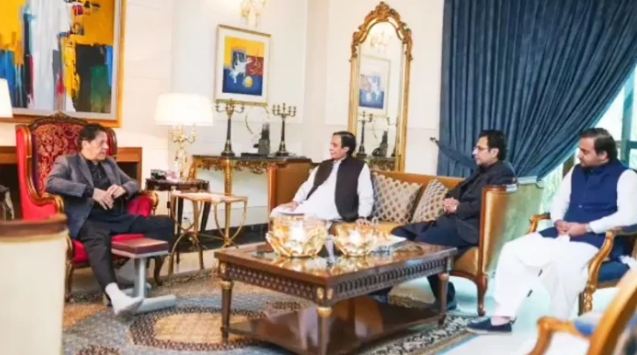
LAHORE, Dec 17: PTI Chairman Imran Khan on Saturday announced that his governments in Punjab and Khyber Pakhtunkhwa will dissolve their assemblies on December 23 to pave the way for fresh elections.

Punjab Chief Minister Parvez Elahi and Khyber Pakhtunkhwa Chief Minister Mahmood Khan are beside him as well for the address. Imran thanked the two provincial chiefs for their cooperation with him.

At the outset of his address, Imran said the country needed “fresh and fair elections”.

“We fear the country is drowning,” he added.

Imran started his address by bemoaning the current economic situation of the country and contrasted that with his government’s performance.

He lamented the brain drain ongoing in the country, saying that skilled people and professionals were leaving the country in droves.

“My question today is, who was responsible for this regime change?” he said, referring to his government’s ouster via a no-confidence motion earlier this year.

Imran said unemployment and inflation were on the rise and foreign confidence in the country had eroded, leading to investments drying up.

“Loans keep on increasing. There was only one way to solve this which we did: to increase the country’s wealth. They (the government) don’t have a plan.”

Imran said free and fair elections were the only solution to these problems and said the government was “afraid” of new elections due to the fear of losing.

He also expressed concern that the government might not hold general elections even in October 2023.

The PTI chairman once again raised the question of who was actually responsible for the current affairs of the country. “Only one man is responsible: General (R) [Qamar Javed] Bajwa. I didn’t speak out against him because he was the army chief,” Imran added.

“We want our army to be strong so we kept quiet and kept looking at how the conspiracy happened.”

He said the former army chief had “decided to remove us (PTI government)”.

“My next question is that when the government was ousted and they got to know that the public came to stand with us … and rejected these thieves and our popularity started increasing … then instead of admitting that you made a mistake, [instead] the kind of injustice they did against us, I never saw it before,” Imran said.

The PTI chief mentioned the treatment being meted out to party senator Azam Swati and those who support the PTI, alleging that the former army chief was behind it all and also responsible for giving “NRO-2” to leaders in government.

“I was told at one point by Gen Bajwa that ‘we have files on your people about corruption and their videos have been made’. I said to him, ‘Is this the job of our agencies? That they make videos and files on people? This nation sustains its agencies for their security by sacrificing.’”

The former prime minister also mentioned his own audio leaks, saying that he was the premier and “my own phone was tapped … no one is asking that this is a violation of the Official Secrets Act. Where does this happen? If I am talking to my principal secretary then that was leaked.”

Imran claimed that according to an opinion poll, “70 per cent” of the people were demanding fresh elections, saying that is what the PTI had attempted to convince the government about through its second long march.

Decision on dissolution of assemblies expected as Imran addresses nation

LAHORE, Dec 17: PTI Chairman Imran Khan is currently addressing the nation and a decision is expected on his dissolution of the Punjab and Khyber Pakhtunkhwa assemblies.

Punjab Chief Minister Parvez Elahi and Khyber Pakhtunkhwa Chief Minister Mahmood Khan are beside him as well for the address. At the outset of his address, Imran said the country needed “fresh and fair elections”.

“We fear the country is drowning,” he added.

Imran started his address by bemoaning the current economic situation of the country and contrasted that with his government’s performance.

He lamented the brain drain ongoing in the country, saying that skilled people and professionals were leaving the country in droves.

“My question today is, who was responsible for this regime change?” he said, referring to his government’s ouster via a no-confidence motion earlier this year.

Imran is expected to disclose the date of dissolution of the two assemblies — KP and Punjab — where his party is in power. Last month, Imran said that his party would disassociate itself from the “current corrupt political system” by quitting the two provincial assemblies.

The decision to dissolve assemblies was met with great objection from PML-N and PPP leaders — the main forces of the ruling Pakistan Democratic Movement government. Later, the PML-N had announced that it was ready to contest elections in case the PTI continued with its decision to dissolve the two assemblies.

Footage from Liberty Chowk showed a large crowd of people gathered for Imran’s address.

Earlier, party leader Hammad Azhar lead a caravan of vehicles towards Liberty Chowk.

The movement towards Liberty Chowk began in earnest after Imran wrapped up an important meeting with the Punjab and KP CMs at his Zaman Park residence.

Following the meeting, Punjab CM Parvez Elahi said that he returned Imran’s “mandate of the Punjab Assembly back to him”.

Parvez, his son Moonis Elahi and MNA Hussain Elahi were part of the meeting. KP CM Mahmood Khan, PTI Vice Chairman Shah Mahmood Qureshi, senior leaders Asad Umar, Fawad Chaudhry, Pervez Khattak, Shibli Faraz, Ali Amin Gandapur and others were also present.

According to a press release from the CM Secretariat about the meeting’s details, the PTI chairman will announce his decision pertaining to the dissolution of assemblies alongside the two chief ministers.

Mushahid sees transformation in foreign policy post-Afghanistan

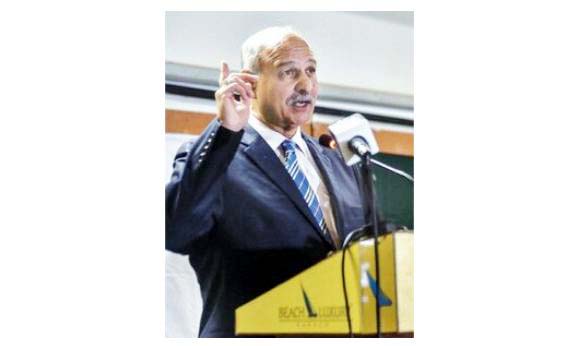
KARACHI, Dec 17: The rise of Hindutva in India is transforming a society which was once based on secularism into a bigoted, divisive and narrow republic targeting non-Hindu minorities.

This was highlighted by Senator Mushahid Hussain during his talk on ‘Pakistan and Changing Regional Scenario: Challenges and Opportunities’ organised by the English Speaking Union of Pakistan (ESUP) at a local hotel on Friday evening.

Senator Hussain started off by saying that we are living in times of turbulence and transformation — a very historic period. Recently, he was struck by statements given by different world leaders. President Biden on Oct 12 said ‘this is going to be decisive decade’. President Putin on Oct 27 said ‘this is the most dangerous decade after the Second World War’. After that came the statement of President Xi Jinping referring to ‘once in a century changes’. Then an article appeared in Foreign Affairs by German Chancellor Olaf Scholz where he talked about a ‘historic turning point’.

Before expanding on the changes, Senator Hussain went down memory lane to shed light on the vision of the founding fathers of Pakistan. Allama Iqbal, 90 years ago, wrote mashriq se ubharte huay suraj ko zara dekh (see the sun rising in the East) and about the rise of China. Quaid-i-Azam Mohammad Ali Jinnah in his first interview with a foreign journalist on Jan 5, 1948 said, ‘Pakistan is the pivot of the world placed on the frontier on which the future of geopolitics of the world revolves.’ When Quaid-i-Millat Liaquat Ali Khan went on his famous visit to the US, a compendium of his speeches was titled Pakistan, the Heart of Asia. “So the vision of Pakistan was not confined to just one area, it was a larger vision.”

Says national security can no longer be measured in terms of military might alone

The senator, coming back to the topic, argued, “When we talk of the global changes impacting on us, I will sum it up in three Rs: the retrenchment of American power in the Muslim world; the resurgence of Asia; and the rise of Hindutva in India that is transforming a society which was once based on Nehruvian secularism into a bigoted, divisive and narrow republic of Hindutva targeting non-Hindu minorities such as Muslims, Christians and Sikhs.

“What are the major trends of our times? The first is that we are seeing the signs of a new Cold War focusing partly on Europe and partly on Asia with the demonization of China and Russia. The second focus of the new Cold War is China. At the core of this new war are the flashpoints that have increased. We have a flashpoint in Korea, a flashpoint in South Asia, we have a flashpoint in the Middle East, Palestine, in Europe.”

He pointed out that it’s the trade and tech war between the US and China. He referred to a report published by Harvard University in December 2021 which called it the great tech rivalry and the conclusion of the report was that China is overtaking the US as the biggest high tech manufacturer.

Senator Hussain said there’s a global consequence of the war in Ukraine. “The initial divide was Islam versus the West. That has been replaced by a north-south divide [north being the West, and south being the developing countries]. For the first time Pakistan, India and China have the same position on Ukraine. So they’re not following what the West is telling them, and the biggest expression of that is the recent visit of Xi Jinping to Saudi Arabia. We’re seeing the emergence of Muslim middle powers — Pakistan, Turkey, Iran and Saudi Arabia.”

Speaking on Pakistan’s foreign policy, he was of the opinion that geopolitics has pushed it to change.

“The post-Afghanistan transition in Pakistan’s foreign policy has begun otherwise our policy was Afghanistan-driven. The central focus of our foreign policy is no longer Afghanistan. Secondly, we are also in a transition domestically to redefine the notion of national security. National security can no longer be measured in terms of military might alone. It is human security, the lives and livelihoods of people, the economy, energy, climate change. Gen Bajwa before he left also mentioned these things. These are the issues facing the people of Pakistan.

“Then the future belongs to regional connectivity. We are the hub of it and the hub is through CPEC, and the centre piece of CPEC is Gwadar Port. We are [also] talking of a greater South Asia driven by economy. A new world is opening up. We are talking of pipelines. We still have on paper the Iran-Pakistan pipeline. We should also invite India to rejoin it — IPI. Originally it was Iran, Pakistan and India.”

Earlier, ESUP President Kalim Farooqui introduced the speaker to the audience. Afshan Lalani and Aziz Memon also spoke.

Pakistan dismissed for 304 by England in 3rd Test

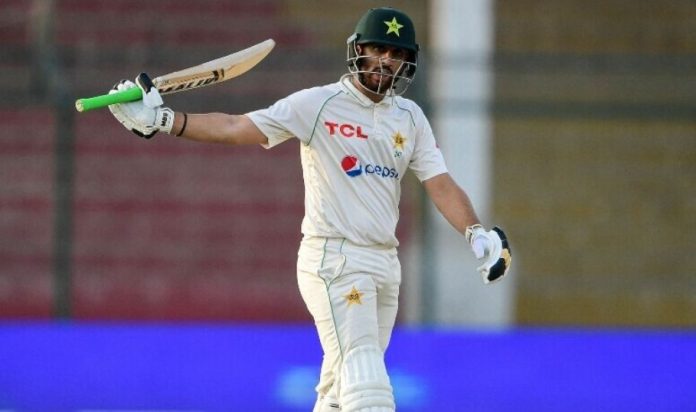
Karachi: England spinners Jack Leach and Rehan Ahmed shared six wickets between them on Saturday as Pakistan were dismissed for 304 on the opening day of the third and final Test in Karachi.

Leach grabbed 4-140 while teenager Ahmed finished with 2-89 after Pakistan won the toss and batted on a slow turner at the National Stadium.

For Pakistan, skipper Babar Azam top scored with 78 and Agha Salman made 56. England lead the three-match series 2-0.

Ahmed had got his first wicket for England before Pakistan reached 204-5 at tea, making history by becoming the youngest player to debut for the side at 16 years and 126 days.

He dismissed Saud Shakeel, who failed to keep a defensive shot down as Ollie Pope dived forward to take a brilliant catch, in his seventh over for 23. At the break, skipper Babar Azam was unbeaten on 71 and Agha Salman on one after Pakistan won the toss and opted to bat on a National Stadium pitch that has a slow turn.

Mohammad Rizwan also failed as he lofted a catch off a Joe Root full toss for 19.

In the first session, Pakistan lost three wickets. Azhar Ali — playing his last Test — fell at the stroke of lunch when he gloved a catch to a diving wicketkeeper Ben Foakes off pacer Ollie Robinson.

Azhar and Azam added 71 for the third wicket, repairing the innings after opener Abdullah Shafique fell for eight and Shan Masood 30.

Sensing the pitch would take spin, England started the attack with left-arm spinner Jack Leach, who trapped Shafique leg-before in the sixth over of the day.

Masood fell to the trap of short bowling as he pulled fast bowler Mark Wood straight into the hands of deep fine-leg fielder Leach.

Masood hit five boundaries while Azhar had six hits to the ropes.

Hard-pressed to avoid their first-ever whitewash in a home series, Pakistan made four changes with Azhar, Masood, Mohammad Wasim and Nauman Ali drafted in the side.

England, who lead the series 2-0, brought Foakes and Ahmed into the side.

Before Ahmed, Brian Close was the youngest England debutant at 18 years and 149 days when he played against New Zealand in 1949.

Teams:

Pakistan: Babar Azam (captain), Abdullah Shafique, Azhar Ali, Shan Masood, Saud Shakeel, Mohammad Rizwan, Agha Salman, Faheem Ashraf, Mohammad Wasim Junior, Abrar Ahmed, Nauman Ali

England: Ben Stokes (captain), Harry Brook, Zak Crawley, Ben Duckett, Ben Foakes, Jack Leach, Ollie Pope, Ollie Robinson, Joe Root, Mark Wood, Rehan Ahmed

Umpires: Joel Wilson (WIS) and Ahsan Raza (PAK)

Tv umpire: Marais Erasmus (RSA)

Match referee: Andy Pycroft (ZIM)

CM Elahi vows to back ‘all decisions’ of Imran as PTI chief set to announce dissolution date

Chief Minister Punjab Chaudhry Parvez Elahi Saturday vowed to back “all decisions” of Pakistan Tehreek-e-Insaf (PTI) Chairman Imran Khan as the allies are all set to move towards dissolving the assemblies of the provinces where they rule — Khyber Pakhtunkhwa and Punjab.

“I will support all of Imran Khan’s decisions. I owed the Punjab Assembly to Imran Khan and I have returned my debt to him,” the chief minister said in a tweet hours before Imran’s scheduled announcement of the dissolution date.

Imran is expected to announce the date of dissolution during the party’s public gathering at Lahore’s iconic Liberty Chowk later tonight, but there were reports of issues between the PTI and Pakistan Muslim League-Quaid (PML-N) on the date of dissolution.

CM Elahi also stressed that Imran has made his political opponents “zero” and said that the people spreading rumours — about a rift between the allies — “have failed once again”.

Stay Connected

64FansLike
60FollowersFollow

Latest Reviews

Exchange Rates

USD - United States Dollar
EUR
1.17
GBP
1.35
AUD
0.67
CAD
0.72