Home Blog Page 1223

Education 4.0 in Pakistan: A precautionary call before disaster

We need a leader with telescopic visions and navigational capabilities.

Education is very vital for the development, prosperity and sovereignty of a country. It is important not only for individual development, earnings and employment but also for the country’s prosperity, economic stability, creativity & innovation, harmony & peace and for social stability. Educational system in Pakistan is not only out dated but also we are far behind from the rest of the surrounding world. Economically, Pakistan is at the 153rd position out of 174 countries and is included in ten countries with worst educational system. Many poorer countries have better literacy rate as compared to Pakistan. Low literacy rate not only decelerates economy growth but also impedes human development, skills, creativity and self-efficacy.
We are witnessing technological revolutions, drastic and swift changes all around us and receiving revolutions to impact lives, societies and global human interactions. Due to digital advancement, the world is changing at a very high pace. So, it is the time to make ourselves compatible with the pace. Pakistan is already facing many crises, economically, politically, nationally and internationally. The only solution to all these is quality education. We cannot predict future but if we couldn’t pace our quality education, we will face digital divide and gap nationally and internationally with a catastrophic end. Are we ready for these emerging challenges in education and society along with existing issues?. For this, we need a leader with telescopic visions and navigational capabilities.
To meet the new demands of tech world and to take countermeasures for technological challenges, Education 4.0 is a contemporary slogan among the educational reformers. The role of education is becoming more vivacious to address disruption, divide and to meet skills requirement with the rapid technological advancement. So, we have to understand Education 4.0 with the context of Industrial Revolution (IR) 4.0 and we have to be vigilant about future challenges.

Late in the 18th century, the first Industrial Revolution 1.0 occurred with generation of water and steam engines for mass and quality production in industry. Its impact appeared in the form of urbanization, boosted economy, massive transportation and industrialization. The introduction of paper-making machine, mechanical printing and type-writers unwrapped new integrations in Education 1.0 for limited fortunate societies only. However, the teacher remained the center of education in this era. The 20th century emerged on the calendar with Industrial Revolution 2.0. Water and steam engine were replaced by oil and electrical energy, mass production and industrialization emerged with low cost. Fertilizers, engines and aerodynamic industries are the product of IR2.0. However, Education 2.0 corresponded itself with IR 2.0 by introducing electronic devices such as computer, multimedia and printers etc. Mass education, standardization, large classes and open & new universities were constructed during this era. The role of teacher shifted from transmitter to facilitator. Computers, transistors and automation has reduced the efforts, costs & work-load and has introduced swiftness & global supply chain in industry by the end of the 20th century, with the immergence of Industrial Revolution 3.0. In Education 3.0, Semantic web, smart mobile devices and internet services were introduced. Students became more conscious about learning styles. Now their role shifted from passive listener to active and participative learner in the classroom. Teacher’s role shifted as collaborator and facilitator. Online and mobile learning became the area of interest for researcher, educator and students as well. However, personalized learning remained wrapped.
The concepts of digitization, globalization and mass production were coined during the Industrial Revolutions 1.0 to 3.0. However, IR 4.0 is diversified from all previous revolutions. The notion of Industrial Revolution 4.0 was propelled by Germany in 2011. It is a blend of Virtual/Augmented reality, Artificial Intelligence, robots, 3D printing, Internet of things, Simulation, Cyber security, material science, System integration, bio and nanotechnology, quantum computing, big data and cloud computing. Humans are being replaced by machines and distorted lines have been drawn between digital, biological and physical worlds. Societies, cultures, industries and economies are being intermingled with each other. So in response to IR 4.0, the term Education 4.0 emerged to align dents of disruption and to fill digital gaps among and within the societies. Societies, economies cultures, living and working standards are being transformed by the Industrial Revolution 4.0. So, it is vital to acclimate the educational system with the emerging issues and requirements of the new societies. Education 4.0 is interlinked with IR 4.0, focusing on the future education of technology and automation. Education 4.0 is addressing all the requirements of IR 4.0 by using technologies. Learning and teaching styles have been changed to ensure the future needs of the workforce and skills. It is a system that transmits quality education along with skills in a self-paced modus as per learner’s needs and capabilities. It is providing quality of information from the globe to teachers and students in a non-traditional way. The concept of Massive Open online Course (MOOCs), Flipped Classroom, smart learning, Open & online learning, self-paced & skill based learning, personalized learning and integration of modern technologies are embraced by Education 4.0. Creativity, Critical thinking and problem solving skills are fundamentals of Education 4.0.
The globe is being changed in all aspects: economically, socially and emotionally with the rapid advancement of technology. Systems are being revolutionized, multi-disciplinary approaches are being adopted. New earnings opportunities are emerging in developed and educated world. Nonetheless, digital divide, disruption, social inequality, cyber security, industrial destruction and ethical issues will become fortune for developing and under developing economies like Pakistan along with existing issues.
Nations with strong economy and high literacy rate have potentials to acclimatize with advancements linked Industrial Revolution 4.0. They have capabilities to take counter measures against emerging issues as digital divide, disruption, unemployment, cyber security industrial destruction and skills gap.
Pakistan’s education system is not only out dated but also has many flaws to meet emerging demands. Our educational system is still focusing on outdated instructional techniques and learning styles. Learning is still confined to physical building school and decelerating the literacy. Examination system is still a measuring inventory of memorization. It is the time to announce education emergency as emergencies have been implemented for natural disasters in 2005 and now 2022. It is the time to revive the whole educational system. Education is the only tool to accelerate economic development and social stability. This can be achieved by making education a priority and budgeting wisely for education. Although budgeting is a foremost impedance for adaption of Education 4.0. However, to embrace minimal features of Education 4.0, at initial stage with available resources, we have to invest in three areas: teacher training, curriculum and pace of learning. Teachers and educators can play a pivotal role for prompt and optimistic revolution in education. So, we have to invest in perpetuation of teacher’s dignity first and then in pre-service and in-service teachers training. Our curriculum is antediluvian and we have to revise our curriculum on futuristic approach as far as we can, to prepare our future generation for IR 4.0 skills and to enable them for contribution in global citizenship. To pace up learning efficiency and effectiveness, we have to augment the use of digital technology in education.
It is a soft precautionary call before disaster. We have to invest in transformation of
Education 4.0. We have to rethink, reimagine, revalue and revive the education. Otherwise, we have to keep in mind “Are our all stakeholders (Leaders, Teachers and parents etc) ready for accumulation of forthcoming challenges of IR 4.0 into prevailing ones or we can say for catastrophic end?”
“We do not yet know just how it will unfold, but one thing is clear: the response to it must be integrated and comprehensive, involving all stakeholders of the global polity, from the public and private sectors to academia and civil society (Schwab, 2016, p. 1).”

For feedback to author:
Muhammad Waseem
[email protected]
Contact at: 0323-5172174
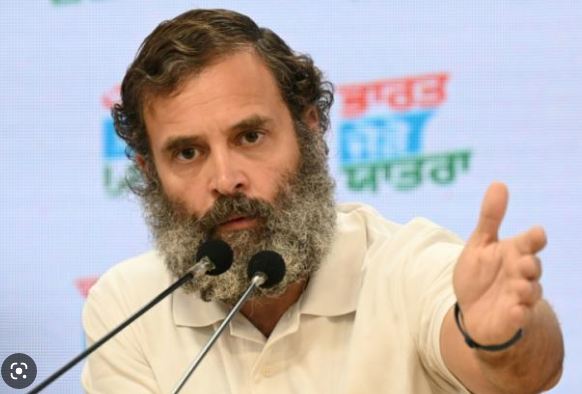
India’s Rahul Gandhi loses parliament seat after conviction

New Delhi, March 24 (AFP/APP): Top opposition figure Rahul Gandhi was expelled from India’s parliament on Friday, a day after his defamation conviction for a remark seen as an insult against Prime Minister Narendra Modi.
Modi’s government has been widely accused of using the law to target and silence critics, and the case in the premier’s home state of Gujarat is one of several lodged against his chief opponent in recent years.
Gandhi, of the opposition Congress party, was sentenced to two years imprisonment but walked free on bail after his lawyers vowed to appeal Thursday’s verdict.
However, the conviction has ruled him ineligible to continue sitting in the Lok Sabha, or lower house of Indian parliament, a notice from the chamber’s joint secretary said.
“Rahul Gandhi… stands disqualified from the member of Lok Sabha from the date of his conviction,” the notice said.
Congress spokesman Akhilesh Pratap Singh confirmed to AFP that his party had received the notice.
“Black Day for Indian Democracy!” wrote Srinivas Bhadravathi Venkata, president of the party’s youth wing, on Twitter.
Gandhi, 52, is the leading face of the Congress party, once the dominant force of Indian politics, with a proud role in ending British colonial rule, but now a shadow of its former self.
He is the scion of India’s most famous political dynasty and the son, grandson and great-grandson of former prime ministers, beginning with independence leader Jawaharlal Nehru.
But he has struggled to challenge the electoral juggernaut of Modi and its nationalist appeals to the country’s Hindu majority.
Thursday’s case stemmed from a remark made during the 2019 election campaign in which Gandhi had asked why “all thieves have Modi as (their) common surname”.
His comments were seen as a slur against the prime minister, who went on to win the election in a landslide.
Members of the government also said the remark was a smear against all those sharing the Modi surname, which is associated with the lower rungs of India’s traditional caste hierarchy.
Gandhi faces at least two other defamation cases in the country and a money laundering case that has been snaking its way through India’s glacial legal system for more than a decade.

  • Action against critics –
    Several senior lawmakers have been disqualified from Indian legislatures in the past, including a state chief minister.
    Indira Gandhi, Rahul’s grandmother, was briefly forced out of the chamber by a court decision in 1977 while she was prime minister.
    But legal action has been widely deployed against opposition party figures and institutions seen as critical of the Modi government in recent years.
    Last month, federal investigators arrested Manish Sisodia, a top member of the Aam Aadmi Party (AAP) which governs New Delhi, on allegations he had corruptly benefitted from reforms to the capital’s liquor licensing rules.
    Sisodia’s party is seeking to supplant Congress as the main opposition to Modi’s government and its members have decried his arrest as politically motivated.
    Also in February, Indian tax authorities raided the BBC’s local offices, weeks after the broadcaster aired a documentary on Modi’s conduct during deadly sectarian riots decades ago.
    The Editors Guild of India said then that the raids were part of a wider “trend of using government agencies to intimidate or harass press organisations that are critical of government policies”.

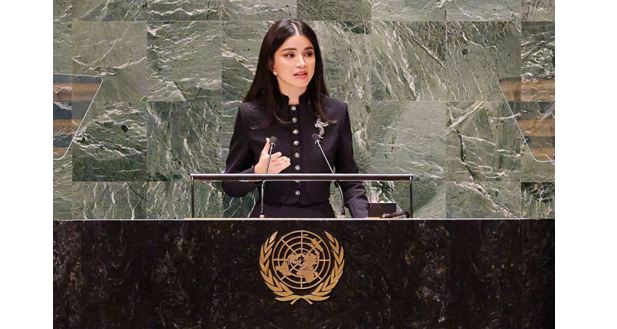
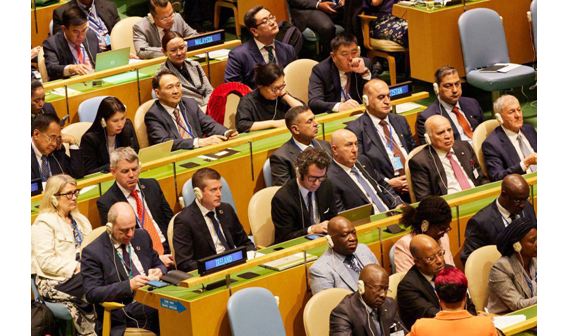
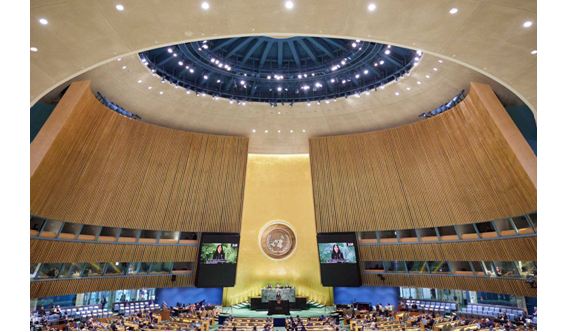
Mrs. Saida Mirziyoyeva addresses at the UN 2023 Water Conference

Janobioliylari,
Hurmatlihamkasblar,
Assalomualaykum!

Mr. President,
YourExcellencies,
Distinguished colleagues,

First of all, I would like to commend the Governments of the Republic of Tajikistan and the Kingdom of the Netherlands and all UN entities for co-hosting and convening the United Nations 2023 Water Conference.
In 2015 the United Nations adopted 17 Sustainable Development Goals to build a better future for all people. Uzbekistan remains strongly committed to achieving these goals and has taken an initiative aimed at revitalizing the region and preserving water and ecosystems of the Aral Sea.
In 2017, UN Secretary-General AntónioGuterres visited the village of Muynak in Karakalpakstan. He said then “The Aral tragedy is the largest environmental catastrophe of our time, an example of how man destroys the planet”. Once the village of Muynak was a prosperous port city, the fourth largest supplier of fish products to twelve republics. There was a cannery, gardens bloomed and people had healthy children and hopes for the future. Then everything changed. People broke the balance, and now there is a cemetery of ships on its dead shores.
Allow me to recite an extract from the elegy of a famous poet YibrayimYusupov:
Таўларшөгип, жергекирмегеншығар,
Жулдызларҳәмбирденсөнбегеншығар.
Дүньяҳешўақта-дакөрмегеншығар:
Бирмайдандатеңизқурыпқалғанын…
The poem describes the tragedy of a sea turning into a desert in a blink of an eye. In Karakalpakstan, they still mourn the Sea as they would a human.
The full sea remains only in the paintings of artists hanging in the Nukus Museum: shining and shimmering, giving life and freedom. It was only when it disappeared that people understood its value.
The crisis of the Aral Sea is a devastating reminder of the Kahn sequences of human environmental neglect. However, thanks to the efforts of caring people, it is now becoming a symbol of hope and renewal.
Our country has been making coherent efforts in addressing the negative Kahn sequences of the desiccation of the Aral Sea. At the 75th session of the UN General Assembly, President Shavkat Mirziyoyev proposed a special resolution declaring the Aral Sea region a zone of environmental innovations and technologies. The resolution was unanimously adopted in 2021 in co-sponsorship of 60 countries.

In 2018, we established the Multi-Partner Human Security Trust Fund for the Aral Sea region. Today with its financing we are implementing a number of projects totaling over $14 million. Our country has set an ambitious task – to turn the dried-up floor of the Aral Sea into a garden, and now almost one and a half million hectare are covered with greenery. We are working tirelessly and urgently on this task because our country deeply understands the value of time in the fight against environmental catastrophe.

I want everyone to fall in love with Karakalpakstan and its people. They are incredible, beautiful, intelligent, hardworking, poetic and very talented people. They are also very courageous. Bear in mind that the climate of this region is very harsh. It’s unbearably hot in summer, and the winters are too cold. And in such difficult conditions, Karakalpakstan grabs every opportunity to improve its situation: to earn, to create, and to contribute something new to its wealth of beautiful traditions.

Opportunities for women in the Aral Sea are very important to me. You are aware that women are most vulnerable to environmental, economic, or political disturbance. Lack or absence of clean drinking water is a huge problem for women and the households for which they are responsible.

To support the people of this region, we have invested not only in experts from the various relevant fields, but also in the creative powers of artists and designers. Through their collective efforts, we have already started to attract attention, produce new stories, and make the invisible visible. We are already creating a new narrative for building a better future – namely, the Aral Cultural Summit.

The activities of the Aral Cultural Summit, initiated by the Art and Culture Development Foundation, will focus on preserving both biocultural diversity and cultural and linguistic diversity. I believe that art, design, and culture can play a crucial role in raising awareness, stimulating ties, bringing the future closer and ultimately creating positive changes.

Therefore, we have set ambitious goals, such as launching scholarship programs and grants, establishing interdisciplinary educational programs, and supporting works of art dedicated to the Aral Sea.

The Aral Cultural Summit unites artists with local farmers, creating sustainable ties in the field of biodesign for cultivation of new plants, and thereby designing a strategic plan for the next 10 years. This will become a center of change for the local community.

A sea of change is on the horizon and we hope you will embrace it with us.

Biz sizgamuammolarimizhaqidaso‘zladik. Bizniqo‘llab-quvvatlashingizgaumidqilamizvaishonamiz.

“World of Books without Borders” opens with Pakistan’s participation

DNA

MINSK: The 30th Minsk International Book Fair “World of Books Without Borders” opened in the Belarusian capital on March 22, with Pakistan’s participation. The Embassy of Pakistan set up a book stall showcasing diverse literature, and the foreign minister and information minister of Belarus visited the Pakistani pavilion. Ambassador Sajjad Haider Khan briefed them about Pakistan’s participation and the literature on display.

The Minsk International Book Fair has been a popular event for book lovers for many years. It brings together writers, publishers, and representatives of the book trade from near and far abroad. This year’s event promises to be just as exciting, with a wide range of books on display.

Pakistan’s participation at the book fair is a testament to its commitment to promoting its rich literary heritage and cultural diversity. The Pakistani pavilion showcased books in various genres, including literature, history, and politics, which were well received by visitors.

The exhibition will run through March 26, providing ample time for visitors to explore the diverse collection of books on display. The Minsk International Book Fair “World of Books Without Borders” is an excellent opportunity to showcase the literary traditions and cultural diversity of Pakistan on a global platform.

We extend our gratitude to the organizers of the Minsk International Book Fair for providing us with the opportunity to participate and showcase Pakistan’s literary and cultural heritage.

Pakistan Day Celebration in Moscow

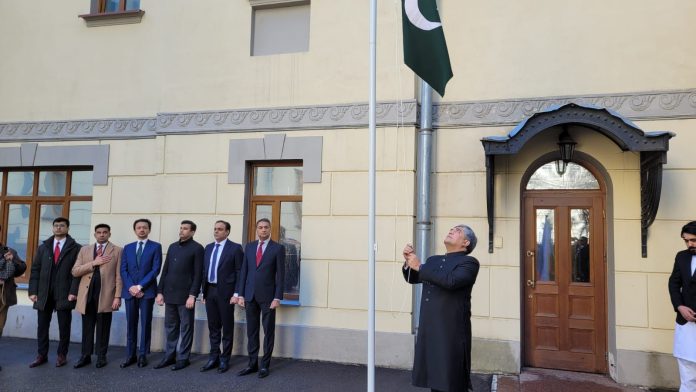
A ceremony to mark the Pakistan Day was held at the Embassy of Pakistan in Moscow today, on 23rd March 2023. The ceremony began with recitation from Holy Quran. Pakistan Ambassador to Russia H.E. Shafqat Ali Khan hoisted Pakistan flag. Pakistan national anthem was played on the occasion.
Special messages of the President of Pakistan Dr. Arif Alvi and Prime Minister of Pakistan Shehbaz Sharif were read by Third Secretaries Mr. Muhammad Tayyab and Dr. Jetha Nand.
The event was attended by the staff of the Embassy, members of Pakistani diaspora and friends of Pakistan.
March 23rd, 2023

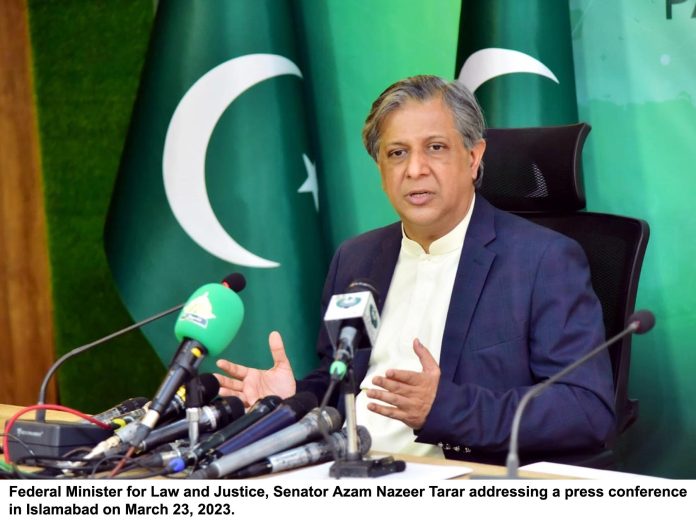
Govt sets up JIT on Imran-led Islamabad riots

Federal Minister for Law and Justice, Senator Azam Nazeer Tarar addressing a press conference in Islamabad on March 23, 2023.

–Interior minister says ex-PM going for tricks to escape trial

ISLAMABAD,): The government has set up a joint investigation
team over the Islamabad riots, Interior Minster Rana Sanaullah said on
Thursday.

Imran Khan attacked the judicial complex with armed groups, he stressed
while addressing a press conference.

Instead of facing the law, Imran Khan is using tricks, he said, adding
that Imran Khan has several cases of corruption including kickbacks,
foreign funding, Toshakhana and concealing facts.

Imran Khan has been on a campaign for snap polls since his ouster from
the prime minister’s house in April last year. He was ousted through a
no-confidence motion. He has been blaming the regime change on a
US-backed plot while the US has been denying any wrongdoing.

Addressing the joint session of the parliament yesterday, the minister
stressed that if elections are not held simultaneously, there will be a
crisis in the country. He added that the crises have been created and a
party and its leader are behind this.

He recalled that anti-national activities began in 2014 and from 2013 to
2018, every day a situation was created that could harm the state.
“Imran Khan was brought to power by manipulating the election. There is
no fault of the current government in the current economic situation.”

He said Prime Minister Shehbaz Sharif called for joint efforts and
invited all the parties to join hands for overcoming the economic crisis
but one party and its leader showed resistance.

He added armed groups attacked Islamabad to create anarchy. He cited the
cypher issue and bid to influence key postings. The minister said Imran
khan has to answer the questions related to the Toshakhana, foreign
funding and concealing the facts.

He stressed that state organs should be empowered to deal with armed
groups and terrorists.

He continued: “Holding the election in 90 days is the responsibility of
the Election Commission and it has been mulling over the matter keeping
in mind the ground realities. It is absolutely wrong that we do not want
elections. We want elections under the constitution. 

Ceremony organized to award prizes to police officials

FROM QAZI SHOAIB KHAN
DNA
ATTOCK (MARCH-22): Inspector General Police Punjab Usman Anwar while expressing his views at prize awarding ceremony to the best police officials has directed to remain engaged with the spirit of dutifulness for eradicating crimes from the society besides delivering their services to the citizens in order to strengthen the trust worthy atmosphere between the police and public with their excellent performance.
The Director public relations officer of Punjab Police told to the media here on Wednesday that IG Punjab in his address has said that the officers and officials who help the oppressed people during duty are the pride and valuable assets of the department and no effort will be spared in honoring them at all levels. IG Punjab said that officers and personnel who are responsible for the good name of the department are being encouraged at all levels and this policy will be continued.
IG Punjab continues to encourage the officers and personnel for their duty and excellent performance. In this regard, IG Punjab has awarded 19 officers and personnel with cash prizes and certificates of appreciation worth around 28 lakh rupees. These awards have been given to the officers and personnel who have rendered brave, dutiful and honest service in different districts of the province.SHOs of Rajanpur police namely Ibrar Ahmad and Imran Jameel have been encouraged with 115,000 each along with a CC1 certificate.
Similarly, SHOs of Rahim Yar Khan Police namely Naveed Nawaz and Said Ullah have been awarded 115,000 each with a CC1 certificate. IG Punjab honored Rahim Yar Khan Police ASI Ejazul Nabi and Constable Mohammad Amir with 126500 each along with CC1 Certificate. Sub-Inspectors Aamir Shahzad, Zubair, Head Constable Khurram Shahzad and Constable Muhammad Tayyab of Lahore Police were given one lakh reward each with CC1 Certificate. Bhakkar Police Constable Ali Haider, Zahid Maqsood and Zafar Iqbal were given one lac rupees each along with CC1 certificate. Likewise, Mianwali Police SHO Mohammad Fayaz was encouraged with 575000 reward and CC1 certificate, similarly Head Constable Amjad Faraz got 172500, Ameer Abdullah got 115000 and Azizullah got 287500 along with CC1 certificates. Whereas, ASI Faisal Shahzad and Constable Zahid Nawaz were awarded Rs 115,000 each and CC1 certificate. IG Punjab directed all the awards recipients to ensure that they discharge their duties with more diligence and conscientiousness than before. He said that all the officers and personnel should keep the doors of their offices open for the citizens and spare no effort in solving the problems with good manners, sincerity and duty, DPR Punjab Police added.

DC Attock chairs price control committee meeting

FROM QAZI SHOAIB KHAN

DNA

ATTOCK (MARCH-22): Deputy Commissioner Attock Rao Atif Raza while presiding over the district price control committee here on Wednesday has directed all the stakeholders to ensure the provision of all kitchen food items to the consumers during the holy month of Ramzan in accordance with the prescribed price list failing which the supervisory officials will be fixed strictly as per law.

The district price control committee after consensus over the prevailing market situation also revised the prices of various grocery and other eatable items which include Rice super old Rs.315 kg, gram pulse (thin)Rs.220kg, gram pulse  ( coarse  )Rs.240 kg,  husked red lentils Rs.280 kg,  husked red lentils (coarse)Rs.260 kg, white coloured lentil (special quality) Rs.400 kg, green gram split Rs.260 kg, white chickpea (thin) Rs.320 kg, white chickpea (coarse) Rs.355 kg,  black chickpea (small)Rs.220 kg, black chickpea (coarse) Rs.225 kg,  chickpea flour Rs.250 kg, mutton Rs.1300 kg, beef Rs.600 kg, milk Rs.135 liter, yogurt Rs.140 kg, oven bread Rs.15, nan plain Rs.20 were fixed.

The committee also recommended that the day to day prices of vegetables, fruits will be released by the respective secretaries market committees through open auction while, the prices of poultry products will be advertised in consensus with the Director Live stockAttock regularly at 7.00 AM, positively. The butchers were restricted to get their animals slaughtered at the state owned butchers home besides selling their meat under official seal of the concerned veterinary doctors. They will also be bound to share any updates with the competent authority or authorized representative.

The notified price list has also circulated among all the Assistant Commissioners, Police stations, Municipal Officers for immediate compliance with the direction to display at the conspicuous places.  The consumers can also file any complaint by phone call 0800-02345 or Qeemat Punjab APP in case  ofany over charging. Earlier, DC Attockalso  kicked off the education move 2023 here the Government MC Boys Schools Attock launched to achieve the targeted enrolment of 6778 children from five to fourteen years which was also attended by CEO Education Attock Malik Mohsin Abbas, DEO Attock Secondary Mr. Akram Zia, DEO Elementary Taqi Shah, Deputy Director Public Relations Attock Mr. Shahzad Niaz  along with other relevant officers of Education Department.  

First fast in Pakistan on Thursday as Ramadan moon sighted

The Central Ruet-e-Hilal Committee has announced that the Ramadan moon was sighted and the first of the holy month will fall on Thursday (tomorrow).

The announcement was made by Central Ruet-e-Hilal Committee chairman Maulana Abdul Khabir Azad at a press conference in Peshawar on Wednesday evening.

According to reports, the Ramadan moon was also not sighted in India and Bangladesh.

However, Saudi Arabia and most other Gulf states will start the fasting month on Thursday (tomorrow).

Is every politician by nature a fascist?

By Qamar Bashir

Our country, which is currently experiencing the worst period of its troubled history, is besieged by perils, difficulties, and hardships which unfortunately do not apply to the politicians, judiciary, civil and military bureaucracy, who on the one hand enjoy fat salaries and massive perks and perquisites while amassing filthy wealth through the use or misuse of their authorities and usurpation of state resources through legal and illegal means at their disposal. These hardships are for the unfortunate people of Pakistan who, while providing these monsters with their blood and sweat, are humiliated, tortured, and mercilessly fleeced of their wealth, right to live with dignity and honor, and subjected to the worst forms of slavery in one form or another. As a result, while they enjoy every privilege under the sun, half of school-aged children are unable to attend, more than 40% are stunted, women are reduced to domestic animals, millions are jobless, the death rate is among the highest in the world and the the region, and yet all elements of power, whether politicians, civil or military bureaucracy, parliamentarians, or the judiciary, are fighting tooth and nail to seize as much kinetic power as possible. Despite the dire financial and economic situation, bureaucrats succeeded in squeezing executive allowances one and a half times of their basic salaries, while judges succeeded in getting exorbitant salary raise even though their monthly salaries are invariably more than one million rupees, not to mention their perks and perquisites, which are in the millions. They argue that it is difficult for them to run their kitchen due to hyperinflation and price hike and that in order to make ends meet, they desperately need salary increases. But how long this looting and plunder will last is anyone’s guess. In the current extreme political polarization, the people of Pakistan will be the ultimate losers, while all rulers will walk away with even more booty than they could in normal times.

Given the country’s worst political polarization and economic and financial hardships, our political parties have shown no signs of slowing down their rhetoric and pledging to annihilate each other. Each of them refers to the opposition party’s leaders as fascists and their party as a fascist party. In almost every public speech, press conference, or media interview, Maryam Nawaz refers to Imran Khan as a fascist leader and a fitna, and expresses her desire to completely demolish both Imran and his party. Mr. Sanahullah, who is also our interior minister, is the custodian of law and order in the country and is obligated to treat every political party or its leader on an equal footing, vowing to eliminate and exterminate Imran Khan to whom he affectionately called fitnah and fascist from the country’s politics. Recently, Mr. Ehsan Iqbal, who, unlike all other Muslim League leaders, seemed to have little bit of sanity left in him joined the bandwagon and labeled Imran Khan a dangerous phenomenon, a fascist leader who poses an imminent threat to the country and must be eliminated and uprooted as soon as possible. The game of blaming does not end here. At one point or another, all political parties, certain members of the judiciary, and the media have labeled the establishment or the deep state as fascist, claiming that it is using brute state kinetic power to abduct, arrest, torture, humiliate, and harrass all those it deems appropriate, whether politicians, judges, media persons, political activists, businessmen, or any other person or institution that they perceive as a threat to their vested interests. But who, in reality, is a fascist? It is Maryam who does not hold any government portfolio but wields all state power and has elevated herself above all state institutions. Is it Imran Khan who is attempting to save his dear life from perceived threats to life, having been named in over 90 FIRs and expected to appear in courts of different parts of the country at the same time, or is his party Fascist who allegedly, is fighting tooth and nail to protect their leader from threats to his life posed by the government and state institutions?

The term “fascist” is a highly charged and politically loaded term, and its definition varies depending on the context and speaker’s perspective. Fascism is a far-right political ideology that is distinguished by authoritarianism, nationalism, and totalitarianism. Fascists believe in the supremacy of the state over the individual and frequently use violence and propaganda to achieve their objectives. Fascism as a political system appeared in Europe in the early twentieth century, characterized by a centralized government, a dictator, and a corporate economy. Fascists emphasize extreme nationalism and frequently use the military force and suppress individual liberties for the greater good. Fascists frequently rely on fear and propaganda to gain support and oppose democracy, liberalism, and other forms of pluralism. It emphasizes hierarchy, order, and discipline and believes that society should be organized around a strong leader with the authority to make decisions on the people’s behalf. Benito Mussolini, the Italian fascist leader who ruled as Prime Minister from 1922 to 1943, Adolf Hitler, the leader of the Nazi Party in Germany, who ruled as Chancellor and then as dictator from 1933 until his death in 1945, Francisco Franco, the leader of the Nationalist forces in the Spanish Civil War, who ruled Spain as a fascist dictatorship from 1939 until his death in 1975, National Front in France, a far-right political party founded in 1972 that espouses nationalist and anti-immigrant views are the few examples of fascists parties and leaders.

Fascist movements often have charismatic leaders who are able to mobilize large numbers of supporters through their rhetoric, charisma, and propaganda whereas Fascist governments are characterized by highly centralized and authoritarian, with power concentrated in the hands of a single leader who uses force, propaganda, and intimidation to maintain their grip on power. They may use surveillance, censorship, and indoctrination to maintain social control and suppress dissent, reject democratic principles and values, such as individual rights, free speech, and the rule of law and suppress opposition parties and restrict freedom of the press.

According to the definitions and explanations, the majority of our political parties and civilian leaders except by sheer dint of definition, TLP and Jamat Islami being far right parties fall under this definition whereas as all other leaders have streaks of fascism in their makeup, behavior or acts. In our system, the military establishment is an important part of national discourse which however, by virtue of its DNA is authoritarian, totalitarian and autocratic and therefore the constitution exclusively assigned it the role of defense of the motherland against foreign aggression. Its training and education is meant to control, guide and lead a disciplined force which are modeled to accept and obey orders of their command without asking questions or showing any hesitation. Moreover, military bureaucracy operates under military law and is subject to different standards of conduct and discipline than civilian officials. That is why the military disciplines are strictly forbidden to involve in civilian affairs. Once however, the military, willingly or unwillingly, is dragged into civilian affairs it acts as per their DNA, expect all civilian disciplines to obey their command and in doing so set aside democratic values, human rights and civilian liberties and act like a fascist force which should not be a surprise. One should only be naive to expect any other behavior other than this. Throughout my 30 years of service and having the opportunity to work closely with many ministers, prime ministers, and two Presidents, invariably each one of them at times complained about their helplessness in making sometimes minor and most of the time major decisions in every sector of statehood. It is widely assumed, rightly or wrongly, that the civilian leadership, both political and bureaucratic, is subservient to the deep state, which enjoys total hegemony as the final and ultimate force to approve or disapprove the civilian leadership’s decisions or impose them on them certain decisions, armed twist them to own them, accept the responsibility for their failure whereas it things goes right give credit to the establishment. The most recent example of vetoing civilian government’s decision was witnessed when former Army Chief Qamar Javaid Bajwa, disregarding stated national policy, condemned Russian evasion with total impunity in one of his speeches.

Even now the helplessness and powerlessness of the government and the political leaders is manifested in their different speeches and statements. Ministers in the cabinets in their various speeches and statements have been bickering openly that their hands are tied to take any major decision. Imran Khan refuses to talk to politicians of the country but is willing to talk with the new army chief to discuss wayforward for holding the next general election as according to him it is where decisions are made while terming the government as a stooge. Maryam Nawaz who by virtue of her own merit and also being a daughter of the PML(N) supremo, although is enjoying full powers but still is demanding the establishment in her various speeches to create a level playing field for everyone and only then would she give her consent for holding early general elections. This reflects where it is perceived rests the power base in the country.

During our informal talks with colleagues, journalists and politicians, we always discussed the difference between civilian and military bureaucracy. A civilian bureaucrat is vulnerable for arm twisting both by the politicians and establishment, while the military bureaucracy remains out of the purview of the civilian government. Each civil servant needs clearance from the agencies specially ISI for every posting and every promotion and they can be removed or installed in any posting by the government without even having the right to protest or agitate. On the other hand, the army is over and above any law of the land. They are governed by Army Act 1958 which makes them immune from any government influence. They themselves are responsible for reward and punishment without any say of the civilian government in their posting or transfer or promotion. None of the civilian departments is involved in vetting of their credentials or qualification and therefore they are totally out of government control except in the case of appointment of armed forces chiefs.

The prime responsibility of Pakistan’s government and leaders is to lead the people and country out of its current quagmire, but the million dollar question is how. The solution is to adopt universal values such as operating within the framework of the law, upholding the principles of fairness and justice, and ensuring that laws are applied fairly and consistently to all citizens, regardless of background or social status. Protect its citizens’ fundamental rights and freedoms, such as freedom of expression, religion, and assembly, and

the right to a fair trial, privacy, and due process. It should be transparent and open in its operations, open to criticism and feedback from the public, and responsive to the needs and concerns of its people. They should also ensure that elections are free and fair, that citizens have equal access to the political process, and that election results are respected. They must respect the diversity of their citizens, work to promote inclusivity and equality, be sensitive to the needs and concerns of various groups, and work to ensure that all citizens can participate fully in society.

Of course, democracy is not a perfect system, and democratic government takes many forms. However, it is frequently viewed as the polar opposite of fascism because it promotes values such as individual freedom, equality, and tolerance, which are opposed to fascism’s authoritarian, nationalist, and anti-democratic values. Are our politicians prepared to usher in true democracy in our country?

Perhaps now is the time for politicians to seize the once-in-a-lifetime opportunity presented by the army’s pledge to stay out of politics. They should play politics within universally accepted principles, treat each other with respect and civility, even if they disagree on policy or ideology, as this is necessary for the functioning of a democratic system as well as healthy debate and the exchange of ideas. They must respect the rule of law, refrain from illegal or unethical behavior, engage in civil discourse, avoid personal attacks or character assassination, and present their arguments in a respectful and constructive manner. They should compete fairly and openly, collaborate and cooperate when it is in the best interests of the country, and work together to address common challenges and find solutions to complex problems. They should respect election results, accept people’s will and refrain from undermining the legitimacy of the electoral process.. Fascism is not a solution, but rather a part of the problem; democracy, while not perfect, is the only solution.

The writer is the Former Press Secretary to the President

Former Press Minister to the Embassy of Pakistan to France

Stay Connected

64FansLike
60FollowersFollow

Latest Reviews

Exchange Rates

USD - United States Dollar
EUR
1.17
GBP
1.35
AUD
0.67
CAD
0.72