Home Blog Page 1222

‘Desert to see economic boom’: PM Shehbaz inaugurates 1,650MW coal-fired power plants in Thar

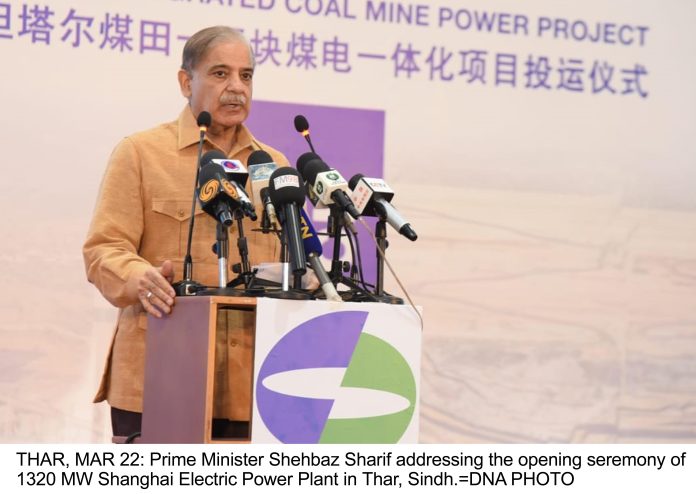
THAR, MAR 22: Prime Minister Shehbaz Sharif addressing the opening seremony of 1320 MW Shanghai Electric Power Plant in Thar, Sindh.=DNA PHOTO

Thar, MAR 22: Prime Minister Shehbaz Sharif on Wednesday inaugurated two coal-fired power plants in Tharparker with a capacity of 1,650 megawatts (MW) of electricity generation, saying that the projects would turn the desert into an “economic hub”.

The projects, including the 1,320MW Shanghai Electric power plant and 330MW Thal Nova power plant, will annually generate 11.24 billion units of low-cost electricity. Through the direct investment of $3.53bn into these projects, the production of coal-based electricity in Thar will increase up to 3,300MW.

Addressing the launch event at Thar’s Islamkot area, the prime minister said it was a “moment of celebration” for the country that the Tharparkar desert was getting a “source of basic facilities for life”.

He dismissed the criticism by certain people against Thar’s coal, terming it a blessing with immense potential for power resources that needed to be untapped.

“The journey of progress will spread across the country and will strengthen the national economy,” PM Shehbaz said, adding that projects which were abandoned during the last four years were being made operational again.

Shehbaz said that by April 30, power turbines would be installed at the projects to generate electricity, which would be supplied to the rest of the country through transmission lines.

He expressed gratitude to the Chinese government for extending support to Pakistan in carrying out development projects under the China-Pakistan Economic Corridor (CPEC).

PM Shehbaz vowed that the coalition government would put in all efforts to materialise CPEC projects, with the agriculture sector as its next phase.

The prime minister also announced a hospital for the people of Tharparkar to provide them with medical facilities at their doorsteps.

PM Shehbaz also condemned Tuesday’s terrorist incident that targeted military personnel and said the “malicious agenda” of the nation’s enemies would be foiled.

“No one is above the law and will not be allowed to support terrorists and use them as shields.”

Meanwhile, Foreign Minister Bilawal Bhutto Zardari said the power projects could be materialised as the federal government and the Sindh government “worked in harmony to facilitate the masses”.

He expressed satisfaction over the level of cooperation between Pakistan and China on carrying out development projects, which he said, had resulted in the “improvement of health and educational facilities”.

Power Minister Khurram Dastagir said the government was “committed to providing civic amenities to the people across the country”.

He said under CPEC, the development of indigenous resources was a “big step towards self-reliance” and was also valuable for foreign exchange reserves.

Sindh Chief Minister Murad Ali Shah said the political and economic interests of Pakistan and China were aligned for the benefit of the two nations. He termed the completion of the Thar Coal project a “success for all stakeholders” from both countries.

Chinese Charge d’Affaires Pang Chunxue said the commercial operation of the Thar coal project ranked high among other coal-fired power plants. She assured all possible cooperation by China in the field of development and progress.

Shanghai Electric Power Company Limited is the executing agency of the projects, while the Ministry of Energy (Power Division) is the coordinating ministry and Private Power and Infrastructure Board is the supervising agency.

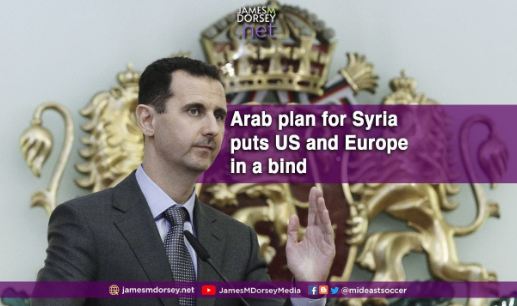
Arab plan for Syria puts US and Europe in a bind

A push by Arab allies of the United States to bring Syria in from the cold highlights the limits of a Chinese-mediated rapprochement between the Middle East’s archrivals, Saudi Arabia and Iran.

The effort spearheaded by the United Arab Emirates, and supported by Saudi Arabia, Egypt, and Jordan, demonstrates that the expected restoration of diplomatic relations between the kingdom and the Islamic republic has done nothing to reduce geopolitical jockeying and rebuild trust.

At best, the Chinese-mediated agreement establishes guardrails to prevent regional rivalries from spinning out of control, a principle of Chinese policy towards the Middle East.

The Saudi-Iran agreement also is an exercise in regime survival.

It potentially allows the two countries to pursue their economic goals unfettered by regional tensions.

For Saudi Arabia, that means diversification and restructuring of the kingdom’s economy, while Iran seeks to offset the impact of harsh US sanctions.

The goal of countering Iran in Syria is upfront in the Arab proposal for returning Syrian President Bashar al-Assad to the Arab and international fold.

If accepted by Syria, the United States, and Europe, it would initiate a political process that could produce a less sympathetic Syrian government to Iran.

It would also establish an Arab military presence in Syria designed to prevent Iran from extending its influence under the guise of securing the return of refugees.

For Mr. Al-Assad, the carrot is tens of billions of dollars needed to rebuild his war-ravaged country and alleviate the humanitarian fallout of last month’s devastating earthquakes in northern Syria.

Hampered by sanctions, Mr. Al-Assad’s Russian and Iranian backers don’t have the economic or political wherewithal to foot the bill.

Nevertheless, potential Gulf investment is likely to encounter obstacles. The US sanctions that hamper Russia and Iran, also erect barriers for Saudi Arabia and the UAE that will limit the degree to which they want to be seen as sanctions busters.

Moreover, countering Iranian influence in Syria would have to go beyond trade and investment in physical reconstruction. Iran has over the years garnered substantial soft power by focusing on embedding itself in Syrian culture and education, providing social services, and religious proselytization.

Meanwhile, China has made clear that its interests are commercial and further limited to aspects of Syrian reconstruction that serve its geopolitical and geoeconomic goals.

Mr. Al-Assad was in Moscow this week to discuss trade and humanitarian aid.

The Syrian president’s rejection of a Russian request that he meets his Turkish counterpart, Recep Tayyip Erdogan, suggests that Mr. Al-Assad will be equally opposed to key elements of the Arab proposal.

The Syrian president said he would only meet Mr. Erdogan once Turkey withdraws its troops from rebel-held areas of northern Syria.

Even so, the Arab push potentially offers the United States and Europe the ability to strike a reasonable balance between their lofty moral, ethical, and human rights principles and the less savory contingencies of realpolitik.

The terms of the Arab proposal to allow Syria back into the international fold after a decade of brutal civil war that killed some 600,000 people, displaced millions more, and significantly enhanced Iran’s regional footprint appears to take that into account.

According to The Wall Street Journal, the proposal offers something for everyone but also contains elements that are likely to be difficult to swallow for various parties.

While Mr. Al-Assad rejects the principle of political reform and the presence of more foreign troops on Syrian territory, legitimizing the regime of a man accused of war crimes, including using chemical weapons against civilians, is a hard pill to swallow for the United States and Europe.

However, it is easy to claim the moral high ground on the backs of thousands trying to pick up the pieces in the wake of the earthquakes.

The same is true for the plight of the millions of refugees from the war whose presence in Turkey and elsewhere is increasingly precarious because of mounting anti-migrant sentiment.

That is not to say that Mr. Al-Assad should go scot-free.

Nonetheless, the failure to defeat the Syrian regime, after 12 years in which it brutally prosecuted a war with the backing of Russia and Iran, suggests the time has come to think out of the box.

The alternative is maintaining a status quo that can claim the moral high ground but holds out no prospect of change or alleviation of the plight of millions of innocent people.

To be sure, morality is not a concern of Arab regimes seeking to bring Mr. Al-Assad in from the cold. However, countering Iran and managing regional conflicts to prevent them from spinning out of control is.

Even so, the Arab proposition potentially opens a way out of a quagmire.

It would enhance the leverage of the United States and Europe to ensure that political reform is the cornerstone of Mr. Al-Assad’s engagement with elements of the Syrian opposition.

In other words, rather than rejecting any solution that does not involve Mr. Al-Assad’s removal from power, the United States and Europe could lift sanctions contingent on agreement and implementation of reforms.

Similarly, the US and Europe could make sanctions relief contingent on a safe, uninhibited, and orderly return of refugees.

However, there would be questions about the ability and willingness of Arab forces loyal to autocratic regimes to safeguard that process impartially.

US and European engagement with Arab proponents of dealing with Mr. Al-Assad would potentially also give them a seat on a train that has already left the station despite their objections.

Ali Shamkani, the Iranian national security official who negotiated the deal with Saudi Arabia in Beijing, was in the UAE this week to meet President Mohammed bin Zayed. There is little doubt that Syria was on the two men’s agenda.

Mr. Al-Assad met this weekend in Abu Dhabi with Mr. Bin Zayed for the second time in a year and traveled to Oman for talks with Sultan Haitham bin Tariq last month.

The Jordanian and Egyptian foreign ministers recently trekked separately to Damascus for the first time since the civil war in Syria erupted in 2011.

Perhaps, the most fundamental obstacle to the Arab proposition is not the fact that Syria, the United States, and Europe would have to swallow bitter pills.

The prime obstacle is likely to be the Arab proponents of the plan. The UAE, Saudi Arabia, Egypt, and Jordan are unlikely to stick to their guns in presenting the plan as a package.

Having taken the lead in cozying up to Mr. Al-Assad, the UAE has since last year demonstrated that it is willing to coax the Syrian leader to back away from Iran at whatever cost to prospects for reform or alleviation of the plight of his victims.

Saudi Arabia, like Qatar and several other Arab countries, initially opposed reconciliation but the kingdom has since embraced the notion of rehabilitation of Mr. Al-Assad.

In early March, Saudi Foreign Minister Faisal bin Farhan Al Saud noted “that there is a consensus building in the Arab world, that the status quo is not tenable. And that means we have to find a way to move beyond that status quo.”

Mr, Al-Saud insisted, however, that it was “too early” to discuss Syria’s return to the Arab League that groups the Middle East’s 22 Arab states. The League suspended Syrian membership in 2011 because of Mr. Al-Assad’s prosecution of the civil war.

Even so, this puts the ball in the US and European courts.

Much of the Arab proposition is about enticing the United States and Europe to be more accommodating and more inclined to a conditioned lifting of sanctions.

The problem is that Mr. Al-Assad is likely to call the Arab states’ bluff in the knowledge that Iran is his trump card.

A speedy in principle US and European embrace of the Arab proposition would hold Emirati and Saudi feet to the fire and put Mr. Al-Assad on the back foot.

Thank you for joining me today. I hope you enjoyed the newsletter and/or podcast. Diplomats, policymakers, investors, executives, journalists and academics listen to my twice-weekly podcast and/or read my syndicated newsletter that is republished by media across the globe. Maintaining free distribution ensures that the podcast and newsletter have maximum impact Paid subscribers help me cover the monthly cost of producing the newsletter and podcast. Please consider becoming a paid subscriber. You can do so by clicking on Substack on the subscription button at www.jamesmdorsey.substack.com and choosing one of the subscription options or support me on Patreon at www.patreon.com/mideastsoccer. Please join me for my next podcast in the coming days. Thank you, take care and best wishes.

Dr. James M. Dorsey is an award-winning journalist and scholar, an Adjunct Senior Fellow at Nanyang Technological University’s S. Rajaratnam School of International Studies, and the author of the syndicated column and podcast, The Turbulent World with James M. Dorsey.

PTCL Group Celebrates International Women’s Day

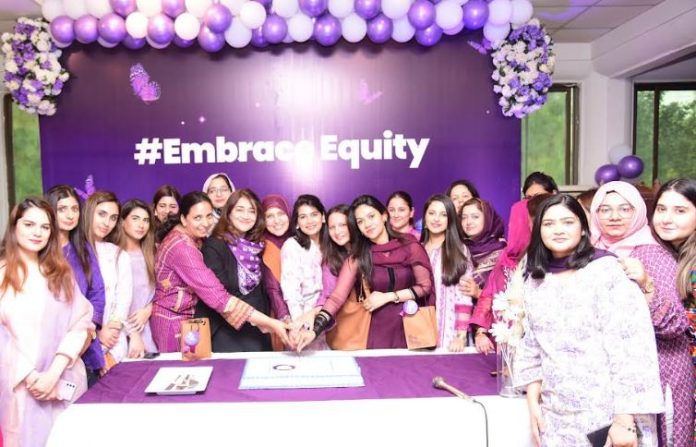
Islamabad, MAR 22 /DNA/ – Pakistan’s largest integrated ICT provider, PTCL Group (PTCL & Ufone 4G) celebrated International Women’s Day 2023 at its Islamabad Headquarters. Saadia Khan, Ex-Commissioner of the Securities and Exchange Commission of Pakistan (SECP) graced the event as a chief guest while prominent Jordanian molecular biologist, Dr. Rana Dajani also joined the event remotely.

The theme for this year’s International Women’s Day is ‘DigitAll Innovation and Technology for Gender Equality’, which emphasizes the role of technology in empowering women and promoting gender equality. PTCL Group realizes that bringing women into technology results in more creative solutions and has greater potential for innovations that meet women’s needs and promote gender equality. Therefore, it is committed to leveraging its technological expertise to create opportunities for women and provide a more inclusive workplace where women can thrive and excel.

The event showcased PTCL Group’s commitment to gender equality and women empowerment through its various gender-focused initiatives. Sharing his thoughts, President and Group CEO, PTCL & Ufone, Hatem Bamatraf said, “As we join the world in commemorating International Women’s Day, we reaffirm our steadfastness in embracing equity in all aspects of our organization. At PTCL Group diversity and inclusion remain the key drivers of innovation, success, and progress across all our operating companies, PTCL, Ufone & Ubank. Therefore, we remain dedicated to create a workplace where all our team members regardless of their gender, feel valued, respected, and empowered to reach their full potential. Our D&I-focused initiatives break down gender-related barriers to help women co-workers/team members to concentrate solely on their personal and professional growth and gratification.”

Employees pledged to embrace equity during the event by sharing their pledges on the pledge wall. The event was followed by Hi-Tea hosted by Pink Club, an exclusive all-female club at the organization. Employees also participated in the campaign “The woman in your life,” where they enthusiastically shared personal stories about the women who helped shape their lives and guided them to personal and professional success and gratification.

The event also saw the launch of the DIGIHER Hackathon, an initiative to give talented women the opportunity in the technology field to create usable solutions with a specific outcome in mind. This will include analyzing case studies, collecting extensive data, assessing possibilities, and proposing solutions for business-critical technology-related problems. The event concluded with a surprise performance by Nimra Rafiq who has previously released a couple of hit singles. The audience thoroughly enjoyed her power-packed performance.

International Women’s Day celebrations are an annual affair at PTCL and Ufone 4G which provide the group with the opportunity to reaffirm its pledge to diversity and inclusion. The Group remains committed to its goal of creating an inclusive workplace that values diversity and promotes equity, to set the right precedent for society.

Afghan Taliban raid in Kabul kills 3 Daesh members

News Desk

ISLAMABAD: An overnight raid by Taliban forces in Afghanistan’s capital killed three members of the extremist Daesh group, a Taliban spokesman said on Wednesday.

The regional affiliate of the Daesh group — known as the Islamic State in Khorasan Province — has been the key rival of the Taliban since their takeover of Afghanistan in August 2021. The militant group has increased its attacks, targeting both Taliban patrols and members of Afghanistan’s Shiite minority.

According to Zabihullah Mujahid, the Taliban government spokesman, the operation on Tuesday targeted an Daesh hideout in Kabul and killed three prominent members of the militant group who were plotting attacks during the Islamic holy month of Ramadan, which starts at sundown on Wednesday.

“The [Daesh] members used the hideout to carry out attacks in Kabul city and planned to target religious places and civilians during the upcoming month of Ramadan,” Mujahid said. The Taliban swept across Afghanistan in mid-August 2021, seizing power as US and NATO forces were withdrawing from Afghanistan after 20 years of war.

The international community has not recognized the Taliban government, wary of the harsh measures they have imposed since their takeover — including restricting rights and freedoms, especially for of women and minorities.

How can I abandon I?

Global Misperceptions

Adil Asad
Pakistan is an idea and an ideology. Pakistan is just not another State. It transcends the boundaries of time and space. Pakistan is a hope. The movement for the formation of Pakistan as a territory was essentially a movement for justice. Pakistan thus created on the edifice of justice to ensure justice and peace as its only goals. We often tend to timeline the history of Pakistan from 1947. But Pakistan pre-dates history. Every human that has strived for justice and liberty has actually strived for Pakistan. My Pakistan is thus a utopian ideology, a pure idea, a movement, a state, and a faith that has to ensure the defense of the helpless, occupied and abused. Every institution in Pakistan – the army, the Parliament, the courts, political parties, educational institutions, economic structures, and religious institutions are actually duty-bound to cut the cuffs of slavery wherever it exists. The people who have been occupied also need to understand and keep their hopes alive always that Allah has bestowed Pakistan with the power to act on behalf of them. No matter how weak or chaotic the situation is momentarily in Pakistan, Pakistan is coming Inshallah!, to break the shackles of slavery and to free you from the burden of injustice.
Long before the idea of Pakistan as a territorial entity was conceived, Pakistan existed in Occupied Kashmir. Long before Allama Iqbal chose Qaid-e-Azam to lead Pakistan and gave him the responsibility of our nation, Allama- a Kashmiri himself wailed about the People of Kashmir and the Treaty of Amritsar, who had been sold by the British to a Hindu Dogra King. He wrote:
Their fields, their crops, their streams,
Even the peasant in the vale,
They sold, they sold all alas,
How cheap was the sale.” (Allama Iqbal)
He also wrote:
Aaj Woh Kashmir Hai MakhoomMajboor-O-Faqeer
KalJisayAhle-E-NazarKehteThay Iran-E-Sageer
Today that land of Kashmir, under the heels of the enemy, has become weak, helpless, and poor-
Once known among the wise as little Iran)
Allama describes his location and identity as:
TanamGulai Zi Khayanban-e-Janat-e-Kashmir,
Dil Az HareemiHejaze Nawa Ze SheerazAst!
(My body comes from the earthy paradise of Kashmir; my heart belongs to the holy land of Hijaz, and my song to Shiraz.)
It was thus after his visit to Kashmir Allama envisioned a territorial power that would be created to break the shackles of slavery.
JisKhaak K Zameer Mein Hai Aatish Chinar
MumkinNahi Hai Ki Sarad Ho Woh KhaakiArjumand
(The earth that enshrines in its bosom the fire of Chinar:
This exalted earth can never be dead and cold)
One of the main objectives of the creation of Pakistan as a territorial unit was thus Kashmir. Kashmir isn’t just the Juglar vein of Pakistan; it is the soul (rooh) of Pakistan. The movement for freedom of Kashmir is thus the struggle of a body for its soul. A soul that is still in chains of slavery. Even if everyone conspires for abandoning Kashmir, even if the arguments are pseudo –rationale, the body would always search for its soul. Everything else can wait. Kashmir is embedded in the idea and ideology of Pakistan.
The people of occupied Kashmir need not pay any heed to political or economic maneuvering. The Kashmir question is intertwined with the question of Pakistan in such a manner that the struggle for Kashmir would always be reproduced and replicated organically even if there is no alignment for it. Pakistan doesn’t need to have a Kashmir policy or strategy either, because Kashmir is Pakistan and Pakistan is Kashmir. The Kashmir question is in its essence the Pakistan question. The question is existential and all existential questions don’t have answers and strategies. There is no escape from existential threats. Resistance isn’t a choice. It is organic. The positioning that we often adopt in language by referring to Pakistan and Kashmir rigidly as two entities are the barbarity of language and references. The day we use Pakistan and Kashmir interchangeably our doubts would erase. Our mutual doubts would disappear. We won’t need Kashmir committees and solidarity days. Our goals and means would come in unison.
Syed Ali Shah Geelani (RA) the face of resistance truly remarked:
“Hum Pakistani hai, Pakistan Hamaarahai”. We are Pakistanis and Pakistan is ours.
This isn’t just a hollow slogan but the essence of resistance in Kashmir. So, how can I abandon I?
*Adil Asad is doing his Ph.D. in sociology.

LHC orders govt to make public Toshakhana records from 1990 to 2001

Lahore, MAR 22: /DNA/ – The Lahore High Court (LHC) on Wednesday ordered the government to make public the record of Toshakhana gifts received by public office holders from foreign governments and dignitaries between 1990 and 2001 as well.

The high court’s directives came days after the government, under a previous order of the court, had made public the details of foreign gifts retained by public office holders — presidents, prime ministers, federal cabinet members, politicians, bureaucrats, retired generals, judges and journalists from 2002 to 2022.

Justice Asim Hafeez issued the orders today while presiding a hearing on a petition filed by Munir Ahmad through Advocate Azhar Siddique seeking the government to make public the complete details of Toshakhana gifts received by political rulers and bureaucrats from foreign dignitaries since the creation of Pakistan.

In the previous hearing, a day after the release of Toshakhana records from 2002 onwards, the high court had directed the law officer representing the government to “submit in chamber” the remaining record before 2002, including the names of those who gave those gifts.

During today’s hearing, the judge said that any gifts received by the country from friendly nations should also be made public, adding that nothing should be hidden.

Additional Attorney General Mirza Nassar, representing the government, objected to the directive concerning the disclosure of sources of gifts.

Despite the objection, the court insisted that all details should be disclosed to the public.

“We intend to file an appeal against the direction,” Nassar informed the court. Justice Hafeez assured the additional attorney general of their right to appeal.

The judge also emphasised that no one could retain any gift without making the necessary payment.

Furthermore, the judge stated that complete transparency should be maintained, and nothing should be hidden.

Subsequently, the court disposed of the petition.

The Tosha­khana is a department under the administrative control of the Cabinet Division and stores precious gifts given to rulers, parliamentarians, bureaucrats, and officials by heads of other governments and states and foreign dignitaries.

According to Toshakhana rules, gifts/presents and other such materials received by persons to whom these rules apply shall be reported to the Cabinet Division.

The plea
The plea seeking the details was filed by lawyer Munir Ahmad through Advocate Azhar Siddique in December 2022.

The plea stated: “The right to information is an integral part of a progressive democratic state and the same has been elaborated by the superior courts saying the right to information in all matters of public importance is indisputably a fundamental right guaranteed under Article(s) 19 and 19-A of the Constitution.”

According to the petitioner, the right to information stems from the requirement that members of a democratic society should be sufficiently informed that they may intelligently influence the decision which may affect them.

Therefore, he argued, the people of Pakistan had the right to know every public act, everything that is done in a public way, by public functionaries and their chosen representatives.

The petitioner contended that people at large were entitled to know details of every public transaction and acquire information in all matters of public importance.

“This enables people to contribute in debate on social and moral issues and matter of public importance.”

The plea urged the court to order the respondents to make public the details of assets gifted to rulers as well as bureaucrats and also provide the names, details, information, documentation and materials in respect of the persons/officials who have obtained the assets by making the payment.

The petitioner also sought details of the methodology used to determine the price of the Toshakhana articles.

Ministries of Parliamentary Affairs and Interior and Pakistan Information Commission were arrayed as respondents in the petition.

Supreme Court being ‘maligned’ via audio leaks: CJP Bandial

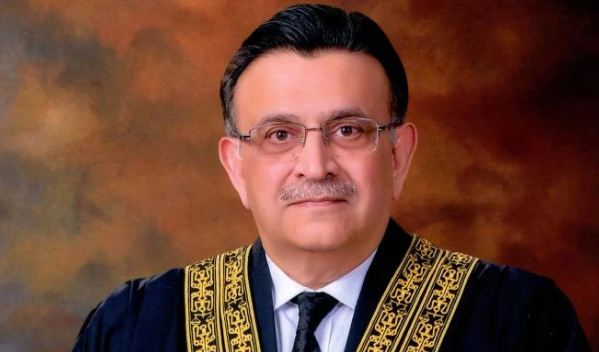
ISLAMABAD: Following a series of leaked audios against judges, Chief Justice of Pakistan (CJP) Umar Ata Bandial on Wednesday observed that the Supreme Court is a constitutional institution which is being “maligned” via audio tapes.

The remarks were passed by the top judge while heading a two-member bench hearing a plea filed by former Lahore capital city police officer Ghulam Mehmood Dogar against his transfer. During the hearing, the Supreme Court also disposed of the appeal as it was taken back by the petitioner.

“The Supreme Court is a constitutional institution which is being maligned through audio tapes,” the CJP said. He added that the apex court will work with patience to protect the institution.

“These audio tapes defaming constitutional institutions are of no importance. We are being patient and taking a lenient view of these tapes. We will protect the institution,” said the CJP. He added that it was unfortunate that baseless and false allegations have been made against the judges in audio and video leaks.

“What is the authenticity of these audio and video tapes?” remarked the CJP.

Earlier at the outset of the hearing, Dogar’s lawyer Abid Zuberi told the court that he wishes to take back the petition.

Meanwhile, the Election Commission of Pakistan’s (ECP) lawyer informed the court that the election schedule has been issued for the polls in Punjab.

“As per Article 218 holding free and fair elections is our responsibility. For a level-playing field, the ECP has the power to shuffle the bureaucracy,” said the lawyer. He added that the caretaker government can also transfer officers with the ECP’s approval.

At this, Justice Yahya Afridi asked, when does the ECP exercise its power of issuing transfer and posting orders?

CJP Bandial remarked that the ECP uses the power to transfer officers to ensure transparent elections. “It has been proven that the caretaker government transfers officials with the ECP’s permission.”

“The Election Commission itself can give orders to the caretaker government to transfer officers,” said the CJP.

Moving on, CJP Bandial remarked that the ECP has wide-ranging powers, adding that all political parties should get an equal chance during elections.

The top judge also remarked that the ECP should not give a free hand to the caretaker government for the transfer of the officers. He added that ECP should ask the caretaker government about such transfers.

“At times Supreme Court’s words are misinterpreted,” said the CJP. He added that the court had remarked that in 1988 there was an honest prime minister which was misunderstood by the Parliament.

“We did not say that till now there has been only one honest prime minister,” clarified the CJP. He added that the court has protected constitutional institutions in its decisions.

“Judiciary is being attacked [and] judiciary we will be protected,” said the top judge.

Pakistan, India need to adopt self-reflection, experts agree

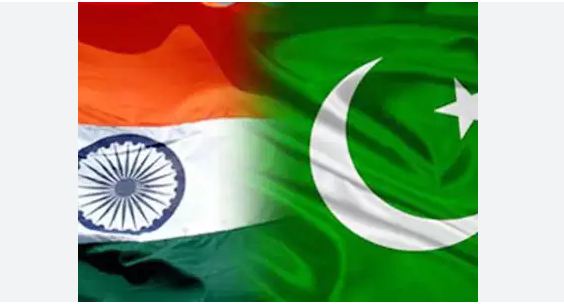
ISLAMABAD, MAR 22 /DNA/ – Both New Delhi and Islamabad were at a point in their relations where surviving in isolation was not an option and engagement was essential, however, a thorough inward introspection was direly needed for the two countries to progress beyond their deep-rooted animosity, agreed a panel of experts addressing a roundtable discussion titled Track Two Diplomacy: Viability between India and Pakistan. The roundtable discussion was organized by the Institute of Regional Studies (IRS).

Dr Arshi Saleem Hashmi, Head of Peace and Conflict Studies (PCS) Department at National Defense University (NDU) Islamabad said that both Pakistan and India required a multi-track diplomacy which prioritized initiation of goodwill on both parts rather than being solely focused on the outcomes of any potential engagement. She said that while previous leaders had tried their utmost to keep the communication networks alive and kicking through track IIs, lately the muting of all such channels was deeply concerning. The growing hyper-nationalism in addition to the irritants impeding communications were deepening a hate-based political culture across borders, she added.

Dr Farhan Hanif Siddiqui, Assistant Professor at Quaid-i-Azam University (QAU) was of the opinion that zero-sum strategizing had to be eliminated if India and Pakistan wished to progress their diplomatic ties in contemporary times. He said that while Kashmir was and will be a cause deeply significant for Pakistan, it was important to realize that India had already domesticated the issue and that this domestication had led every other effort towards engagement futile. Disassociation with all sorts of engagement with the non-state actors was imperative to ensure working relations with the eastern neighbor, he added.

Parliamentary Secy for unity to foil evil designs

Agencies

ISLAMABAD, Federal Parliamentary Secretary for Information and Broadcasting Chaudhry Muhammad Shahbaz Babar said on Wednesday that unity was the greatest strength of a nation and there was a great need of showing unity to foil enemies’ nefarious designs against Pakistan.

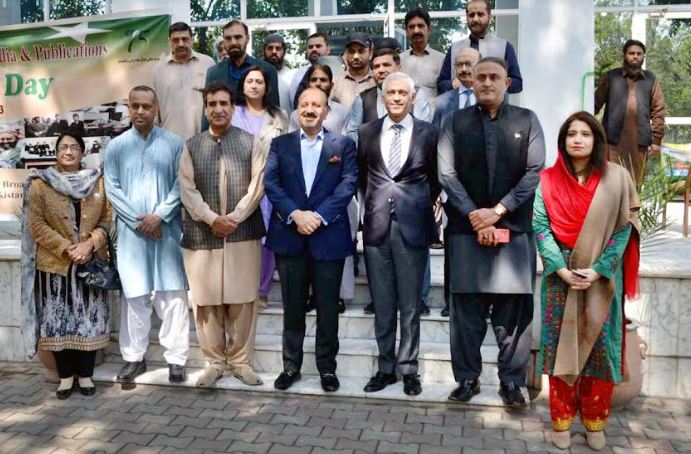
He was speaking at the opening ceremony of the Digital Photographic Exhibition on the eve of Pakistan Day organized by the Directorate of Electronic Media and Publications (DEMP), an attached department of the Ministry of Information and Broadcasting, at the Information Services Academy.

” Protection of Pakistan should be our life goal, March 23 is the day of renewal of pledge, today we should make a commitment that we will give any sacrifice for development and defense of our beloved country”, he said.

 Executive Director General of DEMP Tariq Mehmood,  Director Film DEMP Asifur Rehman, Deputy Director Exhibition DEMP Farina Mughal, senior officers of the Ministry of Information and Broadcasting and a large number of students from the twin cities were present.

 Briefing the chief guest and participants about the exhibition, Executive Director General DEMP Tariq Mehmood said that the directorate has organised a competition of digital pictures and paintings related to the freedom struggle of Pakistan, Kashmiris movement for independence for the students of educational institutions of the twin cities.    More than 200 pictures and paintings have been selected and put on display in the exhibition.

Shahbaz Babar while addressing the participants after the opening of the exhibition said that the day of March 1940 resolution was a milestone in our national history and an important turning point in the freedom struggle.

He said on Pakistan Day that everyone should renew the pledge to serve the country with honesty and sincerity.

 Chaudhry Muhammad  Shahbaz Babar said that the government was striving to transform Pakistan into a Pakistan a peaceful and moderate Islamic welfare state as envisaged by the Quaid-e-Azam Muhammad Ali Jinnah and Allama Muhammad Iqbal.

He said it was the responsibility of the people of Pakistan to shun mutual differences and play a positive role for the prosperity of Pakistan.

  Earlier, Federal Parliamentary Secretary for Information and Broadcasting Chaudhry Muhammad Shahbaz Babar visited the stalls of books set up by DEMP containing historical documents on the lives of Tehreek-e-Pakistan, the establishment of Pakistan, Quaid-e-Azam and Allama Iqbal.

He also observed the photographs, and paintings on display and also watched a documentary film based on the progress and achievements of Pakistan in 75 years produced by DEMP.

ICCI confers Excellence Awards on women to recognition their contribution

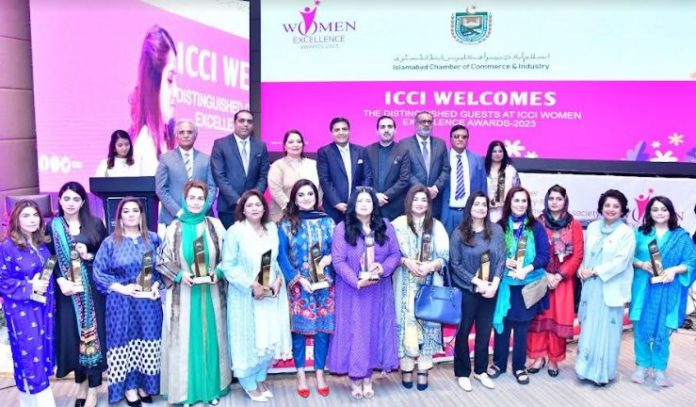
Islamabad, MAR 22 /DNA/ – The Islamabad Chamber of Commerce & Industry (ICCI) organized a Women’s Excellence Awards ceremony to confer awards to high achievers from various fields of life in order to recognize their contribution to the economic development of the country. Mirza Muhammad Afridi, Deputy Chairman Senate was the Chief Guest while Romina Khurshid Alam, Special Assistant to the Prime Minister was the Guest of Honor.

Speaking at the occasion, Mirza Muhammad Afridi, Deputy Chairman Senate said that women have a key role in the economic development of the country and lauded the ICCI for conferring awards on high achiever women to motivate others. He said that women of tribal areas needed skills development so that they could play a more effective role in national development.

Ahsan Zafar Bakhtawari, President, Islamabad Chamber of Commerce & Industry said that our women are second to none in terms of talent and ability. He said that many women have excelled in various fields of life and we feel proud over them. He said that Benazir Bhutto had become the first Prime Minister of Pakistan in Muslim World, which was a source of pride for women. He said that Malala Yousafzai, Sharmeen Obaid Chinoy, Dr. Ayesha Jalal, Prof. Dr. Nargis and many other women have earned great laurels for Pakistan. He said that the role Fatima Jinnah is a torchbearer for other women. He said that Hazrat Khadija and Hazrat Fatima are role models for Muslim women and by following their footsteps, Pakistan can be made a model society in the world. He said that women should be provided more opportunities to excel in life. He stressed that the government should make more conducive policies for women for their economic empowerment. He said that ICCI has taken a positive step to recognize those women who have excelled in various fields of life and assured that ICCI would continue to encourage women entrepreneurs so that they could contribute more effectively towards the economic development of the country.

Romina Khurshid Alam, SAPM said that women empowerment makes the nation stronger as when women rise, nations rise. She said that Islam has given women more respect, power and rights. She said that women have great talent and they should work with determination and Allah Almighty will help them to rise in life. She lauded ICCI for recognizing the role of women and making its executive member an Honorary President on Women’s International Day.

Khalid Iqbal Malik, ICCI Group leader said that developed countries have achieved fast growth by increasing the role of women in their economies and Pakistan should also increase the share of women in the formal economy to take benefit of their talent for sustainable economic growth.

Faad Waheed, Senior Vice President said that ICCI is the only Chamber that made a women entrepreneur its Senior Vice President and said that ICCI would continue to promote women entrepreneurs.

Zafar Bakhtawari, Secretary General UBG said that the purpose of organizing the awards ceremony is to promote high achievers as role model women in society. He hoped that the award recipients would work harder with honesty and commitment to further excel in life.

Air Marshal (Retd) Sohail Aman, former Chief of Air Staff also lauded ICCI for organizing an awards ceremony for women and said that women are now playing an important role in the Pakistan Air Force.

Azhar ul Islam Zafar, Vice President ICCI thanked all the guests and participants for attending the award ceremony. Zeenat Ayesha entrepreneur shared her success story with the participants.

The Excellence Awards were given to Ms. Farrukh Khan MNA, Kashmala Tariq, Samina Fazal Founder President Islamabad Women Chamber of Commerce, Fatma Azeem former Senior Vice President ICCI, Sana Mir Cricketer, Samina Khayal Baig Mountaineer, Ayela Majid first Pakistani Vice President of ACCA, Fauzia Minallah Environmentalist, Nigar Nazar Cartoon Expert, Dr. Shazia Akbar Poetess, Anna Faisal Educationist, Dr. Shagufta Jabeen Educationist, Dr. Afshan Malik Educationist, Sobia Mustafa Make Up Artist, Sobia Nazir Fashion Designer, Atia Liaquat Realtor, Amina Amir Geo News Reporter, Shifa Yousafzai Anchorperson, Amina Baig SP, Neelam Khalid Chaudhry Entrepreneur, Syeda Tayyaba Kazmi Entrepreneur, Sonia Azeem Singer & Nadia Qureshi ICCI. 

Stay Connected

64FansLike
60FollowersFollow

Latest Reviews

Exchange Rates

USD - United States Dollar
EUR
1.17
GBP
1.36
AUD
0.67
CAD
0.73