Home Blog Page 1206

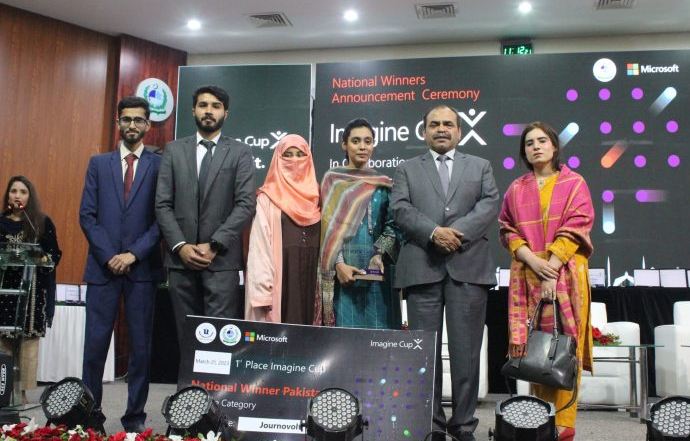
NUTECH students secure top positions in Imagine Cup

DNA

ISLAMABAD:  NUTECH students Junaid Hasan and Syeda Manahil Javed of the CS department batch 2019  secured first positions in Regional and National Finals in Microsoft Imagine Cup 2023 in partnership with HEC and have now moved for World Championship. Their product Journovolt aims to introduce an automated news reporting channel which reports authentic, genuine, bias-free news while simultaneously reducing the expenses and costs that are required to run a usual news broadcasting channel.

Over the past 19 years, more than two million competitors have signed up for Microsoft’s global student technology competition to build something that matters to them, make a difference in their communities, and innovate for impact. Rector NUTECH Lt Gen (R) Moazzam Ejaz appreciated the efforts of all students and congratulated the winning team for achieving a milestone for NUTECH.

Palestine warns against fascism of Israeli officials

DNA

ISLAMABAD: The State of Palestine has warned against the unaccountable fascism, unrestrained power, and unabated criminality of Israel’s officials, sustained by an undemocratic and social system of Jewish supremacy, oppression, racism, and apartheid.

Fascism is enabled by militias ties to power and threatens regional and international peace and security.   Ben Gvir’s reported agreed militias of racial terror will only serve to target, kill, and torture the undefended Palestinian people, en masse.

The government of Israel is responsible for the repercussion  of this deliberate decision, which only confirms Israel’s absolute contempt for Palestinian rights and lives and flagrant breach of the international community’s parameters of a just solution.

We will not stand idly by as a proud terrorist and an anarchist form and lead another Jewish militia with the declared aim of ethnically cleansing the land of its people. The Palestinian people have an unassailable right to defend themselves, their families, homes, and lands, from this State terrorism.

The warning signs are clear. Since the beginning of 2023, Israel has killed over 90 Palestinians including 17 children. Condemnations of and concrete actions against Ben Gvir’s militia of racial terror are necessary. Likewise, the Secretary-General of the United Nations must uphold his obligations and provide immediate international protection for the Palestinian people.    

The rights of the Palestinian people to live as free and independent people in their homeland, in dignity, in peace and security, are neither negotiable nor tradable for internal political fixtures. The rights of the Palestinian people are inalienable and universally recognized and only their realization will end this international crisis and lead to region and international peace and security.

‘Computerized ID cards should be mandatory for marriage’

DNA

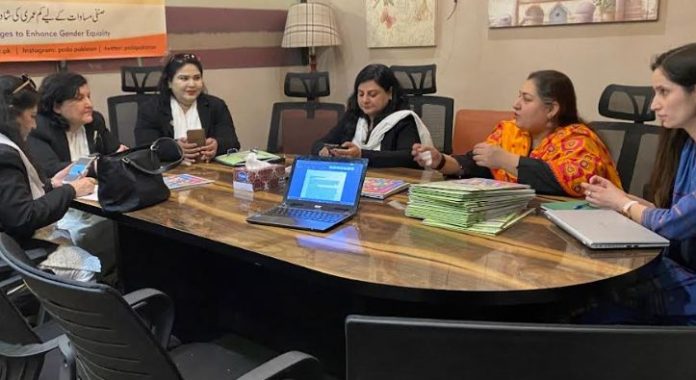
Lahore, MAR 28: In a meeting connected with International Women’s Day held in Lahore, the lawyers demanded the government to bring amendment in the Child Marriage Restraint act 2015 of Punjab to make provision of the Computerized National Identity Card mandatory for marriage.

The meeting was organized by Potohar Organization for Development Advocacy under its project “Reducing Early Age Marriages to Enhance Gender Equality” supported by Royal Norwegian Embassy in Pakistan.

PODA is a women’s rights organization working for women’s social, economic and political empowerment specifically of rural women whose voices are missing altogether in the media and at policymaking level as well.

Hira Imam, the representative of the host organization, PODA provided a brief of the project that is focused on ending early age marriages. She told the audience that with the support of the people from the grassroots level that is connected with the amendment in law , PODA is striving hard to reduce and ultimately end early age marriages which is clearly violation of a girl child.

The meeting was attended by Advocate HifzaBukhari, Finance Secretary of Supreme Court Bar Association Pakistan, Advocate RabiaBajwa, newly elected Vice President of the Lahore High Court Bar Association, and Advocate SabahatRizvi, the newly elected GeneralSecretary of Lahore High Court Bar Association. AdvocateSabahatRizvi is the first-ever female General Secretary elected for the LHCBA since its inception in 130 years.

The lawyers urged the legislators of four provinces to extend coordination on reducing early marriages to bring harmony in the law as after 18thAmendment, it’s the responsibility of the provincial assemblies to address the problems linked with early age marriages in the best interest of the people.

Advocate HifzaBukhari while presenting a provincial comparison of marriage laws shared that only Sindh has a minimum age of marriage of 18 years for both boys and girls. Balochistan, KPK, and Punjab have the minimum age of marriage for girls 16 years, and for boys 18 years.

Advocate RabiaBajwa, Vice President of the Lahore High Court Bar Association said that parliamentarians should be mobilized to bring legislative amendments, and media houses should also be engaged to create awareness to change social norms and culture to support legislative amendments. She applauded the role of PODA for making efforst while adopting multipronged approaches.

CJP Bandial offers pay cut for judges so ‘vital’ elections can be funded

ISLAMABAD, MAR 28: Chief Justice of Pakistan (CJP) Umar Ata Bandial on Tuesday proposed a pay cut for himself and other judges so that the “vital task” of holding elections across the country could be funded and completed.

He passed these remarks as the apex court resumed hearing PTI’s petition challenging the Election Commission of Pakistan’s (ECP) decision to postpone general elections to the Punjab Assembly till October 8.

A five-member larger bench — comprising Chief Justice of Pakistan Umar Ata Bandial, Justice Ijazul Ahsan, Justice Munib Akhtar, Justice Aminuddin Khan and Justice Mandokhail — is hearing the case.

In a surprise move on March 22, the ECP had put off the elections for more than five months citing the deteriorating security situation in the country and the unavailability of finances and security personnel. Subsequently, the PTI challenged the commission’s order in the SC.

Ahead of today’s hearing, the coalition parties — PML-N, PPP and JUI-F — submitted a request in the court to become respondents in the case.

During the proceedings, PTI lawyer Barrister Ali Zafar, Attorney General of Pakistan (AGP) Mansoor Awan, PPP lawyer Farooq H. Naek and others were present.

The hearing
At the outset of the hearing today, CJP Bandial welcomed AGP Awan and said that the court looked forward to receiving assistance for him.

The top judge remarked that “we don’t want to stretch the matter”, stating that the question in front of the court was simple: Can the election date be extended or not?

“If the ECP has the authority [to extend the date] then the matter will be over,” he said.

CJP Bandial noted that the AGP had raised the point to make political parties respondents in the case. “Rule of law is essential for democracy and without rule of law, a democracy cannot function.

“If the political temperature stays so high, problems will increase,” the apex court judge added.

Here, PPP lawyer Farooq H. Naek said that there was “anarchy and fascism” in the country today.

Meanwhile, the attorney general mentioned the dissenting notes of two SC judges.

On Monday, Justice Mansoor Ali Shah and Justice Mandokhail cast doubt on the judgement handed down in the March 1 suo motu regarding elections in Khyber Pakhtunkhwa and Punjab, saying that the proceedings stood dismissed by a majority of 4-3, and contended that the CJP does not have the power to restructure benches without the consent of the respective judges.

Referring to this judgement, AGP Awan said that if the court’s decision [on March 1] was passed by a four-three majority, then there was no order that was violated.

“If there was no court order, then the president could not give a date for elections,” he said, urging the bench to first take a decision on the March 1 verdict.

However, CJP Bandial said: “The question here is not about the judgement but about the ECP’s power.”

The AGP contended that the PTI petition was based on the ECP’s violation of the SC orders.

“The members of the bench are sitting here to review the questions raised in the petition. You [AGP Awan] are relying on a technical point,” the top judge said, adding that the SC’s jurisdiction was not limited to the petition.

Right now, he continued, the matter is not about giving the poll date but delaying it.

“Elections are necessary for democracy … don’t spoil the matter on technical grounds,” the CJP told Awan. “The SC’s March 1 order has already been implemented. Don’t raise this matter or present it in court again.”

Justice Manokhail pointed out that “the number of judges [who issued] the March 1 judgement is Supreme Court’s internal matter”.

He then inquired whether holding elections within the stipulated time of 90 days was not a constitutional requirement. “Can the ECP delay the date for polls?”

At that, the CJP thanked Justice Mandokhail for “clearing the matter”.

“People across the country are standing in queues for subsidised wheat today … it is the responsibility of the PTI and government to improve the situation in the country,” he said, stressing that it was important to respect all of the national institutions.

“But every institution has to work within its constitutional limits,” Barrister Zafar stated here to which the CJP said that the same was expected from the PTI leadership as well.

“PTI has to take the initiative first because it has approached the court,” the top judge said. “There is violence and intolerance in the country today … look at the economic situation … people are waiting in long lines for subsidised wheat.

“Instead of quarrelling among each other, think of these people,” CJP Bandial urged.

For his part, Barrister Zafar said that the crises would escalate if the elections were delayed.

Meanwhile, Justice Aminuddin Khan inquired whether the election schedule could be further reduced from the mandated 90-day period to which Justice Ahsan responded that the ECP had the authority to adjust the election schedule within the 90-day period.

However, he said the ECP could not delay the polls beyond the specified period.

Here, Justice Mandokhail interjected that the 90-day period had already elapsed, and expressed his disappointment that the Constitution was not being taken seriously in the country.

“Elections in the country will be held anyway, but the question is who will extend the date [for polls] beyond 90 days,” he asked. “There is another question that can the assemblies be dissolved on the whim of one man?”

For his part, Barrister Zafar argued that both the prime minister and chief minister were elected representatives to which Justice Mandokhail pointed out that the assembly could be dissolved if the prime minister’s political party intended to bring a vote of no-confidence. Barrister Zafar agreed to this.

The judge then questioned whether the matter should not be debated in parliament. In response, the PTI’s counsel stated that parliament could indeed debate the powers of the prime minister and chief minister.

At one point during the hearing, Justice Ahsan highlighted that the SC’s March 1 decision had been successfully implemented. He recalled that the ECP had issued a schedule on the poll date proposed by the president.

Barrister Zafar also said that the ECP had adhered to the SC’s order as far as elections in Punjab were concerned.

“But the question is does the ECP have the authority to alter the date given by the president? Can the elections be delayed beyond 90 days?” Justice Ahsan asked.

The CJP also inquired about the ECP’s powers to change or reissue the date for elections.

He observed that Section 58 of the Elections Act did not permit the postponement of the polls. Here, Barrister Zafar highlighted that the ECP had relied on two articles of the Constitution.

Justice Mandokhail stated that the ECP had provided reasons for failing to fulfil its constitutional responsibilities and then asked what would have happened if the ECP had not announced the October 8 date for the elections.

Justice Ahsan pointed out that the ECP had the option of contacting the president to request a change in the election date, and reiterated that all administrative departments were obligated to cooperate with the election commission.

However, Barrister Zafar pointed out that Article 220 of the Constitution restricted government institutions from interfering with the ECP’s functions. The PTI counsel accused the ECP of disregarding its constitutional obligation and making the decision on the poll date solely based on the opinions of other institutions.

The counsel urged the court to question the commission about its actions and warned that Article 5 of the Constitution — which talks about the loyalty to State and obedience to the Constitution and law — would come into effect if administrative departments refused to cooperate.

Meanwhile, Justice Mandokhail observed that the date given by the ECP was already beyond the stipulated period of 90 days and asked whether this was acceptable. He suggested that the court could intervene and issue a verdict if elections were not held within the 90-day period.

Justice Akhtar remarked that the ECP should have approached the court if elections were not possible. “[The court] can be approached for elections on the same day if an assembly has been dissolved during the schedule of another assembly.”

The ECP, he continued, cannot issue an order itself. “If the election commission can delay elections for six months it can do the same for two years too.”

Justice Mandokhail noted here that the Constitution was silent when it came to deciding who had the authority to delay the polls. “Should the parliament not amend the Constitution,” he asked rhetorically to which Justice Akhtar said that if the parliament brought amendments everything would be sorted.

“But the question is what will happen to the elections that are to be held until the amendment is made,” he wondered.

Here, Barrister Zafar said that from the basis of the reasons why the elections were delayed, it seemed that election would never be held.

“If the problem is related to funds, then how will the caretaker government issue them?” Justice Akhtar asked.

Justice Ahsan also questioned how could it be determined that the problems that existed today would not be there on October 8 as well.

The PTI lawyer replied that the ECP had said that it was not provided with funds for the elections to which Justice Akhtar stated that he had read a statement given by the prime minister in newspapers.

“The federal government says that Rs500 billion tax was collected till February … it is surprising that out of Rs500 billion, Rs20 billion couldn’t be given [for elections],” the judge pointed out.

Barrister Zafar recalled that in its order, the ECP had quoted the finance secretary as saying it would be difficult to release the funds. “It is to be noted that Finance Ministry had used the word difficult, not rejected [the request].”

Justice Akhtar said that the finance secretary had stated that it did not have funds for elections today and in the future. “This means that elections will not take place at all. How can a government secretary issue such a statement?”

He also noted that after it was collected, the tax was deposited in the federal consolidated funds.

Here, PPP’s Naek contended that federal consolidated funds were only spent with the approval of the Parliament to which Justice Akhtar asked: “If the assembly is dissolved, will the funds not be released?”

The lawyer replied that in the present scenario, a National Assembly was functioning, elaborating that a new assembly could approve the expenditure. “Only the ECP could provide an explanation for the finance secretary’s statement,” he added.

Justice Mandokhail also asked how the finance secretary could disburse funds beyond the approved budget to which Barrister Zafar said that this was a technical point.

At one point during the hearing, the CJP proposed that if cuts were made to his salary and others, then the vital task of carrying out elections could be completed.

“An entire budget is not required for elections … the government can cut back its expenditures and release Rs20 billion,” he said. “An Rs20 billion cut can be made in the salaries of judges.”

CJP Bandial highlighted that the country was in the midst of economic turmoil today and emphasised that sacrifice was needed to deal with the crisis. “A five per cent salary cut can cover the expenses of elections,” he said.

The top judge further pointed out that the security personnel in KP conducted the highest number of operations. He revealed that 61 operations in Punjab, 367 in Sindh and 1,245 operations were conducted in KP.

“The situation in Punjab is different than that in KP,” the CJP noted and gave the example of Turkiye, where he said elections were being held in all the areas that were not struck by the earthquake.

Barrister Zafar concurred and said that even the Election Act, 2017, highlighted that polling could only be cancelled in areas where problems existed. “It is not possible to postpone the entire elections.”

Here, the apex court judge stated that the polls could only be delayed if an emergency was imposed [in the country]. “Does the ECP order mention imposing an emergency?” he asked to which the PTI lawyer replied, “absolutely not”.

“Absolutely not was said by you [the PTI] to someone else,” the CJP quipped, which led to laughter in the courtroom.

At one point, Justice Mandokhail asked if funds were allotted for elections in the budget, saying that the procedure of taking funds was clearly mentioned in the Constitution.

For his part, Barrister Zafar mentioned that last year the CEC had said the ECP would be ready for elections in November 2022. “But now, the ECP all of a sudden says that it does not have funds … the unavailability of funds is no excuse for delaying elections.”

He further said that the ECP has the electoral staff, but had expressed concerns over the availability of security personnel. “The provision of security was the responsibility of the provinces.”

Govt wants full court to hear case
The government, on the other hand, has urged the SC to constitute a full 13-member bench to hear cases that had “significant national and public impact”, including the matter of elections.

Law Minister Azam Nazir Tarar talks to the media outside Supreme Court on Tuesday.
Tarar claimed that the apex court’s March 1 ruling in the election suo motu case was a 4-3 majority decision, and not a 3-2 verdict.

The CJP had last month constituted a nine-member bench to hear the case, however, the bench was later curtailed to five members after four judges — Justice Jamal Khan Mandokhail, Justice Mansoor Ali Shah, Justice Yahya Afridi and Justice Athar Minallah — in their additional notes to the Feb 23 order raised objections on the constitution of the bench as well as the invocation of the apex court’s suo motu jurisdiction by the chief justice.

Two of these judges had also questioned the SC’s jurisdiction to invoke Article 184(3), which relates to its suo motu powers, in this matter.

Justice Ahsan and Justice Naqvi — whose inclusion to the original bench was opposed by the coalition government and the Pakistan Bar Council — as well as Justice Minallah and Justice Afridi had distanced themselves from the bench.

Talking to the media outside the SC today, the law minister said that collective wisdom was more important in decisions regarding matters of public importance.

Discussing the dissenting notes of Justice Mandokhel and Justice Shah, Tarar said important matters warranted that all judges should be taken on board. He also demanded that the matter should be settled once and for all.

ECP asked to justify delay in polls
As the apex court took up PTI’s petition on Monday, it issued a notice to the ECP and asked the body to come prepared to justify its decision to postpone elections to the Punjab Assembly.

The court also issued notices to respondents namely Khyber Pak­h­tunkhwa (KP) governor, federal secretaries cabinet, parliamentary affairs and law and justice.

During yesterday’s hearing, CJP Bandial had observed that the spirit of the Constitution does not envisage the making or breaking of governments, but rather focuses on ensuring good governance and bringing happiness to the people by protecting their rights.

At the same time, the CJP had also shared his worries regarding the prevailing hostility, animosity, and bitterness which he said had been “sown into our polity”, while questioning the role political leaders were playing in restoring peace and calm in society and seeking a ‘commitment’ from parties in this regard.

The petition
PTI’s petition, moved by party’s Secretary General Asad Umar, former Punjab Asse­m­bly speaker Mohammad Sib­tain Khan, former Khy­ber Pakhtunkhwa Assembly Speaker Mushtaq Ahmad Ghani and ex-lawmakers of Punjab Abdul Rehman and Mian Mahmoodur Rashid, pleaded that the ECP’s decision was in violation of the Constitution and tantamount to amending and subverting it.

In the petition, PTI sought directions for the federal government to ensure law and order, provisions of funds and security personnel as per the ECP’s need to hold the elections.

It also requested the court to direct the Khyber Pakhtunkhwa governor to announce the date for elections to the provincial assembly. Last week, KP Governor Ghulam Ali also proposed Oct 8 as the date for elections in the province. Earlier, he had announced May 28 as the date for polls.

The PTI questioned the ECP’s authority to “amend the Constitution” and asked how it could decide to delay elections to any assembly beyond the period of 90 days from the date of dissolution of the said assembly as mandated by the Constitution.

The petition argued that the ECP was bound to obey and implement the judgments of the Supreme Court and had no power or jurisdiction to overrule or review them.

The ECP cannot act in defiance of the Supreme Court’s directions as it has done in this case which was illegal and liable to be set aside, the petition pleaded. By announcing Oct 8 as the date, the ECP has delayed the elections for more than 183 days beyond the 90-day limit as prescribed in the Constitution.

The petition said that if the excuse of unavailability of security personnel was accepted this time, it will set a precedent to delay any future elections.

The petition added that there was no assurance that these factors — financial constraints, security situation and non-availability of security personnel — would improve by Oct 8.

The “so-called excuse” would mean the Constitution could be held in abeyance every time elections were due, the petitioners feared adding that in the past similar situations have persisted, but elections were held in spite of them.

These situations can’t be used as excuses to “subvert” the Constitution and deny people their right to elect representatives.

“Not holding elections in case of threats by terrorists will amount to giving in to the threats, which is in fact the aim of all terrorist activities,” the petition explained.

Mansoor Usman Awan appointed Attorney General for Pakistan

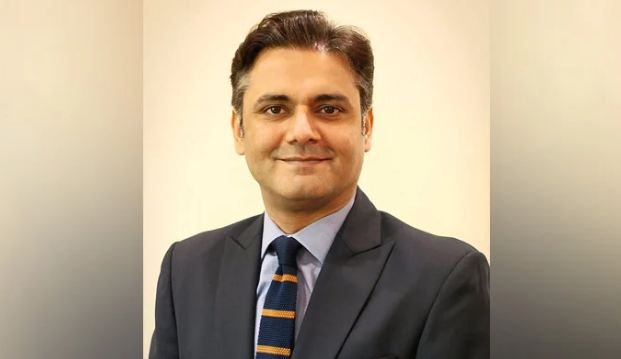
ISLAMABAD: President Arif Alvi Monday appointed Mansoor Usman Awan as the new Attorney General for Pakistan (AGP) after accepting Barrister Shehzad Ata Elahi’s resignation, who left the post after less than two months in the office.

The appointment was approved by the president under Article 100 of the Constitution, a statement from the Aiwan-e-Sadar said, adding that his status will be equal to a federal minister.

Elahi was picked for the coveted post after Awan last year declined to become the attorney general as — despite the president approving his appointment — he was not officially notified.

The government then faced embarrassment from the judiciary for not filling this important constitutional post after ex-AGP Ashtar Ausaf tendered his resignation in October last year.

Awan holds a Master of Laws (LLM) degree from Harvard Law School, USA, and a Bachelor of Laws (LLB) degree from the University of Punjab where he stood first. He was awarded the Justice M Jan Memorial gold medal for obtaining first position in jurisprudence and Charles Earl Bevan Petman Law Prize for first position in criminal law.

Awan is a recipient of the Harvard Law School Dean’s Award for Leadership (2005). At Harvard Law, he was elected as the LLM Representative to Harvard Law School Council and he also served as the vice president of the Harvard Graduate Council.

Resumption of Iran -Saudi Arab relations good omen for Muslim World

The Muslim Ummah must have to take  practical measures against the atrocities on Palestinians and Kashmiris, as with the advent of Ramadan-ul- Mubarak, atrocities increased in the Palestine and Kashmir by Israeli and Indian forces, said Hafiz Muhammad Tahir Mahmood Ashrafi.

Talking to media here in Monday, Hafiz Muhammad Tahir Mahmood Ashrafi, Chairman Pakistan Ulema Council said that the stance of the Organization of Islamic Cooperation on the issue of Palestine and Kashmir is very clear.

 Resumption of relations between the Kingdom of Saudi Arabia and Iran is good news for the entire Muslim Ummah, and it is necessary for the strength of Islamic countries to stop sectarian and foreign interference in affairs of the Muslim countries.

Chairman Pakistan Ulama Council Hafiz Muhammad Tahir Mahmood Ashrafi talking to the media said that Muslim Ummah have to take practical steps on the issues of Palestine and Kashmir.

Israeli atrocious practices towards oppressed Palestinians are increasing and
 Israel is not recognizing international laws and resolutions and this is the situation of India in Occupied Kashmir, said Hafiz Tahir Mahmood Ashrafi.

 He said that the position of the Organization of Islamic Cooperation (OIC) on the issue of Palestine and Kashmir is very clear.  The countries involved in the Organization of Islamic Cooperation will have to solve these issues with unity and unanimously.

 He said that with the arrival of Ramadan, the series of Israeli and Indian atrocities increases on the innocent people of Kashmir and Palestine.

Israel is trampling international laws on the issue of establishing new settlements, while India continues to perpetuate persecution in Occupied Kashmir.

 He said that the restoration of Iran-Saudi Arabia relations is a good news for the Muslim Ummah and the role of Pakistan’s great friend China in this regard is very positive and commendable.

 Saudi Arabia, China and Russia should also play their full role on the issue of Palestine and Kashmir.

Pakistan and Saudi Arabia have the same position on the issue of Palestine, until a free and independent Palestinian state is established, relations with Israel cannot be thought of, said Hafiz Muhammad Tahir Mahmood Ashrafi.

 In response to a question, Hafiz Muhammad Tahir Mahmood Ashrafi said that Saudi Arabia is the center and great power of the Islamic world.

 The role played by the Crown Prince of Saudi Arabia, Muhammad bin Salman, under the patronage of Khadim-e-Harmain Al-Sharifain Shah Salman bin Abdulaziz, is being appreciated all over the world for the end of wars and for the cause of peace.

 The restoration of Saudi Arabia-Iran relations will bring many benefits to Pakistan, said Hafiz Muhammad Tahir Mahmood Ashrafi adding that  the Islamic world has to solve its problems through mutual unity.

 The current situation in the Islamic world is due to external interference, extremism and sectarian violence.

 The Fifth  International  Message of Islam Conference organized by Pakistan Ulema Council on April 10, 2023 in Islamabad will strengthen and stabilize the struggle against extremism and terrorism of Pakistan, Saudi Arabia and friendly countries.

 Religious diplomacy at the global level is a requirement of the prevailing situation and  time, said Tahir Ashrafi adding that religious Leadership has to play their respective role for interfaith and inter religious harmony.

 Ulemas-Mashaykh of Pakistan are in contact with the leadership of all the Islamic countries and  different religions
in order to spread the message of Islam of peace and security, said Tahir Ashrafi.

He said that leaders of all religions and religious sects will participate in the Fifth International Message of Islam Conference scheduled to be held in Islamabad on 10th April 2023.

DEALING WITH ADHD

Global Misperceptions

Nandara Shahid

ADHD stands for Attention Deficit Hyperactivity Disorder which includes two types of conditions; Inattentiveness and Hyperactivity. This disorder develops in children and continues up to adulthood.

For a common person, knowing how to diagnose ADHD, should not be the matter of concern but they shall be aware of how to behave around people suffering from such a condition. This is the reason why spreading awareness about ADHD is crucial. Pakistan is far off from western countries in managing such issues due to lack of awareness, late diagnosis, long untreated period and difficulty in approaching a proper mental health specialist.

There is also a lack of specialty in this field. Moreover, first line medications for such patients are psycho stimulant medicines which are not easily available in Pakistan. So psychiatrists have to go for second line medications for managing the behavioral issues of their patients. We as part of the society should learn to be understanding, compassionate and patient towards people with ADHD because divisions only lead to more divisions. “NOT A DISABILTY BUT A DIFFERENT ABILITY” PARENT’S REACTION: According to a psychiatrist Dr. Aasma Kiyani “parents are usually exhausted when they approach mental health specialists so they are mostly comfortable with the diagnosis of their child and are more interested in treatment prognosis”.

She further explained that it is very easy for parents to notice the symptoms of hyperactivity in their children if they see them overactive or uncontrollable around the house. However, the symptom of inattentiveness is not very frequently caught in parent’s sight and this results in a late diagnosis which may lead to academic decline, nutritional deficiencies, physical injuries, exhaustion, harm to oneself, parenting burden etc.

Thereby, parents are suggested to build conversations with their children and try to understand what their child is going through. Similarly, the Headmistress of Special Children Bahria College explained how sometimes parents even after bringing their children to such schools are not ready to accept that their children are “special” or have a disorder.

Self confidence originates from one’s family. However supportive their friends are, if a person’s family is not ready to accept their ADHD, the person would never be able to accept himself. This lack of awareness among parents would portray a wrong image to their child that they are not a part of this society and a mere burden on their parents.

Families have to ensure that they remain to be a perpetual support for their children. OTHER COMMON REACTIONS: Other people that a person with ADHD frequently might come across could be their fellow peers, classmates and teachers at school etc. It is equally important that they know how they should react around such people. Young people don’t really understand which of their actions can affect another person mentally or emotionally. Hence, they are always requested to be compassionate and patient towards people with ADHD in specific and in general toward all.

The medically able people have more social skills compared to a person suffering from this disorder so they shall be the ones to make the first step to initiate a friendship and not judge them. Secondly, the schools in Pakistan play a great role in such people’s lives. If teachers hold a student with ADHD responsible for disturbing the decorum of the classroom and punish them instead of putting themselves in their shoes and understanding their situation, it would lead to nothing but resentment. Teachers should be supportive, should make such children sit in the front row and repeatedly question if they are understanding or not.

Moreover, if they believe that the student has attention problems and may have a specific disorder, the message must be conveyed to parents as soon as possible and with immense care and respect. We suggest that educational institutions should start awareness campaigns and steps against bullying to not only protect people with ADHD but everyone against discrimination. Furthermore, following the analysis of the situation in Pakistan regarding this issue, we would like to urge the government to set up more special schools with all sorts of facilities for such people.

Conclusively, after conducting several surveys we found out that there is a major lack of awareness about ADHD in Pakistan than in any other country. We have taken the initiative to spread awareness among common people aiming to remove the stigma around ADHD and encourage people to seek a diagnosis for their symptoms.

China urges diplomatic efforts as Russia plans to station tactical nuclear weapons in Belarus

Beijing, MAR 27: China on Monday called for “diplomatic efforts” toward a peaceful solution to the Ukraine crisis after Russia announced its plans to station tactical nuclear weapons in Belarus.

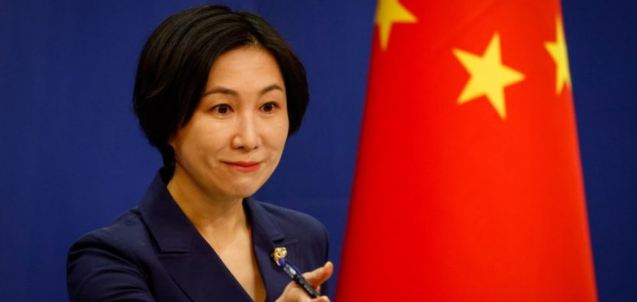
“In the current situation, relevant parties should focus on diplomatic efforts toward a peaceful solution to the Ukraine crisis and push together for an end to tensions,” Mao Ning, spokeswoman for China’s Foreign Ministry, told reporters in Beijing.

In a move certain to stoke tensions in war-torn Ukraine and its Western allies, Russia will complete the construction of a special storage facility for tactical nuclear weapons in neighboring Belarus, according to remarks made last Saturday by Russian President Vladimir Putin.

Russia has already handed over to Belarus the Iskander complex, which can store nuclear weapons, Putin said.

However, Mao recalled that the five nuclear-weapon states issued a joint statement in January 2022 on preventing nuclear war, the Chinese daily Global Times reported.

According to Putin, his Belarusian counterpart Alexander Lukashenko has long raised the issue of deploying Russian tactical nuclear weapons in Belarus, which have not been present there since the early 1990s, when the USSR fell.

“We agreed with Lukashenko that we would place tactical nuclear weapons in Belarus without violating the nonproliferation regime,” Putin said.

The U.S. has long placed such weapons in a number of countries, so there is nothing unusual in Belarus’ request, Putin added.

Putin later said Russia deployed 10 aircraft, all capable of carrying tactical nuclear weapons, to Belarus.

“Ten aircraft are ready to use this type of weapon. We have already transferred to Belarus our well-known, very effective Iskander complex, it can also be a carrier (of tactical nuclear weapons),” he said.

Moscow will start training crews early in April, said Putin, adding that Russia would complete the construction of a storage facility for tactical nuclear weapons in Belarus by July 1 and the control of arms will not be transferred to Minsk.

Since Russia started the war in neighboring Ukraine 13 months ago, Western leaders and commentators have raised concerns that Moscow might make the conflict nuclear, often based on statements by the Russian side.

Woman sells newborn minutes after giving birth

As many as 11 people were arrested by Indian police in connection with a case wherein a woman allegedly sold her newborn baby in India’s Jharkhand state.

The woman identified as Asha Devi gave birth to a baby boy and sold his son minutes after his birth.

According to the Indian police, after receiving the information about the incident the police swung into action arrested the mother and rescued the newborn within 24 hours while seizing Rs 100,000 from the possession of Asha Devi.

Asha Devi led the police to a ‘Sahiya didi’, alias Dimple Devi, based on the lead provided by Dimple Devi, police apprehended the other accused and arrested the gang of 11 people.

In a statement, Dimple Devi confessed that she struck a deal with two brokers for Rs 450,000. While the mother of the baby was given Rs 100,000, the rest Rs 350,000 was shared among the brokers.

A case was registered against the accused brokers and mother on the statement of the Deputy Superintendent of the Hospital, doctor Manish Lal.

Imran Khan secures protective bail in seven cases

ISLAMABAD: The Islamabad High Court (IHC) on Monday granted protective bail to the former prime minister and Pakistan Tehreek-e-Insaf (PTI) Chairman Imran Khan in seven cases.

A bench headed by IHC CJ Aamer Farooq and Justice Mian Gul Hassan Aurangzeb heard the pleas.

At the outset of the hearing, PTI chief’s lawyer Barrister Salman Safdar appeared in the court and maintained that they had acquired Khan’s protective bail from Lahore High Court (LHC) after which they arrived at the judicial complex but they weren’t allowed to move further.

“More FIRs against Imran Khan were lodged that day,” he added. At this, IHC CJ asked the lawyer to clarify why had they bypassed a forum to reach IHC. Imran Khan’s lawyer said attacks on two former prime ministers have taken place, my client has also serious security threats, he added.

To this, CJ IHC remarked that the government has done ‘wrong’ by withdrawing Imran Khan’s security. The notices were also served to the federal govt.

Former prime minister Imran Khan reached Islamabad via road from Zaman Park. Amid security threats, Imran Khan’s vehicle was allowed to enter the premises of the IHC.

Bail pleas, reservations
Imran Khan has filed different petitions for bail before arrest in Islamabad High Court.

The petition argued that cases have been registered on political retaliation, the court should prevent the parties from arresting the petitioner۔

On the other hand, the Islamabad High Court has raised objections to Imran Khan’s 7 bail before arrest petitions. The registrar’s office of the Islamabad High Court has raised 2 each objections.

Read more: Islamabad police finalise strategy to arrest PTI workers

The Registrar’s Office objected that Imran Khan had not done biometrics and how an application could be filed in the High Court before the trial court.

Islamabad police plan to arrest PTI workers
Islamabad police have finalised a plan to arrest Pakistan Tehreek-e-Insaf (PTI) workers during former prime minister and PTI chief Imran Khan’s arrival in the federal capital, said sources.

As per details, the persons wanted during March 18 protests will likely be arrested by Islamabad police for which teams have been given tasks.

The Islamabad police spokesman said that the decision was taken in a meeting was held under the chairmanship of IG Islamabad in connection with Imran Khan’s appearance in the court, in which injured DIG operations, SSP operations and other senior officials were present.

Read more: PEMRA bans live, recorded coverage of rallies in Islamabad

Islamabad police have warned of arrests as section 144 is enforced and people with the court’s permission will only be allowed to enter the premises.

PEMRA bans coverage of rallies
The Pakistan Electronic Media Regulatory Authority (PEMRA) has banned live and recorded coverage of rallies, and public gatherings in Islamabad ahead of former prime minister Imran Khan’s court appearance in the federal capital۔

According to details, PEMRA has issued a notification, stating that the ban has been extended to cover public meetings and rallies in the Islamabad area for March 27۔

The notification said that the license of satellite TV channels would be revoked for violating the instructions۔

Stay Connected

64FansLike
60FollowersFollow

Latest Reviews

Exchange Rates

USD - United States Dollar
EUR
1.17
GBP
1.34
AUD
0.67
CAD
0.73