Home Blog Page 1189

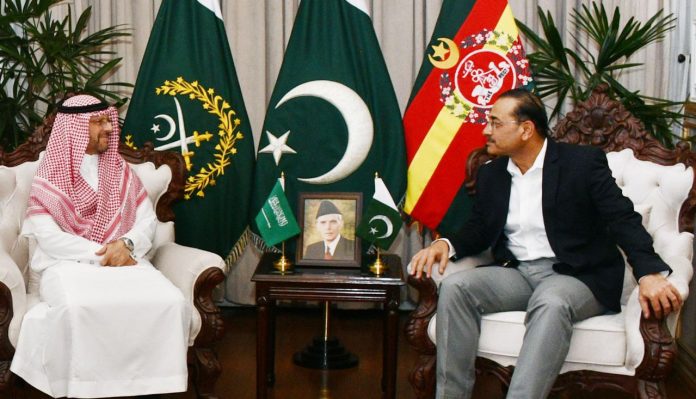
Saudi Chief of General Staff calls on COAS Gen Asim Munir

DNA

Rawalpindi, September 22, 2023:  H.E General Fayyadh Bin Hamed Al Ruwaili, Chief of General Staff Armed Forces of Kingdom of Saudi Arabia,led by a high powered military delegation called on General Syed Asim Munir, HI(M) Chief of Army Staff.

During the meeting, both sides deliberated upon various areas of mutual interest, bilateral cooperation including defence and security matters.

Earlier, delegation also met General Sahir Shamshad Mirza, HI(M) Chairman Joint Chiefs of Staff Committee at Joint Staff Headquarters.

Elections in January: the expected political scenarios

 The real concern lies in whether a government formed through maneuvering and gerrymandering can truly address the wounds afflicting our nation and breathe life into our nearly moribund economy. Unfortunately, the answer appears to be a resounding “no.”

Comment

Ansar M Bhatti

The Election Commission of Pakistan (ECP) has made a significant announcement, confirming that the general elections are slated to take place in the final week of January 2024. This announcement has triggered discussions among legal experts, as it appears to deviate from the Constitutional mandate requiring elections to be held within 90 days following the dissolution of the assemblies. Legal experts are raising concerns about the absence of a legal framework supporting this decision by the ECP. Many argue that such a move necessitates a clear legal basis.

In response to this development, the Pakistan Tehreek-e-Insaf (PTI) has taken a proactive stance, indicating their intent to bring the matter before the apex court. Meanwhile, other political parties, most notably the Pakistan People’s Party (PPP), which has consistently advocated for elections to be held within the constitutionally mandated 90-day window, are expected to unveil their strategies and future courses of action in the coming days. The political landscape in Pakistan is heating up as various parties grapple with the implications of this decision, setting the stage for what promises to be an eventful election season in early 2024.

In addition to the ordinary citizens of Pakistan, international actors have also expressed a strong desire for early, free, and fair elections in the country. Diplomats from prominent nations, including the USA, UK, Australia, UAE, and Saudi Arabia, have engaged in discussions not only with the Election Commission of Pakistan (ECP) but also with leaders from a diverse array of political parties. Against this backdrop, it becomes apparent that the ECP’s announcement may have been influenced by a combination of external and internal pressures, undoubtedly with the explicit consent of influential stakeholders.

Concerning the issue of whether all political parties enjoy an equal and fair playing field, it is evident that this is not the current reality. This is particularly apparent at this juncture, as the Chairman of PTI is incarcerated, and a relentless crackdown on PTI members and supporters persists without respite. If the PTI, which seemingly boasts significant public support, is not granted a fair and equal opportunity to participate in the election, it could cast doubt on the authenticity of the entire electoral process.

The PML-N, which aspires to lead the country, has been working diligently to foster unity within the party through increased inter-party communications. One of the paramount challenges facing the party is the secure and swift return of Nawaz Sharif. He is arguably the only leader who possesses the capability to aid the PML-N in its quest to rekindle its former prestige and support base. However, the recent Supreme Court ruling, which nullified the NAB amendments passed during the PDM government’s tenure, has exacerbated the challenges facing Nawaz Sharif.

In a surprising turn of events, Nawaz Sharif has called upon Shehbaz Sharif and Maryam Nawaz to convene in London for a series of discussions concerning the ever-evolving political landscape. Naturally, this move has left the PML-N leadership somewhat apprehensive, particularly in light of the potential reopening of NAB cases. Should the caretaker government choose not to file a review petition, it would imply that the powers-that-be are in alignment with the verdict of the apex court.

Just a few days ago, Nawaz Sharif confidently asserted that the PML-N is poised to assume power in the upcoming government. In fact, he went a step further by expressing his party’s intent to hold certain individuals accountable, including former army chief General Bajwa, former ISI Chief Faiz Hameed, and the next Chief Justice of Pakistan, Justice Ijazul Ahsan, whom he accused of ‘patronizing’ anti-PML-N factions. It’s worth noting that this particular assertion might have raised eyebrows within the ranks of the Establishment.

Even in my previous analysis, I emphasized the inherent challenge of Nawaz Sharif and the Establishment coexisting peacefully. It is undeniable that the Establishment wields significant influence within Pakistani politics, actively contributing to the shaping of political landscapes. Political parties readily acknowledge this influence when they find themselves in the opposition, but once in power, they often seem to disregard this crucial factor. This shift in perspective is where the real issue arises, potentially explaining why no prime minister has managed to complete a full term to date.

If the elections proceed under the current circumstances, it seems highly likely that no single party will be able to secure an outright majority. In this scenario, the PML N appears to be in a favorable position to secure a significant number of seats, particularly given the prevailing political landscape that seeks to exclude the PTI from the equation.

A plausible outcome could be the formation of a coalition government involving the PML N, the recently established Pakistan Istehkam Party, along with several smaller parties and independent candidates. Collaborating with the PPP would likely be the PML N’s least preferred option, serving as a last resort.

However, the real concern lies in whether a government formed through maneuvering and gerrymandering can truly address the wounds afflicting our nation and breathe life into our nearly moribund economy. Unfortunately, the answer appears to be a resounding “no.” So, what lies ahead? Are we destined to witness yet another cycle of a short-lived prime minister and a government that withers prematurely?

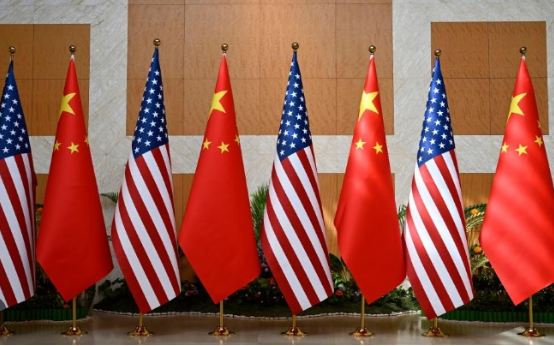
Defining entire China-U.S. relationship as competition is serious misjudgment

Defining entire China-U.S. relationship as competition is serious misjudgment

By Zhong Sheng, People’s Daily

In recent years, the United States has always emphasized “competition” when discussing China-U.S. relations, as if competition has become the dominant theme and even the sole focus of the relationship.

From the “competitive, collaborative and adversarial” rhetoric to the “invest, align and compete” strategy, competition has become the main tone of U.S. policy towards China.

The various measures taken by the United States clearly demonstrate that the so-called “competition” has become synonymous with comprehensive containment, unrestricted suppression, and relentless pressure on China.

As two major countries, it is normal for China and the United States to compete in areas such as trade and technology. Such competition should be fair and reasonable, conducted in a benign and regulated manner, with boundaries and prohibited areas. It should not disregard the rules of the market economy and basic principles of international relations. Core interests should not be used as tools for competition or provocative means.

The United States, under the guise of competition, has used its national machinery to suppress other countries, attempting to sacrifice the interests of other nations and hinder their development and progress in order to seek its own competitive advantage. This approach completely deviates from the true essence of competition and only exposes a zero-sum mindset and Cold War mentality.

The United States shows no intention of engaging in fair competition. It recklessly wields the stick of sanctions, forcefully promotes “decoupling” and so-called “de-risking.” Driven by ideological bias, it generalizes the concept of national security, imposes excessive regulations and scrutiny, and builds “small yard, high fence” around its own interests. It fabricates a false narrative of “democracy versus authoritarianism,” creates an encirclement against China, coerces other countries to take sides, and incites confrontation, disruption, and undermines peace. It constantly provokes China on core issues such as the latter’s political system and territorial sovereignty, seriously violating the basic principles of international relations and damaging the political foundation of China-U.S. relations.

The United States employs all means to hinder China, essentially aiming to deprive the Chinese people of their right to choose their own development path, their right to pursue a better life, their right to achieve legitimate development, their right to build national unity, and their right to develop normal relations with other countries.

America’s perception of competition as the entirety of its relationship with China is fundamentally flawed, and this stems from a directional problem in its understanding of China.

The United States consistently portrays China as the “most serious competitor,” the “most significant long-term challenge,” the “most significant geopolitical challenge,” the “most significant systemic challenge,” and the “only competitor with both the intention and capability to reshape the international order.” It is using its own template of hegemony to mirror China and misjudging China based on the trajectory followed by traditional Western powers.

Viewing the world from a zero-sum perspective, one sees division, competition, and conflicts; viewing the world from a perspective of shared destiny, one sees openness, cooperation, and win-win outcomes. The erroneous perceptions and actions of the United States not only disregard the reality of interdependence between China and the United States, but also distort the history of cooperation and mutual benefit between the two countries, dangerously impacting China-U.S. relations.

Singapore’s Deputy Prime Minister Heng Swee Keat recently warned that U.S. policy towards China is becoming a major issue for the world.

China and the United States bear a special responsibility for global peace, stability, and development. The world needs an overall stable China-US relationship.

The two countries should start from the perspective of shared interests and the future of humanity, and compete in such areas as who can govern their nations better and ensure the well-being of their own people, who can provide greater impetus for global post-pandemic recovery and growth, who can offer more public goods in addressing climate change, who can provide better solutions to regional hotspot issues, and who can make the planet safer, more peaceful, and more prosperous for the 8 billion people living on it, including both Chinese and American citizens.

The Earth is vast enough to accommodate the independent development and shared prosperity of both China and the United States. The United States should abandon zero-sum games and Cold War mentality, break free from the logic of competition and confrontation, and work with China in the same direction with a sense of responsibility towards history, the people, and the world, so as to realize mutual respect, peaceful co-existence and win-win cooperation.

Only by doing so, both countries can learn from each other, make progress together, shoulder international responsibilities as major countries, and contribute their wisdom and strength to global peace and development.

(Zhong Sheng is a pen name often used by People’s Daily to express its views on foreign policy and international affairs.)

Xinjiang makes strides in high-quality economic, social development

Xinjiang makes strides in high-quality economic. social development

By Li Ya’nan, Yang Shuobi, Xiang Zifeng, People’s Daily

China’s Xinjiang Uygur autonomous region is working to build itself into a beautiful Xinjiang that is united, harmonious, prosperous, and culturally advanced, with healthy ecosystems and people living and working in contentment.

Today, China-Europe freight trains are running across this important node along the Silk Road, constantly releasing development potential; the autonomous region’s economic structure is continuously optimized with upgrading traditional industries and new emerging sectors; the prospering green industries are taking the economic development onto a new level.

In Sangong township, Huocheng county, Ili Kazakh autonomous prefecture of Xinjiang, stevia plants were thriving along a national highway. These plants have seen a remarkable price increase, soaring from just over 10 yuan ($1.37) per kilogram to nearly 300 yuan. What is the reason behind this?

In a workshop of a Xinjiang-based biotech firm, a production line of stevia leaf purification was running at full capacity. Zhou Meng, chairman of the company, told People’s Daily that stevia leaf is a natural and high-quality sweetener, with a sweetness which is 300 to 400 times sweeter than sucrose, but its calorie is only 1/300 of white sugar extracted from stevia leaves is widely used in the pharmaceutical and food industries.

The biotech firm is a key technological innovation company in Xinjiang. So far, the company has built two production lines for steviosidey leaf glycosides and has a complete set of supporting equipment.

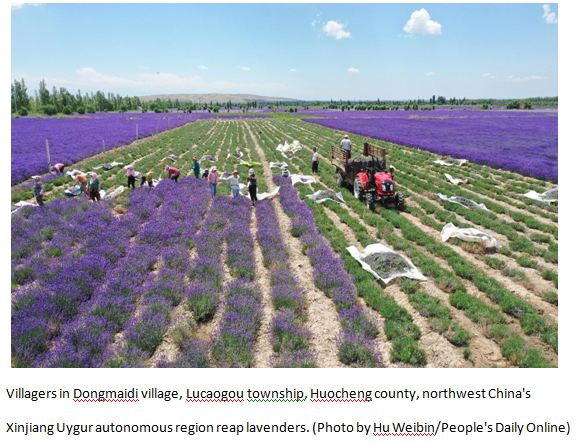
Flower-related industries covering lavender, rose and peony are continuously expanding in Xinjiang, increasing the income for helping local residents.

In Ma Zhongliang’s shop in Sigong village, Lucaogou township, Huocheng county, various lavender processed products were neatly displayed on shelves, including: essential oils, dried flowers, and pillows.

In 2010, Sigong village started developing the lavender industry, established a specialized cooperative, and introduced essential oil processing enterprises. Gradually, a distinctive industry chain was formed, covering lavender cultivation, development, sales, and the recycling of lavender straws. Over 300 local farmers transformed from ” farmers” to ” merchants.”

With the continuous increase in the added value of lavender, by in 2022, the per capita income of villagers average annual income of the in 718 households in Sigong village reached 22,000 yuan, approximately 2,000 yuan higher than the per capita average income of the entire township.

In a vegetable packaging workshop of a trading company in Xinjiang’s Tacheng, fresh vegetables such as bell peppers, cucumbers, and tomatoes were being loaded onto trucks. The freshly picked vegetables  could make their way to the dining tables of Kazakh families the next day.

According to Yu Xinli, manager of the company who has been engaged in fruit and vegetable foreign trade for over 20 years, the company exports an average of about 80,000 tons of fruits and vegetables from the Baketu Port in Tacheng every year. About 40 percent  of goods are local sources, bringing benefits to local farmers.

“We have two harvests in a year, and the earnings from each mu of greenhouse can reach 50,000 yuan,” he said.

The increased income comes from opening up. In December 2013, the Baketu Port, which is just 12 kilometers away from downtown Tacheng, opened the country’s first “green channel” specifically for the quick customs clearance of agricultural and sideline products. Since then, the clearance process has become much faster.

“There is almost no need to wait,” Yu said.

Yu called it “come and go” process.

On May 18, the number of inbound and outbound freight vehicles at the Horgos highway port, Ili Kazakh autonomous prefecture, exceeded 1,000 for the first time, reaching 1,099. The figure was less than 300 in 2019.

Ports in Xinjiang are always kept busy by China-Europe freight trains and cargo trucks fully loaded with containers, which is a miniature of the autonomous region’s ongoing efforts to expand its opening up.

According to statistics, the total value of foreign trade in Xinjiang reached a staggering 183.16 billion yuan in the first seven months of this year, an increase of 59.3 percent over the same period last year.

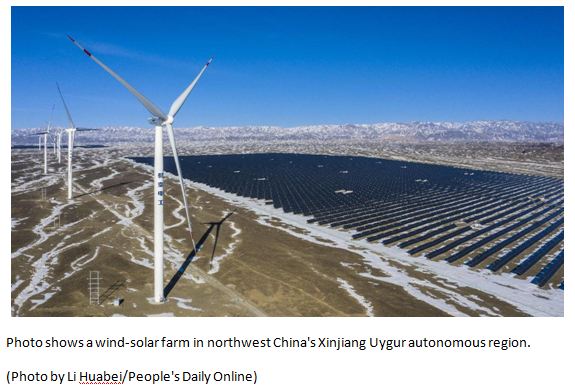
Along a road on the outskirts of the Taklamakan Desert, rows of solar panels were glistening, bringing new hopes to the autonomous region.

In the photovoltaic power station run by State Power Investment Corporation in Luopu county, Hotan, a leader of an installation team, was busy inspecting solar panels. This year, he led some 20 villagers to install solar panels for the power station, and each one of them could earn an average of approximately 10,000 yuan a month.

As the largest new energy power generation project in Hotan, it is expected that the annual average power generation of this photovoltaic power station can reach 360 million kilowatt-hours. During the construction period, the power station employed about 1,500 workers, of which 1,000 were local people in Lopu county.

Xinjiang’s arid and sunny climate with strong winds and sandstorms has become a driving force for the green transformation in the autonomous region. By improving the energy structure and introducing green and low-carbon industries, Xinjiang’s new energy industry has taken new steps towards high-quality development.

In 2010, Xinjiang had no photovoltaic power generation and the installed capacity of wind power was only 1 million kilowatts. Through continuous development, as of mid-July this year, Xinjiang’s installed capacity of new energy had exceeded 50 million kilowatts, accounting for over 40 percent of the total installed capacity.

According to estimation, by 2025, Xinjiang’s total installed capacity of grid-connected new energy is expected to exceed 116 million kilowatts, with wind and solar power projects becoming the main source of new installed capacity. This will inject new momentum into economic growth and the achievement of the “dual carbon” goals.

Xinjiang takes measures to strengthen sustainable use of water resources

Xinjiang takes measures to strengthen sustainable use of water resources

By Li Ya’nan, People’s Daily

Water is the lifeline of economic and social development. It is a fundamental natural resource and economic resource of strategic importance.

For a long time, Xinjiang Uygur autonomous region in northwest China has faced the problem of uneven spatial and temporal distribution of water resources, which led to a prominent structural water shortage.

In recent years, Xinjiang has been working to improve the management of water resources, shifting from a less efficient and unorganized approach to a more refined and science-based one. A unified, efficient, and systematic water resources management system has been formed.

As a result of the efficient allocation and rational use of water resources, Xinjiang has seen continuous improvements in its ecological environment with increasing momentum for high-quality economic and social development. People in the autonomous region now feel more content, joyful and secure.

On March 15, 2021, the Daheyan Reservoir in the northern mountainous area of Daheyan township, Turpan of Xinjiang, officially started supplying water to the downstream areas. The reservoir was built to store excess water in winter and summer and provide water to downstream areas during spring and winter irrigation periods. As a result, the rate of reliable irrigation water supply has increased from 75 percent to 90 percent.

The Hongliuhe horticultural farm is situated downstream of the Daheyan Reservoir. Local fruit farmer Li Xianshui told People’s Daily that in the past, farmers struggled during the grape flowering period in May due to high water demand, which often led to inadequate irrigation. During the peak water flow period in July and August, farmers were unable to make use of the water for irrigation, and could only watch it flow away.

However, things have changed now. Whenever the agricultural water demand reaches its peak, farmers simply need to submit their water usage plans in advance, and the reservoir would provide ample irrigation water.

This has led to a significant improvement in grape production, with yields exceeding 3 tons per mu, or about 667 square meters.

As of the end of 2022, there were a total of 671 reservoirs in Xinjiang, with a total storage capacity exceeding 12.13 billion cubic meters. These reservoirs have supplied a total of 54.27 billion cubic meters of water for agricultural use and 36.7 billion cubic meters for ecological replenishment.

This has successfully achieved the objectives of diversifying water diversion, increasing water supply, and enhancing water storage, and played a significant role in generating social, economic, and ecological benefits from water resources.

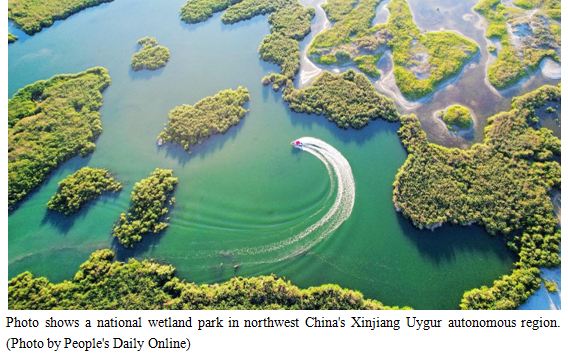
In the southern part of Korla, Bayingolin Mongolian autonomous prefecture of Xinjiang, there is a Dujuan River wetland park, which covers an area of 5,400 mu. It has planted over 10,000 trees and shrubs, as well as a large number of aquatic plants, serving as a “green lung” for the city.

To meet the substantial irrigation needs of this greening project, water is obtained from a wastewater treatment plant situated a few kilometers away. After undergoing rigorous treatment, the domestic sewage is purified to reach Class A standards.

The treated water is then channeled to the wetland park, ensuring a consistent daily supply of 30,000 to 50,000 cubic meters. This saves approximately 9 million to 15 million cubic meters of water each year.

“Currently, 22 percent of the city’s irrigation water for greening comes from reclaimed water, with an annual usage of 15 million cubic meters. This not only reduces the cost of urban greening but also conserves surface water and groundwater resources,” said Guo Wei, deputy director of the gardening and greening affairs center of Korla.

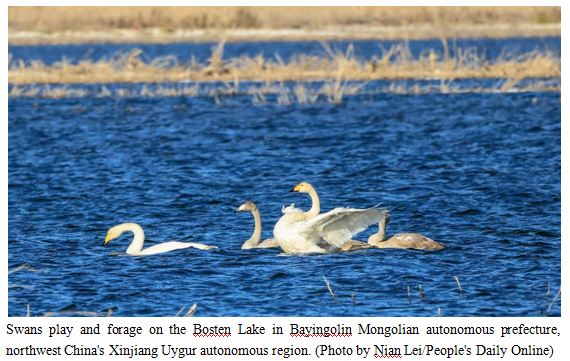
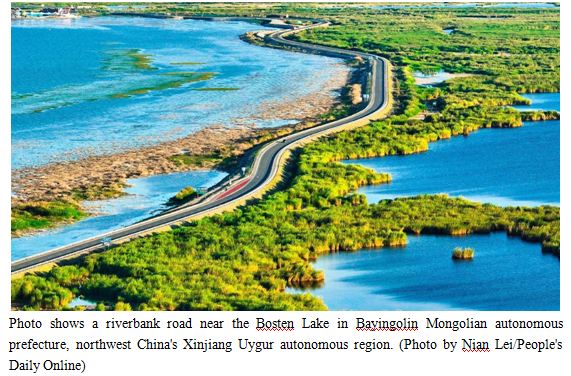
Bosten Lake in Bayingolin Mongolian autonomous prefecture’s Bohu county, the largest inland freshwater lake in China, once faced a series of challenges such as declining water levels, severe pollution, and biodiversity loss.

According to Liu Yi, an official with the local ecological department, significant measures have been taken to address these issues. A total of 29 direct or indirect sewage outlets into the lake have been permanently sealed off.

Since 2018, approximately 807 million cubic meters of water have been transferred from the Kaidu River in Bohu county to the Bosten Lake, promoting the great circulation of water bodies and water quality improvement in the lake.

Currently, the water level of Bosten Lake has risen by nearly 2 meters compared to its lowest point, reaching 1,047 meters, The overall water quality now meets Grade III in the country’s water quality system.

With the continuous improvement of the ecological environment, the variety and number of wild bird species in the Bosten Lake have been increasing. According to observations, there are hundreds of thousands of birds of 198 species passing through the lake during migration. The Bosten Lake is also the largest fishery production base in Xinjiang.

Thanks to the promotion and popularization of efficient water-saving agriculture, agricultural production in Xinjiang has made a new leap forward. This year, the total output of summer grain in Xinjiang reached 7.01 million tons, hitting a new historical high, and various fruits and nuts have achieved both quantity and quality improvement.

In Naomaohu township, Yiwu county, Xinjiang, there lies a vast Hami melon base. “All the melons this year have been sold, and the average income per mu is around 4,000 yuan ($549),” said Liang Juanying, a Hami melon grower who planted 290 mu of melons this year.

Liang attributed the increase in income from Hami melons to the adoption of advanced cultivation techniques, specifically the use of under-mulch drip irrigation.

In 2001, Naomaohu township promoted the cultivation technique of under-mulch drip irrigation in the base. Today, the irrigation in the base can be controlled on a mobile application, which reduces the overall water cost by 30 percent. This has not only achieved efficient utilization of water resources but also improved the quality of Hami melons.

Yuli county is a major cotton producer in Xinjiang. So far, efficient water-saving techniques have been implemented in over a million mu of cotton fields in the county. The average water saving per mu of cotton production has reached 100 cubic meters.

In a 3,000-mu cotton field managed by an agricultural tech firm in the county, over 100 soil sensors were seen autonomously irrigating and fertilizing based on soil moisture conditions.

According to Ai Haipeng, leader of the managing team of the cotton field, told People’s Daily that compared to surrounding traditional farms, the field reduced irrigation water consumption by 47.3 percent last year, while achieving an average yield increase from 300 kilograms per mu to more than 400 kilograms per mu.

China-Laos cooperation bears fruits in Vientiane Saysettha Development Zone

China-Laos cooperation bears fruits in Vientiane Saysettha Development Zone

By Sun Guangyong, Zhang Jinruo, Yu Yichun, Hu Zexi, People’s Daily

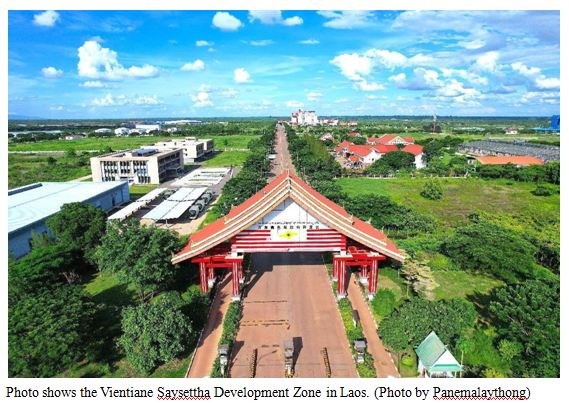
About a 30-minute drive northeast of downtown Vientiane, the capital of Laos, there lies the Vientiane Saysettha Development Zone (SDZ), with factories neatly arranged.

It is the only state-level overseas economic and trade cooperation zone established by China in Laos, as well as Lao’s national-level special economic zone.

As an early fruit of the Belt and Road Initiative (BRI), the SDZ plays an important role in promoting Laos’ industrialization and fostering China-Laos economic cooperation.

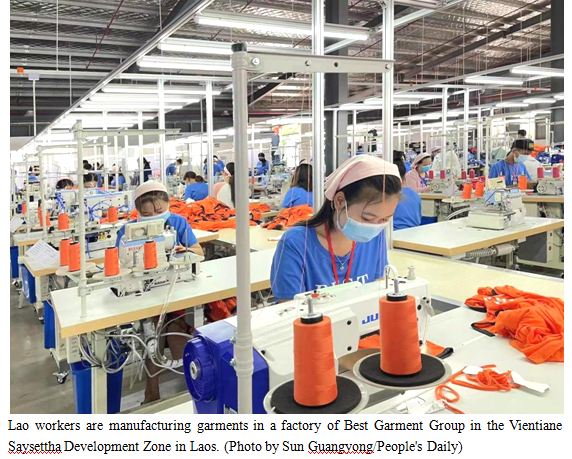
Chinese garment enterprise Best Garment Group has a 20,000-square-meter factory in the SDZ. In the factory workshop, local workers were busy on production lines to make garments for export to Europe.

“We have introduced advanced automated cutting machines and computerized sewing equipment, carried out training, and adopted lean production management and production execution systems. We are committed to building a first-class clothing factory in Laos,” said the general manager of the factory Sun Linhua.

Headquartered in east China’s Jiangsu province, Best Garment Group established its Lao branch in the development zone two years ago. The factory has 40 production lines and hires 2,000 employees, with a designed annual production capacity of 20 million sets of various knitted garments sold to European, American and Japanese markets.

So far, the SDZ has attracted 131 companies from China, Japan, Singapore, Thailand and other countries and regions, with a total investment of over $1.5 billion, creating 6,000 jobs. After all the companies currently stationed in the zone come into operation, the SDZ is expected to generate a total output value exceeding $1.8 billion each year and create more than 10,000 jobs.

“The SDZ has introduced many well-known enterprises, bridging the gap in a number of manufacturing sectors in Laos such as electronics manufacturing, biomedicines, agricultural product processing and textiles. This has played a significant role in promoting the overall industrial development of the country,” said the director of the investment service center of the SDZ.

Blue new energy vehicles, white new energy buses and trucks are always seen running on the roads in the development zone, where solar-powered smart streetlights are lined on both sides of the road. These 3,000 sets of streetlights were all manufactured in China.

The Saysettha Low-Carbon Demonstration Zone is a cooperation project jointly launched by China and Laos in the SDZ to address climate change in the framework of South-South cooperation. It is one of the 10 low-carbon demonstration zones built by China in other developing countries.

According to a memorandum of understanding signed between China and Laos, the two sides will launch a series of cooperation, including promoting a low-carbon lifestyle through low-carbon transportation and improving green infrastructure construction through low-carbon lighting.

“We hope that the Saysettha Low-Carbon Demonstration Zone can gain valuable experience in green development for other parts of Laos,” said Bounkham Vorachit, Minister of Natural Resources and Environment of Laos.

The demonstration zone plays an important role in helping Laos achieve the goal of net zero emissions by 2050, and will strongly promote the sustainable economic and social development of Laos, she added.

The Vientiane South Station of China-Laos Railway, ten kilometers away from the SDZ, showed a busy scene. Lao agricultural products and manufacturing goods were on their way to China along the railway.

Since the opening of the China-Laos Railway in December 2021, the SDZ has embraced better development. It is reported that the development zone has a customs service center, where goods manufactured by enterprises in the zone can be exported to China through various transportation methods after completing customs clearance procedures.

With more convenient logistics and significantly lowered costs, the advantages have become more prominent in the SDZ, and many enterprises there were planning to expand their production.

With the implementation of the Regional Comprehensive Economic Partnership (RCEP) in January 2022, foreign-invested enterprises in the SDZ can enjoy more favorable policies.

The head of Laos Alliance Pharmaceutical Group said that the implementation of the RCEP has reduced the company’s production and sales costs, and it is more convenient for enterprises in the SDZ to process and export products.

Sommad Pholsena, vice president of the Lao National Assembly, said he hoped the SDZ would be built into a model for Laos’ special economic zones, and expected Laos and China to continue strengthening relevant cooperation and drive the development of small and medium-sized enterprises, so as to assist Laos in industrial upgrading, and benefit more Lao people.

China firmly supports Africa to enhance its status with greater voice on world stage

China firmly supports Africa to enhance its status

By He Yin, People’s Daily

The admission of the African Union (AU) as a permanent member to the Group of 20 (G20), agreed by G20 members at a recent summit, is a highlight of the Global South.

China was the first country to explicitly express its support for the AU’s membership of the G20, which marked a vivid practice of promoting the building of a high-level China-Africa community with a shared future, and demonstrated China’s responsibilities as a major country in improving global governance.

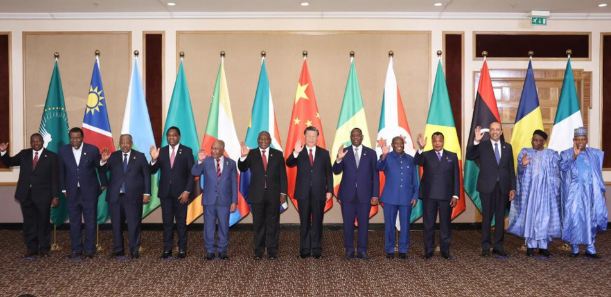
Chinese President Xi Jinping stressed at the 17th G20 summit held in Bali last November that China supports the AU in joining the G20. During the recent China-Africa Leaders’ Dialogue in Johannesburg, Xi once again noted that China would work actively to support the AU’s full membership in the G20.

China’s firm support for Africa to enhance its international status and develop its voice in international discourse fully demonstrates the spirit of China-Africa friendly cooperation, and will continuously strengthen the progressive force safeguarding world peace and stability.

At present, the global governance system is facing profound adjustments, and the representation and say of developing countries need to be enhanced. The admission of the AU to the G20 helps make global governance fairer and more equitable.

The African continent is home to the largest number of developing countries, and has 54 member states of the UN. As one of the largest regional intergovernmental organizations in the world, the AU serves as a great banner and the most important platform leading Africa’s peace and development.

In the maintenance of regional peace and security, the AU actively prevents and mediates hotspot issues in Africa. It is a staunch supporter of peace in the continent. In international affairs, the AU proactively coordinates its members and speaks with one voice on the international stage, drawing attention from all parties while demonstrating the strength of Africa.

Its admission to the G20 will allow the organization to make louder voices globally, strive for more benefits for developing countries, and enhance the Global South’s strength in seeking strategic independence.

The admission of the AU to the G20 helps vitalize global development.

The AU was officially launched in 2002 as a successor to the Organization of African Unity, aiming to achieve the development and revitalization of the African continent by promoting unity and solidarity amongst African countries.

In recent years, the AU has steadily advanced its Agenda 2063, put into operation the African Continental Free Trade Area, and strengthened coordination among subregional organizations. The economic vitality and market potential of Africa are being further released.

It is the broad consensus and common responsibility of the international community to support the development of Africa. The G20 welcomes the AU as a permanent member, and will keep supporting Africa with the G20 Initiative on Supporting Industrialization in Africa and Least Developed Countries, which is conducive to promoting more resilient global development.

China was the first country to explicitly express its support for the AU’s membership of the G20, which manifests the efforts to promote the building of a high-level China-Africa community with a shared future.

China and Africa have always been a community with a shared future. On major international and regional issues, they have coordinated their positions and jointly safeguarded international equality and justice, which is the inevitable choice for China to develop solidarity and cooperation with African countries.

China firmly supports African countries and the AU in playing a greater role in international and regional affairs, supports making special arrangements on the UN Security Council reform to meet Africa’s aspiration as a priority, and calls on multilateral financial institutions to enhance the say of African countries.

China always bears in mind Africa’s concerns and priorities. It supports Africa in implementing the UN 2030 Agenda for Sustainable Development. The admission of the AU to the G20 will guide the Chinese and African sides to better practice true multilateralism and jointly advance modernization.

China was the first country to explicitly express its support for the AU’s membership of the G20, which showcases the country’s responsibilities as a major country in improving global governance.

Faced with the issues of the times, China always stays committed to the principle of consultation and cooperation for shared benefits and actively takes part in global governance.

China has always been a builder of world peace, a contributor to global development and a defender of the international order. It calls for increasing the representation and voice of developing countries in global affairs, and supporting efforts to strengthen the South, a weak link in the global governance system.

China also supports efforts to create synergy in South-South cooperation., and efforts to enable the global governance system to reflect the will and interests of the majority of countries, especially the vast developing countries, in a more balanced way.

The admission of the AU to the G20 will further enhance the strength of the South in global governance, to ensure all countries enjoy equal rights, follow the rules as equals and share equal opportunities.

This year marks the 10th anniversary of the principles of sincerity, real results, amity and good faith, and of pursuing the greater good and shared interests in developing China’s relations with Africa put forth by Xi.

Over the past decade, China has treated its African friends with sincerity and provided sincere support for Africa’s development. China-Africa cooperation has become a model for South-South cooperation and international cooperation with Africa.

China-Africa friendship has not been an overnight achievement, nor has it been gifted from on high. Rather, it has been fostered throughout the years when China and Africa supported and stood alongside each other in trying times.

It is important to follow a correct perspective in international cooperation with Africa. Africa is a big stage for international cooperation, not an arena for major-power rivalry. China is willing to work with its international partners to support the peace and development of Africa.

When AU representatives approached the round table at the G20 summit, they received warm applause. This was a highlight of the Global South.

Standing at a new historical starting point, China and Africa will carry out closer cooperation, build a China-Africa community with a shared future in the new era, and contribute more positive energy to world peace and development.

Seize opportunities for better future of Chinese science fiction

Seize opportunities for better future of Chinese science fiction

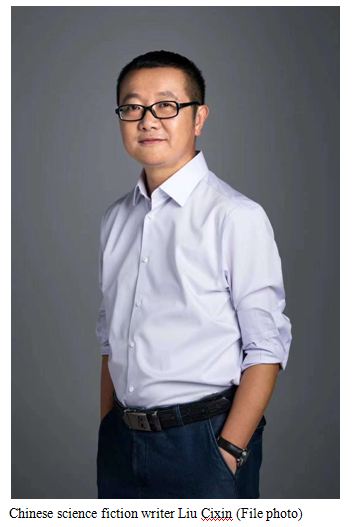
By Liu Cixin

I ventured into the realm of science fiction creation, deeply inspired by the wonders of science. I can still vividly recall the exhilaration I felt when reading the news of the first landing by humans on the moon in my childhood. Over the years, I have imagined countless scenarios of Chinese astronauts walking in space. Now, when I see the frequent launches of the Shenzhou spaceships, and watch Chinese astronauts on space missions on TV, I am occasionally overwhelmed by a surreal feeling – are these truly happening?

In recent years, China’s science fiction industry embraced rapid development and received wide attention. This couldn’t have happened without the overall progress of society, including advancements in the aerospace industry and the wide application of Internet technologies. We are amid rapid modernization, industrialization and digitalization, with opportunities and hopes, as well as pressure and challenges. We marvel at the wonders of science, and expect science and technology to bring a better life to human beings. These all provide a fertile ground for the prosperity of the science fiction industry.

Science, the source of strength for science fiction

Science fiction is an outcome of the modern scientific and technological revolution. In the early 19th century, scientific and technological advancement promoted industrial revolutions and triggered people’s imagination and aspirations for the future. That was how science fiction literature came into being.

As mankind entered the age of electricity from the age of steam between the 1920s and 1960s, the progress of science and technology once again demonstrated the overwhelming power to change the world. The revolution in physics, represented by the theory of relativity and quantum mechanics, has brought people whole new horizons. People’s admiration for the power of science and the longing for the future reached a climax during this period, leading to a flourishing era for science fiction works.

Based on science, science fiction creates a sci-fi universe different from the real world. Although science fiction writers imagine the future worlds, they aim not to predict them. It doesn’t really matter whether a science fiction book’s predictions come true in the future when evaluating its quality. Many science fiction writers, including myself, intentionally choose settings that are unlikely to be realized to tell stories, and use novel perspectives to show the wonders and marvels of science, thus allowing people to experience the beauty of science.

After 200 years of development, countless science fiction works have already envisioned the future in various ways, and it is sometimes questioned whether science fiction will continue to be creative in the future. In my opinion, the creativity of science fiction is infinite. Even traditional themes can be revitalized, depending on how you portray them.

For example, the classic science fiction short story “A Walk in the Sun” depicts a sole survivor of a terrible crash landing on the moon, who must keep walking continually on the surface of the moon to stay in the sunlight with a wing-like solar panel, in order to stay alive. This is a straightforward narrative with a classic moon landing theme, yet it is amazingly well-written.

In my perspective, as China’s aerospace technology continues to advance, it would be a big hit to use a “micro-realism” approach to depict how an engineering team builds a space power station and a lunar base.

Moreover, with progress in science, new fields will constantly emerge, offering new themes for science fiction. Highly developed modern scientific fields, such as physics, cosmology, and molecular biology, show us a more magical, broader, and more unpredictable universe and nature, which contain rich resources for science fiction creation. However, they also make basic science today more complicated in theory and more difficult in mathematical expression, which is hard for non-professionals to understand. How to fully tap into these resources is a great challenge for science fiction writers, and also a hope for the development of science fiction literature.

In the face of the unknown, science fiction should always present fresh, original and surprising concepts to keep readers interested. To achieve this, science fiction writers should always maintain a young mindset, keeping their imagination in sync with the times.

To release beauty from scientific equations

Expanding people’s imagination is an important mission of science fiction. The well-known “Gravity,” a very pure science fiction movie, shows us that for science fiction creation, the most important thing for the creators is to have a poetic feeling towards the universe. Good science fiction works present to us a drop of water from a perspective of the vast ocean, bringing people out of their limited vision to experience a broader world beyond reality.

Science is the source of strength for science fiction, while the beauty of science is often confined within scientific equations. Ordinary people need to make tremendous efforts to catch a glimpse of its brilliance. But once it is presented, its impact and power of purification to our soul are immense, which is difficult to be achieved by other genres of literature. Science fiction is a bridge to the beauty of science, releasing this beauty from equations and presenting it to the public.

The success of science fiction largely depends on the attraction of their mind-blowing imagination. The Big Bang theory of modern cosmology is spectacular and awe-inspiring. The long journey of life evolution is twisted and romantic. The poetic view of spacetime in general relativity, the magical microcosm in quantum physics… The worldview revealed by science is far beyond our imagination. How can writers present such beauty of science?

“Macro-detail” is a technique exclusive to science fiction literature. Although every narrative needs details, the treatment of details has evolved in science fiction. I can imagine a short story—I will call it “Singularity Fireworks”—which describes a group of super-consciousnesses for whom the Big Bang is nothing more than a firework display. The work uses a few words to depict the talks and feelings between two entities before and after the firework, yet it encompasses the history of the universe since the Big Bang in spacetime, unfolding a vision of a supra-cosmos beyond our universe. In my opinion, this kind of “macro-detail” best embodies the characteristics and advantages of science fiction literature.

Since engaging in science fiction creation, I have been looking for story resources from scientific and technological advancements, endeavoring to express the direct and tangible connection between the insignificant human and the grand universe based on scientific principles. In the beginning, the universe was smaller than an atom, and everything was one. This determines the natural connection between the minuscule parts of the universe and the grand whole. Even though the universe has expanded to today’s scale, I believe this connection still exists, and the evolution and changes of the universe are closely related to the lives and destinies of every human being. When I create stories, I always endeavor to envisage several scenarios of the specific connection between humans and the universe, and turn this imagination into captivating and uplifting tales.

Of course, science fiction does not always depict the future and imagination; it also encompasses the present and reality. Taking my novel “The Three-Body Problem” as an example. The first part portrays a fictional past with a strong sense of reality, in order to spark readers’ imaginations. The second part is a long journey from reality to imagination. The third part is a pure science fiction novel with a prominent “science fiction fan” vibe. Starting from reality to a distant and ethereal world is a typical structure of traditional science fiction, and also a narrative mode that Chinese science fiction readers are accustomed to, from reality to the future.

To seize the chance for innovative development

Science fiction movies have had a significant impact on me. The way I tell stories and construct visual imagery are both influenced by science fiction movies. Images are powerful, and many imaginative concepts in science fiction can only be portrayed through visual means. In this regard, films have a significant edge over printed words.

However, due to the low publishing cost and the relatively fixed readership, authors have more room for creation and can explore more innovative ideas and storytelling techniques. The production cost of science fiction films is much higher, as they need to fight for a wider and more diverse audience’s attention. Films need to consider audience acceptability of innovative forms and content, and find a balance point in artistic expression.

In recent years, both science fiction literature and films have played to their respective strengths. The adaptation of some science fiction novels into films and TV series has brought science fiction to a wider audience, driving the growth of the science fiction industry. To further develop science fiction literature today, efforts should be made to expand the pool of Chinese science fiction writers, so that more talents and works will emerge. The development of science fiction films and TV series requires an increase in talent and experience reserves, providing more opportunities for the new generation of screenwriters, directors, and producers to participate in creation. Additionally, it is crucial to strengthen international cooperation and accumulate more mature production experience.

Promoting the development of science fiction raises new requirements for literary theory and reviews. For example, the technique of “macro-detail” and other science fiction creation methods urgently need theoretical refinement to form a conscious expressive technique. Science fiction criticism also needs to keep pace with the times, breaking free from the constraints of using an outdated perspective to view new works and phenomena. Innovative theories and sharp, vibrant comments can certainly drive the development of science fiction creation.

Science fiction works contribute to cultivating the science fiction imagination of young people, stimulating their creativity and innovation abilities. Science fiction education can be properly introduced into school education, by adding science fiction content to textbooks, or cultivating children’s interest through online science fiction creations. It is believed that a considerable number of young readers and viewers will enjoy science fiction, thereby initiating a conscious exploration of science fiction and science.

Chinese science fiction has shown great momentum and potential. We must seize this opportunity to make the industry stronger.

 (The article is compiled by Dong Yang based on an interview with Liu Cixin.)

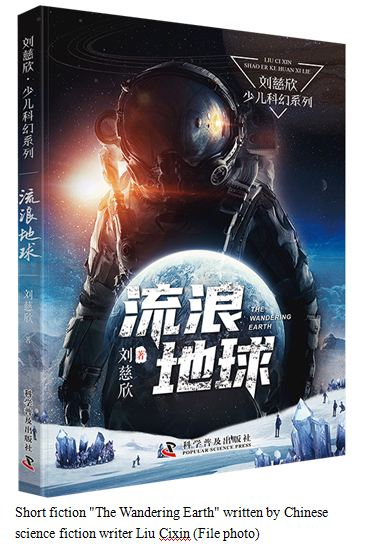
Liu Cixin was born in Yangquan, north China’s Shanxi province in 1963. He has a bachelor’s degree and is a senior engineer, as well as a science fiction writer and a member of the China Writers Association. His representative works include the novels “Supernova Era,” “Ball Lightning,” and “The Three-Body Problem” trilogy, as well as short fiction such as “The Wandering Earth,” “The Village Teacher,” and “Full Spectrum Barrage Jamming.” “The Three-Body Problem” trilogy is widely regarded as a milestone in Chinese science fiction literature.

PLA support base in Djibouti pursues peace, cooperation, friendship

PLA support base in Djibouti pursues peace

By Zhang Zhiwen, Yan Yunming, Huang Weixin, Hou Lulu, People’s Daily

A ceremony marking the entry of troops into the Chinese People’s Liberation Army (PLA) support base in Djibouti was held at the base’s barracks on August 1, 2017, marking the completion and official operation of the base.

The establishment of the PLA Djibouti base was a decision made by the two countries after friendly negotiations.

In accordance with UN Security Council resolutions, China has deployed vessels to the Gulf of Aden and the waters off the Somali coast on escort missions since 2008. During the process, Chinese officers and men encountered difficulties in replenishing food and fuel, and Djibouti offered logistical support in multiple instances.

The construction of the support base enables China to better fulfill its international obligations such as escorts and humanitarian rescue in the Gulf of Aden and the waters off the Somali coast. It also contributes to the economic and social development of Djibouti and enables China to make new and greater contributions to safeguarding peace and stability in Africa and the world.

Over the past six years, the capabilities of the support base have steadily improved. The base has provided efficient and professional support for escort fleets and Chinese peacekeeping troops deployed to South Sudan, Mali and the Democratic Republic of the Congo. The construction and growth of the support base has strongly aided the Chinese military’s escort missions in the Gulf of Aden and peacekeeping operations in Africa, while making prominent contributions to regional peace and stability and safeguarding international maritime channels.

The Chinese support base plays an important role in maintaining regional trade flows, Aboubaker Omar Hadi, chairman of the Djibouti Ports and Free Zones Authority, told People’s Daily.

The PLA support base promotes mutual trust and understanding, and conveys a message of peace and friendship.

Since its establishment, the base has held over 10 joint exercises and drills with Djiboutian and other foreign troops in Djibouti. It has also participated in more than 200 bilateral and multilateral exchange activities, and held five multinational basketball and football tournaments. This has continuously advanced bilateral and multilateral exchanges and showcased the open and confident image of the Chinese military.

Since 2019, the PLA Support Base Hospital in Djibouti has partnered with the general hospital of Djibouti’s military for paired assistance. So far, China has sent over 100 medical experts to Djibouti, assisted with 45 surgeries there and held a series of bilateral clinical skills training sessions.

The base has become an important platform for medical exchanges, said Feng Dan, a medic who has joined multiple exchange activities. “We are very proud to be doctors at the base,” Feng told People’s Daily.

Fran, a military doctor at the Djibouti Military Hospital of the Djiboutian Republican Guard, said that China’s long-term medical assistance is important for Djibouti and it is hoped that there will be further exchanges with the Chinese side to improve local medical capabilities.

Li Zhaohui, head of the PLA support base, noted that the base hopes to strengthen its communication with Djibouti and foreign troops in Djibouti, constantly enhance practical cooperation with them, fulfill China’s international obligations, and work together with them to cope with security threats and challenges, so as to make greater contributions to regional peace and stability.

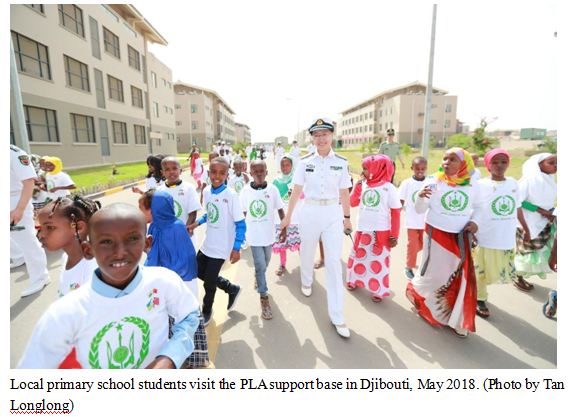
Teenagers are the future of Djibouti’s economic and social development, as well as the hope for the continuous friendship between China and Djibouti. In order to improve the teaching conditions in local schools, the support base has established a regular education assistance mechanism with Djibouti, which conducts public welfare assistance activities.

In January this year, the support base donated computers, projectors, desks and chairs, sports equipment and stationery to three primary schools in the Balbala district of Djibouti City. It was the support base’s third round of public welfare assistance to local schools.

“The new desks, chairs, and equipment have made our school more beautiful,” said Hassan, a student at the PK12 Primary School in Djibouti City, carrying his new blue backpack with a happy smile on his face.

Minister of National Education and Vocational Training of Djibouti Moustapha Mohamed Mahamoud said that with the help of the PLA support base, the teaching environment of local schools has been improved, providing children with better conditions for growth.

“I’m grateful to Chinese doctors and nurses,” said Mohamed Ali Ahmed, a 66-year-old man from Djibouti, who had his cataract cured at the PLA support base after having had the problem for six years.

In December 2019, the support base kicked off a 25-day medical campaign in cooperation with Djibouti’s Ministry of Health, which offered free cataract surgery for over 100 local patients including Ahmed. The campaign received widespread praise from the local community.

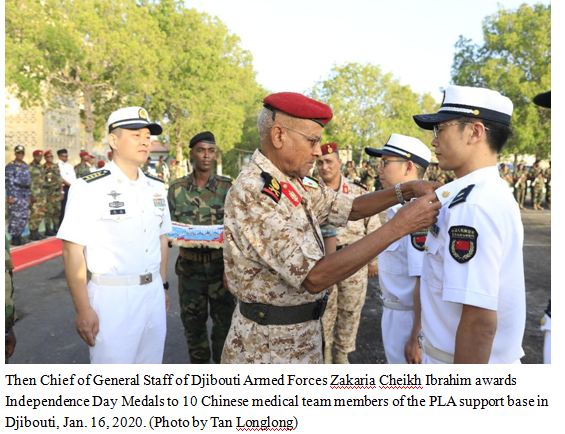
Ten medical staff members of the support base were awarded with the Independence Day Medal signed by President Ismail Omar Guelleh of Djibouti.

Saleh Banoita Tourab, then secretary-general of the Ministry of Health in Djibouti, noted that the Chinese military doctors have brought great relief to local cataract patients, and their act of compassion will be forever remembered by the people of Djibouti.

In 2019, Djibouti experienced a rare heavy rainfall, which caused flooding and resulted in casualties. In response to Djibouti’s request, the PLA support base dispatched troops to provide assistance to the affected population, and thousands of people received timely help.

Idle, a resident of Djibouti, and his family and friends were severely affected by the flood. “The house of a friend of mine was almost swallowed by the flood, and we felt desperate,” he said. Fortunately, Chinese soldiers arrived and helped them with drainage and dredging. “We are grateful to the Chinese military,” Idle said.

Since its establishment, the support base has been committed to assisting in the local economic and social development of Djibouti through various initiatives such as public welfare education, medical services, and disaster relief. These practical actions have earned widespread praise from the government and people of Djibouti.

“When I first arrived in Djibouti in 2018, there were few locals who could speak Chinese,” said Zhang Daqian, a PLA officer who has been stationed at the base for five years. He told People’s Daily that whenever the soldiers go out on missions nowadays, local people would warmly greet them in Chinese and give thumbs-up to them.

“This change is a testament to the unwavering dedication of Chinese soldiers who have been serving the local community. It inspires us and motivates us to continue our efforts,” Zhang said.

General elections to take place in last week of January: ECP

General elections to take place in last week of January: ECP

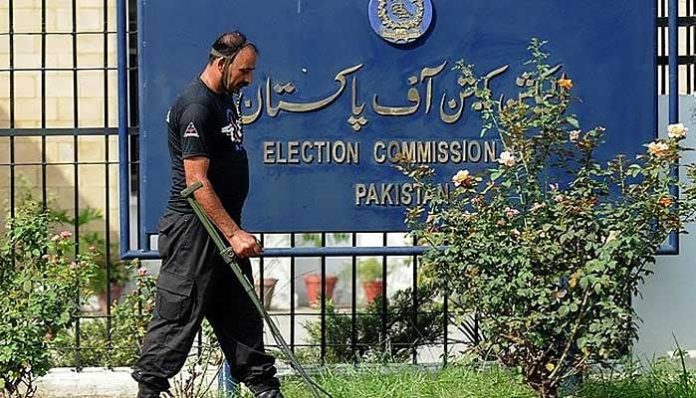
The Election Commission of Pakistan (ECP) announced on Thursday that general elections in the country will take place in the last week of January 2024.

The electoral body said the initial list of delimitations, which are being carried out in line with the new census, will be published on September 27.

The ECP said it reviewed the progress on the delimitation process today and decided that the final list of constituencies will be published on November 30 after hearing the objections and suggestions related to the delimitations. 

Subsequently, the polls will be held in the last week of January 2024 following the completion of the 54-day election schedule, the ECP statement added.

IMF wants Pakistan to tax the rich to protect poor

NEW YORK: The International Monetary Fund (IMF) Wednesday advised Pakistan to tax the wealthy in order to provide relief to the poor segment of society.

In an exclusive conversation after meeting with caretaker Prime Minister Anwaar-ul-Haq Kakar, IMF Managing Director Kristalina Georgieva said, “Of course, it is difficult but Pakistan has to do it in line with the IMF programme as we stand by the people of Pakistan.”

To a question, she said it is in the interest of the people of Pakistan that the country revitalises its economy and addresses some of the “shortcomings” of the past, in reference to reforms the lender is asking the country to execute.

Pakistan has signed a $3 billion bailout package with the IMF under which it has agreed to restructure the bleeding energy sector, introduce reforms in state-owned enterprises, and increase tax collection.

However, the steps taken by the government have made lives difficult for the masses as a massive hike in electricity and petrol prices has pushed inflation to a record level.

The IMF has rejected the proposals floated by the caretaker government to provide relief amid skyrocketing food and energy prices.

“Let me send a simple message to everybody in Pakistan. What we are asking in our programme is please collect more taxes from the wealthy and please protect the poor people of Pakistan,” Kristalina Georgieva noted.

“I do believe that it is in line with what people in Pakistan would like to see for the country.”

Earlier, PM Kakar — who is in New York to attend the 78th UNGA session — termed the meeting with the IMF chief as “constructive”.

He said that the meeting “emphasized extending our mutual commitment towards bolstering economic stability and growth in Pakistan”.

Confusion prevails over suspension of Indian visa services for Canadian nationals

Agencies

OTTAWA: Amid deepening tensions between New Delhi and Ottawa over Sikh leader’s killing, India´s official visa processor in Canada said Thursday it had been told to stop handling applications.

Shortly after the announcement was splashed across Indian media, BLS removed the notice from their website. There was no immediate comment from India´s foreign ministry.

An official at New Delhi-headquartered BLS said they did not want to be quoted and referred AFP to Indian authorities.

“Important notice from Indian Mission: Due to operational reasons, with effect from 21 September 2023, Indian visa services have been suspended till further notice,” BLS International had posted on their website Thursday.

Canada´s Prime Minister Justin Trudeau has demanded India treat with “utmost seriousness” allegations that Indian agents played a role in the June murder of Hardeep Singh Nijjar near Vancouver.

The fallout prompted tit-for-tat diplomatic expulsions and a forceful denial from India, which said any suggestion it played a role in Nijjar´s killing was “absurd”.

The suspension of visas comes a day after India´s foreign ministry said it was concerned for the safety of its citizens in Canada because of “politically-condoned hate crimes and criminal violence”.

“Threats have particularly targeted Indian diplomats and sections of the Indian community who oppose the anti-India agenda,” a ministry statement said Wednesday.

“Indian nationals are therefore advised to avoid travelling to regions and potential venues in Canada that have seen such incidents.”

The advisory did not name specific cities or locations for Indians to avoid.

Nijjar was shot dead by two masked assailants outside the Sikh temple he presided over in Surrey, an outer suburb of Vancouver.

An activist for the creation of a Sikh state known as Khalistan, Nijjar was wanted by Indian authorities for alleged terrorism and conspiracy to commit murder.

He had denied those charges, according to the World Sikh Organisation of Canada, a nonprofit organisation that says it defends the interests of Canadian Sikhs.

The Indian government accuses Ottawa of turning a blind eye to the activities of Sikh nationalists who advocate the creation of an independent Sikh state to be carved out of northern India.

Stay Connected

64FansLike
60FollowersFollow

Latest Reviews

Exchange Rates

USD - United States Dollar
EUR
1.17
GBP
1.35
AUD
0.72
CAD
0.73