Home Blog Page 1182

Crackdown intensifies as cases of vision loss surge in Punjab

Crackdown intensifies as cases of vision loss surge in Punjab

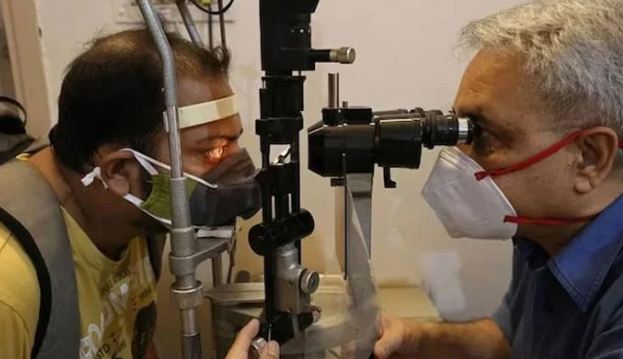
LAHORE/ISLAMABAD: The Drug Regulatory Authority of Pakistan (DRAP) on Monday launched a crackdown against medicine distributors amid the rising cases of vision loss due to the use of substandard injections in Punjab. 

Initially, it was reported that the eyesight of over 40 diabetes patients was affected in Punjab after which the provincial caretaker government imposed a two-week ban on Avastin’s sales and usage for ophthalmology-related treatments.

But the number has now increased by over 70.

After the cases were reported, DRAP banned hospitals, pharmacies, and patients across the country from using the injections. 

DRAP officials said that no hospital, laboratory, or pharmacy in Pakistan has a licence to repack the injection. They revealed that both unregistered and registered injections are available in the market.

The officials further advised the people and hospitals to not use the imported injections before quality check results were obtained. 

Earlier today, DRAP and the provincial drug authorities raided the offices of medicine distributors and recovered 110 vials from there which were sent to a drug testing laboratory in Lahore.

As per recent details, out of 70, 10 patients belonged to Multan, one in Bahawalpur, three in Jhang who are under treatment in Nishtar Hospital, while cases have also been reported in Lahore, Multan, Rahim Yar Khan, Sadiqabad, and Faisalabad. 

The police are in search of two suspects identified as Bilal and Naveed.

In a notification issued by the interim Punjab government, 11 drug inspectors have been arrested for the sale of injections bought from illegal unregistered companies. 

Three drug inspectors from Lahore, two from Bahawalpur and Rahim Yar Khan, and one from Jhang, Sadiqabad, Kasur, Bahawalnagar and Khanewal have been suspended, said the notification. 

A day earlier, the Punjab government imposed a two-week ban on Avastin’s sales and usage for ophthalmology-related treatments. 

Punjab caretaker Chief Minister Mohsin Naqvi also announced free medical treatment to the patients affected by the substandard eye injections.

He vowed that immediate strict action would be taken against drug inspectors responsible for the availability of non-sterile injections with a pending inquiry. The CM said that the government would form a high-powered inquiry team for swift investigation.

Police were instructed to ensure the arrests of those found responsible for the incidents.

COAS emphasizes interfaith harmony and tolerance in meeting with Christian delegation

COAS emphasizes interfaith harmony and tolerance in meeting with Christian delegation

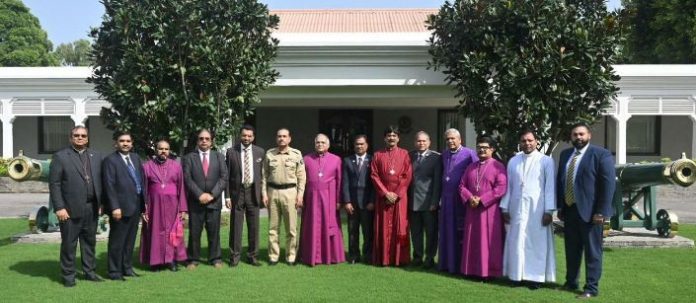
RAWALPINDI, 25 Sept /DNA/ – Azad Marshall, Moderator / President Bishops (Church of Pakistan and Bishop of Raiwind) along with 13 members’ delegation of Christian Community called on General Syed Asim Munir, NI (M), Chief of Army Staff (COAS) at General Headquarters, today.

During the meeting matters of mutual interest, religious and inter-faith harmony were discussed. COAS lauded the contributions of Pakistani Christian Community in national development, including promotion of quality education, healthcare and philanthropic services and outstanding role played by them for the defence of the motherland.

COAS expressed deep respect for Christian community and stressed upon the need for promoting greater interfaith harmony in society in order to follow Quaid’s true vision of a united and progressive Pakistan.

COAS emphasised “Islam is a religion of peace and there is no space for intolerance and extremism in Islam and society. No one can be allowed to take law in his own hands in a civilised society”.

Christian Community members acknowledged Pakistan Army’s efforts in combatting terrorism and providing secure environment to the minorities in the country. They appreciated Army Chief’s gesture as an inspiration for Pakistani minorities to take greater and more active part in nation building and in restoring their faith in a cohesive and tolerant society.

Painting new picture for Asian Games, creating better future for Asia

Painting new picture for Asian Games

By People’s Daily

This is the moment of passion and strength, the moment of hopes and dreams. On the evening of Sept. 23, the 19th Asian Games grandly opened in Hangzhou, east China’s Zhejiang province. On the autumnal equinox, asolar term on the Chinese lunar calendarsymbolizing bumper harvest, athletes from across Asia gathered beside the West Lake, to write a brand-new chapter of peace, friendship and progress.

The Hangzhou Asian Games is the largest and highest-level international comprehensive sports event held in China after the 20th National Congress of the Communist Party of China (CPC). It has attracted nationwide and global attention.

Hangzhou becomes the third city in China that host the Asian Games following Beijing and Guangzhou. Chinese President Xi Jinping said that the Chinese government and people have full confidence in hosting a splendid Asian Games in Hangzhou.

Hosting the Hangzhou Asian Games and Asian Para Games is a major event in the work of the CPC and China this year.

Under the strong leadership of the CPC Central Committee with Comrade Xi Jinping at its core, Zhejiang province has adhered to the concept of “green,””intelligent,””frugal,” and “civilized” in organizing the Games since Hangzhou won the bid to host the Games. With an aim to deliver a streamlined, safe, and splendid event,it has made every effort to excel in all aspects of the preparatory work.

After 8 years of unremitting efforts, China has the confidence and ability to present to the world a wonderful sports event with Chinese characteristics and Asian styles.

Sport is an important symbol of social development and human progress, and a bond of friendship among people.

As the largest comprehensive sports event in Asia, the Asian Games promotes the spirit of sports, showcases the charm of Asia, and fosters friendship and solidarity. It continuously improves the level of competitive sports in the region and has become an important platform for Asian sports solidarityand cooperation.

The Chinese people have a great passion for sports and the Asian Games, and they have always been firm participants, active promoters, and importantcontributors to the Asian sports cause. The Asian Games has ignited the enthusiasm of the Chinese people to participate in sports and witnessed the sports achievements in China.

The number of participants in the Hangzhou Asian Games has reached a record high. The Hangzhou Asian Games is by far the Asiad with the most participants, most sports, and largest overall scale. It fully demonstrates the diversity and inclusiveness of Asian sports culture and will undoubtedly make a lasting impression in the history of the Asian Games, injecting new vitality into this important sports event.

The Asian Games is a stage for competitive sports and a platform for athletes to strive for new heights.

More than 12,000 athletes from 45 countries and regions in Asia are taking part in the Hangzhou Asiad. It is expected that athletes will respect and inspire each other, push their limits, showcase the charm of sports and achieve extraordinary accomplishments through passionate competitions.

China has sent a delegation of 1,329 members to participate in 407 events of 38 sports. They will vigorously promote the Olympic spirit and the Chinese sportsmanship, take on their responsibility, work hard to surpass themselves, and strive for glory for the country. It is believed that they can show the world the formidable strength of sports practicein pursuing Chinese modernization.

Today, changes of the world, of the times and of history are unfolding in ways never seen before. The building of a community with a shared future for mankind is the common aspiration of people from all countries.

As Xi said,”We need to continue developing and strengthening Asia, demonstrate Asia’s resilience, wisdom and strength,” and through efforts towards such a community for Asia, promote a community of common interest for all mankind.

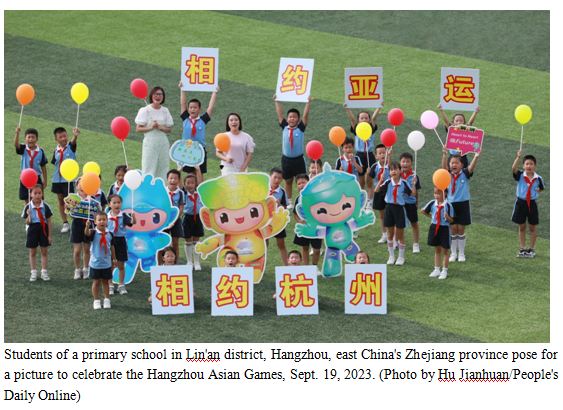
The slogan of the Hangzhou Asian Games, “Heart to Heart, @Future,” aligns perfectly with the Olympic motto of “Faster, Higher, Stronger – Together.” It represents a profound vision of embracing the future and jointly building a community with a shared future for Asia and humanity.

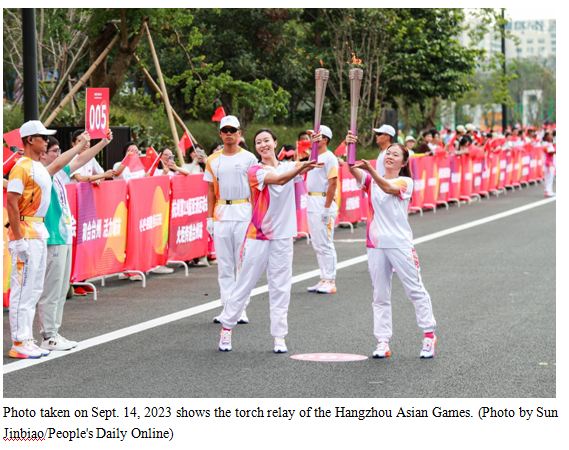
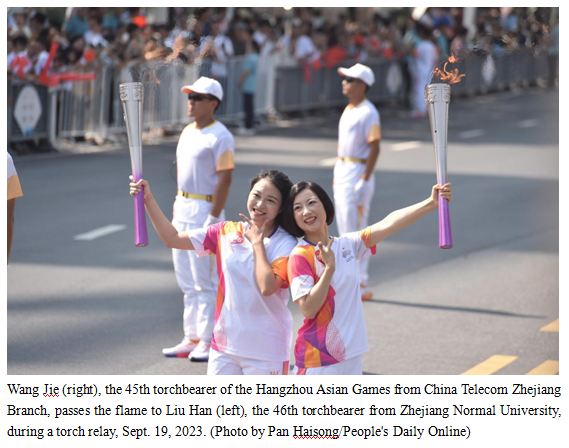
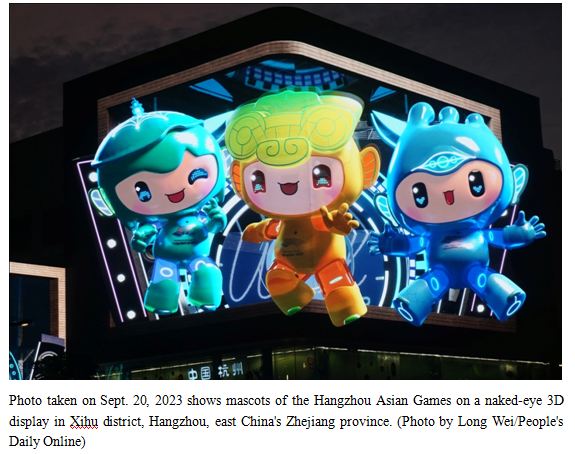
From the opening ceremony of the Hangzhou Asian Games with a theme called “Surging Tides,” to the torch, mascots, and medal designs that incorporate elements of Chinese traditional culture, and to other supporting activities, the Asian Games utilizes sports as a bridge to promote cultural exchanges and mutual learning.

This will undoubtedly open new prospects for cultural exchanges, cultural integration, and people-to-people bonds in Asia. It will inject profound and lasting cultural strength into the building of a community with a shared future for mankind.

Tonight, the light of civilization from the Liangzhu ancient city lighted the torch of Asian solidarity, and the time-honored Chinese civilization and the passionate sporting event shined on each other. Let dreams be the sail and struggle the oar, to paint a new picture for the Asian Games together and create a better future for Asia together.

Wish the 19th Asian Games every success!

Hangzhou Asian Games mirrors China’s vibrancy, progress

Hangzhou Asian Games mirrors China's vibrancy

By Li Zhongwen, Zheng Yi, People’s Daily

The 19th Asian Games opened in Hangzhou, east China’s Zhejiang province on Sept. 23. Hangzhou, together with five co-host cities, namely Ningbo, Wenzhou, Huzhou, Shaoxing, and Jinhua, have always adhered to the concept of hosting a “green, intelligent, frugal and civilized” Asian Games.

Aiming to make the event streamlined, safe and splendid, they are striving to present a wonderful Asian Games with Chinese characteristics and Asian styles.

The Hangzhou Asian Games has by far the largest scope, biggest number of events, and most extensive coverage in history. With 40 sports and 61 disciplines, over 12,000 athletes from 45 countries and regions will compete for a total of 481 gold medals.

From formulating the plans for torch relay and the opening and closing ceremonies, to continuously improving the urban transportation system and comprehensively lifting urban image, Hangzhou has meticulously prepared for the Asian Games in every aspect.

With world-class venues and facilities, smooth event organization, and thoughtful services, Hangzhou is committed to providing Asian athletes with a stage to showcase their talent.

“Hangzhou is fully prepared. This Asian Games will allow the world to see the beauty of Hangzhou, the vitality of Zhejiang, and the splendor of China,” said Chen Weiqiang, executive secretary general of the Hangzhou Asian Games Organizing Committee.

Greenness is the distinct feature of the Hangzhou Asian Games. From venue planning and construction to energy coordination and utilization, and from transportation support to event organization and operation, greenness is highlighted throughout the Games.

Hangzhou has rolled out a Zero-waste Asian Games Improvement Action Plan, setting up 16 “zero-waste Asian Games cell” demonstration sites and striving to make the Hangzhou Asian Games the world’s first large-scale zero-waste sporting event.

Wind and solar power from thousands of miles away is transmitted to Hangzhou and the co-host cities, lighting up 56 competition venues.

The concept of green development is integrated into every aspect of the preparation for the Games, showing the world China’s innovation and actions in creating a green future.

The Hangzhou Asian Games is the first smart Asian Games in history, with numerous technological achievements and cutting-edge technologies widely applied throughout the preparations.

At this Asian Games, venue support, event operations, cloud services and other aspects all strongly demonstrate the power of intelligent technology.

Relying on cloud computing, the Asian Games core system provides a powerful data processing platform for athletes, staff, spectators and more.

Spectators can fully enjoy the Games through a digital platform offering one-stop services. They can also visit scenic spots and museums, and take public transport with the digital package “Asian Games Pass.” Besides, a digital torchbearer program has been launched, allowing everyone to participate in the Asian Games.

With an aim to host a frugal Asian Games, the organizers focused on renovating existing venues rather than building new ones. Out of the 56 competition venues, 44 are renovated or temporary structures, and all 31 training venues remodeled.

The approach for event-related facilities and equipment is to prioritize borrowing over renting, and renting over buying, with a strong emphasis on recycling and reusing whenever possible.

To reduce waste, staff members are encouraged to bring their own water bottles and meals are kept simple to minimize food waste. Paper waste is also reduced wherever possible. Additionally, franchised stores provide eco-friendly mascots and packaging is minimized.

Simple yet sophisticated. More resources are invested into optimizing services. The innovative approach of reducing unnecessary elements greatly contributes to the success of the event.

Hangzhou has launched a campaign to strengthen urban quality, governance and civility in preparation for the Asian Games, holding over ten thousand related events and activities.

Ningbo has implemented and promoted various initiatives to improve urban civility in a coordinated manner, resulting in a noticeable transformation of the city’s urban, rural, and Asian Games environments.

The renovation of Shaoxing Olympic Sports Center Gymnasium focused on the wellbeing of people, enabling people with disabilities to easily access seats with assistive devices.

Taking concrete actions to host a “green, intelligent, frugal and civilized” Asian Games, Hangzhou is doing its best to welcome guests from across Asia and the world.

At the 42nd General Assembly of the Olympic Council of Asia, newly elected President Sheikh Talal Fahad Al-Sabah said that he believes Hangzhou is fully ready to host an exceptional Asian Games.

The Asian Games provides another opportunity for the world to experience and understand China. China’s preparation for the Games not only represents the fulfillment of its promises and efforts to promote development, but also showcases the country’s historic achievements in the new era.

As the third Asian Games hosted in China, the Hangzhou Asian Games has been vibrant since the beginning of its preparation. The event is showing prospects, openness and hopes through the smiles of the 37,600 volunteers for the Games and the 1.48 million city volunteers.

Gathering at Hangzhou Asian Games for better future

Gathering at Hangzhou Asian Games for better future

By Gong Yuhua

A dedicated Asian Flower Theme Park featuring over 200 varieties of flowers held its grand opening in Hangzhou, east China’s Zhejiang province; the torch relay for the Hangzhou Asian Games passed through 11 cities in the province; preparations for catering services have been completed…

With the countdown to the opening of the Hangzhou Asian Games underway, Hangzhou is making final preparations, pulling out all stops to refine organizational details and raise service standards.

From venue maintenance to support services, and from cultural exchange to atmosphere building, Hangzhou welcomes guests from all over the world with great passion and vibrancy.

After the 1990 Beijing Asian Games and the 2010 Guangzhou Asian Games, the Asian Games torch will be lit up in China for the third time.

Over the past 33 years, the Asian Games has witnessed the vigorous development of China’s sports undertakings, and recorded China’s steady march forward.

Since Hangzhou won the bid to host the Asian Games, the city and the 5 co-host cities of Ningbo, Wenzhou, Jinhua, Shaoxing, and Huzhou have upheld the concept of “green,” “intelligent,” “frugal,” and “civilized” in organizing the Games. They are committed to delivering a splendid Asian Games with Chinese characteristics and Asian styles.

It will be a green Games, with the fruitful outcomes of the green development philosophy.

All the Asian Games venues and offices use green electricity, helping create the first carbon-neutral Asian Games in history. Electric power networks deliver green power from thousands of miles away to the venues of the Asian Games; electric vehicles running the streets help foster a new fashion for green transportation; ingeniously designed Asian Games venues utilize technologies to reduce energy consumption and enable sustainability. The “Green Asian Games” matches words with action, reflecting China’s ethos of protecting the ecological environment and caring for the planet.

It will be an intelligent Games, with technological innovation to be seen in every aspect.

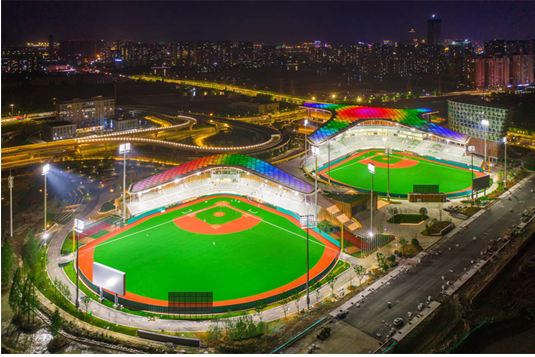
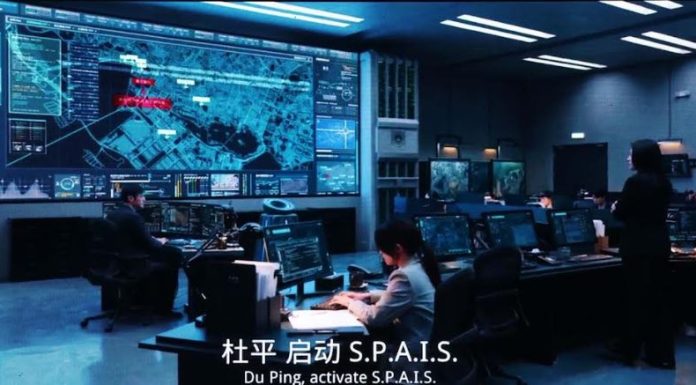
At the Asian Games information technology management center located in Binjiang district of Hangzhou, energy consumption of venues, real-time conditions, passenger flow, traffic flow and other information are shown clearly. On the roads outside the Shaoxing Baseball & Softball Sports Center, autonomous buses decorated with Asian Games elements stand ready to welcome spectators…

Thanks to the extensive use of technologies, venue management for the Hangzhou Asian Games is much more refined, and services comprehensively upgraded, allowing spectators to have better experiences.

It will be a frugal Games, embracing “simple yet sophisticated” as both the pursuit and course of action.

The vast majority of venues for the Hangzhou Asian Games are reconstructed and renovated rather than newly built. For example, the squash venue of the Asian Games is temporarily converted from an exhibition hall at the Hangzhou International Expo Center. The LED screens, spectator seats, and fire equipment inside the venue are rented, so after the Games ends, the venue can be dismantled in the shortest time to restore the exhibition hall to its original function.

A frugal Games does not mean abandoning innovation or lowering standards, but spending less, doing more, and doing things well, following the principle of “substance over extravagance.”

It will be a civilized Games, with the host city showcasing new heights of civility.

The Asian Games spirit and ethos of good manners will prevail. Over 10,000 events have been held as part of extensive efforts to improve urban quality, governance, and civility. Around 10,000 accessible facilities and nursing rooms have been set up at 56 venues. New practices promoting courteous conduct have been pioneered province-wide, enriching urban culture and elevating urban refinement.

Multifaceted enhancements to the city’s image, surroundings and scenery of Hangzhou have stirred a sense of communal pride in all citizens, making it the prevailing ethic that every citizen contributes to the Games.

Over 12,000 athletes from 45 countries and regions across Asia have gathered along the banks of the Qiantang River, coming together for this grand sporting event.

“It’s the home that we love. From our hearts love grows. Near or far we’re together. A million voices full of pride, sing it loud and clear, we are all here in Asia.” As the song “The Love We Share” goes, the Hangzhou Asian Games is becoming an important opportunity to jointly create a better future for Asia and the world.

With sports as a carrier to tell China’s stories and spread China’s voice, the Hangzhou Asian Games, themed “Heart to Heart, @Future,” will make a valuable contribution to building a community with a shared future for mankind.

China committed to building a Global South community with a shared future

China committed to building a Global South community

By He Yin, People’s Daily

The Summit of the Group of 77 (G77) and China recently kicked off in Havana, Cuba. The event was attended by 31 heads of state and government, multiple heads of international and regional organizations, as well as high-level delegationsfrom 116 countries.

On this important multilateral cooperation platform for developing countries, China, together with other developing countries, has held high the banner of development, focused on coordination and cooperation to address current challenges, and sent a strong voice of making global governance fairer and more equitable. This has sent a positive signal of solidarity and self-determination among Global Southcountries.

The world is undergoing changes on a scale unseen in a century. Developing countries are becoming stronger. South-South cooperation is playing an increasingly important role in driving the momentum of collective rise of developing countries and in sustaining the continued global economic growth.

At the same time, however, unilateralism and hegemonism are becoming rampant. Some countries are resorting to such practices as unilateral sanctions, decoupling, and disruption of industrial and supply chains, seriously undermining the legitimate development rights and interests of developing countries and their space for development.

Developing countries generallyhope to strengthen solidarity and cooperation, safeguard their development rights, uphold equity and justice, and make global governance fairer and more equitable.

The summit adopted the Havana Declaration. It stressed the urgent need for a comprehensive reform of the international financial architecture and a more inclusive and coordinated approach to global financial governance, and rejected unilateral sanctions against developing countries.

It fully proves that the G77 and China, practicing true multilateralism, represent a force of justice pursuing solidarity, cooperation and development. They firmly safeguard international equity and justice, strive to make a stronger voice of developing countries, and protect the common interests of developing countries.

UN Secretary-General Antonio Guterres termed the G77 and China “a champion of multilateralism” in his speech, saying they will always be essential for the UN system.

As the world’s largest developing nation and a natural member of the Global South, China breathes the same breath as other developing countries and pursues a shared future with them.

As the world has entered a period of turbulence and transformation with increasing uncertainties and instabilities, China is committed to building a Global South community with a shared future, encouraging developing countries to stay true to the original aspiration for independence and greater collective strength through unity, to advocate equity, justice and inclusiveness, and to pursue development, revitalization and win-win cooperation.

Only by rejecting bloc confrontation and the Cold War mentality and seeking to resolve differences and disputes between countries by peaceful means can developing countries better maintain world peace and tranquility.

Only by actively making their voice heard loud and speaking up for justice on the international stage can developing countries constantly strengthen their voice and representation in global governance and better safeguard their common interests.

South-South cooperation is always a high priority in China’s cooperation with other countries. It is always a staunch advocator and active contributor to global development.

Today, China provides development assistance to more than 160 countries, joins hands with more than 150 countries in building the Belt and Road, and works with over 100 countries and international organizations to advance the Global Development Initiative (GDI), showing its role as a responsible major country.

China will continue to maintain close communication and coordination with G77 members in order to optimize allocation of development resources, ensure efficient use of public goods of the Belt and Road Initiative (BRI) cooperation, and resolve problems in development.

Participants from many countries believe that China’s active promotion ofSouth-South cooperation has played an important role in promoting social progress and improving human welfare in developing countries.

Nicaraguan President Daniel Ortega noted that China’s assistance to the people of Asia, Africa, and Latin America is provided with no conditionsattached, and has contributed to the social progress and well-being of developing countries.

Chinese President Xi Jinping has proposed the vision of building a community with a shared future for mankind, the BRI, the GDI, the Global Security Initiative, and the Global Civilization Initiative, which offer a Chinese approach to lasting peace, greater development, and closer cooperation in the world, and also provide an important platform for deepening South-South cooperation.

The declaration approved by the summit incorporates multiple Chinese ideasand propositions, explicitly stating that relevant parties should strive to achieve global development and win-win cooperationbased on the principle of extensive consultation, joint contribution, and shared benefits, promoting the building of a community with a shared future for mankind.

This once again demonstrates that the Chinese approach is in line with the trend of the times and meets the common expectations of developing countries for development and cooperation.

Cuban President Miguel Diaz-Canel Bermudez pointed out that the GDI is of great significance and value, and this inclusive initiative conforms to the trend of establishing a new international order featuring equity and justice.

Djiboutian Prime Minister Kamil Mohamed stated that developing countries should explore relevant mechanisms and measures to promote domestic production and technological progress, thereby promoting sustainable development, and the GDI proposed by China is in line with this.

China stands firmly on the right side of history, and believes that a just cause should be pursued for the common good. No matter what stage of development it reaches, China will always be part of the developing world and a member of the Global South.

No matter how the international landscape changes, China will remain a sincere friend and reliable partner of developing countries, always firmly support and stand together with the G77, and stay committed to realizing their common development and rejuvenation and an even brighter future for mankind.

Green Asian Games helps create more eco-friendly lifestyles

Green Asian Games helps create more eco-friendly lifestyles

By Li Zhongwen, Dou Hao, People’s Daily

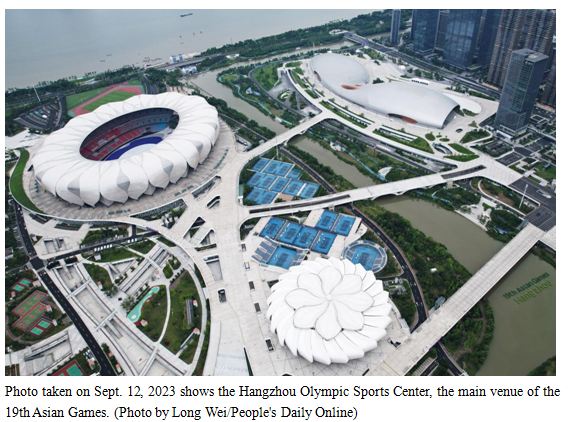
As evening sets in, the main stadium of the Hangzhou Olympic Sports Center, east China’s Zhejiang province, shimmered under dazzling lights.

The green power traceability system displayed on a digital screen at the Zhejiang Power Exchange Center revealed the source of this luminous energy: solar and wind farms in northwest China’s Qinghai province and Xinjiang Uygur autonomous region. Electricity was transmitted across a vast distance to Asian Games venues through ultra-high voltage AC/DC grids.

Zhejiang province is working to ensure green energy supply for the Hangzhou Asian Games.

A total of 94 Asian Games venues in Hangzhou traded 621 million kilowatt-hours of green electricity and 3,982 green energy certificates, which has led to a reduction in carbon dioxide emissions equivalent to approximately 76,320.9 tons of standard coal.

The State Grid Hangzhou Power Supply Company has deployed the first group of “zero-carbon” engineers in the history of the Asian Games. These engineers monitor in detail the electricity usage at each venue and utilize an intelligent platform to identify high energy-consuming equipment. Based on their findings, they propose carbon reduction plans to uncover more emission reduction possibilities for the venues.

Out of the 56 competition venues for the Hangzhou Asian Games and Asian Para Games, only 12 were newly built. The remaining 44 venues were either renovated or constructed temporarily, with many utilizing prefabricated construction methods and recyclable, renewable materials.

The design and construction of Asian Games venues and facilities followed the principle of green, low-carbon sustainability.

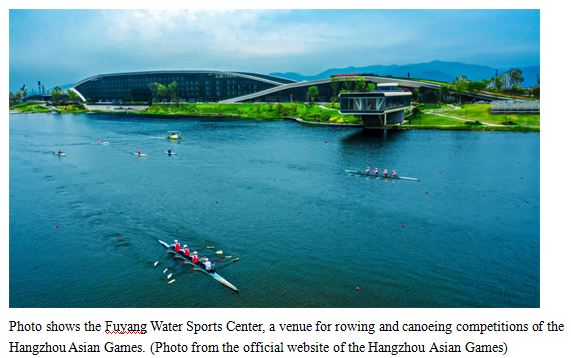
For instance, the Fuyang Water Sports Center, a venue for rowing and canoeing competitions, has adopted an outstanding rainwater collection and recycling system, which initially filters rainwater with pebbles and geotextile fabric on the garden floor and then transmits the water to a series of filtering facilities. The processed water is then used for fountains and irrigation at the water sports center, which helps save 35 percent of water consumption for the venue.

A new type of material is applied on the rooftop of the Shaoxing Baseball & Softball Sports Center, which is light, features excellent thermal insulation performance. It helps maintain a constant temperature inside the building and reduce the use of air conditioning.

The principle of green, low-carbon sustainability is also shown in the Hangzhou Asian Games Village – from coat hangers and cups made of wheat straw in athletes’ rooms, to biodegradable tableware used in the restaurants, and to the solar systems installed on the dining hall roofs…

Sustainability is seen everywhere in the Asian Games Village – electric shuttle buses, rows of shared bikes, and wireless charging stations for electric vehicles.

All 42 competition venues located in Hangzhou have been equipped with vehicle charging facilities, with a total of nearly 800 charging poles installed.

The low-carbon transportation system of the Asian Games Village epitomizes Hangzhou’s transformation towards green and low-carbon mobility. Public bicycles spread across the city’s streets; electric vehicle charging poles are popping up in both old residential blocks and transportation hubs; the city’s taxi fleet is steadily switching from gasoline to electric. Even a “green Asian Games” themed flight departing from the Hangzhou Xiaoshan International Airport used aviation bio-kerosine, reducing carbon emissions by over 70 percent.

With the ongoing promotion of the “Green Asian Games”, green and low-carbon lifestyles are becoming a conscious action for more and more citizens.

At an Asian Games franchised store in downtown Hangzhou, many local residents and tourists were shopping for “zero-carbon mascots,”such as backpack made from 10 recycled beverage bottles, frisbee made from 1,000 grams of rice husks, and recyclable sofa stool made from negative carbon materials…Each purchase of a low-carbon mascot contributes to carbon reduction.

Alipay, a third-party mobile and online payment platform launched by Chinese e-commerce giant Alibaba, is encouraging users to gain energy points by participating in over 60 low-carbon activities, such as joining green transportation, using online public services, and setting air conditioners to appropriate temperatures. So far, more than 100 million people in China have participated in these activities.

More people are enjoying the convenience brought by the green Asian Games. “With the Asian Games approaching, Hangzhou is building more urban greenways. I’m used to biking to work now,” said a local resident Zhao Wenzhe. Hangzhou is home to 16.2 kilometers of riverside greenways, which integrate leisure, sightseeing and entertainment into a slow traffic system.

Statistics show that Hangzhou has built eight types of greenways totaling over 4,700 kilometers, allowing citizens to reach a greenway within five minutes’ walk.

From proposing the “Green Asian Games” concept, to implementing green actions, and to the widespread societal participation, hosting the Asian Games has driven China to advance coordinated urban development and environmental protection, and to better promote low-carbon production and lifestyles.

Enriching Asian Games with beauty of humanity

Enriching Asian Games with beauty of humanity

By Dou Hao, Zheng Yi

The Asian Games is a grand sports event and a cultural feast as well. The Hangzhou Asian Games is brimming with a rich humanistic spirit, from the ingenious designs of the venues to the cultural landscapes in the streets and alleyways of the city, and from the diverse cultural activities to the warm and caring volunteer services.

The emblem “Tides Surging” of the Hangzhou Asian Games is the first visual identity symbol revealed for the Games. Its fan-shaped design integrates elements such as the Qiantang River, Qiantang tidal bore, racetracks, internet symbols, and the sun representing the Olympic Council of Asia, fusing together the distinct culture of Jiangnan, or south of the Yangtze River, with contemporary vibrancy.

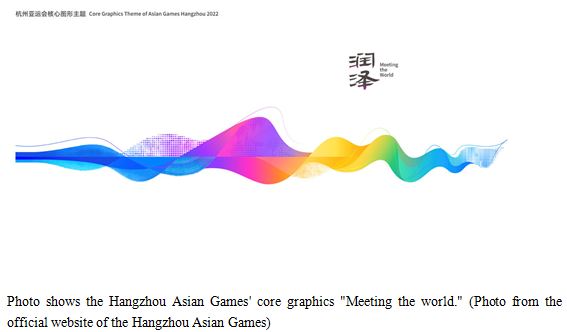
Hangzhou is known as the “City of Silk,” and the silk elements of the city inspired the graceful yet flexible, fine yet smooth, gentle yet vibrant design of the Asian Games’ core graphics “Meeting the world.” It represents the artistic conception of “meeting the world”.

From the West Lake imagery in the “Shan Shui” medals, to the featured floral branches in the victory ceremony bouquet “Fruits of Triumph,” and to the blue and white porcelain elements on the uniforms designed for the Chinese delegation, traditional culture can be seen everywhere, reflecting Hangzhou’s humanistic beauty.

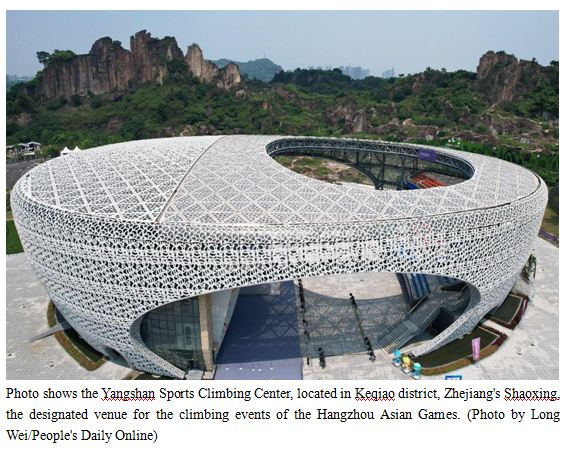
The humanistic touch is also ingrained in the architectural aesthetics of the venues. The Yangshan Sports Climbing Center, located in Keqiao district, Zhejiang’s Shaoxing, resembling a silkworm cocoon, is the designated venue for the climbing events of the Hangzhou Asian Games. The hollowed exterior design reflects the silk culture in the Jiangnan water towns, seamlessly integrating elements of Chinese landscapes and international competitions.

“From the refined and elegant landscapes in the Jiangnan area, we will see a unique Asian Games. The diverse humanistic elements also reflect the cultural heritage and aesthetic charm of the city of Hangzhou,” said an official with the Hangzhou Asian Games Organizing Committee.

Beside the Hangzhou Olympic Sports Center, a dedicated Asian Flower Theme Park gathers over 200 flower varieties, conveying the vision of “Asian people progressing together.” On the Linping People’s Square, there are murals depicting the Grand Canal and intangible cultural heritage elements. In Qianwang street of Hangzhou’s Lin’an district, wall relief sculptures with Asian Games motifs installed on building exteriors are quite eye-catching. Themed landscapes celebrating the Games are greeting visitors everywhere in this city.

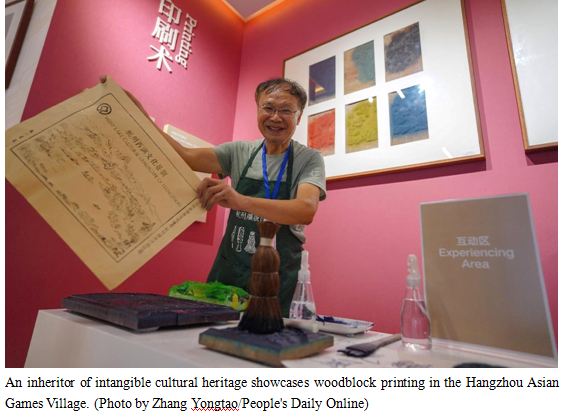
In the Asian Games Village, there are various “Cultural Houses” where athletes are able to enjoy a cup of tea with friends, marveling at the intricate craftsmanship of fan-making, delve into the ancient techniques of traditional embroidery and porcelain making, and design and make their own personalized artistic seals. These “Cultural Houses” are truly enlightening windows showcasing the richness and beauty of the traditional Chinese culture.

In an ancient street in Yuhang district of Hangzhou, there is an Asian Games cultural experience station where inheritors of intangible cultural heritage teach visitors the traditional craft of paper umbrella making. Fifty such cultural experience stations have been established across Hangzhou.

Currently, more than 100 cultural centers in Zhejiang province are collaborating to launch over 5,300 public cultural activities centered around the Asian Games. These activities encompass a wide range of artistic forms, including music, dance, traditional opera, traditional storytelling, fine arts, photography, and more.

Following the spirit of “Everyone is a Host,” the 1.48 million city volunteers in Hangzhou are extending the warmest welcome to guests across streets and neighborhoods, and at dedicated volunteer stations.

At the Asian Games Village, athletesare guided by smiling young volunteers.. At a volunteer station in Xiaoshan district, volunteers offer not only rental services but also traffic guidance and scenic spots introduction for visitors.

The Hangzhou Asian Games not only brings together Asian athletes for competition, but also upholds the vision of “beauty in diversity.” By adding non-Olympic events with unique Asian cultural characteristics, such as sepak takraw, Kabaddi, and karate, the Games encourages broader participation from more countries and regions.

It is believed that the Hangzhou Asian Games, with utmost sincerity, will deliver profound humanistic heritage and warmth to guests.

African youth paintings exhibited on China’s space station

African youth paintings exhibited on China's space station

By Wan Yu, Huang Weixin, Liu Hui, People’s Daily

A unique painting exhibition, embodying the beautiful dreams of African youths, was recently held some 400 kilometers above Earth at China’s Tiangong space station.

The creative works made their debut at an awarding ceremony for the “My Dream” painting competition for African youth.

The competition was launched in March this year by the Secretariat of the Chinese Follow-up Committee of the Forum on China-Africa Cooperation (FOCAC), the China Manned Space Engineering Office and some Chinese embassies and consulates in African countries. It received submissions from some 2,000 youths from 42 African countries.

At the end of May, 10 works were selected as winners of the Tianhe Award, named after the core module of China’s space station. They flew into space along with the crew of China’s Shenzhou-16 mission, and were exhibited on the Tianhe core module on Sept. 13.

Three Chinese astronauts of the Shenzhou-16 mission, namely, Jing Haipeng, Zhu Yangzhu and Gui Haichao, showed and introduced the works to theaudience on Earth from the space stationvia video link.

Looking at an astronaut-themed painting, Zhu said the work shows the enthusiasm of African youth for manned space, and also boosts his confidence in future China-Africa space cooperation.

Exploring the unknown universe and developing space technology are the common endeavors of mankind, Zhu noted, emphasizing the full cooperation of all countries in the world, including Africa.

“We sincerely hope that Chinese and foreign astronauts can work together to make even greater contributions to human exploration of the universe,” he added.

The awarding ceremony was simultaneously held in Beijing and eight African countries including the Central African Republic, Comoros, Egypt, Equatorial Guinea, and Kenya.The award-winning African painters and other African youths repeatedly cheered and applauded during the video link, expressing their excitement.

They asked questions actively to Chinese astronauts, covering various topics such as the possibility of growing vegetables in the space station, the feeling on the space station, the contributions of the space industry to national development, and whether astronauts can see Africa’s Congo River from space.

Chen Dong, a Chinese astronaut who has conducted two manned space missions to Tiangong, answered their questions via video link in Beijing. He is the first Chinese to stay in orbit for more than 200 days.

Kenyan student Melissa Wanjala, a second-prize winner, said joining the competition sparked her dream of space.

She said she was deeply inspired by Chinese astronauts saying that vegetables can be grown in space She wanted to study agriculture and grow food in space to help alleviate poverty and hunger.

China’s cooperation with Africa in space is deepening, which has become a new highlight of China-Africa cooperation. Modern aerospace technology is playing an increasingly important role in promoting the economic and social development of African countries and benefiting the lives of African people.

In recent years, China, giving full play to its advantages in satellite remote sensing technology and resources, has signed memorandums of understanding on satellite data application cooperation with institutions and regional organizations in 13 African countries.

China has provided nearly 40,000 scenes of high-resolution satellite remote sensingdata of Chinese natural resources to 23 African countries and has held multiple technical exchanges and training sessions. They have effectively enhanced the satellite remote sensing application capabilities of African countries and laid a solid foundation for further deepening China-Africa cooperation in the field.

Cooperation between Africa and China in aerospace technology is becoming increasingly close, said Ibrahima Sory Sylla, Ambassador of Senegalto China.

This event was another example of how China has been sincerely sharing development results and opportunities with Africa. African youths who participated via video link said the event aroused their curiosity about exploring the vast universe, and they hope to contribute to promoting friendly cooperation between Africa and China.

Wu Peng, Director-General of the Department of African Affairs of the Foreign Ministry of China, stated at the event that China is willing to support Africa to cultivate talents in various fields, including modernization of governance, economic and social development, technological innovation, and improvement of people’s livelihood and welfare, through the implementation of the Plan for China-Africa Cooperation on Talent Development.

This will create more favorable conditions and provide a broader space for African youths to pursue their dreams and achieve success, Wu added.

China, ASEAN join forces to build an ever closer community with shared future

China, ASEAN join forces to build an ever closer community with shared future

By Pang Geping, Li Zong, People’s Daily

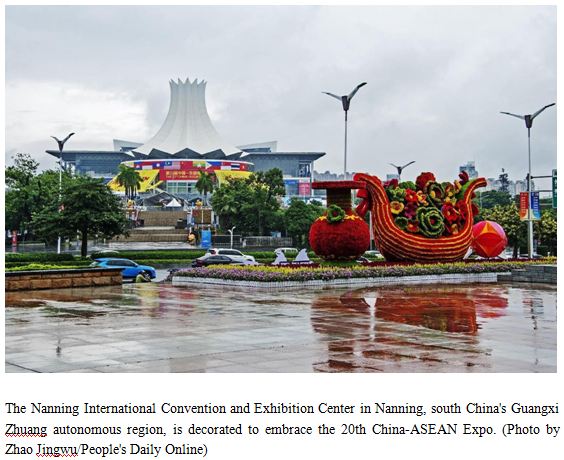
The 20th China-ASEAN Expo and China-ASEAN Business and Investment Summitwas held on Sept. 16 in Nanning, capital of south China’s Guangxi Zhuang autonomous region.

Over the past 20 years, the expo and summit has built collaboration and cooperation mechanisms between China and ASEAN in multiple areas, injecting positive energy into the region and the world’s peace and stability, development and prosperity. It has served as a sound platform that strengthens communication and exchanges between the two sides.

In recent years, more and more featured products have entered the Chinese market via the China-ASEAN Expo, such as durians from Vietnam,mangosteens from Thailandand coffee from Indonesia.

The China-ASEAN Expo and China-ASEAN Business and Investment Summithas become an important platform for communication and cooperation between China and ASEAN, said Wei Zhaohui, secretary-general of the expo’s secretariat.

China and ASEAN established a strategic partnership at the China-ASEAN (10+1) leaders’ meeting in 2003, which marked a new chapter of friendship between the two sides.

At this meeting, China proposed to hold the China-ASEAN Expo in Nanning on an annual basis starting in 2004. In 2004, the first China-ASEAN Expo was successfullyheld and permanently settled in in Nanning, and the China-ASEAN Business and Investment Summit was also held.

The expo and summit has built a bridge of friendly cooperationin multiple fields, forming a new channel for China-ASEAN cooperation. It is a regional public product and international cooperation platform serving China and ASEAN, and even the Regional Comprehensive Economic Partnership (RCEP) and the Belt and Road Initiative.

The previous 19 sessions of the expo and summit were attended by a total of 182 Chinese and foreign leaders, over 3,800 ministerial-level guests and heads of international organizations, as well as more than 1.1 million merchants.

“Thanks to the China-ASEAN Expo and China-ASEAN Business and Investment Summit, the cooperation between the two sides has extended from trade in goods, investment, and services to more areas such as international capacity cooperation and cross-border industrial park construction,” said Zhai Kun, a professor in the School of International Studies, Peking University, adding that the expo and summit has also fostered exchanges in various fields including artificial intelligence, internet technology, and education.

As a result, the cooperation between the two sides is progressing towards a larger scope, with higher standards and at deeper levels, Zhai said.

High-level dialogue and negotiations, multi-level economic and trade activities, and wide-ranging high-level forums were held during the expo and summit. They have showcased the comprehensive cooperation between China and ASEAN over the past 20 years, which hasnot only brought benefits to the region, but also promoted global economic and trade development.

Last year, the RCEP came into effect, creating the world’s largest free trade bloc. “The expo has vigorously promoted the construction of the China-ASEAN Free Trade Area and the RCEP, opening up broader space for regional economic and trade cooperation, accelerating regional economic integration, and injecting strong impetus into regional prosperity and stability,” saidBenjamas Tanvetyanont, Thai consul-general in Nanning.

Trade cooperation is an important witnessto the progress of bilateral relations. Statistics show that the bilateral trade volume between China and ASEAN has increased from over $100 billion in 2004 to $975.34 billion in 2022.

China has maintained ASEAN’s largest trading partner for 14 consecutive years, while ASEAN has been China’s largest trading partner for 3 consecutive years. China-ASEAN economic and trade cooperation has steadily and continuously developed, becoming a successful example of regional cooperation in the Asia-Pacific region.

In recent years, with the construction and opening of more roads and railways, as well as the upgrading and transformation of various ports, the increasing logistics connectivity has accelerated the development of ASEAN countries.

China and ASEAN have joined hands to build a China-ASEAN community with a shared future, promoting common development and prosperity, and enabling over 2 billion people to live a better life. This serves as a vivid example of building a community with a shared future for mankind.

The annual throughput of the Beibu Gulf Port in Guangxi has exceeded 7 million twenty-foot equivalent units, and ASEAN products such as durians and frozen shrimps are entering the Chinese market via the port.

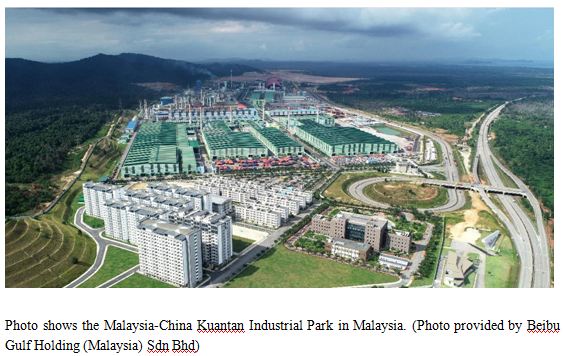
So far, the China-Laos Railway has transported over 20 million passengers. Besides, the agreedinvestment for the Malaysia-China Kuantan Industrial Park stood at about 46 billion yuan ($63.14 billion), with a cumulative industrial output value of over 60 billion yuan.

China and ASEAN are witnessing deepening and solidifying exchanges and cooperation in education, livelihood, and health. The two sides have sent over 200,000 students to each other.

Besides, Chinese universities have established majors in the official languages of the 10 ASEAN countries, and ASEAN countries have set up 42 Confucius Institutes and 39 Confucius Classrooms. Currently, all 10 countries have become popular destinations for Chinese tourists, and both sides are major sources of tourism for each other.

“In the past 20 years, the China-ASEAN Expo has played an increasingly prominent role as an international public product serving global trade. With the accelerated development and upgrading of the expo, the cooperation between China and ASEAN will undoubtedly flourish and yield even more fruitful results,” said Wei.

Stay Connected

64FansLike
60FollowersFollow

Latest Reviews

Exchange Rates

USD - United States Dollar
EUR
1.17
GBP
1.35
AUD
0.72
CAD
0.73