Home Blog Page 1181

President Erdogan visits Azerbaijan after Karabakh victory

President Erdogan visits Azerbaijan after Karabakh victory

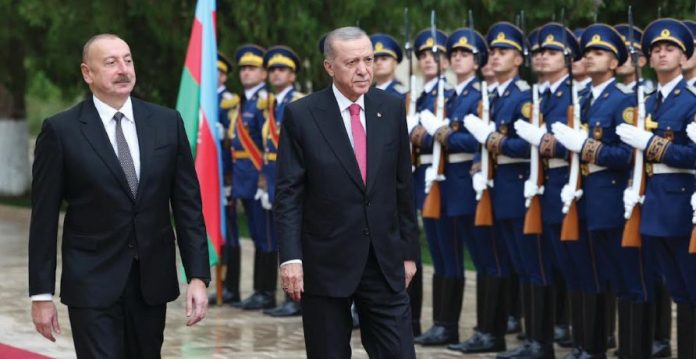
President Erdoğan visited Azerbaijan’s Nakhchivan on Monday where he was warmly welcomed by Ilham Aliyev, who led his country to a victory against the Armenian separatists of Karabakh last week

News Desk

Baku: President Recep Tayyip Erdoğan made a spontaneous visit on Monday to the Azerbaijani exclave of Nakhchivan. Announced one day before, the visit comes on the heels of Azerbaijan’s successful counterterrorism operation in Karabakh, a region regained from Armenia which, last week, was cleared of Armenian separatists.

Azerbaijani President Ilham Aliyev welcomed Erdoğan in an official ceremony before the two leaders headed for talks. The purpose of Erdoğan’s visit is the inauguration of a pipeline between Türkiye’s Iğdır and Nakchivan, and two leaders are also expected to attend the opening of a military complex in the exclave. Nakchivan, which shares Azerbaijan’s only land border with Türkiye, is surrounded by Armenian territories. So, Erdoğan’s visit was symbolic in the aftermath of the victory against Armenian separatists. Azerbaijan and Türkiye are the most intimate allies in the region, with their intertwined history as two Turkic nations. Erdoğan further advanced ties thanks to his close friendship with Aliyev. Two leaders call each other “brothers,” and Türkiye is the most outspoken advocate of Azerbaijan’s rights over Karabakh, forcibly taken by Armenia after the collapse of the USSR.

Karabakh has been quiet after last week’s operation, but Azerbaijan’s Defense Ministry announced on Monday that two Azerbaijani soldiers were killed and another was injured when their military truck hit an antitank land mine planted by Armenian forces in the region. It was the deaths of several Azerbaijani soldiers by a land mine that prompted Azerbaijan to launch a counterterrorism offensive against separatists.

The Azerbaijan military truck struck the mine at 5.35 p.m. local time on Sunday, the ministry said in a statement.

Two soldiers, Ekrem Shadmanov and Tural Seyidov, were killed, and Elvin Aliyev was injured in the explosion of an antitank mine planted by Armenian forces on the route between Azerbaijani positions for terrorist purposes. Aliyev is not in critical condition, the statement added. Some social media posts show Shadmanov was promoted to staff colonel in the Azerbaijani army before the incident. An investigation has been launched into the incident, and the general public has been warned not to enter liberated areas until the region has been cleared of mines.

Mines planted by Armenian forces have killed several Azerbaijani civilians and soldiers in recent years.

Relations between the former Soviet republics of Armenia and Azerbaijan have been tense since 1991, when the Armenian military occupied Karabakh, internationally recognized as an Azerbaijani territory and seven adjacent regions. When new clashes erupted on Sept. 27, the Armenian Army attacked civilians and Azerbaijani forces and violated several humanitarian cease-fire agreements. During the 44-day conflict, Azerbaijan liberated several cities and nearly 300 settlements and villages from the nearly three-decade occupation.

Despite the deal ending the conflict, the Armenian Army several times violated the agreement and martyred several Azerbaijani soldiers and a civilian, as well as wounded a few people, according to the Azerbaijani Defense Ministry.

Azerbaijani officials and a delegation of Armenian separatists held their second meeting following the counterterrorism operation on Monday. Officials of the two sides, who first met in Azerbaijan’s Yevlakh, held their second meeting in the town of Khojaly. On Tuesday, Brussels will host senior envoys from Azerbaijan and Armenia, the European Union said.

Simon Mordue, chief diplomatic advisor to European Council president Charles Michel, will chair the talks, Michel’s spokesperson said. Azerbaijan and Armenia, along with EU heavyweights France and Germany, will be represented by their national security advisors. The EU special representative for the South Caucasus, Estonian diplomat Toivo Klaar, will also attend.

Tuesday’s meeting in Brussels will be the first such encounter since the offensive, but the leaders of both countries are scheduled to meet next month. Armenian Prime Minister Nikol Pashinyan and President Aliyev will be at the European Political Community summit in the Spanish city of Granada on Oct. 5.
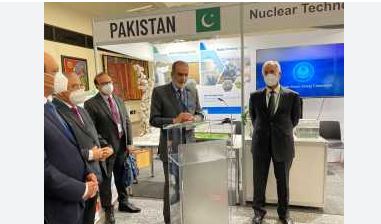
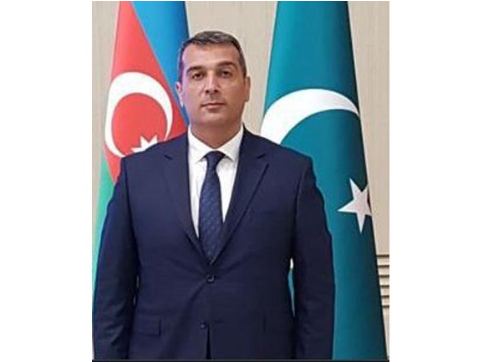
Pakistan’s Achievements in Peaceful Uses of Nuclear Technology Highlighted

Pakistan’s Achievements in Peaceful Uses of Nuclear Technology Highlighted

DNA

Vienna: Chairman PAEC, Dr. Raja Ali Raza Anwar, led Pakistan’s delegation at the 67th Session of the General Conference of the International Atomic Energy Agency (IAEA) which is underway in Vienna, Austria, at the IAEA Headquarters. During his statement, the Chairman underscored that Pakistan highly valued its cooperation with the Agency and remained committed to advance its collaboration by supporting the Agency’s role as per its motto, “atoms for peace and development”.

The Chairman appreciated the Agency’s continued assistance to member states in their efforts to meet developmental challenges through safe, secure and sustainable uses of nuclear science. He also underscored that global issues require global solutions, highlighting that Pakistan remains one of the most vulnerable countries to climate change. He stressed that Pakistan views nuclear power as an affordable, reliable and clean source of energy and a part of the solution to the climate crisis.

While acknowledging that Pakistan had been a beneficiary of the Agency’s assistance, the Chairman shared that Pakistan is effectively utilising nuclear science and technology in areas such as human health, food and agriculture, power generation, industry and environment protection. He also highlighted that Director General Rafael Mariano Grossi’s visit to Pakistan earlier this year provided further impetus to strengthen the mutually beneficial and decades long collaboration between Pakistan and the Agency.

The Chairman stressed that nuclear technology in the human health sector remained a matter of national priority for Pakistan. He shared that, at the moment, 19 cancer hospitals were being run by the Pakistan Atomic Energy Commission which were playing a vital role in providing quality treatment to over 80% of the country’s cancer patients. The Chairman added that nuclear technologies were being deployed to enhance food security and agricultural productivity. In this regard, Pakistan currently has four agriculture and biotechnology centres, out of which the Nuclear Institute for Agriculture and Biology (NIAB) has been designated as an IAEA collaborating Center and is also part of the Agency’s ZODIAC laboratories network. He further shared that, in a significant development, NIAB has been successful in producing coloured cotton and Pakistan is currently planning its large scale production.

On the margins of the General Conference, the Chairman will also hold multiple bilateral meetings to explore possibilities of collaboration in the peaceful uses of nuclear technology under the aegis of the IAEA.

The General Conference consists of representatives of the IAEA Member States who meet in a regular annual session, usually in September, to consider and approve the IAEA’s  budget and to decide on other issues raised by the Board of Governors, the Director General and Member States.

Pakistan, Azerbaijan discuss transport, trade cooperation

Pakistan, Azerbaijan discuss transport, trade cooperation

ISLAMABAD, SEP 25 (DNA) — Caretaker Federal Minister for Communications for Railways Shahid Ashraf Tarar, and Azerbaijani Ambassador to Pakistan Khazar Farhadov discussed issues of mutual interests and strengthened bilateral ties.

The ambassador during a meeting with the minister said the relationship between Pakistan and Azerbaijan is unparalleled in every aspect. The envoy said, following the commencement of direct flights between Pakistan and Azerbaijan, both countries aim to connect through railways and road networks.

The Ambassador said the primary goal is to boost economic cooperation and facilitate the movement of goods and people. “We are keen on promoting economic cooperation,” Ambassador Farhadov said.

He further said, “We envision Pakistan becoming a part of international transport networks, connecting with all regional countries.” He also highlighted the potential for Pakistani trade to gain access to Europe and Russia through Azerbaijan.

The ambassador said, that to achieve this, the private sector will play a crucial role in promoting trade and economic growth. Shahid Ashraf Tarar expressed his commitment to the idea, said, “I have instructed the Chairman of Railways to work on connecting rail routes with Azerbaijan.

“It is time to transform our good relations into economic cooperation,” the minister said. Both parties expressed the urgency of finalizing transit trade agreements between Pakistan and Azerbaijan, indicating their willingness to promptly implement these proposals. “I hope that both countries will collaborate to implement these recommendations swiftly,” the minister said.

The meeting between Minister Shahid Ashraf Tarar and Ambassador Khazar Farhadov reflects the shared determination of Pakistan and Azerbaijan to strengthen their economic ties and facilitate cross-border trade and connectivity. As these discussions progress, the potential for increased economic cooperation between the two nations remains promising. — DNA

Pakistan’s tax-to-GDP ratio stuck at 10.4%, World Bank offers solutions

Pakistan's tax-to-GDP ratio

ISLAMABAD, SEP 25 (DNA) — Pakistan’s economy faces a concerning challenge as its tax-to-GDP ratio stands at a mere 10.4%, according to a report released by the World Bank.

The report, titled “Strengthening Government Revenues,” highlights the significant gap between the country’s tax collections and its tax capacity, which is estimated at over 22% of GDP. This decline in the tax-to-GDP ratio is attributed to rising tax expenditures, particularly at the federal level.

In the fiscal year 2022, Pakistan’s tax collections reached only 10.4% of GDP, a trend that has been steadily declining. The federal government’s tax expenditures increased from 1.3% of GDP in FY16 to 2.7% of GDP in FY22, putting further strain on revenue generation efforts.

Heavy reliance on indirect taxes

The report also highlights that the majority of revenues in Pakistan are collected at the federal level, primarily through indirect taxes on consumption.

These indirect taxes include sales tax, customs duties, and excises. In FY22, the federal government accounted for 91.2% of tax collection, partly due to increased taxation of services by provincial governments. Direct taxes, collected by the federal government, make up only around 33% of total taxes collected.

One of the key challenges noted in the report is the minimal revenue generated from agricultural income tax, with over 90% of farmers falling below the tax threshold. Additionally, total provincial revenue collection remains less than 1% of GDP.

World Bank’s recommendations for reform

To address these challenges and enhance revenue generation, the World Bank has launched a new program titled “Reforms for a Brighter Future: Time to Decide.”

The program offers several recommendations, including: Improving Federal-Provincial Coordination: Enhancing coordination between federal and provincial governments to streamline tax administration and policy reforms; Harmonizing Tax Bases: Creating a single tax market and reducing interactions between taxpayers and revenue authorities within the existing constitutional framework; Digitization Efforts: Expediting ongoing digitization initiatives to reduce compliance costs and minimize taxpayer interactions; Closing Corporate and Personal Income Tax Exemptions: Eliminating exemptions in the energy sector, power generation projects, and real estate investments to generate additional revenue; Increasing Excise Duties on Harmful Goods: Implementing uniform excise duties on items such as cigarettes, with automatic inflation adjustments, to generate more revenue; Reviewing COVID-19 Exemptions: Reevaluating costly exemptions introduced during the pandemic, including those in the pharmaceutical, energy, and food sectors; Eliminating Exemptions on Essential Food Items: Considering the removal of exemptions for essential food items like oil, pulses, animal products, fruits, and dairy; and Reevaluating Concessionary Rates on Fertilizers: Reducing fiscal costs by reevaluating concessionary rates on fertilizers.

The World Bank’s recommendations provide a roadmap for Pakistan to strengthen its revenue generation efforts and address fiscal challenges effectively. With significant potential for improvement in taxation, policymakers are urged to consider these reforms to boost the country’s economic stability.

Najy Benhassine, the Country Director for Pakistan at the World Bank, emphasized the importance of open debates on concrete policy decisions to achieve inclusive, sustainable, and climate-resilient development.

As part of the “Reforms for a Brighter Future” engagement program, the World Bank, in collaboration with the Pakistan Institute of Development Economics, conducted extensive consultations across the country to gather inputs and feedback on the proposed recommendations. The program will continue with online and in-person events in the coming months.

China Pakistan Business Development Council delegation visits RCCI

China Pakistan Business Development Council delegation visits RCCI

DNA

Rawalpindi: A delegation of China Pakistan Business Development Council headed by Council President Chen Jian lu along with Chairman Shafiqur Rehman visited Rawalpindi Chamber of Commerce and Industry (RCCI). They were accompanied by Wang Xiaosan, Ms. Li Xin and Ms LEE WONG.

Chamber President Saqib Rafiq briefed the delegation on the ongoing activities and future programs of the Chamber. He said that there are friendly and deep relations between Pakistan and China, exchange of sector-based information is necessary for further cementing the trade relations.

Group Leader Sohail Altaf said that transfer of technology and industry is necessary for the growth of the industry. He said that progress on industrial zones under CPEC should be accelerated.

 China Pakistan Business Development Council President Chen Jian lu and Chairman Shafiqur Rehman said that the purpose of the visit is to increase contacts with the business community and the Chamber of Commerce to pave the way for joint projects.

Issues related to bilateral trade, information related to the sector and joint projects were discussed in the meeting. An interactive session was also held where information and scope were shared by relevant sectors including pharmaceuticals, poultry, mining, IT, tourism and agriculture etc.

US diplomat Rena Bitter to arrive Pakistan

US diplomat Rena Bitter to arrive Pakistan

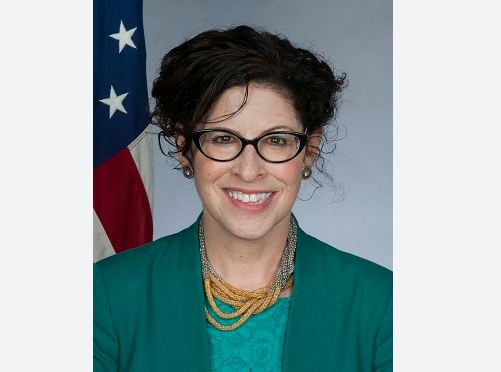
WASHINGTON, Sept 25 /DNA/ – Assistant Secretary of State for Consular Affairs Rena Bitter will embark on a diplomatic journey from September 25 to October 2, with stops in Islamabad, Karachi, and Dhaka.

During her visit, Assistant Secretary Bitter will engage with embassy and consulate personnel, gaining firsthand insight into consular operations. Furthermore, she will hold meetings with host government officials to address critical consular matters.

This mission underscores the enduring commitment of the United States to safeguarding the well-being of U.S. citizens abroad and facilitating legitimate travel and immigration to the United States.

Depriving Khan of right to appear before courts akin to murder of justice: PTI

PTI

Urges SC to ensure PTI Chairman’s court appearance, speedy disposal of fake cases

Rakes up Imran forced to appear in courts despite assassination attempts before incarceration

ISLAMABAD: /DNA/ – Pakistan Tehreek-e-Insaf (PTI) spokesperson termed the ongoing efforts to deprive PTI Chairman Imran Khan of the right to appear before the courts under various pretext as a murder of justice and a shameful attempt to subject a political prisoner to worst political vendetta.

PTI Spokesperson strongly reacted to the ongoing attempts to deny PTI Chairman the right to appearance in hearings in various cases against him in the courts under various excuses and said that it was murder of the justice, besides it was shameful attempt to make him a target of cruel political revenge as a political prisoner.

He said that it was the fundamental legal right of the Chairman Imran Khan to pursue cases against him and attend courts’ hearings regularly. “Before the arrest, Imran Khan was forced to appear in court in hundreds of frivolous, fabricated and politically motivated cases, despite the murderous attacks and serious security threats,” he added.

PTI spokesperson reminded that Chairman PTI’s Lahore Zaman Park’s residence was stormed by police on March 14 last year and operation and sieged continued for 24 hour under the guise to force Khan to appear before the court.

He went on to say that Imran Khan has been deprived of the legal and constitutional rights of appearing before courts after being illegally incarcerated in Attock Jail.

PTI spokesperson said: “Owing to his immense popularity, fascist state authorities want to deprive Imran Khan of justice and forcefully hide him from the public eyes.”

He demanded that the Supreme Court should take immediately notice of the ongoing efforts of the state machinery to deprive PTI Chairman of justice, besides ensuring his presence in the courts to pursue the cases against him so as to take the hundreds of fabricated and fake registered against him to logical conclusion.

British investors keen to invest in financial, capital market of Pakistan

British investors keen to invest in financial

LONDON, SEP 25 (DNA) — The British investors have expressed their keen interest in exploring promising investment opportunities in the financial and capital market of Pakistan, reflecting a growing mutual interest in expanding economic collaboration.

This commitment was shown during a meeting of senior leaders of London’s capital and financial market with Caretaker Prime Minister Anwaar-ul-Haq Kakar in London Monday.

The leaders of the notable investment firms who met the prime minister in London included Fidelity International Limited (FIL), Wellington Management, Ashmore, Jefferies International, Redwheel Capital, Switex Industrial SA, Oxford Frontier Capital, GuarantCo, JP Morgan, Kalrock Capital, and UBL UK.

The Prime Minister informed the delegation about Pakistan’s current economic landscape, highlighting government measures for external account improvement. He said recent administrative actions strengthened the Pakistani rupee against the US dollar, fostering optimism for stability.

He said positive indicators, including inflows from the World Bank, Asian Development Bank, and friendly nations, contributed to reduced inflation, stabilized reserves, and revival of industrial growth.

Anwaar-ul-Haq Kakar spoke about the potential for foreign direct investment in Pakistan’s key sectors and the positive impact of the Stand-By Arrangement with the IMF, exceeding expectations and stabilizing the economy and currency.

He also highlighted economic improvements such as reduced inflation with expected sustained decline, and upcoming growth in agriculture and industry. He mentioned improved trade after removal of restrictions on imports and fiscal measures for monetary support and medium-term inflation targets.

Furthermore, the Prime Minister highlighted Pakistan’s pro-investment efforts, introducing the Special Investment Facilitation Council. This initiative, led by the Prime Minister himself, streamlines investment processes, attracts investments in key sectors, and fosters long-term growth by simplifying the business landscape.

The British investors enquired about the continuity of the IMF program in Pakistan and reform efforts from short to medium term. The Prime Minister assured them that Pakistan had expressed its commitment to the IMF program by undertaking reforms committed with the IMF. — DNA

Human activity amplified Libya’s recent flooding

Human activity amplified Libya's recent flooding

DNA

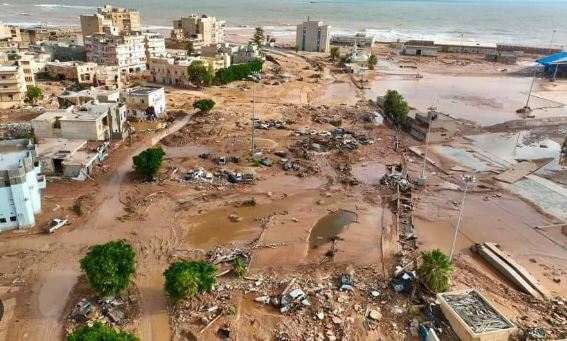
Tripoli: The devastation wreaked by floods in eastern Libya is nothing less than apocalyptic. In Derna, where two dams burst after torrential rains, a wall of water deluged the city and sliced out the land from beneath its inhabitants. Entire neighbourhoods were swept into the sea, which is now dumping bodies along the shore. More than 6,000 have died there, and 10,000 people are said to be missing, but because entire families were washed away, there may be no survivors to report some losses. With other towns and settlements inundated, too, tens of thousands are displaced.

The horror and despair of Libyans is matched by their fury at the rival governments that have split the country and pursued power and profit while ignoring the people’s needs. Storm Daniel is a natural disaster, wrote Elham Saudi, the director of Lawyers for Justice in Libya, but the ensuing catastrophe “is manmade: corruption; lack of infrastructure; impunity; shutting down frontliners in civil society … Be angry at a system that has enabled this tragedy.”

It is too soon to say whether, or how far, Storm Daniel’s terrifying impact is related to the climate crisis. But it is clear that global heating is increasing the frequency and severity of extreme weather events, including flooding. In the last fortnight alone, Hong Kong has seen its heaviest rainfall since records began in 1884, with metro stations inundated, and in Greece, torrential rain triggered landslides and infrastructure collapse. These scenes, like the summer’s extreme rainfalls in China, the US and Spain among others, are a warning of what awaits many more of us, and highlight the need for mitigation measures as well as slashing carbon emissions.

Libya shows the disastrous consequences when governments not only fail to protect their citizens but also put them into greater danger. Muammar Gaddafi’s corrupt regime has been followed by more than a decade of revolution, civil war and political deadlock. Essential infrastructure has not only been neglected – one of Derna’s dams had reportedly not been maintained since 2002 – but also plundered by the powerful and their cronies.

Even when disaster loomed, the authorities in eastern Libya, controlled by the warlord Khalifa Haftar, failed in their most basic duties. As Anas el Gomati of the country’s Sadeq Institute has pointed out, this is not like the earthquake that struck without warning in Morocco last week, killing at least 2,900 people. Officials saw Storm Daniel’s impact in Greece and had days to plan an evacuation. Some people were apparently told to leave, but others were reportedly ordered to stay at home even as water swelled behind the dams.

In the aftermath, with children crying for help in the wreckage, rescue and relief efforts continue to be hampered by politics as well as the destruction of essential infrastructure. There is widespread cynicism about the willingness of the internationally recognised government in Tripoli and Mr Haftar’s rival government to truly put the suffering first. Key figures in civil society, precisely the people who might mobilise relief efforts, languish in jail while their compatriots need them.

But there is also anger that most other governments appear slow to respond to this catastrophe. Vast fossil fuel reserves and regional security objectives have encouraged foreign powers to meddle in Libya. The EU has given the country hundreds of millions of euros to curb migration, ignoring appalling abuses by the Libyan coast guard. Is it now willing to help ordinary Libyans? France, which has done so much to bolster Mr Haftar, has a particular responsibility to ensure a strong European response. Libyans have good reason to feel that they have been failed by the international community as well as their own leaders. Now more than ever, they need real support.

EU Chief sparks protectionism concerns

EU Chief

DNA

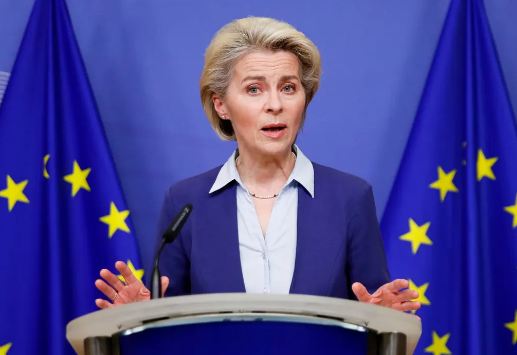
ISLAMABAD: SEPT 25 – With the European Union holding Parliamentary elections next year, European Commission President Ursula von der Leyen seems intent on striking a combative stance toward China, announcing an anti-subsidy probe into Chinese electric vehicles on Wednesday.

Since “global markets are now flooded with cheaper electric cars, and their price is kept artificially low by huge state subsidies”, an investigation is needed to decide whether punitive tariffs should be imposed to protect European EV producers, she said.

Such a combative posture as a champion of European business might in some ways be intended to present a tough image as a champion of EU interests, thus securing her a second term. But it will also undermine the EU’s longstanding role as a leader of global free trade and hinder the development of the European EV industry and be a drag on the bloc’s green transition.

While she claimed that “Europe is open to competition”, the European Commission chief also said that “Europe will do whatever it takes to keep its competitive edge” giving the impression she would not mind becoming less than open when it comes to competition with Chinese EV makers.

It is true that Chinese EVs have witnessed a phenomenal surge in overseas markets recently. According to European Commission data, Chinese-made EVs account for 8 percent of the EU market now, and may reach 15 percent in 2025. The country has surpassed Japan to become the world’s largest auto exporter in the first quarter of 2023, with Chinese auto exports registering a stunning 31 percent rise last month, according to the China Passenger Car Association.

In addition to their industry-leading battery technologies, the EVs are generally 20 percent lower in prices than EU-made models. While the Chinese government does implement an industrial policy that encourages environmentally friendly industries including EVs, it is unfair to attribute the competitive edge of Chinese EV exports entirely to subsidies.

The Chinese Commerce Ministry contends rightly that the sector’s competitive advantage is not due to subsidies, and that the EU is seeking to protect its own industry in the name of “fair competition” with protectionist measures that will seriously disrupt and distort the global automotive industry and supply chains and will have a negative impact on China-EU economic and trade relations.

It is thought-provoking that even Germany, the foremost European automaking country and exporter of automobiles, is against the approach.

German Chancellor Olaf Scholz stated just last week that “Fair competition stimulates the economy…Competition should spur us on, not scare us.”

European critics of the investigation are correct in pointing out the dangers of Europe abandoning its “path of virtue” in defending free trade.

EU auto companies have invested and operated in China for many years, and the Chinese market has become the largest overseas market for many EU car companies. There is actually much space for the Chinese and European automotive industries to cooperate. This would be more mutually beneficial for the two sides than the measures proposed by Von der Leyen.

Stay Connected

64FansLike
60FollowersFollow

Latest Reviews

Exchange Rates

USD - United States Dollar
EUR
1.17
GBP
1.35
AUD
0.72
CAD
0.73