Home Blog Page 1136

Pakistan, Korea celebrate 40 years of strong diplomatic relations

Korea

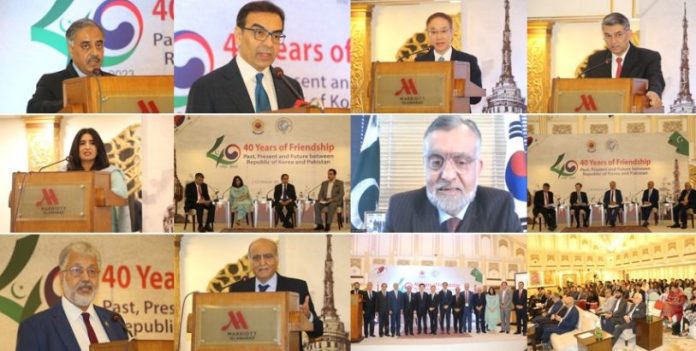
ISLAMABAD, OCT 25 /DNA/ – The Institute of Strategic Studies Islamabad (ISSI), in collaboration with the Embassy of the Republic of Korea (ROK), held a Seminar on “40 Years of Friendship- Past, Present and Future between Republic of Korea and Pakistan” today. Chief Guest on the occasion was Mr. Muhammad Ali, Minister for Energy, Power & Petroleum. Speakers in the inaugural session included Dr. Talat Shabbir, Director, China Pakistan Study Centre ISSI; Ambassador Park Kijun Ambassador of the Republic of Korea; and Ambassador Sohail Mahmood, Director General, ISSI.

During the Inaugural Session, the Speakers celebrated Pakistan-RoK 40-year diplomatic relationship, while highlighting the myriad facets of the strong partnership in various fields, including economic, educational, cultural cooperation, and ‘Gandhara connection.’ Dr Talat Shabbir in his introductory remarks said that the enduring friendship and collaboration between Pakistan and South Korea, nurtured over four decades, had led to significant progress in bilateral relations. Ambassador Park Kijun, in his remarks, emphasized the historic nature of the occasion, underscoring the robust and amicable ties existing between the two nations. He highlighted the vast potential for mutually beneficial collaboration in diverse fields.

DG ISSI Ambassador Sohail Mahmood was of the view that the completion of four decades of Pakistan-Republic of Korea diplomatic ties was, truly, a matter of celebration. He emphasized the extremely friendly and cordial nature of bilateral ties; the steady upward trajectory of the partnership since its inception; and its comprehensive scope, encompassing high-level political and diplomatic exchanges, trade, investments, education, science & technology, defence, cultural cooperation, and people-to-people interactions. The growth in bilateral trade and investments and the increase in Pakistani students studying in South Korea were also noted. Both nations shared an interest in a peaceful and prosperous South Asia and had collaborated in multilateral forums. While celebrating the progress made thus far, Ambassador Sohail Mahmood stressed, it was essential to craft a vision for a robust economic partnership centred essentially on enhanced trade, investments, technology, and green transition.

The keynote address by Minister for Energy, Power & Petroleum Mr. Muhammad Ali emphasized the importance of sustainable energy solutions, research, innovation, and human resource development in advancing shared goals. He highlighted Pakistan’s intrinsic strengths and economic growth potential. The Minister also stressed that, looking ahead, the next 40 years held great promise with new initiatives on the horizon and a steadfast commitment to sustainable solutions, as both nations were driven by a shared vision of prosperity, sustainability and development.

The Working Session I was held to reflect on the 40-year friendship between Korea and Pakistan. The speakers included: Ambassador Nabeel Munir, Ambassador of Pakistan to the Republic of Korea; Ambassador Mumtaz Zahra Baloch, Spokesperson of the Ministry of Foreign Affairs and former Ambassador to RoK; Ambassador Shaukat Mukadam, Former Ambassador to the Republic of Korea; and Raja Amer Iqbal, Former President of Rawalpindi Chamber of Commerce & Industry. Ambassador Nabeel Munir highlighted how the two countries shared family values, a deep sense of community, and a millennia-old bond manifested through the Buddhist tradition and Gandhara civilization. He also emphasized the extensive cooperation between Pakistan and Korea, including in the fields of trade, defence, IT, human resources, and infrastructure.

Spokesperson Mumtaz Zahra Baloch focused on the historical roots of Pakistan-Korea relations, that dated back to the 5th Century. She commended the contributions of Korean peacekeeping troops in the disputed region of Jammu and Kashmir. Pakistan believed the two countries could work together to reinforce peace and security in South Asia as well as contribute to understandings that develop peace in the Asia-Pacific. There is a lot we can learn from each other due to our mutual experience of hostile neighbours, she concluded.

Ambassador Shaukat Mukadam termed economic diplomacy as the bedrock of bilateral relations, with both countries working on hydropower, thermal power, and canal irrigation systems. Quoting an expression from the Korean language ‘Pali, Pali’ (Hurry, Hurry), he informed the audience of the work ethic of Korean people that was premised on hard work and fast work. He noted that Pakistan deeply valued economic development cooperation with Korea. Raja Amer Iqbal discussed Korea’s rural development model, focusing on education, skilled education, and developing a knowledge-based and skilled-based economy.

The Working Session II focused on ‘Future Initiatives for Further Cooperation.’ The Speakers included: Dr. Song Jong-Hwan, Former Korean Ambassador to Pakistan; Dr. Mukhtar Ahmed, Chairman of the Higher Education Commission of Pakistan (HEC); Dr. Abdul Samad, Director of Archaeology Department, University of Peshawar; Dr. Iqrar Ahmed Khan, Vice Chancellor, University of Agriculture, Faisalabad; and Ambassador Tariq Osman Hyder, Former Ambassador to South Korea.

Dr. Samad stressed the need to further the bilateral cultural relations and Gandhara track and to re-establish the missing link that existed before 9/11 between the people of Korea and Pakistan. Dr. Song Jong-Hwan highlighted the increase in positive interactions between the two countries, particularly in trade, investment, and economic cooperation and outlined many areas and specific projects for injecting more content to the relationship. Dr. Iqrar Ahmed Khan suggested that Pakistan needed to invest in high-end technology and make the best use of national and regional markets to become a food-secure country. Dr. Mukhtar Ahmed highlighted the untapped potential in the realm of education and the need for Pakistan to draw inspiration from Korea’s remarkable achievements in fields such as IT, culture, and networking. Ambassador Tariq Osman Hyder proposed that both nations should strengthen cultural connection, actively pursue high-level educational exchanges, establish vocational training centres, and collaborate more in energy sector, including nuclear power generation.

In his concluding remarks, Chairman BoG ISSI Ambassador Khalid Mahmood summarised the points made by all the speakers. He suggested transforming the Korean proposals into reality and utilising the vast potential for future collaboration.
Partiotic War: Azerbaijan envoy all praise for the heroics of soliders

Partiotic War: Azerbaijan envoy all praise for the heroics of soliders

DNA

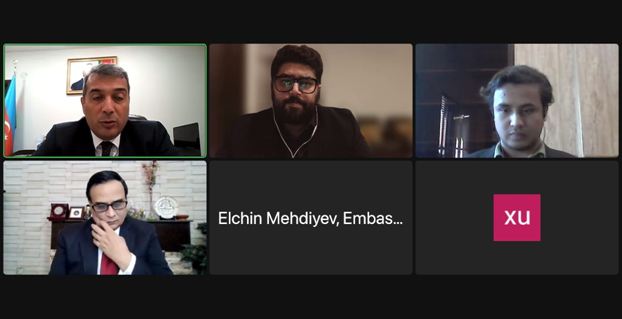
Lahore: Ambassador of the Republic of Azerbaijan Khazar Farhadov showed great respect for soldiers and officers and all the martyrs who fought heroically in the patriotic war and waved the Azerbaijan flag in the liberated lands from Armenia. The envoy highly appreciated the visionary leadership of the President Ilham Aliyev enabling the liberation of illegally occupied territories of Azerbaijan during the famous 44 days Patriotic War.

Addressing an international webinar titled, “Liberation of Karabakh Region of Azerbaijan from Armenia Occupation: Implementation of the UN Security Council’s Resolutions”. The webinar was jointly hosted by the Center of South Asia & International Studies (CSAIS) Islamabad and the Institute of Legal Studies Lahore. It was jointly arranged to celebrate the United Nation Day October 24. It was attended by a large number of experts, researchers, students and media persons. Special participation of Xu Vivien the editor of China Daily graced the event.

Ambassador Khazar Farhadov called for global harmony and peaceful coexistence with neighbours. The envoy termed the 44-day of Patriotic as one of the most glorious pages in the history of Azerbaijan which ended with the liberation of its occupied lands and the historical triumph of Azerbaijan.

The envoy shared that as a result of the Patriotic War in 2020, Azerbaijani Army liberated its territories from Armenian occupation within 44 days. Right after the liberation, the Government of Azerbaijan started large-scale restoration and reconstruction works there and the Great Return of former Azerbaijani IDPs and refugees to their land has begun.

The envoy shed light on the constructive role of the international organizations and platforms like UN Security Council which endorsed principal stance of Azerbaijan about Karabakh and supported peaceful negotiations for conflict resolution with Armenia. 

While responding a question the envoy replied that the government desires to have peaceful diplomatic ties with all the regional countries having spirits of mutual respect, sovereignty and territorial integrity. He upheld that trilateral military cooperation among Azerbaijan, Pakistan and Türkiye is getting momentum useful for regional peace and stability.

The envoy Khazar maintained that military preparedness, tactical readiness, professional skills of armed forces of Azerbaijan, economic stability, prosperity and last but not least visionary leadership of Ilham Aliyev jointly played an important role in the liberation of occupied regions from Armenia.

Dr. Fariz Ismailzade, Vice Rector of ADA University while highlighting the strategic importance of the UN Day appreciated Azerbaijan’s strong commitment to extend international cooperation for conflict resolution in South Caucasus. Vice Rector Ismailzade shared salient features of successful foreign policy of Azerbaijan to liberate Karabakh and other regions from Armenia.

Dr Ismailzade showcased positive, productive and participatory role of Azerbaijan in securing peace and stability in South Caucasus and Caspian Sea regions through immense socio-economic integration, trans-regional connectivity, free trade and food & energy cooperation. He was of the opinion that constant vigilance and military preparedness paved the way of splendid victory in the Patriotic War against Armenia.

Dr Mehmood Ul Hassan Khan in his detailed and articulated speech termed conflicting socio-economic, geopolitical and geostrategic realities in the South Caucasus, Black Sea, Middle East, greater Eurasian region and beyond geared the greater socio-economic, diplomatic and military ties among Azerbaijan, Pakistan and Türkiye covering all aspects of security, development and regional connectivity.

While emphasizing that “Karabakh is Azerbaijan” Dr Khan endorsed  Azerbaijan national narrative, narrating that even before its liberalization the right of Azerbaijan on Karabakh territories had has been recognized by the United Nations Security Council which adopted four resolutions 822, 853, 874 and 884 condemning the use of force against Azerbaijan and the occupation of its territories in 1993. It reaffirmed respect for the sovereignty and territorial integrity of Azerbaijan, reconfirmed that the Karabakh region is an integral part of Azerbaijan and demanded the immediate, full and unconditional withdrawal of the occupying forces from all the occupied territories.

DR Khan concluded that Azerbaijan’s better military preparedness, tactical and professional superiority, use of innovative and advanced technologies of warfare, effective and ideal combination of human as well as artificial intelligence mechanism  and last but not least, “visionary leadership” of Ilham Aliyev ultimately achieved a “miracle” in the second war for the liberation of illegally occupied areas of Karabakh from fascist Armenia.

Janhazeb Jehangiri in his opening remarks highlighted the importance of the UN Day and termed the international webinar as positive showcasing peaceful persuasions of the government of Azerbaijan to liberate its territories from Armenia. Jehangiri was the opinion that international laws and norms should be equally respected and executed.    The webinar was moderated by Zulkafil Hassan Khan the Youth Ambassador of the CSAIS. He thanked all the distinguished guests for their participation. He hoped that rights of Azerbaijan will be further prospering in the days to come.

APNS shocked over PM remarks about print media

APNS shocked over PM remarks about print media

If the Prime Minister thinks this business model is flawed, then the print media is prepared to correct the flawed model by withdrawing these subsidized

DNA

KARACHI: In a statement, APNS has expressed great shock at a statement made by  the Prime Minister, Anwar-ul-Haq Kakar against the print media wherein he has stated that the business model of print media is flawed and it should not depend on government for financial support.

The All Pakistan Newspapers Society in its statement expressed great disappointment at these  remarks of the caretaker Prime Minister against print media while speaking to the media at Islamabad.

The Prime Minister while answering a question on the pending summary of the Ministry of Information for an increase in the government advertisement rates, stated that the print media should change its flawed business model and instead of depending on government funding should generate revenue through its own resources.

 It appears that the Prime Minister is ill-informed about the summary as the print media is not seeking any grant or subsidy from the government but on the contrary, newspapers publish government ads at subsidized rates. Government advertising rates are far lower, at about one fourth of commercial rates.

The outgoing prime minister Mian Shahbaz Sharif had announced a long pending increase in the government advertisement rates, the summary of which is still lying with the Finance Ministry.

 It may also be noted that alarmingly the Federal Government owes almost Rs.2 billion to newspapers towards payment of long outstanding bills.

 If the respected Prime Minister thinks this business model is flawed, then the print media is prepared to correct the flawed model by withdrawing these subsidized rates being offered to the Government by newspapers.

German embassy presents ensemble 4.1: A magnificent evening of classical music in Islamabad

German embassy

Islamabad, OCT 25 /DNA/ – The German Embassy in Islamabad, in collaboration with the Goethe-Institut Pakistan, proudly hosted a captivating German Classical musical concert featuring the renowned Ensemble 4.1 at Marriott Hotel Islamabad.

The German Ambassador, Alfred Grannas, in his inaugural address, emphasized the unifying power of art, particularly music, transcending geographical and cultural boundaries, further enhancing the cultural exchange between Pakistan and Germany.

Ensemble 4.1, a unique piano windtet, was founded a decade ago following an invitation from the then Director of the Goethe-Institut Karachi, which served as the catalyst for its formation. Over the years, the ensemble has achieved remarkable milestones, including 125 concerts, the release of two critically acclaimed CDs, and a prestigious ‘OPUS Klassik’ nomination.

In celebration of their tenth anniversary, the ensemble has graced some of the world’s most iconic venues, including the Berlin Philharmonic, the Elbphilharmonie in Hamburg, the Wigmore Hall in London, and Carnegie Hall in New York. As a tribute to their beginnings, Ensemble 4.1 has returned to Pakistan, where their journey started in Karachi.

The ensemble comprises five distinguished members from top German Orchestras:

• Jörg Schneider, the principal oboe of the Jena Philharmonic Orchestra, boasts numerous accolades, including victories in international chamber music competitions in Osaka, Marseille, and Schwerin, as well as a scholarship from the German Music Competition.

• Alexander Glücksmann, the principal clarinet of the Berlin Symphony Orchestra, has displayed his artistry at the Opera Barga chamber music festival in Italy alongside members of the Berlin Philharmonic. He is also recognized for his work on contemporary music projects with the Chamber Ensemble Quillo.

• Christoph Knitt, the principal bassoon at the Potsdam Chamber Academy since 2006, has been actively involved in cultural reconstruction efforts in Iraq in collaboration with the Goethe-Institut since 2009.

• Sebastian Posch, a distinguished horn player, secured third prize at the international horn competition in Stams/Austria in 1999. His impressive solo performances span prestigious orchestras, including the Frankfurt/Oder State Orchestra, the Philharmonic Orchestra of the Altenburg-Gera Theater, the Young Symphony Berlin, the Berlin Chamber Academy, and the Göttinger Symphoniker.

• Thomas Hoppe, considered one of the finest pianists of his generation, imparts his expertise through masterclasses in piano accompaniment and chamber music across Europe, Australia, China, South America, and the USA.

The ensemble’s performance showcased a repertoire spanning from the late 19th to the 20th century, earning thunderous applause from the discerning audience. The program included masterpieces by revered German composers such as Ludwig van Beethoven’s “Quintett Es-Dur op.16” and Walter Gieseking’s “Quintett B-Dur,” among other exquisite encore pieces.

Ensemble 4.1 has received global acclaim through extensive tours and recitals in countries including China, Pakistan, Austria, Germany, Algeria, Canada, and the USA. They have graced prestigious venues in cities such as Berlin, Istanbul, New York City, Toronto, Ottawa, Karachi, Shanghai, and Torino. The ensemble has left an indelible mark at renowned festivals in Denmark, Malta, Italy’s MiToFestival, and the Elbphilharmonie in Hamburg. Prior to their performance in Islamabad, the ensemble captivated audiences in Karachi, Hyderabad and Lahore on this remarkable tour.

World Cup: De Kock leads batting carnage as South Africa trounce Bangladesh

World Cup: De Kock leads batting carnage as South Africa trounce Bangladesh

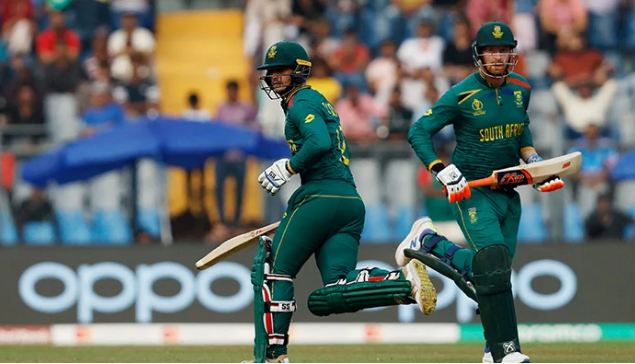
MUMBAI: Quinton de Kock led South Africa’s batting carnage with an incendiary 174 as they crushed Bangladesh by 149 runs to stay on course for a place in the semi-finals of the 50-overs World Cup on Tuesday.

De Kock smashed the ongoing tournament’s highest individual score and South Africa’s middle order hectored a listless Bangladesh attack to amass 382-5 after electing to bat at the Wankhede Stadium.

Their fiery pace attack reduced Bangladesh to 58-5 and eventually bundled them out for 233 in 46.4 overs to register their fourth win in five matches.

For Bangladesh, Mahmudullah offered resistance with a run-a-ball 111 but it was not enough to avert a heavy defeat.

De Kock had announced he would quit one-day internationals after the World Cup in India and the opener appeared determined to make his farewell a memorable one.

South Africa lost Reeza Hendricks and Rassie van der Dussen in successive overs after Aiden Markram, leading the side in the absence of the unwell Temba Bavuma, won the toss and elected to bat.

De Kock combined with Markram (60) in a 131-run stand to steady the innings before he and Heinrich Klaasen tore apart the Bangladesh attack plundering 142 runs from 87 balls.

De Kock duly brought up his third hundred in five matches and went on to topple India’s Virat Kohli as the tournament’s leading scorer.

A double hundred looked on the cards too before de Kock before holed out after a 140-ball blitz that included seven sixes and 15 fours.

His exit brought no relief for Bangladesh though as Klaasen and David Miller, who made 34 not out off 15 balls, continued the mayhem hitting a combined 12 sixes between them.

Klaasen belted 90 off 49 balls and South Africa plundered 144 runs from the last 10 overs to leave Bangladesh with a mountain to climb when they returned.

After six quiet overs, Marco Jansen dented the Bangladesh top order removing Tanzid Hasan and Najmul Hossain Shanto with successive deliveries.

The match was effectively over for Bangladesh when they slumped to 42-2 inside 12 overs with skipper Shakib Al Hasan and veteran Mushfiqur Rahim also back in the pavilion.

South Africa were not equally clinical against the Bangladesh tail though.

Mahmudullah hit four sixes and 11 fours in his gritty knock, which merely delayed Bangladesh’s fourth defeat in five matches.

China removes defence minister, ousts ex-FM from cabinet

China removes defence minister, ousts ex-FM from cabinet

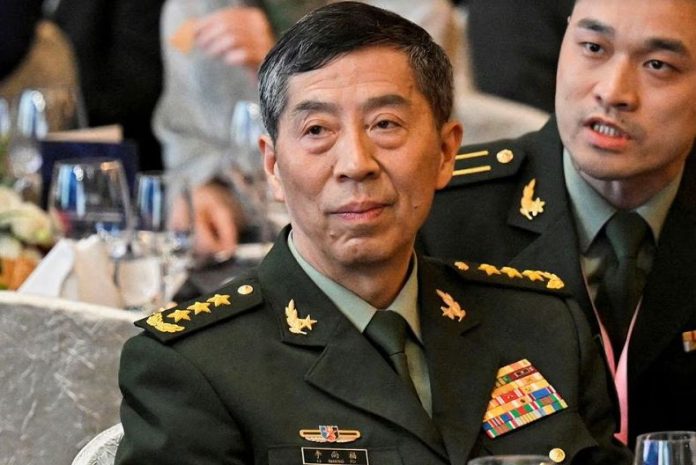
Beijing, OCT 24: China on Tuesday removed defence minister Li Shangfu and ousted former foreign minister Qin Gang from its cabinet, state media reported, as part of a major reshuffle of its top leadership.

The news comes after months of speculation about China’s cabinet, after Qin was abruptly removed from office without explanation in July, and with Li not having been seen in public for months.

Both Qin and Li are believed by experts to have been personally selected for their roles by President Xi Jinping.

On Tuesday state broadcaster CCTV announced the removals in its regular evening bulletin, but did not give reasons for the ministers’ fall from grace.

No replacement for Li as defence minister was announced.

Previously it had been reported that the US government believed Li was under investigation and had been stripped of his ministerial duties, but China had refused to comment on the matter.

Li travelled to Russia in August to attend a security conference near Moscow on August 15. Two days later, the government of Belarus released handout photographs of Li meeting with Belarusian President Alexander Lukashenko in Minsk.

But since then, he has vanished from public view.

Li’s now confirmed removal means there is no apparent host for China’s regional security dialogue, the Xiangshan Forum, which takes place next week.

The US Department of Defense is due to send a delegation to the event.

As well as being removed as defence minister, Li has also lost his position on the State Council, China’s cabinet.

Former foreign minister Qin, who was removed from his post without explanation in July, has now also been stripped of his State Council position.

Qin was removed from office by Beijing’s top lawmaking body after just 207 days in the job, following weeks of speculation that he had fallen out of favour.

He has been replaced by Wang Yi, a veteran diplomat who served as foreign minister before Qin and who outranked him in the Chinese government hierarchy.

Beijing has offered no explanation for Qin’s dismissal.

That opacity was also evident when China announced recently a new leadership for its Rocket Force, the army unit that oversees its nuclear arsenal, as media reported a corruption probe involving its former chief.

The navy’s former deputy commander Wang Houbin was named as the new commander of the force in a brief article by state news agency Xinhua reporting his promotion to the rank of general.

His predecessor, Li Yuchao, had not been seen in public for weeks and the Xinhua article gave no explanation for his removal.

CCTV also announced Tuesday that science and technology minister Wang Zhigang and finance minister Liu Kun had also been removed from their posts.

They will be replaced by current Ministry of Science and Technology party secretary Yin Hejun and finance ministry party secretary Lan Fo’an respectively.

Palestinian ambassador expresses gratitude for Red Crescent Pakistan’s support

Palestinian ambassador expresses gratitude for Red Crescent Pakistan's support

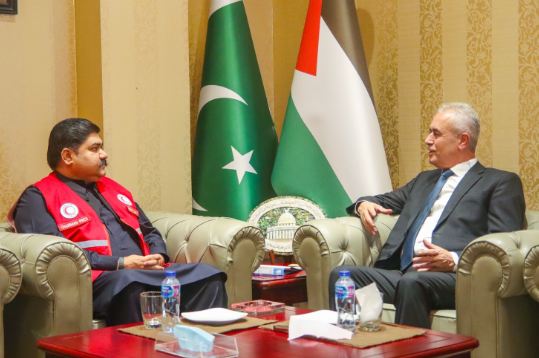
Islamabad, OCT 24 /DNA/ – The Chairman Pakistan Red Crescent Society, Sardar Shahid Ahmed Laghari, visited the Palestinian Embassy and met with Palestinian Ambassador Ahmed Jawad Rabei. Discussions centered on the current situation in Gaza, expressing sorrow over losses in lives and property.

During the meeting, Ambassador Ahmed Jawad Rabei highlighted the severe humanitarian crisis in Gaza, emphasizing the urgent need for water, food, and medical assistance. Chairman Shahid Ahmed Laghari assured that the Pakistan Red Crescent Society is fully aware of the situation in Gaza and pledged support.

Chairman Laghari announced that the Pakistan Red Crescent through the National Disaster Management Authority, will dispatch 4,500 first aid kits, 3,500 hygiene kits, and 3,500 dignity kits. Additionally, a shipment of medicines will be sent through the NDMA.

He urged individuals willing to contribute cash donations PRCS to directly send them to Askari Bank G-8 Markaz Islamabad, account number 01771650501737, or to the Palestine Embassy’s bank, Alfalah Bank, account number 0494-1003784913. For inquiries related to medical donations, Dr. Hashir Parvaiz, Red Crescent’s Health Representative, can be contacted at 0333-5132452.

In a gesture of solidarity, the Pakistan Red Crescent will also contribute $100,000 to the International Federation of Red Cross and Red Crescent Societies for the aid of the Palestinian people. Ambassador Ahmed Jawad Rabei expressed gratitude for the support and acknowledged the significant role of the Red Crescent Pakistan at national and international levels.

The meeting was attended by the Secretary General PRCS Muhammad Abaidullah Khan. On this occasion Chairman Laghari, shared his impressions in a commemorative book placed at the Embassy.

PM vows to resist anti-vaxxers to achieve dream of polio-free Pakistan

PM vows to resist anti-vaxxers to achieve dream of polio-free Pakistan

ISLAMABAD, Oct 24 (DNA): Caretaker Prime Minister Anwaarul Haq Kakar on
Tuesday vowing to resist the individuals propagating against the polio
vaccination, resolved to achieve the dream of polio-free Pakistan by
carrying forward the journey with unshakeable commitment.

“I can assure that we gonna have it. We will realise this dream. We will
never step back, may be an inch, may be a foot or may be a mile. This
will always be a forth-going journey,” the prime minister remarked
addressing a ceremony to mark the World Polio Day.

The event was organised by the Pakistan Polio Programme to pay homage to
the resilience and dedication of frontline workers on World Polio Day
which is commemorated on October 24 every year.

Federal Health Minister Dr Nadeem Jan, Federal Health Secretary Iftikhar
Ali Shallwani, representatives of polio partners Rotary, WHO and UNICEF,
and frontline workers and their families were in attendance. The prime
minister said by opposing the polio vaccine, the anti-vaxxers,
intentionally or unintentionally, were partnering with the forces of
darkness.

He emphasised the role of faith leaders and the society to make such
people realise that they were actually partnering with the destroyer of
the humans. This is unacceptable. We will resist this,” he resolved.

He expressed his gratitude to the global partners who continued to
supporting Pakistan in its andeavour of polio eradication. Recognising
the sacrifices of the polio workers and the security personnel guarding
them, the prime minister said they had paid the highest price for the
cause.

He said the frontline health workers were the heroes of Pakistan, who
were working in challenging environments, facing social barriers and
even threats to their safety without ever losing their dedication.

The prime minister recognised the services of three police constables
who were martyred while on polio duty and to two vaccinators who were
injured. He also presented appreciation shields to the former
coordinator of the Sindh EOC, Fayyaz Abbasi and the family of Huma
Ashraf, who was severely injured in a train accident while on polio duty
in September. The prime minister also announced to personally visit Huma
as a gesture to recognise her services in the mission of polio-free
Pakistan.

“Today is a day to remember how far we have come and how crucial polio
eradication efforts remain. Pakistan cannot be the reason to hold the
world back. We must move forward to 2024 with the realization that the
weight of global eradication lies on our shoulders. We must leave no
room for the virus to spread and reach every child with the vaccine
before the virus has a chance to permanently change their lives,” he
remarked.

Caretaker Health Minister Nadeem Jan, in his address, paid homage to the
polio workers who were striving to accomplish the mission of polio-free
Pakistan while facing many odds and hardships. He emphasised that the
community health workers should be acknowledged and honored as
motivation would be enhanced their performance.

He called for changing the narrative from “Pak Fights Polio” to
“Pakistan Winning Over Polio.” He expressed the hope that the World
Polio Day next year would mark the complete eradiation of polio from
Pakistan.

Federal Health Secretary Iftikhar Shallwani said the campaign was
started in 1994 and continued across Pakistan with dedication to date
with support from the aid agencies. Besides the polio drive, other
related subjects including maternal and neonatal healthcare were also
worked on, he added.

WHO Representative in Pakistan Palitha Mahipala said the Day was
observed to commemorate the global journey. He said the Polio
eradication was one of the major commitments made by the WHO which
provided technical support to Pakistan. He said the day was not far when
Pakistan would get rid of the crippling disease within next few years as
the number of paralysis had sharply declined.

Unicef Chief Polio Officer Melissa Corkum said the credit for the
successes went to the health workers who despite challenges went door to
door in every campaign. She said the Day was not only to commemorate the
successes but also to remember those who sacrificed their lives during
the struggle. DNA

Artificial Intelligence and Human Cognition

Artificial Intelligence and Human Cognition

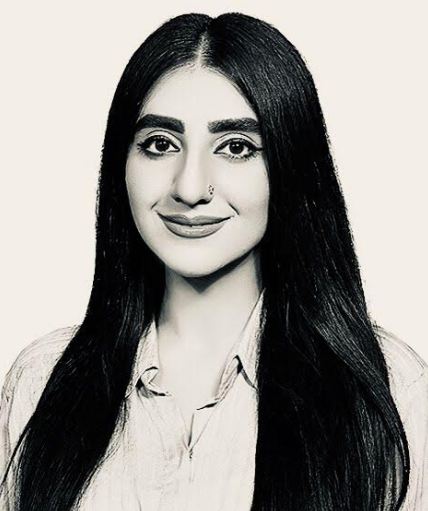
By: Zahra Ali

Artificial Intelligence and Human Cognition

From a psychological standpoint, with an understanding that the integration of Artificial Intelligence (AI) undoubtedly brings forth numerous conveniences and efficiencies. It is crucial to recognize and impede the potential detriments and the multifaceted ways in which an overreliance on Artificial Intelligence can be damaging for human intelligence and cognitive development.

One of the first and foremost concerns lies in the potential stagnation of cognitive growth

One of the first and foremost concerns lies in the potential stagnation of cognitive growth. Human intelligence thrives on challenges, problem-solving, and learning from experiences. Overreliance on Artificial Intelligence, particularly for tasks that require mental exertion, may strip individuals of the opportunity to engage in these cognitive processes. When Artificial Intelligence takes over decision-making, critical thinking or complex problem-solving, the brain’s natural capacity to adapt and evolve is underutilized, leading to a potential stunting of intellectual development.

Jean Piaget, a pioneer in developmental psychology

Jean Piaget, a pioneer in developmental psychology, emphasized the importance of active engagement with the environment for cognitive development. Individuals construct knowledge through interactions with their surroundings. When Artificial Intelligence takes over tasks that involve problem-solving and decision-making, individuals may forgo on these crucial interactions.

Also Read: From river to the sea

Lev Vygotsky argued that social interaction plays a fundamental role in cognitive development. He introduced the concept of the Zone of Proximal Development (ZPD), which is the difference between what a person can do with help and what they can do alone. Excessive dependency on Artificial Intelligence might limit the opportunities for individuals to work within their ZPD, hindering their potential for growth.

Mihaly Robert Flow Theory argued achieving a state of flow

Mihaly Robert Flow Theory argued achieving a state of flow, characterized by deep concentration and a sense of being fully absorbed in an activity, is conducive to optimal cognitive functioning. Excessive use of Artificial Intelligence may limit opportunities for individuals to experience this state, potentially depriving them of the cognitive benefits associated with it.

Human intelligence draws its strength from creativity

Human intelligence draws its strength from creativity, enabling individuals to venture beyond conventional boundaries, devise fresh strategies, and progress. Yet, an overdependence on Artificial Intelligence may inadvertently suppress this innate creative prowess. When tasks requiring imaginative thought or aesthetic expression are taken over by AI algorithms, individuals are deprived of the opportunity to nurture and employ their creative capacities. Over time, this can lead to a decline in ingenuity and imaginative thinking.

Another detrimental consequence of heavy Artificial Intelligence

Another detrimental consequence of heavy Artificial Intelligence reliance is the erosion of problem-solving skills. The act of grappling with challenges, even if aided by Artificial Intelligence, fosters resilience, adaptability, and the development of diverse problem-solving strategies. When individuals bypass this cognitive process and defer to Artificial Intelligence for solutions, they forgo invaluable opportunities for skill-building. Consequently, there is a risk of a gradual decline in the ability to independently approach and resolve complex problems.

Cognitive load refers to the mental effort required to process information

Cognitive load refers to the mental effort required to process information and make decisions. Over time, excessive reliance on Artificial Intelligence for information retrieval and decision-making may lead to a reduction in an individual’s capacity to handle cognitive loads. When confronted with tasks that demand substantial mental effort, individuals accustomed to heavy Artificial Intelligence use may find themselves ill-prepared to effectively process and analyze information, potentially leading to feelings of cognitive strain and reduced efficacy.

Artificial Intelligence undoubtedly offers remarkable benefits

Artificial Intelligence undoubtedly offers remarkable benefits, it is imperative to approach its integration sensibly. The detriments associated with excessive Artificial Intelligence reliance on human intelligence are not to be overlooked. Striking a balance between utilizing Artificial Intelligence as a valuable tool to enhance knowledge and nurturing our own cognitive capacities through critical thinking, creativity, and meaningful social interactions remain paramount in ensuring the holistic development of human intelligence in the age of Artificial Intelligence.

Outlook on China’s Foreign Policy on Its Neighborhood In the New Era

Outlook on China’s Foreign Policy on Its Neighborhood In the New Era

DNA

BEIJING: China and its neighboring countries enjoy geographical proximity, cultural affinity and integrated interests with a shared future. The millennium-old friendly exchanges between the two sides are a vivid history of exchanges and mutual learning among civilizations. Such friendly bonds are best captured by the Chinese saying: “true friendship weathers the changing seasons without fading away and is made even stronger by hardships.”

The neighborhood is where China survives and thrives and the foundation of its development and prosperity. As a member of the Asian family and a responsible major country, China attaches great importance to neighborhood diplomacy, always prioritizes the neighborhood on its diplomatic agenda, and remains committed to promoting regional peace, stability, development and prosperity.

Outlook on China’s Foreign Policy on Its Neighborhood in the New Era, based on the assessment and overview of the current situation and future trends in Asia, comprehensively outlines the achievements, policies, visions and objectives of China’s neighborhood diplomacy, and declares China’s commitment to the path of peaceful development, to promoting development of the neighborhood through its own development, to working with regional countries to advance modernization, to jointly building a community with a shared future among neighboring countries and to realizing the vision of a peaceful, secure, prosperous, beautiful, amicable and harmonious Asia in the new era.

Stay Connected

64FansLike
60FollowersFollow

Latest Reviews

Exchange Rates

USD - United States Dollar
EUR
1.17
GBP
1.35
AUD
0.72
CAD
0.73