Home Blog Page 1101

China-U.S. cooperation contributes to rapid development of Port of Los Angeles

China-U.S. cooperation contributes to rapid development of Port of Los Angeles

By Chen Yiming, Shi Yuanhao, People’s Daily

Along the west coast of the U.S., the Port of Los Angeles is a hive of activity, with massive container ships constantly coming and going.

Mark Wheeler, 70, retired 4 years ago from his position as vice president of the West Basin Container Terminal (WBCT) at the Port of Los Angeles. Although he now lives in South Carolina, Mark still cares deeply about the port where he worked for decades. Whenever he talks about his career, one exciting scene always comes to mind – a visit to the port by Xi Jinping, who serves as the Chinese President today.

It was on Feb. 16, 2012. Xi, then vice president of China, had a tour to a terminal of China’s shipping giant COSCO at the Port of Los Angeles. According to Wheeler, he was serving as the terminal operations manager back then and witnessed a story of mutual benefit and win-win cooperation between the U.S. and China.

Wheeler said he never thought that a leader of a major country could be so approachable, adding that Xi shook hands with everyone and waved enthusiastically to crew members on cargo ships. It was like meeting an old friend, he noted.

The Port of Los Angeles is the largest container port in the United States and serves as the first stop for Chinese goods entering the United States across the Pacific Ocean.

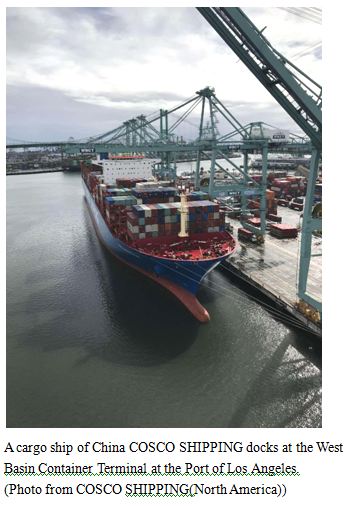
In 2001, a COSCO subsidiary became a shareholder of the port, holding partial equity stakes in the WBCT at the Port of Los Angeles and the Pacific Container Terminal at the Port of Long Beach. This marked the beginning of rapid development for the Port of Los Angeles.

By 2012, the WBCT’s annual container throughput reached 1.5 million twenty-foot equivalent units (TEUs), accounting for 10 percent of the total at the Port of Los Angeles and contributing $100 million in direct tax revenue to the federal and local governments.

Since 2012, COSCO has always adhered to the principles of practical cooperation and mutual benefit in serving the trade sector, and continuously expanded its shipping routes, capital investment, and technological input in the entire Los Angeles.

For many years, the Port of Los Angeles has played an important role in U.S.-China trade, said Wheeler, attributing the development of ports in the Los Angeles area to mutually beneficial cooperation between the two countries.

So far, COSCO has directly created about 2,400 jobs in the United States. Through partnerships with trucking companies, railways, tugboat services and other suppliers, COSCO’s terminals have generated around 15,000 additional jobs in the country.

“COSCO actively promotes local economic and social development at the Ports of Los Angeles and Long Beach, striving to meet customers’ transportation needs. Especially when supply chains get tight, we strive to tackle problems like insufficient capacity and port congestion,” said Gu Quanlin, vice president of COSCO SHIPPING (North America).

According to Gu, during the peak of the COVID-19 pandemic in the United States, COSCO terminals in the country utilized multimodal transportation to swiftly deliver essential medical supplies to customers in the Midwest through the Port of Long Beach. This made a significant contribution to the local population’s response to the pandemic.

Additionally, COSCO Shipping has strengthened management around ship speed reduction, shore power usage, near-shore emissions, and equipment emissions. This aligns fully with the Californian government’s long-standing promotion of green principles.

Among all the terminals at the Ports of Los Angeles and Long Beach, COSCO terminals have always been at the forefront of protecting the ocean environment and marine life, said Paul Nazzaro, executive vice president of COSCO SHIPPING (North America).

The 130-km long Santa Barbara Channel by the Port of Long Beach is a major shipping lane, as well as one of the world’s most important destinations for migrating blue whales. It is visited by many blue whales, humpback whales and fin whales from July to November each year. Excessive ship speeds would severely impact the whales.

Since 2018, COSCO has actively implemented the project of Protecting Blue Whales and Blue Skies. So far, it has carried out relevant eco-friendly operations on 111 voyages, making effective safety nets for marine life and lowering greenhouse gas and suspended particulate emissions.

From 2020 to 2022, COSCO won the top award of the “Protecting Blue Whales and Blue Skies” project, the “Sapphire Prize,” given by the U.S. National Oceanic and Atmospheric Administration for three consecutive years.

Brian Peck, Chair of the Los Angeles Regional Export Council, stated that China is California’s largest trading partner, and one-third of U.S.-China trade passes through the Ports of Los Angeles and Long Beach. California attracts more Chinese investment than any other U.S. state and is home to the largest population of Chinese students and visitors. The close ties between California and China reflect the intertwined interests of the United States and China and demonstrate the mutually beneficial essence of U.S.-China economic and trade cooperation.

Wheeler told People’s Daily that he sincerely hopes that the two largest economies, the United States and China, can find more common ground and write more stories of cooperation and win-win outcomes through exchanges and dialogues.

Flying Tigers spirit promotes China-U.S. friendship

Flying Tigers spirit promotes China-U.S. friendship

By Bai Ziwei, People’s Daily

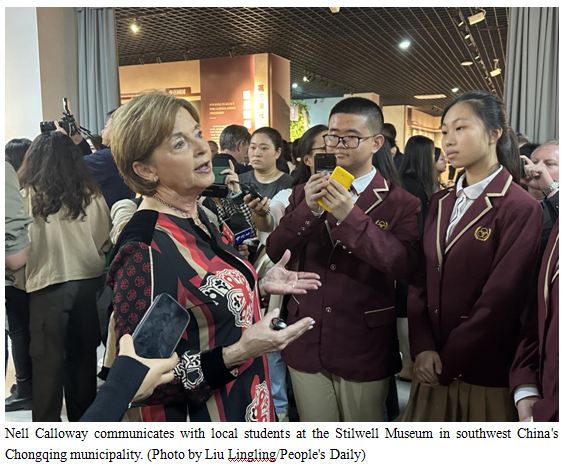
Nell Calloway, granddaughter of Claire Lee Chennault, commander of the Flying Tigers, said she hopes to take the sincerity and goodwill of the American people to China, and share more wonderful stories with the Chinese people during a recent interview with People’s Daily.

Calloway came to China for the 14th time for a visit with a delegation from the Sino-American Aviation Heritage Foundation. The delegation included both Flying Tigers veterans and their descendants, who aimed to reminisce about the old days of the Flying Tigers in China, carry forward the spirit of the Flying Tigers, and pass on the friendship between the two peoples from generation to generation.

Over the years, Calloway has been actively promoting people-to-people friendship between the United States and China. She has established the Chennault Aviation and Military Museum and the Chennault Aviation Academy.

Her efforts started in 2002 when she made her first trip to China together with her mother.

Calloway recalled that her grandfather came to China when her mother was only nine years old. Her mother could not understand why he stayed in China for 7 years until their first visit to China, where they learned about the events that took place during the war era.

Since then, Calloway and her mother have been dedicated to promoting Flying Tigers’ tales and the history of China’s resistance war against Japanese aggression to the American public.

She believed that it’s crucial to share with the world how Chinese people admirably overcame difficulties and fought against Japanese invaders, and said she has always taken it as her mission.

During the resistance war against Japanese aggression, General Claire Lee Chennault led the Flying Tigers to fight alongside the Chinese people.

“We must remember the history,” Calloway has mentioned multiple times in interviews, saying Flying Tigers veterans and their descendants have the responsibility to carry on this precious friendship, to help and assist each other, and to create a better future for future generations.

During her visit to China this time, Calloway always took photos with General Claire Lee Chennault’s pictures at each site.

She said these photos touched her deeply because they signify that many Chinese people still remember the contributions her grandfather had made.

“Over the years, I have witnessed the development and changes in China. It would be wonderful if my grandfather could see today’s China,” Calloway told People’s Daily.

Calloway believes that history needs to be recorded and told, and common memories must be passed on by those who have lived through it.

She said the Flying Tigers veterans she interviewed had great admiration for the Chinese people and were proud that they had fought alongside them against the Japanese invaders.

“Both the United States and China need to understand this shared history,” Calloway noted. As one of the descendants of the Flying Tigers veterans, she said they have a greater responsibility to speak up and continue telling the story of the Flying Tigers.

Coming to China again after four years, Calloway placed particular importance on the power of face-to-face exchanges, believing it to be crucial for promoting people-to-people friendship between the two countries.

She said the two peoples need to engage in more exchanges in order to enhance mutual understanding. When the two peoples are separated by oceans, it is difficult to have a tangible sense of connection; when they come to each other’s land and make eye contact, everything falls into place naturally, she explained.

Calloway expressed her hope that the two peoples, especially the younger generation, can continue to inherit the spirit of the Flying Tigers.

“The U.S.-China relationship is the most important bilateral relationship in the world and is highly regarded by the international community. We should set an example for the world, set aside our differences, extend the hand of friendship, and work towards our common goals,” she said.

Flying Tigers spirit promotes China-U.S. friendship

China’s logistics sector injects new vigor into world economy

China's logistics sector injects new vigor into world economy

By Jia Pingfan

In recent years, Chinese logistics companies have rapidly expanded their presence in overseas markets alongside the growth of China’s cross-border e-commerce platforms. They have entered markets in North America, Europe, Southeast Asia, the Middle East, and Central and South America, bringing digitalized logistics services and efficiency to their target markets while contributing to the global growth of foreign trade.

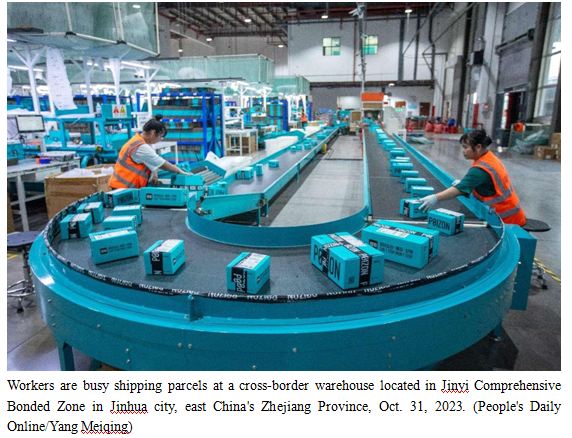
The world’s first live broadcast of cross-border logistics concluded on the evening of Nov. 4, 2023. Over the course of 48 hours, millions of people worldwide witnessed the complete journey of cross-border packages, from packing and sorting to shipping, consolidation, and loading onto international cargo planes.

Cainiao Global, the official global parcel tracking platform of China’s Alibaba Group, has introduced its flagship product, the “Global 5-Day Delivery”express service, for this year’s “Double 11” shopping festival. This service allows products sent from China to reach consumers thousands of miles away in just five days.

To achieve such fast delivery, Cainiao Global has made significant advancements in logistics technology and infrastructure. The company has established the country’s largest cross-border logistics park, equipped with intelligent sorting machines and an automated air freight center. Additionally, the use of a Boeing 747 widebody freighter further enhances the efficiency of the delivery process.

This year’s “Double 11” shopping festival has become a competition for faster delivery, receipt, and after-sales service for cross-border merchants and overseas consumers.

The “Double 11” shopping festival is China’s biggest shopping event. Since its inception in 2009, the festival has been known for its abundance of discounts, promotions, and offers. This year, instead of solely engaging in the price war, companies have prioritized providing high-quality services to their customers.

JD Logistics, the logistics unit of Chinese e-commerce giant JD.com, has been making consistent investments in overseas supply chain logistics facilities.

With nearly 90 bonded warehouses, overseas warehouses, and direct mail warehouses worldwide, JD Logistics has established a self-operated warehousing network in European countries like Germany, France, and the UK. Alongside expanding its warehousing capacity, JD Logistics Europe is actively collaborating with local service providers to enhance its last-mile delivery capabilities.

In 2022, China’s total social logistics reached 347.6 trillion yuan (about $47.89 trillion), marking a 3.4 percent year-on-year growth. With this growth, China’s logistics market has maintained its position as the global leader for seven consecutive years, solidifying its status as a logistics powerhouse.

The steady and positive growth of the Chinese economy has provided significant support for the rapid development of the logistics industry. The government’s increased support to promote economic growth, coupled with a rebound in consumer spending, has led to impressive economic performance in the third quarter.

Data released by the National Bureau of Statistics of China shows that the country’s GDP grew by 4.9 percent year-on-year between July and September this year, surpassing economists’ median forecast of 4.5 percent.

The growth of cross-border e-commerce has contributed to the expansion of China’s cross-border logistics industry. According to recent data from the Korea Customs Service, Koreans spent a total of 4.79 trillion won (approximately $3.65 billion) on cross-border online shopping from Q1 to Q3 this year, marking a 20.4 percent increase compared to the previous year. Chinese e-commerce accounted for 46.4 percent of this total, with sales amounting to 2.22 trillion won.

According to China’s Ministry of Commerce, the import and export volume of China’s cross-border e-commerce reached 1.7 trillion yuan from January to September this year, marking a year-on-year increase of 14.4 percent. China has established trade partnerships with countries worldwide, being one of the countries with the most comprehensive cross-border e-commerce ecosystem.

Overseas warehouses play a crucial role as key nodes for cross-border e-commerce and logistics. They serve as new foreign trade infrastructure and a vital platform for driving the high-quality development of foreign trade.

Xue Qun, head of JD Logistics International, recently expressed that JD.com plans to construct a comprehensive global supply chain logistics network in the coming three years. This network will encompass overseas warehouse networks, international transit hubs, distribution networks in foreign countries, and cross-border transportation networks encompassing key routes.

According to a news report by Quartz, China views logistics as a strategically important industry underpinning the efficiency and competitiveness of its economy. The Chinese government wants to take that a step further by building a modern circulation system that integrates flows of commerce, finance, transportation, and commodities.

According to the news report, one area where China has made significant progress in recent years is the number of overseas warehouses it operates via exporters or cross-border e-commerce firms with operations in international markets. These now number over 2,000, up from less than 100 in 2015, according to Chinese government figures.

Besides physical infrastructure like warehouses, China wants to cultivate a number of homegrown and globally competitive logistics firms, the news report said.

China's logistics sector injects new vigor into world economy

China’s Wuhan steers commercial aerospace industry into broader space

China's Wuhan steers commercial aerospace industry into broader space

By Wu Jun, People’s Daily

As home to China’s first commercial aerospace industrial base, namely the Wuhan National Aerospace Industry Base, Wuhan city, capital of central China’s Hubei province, is making significant progress in the exploration of capabilities and application scenarios of the commercial aerospace industry.

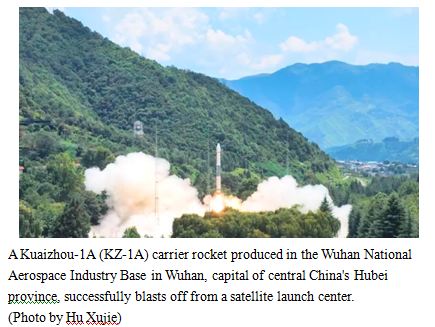
Recently, a Kauizhou-1A (KZ-1A) carrier rocket produced in the Wuhan National Aerospace Industry Base successfully launchedfive satellites, the A to E satellites belonging to theHead-3 micro-satellite constellation, into their planned orbits from the Xichang Satellite Launch Center in southwest China’s Sichuan province.

The Kuaizhou-series rockets are solid-propellant launch vehicles independently developed by the Kuaizhou rocket industrial park within the Wuhan National Aerospace Industry Base. The first batch of the Kuaizhou-1A rockets rolled off the production line at theindustrial park in 2021.

So far, the Kuaizhou series rockets have been successfully launched over 20 times, sending more than 40 satellites into their planned orbits.

Initiated in 2017, the Wuhan National Aerospace Industry Base has achieved an annual production capacity of up to 50 rockets and hasbuilt the backbone of an industry chain encompassing satellites, rockets, cloud platforms and aerospace materials.

In November 2014, China’s State Council issued guidelines on innovating investment and financing mechanisms of key areas to encourage social investment,inspiring private enterprises to participate in civil space infrastructure construction. The document ushered in new opportunities for China’s commercial aerospace industry.

At the time, Wuhan-based China Space Sanjiang Group Co., Ltd., a subsidiary ofthe China Aerospace Science and Industry Corporation Limited (CASIC),envisioned potentialin the commercial aerospace industry and was poised to step into it.

“As a transportation hub linking nine provinces, Wuhan hasrather developed land and water transport. Development of the aerospace industry here not only enjoysthe advantage of convenienttransportation of aerospace products, but can boost the growth of upstream and downstream links of the entire industrial chain across the country,” said an executive of the CASIC.

In 2017, the construction of the Wuhan National Aerospace Industry Base kicked off in Shuangliu subdistrict of Wuhan’s Xinzhou district under a partnership between the CASIC and the Hubei Provincial People’s Government.

Thanks to tireless efforts ofrelevant parties, ademonstration zone featuring the integration of the aerospace industry and city development, with an area of 8 square kilometers, took shape in 2022.

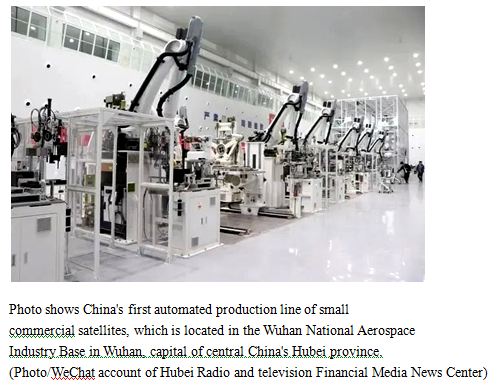
In the satellite industrial park of the Wuhan National Aerospace Industry Base, one can enter China’s first intelligent satellite production lineafter donning white work clothes and cap and going through dust removal.

Inside the satellite production line, dozens of components for satellite manufacturing are neatly placed in a 10-meter-tall component warehouse.

The entire production process, from components delivery to assembly, final assembly and testing, is highly automated.

The production line has realized flexible and intelligent satellite manufacturing, according to Liu Feng, deputy director of the Wuhan intelligent manufacturing center of the CASIC’s Space Engineering Department.

It can meet the needs for the development and production of single satellite as well as mass production of customized satellites, Liu said.

With a deep understanding of the development of theaerospace industrial chain, the Wuhan National Aerospace Industry Base has consistentlyimprovedthe business environment for the growth of aerospace manufacturing, services and supporting industries.

It has attracted 17 industrial projectsspanningsuch industries as commercial aerospace, new materials, and data application, and completedcumulativeinvestments of nearly 20 billion yuan ($2.76 billion).

“We earn our main revenues by providing satellite launch services, and additional income by offering customized peripheral services to companies, enhancingthe overall profitability of commercial rockets,” said Liu Xin, deputy general manager of CASIC Rocket Technology Company, a holding subsidiary of the China Space Sanjiang Group Co., Ltd.

The company has established brand partnerships with over 10 companies, according to Liu.

In addition to satellites and rockets, the Wuhan National Aerospace Industry Base has also continuously explored more application scenarios for space technologies along the long industry chain to expand the development models of the commercial aerospace industry.

At the telemetry, command and control center of a holding subsidiary of the China Space Sanjiang Group Co., Ltd., real-time data on the location, door status, internal temperature and humidity as well as other information about the containers carried by the China-Europe freight trains are displayed on large screens.

This application scenario represents an emerging commercial aerospace development model based on the use of remote sensing satellites, satellite internet and aerospace technologies in areas like environmental monitoring, smart transportation, and emergency communications, according to Pi Benjie, an executive of the telemetry, command and control center.

“In 2020, we successfully launched two communications satellites. After networking them into a constellation, we can eliminate communication blind spots in areas where ground networks can’t reach, like oceans, polar regions, forests and deserts,”explainedPi.

In an effort to strengthen, complement and expand the commercial aerospace industrial chain, local authorities have accelerated efforts to promote communication and attract more enterprises through diverse means.

The government of Xinzhou district has reportedly signed over 10 billion yuan worth of agreements withmany renowned Chinese enterprises to jointly create different commercial aerospace application scenarios.

China's Wuhan steers commercial aerospace industry into broader space

China’s Xinjiang fastens steps of opening up

China's Xinjiang fastens steps of opening up

By Jiang Yunlong, Wen Suwei, People’s Daily

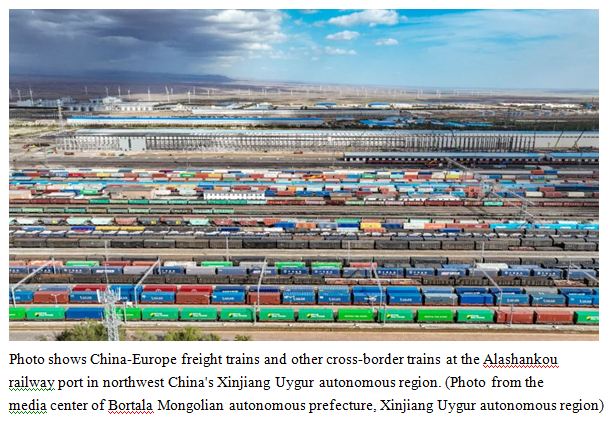
Northwest China’s Xinjiang Uygur autonomous region, located at the heart of the Eurasian continent, sees the most land ports as a provincial-level region in China. It plays an irreplaceable role in the development of the Silk Road Economic Belt.

In Xinjiang, it takes only 0.08 hours for cargos to complete customs clearance through the Alashankou railway port; the number of China-Europe freight trains departing from and arriving in Horgos has increased with an annual growth of 81 percent; foreign trade volume of the autonomous region exceeded 250 billion yuan ($34.44 billion) in the first three quarters this year, reaching a historical high.

In recent years, with China’s efforts to expand opening up, develop its western region, and promote the Belt and Road Initiative, Xinjiang has transformed from a relatively closed inland area to a frontier of opening up.

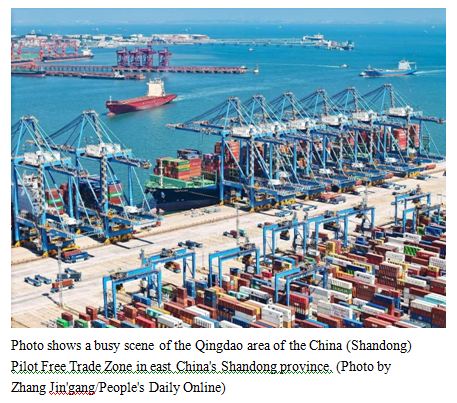
Not long ago, China’s State Council issued a general plan for establishing the Xinjiang Pilot Free Trade Zone (FTZ), further promoting Xinjiang’s high-level opening up and writing a new chapter in the autonomous region’s engagement with the outside world.

Recently, a China-Europe freight train departed from Xinjiang’s Alashankou, also known as Alataw Pass, for Kazakhstan.

“We send polyvinyl chloride materials and solar cells out and take wheat, edible oil, and minerals back to China,” said Guan Xizhi, driver of the train. Thanks to the continuous improvement in transport efficiency, the frequency of the China-Europe freight service has also increased in recent years, Guan added.

It is learned that the Alashankou railway port has introduced a “24/7” appointment-based customs clearance mechanism to ensure quick inspection, verification and release. This helps minimize the time for customs clearance and significantly reduces transportation costs.

Since the freight service was launched in 2011, the number of China-Europe freight trains leaving and entering China via the Alashankou Port has surpassed 30,000. Nearly 6,000 trips are made a year now, up from 17 in the beginning, connecting 25 Chinese provincial-level regions to some 20 countries to the west.

At present, a network covering over 110 routes has been formulated. More than 200 categories of goods are currently being transported along these routes, including automobiles, auto parts, cotton yarn, and timber.

“Reaching Europe via Alashankou is the international trade channel with the shortest distance, the least time and the lowest freight cost on the Silk Road Economic Belt,” said Li Jianglin, executive deputy mayor of the city.

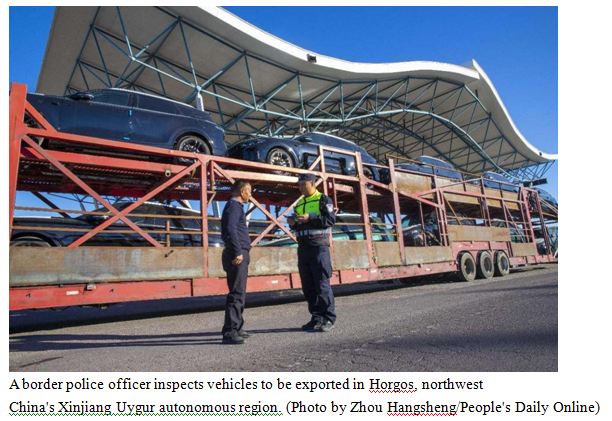
At the Horgos highway port, trucks are often seen lining up. As of Nov. 3 this year, the number of vehicles exported through this port reached 101,100, a year-on-year increase of 177.3 percent. The highest daily export of vehicles reached 1,301 units, showing exponential growth.

“Chinese vehicles, especially new energy vehicles, have become a new highlight of Xinjiang’s foreign trade,” said Hu Laijie, director of the port management bureau of the Horgos economic development zone.

Currently, 35 Chinese carmakers export vehicles through the Horgos highway port, and there are over 80 vehicle export agencies, according to Hu. He said Chinese vehicles are exported via the port to Kazakhstan, Uzbekistan, Russia, and other Belt and Road countries.

“I believe I can find ‘gold’ in the ‘desert,'” said He Haiyan, who came to Alashankou from her hometown Shaanxi province to start a business.

Today, her three small counters have blossomed into a 275-square-meter cross-border e-commerce store. Stepping into the store, visitors are greeted by a dazzling array of imported goods that entice them to fill their shopping carts and spend hours exploring the vast selection.

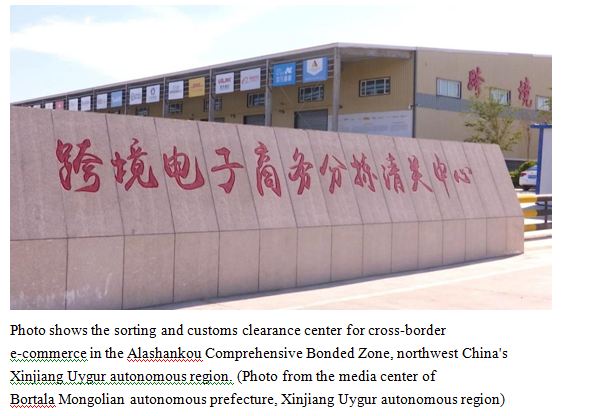
To support the development of cross-border e-commerce and leverage the advantages of the Alashankou port and the Alashankou Comprehensive Bonded Zone, the city has established a 28,000-square-meter sorting and customs clearance center. Renowned e-commerce platforms such as Alibaba, Amazon, and eBay have settled in the city, providing services to 508,000 e-commerce enterprises.

“We have pioneered an innovative ‘slow air transportation’ model, enabling exported goods to reach Europe within 12 to 18 days, at a cost of only 1/5 of regular air transportation and 1/6 of the time taken by sea freight,” said Zhou Chong, deputy director of the management committee of the Alashankou Comprehensive Bonded Zone.

The local authorities have implemented an efficient and fast customs clearance process, prioritizing the declaration, sealing, and inspection of cross-border e-commerce goods, Zhou added.

In addition to numerous cross-border e-commerce enterprises, there is also a fantastic destination for shopaholics in Horgos-the China-Kazakhstan Horgos International Border Cooperation Center. Spanning an area of 3.43 square kilometers on the Chinese side and 2.17 square kilometers on the Kazakh side, this center offers visitors 30 days of visa-free cross-border facilitation.

Entering into the Chinese side of the center, each visitor is allowed to carry 8,000 yuan worth of duty-free goods per day. The center received an average of 24,000 visitors per day from January to September this year.

“The demand for shops is so high that as soon as one becomes available, it is immediately snatched up by eager tenants,” said Ji Gang with the cooperation center.

As the autonomous region becomes more open, ports in Xinjiang are thriving, said Hao Weiming, head of Urumqi Customs. He believes that by taking the establishment of Xinjiang Pilot FTZ as an opportunity, the high-quality development of Xinjiang’s open economy will surely reach a new level.

China's Xinjiang fastens steps of opening up

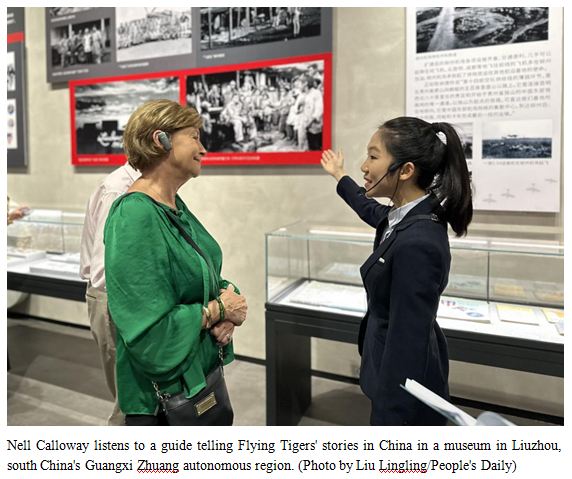
Flying Tigers veterans relive friendship between Chinese and American people during China tour

Flying Tigers veterans relive friendship between Chinese and American people during China tour

By Bai Ziwei, Liu Ge, Liu Lingling, People’s Daily

“Should old acquaintance be forgot, and auld lang syne…”

Accompanied by melodious accordion, a delegation of the U.S. Flying Tigers veterans and their descendants joined teachers and students from the Kunming Foreign Language School, a “Sino-U.S. Hump Airlift Memorial School”, in Kunming, southwest China’s Yunnan province, in singing the song “Auld Lang Syne”during a visit to the school.

The song reminded Flying Tigers veteran Harry Moyer of the days when the Flying Tigers fought alongside the Chinese people against Japanese aggression and forged a deep friendship.

Reliving that history and seeing the smiles on students, Moyer was moved to tears by the performance of the song in the auditorium of the Kunming Foreign Language School.

The friendship did not come easily, said Moyer.

Their visit to the Kunming Foreign Language School was part of a recent China tour organized by the Sino-American Aviation Heritage Foundation formembers of the American Volunteer Group of the Chinese Air Force, known as the “Flying Tigers,” and their descendants.

The delegation visited Chinese cities including Beijing, southwest China’s Chongqing municipality, Kunming, and Liuzhou city of south China’s Guangxi Zhuang autonomous region, renewing friendship between the Chinese and American people.

Moyer told People’s Daily that Kunming was the place he looked forward to visiting the most in this tour of China.

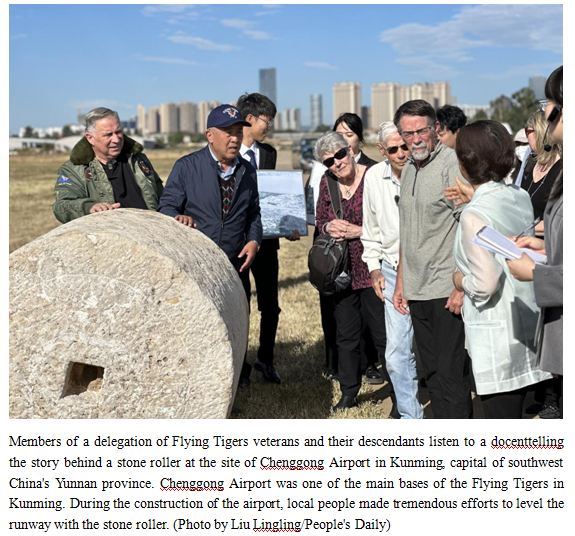
The city was where the Flying Tigers first took off to combat in China, and also the starting point and logistics hub of the famous “Hump” air route, a vital airlift route over the Himalayas and the primary way the Allies supplied China between 1942 and 1945 in World War II.

In 1942, after Japan occupied Myanmar and cut off China’s last international connection, the Flying Tigers blazed a new air route – the “Hump” route over the Himalayas. The route was extremely difficult to fly, but the fearless and selfless members of the Flying Tigers braved all challenges and built an “air bridge” over Kunming.

Back then, people in Yunnan also overcame tremendous difficulties to provide supplies for the Flying Tigers, and did their utmost to rescue downed members of the Flying Tigers, making the legendaryAmerican Volunteer Group a symbol of mutual assistance between the Chinese and American people.

During the visit to the Kunming Foreign Language School, members of the delegation watched the “Green Path and Rainbow: the Story of the Flying Tigers and the Hump”, which showed the Flying Tigers’ adventure to open the “Hump” air route. The was voluntarily created by locals of Kunming.

As actors playing locals gave a thumbs-up gesture and praised the bravery of members of the Flying Tigers as “ding hao” (“top-notch”)in local dialect, Moyer, sitting in the audience, also raised his hands and gave a thumbs-up to the actors on stage.

The American people speak a different language from the Chinese people, but the friendship and emotions between the two peoples are connected, said Moyer’s granddaughter Sarah Moyer.

Deeply touched by the performance, she said she will definitely pass on this sincere friendship.

At the Kunming Flying Tigers Museum, exhibits including pilot goggles, military oil stoves, and group photos of members of Flying Tigers andChinese soldiers and civilians evoked memories of the Flying Tigers.

Jane Bonner Scott, daughter ofFlying Tigers pilot Steve Bonner,couldn’t help but shed tears as she saw her father’s photos in the museum.

Her father loved China very much, according to Jane Bonner Scott, who recalled that her father, who passed away two years ago, often talked to her about China and the Chinese people.

Coming to China to visit the place where her fatherhad fought madeher think of him a lot, Jane Bonner Scott said.

The history and memories of the Flying Tigers belong not only to her and her family, but also to the people of both countries, noted Jane Bonner Scott, who added thatshe hopes more young people will learn about the Flying Tigers’ story and cherish peace and friendship.

The name “Flying Tigers” can be frequently seen along the streets of Kunming, where there are buildings, avenues, theme restaurants, among other facilities named after the Flying Tigers, which have become a vivid demonstrationof the profound friendship between the Flying Tigers and the Chinese people.

Nell Calloway, granddaughter of U.S. General Claire Lee Chennault, who led the wartime Flying Tigers pilots to fight Japanese invaders in China during World War II,has visited Kunming more than once.

All the members of the Flying Tigers she knows have told her that they received warm welcome and support from the Chinese people, said Calloway, who disclosed that she was present at the opening of the Kunming Flying Tigers Museum.

During her recent visit to Kunming, Calloway expressed her heartfelt wish for the deep friendship between the Flying Tigers and the Chinese people to continue to be passed down from generation to generation, and for a continuation of the beautiful story of friendship between the American and Chinese people.

Flying Tigers veterans relive friendship between Chinese and American people during China tour

To jointly build Asia-Pacific community with shared future

To jointly build Asia-Pacific community with shared future

By He Yin, People’s Daily

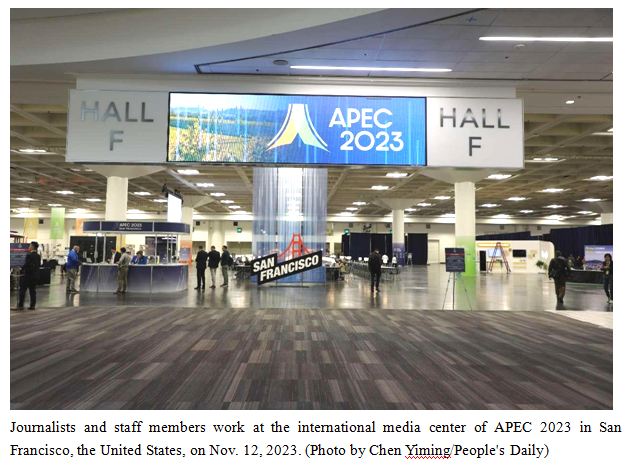
This year marks the 30th anniversary of the first Asia-Pacific Economic Cooperation (APEC) Economic Leaders’ Meeting. Chinese President Xi Jinping has been invited to attend the 30th APEC Economic Leaders’ Meeting, which fully showcases the great importance China attaches to Asia-Pacific economic cooperation.

China will continue to contribute wisdom and strength to deepen Asia-Pacific cooperation and promote the building of an Asia-Pacific community with a shared future.

The Asia-Pacific region accounts for one-third of the world’s population, over 60 percent of the world’s economic output, and nearly half of global trade. It is the most dynamic economic area of the world.

As an important economic cooperation platform in the Asia-Pacific region, APEC has made continuous progress in promoting regional trade and investment liberalization and facilitation and played a positive role in driving global and regional economic growth.

Currently, the Asia-Pacific region enjoys overall stability, and regional cooperation continues to make progress. Peaceful development and win-win cooperation remain the mainstream.

At the same time, the world enters a new period of turbulence and transformation, with geopolitical tensions and an evolving economic landscape impacting the development environment and cooperation framework in the Asia-Pacific region.

All parties expect the Asia-Pacific region to follow the path of peaceful, open, cooperative, win-win and inclusive development, respond to the challenges of the times, promote regional economic integration, explore new development prospects, and lead global economic growth.

China has been actively advocating for the building of an Asia-Pacific community with a shared future and firmly led the direction in promoting cooperation in the region.

Since 2013, Xi has attended or chaired APEC Economic Leaders’ Meetings and delivered important speeches.

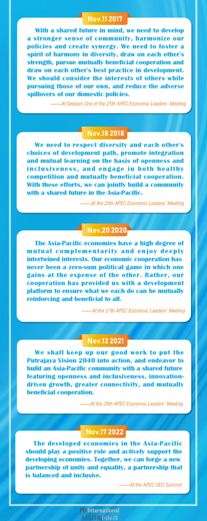
China has promoted Asia-Pacific cooperation through its propositions, promoted the development of the region with its contributions, built consensus in the region with its wisdom, and promoted the joint construction of an Asia-Pacific community with a shared future featuring openness and inclusiveness, innovation-driven growth, greater connectivity, and mutually beneficial cooperation.

At the 30th APEC Economic Leaders’ Meeting, Xi will deliver an important speech to fully elaborate on China’s major propositions on deepening Asia-Pacific cooperation and driving regional and global growth.

China will steadfastly work with all parties to promote the prosperity and development of the Asia-Pacific region and create a better future for the region.

China, as a key player in the Asia-Pacific region, holds immense potential for economic growth and plays a significant role in driving regional economic development.

The Asian Development Bank’s Asia Economic Integration Report 2023 indicated that China contributed 64.2 percent to the region’s total economic growth, 37.6 percent of the growth in trade in goods, and 44.6 percent of the growth in trade in services.

The country is dedicated to deepening the Asia-Pacific partnership featuring mutual trust, inclusiveness and mutually beneficial cooperation. It aims to build an Asia-Pacific community with a shared future that is peaceful, stable, clean and beautiful, a region where all are ready to help each other and that brings prosperity for all.

The commitment will create new opportunities and inject fresh impetus into the development and prosperity of both the Asia-Pacific region and the world at large.

China’s development has benefited from the Asia-Pacific region, and China reciprocates by benefiting the region through its own progress.

China stays committed to opening up in a wider scope and broader areas and at a deeper level. It sticks to Chinese modernization and builds new systems for higher-level open economy. China will continue to share its development opportunities with the world, especially with the Asia-Pacific region.

It is widely recognized that a prosperous and strong China not only serves the fundamental interests of the Chinese people but also brings more benefits to the Asia-Pacific and the world.

The peace, stability, and prosperity of the Asia-Pacific region belong to all the people in the region, and the future of the Asia-Pacific relies on the joint efforts of the people.

All parties should stay true to their original aspirations, adopt a strategic and long-term perspective on regional cooperation, and uphold APEC’s role as the main channel in regional cooperation and keep Asia-Pacific cooperation in the right direction, so as to work together to build an Asia-Pacific community with a shared future.

To jointly build Asia-Pacific community with shared future

To strive for lasting peace, common prosperity in Asia-Pacific region

The 30th Asia-Pacific Economic Cooperation (APEC)

By Huan Yuping, People’s Daily

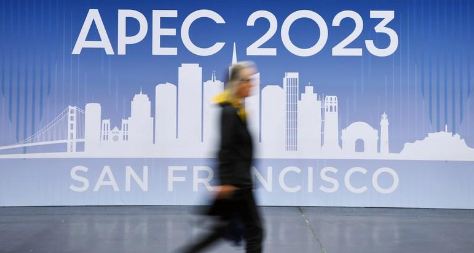
The 30th Asia-Pacific Economic Cooperation (APEC) Economic Leaders’ Meeting is scheduled for Nov. 15-17. Currently, the Asia-Pacific region enjoys overall stability, and regional cooperation continues to make progress. Peaceful development and win-win cooperation remain the mainstream.

At the same time, the world enters a new period of turbulence and transformation, with geopolitical tensions and an evolving economic landscape impacting the development environment and cooperation framework in the Asia-Pacific region.

Standing at a new crossroads, whether Asia-Pacific cooperation can stay true to its original aspiration, follow the correct direction, and steadfastly move towards the goal of building an Asia-Pacific community with a shared future, is crucial to world peace and development, and tests the wisdom and responsibility of all parties in the region.

The 21st century is the Asia-Pacific century. The establishment and development of APEC are in line with the historical trend of openness and integration, the strong aspiration for development in the Asia-Pacific region, and the common demand of people from various countries for jointly addressing challenges.

Over the past more than 30 years since its establishment, APEC has gradually grown into the highest-level and most influential mechanism for economic cooperation covering the broadest area in the Asia-Pacific region. It has witnessed the historical achievements of Asia-Pacific development and is an important propeller of the “Asia-Pacific miracle.”

According to the Regional Economic Outlook for Asia and Pacific recently released by the International Monetary Fund, the region is expected to grow by 4.6 percent this year, and economic activity in Asia and the Pacific remains on track to contribute about 2/3 of global growth in 2023. This once again highlighted the Asia-Pacific region as the most dynamic and promising economic area of the world, and a crucial engine for global economic growth.

The success story of APEC is a remarkable chapter in the construction of an open world economy. Guided by the Bogor Goals, APEC has continuously enhanced regional economic integration. It has advanced trade and investment liberalization and facilitation in tandem with economic and technical cooperation, with a view to realizing mutual complementarity and balanced development of the “two wheels” of APEC cooperation.

APEC, guided by open regionalism and the principles of diversity and non-discrimination, has become an architecture for inclusive and win-win regional cooperation. It has not only benefited the region, but also played a significant role in leading the evolution of the multilateral trading system.

Over the past decades, economies in the Asia-Pacific region have broken market barriers, strengthened economic ties, and actively embraced the world, creating vast opportunities for economic development.

In the 26 years since the implementation of the Bogor Goals, the region’s trade volume increased five times with an average annual growth rate of 6.7 percent, and two-way investment increased 12 times with an average annual growth rate of over 10 percent.

Currently, the international situation is complex and volatile. The Asia-Pacific region has seen practices that distorted international norms, impeded economic ties, and exacerbated regional tensions.

At this critical juncture, all parties in the region need to take a strategic and long-term perspective on Asia-Pacific cooperation. By upholding APEC’s role as the main channel in regional cooperation and keeping Asia-Pacific cooperation in the right direction, the region can effectively respond to the challenges of the times and jointly forge a new path for development.

To further strengthen APEC cooperation, it is important to adhere to the established goals. APEC members, based on the initial realization of the Bogor Goals, have launched the Putrajaya Vision 2040, aiming to build an open, dynamic, resilient and peaceful Asia-Pacific community, which offers important guidance for economic cooperation in the region in the near future.

With clear objectives in place, it is crucial to take action. APEC members should deepen cooperation within the APEC framework, advance the Free Trade Area of the Asia-Pacific, and implement the Putrajaya Vision 2040.

Deliberate attempts to dilute the concept of “Asia-Pacific” and replace the region’s well-established cooperation structure with a new one will only divert Asia-Pacific cooperation from the right track and hinder the development of the region.

To further strengthen cooperation within the APEC framework, it is necessary to build closer partnerships. APEC is a big family, and it is in the common interest of all members to build an open Asia-Pacific economy featuring innovative development, interconnected growth, and shared interests. The Asia-Pacific partnership featuring mutual trust, inclusiveness and mutually beneficial cooperation is the spiritual bond of the APEC family and an important guarantee for keeping APEC cooperation on the right track.

There are various national conditions in the Asia-Pacific region, thus there will be differences. The key is to adhere to the common goal of seeking development, promote the spirit of partnership, negotiate and address differences, and explore solutions to common challenges.

Only by adhering to the right direction can regional countries renew the “Asia-Pacific miracle” together. Each APEC member should uphold the purposes and principles of APEC, continuously deepen partnerships in the Asia-Pacific region, promote the spirit of the Asia-Pacific family, and work together in solidarity and with mutual assistance. Building an Asia-Pacific community with a shared future is the correct choice that conforms to the trend of history, regional consensus, and the will of the people.

To make greater contributions to Asia-Pacific’s stability, prosperity

To make greater contributions to Asia-Pacific's stability, prosperity

By Yu Yichun, Cao Shiyun, People’s Daily

This year marks the 30th anniversary of the first Asia-Pacific Economic Cooperation (APEC) Economic Leaders’ Meeting. Over the past 30 years, China’s deepening reforms and expanding opening up have gone hand in hand with the continuous expansion of Asia-Pacific economic cooperation.

Since 2013, Chinese President Xi Jinping has attended or chaired APEC Economic Leaders’ Meetings and delivered important speeches.

From “building an Asia-Pacific community with a shared future” to “creating and fulfilling an Asia-Pacific dream,” and from “forging an Asia-Pacific partnership” to “building a high-quality Asia-Pacific connectivity network,” Chinese ideas and proposals have sparked strong resonance in the Asia-Pacific region, making significant contributions to the stability and prosperity of the region.

China’s opening up and development are closely related to the Asia-Pacific region. China has always been a staunch supporter and active promoter of Asia-Pacific regional economic cooperation, integrating its own development with regional development and driving the opening up of the whole region through its own opening up.

In 2022, China’s trade volume with Asia-Pacific economies reached $3.1 trillion, a year-on-year increase of 19.2 percent, accounting for 36.8 percent of China’s total foreign trade.

During the same period, China’s high-quality implementation of the Regional Comprehensive Economic Partnership (RCEP) resulted in a total of 12.95 trillion yuan ($1.78 trillion) in imports and exports to other RCEP members, growing 7.5 percent from a year ago.

According to the Asian Economic Integration Report 2023 by the Asian Development Bank, Asia’s economic recovery is driven particularly by China, which accounted for 64.2 percent of total growth.

China has been making continuous and concrete efforts to deepen trade and investment cooperation with regional economies, contributing its part to building an open economy in the Asia-Pacific.

It pushed for the launch of the process to build a Free Trade Area of the Asia-Pacific at the 2014 APEC meeting in Beijing, and actively worked to join the Comprehensive and Progressive Agreement for Trans-Pacific Partnership and the Digital Economy Partnership Agreement. Furthermore, China has been actively promoting the China-ASEAN Free Trade Area 3.0 with ASEAN members.

The 30th APEC Economic Leaders’ Meeting, with the theme of “Creating a Resilient and Sustainable Future for All,” conveys the significance of green development and innovation for the Asia-Pacific region.

Under the active promotion by the Chinese government and the vigorous participation of Chinese enterprises, cooperation platforms such as the APEC Sustainable Energy Center and the China-Pacific Island Countries Climate Change Cooperation Center have gradually been established. Green development projects, including the Dzilam State Reserve located in Mexico’s Yucatan Peninsula, have commenced, contributing Chinese wisdom and solutions to building a clean and beautiful Asia-Pacific region.

APEC Secretariat Executive Director Rebecca Sta Maria noted that China has demonstrated its determination to achieve sustainable development through practical actions and has fulfilled its international commitments in the field of sustainable development.

Leveraging the digital twin technology, Chinese scientists are providing more solutions for the protection of marine biodiversity in Latin American countries. By introducing technologies such as 5G, cloud computing, and artificial intelligence, Chinese companies are helping Thai hospitals achieve comprehensive intelligent transformation in their services. With the assistance of the China-ASEAN Information Harbor, the level of cross-border trade and economic services between China and ASEAN countries continues to improve.

China not only leads the world in technological innovation and digital economic development, but also actively promotes digital transformation in the Asia-Pacific region and even the world at large.

Working with its partners to promote high-quality Belt and Road cooperation, China is improving the connectivity level in the Asia-Pacific region. It proposed to establish the Asian Infrastructure Investment Bank, aiming to provide financial support for regional infrastructure development.

China has hosted a series of international exhibitions such as the China Import and Export Fair, China International Fair for Trade in Services, and the China International Consumer Products Expo at high standards, collaborating with various parties to write stories of open cooperation and mutual benefit.

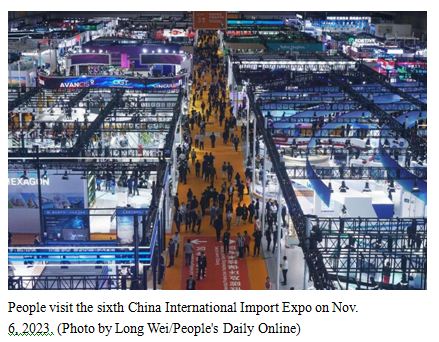
The just-concluded sixth China International Import Expo achieved fruitful results, with tentative deals reaching a new high of $78.41 billion, a 6.7 percent increase from the previous year.

China is committed to advancing high-level opening up, continuously providing new opportunities for the Asia-Pacific region and the world through its new development, and contributing Chinese strength to the construction of an open world economy.

Major countries should shoulder great responsibility. The United States is the host of the 30th APEC Economic Leaders’ Meeting. China and the United States are the world’s top two economies, accounting for over 1/3 of the global economic output, nearly 1/4 of the world’s population, and approximately 1/5 of global bilateral trade. They play a unique and important role in driving economic growth in the Asia-Pacific region and promoting regional cooperation.

The wide globe is fully capable for the two countries to develop themselves and prosper together. Stabilizing and improving China-U.S. relations not only serves the fundamental interests of both countries and their peoples, but also contributes to peace and prosperity in the Asia-Pacific region and even the world.

The world is once again at the crossroads of history. Under the new situation, Asia-Pacific economies need to learn from past experiences and lessons, respond to the challenges of the times and steadfastly advance Asia-Pacific regional economic integration, so as to jointly break new ground in development and build an Asia-Pacific community with a shared future. They will contribute wisdom and strength to world peace and development with the stability and prosperity of the Asia-Pacific region.

To make greater contributions to Asia-Pacific's stability, prosperity

To open new, splendid era of long-term peace, stability, high-quality development in Xizang

To open new, splendid era of long-term peace, stability, high-quality development in Xizang

By People’s Daily

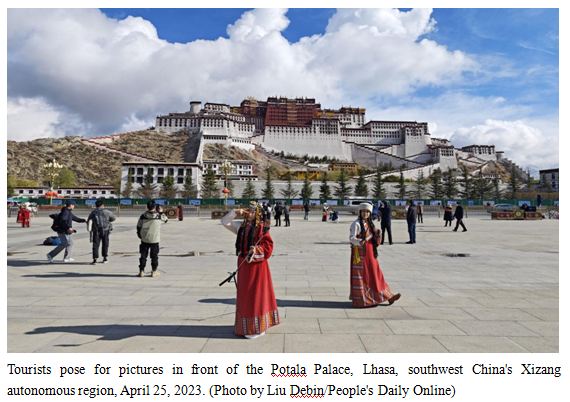
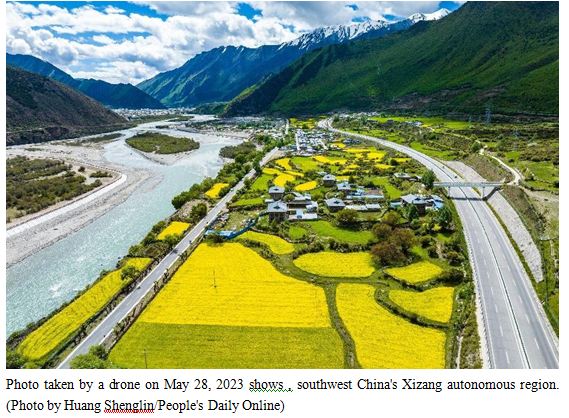
The social and economic progress of Xizang epitomizes the nation’s outstanding achievements in development, created on the roof of the world through the Chinese path to modernization, says a white paper titled “Communist Party of China (CPC) Policies on the Governance of Xizang in the New Era: Approach and Achievements.”

The white paper was released by China’s State Council Information Office on Nov. 10. With detailed statistics and abundant facts, the document systematically summarizes the comprehensive progress and historic achievements in all undertakings related to the Xizang autonomous region under the CPC’s strategy in governing Xizang in the new era. It fully demonstrates China’s firm determination and strong confidence in ensuring good governance in Xizang and maintain long-term stability and high-quality development in the autonomous region.

To govern the country well, China must first govern the frontiers well, and to govern the frontiers well, the country must first ensure stability in Xizang.

Since the 18th National Congress of the CPC held in 2012, the CPC Central Committee with Comrade Xi Jinping at its core has deepened its understanding of the work related to Xizang through years of practice, summarized the successful experience of the CPC in leading the people to govern, stabilize, and develop Xizang, and has formulated the CPC policies on the governance of Xizang in the new era. This provides fundamental guidance for effectively carrying out work related to Xizang in the new era.

The CPC policies on the governance of Xizang in the new era, grounded on the practice of socialism with Chinese characteristics and the actual situation of Xizang, demonstrate a keen understanding of work related to Xizang. They encapsulate the CPC’s past successes in stabilizing Xizang and its plans for future development. Embodying Xi Jinping Thought on Socialism with Chinese Characteristics for a New Era, these guidelines provide answers to a series of questions on the future direction and strategy in governing Xizang.

The main driver of the CPC’s endeavors is the people’s aspirations for a better life. From eradicating absolute poverty to developing a system of public cultural services, from strengthening its work related to ethnic affairs and managing religious affairs in accordance with the law to constantly improving its working mechanisms and governance capacity, and from making efforts to become a national or even an international model in advancing eco-civilization to ensuring the right of all people of all ethnic groups to be masters of the region and the country, Xizang, following the CPC policies on the governance of Xizang in the new era, has made significant progress in stabilizing the social environment, achieving rapid economic progress, and strengthening the Party organization in Xizang, which has led to a better life to its people, amity among all ethnic groups and religions, cultural prosperity, sound ecological systems, and secured borders.

Together with the rest of the country, people in Xizang have witnessed the tremendous transformation of the Chinese nation from standing up and becoming prosperous to growing in strength.

Since the new era, Xizang has experienced a period of unprecedented development and huge change, bringing more tangible benefits to the people. It has achieved all-round progress and historic success in various undertakings. The fundamental reason for such huge progress is that the autonomous region follows the strong leadership of the CPC Central Committee with Comrade Xi Jinping at its core and follows the scientific guidance of Xi Jinping Thought on Socialism with Chinese Characteristics for a New Era.

The region’s achievements have proved that to ensure long-term stability and high-quality development in the region, the Party’s guidelines on the governance of Xizang in the new era must be fully and thoroughly implemented. The region’s development must serve to benefit ethnic unity and progress, to safeguard national unity and oppose separatism, and to improve people’s lives and build social consensus, so that people of all ethnic groups in Xizang will have a greater sense of gain, fulfillment and security. To ensure long-term stability, prosperity and high-quality development in Xizang, the four main tasks of ensuring stability, facilitating development, protecting the eco-environment, and strengthening the borders must be successfully and effectively fulfilled.

Since the 20th National Congress of the CPC held in 2022, people of all ethnic groups in China have embarked on a new journey of promoting comprehensive national development and achieving the great rejuvenation of the Chinese nation through the Chinese path to modernization.

Xi Jinping, general secretary of the CPC Central Committee stressed that no ethnic group shall be left behind in building a great modern socialist country in all respects.

He urged full realization of common prosperity and development of all ethnic groups, so as to ensure that people of all ethnic groups can share the glory of building China into a great country and advancing the rejuvenation of the Chinese nation..

Embarking on the new journey, China must align its thoughts and actions with the decisions and deployments of the CPC Central Committee. It must firmly forge a stronger sense of the Chinese nation as one single community, unswervingly follow a Chinese approach to ethnic issues, fully implement the Party’s policies on the governance of Xizang in the new era, apply the new development philosophy in full, to the letter and in all fields, and promote ethnic unity and progress on all fronts.

The country must focus on safeguarding national unification and strengthening ethnic unity, focus on improving people’s lives and strengthening unity in socio-economic development, consolidate its achievements in poverty reduction and comprehensively advance rural vitalization, build Xizang into a high ground of ecological progress, and pave a path of high-quality development that suits Xizang’s reality.

It has been proved that without the CPC, there would have been neither New China nor new Xizang, said Xi during an inspection tour in Xizang. The CPC Central Committee’s guidelines and policies concerning Xizang work are completely correct, he added.

Today, Xizang is embracing an unprecedented and extraordinary opportunity for development, as it takes flight towards a brighter future.

Under the strong leadership of the CPC Central Committee with Comrade Xi Jinping at its core, guided by the CPC policies on the governance of Xizang in the new era, and with the wholehearted support of the people across the nation, as well as the collective efforts of all ethnic groups in Xizang, the autonomous region will surely open a new and splendid era of long-term peace and stability and high-quality development.

To open new, splendid era of long-term peace, stability, high-quality development in Xizang

Stay Connected

64FansLike
60FollowersFollow

Latest Reviews

Exchange Rates

USD - United States Dollar
EUR
1.17
GBP
1.35
AUD
0.72
CAD
0.73