Home Blog Page 1097

Passive Income is Part of Cyber Boy Corp.’s Paradigm

Cyber Boy Corp. passive income

BEVERLY HILLS, CA – In the dynamic world of business and technology, Cyber Boy Corp. has shown time and time again that it is the undisputed leader in innovation.

In addition to its well-known history of innovative breakthroughs, the company is now creating a paradigm shift beyond conventional revenue models.

Examining the cornerstones of Cyber Boy Corp.’s strategy, this article highlights the importance of passive income in the company’s growing business model.
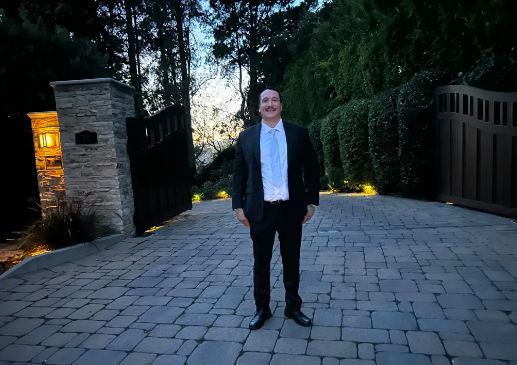
Passive income generation via non-traditional means is a top priority for Cyber Boy Corp.

Seeing the opportunity for innovation in revenue generation, the organization has changed its business strategy to embrace the idea of passive income intentionally.

Increasing the diversity of income streams and laying a solid foundation for future financial security are the two main goals of this strategic shift.

The fact that Cyber Boy Corp. has branched out into print-on-demand shows how seriously it takes encouraging innovation.

All Sunsets, Creative Fabrica, and Vexels are just a few of the platforms the company has used to generate passive income.

In this model, sellers use the platform to easily create and market designs, and then third-party suppliers handle production, packaging, and delivery.

T-shirt sales are a noteworthy way Cyber Boy Corp. uses this creative strategy to generate passive money. The business uses Amazon Merch on Demand, a flexible platform that does not need an initial inventory commitment.

Also Read: AI Armageddon: Can Amazon.com slay tech giants Google, Microsoft?

Designing, uploading, and selling items is all that is required in this simplified process; Amazon takes care of the details of manufacturing, shipping, and customer support.

Depending on the product category and listing price, Cyber Boy Corp. may get royalties from Amazon Merch on Demand ranging from 13% to 37%.

Incorporating passive income via print-on-demand, namely in the domain of T-shirt sales, broadens the range of revenue sources for Cyber Boy Corp.

Additionally, this integration harmoniously corresponds with the company’s fundamental business philosophy.

The unique strategy discussed herein has a multifaceted influence, including enhancing financial stability, minimising risk, and cultivating a creative atmosphere that prioritizes design and marketing. Sr. Roy Andrade, CTO, of Cyber Boy Corp. is at the forefront of pioneering novel methodologies, exemplifying a distinctive approach that provides insight into the prospective integration of passive income within company models.

The foray of Cyber Boy Corp. into generating passive income via print-on-demand demonstrates its dedication to reinventing conventional methods of generating cash.

The efficacy of strategic alliances and inventive business frameworks is shown by the triumph of T-shirt sales, which has been helped by platforms such as Amazon Merch on Demand.

This case study contributes to the framework of Cyber Boy Corp. It provides evidence of the dynamic nature of the business environment in which passive income is pivotal in establishing a sustainable and profitable future.

The progress of Cyber Boy Corp. is a creative endeavour that encompasses more than just a mere business plan.

It marks a transforming voyage towards achieving financial sustainability and fostering creativity within the dynamic and always-evolving digital realm.

—————————–

References

Contributor, R. H. (2022, November 9). This 33-year-old makes $14,600 monthly in passive income: “I work just one hour a day” on my online business. CNBC. https://www.cnbc.com/2022/11/09/33-year-old-makes-14000-month-in-passive-income-from-online-business-i-work-on-it-just-1-hour-a-day.html

M, K. R. (2023). The Role of Cyber Boy Corp. and Sr. Roy Andrade in Technology, Philanthropy, and Innovation. Deccan Herald. https://www.deccanherald.com/brandpr/the-role-of-cyber-boy-corp-and-sr-roy-andrade-in-technology-philanthropy-and-innovation-2773146

Simplilearn. (2023). What is Cybersecurity & Importance of Cyber Security | Simplilearn? Simplilearn.com. https://www.simplilearn.com/tutorials/cyber-security-tutorial/what-is-cyber-security#:~:text=Cybersecurity%20is%20the%20protection%20to
Zardari forms committee for talks with electables

Zardari forms committee for talks with electables

Committee, as per a PPPP notification, comprises of members from all four provinces

Mehtab Pirzada

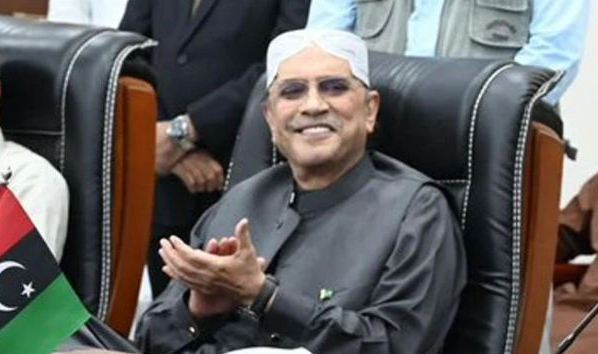
ISLAMABAD: Under the leadership of former president Asif Ali Zardari, the Pakistan Peoples Party Parliamentarians (PPPP), will contact political parties and politicians for dialogue both before and after the general elections, scheduled to take place on February 8 next year.

The development was announced after Zardari formed a committee, comprising his party’s members, to get in touch with parties and politicos with the aim of fostering dialogue as the country approaches general polls in 2024.

The committee, as per a PPPP notification, will comprise members from all four provinces. From Punjab and Khyber Pakhtunkhwa Secretary General PPP Syed Nayyer Hussain Bukhari, Qamar Zaman Kaira, Secretary Information PPP Faisal Karim Kundi, Muhammad Ali Shah Bacha and Sajid Toori will be a part of the committee.

Members from Sindh are Saeed Ghani and Syed Nasir Hussain Shah, while Chengez Khan Jamali, Rozi Khan Kakar and Sabir Ali Baloch will participate from Balochistan.

When contracted, Secretary Information PPP Kundi confirmed forming the committee for dialogue with political parties and personalities under a well-planned strategy.

The PPP co-chairman is known for his reconciliatory ways of politics and has been a proponent of a coalition government for the betterment of the country. He has consistently ruled out the formation of a single-party government and this time around, too, the senior politician is looking towards the many political groups in Pakistan.

PM Kakar to meet MBZ during UAE trip

PM Kakar to meet MBZ during UAE trip

Visit will include signing of MoUs between Pakistan and UAE

DNA

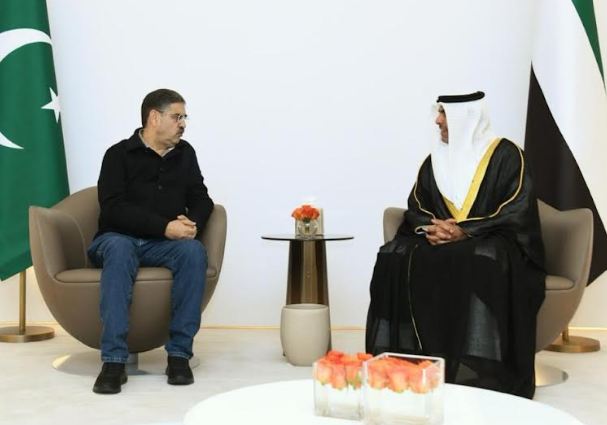
ISLAMABAD: Caretaker Prime Minister Anwaar-ul-Haq Kakar has arrived in UAE for a three-day bilateral visit to the United Arab Emirates.

According to the statement, the prime minister will meet UAE President Sheikh Mohamed bin Zayed during the visit starting from 26 till November 28.

The engagement between the two dignitaries will provide an opportunity to advance bilateral ties in all spheres including political, economic, trade, investment, cultural, defence and people-to-people relations.

The visit will include the signing of MoUs between Pakistan and the UAE in a range of areas including investment cooperation in the sectors of energy, port operations projects, waste water treatment, food security, logistics, mining, aviation, and banking & financial services.

Pakistan and the UAE enjoy warm and long-standing fraternal ties that have stood multiple tests of time, it added.

Moreover, PM Kakar will also lead a delegation to attend the celebrations of the 52nd National Day of the UAE and the 28th meeting of the Conference of the Parties (COP 28) in Dubai.

90 heads of the states including Pakistan and 7,000 representatives across the world will be a part of the celebrations.

The foreign heads of states and representatives were invited to the celebrations of the National Day of UAE on December 2.

Therefore, the reception of National Day on behalf of the UAE Embassy has been cancelled in Islamabad. The UN Climate Change Conference of 2023 will be held in UAE from November 30 to December 12.

Various programmes of the international climate change conference will continue in UAE till December 15.

On the invitation of the UAE president, a high-level delegation of Pakistan headed by PM Kakar and caretaker ministers of trade, climate change, health and finance will supervise Pakistan during the celebrations which are to take place on December 1 and 2.

On this occasion, the premier will hold meetings with world leaders and representatives of foreign countries including the prime minster of UAE and ruler of Dubai.

Hamas releases more prisoners as truce holds

Hamas releases more prisoners as truce holds

Yemen’s Houthia have seized a tanker linked to Israel off the coast of Yemen

News Desk

GAZA CITY: Hamas on Sunday, handed over another 13 Israeli hostages to the Red Cross along with three Thai nationals, Reuters reported.

Meanwhile, the Israel Defence Forces (IDF) have also confirmed that 14 Israeli captives — one accounting to a Russian citizen who holds dual nationality — have been received by the Red Cross.

“Based on information that was received from the Red Cross, 14 Israeli hostages and three foreign hostages have been transferred to the Red Cross,” read the statement issued by the Israeli military on social media platform X.Al-Shifa Hospital has been a major focus of Israel’s ground offensive in northern Gaza, with the World Health Organization, the United Nations health agency, calling it “a death zone”.

More than 200 medical personnel have been killed and most hospitals shut down in the weeks of indiscriminate bombing by Israel.

The Israeli army ordered an evacuation of Gaza’s largest medical facility on November 18, but it was not possible to evacuate all the patients, as for some, an evacuation would have presented high health risks.

Israeli forces, which raided the hospital last week, alleged that Hamas fighters used a tunnel complex beneath the facility in Gaza City to stage attacks. Hamas and hospital officials have repeatedly denied the claims.

Israel has also taken into custody Muhammad Abu Salmiya, the director of al-Shifa Hospital.

The Ramallah Friends School says three of its graduates who had left the occupied West Bank to study in the United States have been shot at in Burlington, Vermont.

They have been identified as Hisham Awartani, who studies at Brown University, Kinnan Abdel Hamid, who goes to Haverford University, and Tahseen Ahmed, who is a student at Trinity College.

Awartani was reportedly shot in the back, Ahmed in the chest and Abdel Hamid sustained minor injuries.

Family members are calling it a hate crime, but police have yet to assess the motive for the shootings.

Of the 24 hospitals operating in northern Gaza prior to the war, only four small ones are operational and admitting new patients, the UN agency OCHA says.

Of the 11 medical facilities in the south, eight are currently functional, it said.

The bed capacity across Gaza has declined from 3,500 prior to the war to 1,400 presently, amid a surge in those seeking treatment, the UN agency said.

Only one of the currently functional hospitals in the south has the capacity to treat critical trauma cases or perform complex surgery, according to the WHO.

The White House aims to lift nearly all restrictions on Israel’s access to weapons from a crucial US stockpile, enabling a smoother weapons pipeline to Israel.

The White House asked the US Senate to scrap the restrictions in its latest supplementary budget request on October 20.

If granted, the request would enable Israel to access more high-powered US weapons at a reduced cost, with less congressional oversight.

Attackers have seized a tanker linked to Israel off the coast of Yemen.

The attackers seized the Central Park, managed by Zodiac Maritime, in the Gulf of Aden.

“Our priority is the safety of our 22 crew onboard,” Zodiac said in a statement. “The Turkish-captained vessel has a multinational crew consisting of a crew of Russian, Vietnamese, Bulgarian, Indian, Georgian and Filipino nationals. The vessel is carrying a full cargo of phosphoric acid.”

Zodiac described the vessel as being owned by Clumvez Shipping Inc, though other records directly linked Zodiac as the owner. London-based Zodiac Maritime is part of Israeli billionaire Eyal Ofer’s Zodiac Group.

While no group immediately claimed responsibility, it comes as at least two other maritime attacks in recent days have been linked to the Israel-Hamas war.

General elections still doubtful? Some musings

Analysis

Ansar M Bhatti

It is intriguing to observe that, as the elections draw near, a substantial number of political parties have not yet initiated a comprehensive election campaign.

An exception to this trend is evident in the PPP, which has actively shifted into election mode. Up until now, the momentum seemed to favor the PPP; however, a pivotal moment occurred with Asif Zardari’s interview on a private TV channel a couple of weeks ago, sending waves of unrest within the party ranks.

In response, PPP Chairman Bilawal Bhutto Zardari found himself compelled to hastily depart for Dubai, abruptly interrupting the ongoing election campaign. This unexpected development has added a layer of complexity to the political landscape and warrants close observation.

Asif Zardari seized immediate media and public attention by unequivocally asserting his authority in awarding party tickets for the upcoming elections, thereby overshadowing Bilawal and rendering him seemingly irrelevant.

This announcement came in response to Bilawal’s stance advocating for a transition of power to the younger generation, implying that the old guard, including his own father, should step aside. Initially, analysts speculated that Bilawal was alluding to figures like Nawaz Sharif, but it became evident that his own father was the intended target as well. In light of this revelation, Asif Zardari entered the fray, intensifying the rift between father and son.

This controversy has precipitated a consequential face-off within the party, and its resolution at this juncture is imperative to avert potential detriment to the party’s prospects in the upcoming elections.

There is a prevailing sentiment within the PPP that having Asif Zardari at the helm could pose a significant challenge due to his less-than-impeccable reputation.

Concerns linger that the party might face substantial setbacks if it ventures into the elections with Zardari in a prominent role. In contrast, Bilawal Bhutto is seen as a more forward-looking and popular politician, having improved his credentials over time. Bilawal himself believes that his tenure as the foreign minister in the PDM government garnered him international acceptance as a prospective leader for Pakistan.

While Bilawal’s optimism about his global standing holds some merit, the reality at home presents a myriad of challenges. Leading a party historically marred by allegations of corruption, Bilawal confronts the daunting task of addressing public skepticism and countering the party’s past tarnished image. Despite his aspirations for international recognition, the intricate web of domestic challenges demands careful navigation for Bilawal to solidify his leadership and enhance the party’s credibility in the eyes of the electorate. But that is possible only when he has full support of his father.

Internal divisions within the People’s Party could significantly advantage the PML-N, considering that the PPP is currently the primary contender challenging the PML-N in the political arena. The PTI, having already experienced internal challenges, is perceived to be significantly weakened, and there are expectations that any remaining strength within the party might further splinter. This fragmentation would strategically prevent the PTI from emerging as a potent threat to the PML-N, which seems to enjoy a favored status with the Establishment.

In essence, the rifts within the PPP create a political landscape where the PML-N stands as the dominant force, particularly in the absence of a consolidated and formidable opposition. The potential disarray among rival parties positions the PML-N favorably, strengthening its political standing and reinforcing the perception of it being the preferred choice for the Establishment.

The unfolding dynamics within these political entities will undoubtedly shape the broader narrative of the upcoming elections and the power balance within the political landscape.

According to certain sources, there have been attempts by the Establishment to court the PTI, utilizing figures such as President Arif Alvi and former minister Muhammad Ali Durrani as intermediaries.

 These reports suggest that the PTI was presented with an offer, proposing control over two provinces—Punjab and KPK. However, a condition was attached, stipulating that either Ch. Pervez Elahi or Shah Mahmood Qureshi should be endorsed by the PTI Chairman to lead in Punjab. Imran Khan reportedly declined this proposition outright.

In response to the rejection, the Establishment opted to bolster the newly-formed IPP, spearheaded by Jehangir Tareen and Aleem Khan. This development sheds light on the intricate political dynamics at play, with negotiations and alignments taking shape behind the scenes, showcasing the delicate balance of power and influence within the political landscape.

Despite the intricate political maneuvers and strategies employed by both the IPP and the PML-N, they have thus far been unsuccessful in garnering the support of the people. The public sentiment continues to favor the PTI and its chairman, who is perceived by many as a messiah figure.

This suggests that, despite the efforts and tactics implemented by other political entities, the PTI maintains a distinctive and enduring appeal among the populace. The challenge for the IPP and the PML-N lies in understanding and addressing the factors that contribute to the continued resonance of the PTI and its chairman as a preferred choice in the eyes of the electorate.

Despite the unequivocal directives from the Supreme Court mandating elections on February 8, 2024, widespread skepticism persists regarding the timely conduct of the elections. Various factors contribute to the prevailing doubts, casting uncertainty over the scheduled date.

Primarily, key political parties, notably the PML N, have yet to initiate full-fledged election campaigns. The party is currently engaged in organizing corner meetings and dialogues with business entities, indicating a potential lack of preparedness. Analysts posit that the party is grappling with significant internal challenges, particularly in the pivotal province of Punjab.

Furthermore, concerns within the party about its ability to draw substantial crowds loom large. The perceived failure to convincingly dispel suspicions of collusion with the Establishment has created apprehensions, possibly deterring a significant voter turnout.

These multifaceted challenges collectively raise apprehensions about the feasibility of conducting the elections as scheduled on February 8, 2024, because if the so-called ‘King’s Party’ cannot secure a win then the powers-that-be don’t see any rationale in facilitating the election drill on February 8.

The proposition of establishing a unity government for a limited duration, without the necessity of immediate elections, is also being explored. This prospective unity government aims to include all major political parties, with the exception of the PTI. Notably, the PPP, particularly the Asif Zardari group, appears amenable to this proposed arrangement. There is also a possibility of persuading the PML N to join this initiative. However, it is imperative to approach this proposal with caution, considering the challenges encountered during the PDM experience. Lessons learned from that endeavor suggest that the implementation of a unity government without a clear roadmap may potentially yield counterproductive results.

China’s contributions to world heritage preservation, cooperation

China's contributions to world heritage preservation, cooperation

By Lyu Zhou

The Cultural Landscape of Old Tea Forests of Jingmai Mountain in Pu’er, southwest China’s Yunnan province, was inscribed on the UNESCO World Heritage List at the extended 45th session of the UNESCO World Heritage Committee that concluded in September this year.

China now has 57 World Heritage Sites, including 39 cultural sites, 14 natural sites, and four cultural and natural heritage sites. Together, they mirror the five prominent features regarding Chinese civilization-consistency, originality, uniformity, inclusivity, and peaceful nature.

To be included on the World Heritage List, sites must meet strict criteria. Selection criteria include exhibiting an important interchange of human values, being an outstanding example of a type of building or landscape, and being directly or tangibly associated with events or living traditions, with beliefs, with artistic and literary works of outstanding universal significance. The authenticity and integrity of properties are also important considerations.  

In the long river of history, the Chinese people have created numerous engineering wonders, showcasing the outstanding originality of the Chinese civilization.

The Great Wall, included on the World Heritage List in 1987, as well as the Mount Qingcheng and the Dujiangyan Irrigation System included in 2000 and the Grand Canal included in 2014, are all ancient engineering classics. The Grand Canal, whose excavation began in the 5th century BC, and the Mount Qingcheng and the Dujiangyan Irrigation System, which was built in the 3rd century BC, are still functional in shipping and irrigation today, serving as examples of sustainable development of humanity.

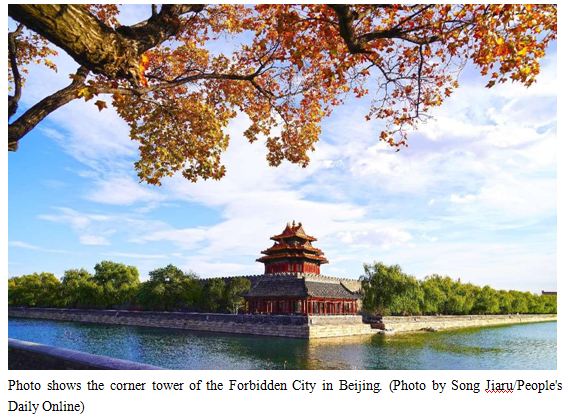
Chinese heritage sites included on the World Heritage List, such as the Forbidden City and Temple of Heaven in Beijing, the classical gardens of Suzhou, and the West Lake cultural landscape of Hangzhou, reflect the unique aesthetic characteristics of the Chinese civilization.

Besides, the historic ensemble of the Potala Palace in Lhasa, the Old Town of Lijiang, the cultural landscape of Honghe Hani Rice Terraces, the ancient city of Pingyao, and the Fujian Tulou are examples of the diverse and colorful Chinese civilization created by various ethnic groups. These sites have witnessed the uniformity of diverse Chinese civilization.

Chinese heritage sites included on the World Heritage List also reflect the inclusivity of the Chinese civilization. In 2014, the Silk Roads: the Routes Network of Chang’an-Tianshan Corridor was included on the World Heritage List. This project, jointly proposed by China, Kazakhstan, and Kyrgyzstan, reflects the trade and cultural exchanges between the Asian and European continents from the 2nd century BC to the 16th century AD, as well as the resulting technological innovations.

Such cultural inclusivity is also evident in World Heritage Sites such as the Yungang Grottoes, Longmen Grottoes, Dazu Rock Carvings, and Quanzhou: Emporium of the World in Song-Yuan China.

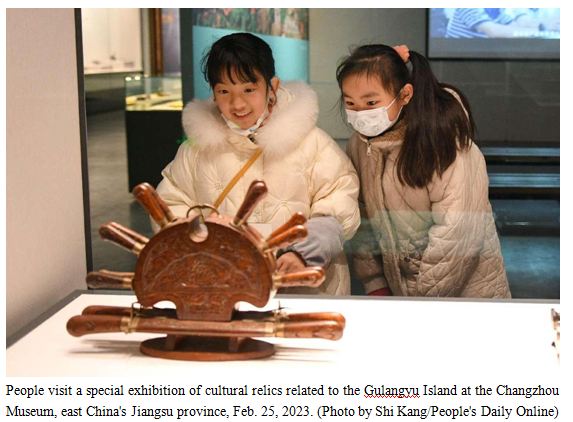
“Although Gulangyu Island is small in area, it is of great value and profound cultural heritage,” said Irina Bokova, former director-general of UNESCO. She made the remarks when presenting the World Heritage certificate to Gulangyu Island in 2017.

She said Gulangyu Island gave people hope, and it is an important classroom for global citizenship that inspires and guides people towards peaceful coexistence of cultures, which is a message needed more than ever.

On the island, the local culture in the early 20th century, the Western culture brought by the opening of ports, and the Nanyang culture brought by returning overseas Chinese converged and blended into a new look. This is the contemporary value of the World Heritage Site.

At the initial stage of China’s accession to the Convention Concerning the Protection of the World Cultural and Natural Heritage, China received technical and financial assistance and support from many countries and international organizations, which enabled it to continuously improve its capacity in cultural and natural heritage protection.

After extensive practice, China has gained rich management experiences and excellent technical capabilities, transforming from a recipient to a provider of heritage protection.

Starting from 1993, China has participated in international aid and cooperation for the preservation of the Angkor heritage site in Cambodia, restoring the Chau Say Tevoda temple and the Ta Keo temple, and becoming the co-chair of the International Coordination Committee for the Safeguarding and the Development of Preah Vihear.

In 2017, the Chinese government undertook a restoration project for the quake-hit Nine-Storeyed Basantapur Palace complex in Kathmandu, Nepal, making significant contributions to Nepal’s post-disaster reconstruction and social recovery.

In addition, China has also participated in cultural heritage protection projects in Uzbekistan, Myanmar, and other countries. In the course of assistance, China has maintained close exchanges and cooperation with other participating countries and recipient countries, with an aim to achieve common progress in heritage conservation.

Protecting world heritage is an international obligation of China, and also a historical responsibility of the country to pass on the Chinese civilization. As more Chinese heritage sites are included on the World Heritage List, it is believed that people will have a deeper understanding of the sites in China. China will work together with more countries to safeguard the spark of human civilization and build a shared home for humanity.

(Lyu Zhou is a professor at Tsinghua University and director of National Heritage Center of Tsinghua University)

China's contributions to world heritage preservation, cooperation
By Lyu Zhou
The Cultural Landscape of Old Tea Forests of Jingmai Mountain in Pu'er, southwest China's Yunnan province, was inscribed on the UNESCO World Heritage List at the extended 45th session of the UNESCO World Heritage Committee that concluded in September this year.
China now has 57 World Heritage Sites, including 39 cultural sites, 14 natural sites, and four cultural and natural heritage sites. Together, they mirror the five prominent features regarding Chinese civilization-consistency, originality, uniformity, inclusivity, and peaceful nature.
To be included on the World Heritage List, sites must meet strict criteria. Selection criteria include exhibiting an important interchange of human values, being an outstanding example of a type of building or landscape, and being directly or tangibly associated with events or living traditions, with beliefs, with artistic and literary works of outstanding universal significance. The authenticity and integrity of properties are also important considerations.  
In the long river of history, the Chinese people have created numerous engineering wonders, showcasing the outstanding originality of the Chinese civilization. 
The Great Wall, included on the World Heritage List in 1987, as well as the Mount Qingcheng and the Dujiangyan Irrigation System included in 2000 and the Grand Canal included in 2014, are all ancient engineering classics. The Grand Canal, whose excavation began in the 5th century BC, and the Mount Qingcheng and the Dujiangyan Irrigation System, which was built in the 3rd century BC, are still functional in shipping and irrigation today, serving as examples of sustainable development of humanity.
Chinese heritage sites included on the World Heritage List, such as the Forbidden City and Temple of Heaven in Beijing, the classical gardens of Suzhou, and the West Lake cultural landscape of Hangzhou, reflect the unique aesthetic characteristics of the Chinese civilization. 
Besides, the historic ensemble of the Potala Palace in Lhasa, the Old Town of Lijiang, the cultural landscape of Honghe Hani Rice Terraces, the ancient city of Pingyao, and the Fujian Tulou are examples of the diverse and colorful Chinese civilization created by various ethnic groups. These sites have witnessed the uniformity of diverse Chinese civilization.
Chinese heritage sites included on the World Heritage List also reflect the inclusivity of the Chinese civilization. In 2014, the Silk Roads: the Routes Network of Chang'an-Tianshan Corridor was included on the World Heritage List. This project, jointly proposed by China, Kazakhstan, and Kyrgyzstan, reflects the trade and cultural exchanges between the Asian and European continents from the 2nd century BC to the 16th century AD, as well as the resulting technological innovations. 
Such cultural inclusivity is also evident in World Heritage Sites such as the Yungang Grottoes, Longmen Grottoes, Dazu Rock Carvings, and Quanzhou: Emporium of the World in Song-Yuan China.
"Although Gulangyu Island is small in area, it is of great value and profound cultural heritage," said Irina Bokova, former director-general of UNESCO. She made the remarks when presenting the World Heritage certificate to Gulangyu Island in 2017.
She said Gulangyu Island gave people hope, and it is an important classroom for global citizenship that inspires and guides people towards peaceful coexistence of cultures, which is a message needed more than ever.
On the island, the local culture in the early 20th century, the Western culture brought by the opening of ports, and the Nanyang culture brought by returning overseas Chinese converged and blended into a new look. This is the contemporary value of the World Heritage Site.
At the initial stage of China's accession to the Convention Concerning the Protection of the World Cultural and Natural Heritage, China received technical and financial assistance and support from many countries and international organizations, which enabled it to continuously improve its capacity in cultural and natural heritage protection. 
After extensive practice, China has gained rich management experiences and excellent technical capabilities, transforming from a recipient to a provider of heritage protection. 
Starting from 1993, China has participated in international aid and cooperation for the preservation of the Angkor heritage site in Cambodia, restoring the Chau Say Tevoda temple and the Ta Keo temple, and becoming the co-chair of the International Coordination Committee for the Safeguarding and the Development of Preah Vihear. 
In 2017, the Chinese government undertook a restoration project for the quake-hit Nine-Storeyed Basantapur Palace complex in Kathmandu, Nepal, making significant contributions to Nepal's post-disaster reconstruction and social recovery. 
In addition, China has also participated in cultural heritage protection projects in Uzbekistan, Myanmar, and other countries. In the course of assistance, China has maintained close exchanges and cooperation with other participating countries and recipient countries, with an aim to achieve common progress in heritage conservation.
Protecting world heritage is an international obligation of China, and also a historical responsibility of the country to pass on the Chinese civilization. As more Chinese heritage sites are included on the World Heritage List, it is believed that people will have a deeper understanding of the sites in China. China will work together with more countries to safeguard the spark of human civilization and build a shared home for humanity.
(Lyu Zhou is a professor at Tsinghua University and director of National Heritage Center of Tsinghua University)
China's contributions to world heritage preservation, cooperation
By Lyu Zhou
The Cultural Landscape of Old Tea Forests of Jingmai Mountain in Pu'er, southwest China's Yunnan province, was inscribed on the UNESCO World Heritage List at the extended 45th session of the UNESCO World Heritage Committee that concluded in September this year.
China now has 57 World Heritage Sites, including 39 cultural sites, 14 natural sites, and four cultural and natural heritage sites. Together, they mirror the five prominent features regarding Chinese civilization-consistency, originality, uniformity, inclusivity, and peaceful nature.
To be included on the World Heritage List, sites must meet strict criteria. Selection criteria include exhibiting an important interchange of human values, being an outstanding example of a type of building or landscape, and being directly or tangibly associated with events or living traditions, with beliefs, with artistic and literary works of outstanding universal significance. The authenticity and integrity of properties are also important considerations.  
In the long river of history, the Chinese people have created numerous engineering wonders, showcasing the outstanding originality of the Chinese civilization. 
The Great Wall, included on the World Heritage List in 1987, as well as the Mount Qingcheng and the Dujiangyan Irrigation System included in 2000 and the Grand Canal included in 2014, are all ancient engineering classics. The Grand Canal, whose excavation began in the 5th century BC, and the Mount Qingcheng and the Dujiangyan Irrigation System, which was built in the 3rd century BC, are still functional in shipping and irrigation today, serving as examples of sustainable development of humanity.
Chinese heritage sites included on the World Heritage List, such as the Forbidden City and Temple of Heaven in Beijing, the classical gardens of Suzhou, and the West Lake cultural landscape of Hangzhou, reflect the unique aesthetic characteristics of the Chinese civilization. 
Besides, the historic ensemble of the Potala Palace in Lhasa, the Old Town of Lijiang, the cultural landscape of Honghe Hani Rice Terraces, the ancient city of Pingyao, and the Fujian Tulou are examples of the diverse and colorful Chinese civilization created by various ethnic groups. These sites have witnessed the uniformity of diverse Chinese civilization.
Chinese heritage sites included on the World Heritage List also reflect the inclusivity of the Chinese civilization. In 2014, the Silk Roads: the Routes Network of Chang'an-Tianshan Corridor was included on the World Heritage List. This project, jointly proposed by China, Kazakhstan, and Kyrgyzstan, reflects the trade and cultural exchanges between the Asian and European continents from the 2nd century BC to the 16th century AD, as well as the resulting technological innovations. 
Such cultural inclusivity is also evident in World Heritage Sites such as the Yungang Grottoes, Longmen Grottoes, Dazu Rock Carvings, and Quanzhou: Emporium of the World in Song-Yuan China.
"Although Gulangyu Island is small in area, it is of great value and profound cultural heritage," said Irina Bokova, former director-general of UNESCO. She made the remarks when presenting the World Heritage certificate to Gulangyu Island in 2017.
She said Gulangyu Island gave people hope, and it is an important classroom for global citizenship that inspires and guides people towards peaceful coexistence of cultures, which is a message needed more than ever.
On the island, the local culture in the early 20th century, the Western culture brought by the opening of ports, and the Nanyang culture brought by returning overseas Chinese converged and blended into a new look. This is the contemporary value of the World Heritage Site.
At the initial stage of China's accession to the Convention Concerning the Protection of the World Cultural and Natural Heritage, China received technical and financial assistance and support from many countries and international organizations, which enabled it to continuously improve its capacity in cultural and natural heritage protection. 
After extensive practice, China has gained rich management experiences and excellent technical capabilities, transforming from a recipient to a provider of heritage protection. 
Starting from 1993, China has participated in international aid and cooperation for the preservation of the Angkor heritage site in Cambodia, restoring the Chau Say Tevoda temple and the Ta Keo temple, and becoming the co-chair of the International Coordination Committee for the Safeguarding and the Development of Preah Vihear. 
In 2017, the Chinese government undertook a restoration project for the quake-hit Nine-Storeyed Basantapur Palace complex in Kathmandu, Nepal, making significant contributions to Nepal's post-disaster reconstruction and social recovery. 
In addition, China has also participated in cultural heritage protection projects in Uzbekistan, Myanmar, and other countries. In the course of assistance, China has maintained close exchanges and cooperation with other participating countries and recipient countries, with an aim to achieve common progress in heritage conservation.
Protecting world heritage is an international obligation of China, and also a historical responsibility of the country to pass on the Chinese civilization. As more Chinese heritage sites are included on the World Heritage List, it is believed that people will have a deeper understanding of the sites in China. China will work together with more countries to safeguard the spark of human civilization and build a shared home for humanity.
(Lyu Zhou is a professor at Tsinghua University and director of National Heritage Center of Tsinghua University)

China, U.S. advance practical cooperation, promote communication, mutual understanding

China, U.S. advance practical cooperation, promote communication, mutual understanding

By Yang Yi, Shi Yuanhao, Li Zhiwei, People’s Daily

The practical cooperation between China and the United States in recent years in trade, clean energy, and culture just demonstrates the close economic and social ties between the two countries and the aspirations of the two peoples.

Strengthening cooperation in various fields between China and the United States is in the interests of both countries and will also benefit the rest of the world.

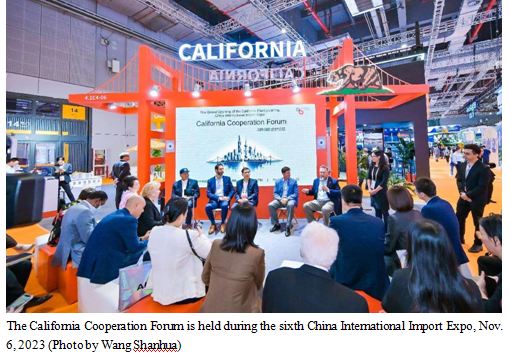
Wines, almonds, cranberry sauce, cheese… Recently, these agricultural products from the United States attracted a lot of attention at the American Food and Agriculture pavilion, set up for the first time by the U.S. government at the China International Import Expo.

The CIIE this year witnessed an unprecedented level of participation from the United States – over 200 American companies engaged in agriculture, automotive, technology, pharmaceuticals, and healthcare industries joined the event.

The California pavilion has attended the expo for six consecutive years, which, in the view of Jim Sutter, CEO of the U.S. Soybean Export Council, was a great signal.

“We value our partnership with China,” Sutter said.

China and the U.S., as the world’s top two economies, account for over 1/3 of the global economy, nearly 1/4 of the world’s population, and approximately 1/5 of global bilateral trade. Bilateral trade between the two counties hit $760 billion last year, setting a record high.

Craig Allen, president of the U.S.-China Business Council, said that American companies are eagerly looking forward to further expanding into the Chinese market. He believes that the economies of the United States and China should not decouple, and strengthening cooperation is beneficial for both peoples.

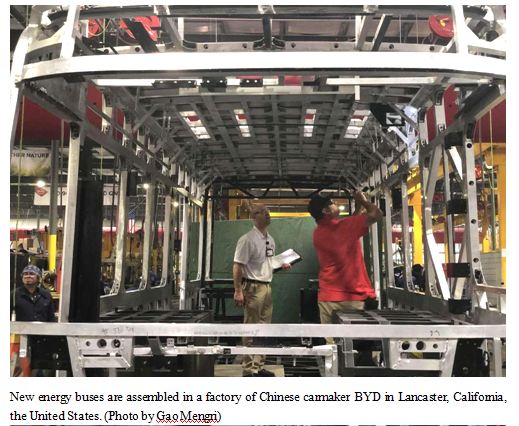
Located in Southern California, Lancaster is featured by sparse vegetation and exposed sand dunes. In 2013, Chinese new energy vehicle giant BYD established an electric bus factory in Lancaster, which was put into operation in the following year. BYD’s arrival has brought vitality to this small city. The factory has employed nearly 1,000 local workers, with only a few engineers coming from China.

According to statistics, approximately 75 percent of the parts used for production at the Lancaster plant are sourced from American suppliers. Through investments in facilities, equipment, and other resources, BYD has brought opportunities for the development of the entire industrial chain. In 2020, BYD opened a forklift center in Rancho Dominguez, California, and established a service network across the United States, further enriching the diversity of its products and strengthening its services.

Recently, a group of local students who learn Chinese visited a subsidiary of China-based company Fuyao Glass Industry Group Co., Ltd. in Moraine, Dayton, Ohio. After the visit, they hailed the working environment and the mix of American and Chinese cultures at the facility. One student said that he hopes to get an opportunity to work in a Chinese company in the future and gain a deeper understanding of Chinese culture.

According to statistics, the automotive glass produced by this subsidiary takes 30 percent of the market share in the United States. It directly creates nearly 2,000 jobs for local communities and offers 6,000 jobs indirectly. Currently, the construction of a new factory by the subsidiary in Dayton has begun, and it is expected to be put into production by the third quarter of 2024.

Michael Davis, the city manager of Moraine, said that this will provide excellent employment opportunities for the workforce in Moraine and surrounding areas.

Chinese Consul General in New York Huang Ping noted that the economic structures of China and the United States are highly complementary, with closely intertwined interests. The economic and trade cooperation between the two countries is unstoppable and inseparable, he added.

The development of Fuyao in the United States demonstrates that “Made in China” and “Made in America” can promote and complement each other, making greater contributions to bilateral cooperation and local development.

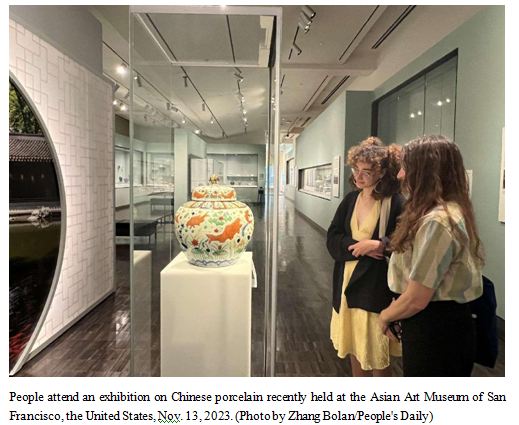
In addition to economic and trade cooperation, cultural exchanges between China and the United States are also continuing to advance. This month, the 19th Chinese American Film Festival and the Chinese American Television Festival have presented a series of exciting activities. Excellent Chinese films and TV shows are also hitting the screens in the United States.

The festival, which began in 2005, has become a highly anticipated film and television exchange event between the two countries after nearly 20 years of development. This year’s festival featured over 30 offline screenings, with more than 100 Chinese and American film and television companies participating in film promotion meetings and virtual marketplaces, and over 1,000 film and television professionals from both countries attending the activities.

James Su, chairman of the Chinese American Film Festival and the Chinese American Television Festival, noted that this year’s activities aimed to promote exchange and cooperation in the film and television industry between China and the United States and build a bridge for communication and understanding with a more inclusive and open mindset.

This event showcases creativity and cultural diversity, proving the power of film to bring people together, said Mark Viane, Paramount’s president of international theatrical distribution. He emphasized that the festival has played a significant role in promoting film industry collaboration between the two countries, facilitating the exchange of talent, ideas, and experiences.

China, U.S. advance practical cooperation, promote communication, mutual understanding

Australian High Commissioner Neil Hawkins meets Pakistan test squad 

AFZAL JAVED 

https://googleads.g.doubleclick.net/pagead/ads?client=ca-pub-7078513716629609&output=html&h=280&slotname=3959878650&adk=3720526663&adf=726304791&pi=t.ma~as.3959878650&w=696&fwrn=4&fwrnh=100&lmt=1701013928&rafmt=1&format=696×280&url=https%3A%2F%2Fislamabadpost.com.pk%2Faustralian-high-commissioner-meet-pakistan-test-squad%2F&ea=0&host=ca-host-pub-2644536267352236&fwr=0&fwrattr=true&rpe=1&resp_fmts=3&wgl=1&dt=1701013928112&bpp=1&bdt=1977&idt=528&shv=r20231109&mjsv=m202311150101&ptt=9&saldr=aa&abxe=1&cookie=ID%3D513e85dde3056014%3AT%3D1700224343%3ART%3D1701013645%3AS%3DALNI_MaKWFcFNveLkqytCkRThEvJ12IfjA&gpic=UID%3D00000cdc35875322%3AT%3D1700224343%3ART%3D1701013645%3AS%3DALNI_MaHjzDZAymnaDRE6mwnwHlKd6VQzg&prev_fmts=0x0&nras=1&correlator=1103220319807&frm=20&pv=2&ga_vid=1176940254.1701013928&ga_sid=1701013928&ga_hid=1161474816&ga_fc=0&u_tz=300&u_his=3&u_h=768&u_w=1366&u_ah=728&u_aw=1366&u_cd=24&u_sd=1&adx=141&ady=1105&biw=1349&bih=643&scr_x=0&scr_y=0&eid=44759875%2C44759926%2C42532524%2C44795922%2C44809315%2C31078301%2C31079757%2C44806139%2C44807764%2C44808149%2C44808284%2C44809056&oid=2&pvsid=3137578993304496&tmod=1367465016&uas=3&nvt=1&ref=https%3A%2F%2Fislamabadpost.com.pk%2F&fc=1920&brdim=-8%2C-8%2C-8%2C-8%2C1366%2C0%2C1382%2C744%2C1366%2C643&vis=1&rsz=%7C%7CoeEbr%7C&abl=CS&pfx=0&fu=128&bc=31&psd=W251bGwsbnVsbCxudWxsLDNd&ifi=2&uci=a!2&btvi=1&fsb=1&dtd=545

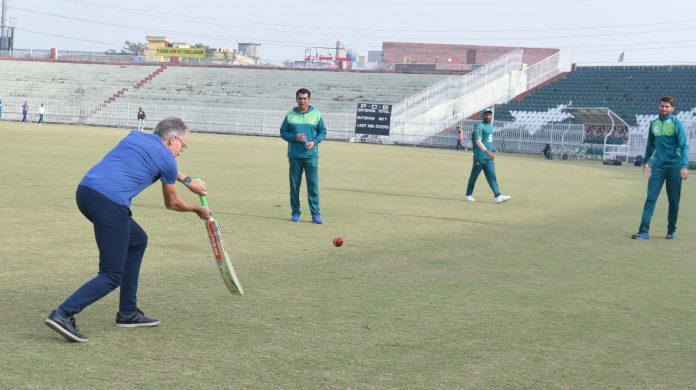
ISLAMABAD: The Australian High Commissioner to Pakistan Neil Hawkins on Sunday met the players and officials of Pakistan cricket test squad and expressed good wishes for Pakistan team’s visit to Australia.

Australian High Commissioner visited Pindi cricket stadium and meet the Pakistan test team captain Shan Masood, Babar Azam, Shaheen Afridi, Muhammad Rizwan and other members along with team director Mohammad Hafeez and inquired about the preparations of upcoming three matches test series against Australia. 

https://googleads.g.doubleclick.net/pagead/ads?client=ca-pub-7078513716629609&output=html&h=280&slotname=3959878650&adk=3720526663&adf=912248345&pi=t.ma~as.3959878650&w=696&fwrn=4&fwrnh=100&lmt=1701013928&rafmt=1&format=696×280&url=https%3A%2F%2Fislamabadpost.com.pk%2Faustralian-high-commissioner-meet-pakistan-test-squad%2F&ea=0&host=ca-host-pub-2644536267352236&fwr=0&fwrattr=true&rpe=1&resp_fmts=3&wgl=1&dt=1701013928113&bpp=2&bdt=1978&idt=585&shv=r20231109&mjsv=m202311150101&ptt=9&saldr=aa&abxe=1&cookie=ID%3D513e85dde3056014%3AT%3D1700224343%3ART%3D1701013645%3AS%3DALNI_MaKWFcFNveLkqytCkRThEvJ12IfjA&gpic=UID%3D00000cdc35875322%3AT%3D1700224343%3ART%3D1701013645%3AS%3DALNI_MaHjzDZAymnaDRE6mwnwHlKd6VQzg&prev_fmts=0x0%2C696x280&nras=1&correlator=1103220319807&frm=20&pv=1&ga_vid=1176940254.1701013928&ga_sid=1701013928&ga_hid=1161474816&ga_fc=0&u_tz=300&u_his=3&u_h=768&u_w=1366&u_ah=728&u_aw=1366&u_cd=24&u_sd=1&adx=141&ady=1628&biw=1349&bih=643&scr_x=0&scr_y=0&eid=44759875%2C44759926%2C42532524%2C44795922%2C44809315%2C31078301%2C31079757%2C44806139%2C44807764%2C44808149%2C44808284%2C44809056&oid=2&pvsid=3137578993304496&tmod=1367465016&uas=3&nvt=1&ref=https%3A%2F%2Fislamabadpost.com.pk%2F&fc=1920&brdim=-8%2C-8%2C-8%2C-8%2C1366%2C0%2C1382%2C744%2C1366%2C643&vis=1&rsz=%7C%7CoeEbr%7C&abl=CS&pfx=0&fu=128&bc=31&psd=W251bGwsbnVsbCxudWxsLDNd&ifi=3&uci=a!3&btvi=2&fsb=1&dtd=592

Team Director Mohammad Hafeez informed Neil Hawkins about the team preparations of test squad for upcoming series.

The Australian High Commissioner also played cricket with players and expressed his good wishes for Pakistan team’s visit to Australia. 

https://googleads.g.doubleclick.net/pagead/ads?client=ca-pub-7078513716629609&output=html&h=280&slotname=3959878650&adk=3720526663&adf=474682421&pi=t.ma~as.3959878650&w=696&fwrn=4&fwrnh=100&lmt=1701013928&rafmt=1&format=696×280&url=https%3A%2F%2Fislamabadpost.com.pk%2Faustralian-high-commissioner-meet-pakistan-test-squad%2F&ea=0&host=ca-host-pub-2644536267352236&fwr=0&fwrattr=true&rpe=1&resp_fmts=3&wgl=1&dt=1701013928115&bpp=6&bdt=1980&idt=687&shv=r20231109&mjsv=m202311150101&ptt=9&saldr=aa&abxe=1&cookie=ID%3D513e85dde3056014%3AT%3D1700224343%3ART%3D1701013645%3AS%3DALNI_MaKWFcFNveLkqytCkRThEvJ12IfjA&gpic=UID%3D00000cdc35875322%3AT%3D1700224343%3ART%3D1701013645%3AS%3DALNI_MaHjzDZAymnaDRE6mwnwHlKd6VQzg&prev_fmts=0x0%2C696x280%2C696x280&nras=1&correlator=1103220319807&frm=20&pv=1&ga_vid=1176940254.1701013928&ga_sid=1701013928&ga_hid=1161474816&ga_fc=0&u_tz=300&u_his=3&u_h=768&u_w=1366&u_ah=728&u_aw=1366&u_cd=24&u_sd=1&adx=141&ady=2072&biw=1349&bih=643&scr_x=0&scr_y=0&eid=44759875%2C44759926%2C42532524%2C44795922%2C44809315%2C31078301%2C31079757%2C44806139%2C44807764%2C44808149%2C44808284%2C44809056&oid=2&pvsid=3137578993304496&tmod=1367465016&uas=3&nvt=1&ref=https%3A%2F%2Fislamabadpost.com.pk%2F&fc=1920&brdim=-8%2C-8%2C-8%2C-8%2C1366%2C0%2C1382%2C744%2C1366%2C643&vis=1&rsz=%7C%7CoeEbr%7C&abl=CS&pfx=0&fu=128&bc=31&psd=W251bGwsbnVsbCxudWxsLDNd&ifi=4&uci=a!4&btvi=3&fsb=1&dtd=696

The tour will open at the Perth Stadium on 14 December and it will mark the first instance of Pakistan playing a Test at the venue. 

The two teams will face off in the Boxing Day Test at the iconic Melbourne Cricket Ground from 26 till 30 December and the third and final match will be played at the Sydney Cricket Ground from 3 January, 2024.

To move China-U.S. relations on track of healthy, stable, sustainable development

To move China-U.S. relations on track of healthy, stable, sustainable development

By Zhong Sheng, People’s Daily

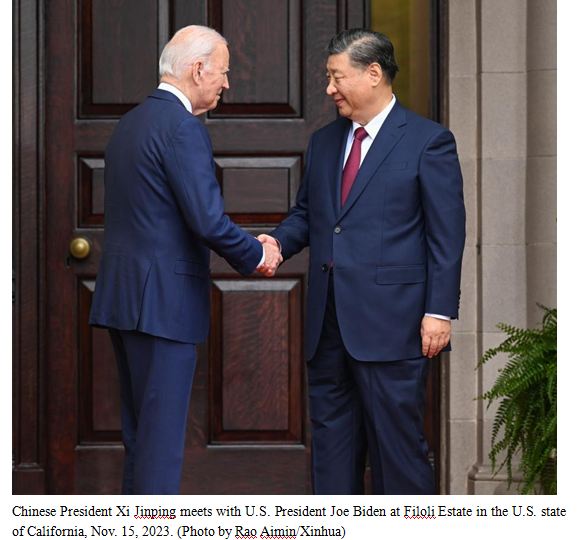
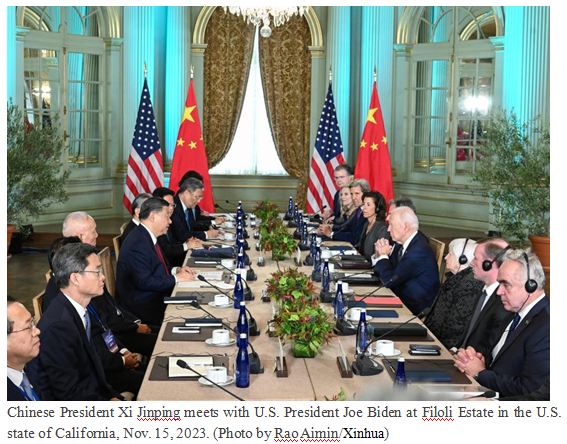
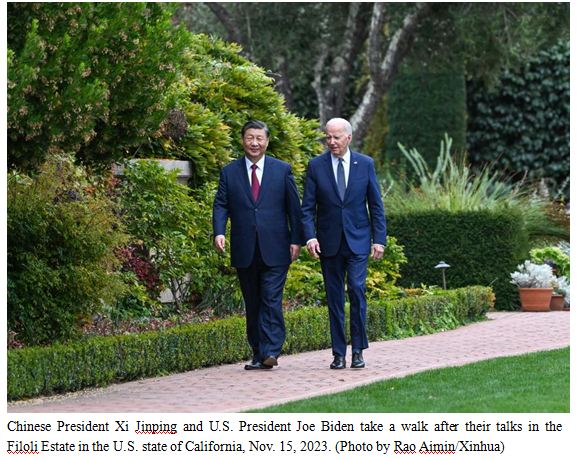
Chinese President Xi Jinping met with U.S. President Joe Biden at Filoli Estate, San Francisco on Nov. 15, local time. It was a strategically significant and far-reaching meeting of the two heads of state.

Xi and Biden had an exchange of views on strategic and overarching issues critical to the direction of China-U.S. relations and on major issues affecting world peace and development.

Xi gave a comprehensive and authoritative presentation on China’s position on stabilizing and improving China-U.S. relations, stressing the importance of making the right choice for history, finding the right way to get along and fostering a San Francisco vision for the relations.

The meeting is significant for enhancing trust, removing suspicion, managing differences and expanding cooperation between China and the United States. It is also significant for injecting certainty and stability into a world of turbulence and transformation.

China and the United States are the world’s top two economies. Are China and the United States partners or rivals? Should they engage in mutually beneficial cooperation or antagonism and confrontation? This is a fundamental question on which disastrous mistakes must be avoided.

If one sees the other side as a primary competitor, the most consequential geopolitical challenge and a pacing threat, it will only lead to misinformed policy making, misguided actions, and unwanted results.

For China and the United States, turning their back on each other is not an option, Xi noted, stressing it is unrealistic for one side to remodel the other, and conflict and confrontation has unbearable consequences for both sides.

Major-country competition cannot solve the problems facing China and the United States or the world, he continued, noting that the world is big enough to accommodate both countries, and one country’s success is an opportunity for the other.

China hopes that the two countries could be partners, perceiving and envisioning China-U.S. relations from the perspective of the future of humanity and Planet Earth. This fully demonstrated China’s major country responsibility for history, people and the world.

The fundamental principles that China follows in handling China-U.S. relations are mutual respect, peaceful coexistence and win-win cooperation, which are the lessons learned from 50 years of China-U.S. relations and the conflicts between major countries in history. They should be the direction of joint efforts between the two countries.

Just as mutual respect is a basic code of behavior for individuals, it is fundamental for China-U.S. relations. The two countries’ paths are different, but both are the choice by their peoples, and both lead to the realization of the common values of humanity. They should be both respected.

Peaceful coexistence is a basic norm for international relations, and is even more of a baseline that China and the United States should hold on to as two major countries.

China never bets against the United States, and never interferes in its internal affairs. China has no intention to challenge the United States or to unseat it. Instead, it will be glad to see a confident, open, ever-growing and prosperous United States.

Likewise, the United States should not bet against China, or interfere in China’s internal affairs. It should instead welcome a peaceful, stable and prosperous China.

Win-win cooperation is the trend of the times, and it is also an inherent property of China-U.S. relations.

China is pursuing high-quality development, and the United States is revitalizing its economy. There is plenty of room for their cooperation, and they are fully able to help each other succeed and achieve win-win outcomes. They should make the cooperation list longer and the pie of cooperation bigger.

Recently, the two countries have been actively implementing the consensus reached by the two heads of state in Bali, Indonesia, creating conditions for fostering a San Francisco vision for the relations.

During his meeting with Biden this time in San Francisco, Xi said that China and the United States should jointly develop a right perception, jointly manage disagreements effectively, jointly advance mutually beneficial cooperation, jointly shoulder responsibilities as major countries, and jointly promote people-to-people exchanges.

Through joint efforts in these five areas, five pillars can be put in place for China-U.S. relations to grow steadily and a new vision is fostered for China-U.S. relations going into the future.

The summit meeting reached more than 20 deliverables in such areas as political affairs and foreign policy, people-to-people exchange, global governance, and military and security.

On principles guiding the China-U.S. relations, the two presidents endorsed the efforts of their respective diplomatic teams to discuss principles related to China-U.S. relations since the Bali meeting and the common understandings arising from those discussions.

They stressed the importance of all countries treating each other with respect and finding a way to live alongside each other peacefully, and of maintaining open lines of communication, preventing conflict, upholding the United Nations Charter, cooperating in areas of shared interest, and responsibly managing competitive aspects of the relationship.

These seven points of common understanding are very important in that they provide a solid foundation for deeper discussions going forward. They are further proof of the broad common interests of China and the United States and the mutually beneficial nature of China-U.S. relations. They demonstrate that dialogue and cooperation is the only right choice for the two countries.

China and the United States are different in history, culture and social system, and how to deal with these differences is an important issue that both sides always need to address.

China is committed to having a stable, healthy and sustainable relationship with the United States. At the same time, China has legitimate interests that must be safeguarded, principles and positions that must be upheld, and red lines that must not be crossed.

If the U.S. side is bent on encircling and containing China under the pretext of competition, China will firmly uphold its sovereignty, security and development interests.

The Taiwan question remains the most important and most sensitive issue in China-U.S. relations. China urges the United States to honor the one-China principle, oppose “Taiwan independence,” stop arming Taiwan, stop interfering in China’s internal affairs, and support China’s peaceful reunification. China will realize reunification, and this is unstoppable.

U.S. attempts to curb or suppress China on economy, trade and technology are creating risks instead of “de-risking.” These misguided actions, and the ensuing uncertainty for China-U.S. relations, have become the biggest risk.

Stifling China’s technological progress is nothing but a move to curb China’s high-quality development and deprive the Chinese people of their right to development. China will not accept that and such a move will not succeed.

China’s development and growing strength, powered by strong internal drivers and its own inherent logic, will not be stopped by external forces. It is important that the U.S. side take China’s concerns seriously, lift unilateral sanctions, and provide an equal, fair, and nondiscriminatory environment for Chinese businesses.

A stabilizing and improving China-U.S. relationship is in the fundamental interests of the two countries and the common aspiration of the international community. Under the stewardship of the two presidents, the giant ship of China-U.S. relations has navigated hidden rocks and dangerous shoals.

The journey from Bali to San Francisco has not been an easy one. However, San Francisco should not be the finish line; it should be a new starting point. From San Francisco onward, the two sides should foster a new vision, further consolidate the foundation of their relations, build pillars for peaceful coexistence, and move their relationship in the direction of healthy, stable and sustainable development.

(Zhong Sheng is a pen name often used by People’s Daily to express its views on foreign policy and international affairs.)

To move China-U.S. relations on track of healthy, stable, sustainable development

Punjab CM assures Sikh pilgrims of resolving visas, other issues

Punjab CM assures Sikh pilgrims of resolving visas, other issues

LAHORE, NOV 26 (DNA) — A 39-member delegation of Sikh pilgrims visiting Baba Guru Nanak’s birthday celebrations met with Punjab Chief Minister Mohsin Naqvi on Sunday. During the meeting, Chief Minister Mohsin Naqvi noted down the suggestions and recommendations of the Sikh pilgrims and assured them of their redressal.

On the instructions of Chief Minister Mohsin Naqvi, Provincial Minister Auqaf Azfar Nasir and Additional Chief Secretary will go to Nankana Sahib for the birthday celebrations. Chief Minister Mohsin Naqvi and IG Punjab talk to Sikh pilgrims in pure Punjabi language and welcomed them in Punjabi.

He will solve the visa issue and other problems facing the Sikh pilgrims as soon as possible, Mohsin Naqvi assured them. Mohsin Naqvi said that we welcome the elders Sikh pilgrims come to Lahore, but the youth should come to Lahore as well.

In Gujranwala, the old Gurdwara and ancient mansions will be constructed and restored, said Mohsin Naqvi. Not tourism, Sikh brothers are called here with love, Mohsin Naqvi said. Pakistani jaggery is healthy and delicious and such Pakistani goods can be sold a lot in Canada, a Sikh pilgrim Gyan Singh Gill suggested.

This is the best opportunity for Pakistan to increase business in Canada, Gyan Singh Gill advised. The people from Lahore and Amritsar live together in Canada, Gyan Singh Gill said. Chief Minister Mohsin Naqvi invited them in his office which is owner for us and we are thankful to him for a cup of tea, they said.

Provincial Ministers Aamir Mir, Azfar Ali Nasir, Additional Chief Secretary, Inspector General of Police, Secretary Human Rights, Secretary Tourism, Chairman PITBO and other relevant officials were also present on the occasion. — DNA

Stay Connected

64FansLike
60FollowersFollow

Latest Reviews

Exchange Rates

USD - United States Dollar
EUR
1.17
GBP
1.35
AUD
0.72
CAD
0.73