Quito, Jan 11:With city streets largely deserted apart from a massive military deployment, Ecuador found itself in a "state of war" Wednesday as drug cartels waged a brutal campaign of kidnappings and attacks in response to a government crackdown.
              Hundreds of soldiers patrolled the capital Quito, where residents were gripped by fear over a surge of violence that has also prompted alarm abroad.
              The small South American country has been plunged into crisis after years of growing control by transnational cartels that use its ports to ship cocaine to the United States and Europe.
              The latest outburst of violence was sparked by the discovery Sunday of the prison escape of one of the country's most powerful narco bosses, Jose Adolfo Macias, known by the alias "Fito."
              On Monday, President Daniel Noboa imposed a state of emergency and nighttime curfew, but the gangs hit back with a declaration of "war" -- threatening to execute civilians and security forces.
              They have also instigated numerous prison riots, set off explosions in public places and waged attacks in which at least 14 people have been killed.
              More than 100 prison guards and administrative staff have been taken hostage, the SNAI prisons authority said.
              In the port city of Guayaquil, attackers wearing balaclavas stormed a state-owned TV station Tuesday, briefly taking several journalists and staff members hostage and firing shots in dramatic scenes broadcast live before police arrived.
              Local media reported some of the attackers were as young as 16.
              This attack in particular gave rise to panic in the general population, many of whom left work and closed shops to run to the safety of home.
              "Today we are not safe, anything can happen," said Luis Chiligano, a 53-year-old security guard in Quito who explained he was opting to hide rather than confront "the criminals, who are better armed."
              "There is fear, you need to be careful, looking here and there, if you take this bus, what will happen," a 68-year-old woman told AFP elsewhere in the capital -- speaking on condition of anonymity and describing herself as terrified.
Noboa said Wednesday the country was now in a "state of war," as he vowed not to yield to the gangs.Ecuador ‘in state of war’ on third day of cartel terror campaign
Brunei’s polo-playing prince marries commoner
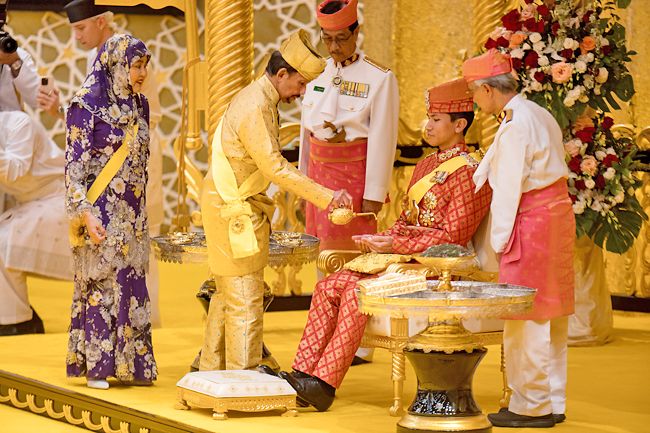
Bandar Seri Begawan, :Brunei's polo-playing Prince Abdul Mateen, one of Asia's most eligible bachelors, married his commoner fiancee on Thursday as part of a lavish 10-day celebration in the oil-rich sultanate.
              An Islamic marriage ceremony for the 32-year-old prince and Yang Mulia Anisha Rosnah, 29, was held inside a gold-domed mosque in the capital Bandar Seri Begawan.
              Mateen is the 10th child of Sultan Hassanal Bolkiah -- the world's longest reigning monarch and once the richest man on the planet -- and is well down the succession pecking order.
              His bride -- the granddaughter of one of his father's key advisers -- reportedly has a fashion brand and co-owns a tourism business.
              Mateen, wearing a traditional white outfit decorated with diamond-shaped motifs and a matching headpiece, was driven to the mosque in a luxury saloon.
              He sat on an elevated yellow cushion in front of an imam who presided over the male-only ceremony attended by the sultan and other relatives and guests.
              Afterwards, Mateen approached his father and kissed his hand.
              Celebrations for the royal wedding reach their climax on Sunday with a glittering ceremony in the 1,788-room palace and an elaborate procession.
              The guest list is expected to include international royalty and political leaders.
              "It's like a fairytale," university student Syahida Wafa Mohamed Shah, 22, told AFP on Wednesday, near the Omar Ali Saifuddien Mosque, where the marriage was solemnised.
              Many Bruneians plan to line the streets on Sunday to watch the royal newlyweds take part in a procession.
              "It's like something from a movie," said Nazatul Izzati Saifulrizal, 19.

              The pomp and pageantry of the royal extravaganza highlight the tiny country's extreme wealth, which is almost entirely derived from its enormous oil reserves.
              A sliver of land on the northern edge of Borneo island in Southeast Asia, Brunei was influenced by Buddhism and Hinduism before its rulers converted to Islam in the 14th century.
              It fell under British rule in the 19th century and gained independence in 1984.
              An absolute monarchy with strict Islamic laws and a population of only around 450,000 people, Brunei is one of the world's richest countries.
              Its annual GDP per capita is nearly $36,000, according to the International Monetary Fund. However, analysts have warned that Brunei faces serious challenges to diversify its economy away from oil as crude prices remain volatile and its reserves dwindle.
              While the sultan has long lost the title of the world's richest man to tech billionaires, his wealth remains the stuff of legend.
              He is reported to have a vast collection of luxury vehicles and his riverside official residence is one of the world's largest palaces.

              While Mateen is unlikely to ever ascend the throne, his matinee idol looks and huge following on social media have made him one of the highest-profile members of the royal family.
              A helicopter pilot in his country's air force, he has often been compared in the media with Britain's Prince Harry and was previously dubbed the "hot royal".
              Mateen graduated as an officer cadet in Britain's Royal Military Academy Sandhurst and represented his country in polo at the 2019 Southeast Asian Games.
              In recent years, he has played a growing role in international diplomacy.
              The prince accompanied his father to the coronation of King Charles and Queen Camilla in May last year, and Queen Elizabeth's funeral in 2022.
DRAP recalls syrup after detection of ‘poisonous impurities’

DRAP recalls syrup after detection of ‘poisonous impurities’
ISLAMABAD: Following the detection of “poisonous impurities,” the Drug Regulatory Authority of Pakistan (DRAP) recalled a cough syrup and imported raw material used in it, The News reported on Thursday.
The “poisonous impurities” were detected in the cough syrup during testing at the Central Drug Testing Lab (CDL) Karachi, the publication quoted officials as saying.
The raw material, Propylene Glycol was imported by a local firm from Thailand and supplied to different pharmaceutical companies throughout the country for manufacturing of cough syrups, which are high in demand these days due to the outbreak of influenza and other respiratory illnesses in the country, DRAP officials added.
“Today we have ordered recall of Delorvin Syrup, and Propylene Glycol, a raw material used in the manufacturing of cough syrup. During testing, poisonous amount of two lethal impurities i.e. Ethylene Glycol (EG) and Diethylene Glycol (EG) were detected in the cough syrup and the raw material used in it”, a senior DRAP official told The News.
In addition to recalling the cough syrup and raw material used in the manufacturing of the syrup, DRAP officials launched a countrywide investigation to identify the importer who provided the raw material to different pharmaceutical companies and ascertain the companies which used the “substandard” raw material.
Propylene Glycol is used as an excipient or non-active pharmaceutical ingredient in manufacturing of syrups, especially cough syrups, experts said, adding that some companies try to use industrial-grade Propylene Glycol, which was not safe for human consumption as it carried “poisonous levels” of Ethylene Glycol and Diethylene Glycol.
Hundreds of children have so far died in many countries after some Indian companies exported cough syrups containing poisonous impurities, including EG and DEG, while a few weeks back, some cough syrups manufactured by a Lahore-based pharmaceutical company were also detected by the World Health Organization (WHO) in Maldives and some other countries of the world.
DRAP official claimed that a pharmaceutical firm itself approached the drug regulatory authority to get the cough syrup tested for poisonous impurities and when the prepared batch of the cough syrup and raw material was tested at the CDL Karachi, it was found to be substandard, containing poisonous impurities.
To a query, DRAP’s senior official said every pharmaceutical company was supposed to test all the active as well as non-active raw materials for impurities for the safety of patients adding that DRAP was also starting “risk-based sampling and testing” of raw materials being imported in the country. Asked why criminal proceedings were not being launched against the manufacturers and importers, the DRAP official said some of the companies would be prosecuted as they were found involved in criminal activities.
“Here in this fresh case, we suspect that some middle man imported raw material from an authentic source in Thailand but later added industrial grade material in it to increase its quantity and provided it to the manufacturers. We are not only recalling the raw material imported by this middle man but are also going to lodge a criminal case if any wrongdoing was proved after investigations,” the official added.
MQM-P names contestants from Karachi for NA seats

KARACHI: The Muttahida Qaumi Movement-Pakistan (MQM-P) on Thursday released a list of the party candidates contesting elections on National Assembly seats from Karachi, according to which MQM-P’s 16 candidates would contest elections from 18 NA seats in the megalopolis, Geo News reported.
As per the list, in order from the lower number of NA seats to the higher number, MQM-P will field Aasia Ishaque from NA-232, Javed Hanif from NA-233, Muhammad Abubakar from NA-234, Iqbal Mahsud from NA-235 and Hassan Sabir from NA-236 constituency of Karachi.
While, Abdul Rauf Siddiqui will contest elections on NA-237 seat, Sadiq Iftikhar on NA-238, Arshad Vohra on NA-240 and Dr Farooq Sattar from district South’s NA-241.
MQM-P Senior Deputy Convener Mustafa Kamal will contend for the hot seat of NA-242 situated in Keamari district. The Pakistan Muslim League-Nawaz has been luring the party to withdraw its candidate in favour of former prime minister Shehbaz Sharif.
Humayun Usman will be the candidate for NA-243 seat, Farooq Sattar for NA-244, Hafizuddin for NA-245, Aminul Haque for NA-246 and Mustafa Kamal for NA-247.
MQM-P Convener Khalid Maqbool Siddiqui will be the party candidate on NA-248 seat in district Central, while Ahmed Saleem Siddiqui will contest on NA-249 and Farhan Chishti on NA-250.
The party did not issue any NA ticket to a candidate for the NA seat in Lyari.
Ministry Condemns Israeli Policies Targeting Palestinian Civilians
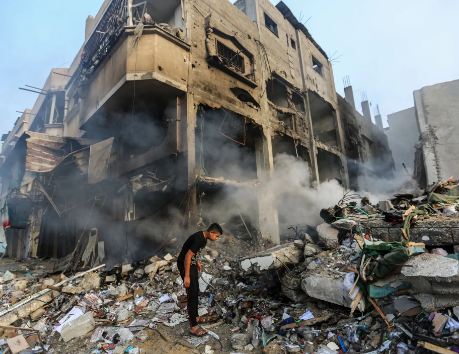
The Ministry believes that the Israeli right and the ruling extreme right follow a clear-cut policy that, through its application, deliberately targets Palestinian civilians throughout the occupied Palestinian territory, and strikes and persecutes all elements of their existence and human survival in their homeland, and does not waste any opportunity to harm the dignity of citizens and confiscate their livelihoods and their ability to fulfill their obligations.
Humanity towards their children and their future, through a long series of unilateral, illegal measures that achieve this racist colonial goal on a daily basis, whether by confiscating the lands of the Palestinian citizen and granting them to a handful of colonizers to protect his hearing and sight, or demolishing his home and economic interests under flimsy pretexts that have nothing to do with international law.
To the obligations of the occupying power, and subject it to a series of unlimited collective punishments that control its ability to move and reach its interests and businesses outside the scope of its residence, as the occupation army is creative in erecting thousands of iron gates, military towers and death barriers that strangle every camp, town and city and cut off the pieces of the occupied West Bank. Turning them into prisons from which exit or entry is not permitted except with the approval of the occupying Israeli. This is in addition to the systematic daily intimidation operations represented by invasions, raids, arrests, and field executions, which are always accompanied by heavy firing of bullets, sound bombs, and gas bombs over the heads of defenseless citizens, and the demolition of infrastructure, including streets, water lines, electricity, and sewerage, as collective punishment of Palestinian citizens.
This is the case in the occupied West Bank, including East Jerusalem, the intensity of which escalated significantly with the beginning of the war of extermination against our people in the Gaza Strip, in the intense hostility of the Israeli extreme right to the Palestinians, under the guidance of Smotrich and Ben Gvir.
The Ministry confirms that this futile policy expresses a state of loss of balance that is now controlling decision-making centers in Israel and does not lead anywhere except more escalation, igniting fires, and an endless cycle of violence.
It also affirms that the steadfastness and survival of the Palestinian people in their homeland is a constant foundation in their lives and will not leave it anywhere in the world, which requires the decision-making circles in the occupying state to acknowledge the failure of its oppressive and abusive policies and procedures against citizens, and to take the initiative to recognize their right to self-determination and the embodiment of their state. On the ground as the only gateway to achieving security and stability for both sides of the conflict, the region and the world.
Security forces neutralize terrorists in Lakki Marwat, two brave soldiers martyred
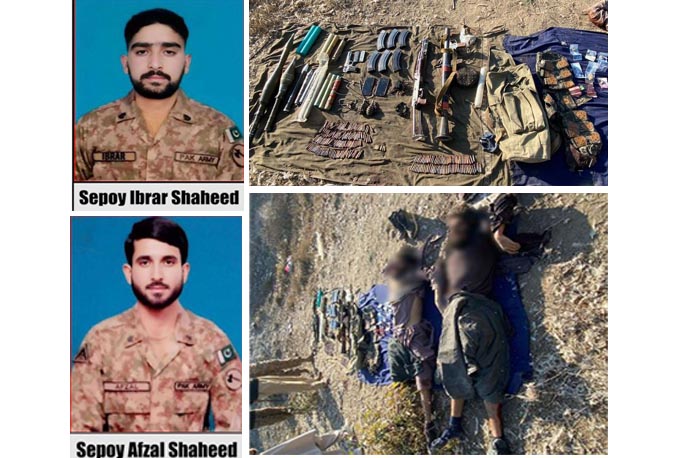
Rawalpindi, JAN 10 /DNA/ – A fire exchange took place between security forces and terrorists in Lakki Marwat district.
Own troops effectively engaged the terrorists’ location as a result of which two terrorists were sent to hell; Aftab @Malang and Terrorist Masood Shah.
These terrorists remained actively involved in numerous terrorist activities against the security forces as well as target killings of innocent civilians. Weapons, ammunition and explosives were also recovered from them.
However, during intense exchange of fire, two brave soldiers; Sepoy Muhammad Afzal (age 29 years; resident of district Bhimber, Azad Kashmir) and Sepoy Ibrar Hussain (age 27 years; resident of district Mansehra), having fought gallantly, embraced Shahadat.
Sanitization operation is being carried out to eliminate any terrorists found in the area as the Security forces of Pakistan are determined to wipe-out the menace of terrorism from the country and such sacrifices of our brave soldiers further strengthen our resolve.
RCCI organizes Belgian business contact day and catalogue exhibition
DNA
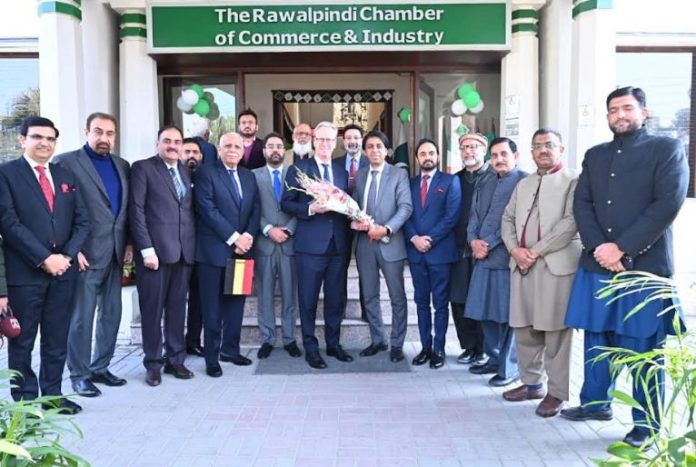
RAWALPINDI: The Rawalpindi Chamber of Commerce and Industry (RCCI) organized the Belgian Business Contact Day and Catalogue Exhibition at the chamber house here on Wednesday.
Books, magazines and trade directories were part of the catalogue exhibition providing an opportunity for visitors to get information about key sectors including tourism, education, services, agro-food processing, chemicals, surgical instruments, paper and paperboard, dairy and renewable energy.
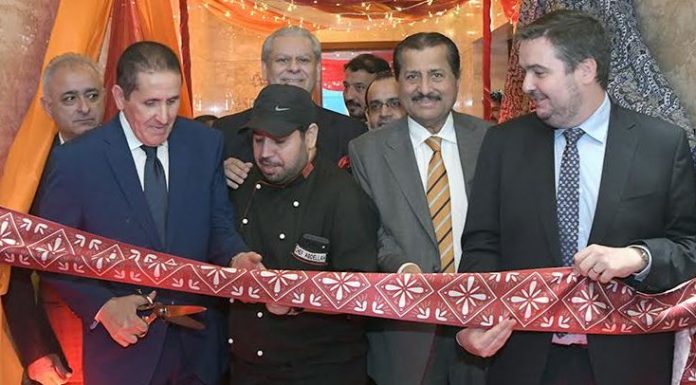
Ambassador of Belgium H.E Charles Delogne who was the chief guest on the occasion, inaugurated the Belgian Business Contact Day and Catalogue Exhibition. President RCCI Saqib Rafiq in his welcome remarks gave a short summary of RCCI current activities and upcoming programs. He briefed the Belgium Ambassador about the potential opportunities for joint ventures and investment opportunities in Pakistan. He said that Belgium was one of Pakistan’s important trading partners within the European Union. He assured that RCCI will work closely with the Belgium Embassy to further strengthen connectivity between private sectors of both countries.
Charles Delogne, Ambassador of Belgium, said that current Generalised System of Preferences (GSP) for another four years, until 2027 and it’s a great opportunity for Pakistan to implement GSP Plus conventions, especially labor rights, human rights and environmental protection which would help Pakistan to further improve its trade with EU countries.
Belgium has excellent relations with Pakistan and added that Belgium is the 5th largest trading partner of Pakistan in the EU and it is interested to further enhance cooperation with Pakistan in various sectors including trade, scientific research, renewable energy, and education sectors.
Senior Vice President Muhammad Hamza Sarosh , Vice President Faisal Shahzad and Executive Committee Members, Trade Commissioner Abid Husain, Commercial officer Shaukat Niazi and members of the RCCI were also present on the occasion.
PIPD celebrates cultural day of Romania in Islamabad
ISLAMABAD, JAN 10 /DNA/ – Pakistan and Romania enjoy great cordial and friendly relations based upon mutual trust and close cooperation.
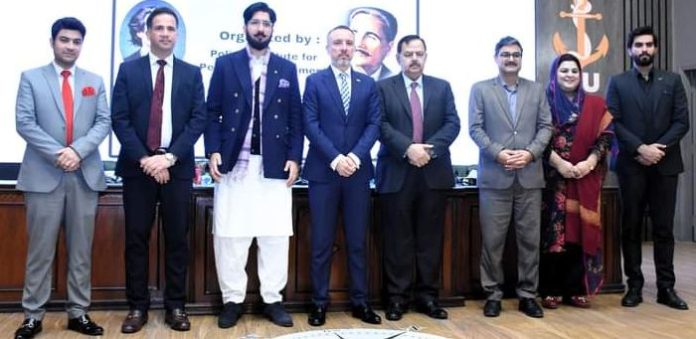
In an effort to further strengthen the cultural and literary bond between the two nations, Policy institute for peace and development in collaboration with the Embassy of Romania and Bahria University organized a conference aiming the cultural diplomacy among the two countries under the topic “Allama Iqbal & Mihai Eminescu-cultural linkages between Pakistan and Romania”
The aim of the conference was to pay tribute to the national poets of Pakistan and Romania and to highlight the uniqueness and the similarities among them, the conference was specifically organized to mark the cultural day of Romania which is the Birthday the Great Mihai Eminescu.
On the occasion Eduard-Robert Preda (Charge d’Affairs, Embassy of Romania) Thanked PIPD and Bahria University for organizing an event and paid tribute to Mihai Eminescu (The National poet of Romania), who was born on January 15, 1850.
He further said that every year on January 15, Romania celebrates cultural day on the Birthday of the Great Mihai Eminescu and highlighted its significance and emphasized that this day serves to promote Romanian culture both within the country and abroad.
H.E Eduard Robert Preda further added an overview of the legacy of the poet, and how positively he transformed the Romanian poetry, creating a distinct school of poetry that resonated strongly in the west, he also recited a poem of Eminescu in Romanian language in an effort to convey it in the proper intellect and Rhythm, offering a glimpse into the rich cultural tapestry of Romania, which was highly appreciated and liked by the audience.
On this occasion, President Policy Institute for Peace & Development Ms.Wadana Gul in her speech stressed upon the crucial role of cultural diplomacy and people to people contact in bringing the nations closer.
She expressed the dire need for cross-cultural collaboration between Pakistan and Romania both at the government and the public level to further enhance the ties and faster the already strong diplomatic relations.
Maj Gen (Rtd) Khalid Amir Jaffery further delved into the rich history of Romania, noting its resilience through various empires, including the Roman Empire, the Austro-Hungarian Empire, and the Ottoman Empire. He shared the lesser known historical anecdote, Recounting how soldiers from the British Indian Army, Mainly from Punjab and Khyber Pakhtunkhwa, fought alongside the Romanian Army in World War 1.
Highlighting the diplomatic relations established in 1964, Maj.Gen Jaffery applauded the strong support Romania provided to Pakistan, particularly in matters such as the GSP plus issue, resulting in a significant 30% increase in Pakistan’s exports to Europe and further emphasized the vast potential for export and import between the two countries.
Stressing on the importance of people to people contact, Maj.Gen Jaffery also highlighted the significance of cultural understanding. He complimented Romania’s management of its multicultural society and advised for increased interactions and collaborations among the two nations.
Adding to the knowledgeable and the fruitful event, Mr Sahibzada Sultan Ahmed, Chairman Muslim Institute, highly appreciated PIPD for holding the conference and further nurtured the audience with the philosophy of Allama Iqbal.
He further paid tribute to Allama Iqbal and explained the legacy of the national poet.
Dean Department of social sciences Dr. Adam Saud Presented a scholarly point of view about the historical and the current Perspective of relations between Romania and Pakistan while exploring the new domains of cooperation and strengthening of bilateral ties.
He said that there exist a number of areas in which Romania and Pakistan can work jointly and mutually collaborate aiming to further strengthen the bilateral relation.
The students of Bahria University showed great interest and actively participated in the conference by translating the poems of Mihai Eminescu from English to Urdu language and recited them on the stage which was highly appreciated by Charge d’affairs H.E Eduard Preda and further motivated the students by distributing certificates among them.
Blinken meets Palestinian leader after urging Israel to spare Gaza civilians
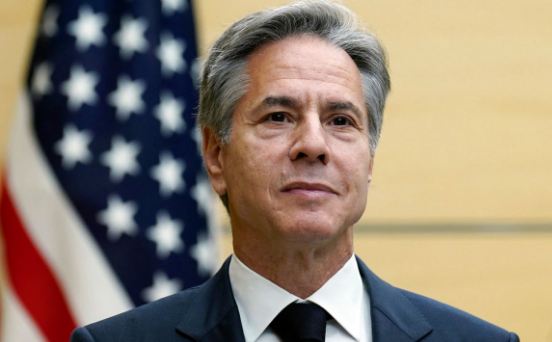
Ramallah, Palestinian Territories, Jan 10 (AFP/APP/DNA): Israel kept bombing Gaza on Wednesday as US top diplomat Antony Blinken met the head of the Palestinian Authority, which Washington hopes could govern the coastal territory after the war ends.
As the US secretary of state arrived under tight security in Ramallah in the occupied West Bank, protesters held up signs that read “Stop the genocide”, “Free Palestine” and “Blinken out”.
Blinken then met Palestinian President Mahmud Abbas, who was later set to discuss a “push for an immediate ceasefire” in talks with Jordan’s King Abdullah II and Egyptian President Abdel Fattah al-Sisi in the Red Sea port city of Aqaba.
The bloodiest ever Gaza war started by the October 7 attack on southern Israel has raged on for more than three months and killed over 23,000 people in the Strip.
Global concern has flared over the spiralling humanitarian crisis, and Blinken — while voicing continued US political and military support for top regional ally Israel — has urged steps to reduce the surging civilian death toll.
Dire shortages brought by an Israeli siege mean the “daily toll on civilians in Gaza, particularly children, is far too high,” Blinken said on Tuesday at a joint press conference with Prime Minister Benjamin Netanyahu.
PM for establishing global fund to ensure worldwide health security
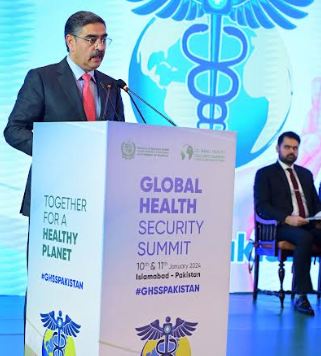
ISLAMABAD, JAN 10: /DNA/ – Caretaker Prime Minister Anwaar-ul-Haq Kakar on Wednesday stressed the need to explore mechanisms for global funding that could support nations in need, ensuring that no one was left behind, in the global pursuit of health security.
“The call for a sufficiently funded, widely supported country medium-term road-map, as highlighted in the International Health Regulations Core Capacities evaluation, resonates globally. We must invest in open, transparent, and multi-sectoral processes to strengthen buy-in and commitment at all levels,” the prime minister said while addressing the inaugural session of the first-ever two-day Global Health Security Summit 2024.
Highlighting the importance of enhancing coordination in the health sector beyond borders, Prime Minister Kakar said “One Health” approach, recognized the interconnectedness of human, animal, and environmental health. “Our commitment should extend to establishing global frameworks that facilitate information sharing, joint research, and collaborative strategies for an effective response during emergencies.”
He stressed the need for a strong, visible, active surveillance and tiered public health laboratory system that was integral to early detection, response, and mitigation.
He also called for collaboratively working towards establishing international standards for food safety, harmonizing regulations to ensure the highest level of protection for populations worldwide.
“A cross-sectoral approach to managing antimicrobial resistance requires international collaboration,” he said adding “We need a unified front against antimicrobial resistance, with coordinated efforts to develop and enforce global standards for the responsible use of antibiotics and infection prevention,” he remarked.
Highlighting the need of collective response to address external and internal health challenge, he said no state in the world could meet the health challenges all alone. Likewise, he said the internal challenges posed by population growth, rapid urbanization and climate change could not be dealt with by a country alone.
“New diseases, like COVID-19 and climate-induced incidents such as the historic floods of 2022 in Pakistan, are disrupting our citizens’ health and causing social and economic impacts. While the developed world has systems in place to timely respond to such health emergencies, a similar ideal system is lacking in the developing world as health systems are relatively weak,” he added.
The prime minister said the COVID-19 pandemic had taught us invaluable lessons about the importance of collaboration, preparedness, and a unified response. “It is in this spirit that we convene today, not merely as representatives of our respective countries, but as overseers of global health security.”
He called for establishing a shared vision of the world where health security was not a privilege but a universal right and where the strength of a nation’s health systems was measured not only by its capacity to respond to crises but also by its ability to prevent, detect, and mitigate health threats.
“In pursuit of this vision, we must recognize that health security extends beyond the realm of traditional healthcare. It encompasses multi-spectral collaboration, as highlighted in the “Joint External Evaluation of International Health Regulations Core Capacities,” where the interplay of health, environment, agriculture, and security is crucial. Our collective vision is not just about reacting to crises but forging a proactive, precipitated and interconnected global health ecosystem.”
As regards the challenge of climate change, the prime minister said the global Climate Risk Index identifies Pakistan as the eighth most vulnerable country to the impacts of climate change. “As echoed in the “Framework for Climate Resilient Health Systems Pakistan”, we must integrate climate resilience into our health policies and systems. This is not a challenge confined to borders; it is a shared responsibility that necessitates a collective response,” he added.
He said the cost of climate injustice in Pakistan was 33 million affected population, 17,000 deaths, and economic loss of more than 30 billion USD.
The prime minister hoped that the Summit would mark a huge moment in the journey of global progress towards a healthier world besides ensuring a future where health is truly a global asset.
He also appreciated Minister for National Health Services Dr. Nadeem Jan and his ministry for tireless efforts to organize the event successfully.
Caretaker Foreign Minister Jalil Abbas Jilani said the summit was a timely initiative which would help ensure a safer and healthier world for future generations.
He said the COVID-19 pandemic that incurred loss of 3.5 million lives and US$ 12.5 trillion across the globe, ruthlessly exposed the vulnerability of global health security.
He said Pakistan continued to collaborate with the World Health Organization (WHO) and other international entities in shaping global health policies.
He said international cooperation was required to make the health sector more resilient.
Health Minister Dr Nadeem Jan said the summit, aimed at collaborating with global leaders to ensure equity-based pandemic preparedness financing for low and middle-income countries and mutual exchange of knowledge and rich experience with member states and experts around summit thematic areas which focuses on vaccine equity, patent deregulation and transfer of technology.
He said the ongoing global health challenges had highlighted the significance of working together, exchanging information, and taking united action. He said this summit provided a forum to combine our knowledge, exchange perspectives, and establish the partnership that go beyond international boundaries.
Ambassador of the United States to Pakistan Donald Bloom said the US was helping the developing nations to improve their health systems and enabled them effectively responding to future outbreaks.
Deputy Health Minister of Saudi Arabia, Dr Hani Jokhdar said his country believed in importance of the global health security. Besides, he also acknowledged the significance of pandemic fund.
Afghanistan Minister for Public Health Dr Qalandar Ebad said the developing nations needed the international cooperation in health sector as they were not able to tackle the infectious diseases such as Malaria, TB, and HIV Aids alone.
He said both Pakistan and Afghanistan were facing the challenge of the polio disease. He said these infectious diseases could challenge global health security.
Heads of delegations from Turkiye, Kyrgyzstan and Tajikistan also spoke on the occasion.