Home Blog Page 1055

PID strives to foster electoral understanding among masses

PID

ISLAMABAD, Jan 15 (DNA): The Press Information Department (PID) is committed to foster electoral understanding among the masses through awareness campaigns ahead of the general elections in 2024.

The PID, in this regard, has already launched a series of seminars to ensure active civic engagement and participation in the electoral process and elections slated for February 8.

According to the PID, the stakeholders being invited to the seminars included representatives from mainstream political parties, the Election Commission of Pakistan, media, academia, civil society and the general public.

It said these seminars would serve as a platform to educate citizens on the importance of voting, the electoral system, and the role of elected representatives.

“By fostering public awareness, the seminars seek to empower individuals to make informed decisions, ultimately contributing to a more robust and accountable democratic system,” the PID added.

On January 11, the PID organized its first seminar titled ‘Pakistan elections 2024: The Economic Reforms Agenda of Political Parties’ here at a local hotel in Islamabad which had across-the-board representation from the stakeholders.  

According to the PID, the spotlight was on the economic reform agendas presented by political parties of Pakistan gearing up for the 2024 elections.

“The electorate is keenly interested in the economic visions put forth by diverse political entities and this exploration aims to provide a concise overview of the economic landscapes envisioned by the key players in Pakistan’s political arena.”

For general public knowledge, it is informed that the PID had planned three more seminars here in the Capital city on different topics. The second seminar titled ‘Changing Landscape of Pakistani Electorate and Role of Political Parties in Fair Representation’ will be held on January 18, while the third one on the Electoral Code of Conduct: Ethical Practices of Stakeholders Including Media is planned for January 25.

The seminar titled ‘Political Participation and Empowerment of Youth, Women, Transgenders, and Cultural Minorities will be held on February 1.

Gallup World Poll 2022: Analysis of the results of surveys of Uzbekistan residents

Gallup World Poll 2022: Analysis of the results of surveys of Uzbekistan residents

DNA

TASHKENT: The Center for Economic Research and Reforms (CERR) analyzed the annual Gallup World Poll, which is being prepared based on the study of public opinion.


Since 2005, Gallup has been conducting an annual World Poll among 160 countries (1 thousand people per country), which accounts for 98% of the world’s adult population. The Gallup World Poll consists of 100 questions and includes Indexes:
• Law and order;
• Food and accommodation;
• Institutes and infrastructure;
• Good jobs;
• Well-being.
Gallup’s study compares Uzbekistan with the countries of the post-Soviet Eurasian region.
Indicators of Well-being

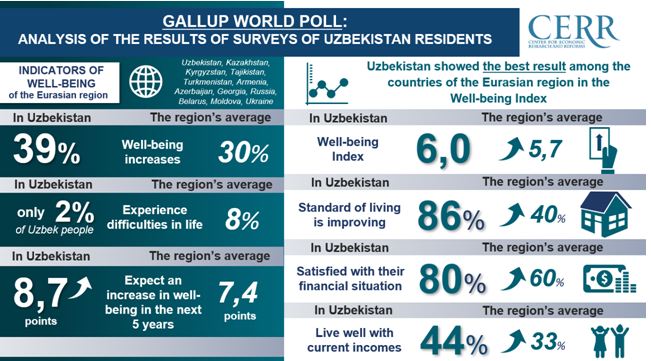
In 2022, the Well-being Index (from 0 to 10 points) was 6.0 points, while the region’s average is estimated at 5.7 points. Consequently, Uzbekistan has shown one of the best results among the countries of the post-Soviet Eurasian region.

The region of post-Soviet Eurasia includes such countries as Uzbekistan, Kazakhstan, Kyrgyzstan, Tajikistan, Turkmenistan, Armenia, Azerbaijan, Georgia, Russia, Belarus, Moldova, Ukraine.

According to the results of the survey in 2022, 39% of Uzbek people indicated that their well-being is currently increasing, which is significantly higher than the region’s average of 30%.

To evaluate life satisfaction, the results of a survey called the Cantril-ladder scale are used. Respondents are asked to imagine a ladder from 0 to 10, where step 0 means the worst possible life, and step 10 means the best possible life.

Only 2% of Uzbek people reported experiencing difficulties in their lives, which is 6% lower than the region’s average result.

Uzbekistan showed the best result among the countries of the region in the Well-being Index.

At the same time, Gallup estimated that Uzbekistan has become the fastest recovering country after the pandemic.

Uzbek people rated their well-being in the next 5 years at 8.7 points. In particular, regarding expectations of future well-being, Uzbekistan showed the highest result in the region, while the region’s average score was 7.4.

86% of respondents stated that standard of living is currently improving, and the average for this indicator in the region was 40%.

80% of the surveyed residents of Uzbekistan expressed their satisfaction with their current financial situation, which is also a high indicator for the region, where the average score was 60%.

44% of Uzbek people believed that they live well with current incomes, whereas the average for the region was 33%.

Indicators of good jobs

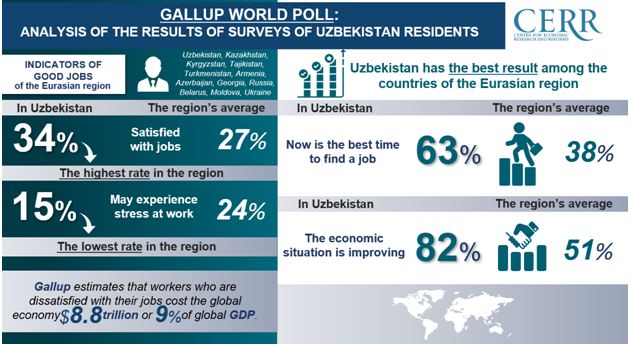
34% of workers in Uzbekistan stated they were satisfied with their jobs. This, in turn, is the highest rate in the region, where the average score was 27%.

According to Gallup estimates, workers who are dissatisfied with their jobs cost the global economy $8.8 trillion, or 9% of global GDP.

15% of workers in Uzbekistan reported that they may experience stress at work, 24% in the region.

Since 2020, the share of those who believe that now is the best time to find a job has increased by 17% and amounted to 63% which is one of the highest rates in the region, where the average score was 38%.

In two years, the confidence of Uzbek people in the improvement of the country’s economy has increased by 7%, reaching 82%. This indicator averaged 51% in the region.

Institutions and infrastructure

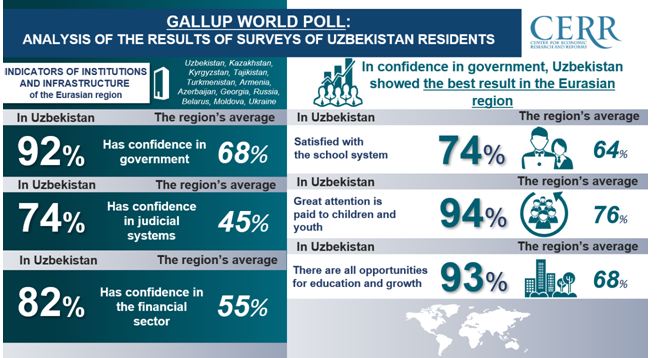
The confidence of Uzbek people in their government has improved and amounted to 92% in 2022, which is one of the best results among the countries of the region, where the average score was 68%.

At the same time, the share of those who have confidence in judicial systems in Uzbekistan has increased by 10% in two years and amounted to 74% in 2022. This indicator is noticeably lower in the region, about 45%.

On average, 55% of the region’s residents have confidence in the financial sector. 82% of Uzbek people expressed “quite high” confidence in the banking and financial system.

94% of Uzbek people note “great” attention to children and youth, which is also a high indicator relative to the region’s average of 76%.

93% of Uzbek respondents reported having all the opportunities for education and growth in the country, compared to 68% in the region.

New resolution seeking polls postponement lands in Senate

New resolution seeking polls postponement lands in Senate

Independent Senator Hilal-ur-Rehman submits a resolution to Senate Secretariat

Khayam Abbasi

ISLAMABAD: Another resolution has been submitted to the Senate Secretariat on Sunday seeking a delay in the general elections slated for February 8 citing harsh weather conditions and security situation as reasons for deferring the polls.

The third resolution seeking to defer elections in the country has been submitted by an independent senator from erstwhile FATA, Hilal-ur-Rehman, in the Senate, only two days after an identical resolution was moved in the upper house of parliament.

In the resolution, Senator Rehman said extreme cold weather and snowfall would create difficulties for the citizens to cast ballots in Khyber Pakhtunkhwa. He also highlighted that candidates participating in the polls encountered numerous challenges in running election campaigns.

The resolution also mentioned that the candidates are wary of terrorist attacks amid “security concerns” in KP.

It said the voters and candidates had a sense of deprivation in the province as the election date in KP is proving to be “infeasible” for the voters in the province.

“Hence, the elections should be deferred to a suitable date from February 8,” the resolution demanded.

Another independent senator, Hidayat Ullah, had submitted a resolution on January 12 calling for postponing the February 8 general elections in view of the “security challenges”.

The resolution said the upper house “calls upon the Election Commission of Pakistan and the Supreme Court” to consider holding peaceful elections and postpone the polls for three months in view of the “security challenges”.

The resolution also expressed concerns over “rising incidents” of targeting of the candidates contesting the upcoming elections.

To the surprise and disbelief of many, on January 5, the Senate unanimously passed a resolution to postpone the February 8 general elections in the country.

Majority of the lawmakers present in the legislature had approved the resolution — seeking polls delay in the light of extreme weather in hilly areas and the deteriorating security situation — moved by independent lawmaker Senator Dilawar Khan.

During the passage of the resolution, only 14 senators were present in the 100-strong Senate. Pakistan Muslim League-Nawaz (PML-N) Senator Afnanullah Khan and caretaker Information Minister Murtaza Solangi had opposed the resolution while PPP’s Senator Bahramand Khan Tangi and PTI’s Senator Gurdeep Singh remained silent.

However, no one raised the quorum of the House during the moving and passage process of the resolution in the Senate.

Speaking in the Senate, mover Dilawar Khan had said that there was a severe winter season in some parts of the country.

He said that there are security threats to the leaders of some political parties and intelligence agencies have issued a security alert of attacks on rallies.

Senator Dilawar said the issue of COVID-19 is also there, so the elections on February 8 should be postponed.

Another ‘judicial casualty’: victim is a political party this time

Comment
Ansar M Bhatti

The historical significance of January 13, 2024, will forever be etched in the political and judicial archives of Pakistan as a somber day, marking the unsettling exclusion of the prominent political entity, Pakistan Tehreek-e-Insaf (PTI), from the impending elections set for February 8, 2024. This unsettling development unfolded on the grounds of what can only be described as purely technical reasons, casting a shadow reminiscent of the dark chapters in Pakistan’s past.

The Supreme Court, led by Chief Justice Qazi Faez Isa, and comprising Justice Mohammad Ali Mazhar and Justice Musarrat Hilali, delivered a ‘stringent’ verdict against the PTI, citing apparent violations of intra-party election procedures outlined in both the party’s constitution and the guidelines established by the Election Commission of Pakistan. Critics argue that these grounds seem somewhat trivial, given the pervasive challenges faced by political parties across Pakistan in conducting flawless intra-party elections.

The selective enforcement of these technicalities, singling out the PTI, raises questions about the consistency and impartiality of such legal actions. This episode joins the ranks of infamous judicial events, including the tragic judicial fate of PPP leader Zulfiqar Ali Bhutto and the ousting of PML leader Nawaz Sharif in the Panama case. Strikingly, the common thread connecting these three political dismissals is their confrontation with the Establishment. In each instance, those who dared to challenge the status quo found themselves on the wrong side of the political spectrum, meeting a fate reminiscent of the proverbial judicial murder.

The echoes of history resound in the parallel narratives of these political leaders, all of whom became casualties in their endeavor to contest the dominance of the Establishment. As the nation grapples with the aftermath of this latest setback, the events of January 13, 2024, serve as a stark reminder of the complex interplay between politics and power in Pakistan, where challenging the established order comes with profound consequences.

The recent developments in Pakistan raise concerns about the potential weakening of the political and democratic order in the country. Unfortunately, the decisions made seem to cast a shadow over the future of democracy in Pakistan. The responsibility for this situation falls not only on the decision-makers but also on the political parties, who share equal blame for the current state of affairs.

It is disheartening to observe that political parties, in pursuit of short-term gains, often align themselves with the forces maintaining the status quo. However, when they themselves become targets of such decisions later on, they lament their earlier choices. This opportunistic approach by political parties ultimately harms the democratic fabric of the nation.

Drawing lessons from recent history, it becomes apparent that in 2018, the PTI ascended to power with the support of the Establishment. However, as the party flexed its muscles, it eventually fell out of favor and was sidelined. Presently, the PML N seems to enjoy the favor of the Establishment, positioning itself as the chosen one.

With the backing of influential circles, the PML N is determined to seize power. The party’s leader, Nawaz Sharif, emerges as the top contender for the coveted position of prime minister. Following the PTI’s exit from the political arena, the PML N stands poised to secure the necessary majority to establish a government at the federal level.

All said and done, the real question that boggles everybody’s minds is whether the upcoming elections will have any credibility when one of the leading political parties shall not be taking part in this drill as a party because after the apex court verdict, the PTI candidates have been rendered independents, which means every candidate will have a separate election symbol.

Let me borrow following few lines from my previous article titled ‘PML-N -Establishment nexus ‘published in this newspaper on December 5, 2023.

‘’In a bid to curtail the PTI’s chances, there is speculation that the party might face the removal of its distinctive election symbol – the ‘bat.’ This strategic move aims to disrupt the party’s connection with voters, particularly in rural areas where illiteracy prevails. The risk lies in the potential confusion among voters, accustomed to identifying the PTI by the ‘bat’ symbol. Altering this familiar emblem could create a hurdle for the party as voters may struggle to navigate the ballot’’.

The recent developments in Pakistan underscore a disconcerting reality – a seeming lack of commitment to ensuring a free, fair, and inclusive national election. Instead of prioritizing the democratic principles that underpin the electoral process, there’s a conspicuous emphasis on securing victory for preferred parties. This raises legitimate concerns about the integrity of the electoral system.

The responsibility for the current situation lies not only with the PTI lawyers but also with the incumbent leadership. Firstly, they should have prioritized conducting intra-party elections with the utmost transparency. Recognizing the potential for opponents to exploit any perceived shortcomings, the party should have ensured a meticulous and fair electoral process.

Moreover, to strengthen their legal position, the PTI leadership ought to have engaged reputable lawyers beyond those affiliated with the party. By bringing in legal experts with a broader perspective, the party could have presented a more compelling and comprehensive case before the apex court.

It is disheartening to observe a preordained nature to these events, with outcomes seemingly predetermined well in advance of the actual election. The question that looms large is what international election observers will have to report, given the apparent lack of genuine competition and the perception that everything has been orchestrated well before the electorate has had a chance to cast their votes.

In the pursuit of a truly democratic society, it is crucial that elections are conducted transparently, allowing for a diverse range of voices to be heard. The current trajectory, however, paints a picture of a process where the notion of a level playing field is compromised, and the democratic spirit is overshadowed by partisan interests.

This scenario not only undermines the credibility of the electoral process but also raises doubts about the legitimacy of the outcomes. International election observers, tasked with evaluating the fairness of elections, will likely face a challenging task in reconciling the observed realities with the principles of democratic governance.

For Pakistan to build a robust and trustworthy democratic system, there must be a collective commitment to fostering an environment where electoral processes are not only free and fair but are also perceived as such by the citizens and the international community. The current state of affairs, as witnessed in recent events, demands a reevaluation of priorities to safeguard the democratic principles that form the bedrock of a truly representative government.

At the same time, it is crucial for political stakeholders to prioritize the long-term well-being of democracy over immediate gains. Collaborative efforts should be directed towards building a resilient and inclusive political system, free from the influence of vested interests.

In conclusion, it is imperative for justice that Chief Justice of Pakistan, Qazi Faez Isa, should have recused himself from the bench due to concerns raised by analysts about a ‘potential bias’ against the PTI. This speculation stems from the fact that he faced a Presidential reference during the party’s tenure in power, leading to an impression that he might be seeking to settle scores now. Interestingly, the PTI’s legal representatives did not raise objections to the bench’s composition. If the party leaders are contemplating such objections in the future, it may be too late, as the damage caused cannot be undone now.

Bilawal Bhutto expresses concern over PML-N’s potential impact on Balochistan

Bilawal

NASIRABAD, Jan 14: /DNA/ – Chairman Pakistan People’s Party (PPP) Bilawal Bhutto Zardari has said that the electoral symbol of Bat is no more; now, a battle is imminent between Arrow and the Lion. However, what kind of lion is this, hiding inside the house? He expressed concern that if the PML-N comes into power, there will be no development in Balochistan for the next five years, and the public will continue to suffer.

“If the government formed under my leadership after the election, I will complete the Pakistan-Iran gas pipeline project and take steps to resolve the Kashmir issue,” he vowed.

According to the press release issued by Media Cell Bilawal House, the PPP Chairman, while addressing a grand public meeting held in Dera Murad Jamali, headquarters of Naseerabad district in Balochistan, said that the people of the four provinces are not happy with the role of the rulers sitting in Islamabad. “Whom you made prime minister three times and whom you are trying to impose for the fourth time, the people do not accept such decision,” he warned.

Chairman Bilawal Bhutto Zardari said that conspiracies against Pakistan are brewing everywhere, adding: “Be it Afghanistan, Iran, or India. Our relations are not good. My people of Balochistan, the people of Pakhtunkhwa and the people of Sindh are bearing the loss.” He said that in view of the challenges faced by Pakistan, the party which has been serving the people for three generations should form the government in the country. “If other parties come to power, they will give relief to the rich, while the poor will only suffer. When the PPP government is formed, we will give relief to the people,” he added.

“If you support the PPP, stamp the arrow on the ballot paper, I promise you that I will fully deliver by implementing the 10-point election manifesto,” he said, and elaborating on his 10-point agenda, added that his top priority after getting the government would be to double the salaries. “I will not only increase your income, I will show it by doubling your salaries. I will provide 300 units of electricity per month for free to poor families,” he pledged.

He said that if the people elect a PPP chief minister in Balochistan, he will establish free education and free health institutions in every district. “God willing, I will build a university in Naseerabad, I will build a hospital like NICVD for you, then you will not have to go to Sukkur or Khairpur for treatment,” he added. He said that the Quaid-i-Awam Shaheez Zulfikar Ali Bhutto had started 5 marla land scheme for homeless families and Shaheed Mohtarma Benazir Bhutto had started 7 marla land scheme. He said that the previous provincial government of PPP has introduced a plan to build 2 million houses for flood victims in Sindh. “I am building 2 million houses within a year, I have also given the ownership rights of these houses,” he said and questioned why such measures were not taken for the flood victims of Nasirabad. He said that if the people give the mandate, then the incoming PPP government will build houses for the flood victims and also give ownership rights.

He said that the incoming PPP government will also introduce Kissan Card, Mazdoor Card and Youth Card, through which these sections will be financially supported. He said that the incoming PPP government will start the hunger eradication program.

Chairman Bilawal Bhutto Zardari said that currently only two parties are contesting elections in the country, now people should decide whether they want new thinking and new leadership or old politics and old politicians. “I am contesting elections to change the destiny of the people to serve them. I trust the people, I am still standing among the people, and I am looking towards the people,” he said.

The PPP Chairman said that this is his message to all political workers that they should not waste their votes, rather they should support the PPP. “The people of Balochistan are requested to support the Party of Martyrs. If you give me a chance, I will change the health system of Balochistan,” he added.

He reiterated his commitment that he will also solve the problem of terrorism and missing persons from the country, and added: “My brothers are protesting for families of victims of terrorism and my sisters are protesting for missing persons. I can solve the problem of terrorism and missing persons.”

Chairman Bilawal Bhutto Zardari appealed to the people of Nasirabad to vote for PPP candidates Mir Changez Khan Jamali, Mir Sadiq Umrani, Baboo Ghulam Hussain, Hasan Ali Jamali, Mir Ghulam Fareed Raisani, Faisal Khan Jamali and Maula Dad Khan on February 8.

Political parties asked to ensure ‘mandatory’ women representation in Feb 8 general elections

Feb 8 general elections

ISLAMABAD: Ahead of the sought-after February 8 elections, political parties have been directed to ensure “mandatory” 5 per cent representation of women candidates on general seats.

In an order issued on Sunday, the Election Commission of Pakistan (ECP) asked all political parties concerned to comply with Section 206 of the Elections Act, 2017, to ensure mandatory 5% representation of women candidates on general seats after the allocation of election symbols.

The electoral watchdog also ordered the political parties to submit the list of male and female candidates for general seats within five days.

Copy of the election commission’s order in which political parties with election symbols are called upon to submit lists of male and female candidates. — ECP
The top electoral body had a hectic day yesterday to conclude the crucial phase of allotment of electoral symbols to the registered political parties.

The institution was forced to extend its deadline for symbols’ allocation multiple times due to the pending verdict of the Supreme Court hearing embattled Pakistan Tehreek-e-Insaf (PTI) desperately seeking to get back its iconic ‘bat’ sign.

A three-member bench — headed by Chief Justice of Pakistan (CJP) Qazi Faez Isa and comprising Justice Muhammad Ali Mazhar and Justice Musarrat Hilali — announced its unanimous verdict after a day-long hearing.

The top court declared the Peshawar High Court’s (PHC) January 10 order “null and void”, depriving the former ruling party of its ‘iconic’ electoral symbol — bat — just days ahead of the general elections.

The electoral symbol is crucial to any political party as voters are aware of which candidate to vote for on polling day; however, since the PTI does not have a unified symbol now, it might lose votes due to confusion among the people.

Following the verdict, the electoral watchdog concluded its symbols’ allocation process late Saturday night to advance to the next phases of the forthcoming polls.

As per schedule, the upcoming phase would further clear the air about their final candidates going to join the decisive electoral battle.

The general elections are set for the 8th of the next month.

Private sector can play role in promoting Azerbaijan-Pak ties

Azerbaijan

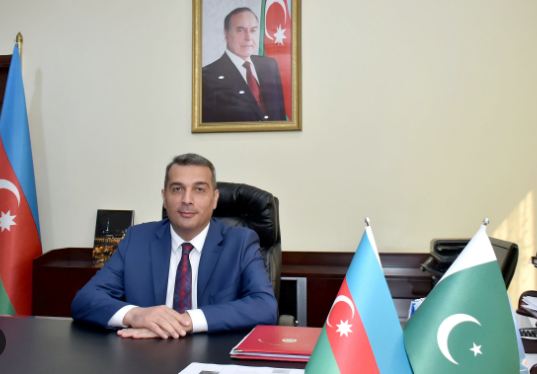
ISLAMABAD, JAN 14 (DNA) — Ambassador of Azerbaijan, Khazar Farhadov has said that the role of the private sector, including the government of Pakistan, in promoting cooperation between Pakistan and Azerbaijan in the fields of tourism is commendable.

The CEO of Pakistan is young entrepreneur Mohammad Rauf Appreciating the efforts and assured him of our all possible support – MD Pakistan Tourism Development Corporation Aftab Rahman Rana while speaking said that the projects of several new tourist destinations in Pakistan organized by the Government of Pakistan and Provincial Governments have been completed rapidly.

After Covid pandemic welcoming the arrival of a large number of tourists in Pakistan is much appreciable , he expressed his determination that maximum facilities will be provided for domestic and foreign tourists during this year also through a panel discussion on this occasion Experts expressing views to investing in tourism and hospitality sector in Pakistan and emphasized the increase and said that it will bring economic stability to Pakistan and the development of tourism sector will increase business activities in Pakistan – CEO Brain Designer Rauf Raja said that the promotion of tourism and investment events will continue and our next event will be in the held in UK month of April. — DNA

Renowned playwright, poet Asghar Nadeem Syed turns 74

poet Asghar Nadeem Syed turns 74

ISLAMABAD, JAN 14 (DNA) —Renowned playwright, poet, and intellectual Asghar Nadeem Syed turned 74 on Sunday. Born on January 14, 1950, in Multan to a Syed family, he received his master’s degree in Urdu language from the University of Punjab, Lahore, and completed his PhD at Bahauddin Zakariya University in Multan. Asghar Nadeem Syed has written many famous dramas for television.

His dramas depict the social injustices in society. He has written plays depicting the feudal culture in rural areas, the exploitation of women, the oligarchic structure in Pakistan, comprising politicians, feudals, media moguls, and the

Bureaucracy.

Some of his famous television plays written by Asghar Nadeem Syed included Chand Grehan,Nijaat, Hawaii,Pyas, Maigh Malhar,Ghulam Gardish,Riyasat,Bol Meri Machli,Khuda Zameen Se Gaya Nahin,Tum Ho Ke Chup, and Jaan’nisar. .

In 2013, he served on the Board of Governors of the Pakistan Academy of Letters, and in 2020, he was appointed as one of the directors of Pakistan Television. He has written three books, including Aadhe Chand Ki Raat, Tarz-e-Ehsas, and Adhoori Kulliyat. — DNA

Mian Anjum Nisar says Pakistan needs sound economic management

Mian Anjum Nisar

DNA

ISLAMABAD: As the Executive Board of the International Monetary Fund has completed the 1st review Stand By Arrangement, allowing for disbursement of $ 700 million, bringing the total disbursements to $ 1.9 billion for Pakistan, the Federation of Pakistan Chambers of Commerce and Industry’s Businessmen Panel (BMP) has warned that a bailout from the IMF alone was unlikely to speed up economic growth, as the political instability and lack of reforms would further deteriorate the financial situation in the country.

FPCCI former president and BMP Chairman Mian Anjum Nisar observed that amidst continuous of hike in cost of production in the country, what the Pakistan’s economy really needs is persistent and sound economic management. He asked the authorities for undertaking economic reforms and improving the regulatory environment to boost foreign investment so that financial stability can be achieved in the long-run.

The Businessmen Panel (BMP) chief stressed the need for reducing cost of doing business, besides evolving a new price control mechanism, as huge taxation, rising oil prices and constant jump in electricity and gas tariffs have lifted the inflation to decades high level in 2023.

Mian Anjum Nisar warned the authorities that inflation above 6 percent can hurt economic growth and a careful policy is required to keep it in control. He said that the pace of inflation is skyrocketing at a time when the economic activity is slowing down.

As the oil prices have been increased and power tariff has gone up further the BMP chairman stated that the government has dropped a fuel bomb on the businessmen after it suffered an electric shock to meet the conditions of IMF for the revival of the stalled loan program- a recipe to shake the trade and industry.

The FPCCI former president said that the decision would prove detrimental to the industries due to high cost of doing business and will also open the floodgates of inflation. In addition to making the electricity bills costlier and unaffordable for the consumers, the hike in base tariff would escalate prices of all household goods being widely used in every household, he added.

He termed the increase in tariff unlawful and a violation of NEPRA’s own rules and regulations, as any increase in tariff has to be determined and implemented only after holding public hearings but unfortunately they have solely decided to raise the tariff without holding public hearings, he argued.

He condemned the National Electric Power Regulatory Authority’s decision to increase electricity tariffs, stating that the burden of power theft, mismanagement, and inefficiencies cannot be shifted to consumers on the pretext of fuel adjustment.

Mian Anjum Nisar said that Pakistan’s industry had been harmed by the high cost of doing business, which discouraged investment in capacity and capability and called for easing the burden of heavy taxes on the power sector.

Anjum Nisar stated that the constant increase in power tariffs on the pretext of fuel adjustment had increased electricity prices and added to the already high cost of trade and industry. Seeking comparable energy tariffs for domestic industries in order to capture the global market, he stated that due to high electricity rates, power theft became rampant as the tariff was unaffordable to consumers.

He urged the power ministry to identify system constraints and communicate targets to all concerned departments in order to launch a wartime effort to upgrade the transmission system.

He urged the completion of all ongoing power projects well ahead of schedule. He stated that business-friendly policies must be adopted, similar to those adopted by other neighbouring countries in the region.

He suggested that the amount specified in trade policy be used to promote exports by providing incentives to trade and industry and by exploring new markets. According to the BMP Chairman, Pakistan’s electricity prices were already on the high side, which was the primary reason for the country’s price hikes. He stated that providing affordable electricity would assist in lowering production costs, thereby benefiting the public. He stated that rising imports and a widening trade deficit posed a serious threat to economic growth and must be addressed urgently.

Mian Anjum Nisar said that the continuous increase in fuel and electricity rates will add to the miseries of the businessmen, who are already feeling the heat of runaway inflation. He said that increase in fuel prices and tariff rates would also bring about another flood of inflation in Pakistan as it would increase the cost of doing business in the country.

The Pakistan Bureau of Statistics reported that inflation hit the 48 years’ highest level in 2023. The likely acceleration in the index would bring more misery for the trade and industry which was facing difficulties in meeting soaring cost. He asked the government to inform the IMF that due to floods, tight monetary policy, high inflation, and a less conducive global environment, the economic growth rate might slow down in the range of 1.5 percent.

PHMA asks for more funds in SBP solar financing as all funding goes to big industry

PHMA

DNA

ISLAMABAD: The Pakistan Hosiery Manufacturers & Exporters Association (PHMA) has proposed the State Bank of Pakistan to allocate more funds for renewable energy schemes, including solar energy financing exclusively to the export-oriented value-added textile sector. This strategic allocation will not only boost apparel sector’s growth but also promote a more inclusive and resilient economy.
These views were expressed in an interactive session held here at PHMA regional office to review the private sector credit offtake, especially to the Apparel sector’s SMEs, with the PHMA north zone senior vice chairman Amanullah Khan in the chair.

Participants of the meeting urged the Federal Board of Revenue (FBR) to strengthen the industry and export sector by releasing their payment, as a huge amount of refund claims under DLTL 2021 is pending, beside speedy payment of sales tax refunds, because the commitment of the FBR to instantly release exporters’ tax refund claims through FASTER System seems to be just an eyewash.

Amanullah Khan, in his key note address, proposed the central bank to review its credit policies by fixing a special quota to finance the hosiery sector’s small and medium enterprises, as only the large industries have been availing government’s all major concessional export loaning facilities, with very limited financing is left for the PHMA members which are the backbone of the economy.

PHMA north zone senior vice chairman observed that despite significance of SMEs, more than 5 million SMEs face a significant credit gap, receiving just 7 percent of private sector credit. To achieve this, we must advocate for targeted and fixed allocations for apparel sector SMEs in renewable and solar energy financing, particularly those aimed at the export-oriented sector.

He said that the State Bank of Pakistan has launched various policies for the promotion of SME finance, but the required results were still awaited. It was unfortunate that banks were always reluctant to provide financing to SMEs as their financing continued to show negative growth.

PHMA members, on this occasion, said that the government with a view to help grow the apparel exports will have to take solid measures to strengthen the industry, especially the SMEs, saving the livelihood of millions of workers associated with the small industries. The government will have to make a visible reduction in markup rate to help grow the businesses, particularly the SME sector, as Pakistan needs millions of jobs annually.

We need to highlight the critical role of Small & Medium Enterprises in driving sustainable economic development in Pakistan. With an estimated 5.2 million businesses, the SME sector is a cornerstone of our economy, fostering employment, growth, and export diversification.

He said that in its endeavor to provide concessional financing to the export-oriented sector, the State Bank Pakistan had announced to extend the financing scheme for renewable energy for next two years till 2024.

The objective of the scheme was to lend support in addressing the dual challenge of energy shortage and climate change through the promotion of renewable energy. It may be mentioned here that Pakistan’s economy is facing the dual challenge of energy shortage and climate change. The inadequate supply of energy has severely impacted the growth of industries.

Similarly, the effects of climate change have been observed in the form of devastating floods, droughts, heat waves and changing weather patterns. These changes essentially inhibit our ability to develop sustainably.

Stay Connected

64FansLike
60FollowersFollow

Latest Reviews

Exchange Rates

USD - United States Dollar
EUR
1.17
GBP
1.35
AUD
0.72
CAD
0.73