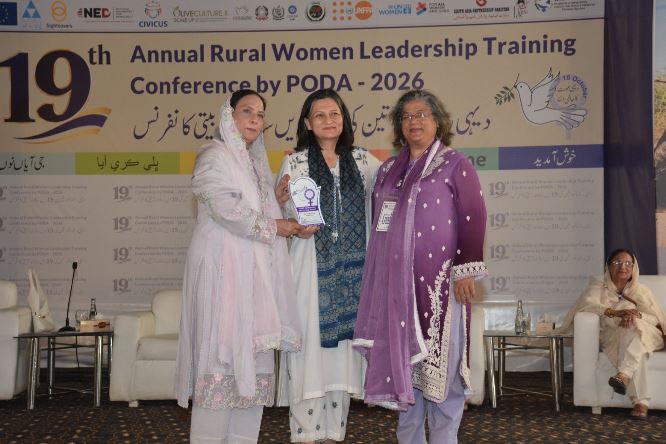
ISLAMABAD, OCT 27 /DNA/ – More than 600 delegates from around 100 districts on Tuesday called education the most effective safeguard against discrimination against girls and women, and a foundation for their civic and economic empowerment. This was the highlight of the opening day of the three-day 19th Annual Rural Women Leadership Training Conference, organised by PODA-Pakistan, which will conclude on Thursday, 29 October.
Welcoming the rural women leaders, PODA Board Member Mumtaz Esker congratulated rural women for their advocacy for legislation to end child marriage, particularly in Punjab and Islamabad Capital Territory (ICT). She urged effective implementation of the Child Marriage Restraint Acts adopted in three provinces and ICT, as well as the Christian Marriage Act. She noted that Sindh became the first province to legislate against child marriage in 2013, followed by Balochistan and ICT, while Khyber Pakhtunkhwa has yet to enact similar legislation. She also emphasized the importance of family planning for the health of mothers and children.
ED-PODA Sameena Nazir urged them to work hard, following the passage of child marriage legislation, to develop effective mechanisms to ensure protection and safeguard young girls.
During a session titled “Protection from Child Marriage Through 12 Years of Compulsory Education,” MNA Dr Shahida Rehmani, Secretary of the Women Parliamentary Caucus, described education as an agent of change essential to national progress. “Rural women are vital to Pakistan’s social and economic development, contributing significantly to agriculture, food security, household economies, and community resilience. However, many continue to face barriers to education, healthcare, property ownership, legal protection, economic opportunities, and participation in decision-making. Recognizing their contributions must go hand in hand with ensuring their rights, dignity, and equal opportunities,” she said.
Afshan Tehseen, CEO of Human Capital Pakistan and former founding chairperson of the National Commission on the Rights of Child (NCRC), highlighted the damaging impact of early marriage on girls’ health, education and independence. She noted that although women constitute half of Pakistan’s population, they represent only about 20 percent of the labour force, and cited legal minimum marriage ages in other Muslim-majority countries which is 18 years.
Dr Nishat Riaz of the Malala Fund recalled that PODA introduced Malala Yousafzai at a conference in 2009, when she was 12 years old. Quoting Malala, she said democracy remains incomplete without women’s effective participation, adding that every woman carries immense potential that can be realized through education.
Chairing a session on “Ensuring Safe Digital Spaces for Women and Girls,” Senator Sana Jamali of Balochistan highlighted the digital divide in rural areas, especially Balochistan. She called for improved internet access, online safety measures and responsible use of artificial intelligence, while encouraging the use of digital platforms to preserve and promote Baloch culture and crafts.
Mahreen Talha, CEO of Aurattech, led a session on digital safety, warning participants against sharing banking verification codes with unknown callers. She advised women facing online harassment to avoid transferring money, preserve evidence through screenshots, block abusive numbers and report incidents to trusted individuals and relevant platforms. Her key message was: Do not share your code or PIN with anyone. Lock your WhatsApp. You are not alone. Report online abuse or harassment.”
Manya Bangash, Assistant Chief Manager at the State Bank of Pakistan’s Banking Services Corporation, presented the central bank’s “Banking on Equality” policy for financial inclusion. She outlined five pillars: greater women’s representation on bank boards; women-focused products; dedicated customer facilitation; gender-disaggregated data collection; and policy and cultural reforms. She said these measures had helped reduce Pakistan’s gender gap in financial inclusion to 29 percent by 2025, and highlighted tools including the Sunwai complaint app, credit-check services linked to CNICs, and the Raast digital payment platform.
Aqsa Mirwani, a farmer from Awaran, recipient of the President’s Pride of Pakistan Award 2025 and one of the FAO’s 100 Women Heroes in Agri-Food Systems and Rural Development, shared her journey from a district with severe barriers to girls’ education to becoming the first woman in her area to own land. Founder of the Amma Naima Foundation, which supports 1,264 beneficiaries, she urged civil society organisations to establish schools and skills-training centres in Korak, where girls’ education remains nearly nonexistent and health facilities are absent.
In the concluding session, “Voice and Visibility of Rural Women Leaders from Pakistan at COP31 in Türkiye,” supported by the National Disaster Management Authority (NDMA), participants called for climate-disaster education to begin at school level. They stressed that disaster response must prioritise women’s needs, as rural women face disproportionate impacts from climate-related emergencies.
President Asif Ali Zardari said in his message for the conference participants: “We remain committed to promoting equal opportunities for women, particularly those living in rural and underserved areas and to supporting their meaningful participation in economic, social and public life. Empowering rural women is not only a matter of equality and justice but also an important investment in Pakistan’s sustainable and prosperous future”.
The rural women leaders also validated the current challenges they face and shared recommendations for solutions.