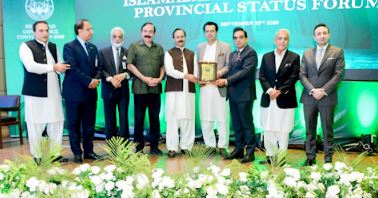
ISLAMABAD, SEP 25: /DNA/ – Minister for Parliamentary Affairs Tariq Fazal Chaudhry has said that Islamabad needs a stronger, more representative and empowered governance model that gives its people a meaningful voice in legislation, administration and development. Addressing the Islamabad Governance and Provincial Status Convention organized by the Islamabad Chamber of Commerce and Industry (ICCI) here on Friday he said the national debate on new provinces and administrative units must be settled through constitutional means and meaningful public consultation. He pointed out that Islamabad’s affairs are currently fragmented among multiple federal institutions, resulting in gaps in water supply, sewerage, drainage, infrastructure and rural development. A capital that generates significant revenue must have an effective mechanism to translate its resources into better public services, he stressed, adding that the proposed governance model should be elected, financially viable and institutionally stable, while national security, law and order and protection of sensitive federal installations should remain the responsibility of the federal government. The Minister along with the ICCI President also inaugurated the Overseas Facilitation Centre at the ICCI Premises.
Minister of State for Interior Talal Chaudhry said the people of Islamabad must have a meaningful say in determining the governance model of the federal capital and appreciated ICCI for bringing political representatives, parliamentarians, business leaders and civil society together for broad-based dialogue. He said the debate should move beyond slogans and translate into practical reforms aimed at strengthening representation, accountability and service delivery. He highlighted measures including improvement of major traffic corridors, expansion of the Safe City system, recruitment of 10,000 police personnel on merit, development of new water reservoirs and replacement of ageing pipelines, while emphasizing that Islamabad’s rural communities must receive equitable civic facilities. He said the future governance model should combine stronger public representation with institutional stability and political maturity, while safeguarding the federal government’s responsibility for national security and law and order.
The State Minister along with the ICCI President also inaugurated the Passport Counter at the NADRA office in the Chamber’s premises.
Prime Minister’s National Coordinator for Tourism Sardar Yasir Ilyas said the people must have a meaningful role in choosing the governance system under which they are governed, adding that the disconnect between public aspirations and policymaking has contributed to adverse economic outcomes. He called for adapting global governance trends to local realities through meaningful stakeholder consultation and stressed that institutional models should be based on professionalism, discipline, continuity and clear accountability rather than individuals. He said reform required not only new policies but also changes in the people and structures responsible for implementation. Referring to overseas Pakistanis, he noted their significant contribution to the national economy through remittances and emphasized the need for policies that maintain their economic linkage with the country.
Senator Talha Mahmood said Islamabad urgently requires a more effective administrative structure as the existing system is no longer adequate for a rapidly expanding capital. He said the recent national debate on new provinces and administrative units had reinforced the need to bring decision-making closer to the people. Emphasizing the central role of the private sector in economic development, he said Pakistan’s economic challenges could be addressed by creating a stronger business environment in which the business community has greater opportunities to invest, operate and grow. He also stressed the need for leadership with practical understanding of economic management and the ability to identify and resolve problems, adding that Pakistan’s improved security environment should be translated into greater economic activity and tangible benefits for citizens.
ICCI President Sardar Tahir Mehmood said Islamabad, now home to more than 2.4 million people with a growing business, industrial, IT and academic base, could no longer be governed through an outdated administrative structure. He said the city needed an effective, accountable and representative governance system because citizens often remain uncertain about which institution is responsible for essential services. “Everyone has authority, but no one has accountability,” he said, stressing that governance was not a political issue for the business community but a fundamental economic concern affecting investment, employment and the cost of doing business. He said ICCI had proposed meaningful financial autonomy for the elected government, protection of citizens’ and investors’ rights during the transfer of powers from CDA, a clear timeframe for elections, institutionalized consultation with the business community and civil society, and equal development and representation for rural Islamabad. He also announced the formation of a broad-based, non-partisan forum to review the proposed governance framework and submit recommendations to the government.
Member National Assembly Anjum Aqeel Khan supported the idea of an elected assembly for Islamabad to address the challenges confronting the capital and expressed hope that a 27-member assembly would soon be constituted for this purpose. Former Chairman Senate and Secretary General Pakistan Peoples Party Syed Nayyar Hussain Bukhari, while supporting the core idea, underscored the need for in-depth brainstorming and wider consultation on the proposed governance structure. Jamaat-e-Islami Islamabad leader Nasrullah Randhawa also called for comprehensive stakeholder input into the draft, highlighting the pressing civic issues confronting the capital and advocating a vision of a “3-D Islamabad”—democratic, developed and digital.
Chairman ICCI Founder Group Tariq Sadiq in his welcome address explained the objectives and significance of the convention and called for a constructive national dialogue on the future governance of Islamabad. Vice Chairman Islamabad Bar Council Ch. Asif Irfan, Advocate Supreme Court and former Vice Chairman Islamabad Bar Council Adil Aziz Qazi, and President Islamabad District Bar Association Ch. Naeem Ali Gujjar also addressed the gathering and shared their views on strengthening the city’s governance and representation. ICCI Senior Vice President Tahir Ayub moderated the proceedings efficiently.