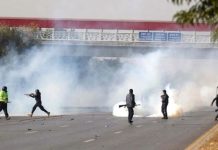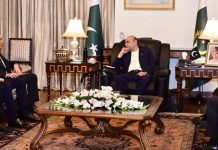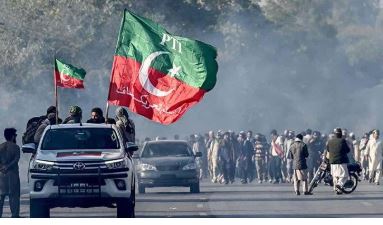
No political party or political leader had the right to obstruct the free movement of citizens, the order stated, adding that provincial governments must ensure that government resources were not used for any march, procession or rally
DNA
ISLAMABAD: The Islamabad High Court (IHC) on Monday disposed of a plea against the PTI’s planned long march and protest in the federal capital on Sept 27, directing the chief ministers of all provinces to ensure that no government resources or official machinery were used in this regard.
The PTI has announced a nationwide protest, including in Islamabad, on Sept 27 to demand the release of party founder Imran Khan and mobilise people for the supremacy of the Constitution.
A citizen, Waqas Ahmed, had challenged the planned move on the grounds that the protest could disrupt routine life, traffic and business activities in the federal capital.
A larger bench, headed by IHC Chief Justice Sardar Muhammad Sarfraz Dogar and including Justice Muhammad Azam Khan and Justice Muhammad Asif, took up the plea.
The bench’s short order, which was announced in the court, said that no political party or its leadership had the “lawful right to occupy public roads, highways, interchanges, toll plazas and buildings in Islamabad that would obstruct in any manner access to educational institutions and medical facilities”.
No political party or political leader had the right to obstruct the free movement of citizens, the order stated, adding that provincial governments must ensure that government resources were not used for any march, procession or rally.
Chief ministers must ensure that public funds or government officials were not used for any protest, and official vehicles, machinery or other government equipment must not be used to facilitate any march, procession or rally, it said.
Moreover, no public servant should be compelled to participate in any march, procession or rally, the court ruled.
Any person, public office holder who undertook any activity against these instructions should be deemed to have violated the Constitution, it said.
The court directed the Islamabad administration and the interior ministry to ensure protection of citizens’ constitutional rights, and the chief secretaries and provincial police chiefs to ensure implementation of court directives.
The interior secretary and Islamabad chief commissioner and inspector general were directed to ensure compliance with court orders.
The hearing
The bench had reserved its verdict on the plea earlier in the day after the Khyber Pakhtunkhwa police chief assured the court that no “illegal or unconstitutional activities” would be allowed in connection with the protest.
At one point during the hearing, Chief Justice Dogar recalled that the Khyber Pakhtunkhwa Advocate General (AG) Shah Faisal Utmankhel had stated during the previous hearing that notices had been issued to provincial authorities for judicial assistance.
The chief justice clarified that the court had not issued any notice under Section 27-A of the Civil Procedure Code for judicial assistance from provincial law officers, observing that such assistance could only be sought through the attorney general, the federal government’s law officer.
Islamabad Advocate General Naveed Hayat Malik, who was among those who appeared before the court today, informed the bench that a miscellaneous application had been filed seeking permission to screen videos of the PTI’s protests in 2022 and 2024.
The Islamabad AG noted that the PTI leadership was claiming that its planned long march would remain peaceful and was aimed at strengthening the judiciary. He said he wished to place before the court statements made by PTI leaders as well as videos of the party’s previous protests.
Initially, Justice Dogar expressed reluctance to allow the screening of videos.
“That is not the practice of this court,” he observed when the AG sought permission to play footage of the November 2024 protest.
When the law officer pointed out instances of videos being played in the Supreme Court, Justice Dogar remarked that the IHC did not wish to establish a precedent of routinely playing videos during court proceedings.
After a brief break, however, the bench allowed the footage to be screened, with the chief justice making it clear that the videos would be played only once.
The Islamabad AG then played videos related to the PTI’s 2022 and 2024 protests and argued that the demonstrations could not be described as peaceful.
He alleged that state machinery had been used during the 2022 protest and that barriers placed by the Islamabad administration to stop the march were removed with the help of cranes.
The law officer alleged that property at D-Chowk was set on fire and that a police official was martyred during the violence.
He claimed that similar incidents occurred during the PTI’s 2024 protest, which he described as an “assault on Islamabad”.
“This was by no means peaceful. This does not look like a scene from a public rally,” the AG argued. He alleged individuals were seen firing shells at Islamabad police personnel and that Rangers officials were run over by a vehicle during the protest.
The law officer also referred to vehicles being set ablaze near F-9 Park, and pointed out that there was a legal framework governing public meetings and protests in the federal capital.
He said any person or political party intending to hold a protest was required to submit an application containing complete details so that the administration could make appropriate security arrangements.
According to the AG, the district magistrate had the authority either to grant or reject the request for permission, and no protest could be held without such approval.
He further argued that the government also had the authority to declare any area a “red zone” and impose restrictions, including Section 144 of the Code of Criminal Procedure, where required to maintain law and order.
The Islamabad AG contended that there were two objectives of the PTI’s planned march: the “release of a convicted prisoner and the removal of the government”.
And both of those objectives were unconstitutional, he remarked.
“They claim to be protesting for the rule of law and the strengthening of the judiciary,” the law officer said, adding that the “release of a convicted prisoner could only be sought through legal remedies before the courts”.
“If you are dissatisfied with the prime minister, go to Parliament and move a vote of no-confidence,” he added. “If you want to topple the government in the streets and public squares, then do not speak of the rule of law.”
Questioning the PTI’s claim that it was marching to strengthen the judiciary, the AG argued that an increase in litigation showed growing public confidence in the courts.
He further contended that there was no evidence to suggest that the proposed rally would remain peaceful.
The Islamabad AG further said the administration did not have the “physical capacity to stop a massive crowd if the PTI brought its full resources to Islamabad”.
“We can only make precautionary arrangements, such as imposing Section 144 and placing containers,” he said. “We cannot fire upon our citizens; we cannot take their lives.”
He stressed that preventive measures had to be taken before the situation “gets out of control”.
Presenting his arguments, the petitioner’s lawyer, Chheena, opposed that the petition was premature.
He said the Khyber Pakhtunkhwa advocate general had argued that the petition could not be entertained before any actual protest had taken place.
“My life and my children’s education are fundamental rights under the Constitution,” the counsel argued and questioned whether a citizen was required to wait until their life was endangered or actual damage had occurred before approaching the court.
“Should I only come to court after my children’s school has been seized?” he asked.
The lawyer further argued that it was neither practical nor legally necessary for a citizen to wait until someone was “holding a gun to my head” before seeking judicial protection.
He then referred to speeches by Khyber Pakhtunkhwa Chief Minister Sohail Afridi, who, according to the petitioner’s counsel, had declared that he would bring millions of people to Islamabad.
The counsel argued that “such mobilisation is being undertaken for the release of a convicted prisoner”.
“If millions of people arrive here, will the government direct this court to grant bail to the prisoner?” he asked. “Is such a thing possible? What would become of judicial independence?”
He argued that protests could not be held to pursue “unconstitutional objectives” and pointed out that the Islamabad advocate general had acknowledged that the administration lacked the capacity to physically stop a crowd “numbering in the millions”.
During the hearing, the court also called KP Inspector General (IG) Zulfiqar Hameed to the rostrum and directed him to read out an affidavit submitted by him.
After he read out the document, CJ Dogar questioned what measures the provincial police would take to prevent an “illegal protest”.
The petitioner’s counsel argued that the affidavit should not only prohibit the use of state machinery for the long march but should also clearly state that the authorities would prevent an “illegal or unconstitutional gathering”.
At that, Justice Dogar asked the KP police chief, “If an illegal and unconstitutional act takes place, will you not stop it?”