BEIJING, SEP 13 /DNA/ – The Embassy of Pakistan in Beijing, the Pakistan Center for Culture and Communication, and the School of Journalism and Communication at Tsinghua University jointly hosted the launch of the groundbreaking book “Indus and Yangtze: A Journey of Two Rivers from One Origin” to mark the 75th anniversary of the establishment of diplomatic relations between Pakistan and China.
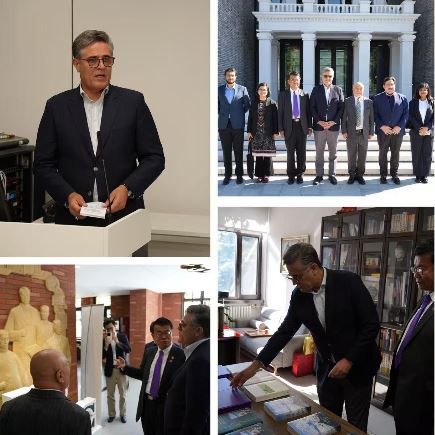
The event featured the launch of the book, along with presentations on outstanding doctoral research on Pakistan, an oral history project documenting the builders of the Karakoram Highway, research into the ancient routes of the Yarkand River Valley, and related documentary productions. These recent research and cultural initiatives, documenting the historical, social, and intellectual links between Pakistan and China, brought together H.E. Khalil Hashmi, Ambassador of Pakistan to China, as well as leading scholars, researchers, diplomats, academics, faculty members, and students.
The book, Indus and Yangtze: A Journey of Two Rivers from One Origin, edited by Professor Li Xiguang, former Executive Vice Dean of the School of Journalism and Communication at Tsinghua University, and Professor Zahid Anwer, former Vice Chancellor of the University of Peshawar, was presented in its English, Urdu, and Chinese editions. The editors highlighted the shared historical and cultural connections between the civilizations of the Indus and Yangtze river basins and underscored the importance of scholarship in strengthening mutual understanding between the peoples of Pakistan and China.
The event also featured presentations by Dr. Wen Sanmei and Dr. Liu Bei. Their work demonstrated the growing depth and diversity of academic research on Pakistan within Chinese universities and research institutions.
Another highlight was the presentation of “An Oral History of the Builders of the Karakoram Highway”. Lecturer Zhang Jing presented research and interviews documenting the experiences of those who contributed to the construction of the landmark highway. Excerpts from the accompanying documentary further brought these personal histories to life.
Research on the historical links between Pakistan and China was also showcased through the project Yarkand River Valley—Exploring the Ancient Route to Pakistan, presented by Professor Guo Xiaoke and Li Zhenyuan. The project combines field research, historical inquiry, and documentary filmmaking to explore ancient routes and exchanges connecting the two regions.
Professor Li Xiguang further presented research on historical Pakistan-China exchanges, including “The Westward Route in Search of the Dharma to the Kingdom of Uddiyana”, highlighting the long history of cultural interaction and movement across Central and South Asia.
The dialogue also featured contributions from senior academics and experts, including Shi Anbin, Party Secretary of the School of Journalism and Communication at Tsinghua University; Yao Yuanjun, Senior Advisor and Deputy Secretary-General of the Yangtze River Culture Promotion Association; Zhang Heqing; Professor Xiang Debao of Beijing Foreign Studies University; Professor Guo Xiaoke of Communication University of China; Chen Ruihua, Director of the Pakistan Study Center at Nankai University; Zhang Chaowen, Director of the Pakistan Study Center at Sichuan University; and Guo Yaling, Director of the Pakistan Study Center at Hebei Normal University.
Representatives of the CITIC Foundation for Reform and Development Studies, the Yangtze River Culture Promotion Association, Tsinghua University, and other academic and cultural institutions also participated in the exchange.
In his keynote address, Ambassador of Pakistan to China H.E. Khalil Hashmi welcomed the launch of the multilingual monograph Indus and Yangtze: A Journey of Two Rivers from One Origin in English, Chinese, and Urdu. He commended Professor Li Xiguang, Professor Zahid Anwer, their teams, and the contributing scholars for undertaking extensive research into the geographical, historical, economic, and cultural linkages associated with the two river systems.
Referring to the 75th anniversary of Pakistan-China bilateral relations, the Ambassador highlighted the enduring friendship between the two countries and the importance of academic, cultural, and people-to-people exchanges. Ambassador Khalil Hashmi outlined three key dimensions of the bilateral partnership: government-to-government, business-to-business, and people-to-people cooperation.
Ambassador Hashmi called for greater university-to-university cooperation, student and faculty exchanges, STEM collaboration, language learning, and cultural engagement.
The gathering reaffirmed that the Pakistan China relationship extends beyond diplomatic and economic cooperation to encompass deep historical, cultural, educational, and people-to-people connections. By bringing together scholarship, oral history, documentary storytelling, and contemporary academic dialogue, the event sought to preserve shared memories while creating new intellectual bridges between the two countries.
The commemorative programme concluded with a dinner featuring Pakistani cuisine, providing participants with an opportunity for further informal exchange and cultural interaction.