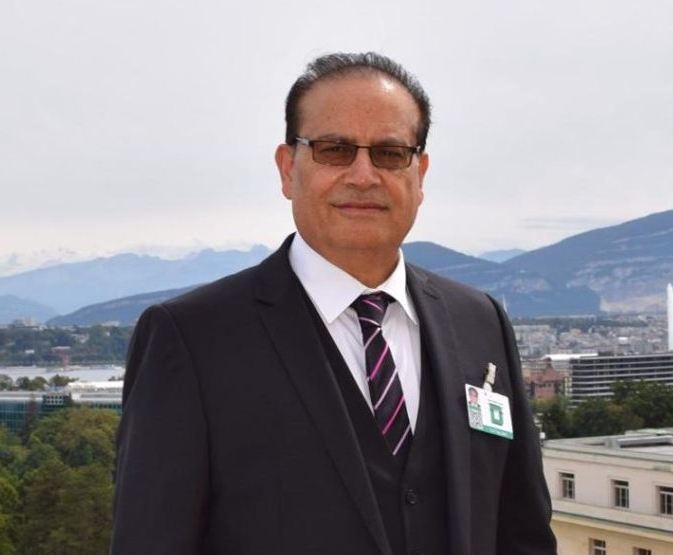
Qamar Bashir
For countless people living in developing countries, the United States and Europe have represented a dream. This attraction is not based only on wealth, employment or a higher standard of living. More importantly, these societies have been regarded as places where the state does not discriminate among citizens on the basis of religion, color, race or creed. For people persecuted because of their faith, ethnicity, culture or way of life, migration to the West has promised safety from hatred, violence and official discrimination.
The foundation of this dream is secular government. Secularism does not mean hostility to religion or the exclusion of religious people from public life. It means that the state itself does not belong to one religion. A secular government protects Christians, Muslims, Jews, Hindus, Sikhs, atheists and others under the same law. It asks citizens to obey the Constitution, not to adopt the religion or culture of the majority.
Today, however, a contrary narrative is gaining political power. Leaders and movements in the United States increasingly describe America as a Christian nation. President Donald Trump has promised to defend the “Judeo-Christian principles of our founding” and has declared that America is “one nation under God.” In Europe, Hungarian Prime Minister Viktor Orbán has stated even more directly: “Europe is a Christian continent, and this is how we want to keep it.” He has connected the preservation of this identity with opposition to immigration and the fear that Muslims will transform Europe’s ethnic and cultural composition.
Israel, meanwhile, expressly defines itself as a Jewish state. Its 2018 Nation-State Basic Law declares that Israel is “the nation state of the Jewish People” and that national self-determination in the state is “exclusive to the Jewish People.” It also describes Jewish settlement as a national value. The danger lies not in Judaism—or in Christianity or Islam—but in giving one religious or ethno-religious identity a constitutionally superior relationship with the state.
These declarations must be tested against the constitutional principles that made the West attractive. The U.S. Constitution neither establishes Christianity nor grants it privileged status: the First Amendment prohibits laws “respecting an establishment of religion,” while Article VI bars religious tests for public office. Although the Declaration of Independence refers to a Creator, the Constitution is the governing legal document and protects equal citizenship regardless of belief. Yet the tension persists: a 2024 Pew survey found that 13 percent of Americans supported declaring Christianity the official religion, while 44 percent favored promoting Christian values without formal establishment—a distinction that becomes dangerous when moral advocacy turns into state preference and the exclusion of other faiths.
European Convention on Human Rights. Article 9 guarantees everyone “freedom of thought, conscience and religion,” including the freedom to change religion and to manifest belief privately or publicly. The European Court of Human Rights has held that the state must remain a “neutral and impartial” organizer of religious life because pluralism is essential to democracy.
The Magna Carta is often invoked as a symbol of Western liberty and government under law, although it is not a modern constitution or a comprehensive guarantee of religious equality. Its lasting importance is the principle that political authority is subject to law. The modern constitutional descendants of that principle are equal citizenship, due process, religious liberty and protection against arbitrary power. Religious nationalism undermines this inheritance when it divides lawful citizens into authentic members and tolerated outsiders.
The consequences are visible in contemporary politics. During Zohran Mamdani’s campaign for mayor of New York, opponents and online commentators connected his Muslim identity with terrorism, jihad and Sharia. Some called for his denaturalization or deportation, despite the absence of evidence that he intended to impose Islamic law. Mamdani nevertheless won the November 2025 election and became New York City’s first Muslim mayor. His victory affirmed constitutional inclusion, but the reaction exposed how readily a Muslim candidate’s faith could be presented as a security threat.
Michigan politician Abdul El-Sayed has faced similar attempts to associate his Muslim identity with extremism. Dearborn, a city with a large Arab-American and Muslim population, has become a national target for agitators warning about the supposed “Islamification” of America. Yet electing Muslim mayors, council members or police officials is not evidence of religious conquest. It is democracy: citizens exercising the same political rights that the Constitution guarantees to Christians.
Nor is Sharia the governing law of Michigan, New York or any European country. Muslims may voluntarily follow religious principles in their private lives, just as Christians and Jews may consult their own traditions. Civil law nevertheless remains supreme. Raising the specter of Sharia without evidence transforms a religious minority into a permanently suspect population.
The problem is measurable. The U.S. Department of Justice recorded 236 anti-Muslim hate incidents and 156 anti-Sikh incidents in 2023. In the European Union, a survey of almost 10,000 Muslims across 13 countries found that 47 percent had experienced racial discrimination within the preceding five years, particularly in employment and housing.
The same constitutional test must be applied to Israel. Israel emerged from Zionism, British rule in Palestine, European antisemitism culminating in the Holocaust, and the United Nations’ 1947 proposal for separate Arab and Jewish states. It would be historically inaccurate to reduce its creation to a single Western plan for removing Jews from Europe. Nevertheless, defining national self-determination as exclusive to one people raises a profound question about equality for Palestinians and other non-Jewish citizens and residents.
That concern is intensified by occupation and settlement. In a 2024 advisory opinion, the International Court of Justice concluded that Israel’s continued presence in the occupied Palestinian territory is unlawful and that settlement activity must cease. United Nations satellite analysis later estimated that approximately 81 percent of structures in Gaza had been damaged by October 2025.
The conclusion is not that religion must disappear. Religion can inspire compassion, justice and service. The danger begins when it becomes a certificate of citizenship or a weapon for deciding who truly belongs. A Muslim, Jew, Christian, Hindu, Sikh or nonbeliever should not have to become culturally “like” the majority to receive equal protection.
The United States and Europe became dreams because they promised that law would stand above sectarian identity. If their leaders replace that promise with competing religious nationalisms, they will revive the divisions their constitutional systems were designed to restrain. Their future peace and prosperity therefore depend upon returning to the essential principle of secular democracy: the state has no favored faith, and every citizen stands equal before the law.
Qamar Bashir
Press Secretary to the President (Rtd)
Former Press Minister, Embassy of Pakistan to France
Former Press Attaché to Malaysia
Former MD, SRBC | Michigan, USA