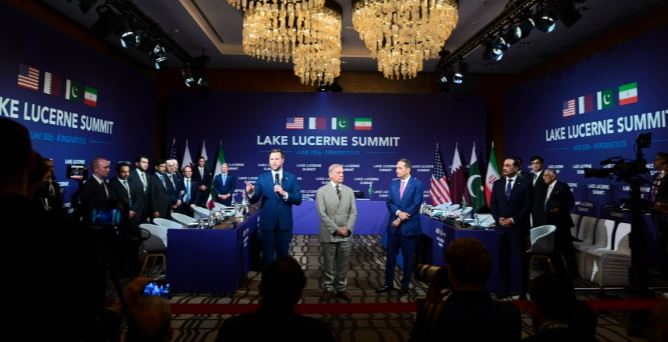
BURGENSTOCK, Switzerland – JUN 21 /DNA/ – In a significant diplomatic breakthrough, Pakistan convened the first technical-level talks between the United States and the Islamic Republic of Iran today, with Prime Minister Muhammad Shehbaz Sharif playing the role of host and mediator. The high-stakes dialogue, held at the scenic Burgenstock resort, aims to de-escalate tensions and explore pathways toward mutual understanding on regional security and nuclear-related issues.
Ahead of the closed-door sessions, Prime Minister Shehbaz Sharif, flanked by U.S. Vice President J.D. Vance and Qatar’s Prime Minister and Foreign Minister Sheikh Mohammed bin Abdulrahman bin Jassim bin Jaber Al Thani, addressed the international media corps in a brief but cordial interaction. The presence of the Qatari leader underscored Doha’s continued role as a key facilitator in Middle Eastern diplomacy.
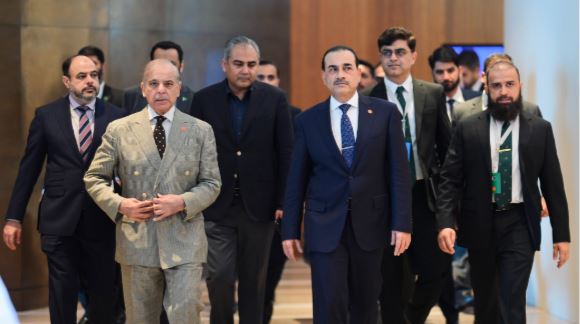
Prime Minister Sharif opened the interaction by emphasizing Pakistan’s historic responsibility as a nation that seeks peace and stability in the region. “Today, we are not just hosting a meeting; we are hosting a conversation. The world is watching, and the people of this region deserve a future free from conflict. Pakistan stands ready to facilitate every step that leads toward trust and understanding,” he stated.
He thanked Vice President Vance and Prime Minister Al Thani for their “unwavering support” in making this dialogue possible, noting that the Burgenstock venue was chosen for its neutrality and serenity, symbolizing the calm that both nations are striving to achieve.
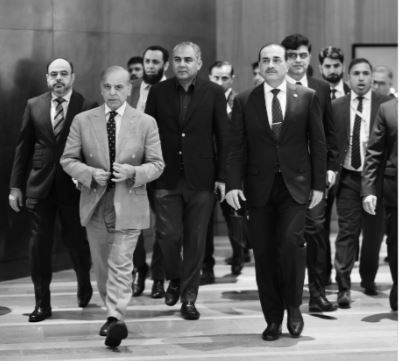
Vice President J.D. Vance, in his brief remarks, struck a measured tone, reflecting the Biden-Harris administration’s desire for a diplomatic off-ramp. “The United States has always believed that diplomacy, however difficult, is the most durable path to security. We have come here with an open mind and a clear objective: to listen to Iran’s concerns and to see if a responsible, verifiable framework can be established. This is a technical meeting, but it is the foundation upon which larger conversations can be built,” Vance said.
He specifically praised Pakistan’s role in creating a safe and impartial environment, calling Prime Minister Sharif “a sincere friend who understands that the world cannot afford another flashpoint in the Middle East.”
Qatar’s Mediating Role
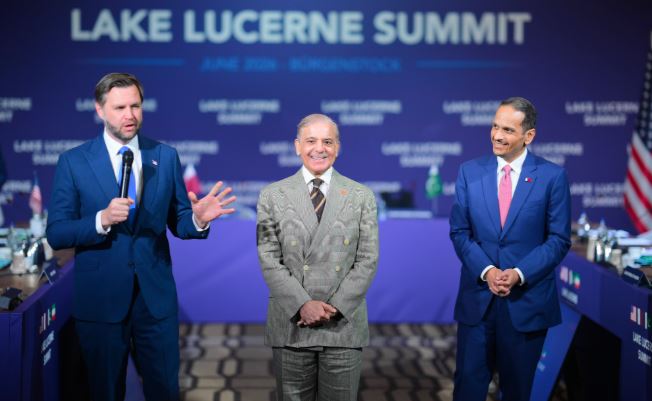
Prime Minister and Foreign Minister Sheikh Mohammed bin Abdulrahman bin Jassim bin Jaber Al Thani reiterated Qatar’s commitment to facilitating peace, highlighting the urgency of the moment. “We have seen the consequences of misunderstanding and miscalculation. Today’s technical-level talks are not about immediate breakthroughs, but about building a language of dialogue that has been missing for years. Qatar will continue to support any initiative that brings the parties closer to a tangible agreement,” he stated.
The Road Ahead
The technical talks are expected to focus on a range of contentious issues, including the nuclear program, sanctions relief, and regional security guarantees. While no formal agreements are expected from this initial round, both Washington and Tehran have agreed to a second session to be hosted by Qatar in Doha in late July.
The Burgenstock meeting comes at a critical juncture, with global attention fixed on whether these low-level, expert-driven discussions can evolve into a broader diplomatic framework. For now, the photo of the three leaders shaking hands with the Swiss Alps in the background has already made headlines as a symbol of rare and hopeful multilateralism.