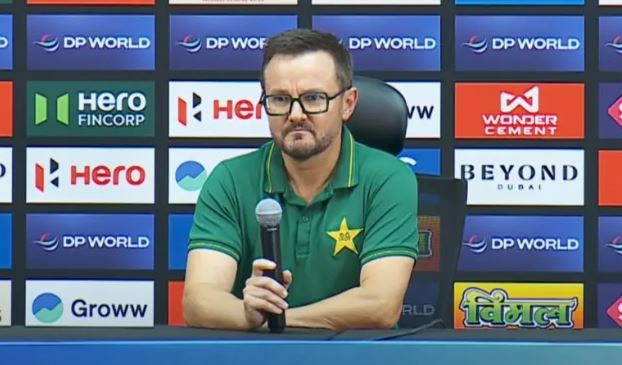
COLOMBO, FEB 16 – Pakistan white-ball head coach Mike Hesson did not mince words when assessing where things went wrong for his side following Pakistan’s crushing 61-run defeat to India in the ICC Men’s T20 World Cup 2026 clash at R. Premadasa Stadium on Sunday.
The loss, which leaves Pakistan’s tournament hopes hanging by a thread, was dissected with brutal honesty by the New Zealander in the post-match press conference.
But where exactly did Pakistan lose the match? Was it at the toss when they elected to field first? Was it during overs 5-8 when Ishan Kishan plundered 52 runs? Or was it in their calamitous batting powerplay, which ended with the scoreboard reading a dismal 38 for 4?
For Hesson, the answer was clear: the batting collapse proved decisive, with his players making poor decisions and tactical errors as India’s bowlers tightened the screws.
“When the guys are putting you under pressure, are you going to stick to your basics or are you going to go away from that,” Hesson asked in response to a question at the press briefing after the game. “And that’s going to be a real challenge as the tournament progresses: we’ll be put under pressure again and that’s how we respond when you are under the pump.
The coach didn’t spare his batters from criticism. While Saim Ayub fell to a fast, swinging yorker from Jasprit Bumrah that would have troubled any batsman, the shot selection of Sahibzada Farhan, Salman Agha, and Babar Azam left Hesson searching for answers.
“All these guys are international players, they’re all good players, but when the pressure comes on are they going to trust the decision-making or are they going to probably go outside [of their plans]? And today, pressure made us go outside there and that’s something that for us to progress further in this tournament, it’s something we are going to have to get better at.”
Hesson conceded that his batters succumbed to overthinking, possibly trying to play like “Superman” to chase down a target he believed was 25 runs above par. The magnitude of an India-Pakistan contest, he suggested, may have contributed to the mental errors.
“I think they can [overthink],” he said. “When you see a score and you know that it’s probably a little bit above par, you almost feel like you’re going to play like a Superman and take the game on earlier than the conditions allow you to.
The coach was particularly critical of the shot selection that led to early wickets.
“We lost wickets early on to shots that I’m sure on that surface they were pretty tough, tough options. On a quicker surface, [like the] SSC, it might be a little bit different. So it is about adapting and we’ve been really good the last few months about adapting to different conditions. Today we probably took a little step back.”
Despite mounting questions about whether Pakistan erred by putting India in to bat, Hesson staunchly defended the decision.
“Both sides were going to bowl first because the pitch was soft and the ball spun twice as much in the first innings than the second,” he said. “The ball skidded on [in the first innings]. So there’s nothing wrong with the decision to bowl first.”
When comparisons were drawn to Australia’s defeat against Zimbabwe in a day game where the winning side batted first, Hesson dismissed the parallel. “That was a day game. This is a night game. Nothing to do with the toss – it was just execution.”
Hesson revealed the defeat had hit hard in the Pakistan dressing room, with players acutely aware of what the fixture means to their nation.
“It’s a pretty disappointed dressing room in there at the moment because they know how much it means to Pakistan,” Hesson said. “And we are really disappointed we didn’t play as well as we could, but we’re also part of the tournament and we know in tournament-play that it’s not always going to go your way. So our job is to pick ourselves up and make sure that we’re very good in two or three days.”
For the unversed, Pakistan will now face Namibia in their final group-stage fixture in Colombo on Wednesday.