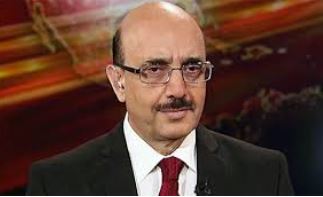
ISLAMABAD, Dec 10 (APP/DNA): Ambassador Masood Khan, Pakistan’s former Ambassador to the United States, China, and the United Nations, stated on Wednesday that Pakistan’s decisive response to the Chaman–Spin-Boldak attack constituted “a major success,” affirming that any assault on Pakistan’s sovereignty would be met with “zero tolerance and an immediate, punitive response.”
In a statement issued here, he praised Pakistan’s armed forces, intelligence agencies, and civilian leadership for their seamless coordination in repelling the latest Afghan-initiated incursion, noting that the political message to Kabul is “clear, firm, and non-negotiable: Pakistan seeks peaceful neighbourhoods, but never at the cost of its national security.”
Discussing the escalating provocations from Afghan soil. Ambassador Khan described the Taliban regime as “delusional and disconnected from their own population,” adding that their internal dysfunctions and ideological rigidity have made Afghanistan “a proxy extension of India.”
He warned that the Taliban’s refusal to regulate borders, curb terrorism, or acknowledge Pakistan’s legitimate security concerns has inflicted severe damage on both countries.
“Pakistan tried tirelessly to rehabilitate the Afghan Taliban into the international system,” he said, “but the surge of terrorism emanating from their territory has undermined any prospect of cooperation.”
Reflecting on the diplomatic engagements held earlier in Doha and Istanbul, Ambassador Khan said that Islamabad entered the talks in good faith, but the Afghan delegation’s conduct in Istanbul “scuttled the progress made in Qatar.”
He lamented that the Taliban have now resorted to “open warfare against Pakistan,” with Tehreek-e-Taliban Pakistan (TTP) enjoying sanctuaries and support in Afghan-controlled territories. “These are not ungoverned spaces,” he stressed. “These areas are fully under Taliban jurisdiction, yet they host, arm, and finance anti-Pakistan terrorists—often on India’s prompting.”
Ambassador Khan underscored the strategic danger posed by Afghanistan’s role in enabling transnational terrorism, which threatens not only Pakistan but also Central Asia, China, the United States, and the wider international community.
“The Taliban pledged in 2020 that Afghan soil would not be used for terrorism,” he said. “Today, that pledge stands broken. No country in the region is safe from the metastasis of Afghan-based militant networks.”
He emphasized Pakistan’s continued coordination with regional counterterrorism frameworks—including mechanisms under China, Tajikistan, and the Shanghai Cooperation Organisation’s Regional Anti-Terrorist Structure (RATS)—which Pakistan currently chairs.
He noted that attacks against Chinese personnel and regional infrastructure highlight the urgency of confronting Afghan-based threats, but added that Islamabad had exercised remarkable restraint to minimize harm to Afghan civilians.
Addressing the role of global powers, Ambassador Khan observed that the United States maintains significant leverage in Kabul due to its sustained humanitarian engagement. He urged Washington to use its influence to counsel the Taliban to cease hostilities, regulate borders, and curb terrorism. “If the Taliban continue their aggressive posture,” he warned, “they will invite isolation, instability, and possibly an internal implosion, because they are unrepresentative and face growing dissent both inside Afghanistan and throughout the diaspora.”
Ambassador Khan reiterated that Pakistan values centuries-old ties with the Afghan people and seeks stability, connectivity, and economic cooperation. However, he warned that the Afghan Taliban are “pitting Afghans against Pakistanis,” a policy rejected by the overwhelming majority on both sides of the border. “We are intertwined by kinship, history, and geography,” he said. “The Afghan regime’s hostility is neither sustainable nor reflective of the will of the people.”
On the question of future engagement, Ambassador Khan said that Pakistan remains open to bilateral negotiations, third-party mediation through Qatar, China, Russia, Saudi Arabia, or the United States, and regional diplomatic channels. But he cautioned that if aggression persists, Pakistan will exercise its inherent right of self-defence under Article 51 of the UN Charter. “If Afghan territory is used for attacks against us,” he declared, “Pakistan’s response will be immediate, proportionate, and punitive.”